The Fairies’ Lullaby. The Adulteress SongLittle white bug Little black bug from : The adulteress song that is sung in Alba de Tormes |
 First Published in GB by Marion Boyars Publishers Limited 1980. translations by Christopher Maurer. |
The Fairies’ Lullaby. The Adulteress SongLittle white bug Little black bug from : The adulteress song that is sung in Alba de Tormes |
|
First Published in GB by Marion Boyars Publishers Limited 1980. translations by Christopher Maurer. |
|
In the hush of my father’s house,
before dusk rustles over the horizon,
I take off the dress my mother made
-it’s as ruby red as St Michael’s cloak-
and with a stitch of linen, bind my breasts.
By the greasy light of a candle,
I shear my hair to the style of a boy,
in the looking glass I see my girlhood
swallowed up in a tunic and pants,
I lace them tightly to safeguard myself.
My soldiers call me ‘Pucelle’, maiden,
they cleave the suit of armour to my body,
and know when following my banner
over ramparts into Orléans, that
there will only ever be one like me.
When the pyre flames fly up my legs,
I do not think of the Dauphin,
or my trial as a heretical pretender,
but see my mother, head bent low,
sewing a red dress for her daughter to wear.
As Tatú, le Nuala Ní Chonchuir, Arlen House, 2007.
http://poethead.wordpress.com/2009/06/13/la-pucelle-by-ni-chonchuir/
|
A poet
must talk in riddles
if he will not risk himself
for fear
of public eye and tongue
blaspheming privacies :
a host
of leeches sucking parallels
carnivores to strip his shivering secrecies
wrapped
intricately. he should be
silent or speak out.
No one
asked for
his arbitrary offerings.
from Sarah in Passing , by Eithne Strong. Dolmen Books 1974.
http://poethead.wordpress.com/2011/03/19/strip-tease-by-eithne-strong/
|
On the morning of the fifteenth time we went through
our sleep-with-your-ex routine, I had the usual optimism
thing about mistakes is to not keep repeating the same ones
I said disregarding the government health warning
on the cigarettes I was sucking, crossing the road without
stopping speaking or looking, ignoring the red man pulsing
on the lights at the junction, I was wired direct and I said;
I know, I’ll write you the definitive user manual for me.
You said I was arrogant that we should make it up as we go,
and I said; well could I do a mind map then? With
here be dragons marked clearly in red, so we won’t flounder
like last time end up washed up dehydrated and drained
well I was, fairly wired, I said ‘in each shipwreck we’re lessened
embittered, come on, let me at least try to fix it, I can write us
a blueprint for the new improved version, and you laughed
and said well damn you for a head-wreck, go on then and do it.
So I wrote, but it came out all stilted, like a work in translation
see when I say, let me fix that or give it here and I’ll do it
it means I need you, and if I tell you for example how
I’ll re-arrange the universe to your liking it doesn’t mean
I’m superior in fact, translated it’s about the same as the last one-
‘can you not see, how I need you? And when I come out with all those
‘you-shoulds’ that drive you demented, there’s no disrespect in ‘em
verbatim they’re whispering I’d be desolated without you
and when you call me control freak, the tendencies you’re describing
are inherently rooted in my fear of you leaving and how I’ll react.
Less-wired more hopeful I brought you my phrase book
on our very next meeting but you kissed my cheek and said
let me stop you a minute and then those awful words that never
signify good outcomes, listen I’ve been thinking… I know
we’ve got this weird cyclical attraction thing going and I’m sorry
for my part in it but really I can’t see it working, the problem
for me is how you just don’t need anything and my phrase book
had nothing listed under that heading.
© Sarah Clancy
Thanks to Sarah Clancy for the poem, Phrase Books Never Equip you for the Answers , which is taken from Thanks for Nothing Hippies . Published Salmon Poetry 2012.
|
For Grace
On the last day of term
you brought home a present,
placed it under the tree,
a light, chest-shaped mystery
wrapped in potato stamped paper
intricate with angels and stars.
Christmas morning
you watched as we opened it,
cautious not to tear the covering.
Inside, a margarine tub, empty.
Do you like it? eyes huge.
It’s beautiful.
What is it, sweetheart?
A box full of love, you said.
You should know, O my darling girl,
it’s on the dresser still
and from time to time, we open it.”
© Kate Dempsey, all rights reserved.
|
Taim ag caoineadh anois chomh fada
agus is chumhin liom
ce gur dócha go raibh me óg trath-
seans fiú amháin gp mbinn ag súgradh.
Ni cuimhin liom an t-am sin
ná an ghruaim a chinn an ghairm seo dom.
Ni cuimhin liom ach oiread
éinne den dream
atá caointe agam-
ní dhearna mé taighde ar a saol
ná nior léigh mé cur síos orthu
i gcolún na marbh.
Ach is maith is eol dom
gach uair a sheas mé
taobh le huaigh bhealschoilte,
gur chomóir me gach saol
go huile is go hiomlán,
gur laoidh mé éachtaí
na nua-mharbh
is gur eachtaigh mé
lorg a sinsear.
Tigím anois
go bhfuil na caointe seo
tar éis dul in bhfedhim orm.
Dá mbeadh jab eile agam
ba bhreá liom bheith im scealaí-
sui le hais na tine is scéalta a insint.
D’éistfeá liom- tharraingeodh
d’Eddifon asam iad
á n-alpadh sa treo is go slanofaí mé.
Faoi Chabáistí is Ríonacha, Published by Clo Iar-Chonnachta, indreabhán, 2001.
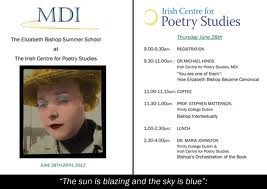 “The sun is blazing and the sky is blue”. . . The Irish Centre for Poetry Studies at Mater Dei Institute are proud to announce details for their upcoming Elizabeth Bishop Summer School. Date: Thursday 28th June – Friday 29th June 9.00-9.30 am REGISTRATION “You are one of them”: Bishop Intertextually Friday June 29th Bishop and Sexuality “Manners”: Bishop, Friendship and email Michael Hinds michael.hinds@materdei.dcu.ie for more details on fees or to book a place JUNE 28TH-29TH, 2012
|
|
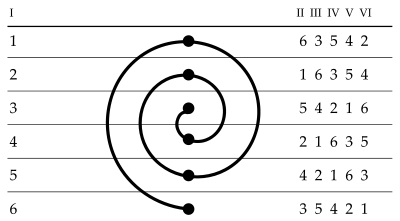
Sestina by Elizabeth Bishop ” September rain falls on the house. She thinks that her equinoctial tears It’s time for tea now; but the child on its string. Birdlike, the almanac It was to be, says the Marvel Stove. But secretly, while the grandmother Time to plant tears, says the almanac. Sestina by Elizabeth Bishop Sestina by Elizabeth Bishop is published in Questions of Travel , which is discussed here in Modern American Poetry. Information on the poem is also published in a previous post about sestinas.
|
‘She is every woman
who struggles for survival
in a world of prisons
of one form or another.
Her stories, etched on the
landscapes of the universe.
She is the mouth
of the Blackwater,
the secrets of the Alder,
the writing on the caves
and the shedder of light.
She is the blueprints
of the past,
the wishes of the unborn,
the spirit of the crops
and the heat of the sun
bursting on buds.
Shes the midges on the lough,
the guardian of the wells,
the bones of the earth
and the ties that bind
by spirit and blood.
Shes the songs sung so often
renewed on the lips of the young.
Her tongue fiery can cut like an axe
or sooth like a lullaby.
She is goddess of the people,
the fire on the hills.
Shes the shadow on the stones
glinting on river beds.
The breath of a new morning,
and a beacon in the night.
She is every woman.
She is Aine,
fire of the gaels.’
Fire of the Gaels is © Aine Mac Aodha, all rights reserved. The poem was first published in Argotistonline
 Aine Mac Aodha lives in Omagh. Her work has been published internationally as well as locally, and in the UK. She is a Founder member of The Busheaneys Writers Group and The Derry Playhouse Writers. Her work has appeared in Luciole Press, The Glasgow Review, Irish Haiku, Pirene’s Fountain and Argotist online to name a few. She begins much of her writing at her Residencies at The Tyrone Guthrie Centre in Monaghan and is greatful to her time spent there. Aine Mac Aodha lives in Omagh. Her work has been published internationally as well as locally, and in the UK. She is a Founder member of The Busheaneys Writers Group and The Derry Playhouse Writers. Her work has appeared in Luciole Press, The Glasgow Review, Irish Haiku, Pirene’s Fountain and Argotist online to name a few. She begins much of her writing at her Residencies at The Tyrone Guthrie Centre in Monaghan and is greatful to her time spent there.Her poetry is plainly written, she is inspired by the Irish landscape and by poets Seamus Heaney, John Montague, Rumi, Basho and many of the modern poets today. Related links |
I stopped at the gate of a rich city.
I had everything the gods required;
I was ready; the burdens
of preparation had been long.
And the moment was the right moment,
the moment assigned to me.
Why were you afraid ?
The moment was the right moment;
response must be ready.
On my lips,
the words trembled that were
the right words. Trembled-
And I knew that if I failed to answer
quickly enough, I would be turned away.

| Durham Cathedral engraving by William Miller after J M W Turner, published in Picturesque Views in England and Wales. From Drawings by J.M.W. Turner, engraved under the superintendence of Mr. Charles Heath with descriptive and historic illustrations by H.E. Lloyd. London: Longman, Orme, Brown, Green, and Longmans, 1838. Rawlinson 297 |
Earthly Terror, by Louise Glück , from The Making of a Sonnet, eds. Edward Hirsch and Eavan Boland
I have come, alas, to the great circle of shadow,
to the short day and to the whitening hills,
when the colour is all lost from the grass,
though my desire will not lose its green,
so rooted is it in this hardest stone,
that speaks and feels as though it were a woman.
And likewise this heaven-born woman
stays frozen, like the snow in shadow,
and is unmoved, or moved like a stone,
by the sweet season that warms all the hills,
and makes them alter from pure white to green,
so as to clothe them with the flowers and grass.
When her head wears a crown of grass
she draws the mind from any other woman,
because she blends her gold hair with the green
so well that Amor lingers in their shadow,
he who fastens me in these low hills,
more certainly than lime fastens stone.
Her beauty has more virtue than rare stone.
The wound she gives cannot be healed with grass,
since I have travelled, through the plains and hills,
to find my release from such a woman,
yet from her light had never a shadow
thrown on me, by hill, wall, or leaves’ green.
I have seen her walk all dressed in green,
so formed she would have sparked love in a stone,
that love I bear for her very shadow,
so that I wished her, in those fields of grass,
as much in love as ever yet was woman,
closed around by all the highest hills.
The rivers will flow upwards to the hills
before this wood, that is so soft and green,
takes fire, as might ever lovely woman,
for me, who would choose to sleep on stone,
all my life, and go eating grass,
only to gaze at where her clothes cast shadow.
Whenever the hills cast blackest shadow,
with her sweet green, the lovely woman
hides it, as a man hides stone in grass.
.
Sestina by Dante Alighieri
The image at the base of this post is from the Wikipedia Site discussion on the Sestina form . I am adding here a Poets.org discussion on the form used by both poets in the above post . I wanted to focus on content , which is after all what poetry is about (that and adaptions/metamorphosis/shape-shifting and code !).
September rain falls on the house.
In the failing light, the old grandmother
sits in the kitchen with the child
beside the Little Marvel Stove,
reading the jokes from the almanac,
laughing and talking to hide her tears.
She thinks that her equinoctial tears
and the rain that beats on the roof of the house
were both foretold by the almanac,
but only known to a grandmother.
The iron kettle sings on the stove.
She cuts some bread and says to the child,
It’s time for tea now; but the child
is watching the teakettle’s small hard tears
dance like mad on the hot black stove,
the way the rain must dance on the house.
Tidying up, the old grandmother
hangs up the clever almanac
on its string. Birdlike, the almanac
hovers half open above the child,
hovers above the old grandmother
and her teacup full of dark brown tears.
She shivers and says she thinks the house
feels chilly, and puts more wood in the stove.
It was to be, says the Marvel Stove.
I know what I know, says the almanac.
With crayons the child draws a rigid house
and a winding pathway. Then the child
puts in a man with buttons like tears
and shows it proudly to the grandmother.
But secretly, while the grandmother
busies herself about the stove,
the little moons fall down like tears
from between the pages of the almanac
into the flower bed the child
has carefully placed in the front of the house.
Time to plant tears, says the almanac.
The grandmother sings to the marvelous stove
and the child draws another inscrutable house.
Sestina by Elizabeth Bishop
Listen to the poem here , Sestina . Sestina by Elizabeth Bishop is published in Questions of Travel, which is discussed here in Modern American Poetry
The following tables are from Poets.org and Wikipedia showing the Sestina form in its essence,
Herein follows an incomplete list of book-links related to Dorothy L. Sayers’ translation of The Divine Comedy by Dante Alighieri.
Readers of the poethead blog will note that I dedicate Saturday mornings to the work of women writers, editors and translators. The translation of The Divine Comedy undertaken by Dorothy L. Sayers was completed in part by Barbara Reynolds.
Dorothy L. Sayers considered her translation of The Commedia to be her most important work, and yet only one copy of the book was available through the Dublin Library Service last week. The Guardian Newspaper devoted just a single line to the fact that this work of translation was undertaken by Sayers. In the same instance both The Guardian and the Dublin library service suffer a surfeit of Sayers’ genre or detective stories.

Dorothy L. Sayers produced a classic translation of Dante’s Hell and Purgatorio which is still read. The problem with media and literary journals not citing Sayers or Glasscoe, appears to be based in an institutionalised sexism which is a contributory factor in the invisibility of women editors. Evidently, The Guardian Newspaper and the Dublin library service give more attention to Sayers’ genre works than they do to her translation and other works.
It does not seem to pose great difficulty for male editors and writers to consistently cite what they feel are the definitive texts when the writer happens to be a dude. I believe that women editors and writers must begin to cite the works of women when quoting classical works of literature. If nothing else it may help those women journalists who seem incapable of taking women’s literature seriously.
Note : Recent attacks on Dante’s Commedia delineated in this article show a lack of critical discernment and appreciation by those who would chose what anyone may read.

A conversation among trees
I cannot hear what they are saying, that young girl and the tree,
their whispers are intimate, ceaseless.
I am sunk into a conifer hedge, tamped into a wall,
threaded into the blue ivy.
This is a warm chaplet against the rain,
I would lie here if it wasn’t for the sky—
the sky will not skew to my vision,
body conspires with green-leaf to thrust me forward
I am become aware that it is time for this to cease,
a mead of daisies whiten on the windward side
of a grove. Trees,
daisies, are blown white beneath a silver beech.
Those hues balance
for once —
And,
and If I step at once from the shelter of this close bower,
will I hold?
© C. Murray

The image Chaplet is by Alice Maher and is used for this poem courtesy of Alice Maher and the Green on Red Gallery, Dublin, Ireland. Chaplet © C Murray |
“On granite rock,
The woman sat.
Damp hair trickled down her back,
Azure highlights glimmering,
Golden curls shimmering.
Seaweed sparkled; waving wildly
White foam horses rear and pound,
Surging through the rocky mound.
Crashing against the sleeping stone.
Woman sits and
Stares alone.
Black cloud glares,
Fog horn blares,
Lightning screams across the sky.
Green eyes pierce through crushing waves,
As raging waters tumble by,
Swirling through the hidden reef.
Sharp fanged rocks, lurk just beneath.
Hungry for their prey….
Fisherman caught
In the storm.
Spies cast off lover all forlorn.
His heart pounds with fear and shock,
Demon lover clinging to demon rock,
Soaked in sea spray but shining still
Fisherman feels a surging thrill,
Pulls rudder across hard and fast,
Sails moan and flap against the mast.
Fishing boat thrown up and down,
Fishermans’ face creased with frown.
Woman sits in silence
Undertones of
Violence.
Green eyes glowing at her lovers face,
Thinking of happier times and place.
These eyes melt his heart of stone,
How could he have left her all alone?
Fishing boat drops from wave on high,
For a minute caught, seeming to fly.
Then falls and smashes into the foam,
Broken, drifting forever to roam.
Woman smiles and sings her song,
Waiting for another to come along….”
By Rainbow Reed ©2009 http://wickedpoetry.jigsy.com/AboutUs
Thanks to Rainbow for the poem and the site-link. This is the fourth poem in the Poethead New Poetry category. These women writers are mostly published poets who use blogs and multimedia to publish their works. Each writer has allowed me to choose one or two poems for this blog. The poetry comes with a blog or website link to their work and sometimes an image or a bio. Poets published in this category are Teresa Edmond, Brittany Hill , Rainbow Reed and Kitt Fryatt. I would also include some pre-publication tasters by Sarah Clancy and one or two of my own about to be published poems here too.
Bonny Sandy breaks my heart
no coming to couch the night
& his blade red wine
& his thrapplejammer white wine
bonny Sandy brooks my hurt
this ae night
ilka night
& the horns of young green wine
bonny Sandy brakes his hart.
Love whinges & crines. The bonny knight
in ague sweat & his ain shite, unhurt.
© Kit Fryatt, all rights reserved.
Dance the lamb
ra-ra
lamb
ra-ra
mutton hunks
It’s a shame the way we carry on
The streets stink tonight; my skullpan’s pounding
for rain or riot, I’m not so young, scarred from mound
to sternum, childless pale citadel of bravado and competence;
though if it gets too tasty I’ll hitch my mobile home
and flit this meatpacking warehouse district
but for now I’m hanging in there, for a sniff at the grinding bliss
the brazen looter children have, this year’s corn kings─
with sordid cold, blanket, galvanise tray, comes the morning in.
Dress the lamb
rare-rare
rare-rare
mutton bird
It’s a shame the way we carry on
Come sisters, these Lammas shiftless we could use, straw
men to our hags, the blintering braggarts will fight our wars
and decorate our palaces, symbolize in their dying
everything that comforts people, and stupefies.
The estate we lost thirty grand years ago, tonight we take
ground, we rise, inhale, we’re scary cunts, tonight we tear
spoil through locked wards, mindless, knowing that
our chicken limbs may splinter, falter; like, a freedom act
like, do whatever you want
mate
do
the mutton flap
It’s a shame
© Kit Fryatt, all rights reserved.
 Kit Fryatt writes and performs poems at Spoke, Wurm in Apfel and Can Can. I met her at the Mater Dei launch of Post III Magazine and being well-impressed with a card-carrying poet, I begged some poems for my Saturday Woman Poet blog. I got three unpublished poems , which would be considered over-generous, so I am publishing two of them today and returning the third with the proviso that if they are published online, they are Published work. Thanks to Kit for her generous contribution to Poethead. Copyright of the above poems remains with the author.

Two Poems by Kit Fryatt is licensed under a Creative Commons Attribution-NonCommercial-NoDerivs 3.0 Unported License.
Based on a work at wurmimapfel.net.


 Sarah Clancy

 Chris Murray