Saint Teresa’s Heart the walls of its chambers reverberate still. none can unravel. A mystic with inquisitorial immaculate and shining in fields of barley O my sisters this I left, leaving only entrails pencils in its margins: morning has come Saint Christina’s Gut Hunched on the top branch I, my own cartographer Out at the end of a birch twig No holy anorexic I gorge High among incensed rafters Saint Christina’s Gut published Abridged 0-37 (July 2014), p. 44. Saint Joan’s Mirror Whispering we know She will put the Dauphin Mary Magdalene’s Foot A wanderer then And washing others Some stormy season Mary Magdalene’s Foot published A New Ulster 39 (Dec 2015), pp. 15/6. Julian’s Eyes She did not drink dark cups from the sores the arc her spine, sculpt her sigh or tease out The remaining years in an anchorite’s cell she wrote: do not accuse yourself of sin but your own. The father no entity only place Julian’s Eyes published The Galway Review (January 29 2016). Mechthild’s Tongue Though they think still will I speak with you tasted mint drank wine and wild honey divining blue, the fish always outside their book who withholding holy office beside the spring Mechtild’s Tongue published The Galway Review (January 29 2016). Our Lady of Częstochowa Not ones for faffing around Her right hand pointing at her son. |
Category: Ephemera
-
-
Untitled
for Andre Breton
Nostalgic sentiments and new wave nocturnes
intersecting in a normal chaos of life
an hourglass of neglected affinities
idols of saturated phenomena
night of filth, night of flowers
the aporia of revelation
Magic Bullet
(for Tristan Tzara)
Smell of death
smell of life of embrace
a medicine of moments
semiquavers and sundial conductors
of the postspectacle
deposits of legitimacy left behind
sortilege of the divine decree
words in blood like flowers
Grand Hotel Abyss
Selenophilia of our being
the obscuring of the queen
vexed in your hollow divine
incipience of the notable nonesuch
like fragrant paperwhites in the
corner of the transcendental frame
pleasure ground of annulled pretext
in hysterically real daymares
everyday extraordinary
grand hotel abyss
Masque of the minutes
for Adam Lovasz
Masque of the minutes
like a red psychotonic cry
agnosia of the just interloper
scarlet bellowing of the deep end
excisions on vacuous origins
temporal flight of the elemental route
Hygge
A sense of timelessness surrounds her
mistress of malfunction
platinum god afterbirth
countdown to zero
inferior rhyme over the threshold
redux and progression
Magic Bullet and other poems are © Rus Khomutoff.
My name is Rus Khomutoff and I am a neo surrealist poet in Brooklyn, NY. My poetry has appeared in Erbacce, Uut Poetry and Burning House Press.Last year I published an ebook called Immaculate Days. I am also on twitter:
-
From Parvit of Agelast
'Your face is ridiculous: O. . . . . leeeeee ugly 🙂❤ / thanks, sure i know !’ :L’ – Ciara Pugsley, ask.fm net whn th little lite shinin frm abve doesnt n younguns mad fr luv r spected 2 b home thumbs go drum on magic pads n open windows so they travel in thr dreambots huntin souls they go weft upon th crystal warp unshuttled hookin up witout a plan 2 build a planet trances risin tru th base n snare of ask n tell wot u c is wot u feel n wot u feels rite tho snot a total giggle when th trolls r out —no1 knows th cause like with any freakin demic— bitch please u aint jesus wots wit all the posin howd u like my cock up ur ass, u cross-eyed ho som1 feelin tiny in the sprawlin fabric hauls back in2 her drum for a re-birth much 2 brite bodys blinded so her double takes it weepin 2 th woods to be an hero wit a reel hank o rope (Verse Fantasy, published by Arlen House in 2016. The poems are aspects of the ‘real’ world.)
‘…the body of Wafa became shrapnel that eliminated despair and aroused hope.’ – Adel Sadew
The Key to Paradise
You will be snatched back from the place of no landmark,
where you wander, scapegoat, under the frozen hot eye,
blister-backed, hairy, and crunching backward to beast.You will regain the unrivalled kingdom of your source,
your beauty will be unsurpassed, and you will sit
on the right knee of a virtuous king, all-powerful but
for his abject love of you. There will be bright-plumed birds
and four undying springs of milk, honey, oil and wine.Your lover will adore you under the great tree, and there
will never be a touch without the perfect ecstatic end
that leaves you weak and wed to the grass you collapse on.
There will be no argument and never pain. Balm will drip
from every leaf in this catchment of considerate sun.Best of all, you will be thought wise, not inessential.
So gird your waist with red rockets and blow your littler self
to the garden of infinite fecundity. Do it. In one starry bang.
Sleep is the only escape I have. When I don’t dare think, I dare to dream.’ – Jaycee Dugard
Pine
Each autumn, in Lake Tahoe, El Dorado county, CA,
the kokanee salmon turn from silver-blue to vermilion.
After spawning they die and their carcasses are meat for mink,that some unabused women sport as symbols of perhaps love.
The kokanee is not a native, arrived in 1944, so a mere child
compared to the happy-birthday lake two million years old.Jaycee’s eleven were a tiny tint to that time spread,
and the moment when her fingertips touched the pine cone—
print to Fibonacci imprint, whorl to spiral—a netsuke eye.That darkened in the backyard in the small shed where sleep
was the best activity and a gnarled man made her pine and desire
the woody grenade that was the last thing she had touched before.A pine can last a thousand years, an eye much less; Jaycee eighteen
in the pulp of a small brain, twisted in and round, not knowing
what would sprout when a forest fire melted the resin
and out fell, in hazardous liberation, winged seeds.From: Imbolg
(Unpublished Collection)
Your Grace
You are alone in what they would call a new life. What they don’t know is
that for you nothing is old. A morning is always a question, as if you were
a web living each day in a different cell of itself, seeking.Seeking maybe nothing, but in that mode, hiatus behind and before. It has
seemed true to take a sable cloth to the slate of fact and not only wipe
but cover, occlusion of the frame removing the form entirely.Entirely it might seem, but like minerals that leave a trace in water, small
events make change. Tonight you have remembered a Columbian dress you bought
on impulse at a Fairtrade sale, undyed, handwoven.Woven into your consciousness now like most of your clothes, but you wore this
slinky to a wedding and people remarked. For the first time you thought your
body taut and that of the normal, not a flop. You flaunted.Flaunting was your wont in a sub-chador sort of way. Exclusivity was the bait,
the prospect of private vice. But you see in the mirror tonight a shape that
could turn heads. There’s a Grecian curve at the base of your back.Back to where you sat huddled in a lone hut by a struggling fire, watching the small
yellow flame fight the red. You had crammed a bush into each windy gap of the hedge.
Beyond, how could you know several had gathered to your grace.Grace was a false thing, you said, being rustic. But many thought you walked like
a careless queen. They took the switch in your hand for a sceptre, wielded fiercely
against the meek, shaken at the indifferent.Indifferently endowed, you thought you were, and hardly cared, except for the
faint sense of an untried trail. It occurs to your image now that you could have
kept your own counsel, sat straight-backed and been petal-showered.Showering in what was given, you might have made some plans, not waited for
a suitor to tear at the bushes and tell you your mind.climacteric in the extreme
the room darkens. foetal faces draw spotlights from the dense matrix. she kneels. not a whimper but centrifugal quake and strain. ovular potentials huddle in lines for stringing crowded and frozen onto a tight choke. she hugs her shoulders, surrogate, unconsoled, and a creature leaps out, trailing chains, snarls and spits, goes surfing the tidal walls. he will not come again to her bucking bounty, her bawdy talk, her raucous primitive yells; she will not be the bright-haired goddess of the barstool, fabled and revered in ten parched villages. hail of the ripped legend falls in blades, a thing of flesh flames in the mouth of the monster and she recalls a hard prophesy told in the spring grass. lincolns rev on the melting brick informants crouch in a lonely copse and beg for mercy in the torture room the air sparks and yellows black seeps into old pictures and the girl with the lank dead hair creeps blindly from the screen. she probes her body and finds a silent blowhole. her fingers return a thousand red messages that pool and brindle in the cradle of her palms. if she screams she doesn’t know, but colours curry the weather pumpkin, desert and vulva, lunatic yellow, bum-in-the-gutter green. she crashes, glass and glint flinging themselves too, watches her eyes picked to the veined bone. girl, crook and goblet smithered on the lizard- dark floor.history
(from ‘the second of april’) I walk. Where is home except in repeated kisses of foot and ground. I am having affairs. With, for one, the bonded pavement, complicit as a slice of river. I glide on ice, step lightly on the unreflecting glass panel of a foyer floor. Nakedness is rare. I don’t tell how I used to take off my shoes and mesh my toes with sand. But even that was a skim. I slyly stepped on a rock and, recalcitrant, took off. I pause at running water and watch its inscrutable fingers take sun to rock in a work of art, then abandon it, dissatisfied. Among a tree I become a stretch of soil and burnt grass and harden. There are always tears. They seem to come from outside and wash me down until, like ivy, I am again rambling. On a tarred path my jaw is jolted by hard, inexplicable haste. My ankles wound each other. I bleed and wonder if I should spancel myself to slow. There are creatures who only pace the one field. Even a hobbled route finds knowledge. I look at my feet and don’t know them. Too long with my eyes on a misted goal has cost me my body. Happenings are always outside. Strange, when I see no walls. Where is the place of occurrence? I thought life was movement. Coming to gravel I have less ground and that brings thoughts of release. Water is too deep and I fear high places. To walk is the freest I can do and I wipe my tracks. What will pass is the breeze of a small body, non-native, a light touch on a puzzled cheek. -
Maternity
I want to have poems
by Caesarean section
wearing my Infallible lip gloss
and counting on my designer
obstetrician.
I will keep my bump discreet,
drink litres of San Pellegrino,
strive to avoid striae gravidarum,
laser them later if it comes to it.
I want to live a normal life
despite the media,
and when it’s time,
my lines will glide out raring
to open their lungs and wail
as true as any natural birth.
Published in Clifden Anthology 35, 2013
Red Hen
We know nothing
about hens, yet find ourselves
in charge of half a dozen.
The odd girl out –
you call her Mrs.One – loses
her footing in the mud.
You carry her
into the hen-house
with piano player hands.
Still there the next day,
she has turned her blunt
red beak to the wall.
We talk to neighbours
about red mites, infections,
wonder if she’s egg-bound.
We fill her bowl
with cabbage-leaves,
stroke her tight wings.
Her sisters cry out,
foul her water,
shit on her plumage.
We are told you’d get
a new hen for the price
of the vet. For the first time
I want to crack a bird’s neck.
Instead we hand her back,
ailing but alive.
Weeks later you find me
in quick tears
for the red hen;
you brush the rust
of my feathers, fill up
my hopper with oyster shells.
Published in Orbis, 2014
Yoga class
I skipped my yoga class
because the man was due
to fix the curtain rail.
Upstairs, he poised in heavy boots
on the edge of my bed,
but not before prudently
peeling back the elegant blue
Brown Thomas duvet.
Beneath him I stood
at optimal angle to flaunt
my cleavage, to hand him screws.
Smoothly he inserted the rawl plug,
then with slightly quicker breath
he drove it deep
into my freshly painted, trembling
Orchid White walls.
Threading the hoops unto the pole
we lifted it together,
our fingers touching
as he tenderly
completed the work.
Later we did yoga together
dreamt up new asanas
and held them, and each other
until light began slinking through
my brand new curtains.
From Who’s Counting?
Text Sex
Text messaging,
the first hot Sunday in May-
he: I hope you’re doing something
wild. I’m
busy with lambing.
She: Sun-bathing
out the back,
does that count as wild?
He: That depends
on how naked you are…
She pictures him delivering,
arm-deep
in placenta,
imagining her nakeder, fuller,
redder than she really is, outside
on a blue rug holding
a silver mobile phone.
She turns over, pale still,
unhooks her bra;
they joke about his sad life
chatting to sheep
phone dating,
dreaming of nakedness
in Edenbrook Heights.
If she were less prudent,
She’d ask him over now,
shower him, sponge each finger carefully,
massage his neck and armpits
with apricot soap;
but it’s not like that with them,
his wedding band has left a mark
that no lamb’s blood can cover.
She dresses, texts goodbye
and phones
the take-away.
From Who’s Counting? -

‘Visitation’ by Noah Saterstrom (2012) Martyrdom
I never imagined love as a cause for suicide. But there we
were, surrounded by all of the tell-tale signs: a breadknife,
a withered corsage, a white dress with some ruffles along
the bottom.
The night before I sensed that something had gone
terribly wrong. He told her, brushing the hair from his
eyes, how her sonnets failed to turn at the Volta.
Now she’s gliding along the surface of the lake. Her hands
folded like the knot on a small bouquet.
So he tries and tries to wake her. He looks at her perfect
wrists, nearly submerged: cold skin, a silver watch, every
bracelet fastened in place.
Martyrdom is © Kristina Marie Darling, from Brushes With (Blazevox Books 2013)
-
This is a brief note about the And Other Poems blog which is owned and written by Josephine Corcoran. What a breath of fresh air the blog is, judging by contemporary availability of good poetry (and critique). To say that poetry is sorely neglected in the face of market-forces is a wild understatement, but more polemic anon.
“And Other Poems is simply a quiet, uncluttered place to read poems by different writers posted by Josephine Corcoran. The blog’s aim is to give readership to poems which would not otherwise be available, for instance poems no longer elsewhere online, out of print poems, poems published in print but not online, and new, unpublished poems by established writers. Poets have given permission for their work to be featured and copyrights remain with the poets.”
I had been seeing some of Josephine’s link on Twitter for a period of time, and as always was gladdened to see the advent of blogs and websites dedicated to the reader of poetry. Quite a few blogs and websites deal in modern and contemporary poetry in all its wonderful variety. Whilst some people may look on this avant-gardeism as a niche-activity, it is important that the poetry-reader can access all types of poetic-writing. It has been a while since I looked at how poets use online tools to disseminate literature but I see a radical improvement and diversification in the area. Josephine knows her poetry which is excellent for her readers. I recommend a perusal of her blog and of her list of poets which is wonderfully diverse. I am adding here the And Other Poems index , and of course a link to my poem i and the village (after Marc Chagall) which she kindly published on 11/09/2012.
I have never presumed that poetics are a niche-activity , but that a wholly conservative approach to critique combined with a mechanistic desire to advance contemporary fiction book-sales dominate newspaper editorials/reviews, at least in Ireland. The fact that many readers seek poetics through varieties of means, combined with news that 30,000 people signed up to PENN State’s Modern and Contemporary Poetry Course in 2012 would suggest that market-forces are just wrong. Or actually repellent ! Editors would rather clever women review silly books, than look at poetry or actual literature. If poetry readers seek adequate reviews of women authors and their books they must look elsewhere than the media, hence the blogs, the small presses, the literary journals and forums dedicated to poetry.
There is a list of blogs and websites dedicated to poetry on the right sidebar of this site. Links to And Other Poems are embedded in this post and given below :
- And Other Poems
- List of Poets and Poems from And Other Poems
- Joesphine Corcoran
- Modern and Contemporary Poetry at Pennsylvania University
- Online Poetry
Irish Poetry Imprints (Online and Print)
- CanCan
- Cló Iar-Chonnachta
- Crannóg Literary magazine
- Dedalus Press
- Gallery Press
- Irish Pages
- Michael J Maguire
- Partial Shade
- Poetry Ireland Review Newsletter
- Post
- Revival Literary Journal
- Salmon Press
- Southword
- The Burning Bush Revival Meeting
- The Columba Press
- The Dolmen Press
- The Gallery Press
- The Penny Dreadful
- The SHOp , Poetry Magazine
- The Stinging Fly
- Wurm in Apfel
-

It seems that muses, those shadowy goddesses who influence writers, are limited under current editorial and employment injunctions to give inspiration alone to great male poets. Or so Simon Gough would have us believe.
Muses apparently perform some type of quasi-sexual inspirational function and it doesn’t matter if they are girls or boys, once the poet is a dude and his inspiration is carried through the ages to the makers of poetry. I wonder (aloud) if the linked article had been written by a female poet, a woman writer – would the muse issue be a bit more interesting, or complex ?
“There’s no reason on earth why a muse should have to be female. Whatever the truth of the matter (and uncertainty still rages in the higher corridors of intellectual power), the identity of “the fair youth”, to whom Shakespeare dedicated so many of his sonnets is almost immaterial. The one certainty is that he had a muse, who provoked
‘But thy eternal summer shall not fade
Nor lose possession of that fair thou ow’st;
Nor shall Death drag thou wander’st in his shade,
When in eternal lines to time thou grow’st.’Here is Simon’s top nine list of great poets and their muses :
-
Catullus – Lesbia
-
John Keats -Fanny Brawne
-
Thomas Hardy – Emma Gifford/Florence Dugdale
-
W.B Yeats – Maud Gonne
-
F. Scott Fitzgerald -Zelda Fitzgerald
-
Bob Dylan – Sarah Lowndes
-
Neal Cassady -Jack Kerouac
-
Robert Graves – Margot Callas
The woman muse (or sometimes the young boy muse) provides the meat and torture of poetic inspiration to a succession of male writers in Gough’s imagination. He makes no mention of the muses of Elizabeth Barrett-Browning, of Adrienne Cecile Rich, of Sylvia Plath. The entire list of writers produced by Gough includes not a single woman poet !
I’d like to see a woman poet’s perspective on the muse. Maybe that will happen in a century or so when the literary establishment comes round to the idea that women write rather excellent poetry. I have to say that I rather prefer the idea of the Duende anyway. Writers interested in the idea of the muse and of the Duende should look up Federico Garcia Lorca.
The muse who features on Poethead is called Euterpe.
-
-
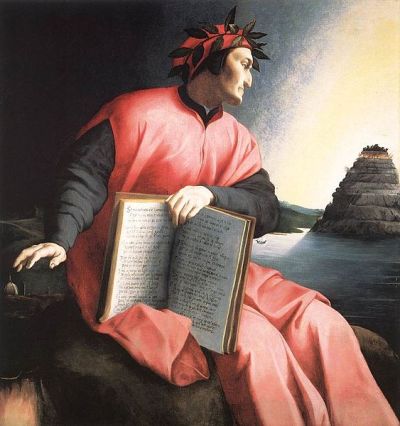
‘Sestina’ by Dante Alighieri
I have come, alas, to the great circle of shadow,
to the short day and to the whitening hills,
when the colour is all lost from the grass,
though my desire will not lose its green,
so rooted is it in this hardest stone,
that speaks and feels as though it were a woman.And likewise this heaven-born woman
stays frozen, like the snow in shadow,
and is unmoved, or moved like a stone,
by the sweet season that warms all the hills,
and makes them alter from pure white to green,
so as to clothe them with the flowers and grass.When her head wears a crown of grass
she draws the mind from any other woman,
because she blends her gold hair with the green
so well that Amor lingers in their shadow,
he who fastens me in these low hills,
more certainly than lime fastens stone.Her beauty has more virtue than rare stone.
The wound she gives cannot be healed with grass,
since I have travelled, through the plains and hills,
to find my release from such a woman,
yet from her light had never a shadow
thrown on me, by hill, wall, or leaves’ green.I have seen her walk all dressed in green,
so formed she would have sparked love in a stone,
that love I bear for her very shadow,
so that I wished her, in those fields of grass,
as much in love as ever yet was woman,
closed around by all the highest hills.The rivers will flow upwards to the hills
before this wood, that is so soft and green,
takes fire, as might ever lovely woman,
for me, who would choose to sleep on stone,
all my life, and go eating grass,
only to gaze at where her clothes cast shadow.Whenever the hills cast blackest shadow,
with her sweet green, the lovely woman
hides it, as a man hides stone in grass..
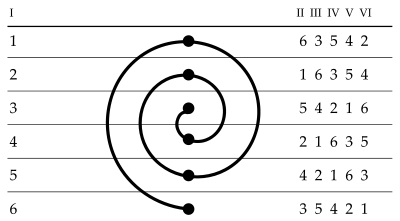
Sestina by Dante AlighieriThe image at the base of this post is from the Wikipedia Site discussion on the Sestina form . I am adding here a Poets.org discussion on the form used by both poets in the above post . I wanted to focus on content , which is after all what poetry is about (that and adaptions/metamorphosis/shape-shifting and code !).
‘Sestina’ by Elizabeth Bishop
September rain falls on the house.
In the failing light, the old grandmother
sits in the kitchen with the child
beside the Little Marvel Stove,
reading the jokes from the almanac,
laughing and talking to hide her tears.She thinks that her equinoctial tears
and the rain that beats on the roof of the house
were both foretold by the almanac,
but only known to a grandmother.
The iron kettle sings on the stove.
She cuts some bread and says to the child,It’s time for tea now; but the child
is watching the teakettle’s small hard tears
dance like mad on the hot black stove,
the way the rain must dance on the house.
Tidying up, the old grandmother
hangs up the clever almanacon its string. Birdlike, the almanac
hovers half open above the child,
hovers above the old grandmother
and her teacup full of dark brown tears.
She shivers and says she thinks the house
feels chilly, and puts more wood in the stove.It was to be, says the Marvel Stove.
I know what I know, says the almanac.
With crayons the child draws a rigid house
and a winding pathway. Then the child
puts in a man with buttons like tears
and shows it proudly to the grandmother.But secretly, while the grandmother
busies herself about the stove,
the little moons fall down like tears
from between the pages of the almanac
into the flower bed the child
has carefully placed in the front of the house.Time to plant tears, says the almanac.
The grandmother sings to the marvelous stove
and the child draws another inscrutable house.Sestina by Elizabeth Bishop
Listen to the poem here , Sestina . Sestina by Elizabeth Bishop is published in Questions of Travel, which is discussed here in Modern American Poetry
The following tables are from Poets.org and Wikipedia showing the Sestina form in its essence,
1. ABCDEF
2. FAEBDC
3. CFDABE
4. ECBFAD
5. DEACFB
6. BDFECA
7. (envoi) ECA or ACE