First, make a letter like a monument – An upright like the fast-held hewn stone Immovable , and half-rimming it The strength of Behemoth his neck-bone, And underneath that yoke, a staff, a rood of no less hardness than the cedar wood. Then, on a page made golden as the crown Of sainted man. a scripture you enscroll Blackly, firmly with the quickened skill Lessoned by famous masters in our school, And with an ink whose lustre will keep fresh For fifty generations of our flesh. And limn below it the Evangelist In raddled coat, on bench abidingly, Simple and bland: Matthew his name or Mark, Or Luke or John; the book is by his knees, And thereby his similitudes : Lion, Or Calf , or Eagle, or Exalted Man. The winds that blow around the World- the four Winds in their colours on your pages join – The Northern Wind – its blackness interpose; The Southern Wind -its blueness gather in; In redness and in greenness manifest The splendours of the Winds of East and West. And with these colours on a ground of gold Compose a circuit will be seen by men As endless patience; but is nether web Of endless effort- a strict pattern: illumination lighting interlace Of cirque and scroll, of panel and lattice. A single line describes them and enfolds, One line, one course whose term there is none, Which in its termlessness is envoying The going forth and the return one. With man and beast and bird and fish therein Transformed to species that have never been. -With mouth a-gape or beak a-gape each stands initial to a verse of miracle, Of mystery and of marvel (Depth of God) That Alpha and Omega may not spell, Then,finished with these wonders and these signs, Turn to the figure of your first outlines. Axal, our angel, has sustained you so In hand, in brain; now to seal that thing With figures many as the days of man, And colours, like the fire’s enamelling That baulk, that letter you have greatly reared To stay the violence of the entering Word ! Adjutorium nostrum , in nomine Domini Qui fecit caelum et terram.
With thanks to Judith Buckrich (ex-Chair) of The International PEN Women Writers Committee,and Vice-President of The PEN Centre in Melbourne. I am attaching a linked Paragraph from :Women left on bottom bookshelf (Emma Young, full article at the base of this piece. (link#1)
“It’s hard to deny that this is a part of life in fiction. It’s a popularly condoned idea that novels written by men are neutral and on the shelves to be enjoyed by anyone but novels written by women can excite lower expectations and are looked at as exclusively feminine: a female voice for a female audience. In other words, books written for women are chick lit, while books written for men are just books. This idea also has legs in the world outside fiction.” (link#2)
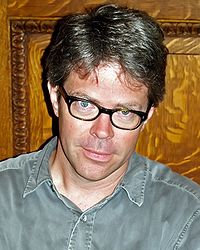
Oh ! back to the vexatious Chick-lit question, where consumer-choice and empty lifestyle pretendsto an Austen-like inch of ivory, and where in Ireland (at least ) vacuity is rewarded with attempts bycertain media-types to include disposable novels on our children’s examination certificate syllabi!!Sure police-helicopters are sent in hunt for Jonathan Franzen‘s bifocals and this tittle dominatesmedia-time. It appears one must have a testicular style to become the luvvie, though I expect italso helps to be a writer of merit, which cannot be denied . This doesn’t explain why women writersand makers of literature are shoved into the shadows, critically, academically and historically , untilthey acquire the label specialisation.
Further to the discussion, VIDA have recently published a forum on Gender and Publishing, excerptedhere and linked beneath Dr Buckrich’s Website and Emma Young’s Piece here as third link. it is worth the read:
Tracy Bowling: “I do believe that bias is present in the publishing world such that women writers are underpublicized and undersold after their work is published, but it’s not a bias I feel very qualified to speak to. The more distressing evidence of a gender bias I see comes before publication, in that women writers often seem pressed to fit themselves very neatly into categories, to define a space for their work or to proclaim whose footsteps they’re following in. In the wake of Jonathan Franzen’s glowing reception, many writers have discussed the infrequency with which the word “genius” is applied to women writers; I’d be curious to see if the same is true of words like “breakthrough,” “innovative,” and “new.” I think that in order to attain success, especially in mainstream publishing, women often have to (often artificially) join a particular group or cohort of other women writers in order for their craft to be perceived as serious and studied. I’ve seen this a lot among women who write fantastic or fairy tale fiction, where, for example, no matter how little one’s work resembles or echoes that of Angela Carter, that work rarely gets discussed without heavy reference to Angela Carter. The really unfortunate side effect of having to strategize and situate oneself as one among many others, I think, is that women become less likely to write the Franzen-esque literary epics, simply because there is less precedent–less of a niche within which their work can be easily framed.” (link#3)
Personally, I expect that if you are a man, its easy to have a blind-spot on the under-representation ofwomen in Government, in the Literary Arts and in Media. The fact that many (many) people do notequate media-time (luvvieness) and column inches with that strange heeled penile-worship ofmodernism and that frisson of tokenist gender-equality doesn’t mean that the issue of discriminationdoes not occur. It occurs, it is celebrated and it is a part of our lives wherein meritocracy is just another by-word for male dominance.
EDIT : (VIDA discussion re-posted this morning on the Web)
“I soon discovered that a lot of women writers routinely perform their own version of “the count” when surveying anthologies, journals, book reviews, and awards. At the time I was unaware of Juliana Spahr and Stephanie Young’s essay “Numbers Trouble”; nearly all of the women I was in dialogue with directed me to it. I was astonished to discover that a sub-genre of poetry (which I’ll refer to by shorthand as “experimental”) I’d have assumed would most fairly represent the sexes may be as biased as the more “traditional” sub-genres in poetry, as well as the more commercial venues for prose. I would later be struck by the fact that women writing in all genres are affected by this disparity.
This experience was akin to peering over a very high wall to gaze upon a neighbor’s backyard—a neighbor I’d always assumed was living the good life—and discovering that this neighbor’s life was, in fact, quite similar to my own.”
Jonathan Franzen, whose lost glasses sparked a cop-hunt and media-dominance.
One of my favourite poems is The Seafarer, it is linked at the end of this short piece in translation by Ezra Pound. The edition that I own is the Exeter University Press Seafarer ( I will add notes, translation, editor and ISBN later as I am away from my Poetry library). In the meantime, whilst playing with a very elderly book of school-french this morning, I happened upon the phonetic transcription section of the edition which I enjoyed so much that I am adding here a little poem called , Mon Bateau. Though I would gladly add La Cerise and Nocturne also, because they are of such light.
Alone
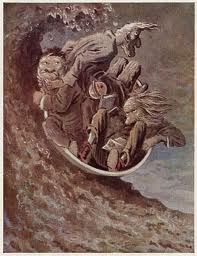
‘The Oldest Joke’ from the Exeter Cathedral Folio
(Georges Rodenbach)
To live as in exile, to live seeing no one in the vast desert of a town that is dying, where one hears nothing but the vague murmur of an organ sobbing, or the belfry tolling.
To feel oneself remote from souls, from minds, from all that bears a diadem on its brow; and without shedding light consume oneself like a futile lamp in the depths of dark burial vaults.
To be like a vessel that dreamed of voyage, triumphal, cheerful, off the red equator which runs into ice flows of coldness and feels itself wrecked without leaving a wake.
oh to live this way ! All alone…. to witness the wilting of the divine soul’s white flowering, in contempt of all and without prediction, alone, alone, always alone, observing one’s own extinction .
Translated from the French by Will Stone.
Interestingly, I met a returned exile today who does not recognise Ireland anymore. He says there is a gentleness that has left the state, I tend to agree with him there.
“The heart’s thought that I on high streams The salt-wavy tumult traverse alone. Moaneth alway my mind’s lust That I fare forth, that I afar hence Seek out a foreign fastness. For this there’s no mood-lofty man over earth’s midst,”
excerpted : The Seafarer , translated by Ezra Pound
{Exeter University Press edition to be added}
Mon Bateau
Quand mon bateau S’en va sur l’eau Poussée gaiment par le bon vent, je voudrais tant Etre dedans!
mais quand la bise la voile brise, Que le navire Soudain chavire, j’aime bien mieux Lui dire adieu.
I was sitting at my desk Outside the boss’s office Replying to emails From candidates for places On the courses we offer; The effective saint; Managing eternity efficiently Level Two; Create the world workshops (NB Seven Day Course). Then what happens? This black yoke comes in With a thousand questions In its beady eye. It has wings like me But otherwise We’ve nothing, nothing In common. Have we ? I gave him the standard line. I regret that on this occasion we have No vacancies for crows or artists. We wish you every success In your future career.
The creature stayed however. I did not call security (Because I am security! I do everything around here) And so the loser stayed.
Forever.
Mark My Words with illustrations by Alice Maher was published in conjunction with The Night Garden exhibition by Alice Maher and lives in a little black folder with pieces by Maher entitled The Bestiary.
Whilst awaiting this morning for a sheaf of three poems from my Saturday WomanWriter, I thought to add in an excerpt from the Notebooks of Simone Weil, whose Necessity is the most sought after poem on the Poethead blog. I will include at the end of the excerpt a link to Necessity in stand alone format (without comment). Here follows an excerpt from Le Personne Et Le Sacré :
“Beauty is the supreme mystery in this world. It is a brilliancethat attracts attention but gives it no motive to stay. Beauty is always promising and never gives anything; it creates a hunger but has in it no food for the part of the soul that tries here below to be satisfied; it has food only for the part of the soul that contemplates. It creates desire, and it makes it clearly felt that there is nothing in it [beauty] to be desired, because one insists above all that nothing about it change. If one does not seek out measures by which to escape from the delicious torment inflicted by it, desire is little by little transformed into love anda seed of the faculty of disinterested and pure attention is created.“
I have used this paragraph before as a static text in this blog, because it epitomizes Weil’s writing. It was the centenary of her birth in 2009 and some of those notebooks made their way into general publication. Weil is placed with Paschalin terms of her philosophical and writing output, but it incredibly difficult to locate texts in ordinary bookshops in Ireland. I have quoted from Thinking Poetically, ed Joan Dargan.
I suppose that it is an approach to art that encapsulates the purity of the relationship between the individual and the transcendent work that I find attractive, living in a country (as one does) where people must fight to bring to Government the necessity and importance of the arts: in their funding, archiving, presentation and their preservation. There is always hope that the necessity of the arts in developing the intellect will be recognised and supported in Ireland.
I have little success getting my poor letters published in the Irish Times, so I have decided to publish it here in toto. It comprises a response to a throwaway comment regarding the responsibility of poets during this post Mythical-Celtic Tiger era.
Re : ‘From the Poetic to the Prosaic’ 20/08/2010
Madam,
This comment from the letter entitled “from the Poetic to the Prosaic” ( Friday August 20th 2010) is quite clearly woefully misguided; ” The role of poets should be respected, but the attempts of politicians to root out the rot and restore order in the State are equally worthy.”
Whilst Poets may be accused historically of being ‘Love-Trips’; and subject to the vagaries of the Taoiseach’s speech-writer , they quite clearly have not beggared the country.
It’s not funny that the Taoiseach would have recourse to writers to disentangle us from this mess.
It is , however, quite hilarious that the very people who have taken the brunt of Fianna Fáil arts policy and cuts would want to extol the virtues of the mythical Celtic Tiger era, in its scenes of cultural devastation from Tara, through cutting to ‘zero’ funds to two of our three major writer’s centres ! ( 0 funds)
Maybe Mr Cowen could ask elsewhere for the extolling of Irish Art. I suggest that he start with the Ahern Family who are getting the tax breaks and are considered to be ‘Artists’ in this benighted state.
your’s etcetera (letter ends)
I reckon that O Donoghue’s 2003 Arts Act is responsible for Taoisigh going where angels fear to tread myself. The Arts should be as independent as possible from the operations of the State- that does not prevent the writer/poet/satirist from commenting on Blasphemy, cultural destruction or the fact that an ex-Taoiseach and his family member are getting tax breaks under the artist’s exemption scheme.
Since new artists have been created under this government, I think that they should be the ones singing the praises of Ireland abroad, even if one of the books was allegedly ghost-written.
Herein a physical description of the Babel Library ,
‘There are five shelves for each of the hexagon’s walls ; each shelf contains thirty-five books of uniform format; each book is of four hundred and ten pages; each page, of forty lines , each line of some eighty letters which are black in colour. There are also letters on the spine of each book; these letters do not indicate or prefigure what the pages will say. I know that this incoherence at the time seemed mysterious.’
The Library of Babel is a story in the Labyrinths Collection , by Jorge Luis Borges. I have even added in the poor tatty (much tattified) image of my copy as accompanying image, because the front of the book when photographed appears even worse. (I put that down to my incompetent camera-work more than the actual cover which is uniformly tatty front and back). Having just emerged from a Labyrinthe journey through re-installing a tiny bit of the data-corrupted software of my PC, I got to thinking about gestures, books, labyrinths, orthography and various losses connected to what was not stored off-site. The web (tangled or no) is a new labyrinth of ill-digested babel-like proportions, wherein treasures and cul-de-sacs, which is why the following is most intriguing;
“I cannot combine some characters dhcmrlchtdj
which the divine library has not foreseen and which in one of its secret tongues do not contain a terrible meaning. No one can articulate a symbol which is not filled with tenderness and fear, which is not , in one of these languages , the powerful name of a god. To speak is to fall into tautology. This wordy and useless epistle already exists in one of the thirty volumes of the five shelves of one of the innumerable hexagons-and its refutation as well. (Any number of possible languages use the same vocabulary; in some of them, the symbol library allows the correct definition a ubiquitous and lasting system of hexagonal galleries , but library is bread or pyramid or anything else , and these seven words which define it have another value).”
Blasphemy and Censorship of the Arts in Ireland 2010
The same politicians using the same vaunted and irredeemable excuses to justify stupid behaviour such as attempting to site blasphemy in outrage, rather than go to the bother of pinning it through definition, have thus created a stealth-tax based in vague albeit vain obfuscations of actual blasphemy.
The books written/unwritten/created/uncreated in Borges’ library are achieved despite the authors, who may have unwittingly made shadow-books. Those who destroy great works of writing have done little damage to the Babel library, I suppose that’s because great truths don’t come easily into profane hands-even if they are followed about by clerks who would justify reams of paper which is ultimately worthless as MCV.
Circuit fifteen ninety-four
‘four hundred and ten pages of inalterable MCVs cannot correspond to any language, no matter how dialectical and rudimentary it may be .’
For information and further discussion on the influence of Circuit ninety-four and MCV, I’d suggest that people should continue to read Borges’ on The Library of Babel, alongside his Book of FabulousBeasts and anything else ye can get your hands on. I am only sorry that he did not write of the fabulous dishonesty of politics, in its encyclopaedic idiocy when it comes to defining such pressing issues as illiteracy, dispossession and proper data-retention for the public record of all amendments, debates and majority voting of the period 2003-2010 in Ireland.
The Old King, a Criminalisation for Blasphemy remains on the Irish Statute.
The image of the Old King is by french expressionist/fauvist painter Georges Rouault who was accused by the predecessors of this Irish Government of both blasphemyand incompetence. His paintings, mainly of religious themes, were refused exhibition in Dublin. A spirited defence of Rouault was undertaken by Louis Le Brocquyin which he accused Fianna Fáil of chocolate-box sentimentalism in their refusal to appreciate art. I believe it is worse than that.
The development of the Arts in Ireland has since 2003 (the O Donoghue Arts Act) been atrophied by the concerns of ministers more interested in sports and who appoint our Arts Council. The all-embracing silence of artists and thinkers on the criminalisation of blasphemy being a pointer to an inability to discuss anything outside of very narrow two-dimensional concerns of output and finance, which isn’t really about the realm of ideas and the intellect at all. It presents a paucity to our future generations in terms of leadership and discussion. We are not making art to reflect our ideas or for our children, we are making it to echo the narrow and constipated concerns of Government !
There were to be two referendums in October 2010. I have commented elsewhere on the postponing of the Children’s Rights Referendum which was to occur on the same day as the blasphemy referendum. It seems that alone in the developed world, we in Ireland have now got an entirely superfluous blasphemy amendment (2006-2009 Defamation Legislation) which will for the forseeable future remain on our statute. Last weekBarry AndrewsTD confirmed another Referendum postponement, until 2011. (Edit: second anniversary of this innovation occurs Jan 2012 – no sign of the promised referendum)
This criminalisation for blasphemic utterance is based not in the definition of blasphemy but in the offender’s ability to generate outrage! As the Roualt controversy showed, it is quite easy for outrage to be generated in Ireland and that the Arts are indeed subject to the manipulations of governments whose inability to lead is propped by unnecessary legislation in order that debate does not occur. Debate generates ideas and discussions which create fear and are thus anathema to would-be leaders.
I have on my studio wall a wonderful early reproduction of the Old King, which stops people in their tracks because the observer can actually see the brush-strokes. I put it there in it’s simple wooden and glass frame as a reminder of the folly of the Rouault controversy and how simple it is to fall into a laughing-stock by virtue of personal vanity.
Quite apart from the events of Elizabeth Barrett-Browning‘s life , which are utterly fascinating, she added to the Poetic Canon some rather appealing images.
I remember that whilst we studied her excerpts of ‘Aurora Leigh‘ in college that our (male) professor worked very hard to dismiss her feminism! The Irish University cycle of English literaturewasn’t given much to gossip or discussion, so it was a few years later before I found that her name was the first woman’s name mentioned in connection with the British Poet Laureateship and while commentators have said it was so mentioned *in Jest* – she drove the establishment nuts with her rhyme schemes, it took until Carol Ann Duffy for a femaleLaureateto get the job.
Thats quite a period of ‘wait’ . Carol Ann was allegedly vetoed by Tony Blair’s government also ‘cos he did not believe that middle-england was prepared for a lesbian laureate. How caught up in politics is the art of poesy ! The poem XLII ‘Sonnets from the Portuguese‘ follows this paragraph.
‘My future will not copy fair my past- I wrote that once; and thinking at my side My ministering life -angel justified The word by his appealing look upcast To the white throne of God, I turned at last, And there , instead, saw thee , not unallied To angels in thy soul! Then I , long tried By natural ills, received the comfort fast, While budding , at thy sight, my pilgrim’s staff Gave out green leaves with morning dew impearled. I seek no copy …Read More




 Chris Murray