Category: Gardening
-
There have been some difficulties with this post, which is companion to Simone Weil‘s Necessity and to Edith Sitwell‘s The Wind’s Bastinado. Both the above poems were transcribed from a small library in Mayo, the original Tula was removed earlier today, this is an edited version.
Leo Tolstoy: Essays from Tula, with an introduction by Nicolas Berdyaev. London, Sheppard Press, 1948.
- Bethink Yourselves.
- The Slavery of our times.
- An Appeal to Social reformers.
- True criticism.
- I Cannot be Silent.
- Thou Shalt Kill No One.
- A Letter to the Peace Conference.
- The End of the Age.
- Love one Another.
Foreword by Nicholas Berdyaev
The book has an interesting tale, it came to me via my favourite wee private book collection in Westport, where the borrowing involves making a note of essay/book/monograph, author and ISBN.
The borrowing can be long term unlike the public libraries which tend toward a three week limit and a fining system.That collection (in Mayo) is also good for transcribing portions of poetry books, and books that are no longer in circulation and is in the way of a discipline regarding what reading matter one wishes to access. Interestingly, a small group of books that are in my possession have been requested by someone who the owner judged not to be ready to request.
It’s funny that often the books we would disregard at certain stages gather potency and relevance as we get a bit more life-experienced (or indeed world-weary).
‘
” Yet a religion which answers to the demands of our time does exist and is known to all men, and in a latent state lives in the hearts of men of the Christian world. Therefore that this religion should become evident to and binding upon all men it is only necessary firstly that educated men, the leaders of the masses, should understand that religion is necessary to man. That without religion man cannot live a good life, and that what they call science cannot replace religion; and secondly that those in power and support the old empty forms of religion should understand that what they support and preach under the form of religion is not only not religion but is the chief obstacle to men’s appropriating the true religion which they already know, and which alone can deliver men from their calamities”.
I have indeed published this in excerpt before now on this very blog. That’s probably because it is imperative to understanding the concept of evolutionary development in human philosophies and wisdom. Theres a huge apocrypha which goes ignored and unconserved in our drive to modernism which really does leave the best bits of our philosophies out. I am not into theorising on why theocracies indulge the most totalitarian aspects of collectivism or why dogma is anti-intellectual: sure that’s all been done before. I would simply say that each individual will take something different from a book they are reading be it poetry, theology, politics, philosophy and that to have that chance is important to everyone and not to the guardians of dogmatism who in many ways have failed quite simply to engage people at any level of understanding saving the overtly materialistic.
I’d highly recommend the writings of Simone Weil to those who wish study how anti-intellectualism makes many of us outsiders to a shared heritage and how close we come to totalitarianism by arrogantly accepting dogma with blind obedience. I will add in the Weill links at the base of this small post.
- Necessity
- Leo Tolstoy’s Essays from Tula with an introduction by Nicolas Berdyaev London, Sheppard Press 1948.
-
Leave some flowers at Rosroe for Richard Murphy RIP. Irish Times 30/31 January 2018 
In Memory of Wittgenstein at Rosroe
A solitary invalid in a fuchsia garden
Where time’s rain eroded the root since Eden,
He became for a tenebrous epoch the stone.Here wisdom surrendered the don’s gown
Choosing for Cambridge, two deck chairs,
A kitchen table, undiluted sun.He clipped with February shears the dead
Metaphysical foliage. Old, in fieldfares
Fantasies rebelled though annihilated.He was haunted by gulls beyond omega shade,
His nerve tormented by terrified knots
In pin-feathered flesh. But all folly repeatsIs worth one snared robin his fingers untied.
He broke prisons, beginning with words,
And at last tamed, by talking, wild birds.Through accident of place, now by belief
I follow his love which bird-handled thoughts
To grasp growth’s terror or death’s leaf.He last on this savage promontory shored
His logical weapon. Genius stirred
A soaring intolerance to teach a blackbird.So before alpha you may still hear sing
In the leaf-dark dusk some descended young
Who exalt the evening to a wordless song.His wisdom widens: he becomes worlds
Where thoughts are wings. But at Rosroe hordes
Of village cats have massacred his birds.(Wittgenstein’s seat is marked by a small plaque in the National Botanic Gardens and generally inhabited by a lazy ginger Tom). The area of Rosroe at Killary Harbour is discussed briefly in the blog under ‘The Brightest Jewel’. Rosroe is a wild and beautiful place, with a hostel (sited now where he had stayed briefly) adorned on it’s periphery by fuchsia hedges and looking onto the small harbour at Killary.
from: Selected Poems by Richard Murphy.
-

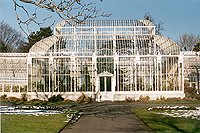
1998 saw the bicentennial of our National Botanic Gardens, which started my first cycle of poems and images, some of which I exhibited in a group show called Ramus (Hugh Lane Gallery, Dublin). The gardens flourish with two of the houses now restored to their former glory, the Curvilinear Range and the Palm House; distinguished by the lolling cat, the connecting door into the fabulous orchid collection, and the little plate which commemorates Wittgenstein‘s seating place.
I am sure Wittgenstein had many places in Ireland, another one is located at the Fjord of Killary harbour where if one is lucky one can see rainbows nestling along the sides, usually in pairs. A small commemorative plate nestles there on a low wall at the site of the visitors youth hostel at Rosroe.
The Botanic Gardens share a boundary with the Huge citadel of Glasnevin Cemetery, where my brother lies in an unmarked grave, and that was the beginning of the poems. Glas Naíon translates into The Stream of the Infants. The River Tolka runs along the edge of the gardens and is nodded to by a huge Socrates who inhabits a niche just beyond the Japanese bridge.
So, there is lots of food for thought for the makers of images and poetry, generally small children are fascinated with the tame squirrel colony and the arching Yew walk. On many days the film-makers, sketchers and thinkers can be seen walking the boundaries and edges of the Gardens, it’s nice to see.
The History of the Herbarium and the Gardens are detailed in the excellent book mentioned at the beginning of this piece:
The Brightest Jewel, by Nelson/Mc Cracken 1987
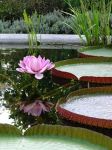
The Victoria Lily is no longer there, the house she occupied is up for renovation, it included a ferns room and cacti. The cacti have been temporarily re-housed in the great palm house. The gardeners will gladly regale with tales of her fertility cycle and blushing when she returns. A small closed in area on the walk to the lily house has a section of Moore’s last Rose of Summer and stops many curious people in their tracks.
The Last Rose of Summer , by Thomas Moore

 Chris Murray