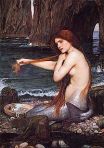
Mud-Matressed under the sign of the hag In a clench of blood, the sleep-talking virgin Gibbets her curse, the moon’s man, Faggot-bearing jack in his crackless egg;
Hatched with a claret hogshead to swig He kings it, navel-knit to no groom, But at the price of a pin-stitched skin Fish-tailed girls purchase each white leg.
This is just a brief note, given my current interest in our small bird population and this year’s lack of snowdrops in my own garden. Indeed it is related somewhat to another entry on Poethead . (cf bottom of this post for linkie)
Every year we wander to the National Botanic Gardens to take a look at the snowdrops in the rockery, this is utterly convenient because the rockery comprises a playground for the burgeoning and largely tame squirrel population; but I digress.. I bought the book for my mother in her early widowhood because she adores climbers, roses and scented stock. Our beautiful Sumac came down in a storm and though I only visit with her , its become obvious that the straggling offspring do not carry the same impact for the local birds or indeed aesthetically.
Thus this evening I am bringing home In Your garden by Sackville West to re-read, and Faber’s CollectedMarina Carr Plays.
We do not often get real sticky wet and slippy snow in Ireland.
Our older people (we will all be elderly soon enough) are carrying themselves with incredible delicacy. The paths present a patchwork of half-hearted sand thrown down and a web of glassy ice. the puddles make a satisfying crack when breached, but bones are delicate.
before becoming a monster and then turned into rocks, Scylla was a nymph with whom Glacus, one of the sea gods, had fallen in love. In order to win her, Glacus sought the help of Circe whose knowledge of herbs and incantations was well known. But Circe became attached to Glacus on sight, only she was unable to get him to forget Scylla, and to punish her rival she poured the juice of poisonous herbs into the fountain where the nymph bathed.
(Borges then excerptsthe Metamorphoses of Ovid, which btw are given a contemporary gloss and translation by the late Ted Hughesand are published by Faber.)
So, poor Scylla became a rock and well our nod to certain difficulties and words in common usage include the phrase:
“Between a rock and a hard place”
though I suppose that since our education system is more based on manual labour preparation and the globalised market, the provenance of such clichéd phrases or truisms gets lost in the translation.
Edit: 07/12/2019: Read H.D’s “Curled Thyme”. H.D was a much ignored and magnificent poet, whom the canon-makers eschewed due to her difficulty. One imagines the canon-makers as lovers of overt simplicity!
Odysseus rested on his oar, and saw The ruffled foreheads of the waves Crocodiling and mincing past; he rammed The oar between their jaws, and looked down In the simmering sea, where scribbles of weeds defined Uncertain depth, and the slim fishes progressed In fatal formation, and thought If there was a single Streak of decency in those waves now, they’d be ridged, Pocked and dented with the battering they’d had And we could name them as Adam named the beasts Saluting a fresh one with dismay, or a notorious one With admiration; they’d notice us passing And rejoice at our destruction, but these Have less Character than sheep and need more patience.
I know what I’ll do he said, I’ll park my ship in the crook of a long pier (And I’ll take you with me, he said to the oar) I’ll face the rising ground, and climb away From tidal waters, up river-beds Where herons parcel out the miles of stream, Over the gaps in the hills, through warm Silent valleys, and when I meet a farmer Bold enough to look me in the eye With ‘Where are you off to with that long Winnowing fan over your shoulder?’ There I will stand still, And I’ll plant you as a gatepost or a hitching-post And leave you for a tidemark. I can go back And organise my house then.
But the profound Unfenced valleys of the ocean still held him; he had only the oar to make them keep their distance; The sea was still frying under the ship’s side. He considered the water-lilies, and thought about fountains Spraying as wide as willows in empty squares; The sugarstick of water clattering into the kettle; The flat lakes bisecting the rushes. He remembered spiders and frogs Housekeeping at the wayside in brown trickles floored with mud, Horsetroughs, the black canal with pale swans at dark; His face grew damp with tears that tasted Like his own sweat or the insults of the sea.
by Eiléan Ní Chuilleanáin.
This poem is culled from The Penguin Book of Irish Verse. It was edited by Poet Brendan Kennelly and published in 1970. Both poets have collections, translations and ongoing works.
I ransack her room. Loot and pillage. I root in her trunk. Crack open the tightly sprung boxes of satin and plush. Pierce my breast with her butterfly
brooch. I pose in her hats, French berets, mantillas of lace, the veil that falls over her face, the boa she wraps round her neck.
I try on her shoes. Her slippers are mules. I can’t walk in her callipered boots. I break into her wardrobe. Hands grope in the dark. Faded bats,
like umbrellas, are humming inside. Stoles of fox-fur and mink: tiny claws, precise nails. Lips clamped in the rictus of death. I’m hot on the scent
of oestrus, umbilicus, afterbirth, eau-de-cologne, I fling myself down on the bed that she made of dirt from the Catacombs, blood
of the saints. Under the counterpane, nettles, goose-feathers, a torc.
from : The New Irish Poets, edited by Selina Guinness Bloodaxe 2004.
The Poems of Dorothy Molloy was launched in November 2019 (Faber & Faber)
I remember well those fox-furs, my own mother was bequeathed a pair and I too delved into the huge old nana wardrobe, bringing out the fur stoles complete with little curled feet and a golden chain effect that operated as a clasp. The wardrobe revelation is part of most girls’ growing. In the meantime, there is a small piece on the trousseau, inheritance and the Island Women on the blog. I quite remember being unable to zip the zipper of my mother’s wedding dress confection onto me at twelve, nor indeed being able to squeeze my toes into the minute satin winkle-pickers that she wore for her wedding day!
EDIT : 25/11/2010, this is a Reblog of a piece written to mark the 16 day Campaign to eliminate Violence Against Women and Girls.
Now bloodless and almost fleshless unmoving , unbreathing, voiceless. With eyes half closed and sunken, what matter if -Anna or Maria, the fine lids will never rise, the clenched lips will not move or ever again utter a moan or sigh. And look how already white and strange is that ring upon her hands, crossed forever.
But do you hear her innocent child crying in a cradle nearby. There is her immortal blood, transferred and her soul now resident in this world. days will pass by, years, centuries and the yielded lips of two young lovers will again whisper ‘Anna’ or ‘Maria’, at night amidst the fragrance of spring. The great-granddaughter will bear everything: name, eyes, lips, locks of the other invisible one.
1925. Selected Poems of Elisaveta Bagryana; Penelope of the Twentieth Century Trans, Brenda walker, Valentine Borrisov and Belin Tonchev. Forest Books.
Yoku Go No Onna from the Chester Beatty Library. Dublin.
Duel
Both earth and sky are greenesses, Greens that explode and expand: Shoes flash like fish as I tread the seas And hang like fish when I stand, And happiness swims in the shadow of trees As the light blade hangs from my hand.
Moonlight and Jellyfish
I swim in the moonlight, swim to snare Jellyfish swarming, flocks of phlegm.
My hands stream out, forgoing me: Further and further they extend Among those moving mirrors where, Coiling, the seaweeds cumber them; Where, in the mooned alembic sea, My flesh turns glassy, glassily.
A thing transparent, a chilly thing, Flows in the water, knows no end…
My soul near frozen, shivering, Sinks in the sea, is almost drowned, Drowned in its very trance of prayer While swarming everywhere around, Swarming round me everywhere, The jellyfish in trembles of pure blue Swim out, swim through That moonlight they are turning to….
I shall have to balance these excerpts from The Face at the Bottom of the World with a woman poet, when I get two minutes. In the meantime the edition I read these in is from the UNESCO Collection, Published by Charles E Tuttle and Company 1969.
Here, In Ireland our jellyfish are small and brown with electric blue veins in the top. I made a poem about a whole lot of them beached and rotting In Irishtown a number of years ago.There were hundreds lining the beach after a wild storm.
I am publishing this in Images, tagged with Visions.
Round his left shoulder, as he got up slowly every day’s muscle gathered in agony His death was flayed off him like a gauze. Because second-birth has such harsh laws.
From: Between by Ágnes Nemes Nagy.Trans, Hugh Maxton.Dedalus Press , Dublin and Corvina Press, Budapest.



 Chris Murray