Wie is de vrouw on de overkant? Delta The Metronome Marina Tsvetayeva The Portrait of his First Wife Maria Alexandrovna Blinking in the Dark |
Category: poetry
-
-
There is an interest for women poets in how media presents electoral processes like the recent Oxford Professor of Poetry appointment. Just as there is an interest in how media views poetry generally.
“I would like to see something different at the next election. I would like to see the media discussing women poets and the benefits that they can bring to the chair, and how their role can influence emerging women poets. I feel that this can be achieved by speaking to women candidates with intelligence and not utilising them as filler material in your ossified view of what poetry is.” (VIDA)
I started Poethead as a platform that could create visibility for women poets and their translators. Poetry is primarily a process of creation, however, media often engages with poetry at the point where it has become a product, often within the published book. This convergence of media and poetry was always going to be problematic. That a lifetime of creative effort goes into a finished book or books is not recognised by the reviewer who is only interested in producing copy. In order to fully understand the poem within the book, and the book as object, one often has to read the entire body of work by the poet. That we need magazines like Jacket2, Harriet, UBUWEB, Wording the Between, Poetry Foundation, and other platforms wholly dedicated to the poem is a given for the poetic reader. That the media finds the poet a difficult and irascible creature is also a given. It seems far easier for media to use a simplified strategm or model to present the reader with something amounting to cultivating interest in poetry. Evidently the British national press has been using outdated models to platform poetry. It requires review.
If the media had generally ignored the Oxford Professor of Poetry election, it might have been better than the samey efforts journalists used to generate interest in the voting process. Mostly the British media opted for failsafe methods in an attempt to bring interest to the Oxford Election. That the press chose to generally ignore one of the candidates who happened to be a woman candidate seems to me beyond remiss. A created invisibility on the part of national media organisations in the case of A. E Stalling’s candidature for the Oxford chair points to laziness and to a lack of effort with regard to examining androcentrism in literary publication and in academic appointment. In the three centuries since its inception the Oxford Chair has been almost wholly occupied by male poets, with the exception of a brief nine-day female occupancy. So, this week I wrote about media laziness for VIDA! Women in the Literary Arts.If the media is incapable of challenging sexism in poetry, is uninterested in the academic perception of poetry as a male preserve, or indeed in the low review numbers of books by women poets that occur in their newspapers, then what happened at Oxford will continue to occur intermittently and that my friends is just boring.
-
summer haiku
choppy Irish Sea
failing to dislodge
this red starfish
poppy bed:
the unopened ones
as lovely as the blooms
a garden full of sunflowers swaying tall
muddy summer frogpond no splash
reject samsara ?
this wild summer river
this wild path
these stone walls
hemming him in too-
cinnabar caterpillar
cloudy afternoon…
my sweet pea flowers
becoming peas
A Train Hurtles West
morning downpour-
we have both dreamt
about our mothers
lingering
in my small bathroom…
mum’s perfume
Auld Lang Syne
in the background-
I sign her DNR request
mother dying a train hurtles west
death cert. incomplete granny’s maiden name
All through the Night:
this out of tune version
strangely moving
cloudy morning…
her solar-powered plastic flower
sways hesitantly
Maeve O’Sullivan works as a media lecturer in the further education sector in Dublin. Her poems and haiku have been widely published and anthologised since the mid-1990s, and she is a former poetry winner at Listowel Writer’s Week. Initial Response, her debut collection of haiku poetry, also from Alba Publishing, was launched in 2011, and was well-received by readers and critics alike. Maeve is a founder member of Haiku Ireland and the Hibernian Poetry Workshop. She also performs at festivals and literary events with the spoken word group The Poetry Divas. Her poem Leaving Vigo was recently nominated for a Forward Prize for a Single Poem by the Limerick-based journal Revival.
- A Train Hurtles West by Maeve O’Sullivan was published in 2015 by Alba Publishing
- Vocal Chords by Maeve O’Sullivan
- Alba Publishing
- An Index Of Contemporary Irish Women Poets
-
-
Poemín
This poem
Will be
Exquisitely short
And
Dinkily dedicated
To you.
Popularity, Personified
Smugness was her scarf,
Inked pinkly, cerisely,
She stroked it smugly.
Smugness was her scarf.
Idleness was her chignon,
Gleaming, burnished, shiny
She fondled it idly.
Idleness was her chignon.
Cuteness was her weapon,
Trigger fingered, ready,
She cocked it cutely.
Cuteness was her weapon.
Blandness was her boyfriend,
Broad-shouldered, dreamy,
She loved blandly.
Blandness was her boyfriend.
For Heaney
The sorrow’s mine and yours.
It’s all of ours. We shake our heads.
Now, when we want words,
We will rifle and riffle
Through pages printed.
We will thumb-skim his volumes.
We will become accustomed,
And forget to mourn, as we do today,
For his bits of the world welded to
Bits of the meaning of the world.
With those new silvered weldings,
Hand-soldered together by him,
Scudding from him to us.
We will miss his missiles of insight.
Tír na nÓg
I saw Tír na nÓg
For the first time
Yesterday.
From the car, while driving
On the M8, before Thurles.
All the plants,
All the trees faced it,
Pulled to it.
I felt the pull myself.
The draw.
And the island?
A mossy green copse,
Saturated in spring green.
On this bright day,
A wisp of mist hung
There. Around.
The rounded island
Otherworldly.
Ah, the longing.
The longing for it lingers.
Offering
I would bring you white roses
And mysterious irises
And open sunflowers
If they would let me
I would bring you sweet port wine
And hoppy beers
And tiny dry Champagne bubbles
If they would let me
I would bring you blissful heat
And cooling showers
And misty hovering bridge fog
If they would let me
I would bring you woven blankets
And intriguing ceramics
And all the treasures of this New World
If they would let me
But they won’t let me
And I just can’t choose
The best offering for you
So my lines will have to suffice.
Please let my lines suffice.
Popping Candy
Your company is
Like popping candy
Fizzing in my head.
Your company is
Like deft acupuncture
Painlessly needling me.
You say something
So unexpectedly funny
That I almost snort.
How long does
Popping candy last?
Does anyone know?
Popping Candy and other poems published here are © Sarah O’Connor.
Sarah O’Connor is originally from Tipperary. She studied in UCC and Boston College, and she now lives in Dublin. She previously worked in publishing and now works in politics. She is 34. She is working on her first novel and on a collection of poetry. She has been published by Wordlegs and The Weary Blues.
Sarah O’Connor blogs at The Ghost Station & tweets at @theghoststation. -
Testudo
A bone-hard carapace,
a shell cast on a hot shore,
emptied by the labour
of leaving the nurturing
sea, scraping broad ribbons
up the sand’s glassy slope .
Gasping, digging a damp hole,
she lays round, sticky eggs,
a hundred leathery balls.
Then spent, noon-dried,
she dies, picked clean
by quick scavengers.
Her hatchlings flail
and scuttle towards
the sea, led by the
gazing moon, their plates
small patterned
purses, hardened
in the rich sea-soup
into a vaulted chamber
built to the blueprints
of this old architecture.
Published in Visual Verse
Blackbird
The blackbird sits, a smudge
in the prickly hedge, stooped,
wings and tail all downward.
I want to touch him, to feel
the quick, warm shape
in a cage of bare branches.
What does a bird fluffed
against the cold see
in his crouched stillness?
If I could grasp him by
his ashy back, hold his whole
breathing body in my hand
what would the soft bones
tell me, the barbed primaries
and the mite-infested down?
The bird stirs, and now
shows a bead, a pinhead eye,
a beak ripening to yellow.
Then the sudden thrust
out of the damp bush,
the perfect trajectory.
This was his first lesson,
the enactment of his ease.
Submitted to The Rialto Poetry competition, February 2015
Dancer, after Yinka Shonibare, ‘Girl Ballerina’
I am tailored, buttoned, piped,
the colonist’s clothes a tight fit
round my slim child’s waist.
Net and frills, my costume’s
a good girl’s best party dress.
But am I a welcome guest
or a blackface clown?
Headless, I say nothing.
I am a dancer’s body
in a pair of cotton shoes.
I am a sister to Marie, the wax
and bronze work of M Degas,
shiny, moulded on a frame
of pipes and paintbrushes.
Called monkey, Aztec,
a medical specimen,
the flower of depravity.
I am ten, to her fourteen, and so,
you could say, innocent.
My neat bodice of East India
Batiks is the bright stuff
of conquest, traded from
Batavia to Benin and now
spread across south London stalls.
My Brixton market wardrobe,
my new flags, my hopeful anthems.
Hands behind my back,
my finger resting on the trigger.
Submitted to Faber New Poets competition, January 2015 -

Questions:
First of all, you have lived in different places in the United States, and now you live in Dublin and are often visiting London. Could you describe how the changing communities you have been a part of have influenced your writing, if so?
Living in different places has certainly influenced my work. Even when I lived in the US I was constantly moving – from Indiana to Alabama to Florida (west coast) to Ohio to Florida (east coast, very different from the west!). The differences among these locations prepared me for living in other countries. There is a tendency to think any given country or place is monolithic and predetermined – we have a sort of place-holder definition in our minds for what a location is. Only when we are there, and, I would argue, there in a very open way, do we note massive differences among people, interactions, expectations, politics, even within a square mile. A friend of mine, Dylan Griffith, who is also from the Midwest in the US and who is now a filmmaker in Los Angeles refers to the idea that as Midwesterners we are extremely flexible and adaptable because we have no distinct culture ourselves. We can easily live anywhere. They call our part of the US ‘flyover country’, and many Europeans and East or West coast Americans perceive us that way. However, to truly understand the American psyche, if there is such a thing, you’d have to understand its immense variation, which includes those lands and people you might normally ‘fly over’.
Which authors inspire you?
I’ve been influenced by the work of Etheridge Knight, H.D. and Susan Howe, all extremely different poets in terms of their approach, but all equally resonant for me. All three are ‘American’ poets approaching their work in different modes but with a similar core. Howe refers to her belief ‘in the sacramental nature of poetry’, which I think also applies to Knight and H.D., and which ultimately underpins my own work.
Much of your work has a sense of roughness about it, like when you write: “The number elevens on the necks/of hungry children. Tendons pushing/flesh at the base of the head. They record/the odds. One to one. A fifty-fifty/chance of making it out alive” in the poem “All Saint’s Day”. Why does this radical raw poetry interest you?.
I wouldn’t say it interests me as much as it seems necessary at the time of writing to create a certain imagery. Some of my poems do have a more familiarly lyric poetic approach: imagery and figurative language are emitted from a distinct poetic speaker. And my particular style of imagery does sometimes head into the rough, as you put it. However, other work definitely does not. Sometimes the imagery is deliberately muted in contrast to the subject, or sometimes the poem comes out of found text, sound poetry, visual poetry. I’m a magpie poet and refuse allegiances to schools (beyond the fact that I do feel more modernist than postmodernist). This belies the influences I’ve outlined above. I can use devastating imagery and a direct voice like Etheridge Knight. I can work on a vatic level like H.D. to create poems that feel like translations of recently discovered ancient texts, but which in fact are created from found text. I can manipulate and excavate an archive visually, like Susan Howe.
Actually, Irish language poet Aifric Mac Aodha recently translated a poem of mine into Irish for a large-scale project I’m working on (www.sacrumprofanumproject.com). This poem was created from a large archive of texts on the sheela-na-gigs, which I amassed over two years. When it’s translated into Irish, the poem sounds ancient. But this ancientness has a strange texture as it’s in modern Irish and some of the contemporary sensibilities in the English text have come across, of course. This process of translation after excavation can have a truly unexpected effect.
Do you consider your found poems to be ‘conceptual’? What is your opinion on conceptual poetry?
In the case of the found sheela-na-gig poems in Strange Country, I don’t see them as conceptual, rather I see them as re-assembled fragments resulting from the excavation of an archive. This excavation strives toward discovering and displaying something essential about the sheela-na-gigs that was previously hidden or submerged. I suppose the process I’ve just described is in itself a concept, but I don’t think that the concept is the driver here. The poem itself emerges from the text, as if from stone being carved
On the other hand, my book with zimZalla is conceptual, and concept is its driver. It will memorialise the 796 babies and children who died at the Bon Secours Mother and Baby Home in Tuam, Ireland. I will create a 796-page record-book as there are death records, but no burial records for these children, so no one knows where they are buried. The mother and baby homes operated in Ireland even as late as the second half of the 20th century. Women who became pregnant out of wedlock were sent there. Their children were often adopted by Irish or foreign families in what is reminiscent of a business transaction brokered by the church. In addition to this trauma, the conditions in these homes were horrific, which led to high rates of infant and child mortality, and a huge amount of suffering for the women. There are accounts of women in labour not being given pain relief by the church-run medical teams because they were meant to appease for their sexual sin. More on that story can be found here. So again, I use whatever tools or modes feel necessary.
Your poetry seems to draw on the unpoetic to a high degree, what is it about the unpoetic that fascinates you?
I’m not sure what is meant by poetic in the 21st century. I think that arguably the notion of the poetic as ‘beautiful’ never actually existed, or if so, only very briefly and not even consistently in the work of those poets who might have espoused it for a little while. Blood-and-guts battles, degradation, injustice, suffering – these tropes have occurred in poetry since the very beginning.
In addition to the question above, I have noticed the fairly frequent use of the word “cunt” in your poetry – what meaning does this word have to you, as a feminist? Do you see this word as a dirty word at all?
In the contexts in which I use it, it is, variously: a provocation, a pun, a cast-off remark, a spell, a descriptor. It is like any word a poet might use, but perhaps with more genealogy.
Is there anything, a feeling, a stance, that you especially want to awaken in your readers? Most of your work provides a critique of the society and human behaviour by means of a certain amount of irony; do you find irony more powerful than other tools of critique?
Irony does seem to be used in my poems in a critical mode as you say, one that’s most often meant to reveal some catastrophic failure in the dominant logic (or a lack of logic altogether). This happens in my poem ‘Birthing Stone’ through the juxtaposition of Doubting Thomas insisting on touching Jesus’s wounds with the Irish medical team insisting on checking for a foetal heartbeat before granting Savita Halapannavar a termination, a delay that resulted in her death. Jesus’s wounds are sometimes portrayed like a vulva or cervix in medieval paintings to evoke the idea that his suffering and death gave birth to the ‘new world’ of eternal life. Pretty ironic in this context.
I’m not sure irony is more powerful than other tools of critique, or whether poetry can sustain and systematically critique in the same ways political or philosophical writing can (or whether it should try to). Irony in my work is a kind of last-ditch effort that certainly won’t win anyone over on a rational basis. None of it is rational, certainly not a person dying for no reason. It follows poetic, figurative logic, rather than the logic you can bring into Parliament or even a political blog post. This can awaken something, I suppose, in some readers? I don’t know.
Your way of reading your poems is very characteristic and at some moments even reminiscent of sound poetry, where does this technique come from? Has there been any inspiration by sound poetry?
I’ve always been intent on the sound of poetry, on poets reading their work and on the reading or reciting of a poem as something quite specific. It’s a quasi-performance, and yet the poet should be out of the way of the poem. There is the phenomenon of the poet who doesn’t read their work very well, or of the poet who inflects all poems with that dramatic ‘poet voice’. An article has even been written on this recently: http://www.cityartsonline.com/articles/stop-using-poet-voice. What I’m aspiring to when I read most of my work is what is naturally in the poem as I composed it. This is why I often have problems with actors reading poems because they have little regard for things like linebreaks and rhythm embedded in the text.
When I was in high school, my friends and I made recordings of ourselves reading poems by Whitman, Rimbaud, Rilke, Celan and Ginsberg. We did a complete recording of Leaves of Grass on a cassette tape. Sometimes I would play records at the same time and distort or disrupt the poetry. This made sense at the time, but I’m not sure where I was getting the ideas. This was in the 1990’s, before the internet was such a vast resource, so I was piecing together an understanding of art, literature and music from an old-fashioned thing called a library card catalogue, as well as an amazing second-hand bookstore called The Bookstack in downtown Elkhart, Indiana, and whatever records and books various people in my family happened to have. My friends and I also jumped on the South Shore train to Chicago where I saw video installation for the first time at the Museum of Contemporary Art. I was not exposed to sound poetry per se until university where everything just opened up and it got so much easier to access everything both in libraries and digitally. I also trained as a musician. So I suppose all this culminates in how I read today.
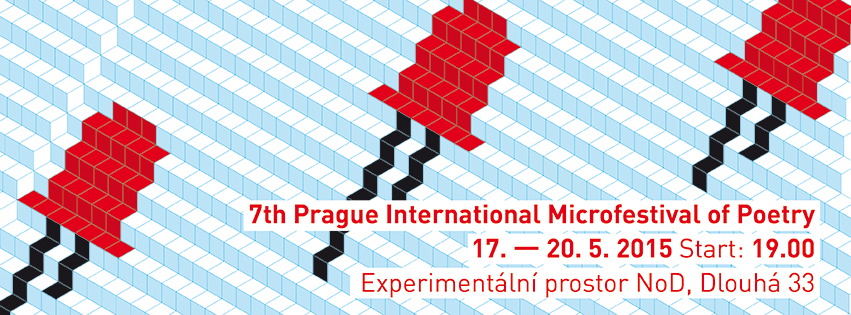
Finally, are you looking forward to “Prague Microfestival” and could you perhaps reveal a little about what the audience can look forward to from your performance?
I’m very excited about the Prague Microfestival and grateful that Olga Pek invited me. I will be performing on the Sound Poetry evening. I will use my translation of the Hymn to Kali (an ancient tantric text written in Sanskrit). It’s quite a refined, H.D.-esque translation. It’s not sound poetry at all. The purpose of the performance will be to digest, degrade, distort and abjectify this translation all the way to the point of pure sound and then back to its original language, which is a very particular language indeed in the context of sound as the mantras themselves are meant to be actual vibrational presences of the gods/spiritual beings.
I will be performing with composer and guitarist Benjamin Dwyer. The guitar itself will also go through this same process. We will create a graphic aleatoric (semi-improvisational) musical score with text that we will use in the performance and which will be projected behind us.
The Prague MicroFestival (PMF) came about in an effort to resuscitate the Prague International Poetry Festival, which took place in 2004, a major undertaking on the scale of the Prague Writers’ Festival, with over 40 writers participating from over 20 countries (including Charles Bernstein, Andrej Soznovsky, Tomaz Salamun, Drew Milne, Jaroslav Rudis, Sudeep Sen, Anselm Hollo). Unlike the annual Writers’ Festival, the Prague International Poetry Festival was integrated into the local culture, with events in established local reading venues, with the aim of fostering dialogue among writers and audience members. PMF’s history dates back to April 2009, when a group of Australian poets (Pam Brown, Phil Hammial, Jill Jones, Mike Farrell) and Irish poets (Trevor Joyce, Maurice Scully) visited Prague thanks to funding from the Australia Council and Ireland’s Department of Foreign Affairs. Along with UK poet Kevin Noland and a group of local Czech and English-language writers, this combined week-long visit became the first MicroFestival. During the three years since that time, PMF has evolved into a major event on Prague literary scene and the only non-commercial literary festival of its size. Since 2011, PMF has entered into a partnership with the Czech poetry magazine Psí Víno and the publisher Petr Štengl, who has released the first anthology of Czech translations originated with the festival, Polibek s rozvodnou (2012).
The purpose of the PMF is to provide a forum for poetic exchange, an alternative to the existing Festival circuit which caters to primarily establishment writers with the inclusion of token Czech authors, and is commercially orientated. The PMF is run by artists, volunteers and students; all events are fully bilingual (English/Czech). The focus of PMF is threefold: to present writing that is innovative/experimental; writing that moves across genres and media (visual culture, music, film) and writing that could be broadly defined as “translocal”, that is, writing outside the confines of nationalism, pursuing a broadly cosmopolitan agenda. It aims to introduce new innovative approaches into the Czech milieu, as well as put Prague on the map of experimental world literature, show Prague as a re-emerging genuinely cosmopolitan centre, whose citizens from all backgrounds and nationalities are contributing to a vital and unique literary culture.
The PMF target audience is anyone with an interest in new writing, in experiment. This year the festival is being co-hosted by the magazines VLAK (in English) and Psí Víno (CZ), and will take place at Student Club Celetná, Celetná 20.
Contact: praguemicrofestival@gmail.com
Facebook: https://www.facebook.com/PrazskyMicrofestival -
Cleaving a Puzzle-Tree
1.
I didn’t see my grandmother’s tree in Chile,
araucaria araucana,
though they grow tall there and are many.
I must have walked under them every day, tripped
over their seeds, but I didn’t think of her, oceans away,
standing in a square of green, raking leaves
around her monkey puzzle tree.
2.
For over a hundred years, that tree stood between
pruned rosebush and clipped hedge, a long shadow
moving over wet fields and stone walls.
As a girl, I clung to the trunk when we played hide and seek,
rough bark printing maps on my palms.
3.
In April gales, the tree sways. From the window,
my grandmother watches a chainsaw blade
spin the tree into a flight of splinters,
until only logs and sawdust are left.
In each neat wheel of wood, an eye opens,
ringed by lines of the past. The logs are split,
stacked, the tree turned into armfuls of firewood
which will rise as smoke to the sky,
a puzzle unravelled.
Frozen Food
In the frozen foods aisle, I think of him
when I shiver among shelves of green flecked
garlic breads and chunks of frozen fish.
I touch the cold door until my thumbs numb.
Strangers unpacked his body in a lab
and thawed his hand, watched long-frozen fingers
unfurl one by one, until his fist finally opened,
let go, and from his grasp rolled
a single sloe,
ice-black with a purple-blue waxy bloom.
Inside the sloe,
a blackthorn stone.
Inside the stone,
a seed.
Standing in the supermarket aisle,
I watch my breath freeze.
Museum
I am custodian of this exhibition of erasures, curator of loss.
I watch over pages of scribbles, deletions, obliterations,
in a museum that preserves not what is left, but what is lost.Where arteries are unblocked, I keep the missing clots.
I collect all the lasered tattoos that let skin start again.
In this exhibition of erasures, I am curator of loss.See the unraveled wool that was once a soldier’s socks,
shredded documents, untied shoestring
knots — my museum protects not what is left, but what is lost.I keep deleted jpegs of strangers with eyes crossed,
and the circle of pale skin where you removed your wedding ring.
I recall all the names you ever forgot. I am curator of loss.Here, the forgotten need for the flint and steel of a tinderbox,
and there, a barber’s pile of scissored hair. I attend
not what is left, but what is lost.I keep shrapnel pulled from wounds where children were shot,
confession sins, abortions, wildflowers lost in cement.
I am custodian of erasures. I am curator of loss
in this museum that protects not what is left, but what is lost.
‘Cleaving a Puzzle-Tree’ and other poems © Doireann Ní Ghríofa
Doireann Ní Ghríofa is an award-winning bilingual poet, writing both in Irish and in English. Paula Meehan awarded her the Ireland Chair of Poetry Bursary 2014-2015. Her collections are Résheoid, Dúlasair (Coiscéim), A Hummingbird, your Heart (Smithereens Press) and Clasp (Dedalus Press). Her work is regularly broadcast on RTE Radio One. Doireann’s poems have previously appeared in literary journals in Ireland and internationally (in Canada, France, Mexico, USA, Scotland and England). Two of her poems are currently Pushcart Prize nominated.
.
www.doireannnighriofa.com & DoireannNiG