Eggs Tadpole Dandelion Clocks |
Category: Small Books
-
-
Forms; A Sampler
for C.M
What would they have said
had you heard the whisperslip ravenous up the avenue
on fat and awkward dialecttowards the parlour comfort
of an army of the wizenedfaces of their mother, who
settled in her embroideriesinternalising the potential
of an inclusive act, to fusethe eschatological omission,
confined in insurrectionto the vortices of daylight,
silently, symbolically laced?Forms; A Sampler is © Chris Allen
Eurydice Series by Anastasia Kashian.
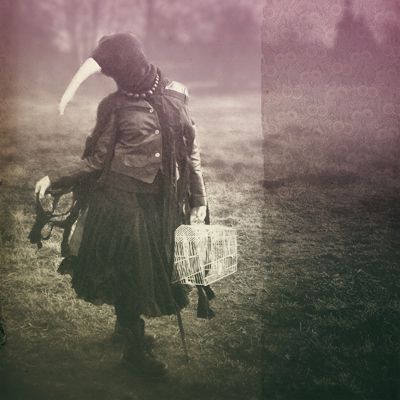
With thanks to Anastasia Kashian for the artwork, from her Eurydice Series. Anastasia’s portfolio is linked at Saatchi online and on herwebsite.

-
I know three places that they go,
and the birds wait in congregation
on pitched roof, tottering lamp-post
in the tree-chorals. They wait mute,gull and urban-pigeon, rook, starling
wood-pigeon and magpie, all wait.
Sparrows await the later crumbs,
the blackbird desires garden-apples.I saw a bird-keeper once.
With her bird-eye. Her empty bag,
her melt into the crowd anonymity.
I saw her just leave a squake of gullsin her wake tearing at the good bread.
She directed her gaze onto me and
I thrilled with the recognition. Each day
at the right time she had walked toa reach of grass at the four roads
opposite the park where herons. Her
bag later stuffed into her ordinary jacket
her streaked hair, her impassive gull-eye.I lost her image in the crowd. Those others,
the bird-keepers of unlikely corners at
the meeting of roads, and roundabouts
carry a backpack, a trolley. One a man,the other a woman. She is old now.
the bird-keepers is © C. Murray , first published in Skylight #47 2013 -
starlings
the sea opened its avenue just now
pearl-throated I
they call mother mother
sweet the sun-in
to walk up into it
and the starlings have come to peck the grass
round us
the young are screaming for the bread that is
at their feet
Starlings is © C. Murray
reduced palette version here (pdf) > starlings pdf

starlings is by C. Murray
-
Nightmare
A cobalt night in blue relief
and the hunt begins.
The green grass black
and the talking baby frightens me.
Bug eyed horrors hover in
our shadows, lingering, carnivorous.
Wailing now to let him stay,
He stumbles after, the talking baby.
Drop under the yickety yackety
picket fence. A treacherous fork
in the road. I know well the dangers.
Where I go the baby follows. I urge him
back to the black green grass, behind the
yickety yackety picket fence.
“You’ll be safer there” I promise.
He crawls back under with pleas
to follow. We neither saw the pit
that he fell in, in velvet silence. A
small hand held the edge but
slipped away beneath my grip.
A cobalt night in blue relief and
And the hunt begins.
Nightmare is © Eleanor Hooker
First published in The Stinging Fly and subsequently The Shadow Owner’s Companion
The Fall
Oh she bared her soul alright; it fell from a star cloud
Reigned by Canis Major. They knew it was authentic,
It whimpered like an unknown set loose inside a crowd
Of urban predators: fierce curs and savage sceptics
That roamed in packs. A few select gave shelter in
The telling, clad the naked soul in their protection,
Made suspect bargains to house her in a harlequin
that masked and silenced looked like her, even wore her skin.
But being undressed is like an honest thought, it cannot
Lie with dogs; it is the thing in itself, nothing more.
The truth is beastly but does not wag the tale. No, that
Is the subplot tellers invent when they call her whore.
And though her flesh is marked by canines, they strain to blame
Her first fall; judging original sin her true shame.
The Fall is © Eleanor Hooker
First published in The Shadow Owner’s Companion, February 2012 -
Rebecca O’Connor
Domestic Bliss
I place a jug of lavender on the table
to mask the smell of mould from under the fridge
while you draw nails to hammer with your fist.
Then I draw a hammer , and watch
as you try to lift it from the page.
by day it’s Mr Men, Mad Men, by night,
your father and I wishing we could be so bold.
you have no such wants, though sometimes I wonder
as you try to peer into Jack and Jill’s well
or climb the tiny ladder of your toy farm
to mend the roof of your miniature barn.
– Rebecca O’Connor

Rebecca O’Connor edits The Moth Magazine and organises the Ballymaloe International Poetry Prize. She worked as a commissioning editor of literary fiction at Telegram Books in London before returning to Ireland with her family in 2008. She won a Geoffrey Dearmer Prize in 2004 and her chapbook Poems was published by the Wordsworth Trust, where she was a writer in residence in 2005. Her poetry has been published in, among other places, The Guardian, Poetry Review and The Spectator.Kelly Creighton
World Put to Rights
The dream that burst riverbanks
held you; blackstrap molasses,
antidote for your poison.
Your plummets spraying wetness
like a coin in a cascade
woke no-one, not even us.
The church spire grew legs, scaled bricks,
ran to your side, spotlighted.
I put glass over that glow.
Quiet-huff of your refuge,
flailing arms, spluttering snores.
Ungainly crooning tunes
to the realms of purity;
I found too sickly-sweet. You
fought the humdrum, from your seat.
You would sleep outside, would sing,
stand on ledges mollified.
I won’t sing, no matter what.
Float on, keep your whistles of
booze-hounds. When I awaken
I will join you, watch for me.
World Put to Rights is © Kelly Creighton , all rights reserved.Kelly Creighton

Kelly Creighton is a poet and writer with work currently and forthcoming in literary journals Ranfurly Review, A New Ulster, Electric Windmill Press, Inkspill Magazine, The Galway Review, Saudade Review, PEN Austria’s Time to Say: No! e-book, Recours au Poeme and other numerous other publications. She has recently finished editing her historical fiction novel Yielding Fruit. Kelly is working on her second poetry collection.Moya Cannon
Viola D’Amore
Sometimes, love does die,
but sometimes , a stream on porous rock,
it slips down into the inner dark of a hill,
joins with other hidden streams
to travel blind as the white fish that live in it.
It forsakes one underground streambed
for the cave that runs under it.
Unseen , it informs the hill
and , like the hidden streams of the viola d’amore,
makes the hill reverberate,
so that people who wander there
wonder why the hill sings,
wonder why they find wells.
Viola D’Amore is © Moya Cannon
Bio (source Wikipedia)
Moya Cannon was born in 1956 in Dunfanaghy, County Donegal. She studied History and Politics at University College Dublin, and at Corpus Christi College, Cambridge.She has taught in the Gaelscoil in Inchicore, in a school for adolescent travellers in Galway, and at the National University of Ireland in Galway. She served as editor of Poetry Ireland in 1995. Her work has appeared in a number of international anthologies and she has held writer-in-residence posts for Kerry County Council and Trent University Ontario (1994–95).
Cannon became a member of Aosdána, the affiliation of creative artists in Ireland, in 2004.
Her first book, Oar, (Salmon 1990, revised edition Gallery Press 2000) won the 1991 Brendan Behan Memorial Prize. It was followed by The Parchment Boat in 1997. Carrying the Songs: New and Selected Poems was published by Carcanet Press in 2007.
Dorothea Herbert
The Rights Of Woman,
Or Fashions for the Year 93 – being the Era of Women’s literally wearing the Breeches. – Health and Fraternity!
Whilst man is so busy asserting his Rights
Shall Woman lie still without gaining new lights
Our sex have been surely restrain’d enough
By stiff prudish Dress and such old fahion’d stuff
Too long have been fetter’d and tramelld I wot
With Cumbersome Trains and the Strict petticoat
Yet should a poor Wife dare her Tyrant to chide
Oh she wears the Breeches they tauntingly cried
But now we’re enlighten’d they’ll find to their Shame
We’ll have the reality not the bare Name
No longer will Woman to Satire be Dupe
For she is determin’d to figure Sans Jupe
And once she is rouzed she will not be outdone
Nor stop at this one Reformation alone
For mark me proud Man she’ll not yield thee a Jot
But soon will become e’en a true Sans-Culote
And flourish away e’er the Ending of Spring
Sans Jupe, Sans Culote , in short – sans any thing
– Ca va et ca…ira
–Liberty and Equality for ever !
© by Dorothea Herbert
from, Introspections, the Poetry and Private World of Dorothea Herbert by Frances Finnegan , Congrave Press 2011.
from Congrave Press
The “lost” poetry of the celebrated Irish writer Dorothea Herbert, whose Retrospections, first published in 1929-30 more than a century after her death, continues to captivate readers. By turns amusing and melancholic, the recently recovered poems – and particularly her astonishing mock-heroic epic The Buckiad – are an important contribution to late eighteenth and early nineteenth century Irish literature.Paula Meehan
Seed
The first warm day of spring
and I step out into the garden from the gloom
of a house where hope had died
to tally the storm damage, to seek what may
have survived. And finding some forgotten
lupins I’d sown from seed last autumn
holding in their fingers a raindrop each
like a peace offering, or a promise,
I am suddenly grateful and would
offer a prayer if I believed in God.
But not believing, I bless the power of seed,
its casual, useful persistence,
and bless the power of sun,
its conspiracy with the underground,
and thank my stars the winter’s ended.
‘Seed’ is © Paula Meehan, all rights reserved.Paula Meehan

Image from Imagine Ireland Paula Meehan has published five collections of poetry, the most recent being Painting Rain (Carcanet, 2009). A selected volume, entitled Mysteries of the Home, was published in 1996. Her writing for stage includes the plays Mrs Sweeney (1997), Cell (1999), and, for children, Kirkle (1995), The Voyage (1997) and The Wolf of Winter (2003/2004). Her poetry has been set to music by artists as diverse as the avant-garde composer John Wolf Brennan and the folksinger Christy Moore.
Eileen Sheehan
All About Climbing
After he slaughtered her
he dumped her body
in the market square
where merchants and citizens
continued their trading
averting their eyes
from the sight of
her broken corpse;
the limbs skewed
at grotesque angles.
A fly alighted on her eyelid
its blue-green body
gleaming like a jewel.
A mouse
nibbled flour
from under a fingernail.
A goat strayed from its pen
sniffed at her body
lay down beside her.
Her house cat
navigated the alleyways
of the rural town
till he found her.
A rat curled to sleep
in her armpit.
Then the last slice of moon
slid down from the sky,
lodged in the small of her back.
From high in the hay loft
an owl let out
it’s long note
across the dark
and that was the sound
she heard as she woke;
the sound that led her
to walk to the foot
of the mountain.
Now she carries
the moon on her back
and she climbs.
Her days are all about climbing;
all about purpose;
committed
to restore the moon
to the sky:
hang it aloft.
So she climbs
in her blood-red shoes,
her tattered garments:
there is no slipping back.
© Eileen Sheehan
from the collection Down the Sunlit Hall (Doghouse Books)Eileen Sheehan

Eileen Sheehan Eileen Sheehan is from Killarney, Co Kerry. Her collections are Song of the Midnight Fox and Down the Sunlit Hall (Doghouse Books). Anthology publications include The Watchful Heart: A New Generation of Irish Poets (ed Joan McBreen/Salmon Poetry) and TEXT: A Transition Year English Reader (ed Niall MacMonagle/ Celtic Press). She has worked as Poet in Residence with Limerick Co Council Arts Office and is on the organizing committee for Éigse Michael Hartnett Literary & Arts Festival. Her third collection, The Narrow Place of Souls, is forthcoming.
Mary O’ Donnell
Hungary
came to me in stamps.
“Magyar Posta” ice-skaters, delicate
as Empire porcelain, a fish, an astronaut
and rocket, a silvery boy on 1960s skis.
I understood only difference.
Now, flying home from Budapest,
I touch the pages of my poems, freshly minted
in translation. Now I really don’t get them,
but did I ever? The words will make me
briefly native to a coffee-slugging morning reader
on the Vaci Ut, who may not understand,
even in his own tongue.
The lines shimmer as night slips
through the tilting crowded cabin. Again
I press fingers to page, blind, as if by touch
I could capture a fish, an astronaut, a rocket,
or those elegant, ice-cutting skaters.
Outside, clouds I cannot see
busily translate country to country.Hungary is © Mary O’ Donnell

Mary O’ Donnell Mary O’Donnell is the author of eleven books, both poetry and fiction, and has also co-edited a book of translations from the Galician. Her titles include the best-selling literary novel “The Light-Makers”, “Virgin and the Boy”, and “The Elysium Testament”, as well as poetry such as “The Place of Miracles”, “Unlegendary Heroes”, and her most recent critically acclaimed sixth collection “The Ark Builders” (Arc Publications UK, 2009). She has been a teacher and has worked intermittently in journalism, especially theatre criticism. Her essays on contemporary literary issues are widely published. She also presented and scripted three series of poetry programmes for the national broadcaster RTE Radio, including a successful series on poetry in translation during 2005 and 2006 called ‘Crossing the Lines‘. Today, she teaches creative writing in a part time capacity at NUI Maynooth, and has worked on the faculty of Carlow University Pittsburgh’s MFA programme in creative writing, as well as on the faculty of the University of Iowa’s summer writing programme at Trinity College Dublin.
-
an elegy of sorts
for want of an ash-tray
I rest my cigarette
on this grey plate,
a remnant
from some depleted set,
now serving as candle-holder
the cigarette tip sizzles
as it hits a pat of wax
I inhale and taste the tallow
as red seeps down the paper
stains the filter
a last molten drop
from a crimson candle, lit
as votive for an injured cat
the cat now buried
in a sunny spot
by the back wall
a favoured place of his
for grooming
somewhere
there was a point to all of this
which now evades me
like that raw evening,
placing his still-warm body
in the grave, how everything
but the weeping
failed me
© Eileen Sheehan from the collection Down the Sunlit Hall (Doghouse Books)What She Sings Of
Once in a time he was the sky clothing me,
the warm earth supporting me,
the all-in-all of every night and day to me.
He was salt waves washing me,
he was wind caressing me, fire igniting me,
the first and last of every cause that moved me.
He was fish that jumped for me,
bird that sang for me, beast that nourished me,
the craving and cure of every need inside of me.
Now he is a bright ship pulling away from me,
white sail gone from me, his rough wake drowning me,
he is shimmer of scales growing out of me;
soon I will sing to him, comb out my hair for him,
draw him back to me, lure him down to me.
© Eileen Sheehan
first published in The Watchful Heart: A New Generation of Irish Poets (ed Joan McBreen/Salmon Poetry)
Eileen Sheehan Eileen Sheehan is from Killarney, Co Kerry. Her collections are Song of the Midnight Fox and Down the Sunlit Hall (Doghouse Books). Anthology publications include The Watchful Heart: A New Generation of Irish Poets (ed Joan McBreen/Salmon Poetry) and TEXT: A Transition Year English Reader (ed Niall MacMonagle/ Celtic Press). She has worked as Poet in Residence with Limerick Co Council Arts Office and is on the organizing committee for Éigse Michael Hartnett Literary & Arts Festival. Her third collection, The Narrow Place of Souls, is forthcoming.
-

A gentle nihilism; on reading of Throats Full of Graves by Gillian Prew. Published Lapwing Publications, Belfast 2013.
My first instinct about naming this reading of Gillian Prew’s poetic-work was to entitle it requirements for poetry. I wanted to focus on what happens to the reader when she approaches a book of poetry that is minimal in its intent, and full of quietude as of necessity.
The necessity inherent in Prew’s expression is dysphoric, that she has pared down her use of symbol to the bare skeletal minimal inviting the reader to partake in a world-view that is bleak and damaging by virtue of its unspoken violences. Motherhood as a type of encroachment and its effect on one’s independence. The violence of the body as witness in its own decay.
Threadings of symbols run through Throats Full Of Graves, small creatures, mirrors, the encroachments of nature and weather. Prew picks up and examines these images in single poems and in series throughout the book.
Prew’s understated and wistful approach to the decay of the body is masterful and nowhere more evident than in Beyond This Skin:
These thin breasts each a grief
plump-robbed and plucked dead
like two starved birds.Beyond this skin the world weeps for its swept-up beds
and its loneliness;
its hearts blown like empty stones.(from Beyond This Skin, by Gillian Prew)
Prew’s imagery recalls Sylvia Plath’s Medean Edge: the mother as vessel of and progenitor. The mother attempting to recall her individualism and usefulness after child-bearing. This is a theme often left unexplored in poetry. I am including an excerpt from Edge here :
Edge
Each dead child coiled, a white serpent,
One at each little
Pitcher of milk, now empty.
She has folded
Them back into her body as petals
Of a rose .
from Edge , by Sylvia Plath from Ariel (Faber and Faber 1965)
Prew does not explore Medean rage, her tone is elegiac throughout. She invites the reader to explore the ravage of time on femininity, the experience of mothering as a type of loss to woman’s identity in which memory plays useful tricks. Prew’s search for joy and self-identity pervades the book as a sub-theme but it never overwhelms the reader.While Reading The Spines Of Books
Up, is a diary of clouds. The sky
tucked into them. There is the
meaning of a bird. There is a quiet belief.Down, we are bare bones of an isolated incident
and we cleanse ourselves in mere water.We are played; music unable to hear itself.
Deaf instruments that skirt shine but
want to build monuments : cold stone and dates.We do not need war to be a broken soldier.
The time we have taken
– rehearsing our exit lines in black seconds.Here, in the spines of books,
it is an expensive place to die.While Reading The Spines Of Books is by Gillian Prew from Throats Full Of Graves.
Prew contains and works her images beautifully throughout this book. She allows herself to pace it according to what she feels is necessary revelation. Her obliqueness is tenacious and requires the reader to engage. I was very taken with her series Six Pieces in Search of Unity which occurs just past the mid-section of the book:
take down
your loud voices from the walls. No one
wants to see them they are blinding. Or
cover them with sheets as if they are yet
to be unveiled as if they are fresh as motion
as if silence still counts for something
when people are trying to die.from Six Pieces in Search of Unity by Gillian Prew

-
From Clare Pollard
I was honoured to present the first Hippocrates Young Poets Award on Saturday, for a poem on a medical subject, to 17-year old Rosalind Jana for a brave, beautiful piece about her treatment for scoliosis of the spine. The award, sponsored by NAWE, was part of an International Symposium on Poetry and Medicine at the Wellcome Centre, organized by Donald Singer and Michael Hulse, and came at the end of an inspiring afternoon.
I started with a quick look around the Wellcome’s brilliant ‘Souzou’ exhibition of Japanese outsider art, created by artists within social welfare facilities (which includes such joyous objects as Shota Katsube’s army of action figures made from the sparkly, multi-coloured twist-ties used for bin-liners; Sakiko Kono’s dolls representing staff who had been kind to her and Takahiro Shimoda’s ‘Fried Chicken Pyjamas’). And then at the conference I heard Cheryl Moskowitz talk about poetry and dementia, Andrew Mcmillan…
View original post 1,060 more words
-
trance the ibisworld
fleur de lys not, but hemlock and yet roses red, pink, yellow,
ligustrum fully gleaming green, the yellow variant of digitalis,
lilies abundant, pink, red and orange in honour of carolyn, the
first buds of saponaria, phlox and a wide assortment of herbs
still undecidedly in the nursery, bilobal firstlings, definitely out,
drawn, because of incessant springsun, rundspringa this fresh
naive sun still easily bearable, friendly, ecofriendly, drawing at
the anthracite earth this anciennity of green carpet when we
walked then, unforgotten and long, long forgotten, softly enjoying
this mildest of pains, pains of the antropocene, connected with
and dissipative condensed out of our collective retroretrieving
unmight, the sheer vulnerability of wo/man, shone by this light
and still we keep searching for the path, home, to the source,
in, out, up, down, left, right, through, before and after where we look
as an archingly achingly old GPS saying, like the birds “this is me”
“here i am” and thinking of the dead continuance “the world”
trance the ibisworld is © Aad de Gids

- Image © Bas de Gids
between inexhaustive mappology
between unphilosophic ‘just a bit walking in the rain and before the rain’
and acknowledging a huge new tiredness of the soles of the feet and muscles
of the legs, arms, pulses, thorax, back, shoulders, face, mouth, calves, thighs and
fleeing the rain also a hazardous affair with halfly a sense of direction, plan
a tired jazz, an endjazz heralded because it gives a spread of soothening space,
that we’re heading slowly towards an end finally,bc gals and boys are we tired
even the boids are tired only MARS has this mussoliniesque presentism to
boss everyone around my god he would even boss a dawg around looking down
upon him, her, with that ‘go fuck yourself’ look, well when MARS isn’t tired that
then isn’t indicative for the levels of the meteorological and emotional tiredness
of the evening, shall this be spring and how lonesome a saxophone, no distant
saxophone, uncertain trumpet , lyotard, with these variables we shall try to
start some mappology of emotions, scents (the magnificent loukhoum by
keiko mecheri, beverly hills, the eau poudrée, this almond-turkish delight confection)
a fantastically jazzy contribution to a somehow emptied out, dysphasic evening
an earned disorientation, an earned depersonalization, longitudinal saxophone
sexy clichéeing not so much as the desolateness of gritty tiles slabs of stones
in the evening which at once invite and make you forget to walk on them, walk
like a hooker walk like a banker walk like a streetwalker, a cigaretteuse who
sexily smokes her pall mall and spikes it with some coke, some laBrea decency
and this is the last evening all is still coloured and cold a spikey spring is waiting
to fill the greenery and furnish the globe also in ‘artificial land’ whereto our
sojourn inescapably leads us and she whore her polyester diaphanous miniskirt
and ‘tonight i am gonna sell every inch of my body’ a micropolitique du jour
between inexhaustive mappology is © Aad de Gids

Image Bas de Gids Thanks to Aad De Gids for the two poems. I begged trance the ibisworld from him when I read it on a Facebook note. It is related to some images by Leonard Baskin who illustrated Crow by Ted Hughes. I hope Poethead readers enjoy Baskin’s extensive sculptural and lithographic work as much as I do.
Aad De Gids ekphrastic textual collaboration with Michael McAloran, Machinations is linked in series below here.
Images are © Bas De Gids