Category: Women Writers
-
Herein follows an incomplete list of book-links related to Dorothy L. Sayers’ translation of The Divine Comedy by Dante Alighieri.
Readers of the poethead blog will note that I dedicate Saturday mornings to the work of women writers, editors and translators. The translation of The Divine Comedy undertaken by Dorothy L. Sayers was completed in part by Barbara Reynolds.
Dorothy L. Sayers considered her translation of The Commedia to be her most important work, and yet only one copy of the book was available through the Dublin Library Service last week. The Guardian Newspaper devoted just a single line to the fact that this work of translation was undertaken by Sayers. In the same instance both The Guardian and the Dublin library service suffer a surfeit of Sayers’ genre or detective stories.
The Divine Comedy translated by Dorothy L. Sayers ( some useful links)
- The published works of Dorothy L. Sayers
- Biography of Dorothy L. Sayers
- Wikipedia Bibliography of the works of Dorothy L. Sayers
- Guardian biography page , gives one line to Sayers‘ translation of The Divine Comedy, www.guardian.co.uk/books/2008/jun/11/dorothylsayers
- The Divine Comedy, Part I, Hell (Penguin Classics)
- The Divine Comedy, Part II, Purgatory (Penguin Classics)
- The Divine Comedy, Part III, Paradise (Penguin Classics) Sayers and Reynolds (Introduction)
Bibliography for Barbara Reynolds (Wikipedia)
- Dante: The Poet, the Political Thinker, the Man. London: I.B. Tauris. 2006. ISBN 978-1845111618.
- Dorothy L. Sayers: Her Life and Soul. London: Hodder & Stoughton. 2002 [1993]. ISBN 0-340-72845-0.
- Radice, William; Reynolds, Barbara, eds. (1987). The Translator’s Art: Essays in Honour of Betty Radice. London: Penguin Books. ISBN 0140092269.
- The Passionate Intellect, Dorothy L. Sayers’s Encounter with Dante. Kent, Ohio:. 1989. ISBN 0873383737.
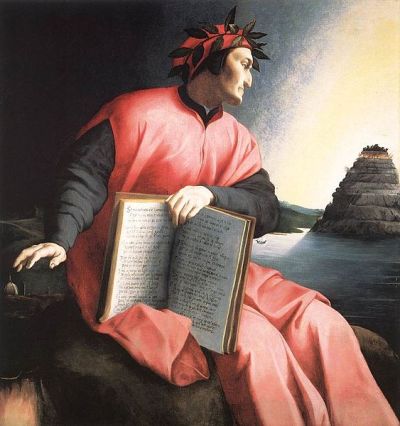
Allegorical portrait of Dante, Agnolo Bronzino, c. 1530 The book he holds is a copy of the Divine Comedy, open to Canto XXV of the Paradiso.Dorothy L. Sayers produced a classic translation of Dante’s Hell and Purgatorio which is still read. The problem with media and literary journals not citing Sayers or Glasscoe, appears to be based in an institutionalised sexism which is a contributory factor in the invisibility of women editors. Evidently, The Guardian Newspaper and the Dublin library service give more attention to Sayers’ genre works than they do to her translation and other works.
It does not seem to pose great difficulty for male editors and writers to consistently cite what they feel are the definitive texts when the writer happens to be a dude. I believe that women editors and writers must begin to cite the works of women when quoting classical works of literature. If nothing else it may help those women journalists who seem incapable of taking women’s literature seriously.
Note : Recent attacks on Dante’s Commedia delineated in this article show a lack of critical discernment and appreciation by those who would chose what anyone may read.

Some related texts
-
Chaplet
I.
A conversation among trees
I cannot hear what they are saying, that young girl and the tree,
their whispers are intimate, ceaseless.I am sunk into a conifer hedge, tamped into a wall,
threaded into the blue ivy.This is a warm chaplet against the rain,
I would lie here if it wasn’t for the sky—the sky will not skew to my vision,
body conspires with green-leaf to thrust me forward
II.
Bower
I am become aware that it is time for this to cease,
a mead of daisies whiten on the windward side
of a grove. Trees,
daisies, are blown white beneath a silver beech.Those hues balance
for once —And,
and If I step at once from the shelter of this close bower,
will I hold?© C. Murray

The image Chaplet is by Alice Maher and is used for this poem courtesy of Alice Maher and the Green on Red Gallery, Dublin, Ireland.
Chaplet © C Murray
-
An Mhurúch san Ospidéal
Dhúisigh sí
agus ní raibh a heireaball éisc ann
níos mó
ach istigh sa leaba léi
bhí an dá rud fada fuar seo.
Ba dhóigh leat gur gaid mhara iad
nó slaimicí feola.‘Mar mhagadh atá siad
ní foláir,
Oíche na Coda Móire.
Tá leath na foirne as a meabhair
le deoch
is an leath eile acu
róthugtha do jokeanna.
Mar sin féin is leor an méid seo,’
is do chaith sí an dá rud
amach as an seomra.Ach seo í an chuid
ná tuigeann sí —
conas a thit sí féin ina ndiaidh
‘cocs-um-bo-head’.
Cén bhaint a bhí
ag an dá rud léi
nó cén bhaint a bhí aici
leosan?An bhanaltra a thug an nod di
is a chuir í i dtreo an eolais —
‘Cos í seo atá ceangailte díot
agus ceann eile acu anseo thíos fút.
Cos, cos eile,
a haon, a dó.Caithfidh tú foghlaim
conas siúl leo.’Ins na míosa fada
a lean
n’fheadar ar thit a croí
de réir mar a thit
trácht na coise uirthi,
a háirsí?© by Nuala Ní Dhomhnaill, all rights reserved. from The Fifty Minute Mermaid (Gallery Books, 2007)
Thank you to Gallery Press for allowing me to use this poem to celebrate Irish Women’s Poetry and translation on International Women’s Day 2012. The English translation of the poem is here.

Clonfert Cathedral mermaid by Andreas F. Borchert -
Post is a Review of Poetry Studies from the Irish Centre for Poetry Studies at the Mater Dei Institute , Dublin City University (D.C.U). The third issue of Post was launched this week, there is .pdf copy available to interested readers now available online, I have linked it at the base of this piece.

In Michael Hind’s editorial, Post III, and the poetry of sport sets the framework for the third issue, and puts some difficulties with it into their proper context. Contributors are Katelyn Ferguson on (Brendan) Kennelly on and off the blocks , Jonathan Silverman ‘trackside vigilance’, Christodoulos Makris , Stephen Wilson, Niall Murphy, Roy Goldblatt, Alexandra Tauvray, Ian Leask, and there’s even a review by me about Jeet Thayil’s selection of Contemporary Indian Poets for Bloodaxe.
Christodoulos Markis’ read from Spitting Out The Mother Tongue on the evening of the launch, and the poems are available in the Post III .pdf , Christodoulos’ blog is here . The above image is by Derek Beaulieu, I am also linking to his blog .
My contribution to Post III was to look at editor Jeet Thayil’s The Bloodaxe Book of Contemporary Indian Poets. I greatly enjoyed his approach to it’s editing which was of a non-chronological construction and was well-populated with women writers , who have stepped from behind the classical Indian constructs of beauty and silence to speak at last. I hope Jeet likes the review, as I have sent it to him (with some trepidation). Two of the women from the Bloodaxe Book of Contemporary Indian Poets have appeared on the pages of Poethead before now. I am linking Imtiaz Dharker’s site , as I have become incredibly fond of her writing as a result of the introduction she received in Jeet Thayil’s book. My review is on pages 130-134 of Post III.
,/tr>
I am adding here an excerpt from Imtiaz Dharker’s Living Space , Into this rough frame,
someone has squeezed
a living spaceand even dared to placethese eggs in a wire basket,fragile curves of whitehung out over the dark edgeof a slanted universe,‘Living Space ‘ , image and poem by Imtiaz Dharker.Poetry by Imtiaz Dharker is available at her website , and linked in at Poetry international Web . Thank you to Jeet Thayil who contacted me about the review of his book, and who appreciates my emphasis on the women poet’s emergence from behind the classical ( and often constructed) representations of women. I have published a brief link to Dharker before now, here.. -
Fable
When I look back I seem to remember singing.
Yet it was always silent in that long warm room.Impenetrable, those walls, we thought,
Dark with ancient shields.The light
Shone on the head of a girl or young limbs
Spread carelessly. And the low voices
Rose in the silence and were lost as in water.Yet, for all it was quiet and warm as a hand,
If one of us drew the curtains
A threaded rain blew carelessly outside.
Sometimes a wind crept, swaying the flames,
And set shadows crouching on the walls,
Or a wolf howled in the wide night outside,
And feeling our flesh chilled we drew together.But for a while the dance went on–
That is how it seems to me now:
Slow forms moving calm through
Pools of light like gold net on the floor.
It might have gone on, dream-like, for ever.But between one year and the next – a new wind blew?
The rain rotted the walls at last?
Wolves’ snouts came thrusting at the fallen beams?It is so long ago.
But sometimes I remember the curtained room
And hear the far-off youthful voices singing.Oh Cherry trees you are too white for my heart
Oh Cherry trees you are too white for my heart,
And all the ground is whitened with your dying,
And all your boughs go dipping towards the river,
And every drop is falling from my heart.’Now if there is justice in the angel with the bright eyes
He will say ‘Stop!’ and hand me a bough of cherry.
The bearded angel, four-square and straight like a goat
Lifts a ruminant head and slowly chews at the snow.Goat, must you stand here?
Must you stand here still?
Is it that you will always stand here,
Proof against faith, proof against innocence?Oh Cherry Trees You Are too White For My Heart, from Fourteen Poems, by Doris Lessing.
Oh Cherry Trees You Are Too White For My Heart and Fable, two Poems 1959 © Doris Lessing are reprinted by kind permission of Jonathan Clowes Ltd., London, on behalf of Doris Lessing.
.
-
Adrienne Cecile Rich has been nominated for the 2011 National Book Award , so no better time to link to her opus. Adrienne is 82 years old and a poet of force. I thought to add a poem and biography here to celebrate.

Adrienne Cecile Rich, pic from Google images/JWA Diving Into the Wreck by Adrienne Cecile Rich.
First having read the book of myths,
and loaded the camera,
and checked the edge of the knife-blade,
I put on
the body-armor of black rubber
the absurd flippers
the grave and awkward mask.
I am having to do this
not like Cousteau with his
assiduous team
aboard the sun-flooded schooner
but here alone.There is a ladder.
The ladder is always there
hanging innocently
close to the side of the schooner.
We know what it is for,
we who have used it.
Otherwise
it is a piece of maritime floss
some sundry equipment.I go down.
Rung after rung and still
the oxygen immerses me
the blue light
the clear atoms
of our human air.
I go down.
My flippers cripple me,
I crawl like an insect down the ladder
and there is no one
to tell me when the ocean
will begin.First the air is blue and then
it is bluer and then green and then
black I am blacking out and yet
my mask is powerful
it pumps my blood with power
the sea is another story
the sea is not a question of power
I have to learn alone
to turn my body without force
in the deep element.And now: it is easy to forget
what I came for
among so many who have always
lived here
swaying their crenellated fans
between the reefs
and besides
you breathe differently down here.I came to explore the wreck.
The words are purposes.
The words are maps.
I came to see the damage that was done
and the treasures that prevail.
I stroke the beam of my lamp
slowly along the flank
of something more permanent
than fish or weedthe thing I came for:
the wreck and not the story of the wreck
the thing itself and not the myth
the drowned face always staring
toward the sun
the evidence of damage
worn by salt and away into this threadbare beauty
the ribs of the disaster
curving their assertion
among the tentative haunters.This is the place.
And I am here, the mermaid whose dark hair
streams black, the merman in his armored body.
We circle silently
about the wreck
we dive into the hold.
I am she: I am hewhose drowned face sleeps with open eyes
whose breasts still bear the stress
whose silver, copper, vermeil cargo lies
obscurely inside barrels
half-wedged and left to rot
we are the half-destroyed instruments
that once held to a course
the water-eaten log
the fouled compassWe are, I am, you are
by cowardice or courage
the one who find our way
back to this scene
carrying a knife, a camera
a book of myths
in which
our names do not appear.
This poem is for lovers of poetry, for those who read women poets and wonder at the gender-imbalance in literary publication. I have decided to keep it simple and to add my favourite Rich , alongside a reading list. This site has always been about encouraging poetry writers and readers to research books that they enjoy and bringing the amazing words of women writers into view. We have a visibility issue which is deeply questionable in my view. There are now 62 Saturday Woman Poets published here since 2008.
Link Bibliography for Adrienne Cecile Rich.
- Arts Of the Possible , Essay and Conversations of Adrienne Cecile Rich http://www.powells.com/biblio/1-9780393050455-6
- National Book Award http://www.boston.com/ae/books/articles/2011/10/12/adrienne_rich_among_national_book_awards_finalists/
- Wikipedia: http://en.wikipedia.org/wiki/Adrienne_Rich
- Jewish Women’s Archive: http://jwa.org/encyclopedia/article/rich-adrienne-cecile
The Poem Read by Rich.
-
It’s What You Put Into It
For Grace
On the last day of term
you brought home a present,
placed it under the tree,
a light, chest-shaped mystery
wrapped in potato stamped paper
intricate with angels and stars.
Christmas morning
you watched as we opened it,
cautious not to tear the covering.
Inside, a margarine tub, empty.
Do you like it? eyes huge.
It’s beautiful.
What is it, sweetheart?
A box full of love, you said.
You should know, O my darling girl,
it’s on the dresser still
and from time to time, we open it. Kate Dempsey’s poetry is widely published in Ireland and the UK including Poetry Ireland Review,The Shop, Orbis and Magma. She won The Plough Prize and has been shortlisted for the Hennessy Award for both poetry and fiction. She was selected to read for Poetry Ireland Introductions and Windows Publications Introductions, as well as at various arts and music festivals with the Poetry Divas. She is grateful for bursaries received from the Arts Council, Dublin South County Council and Kildare County Council. Kate blogs at Writing.ie and Emerging Writer. You can catch her on Twitter at PoetryDivas.
 Reviewed here, The Moth Collection, Little Editions
.
Verbatim
” i.m Barbara Ennis Price
It’s all the fault of the British, she said.
The cursing came in with the troopers,
the other ranks and their wives as bad.
Before that, we Irish never swore.
No curse would pass our tender lips,
no drop of whiskey,
no beatings, no casual cruelty.
Sure, weren’t we a gentle race
until the squaddies boated in?
We were milk and honey,
the soft heads of babes, the pigs at Christmas,
root vegetables and stone walls.
What did we have to swear about
until the British came?”
© Kate Dempsey -
” I give my indulgence – and- I am not the only one – and approval to those who wear the colours of their survival, the signs of their activity into the arena. Too much courage has shone among the female kind, and for too many years, for women, under the pretext of loyalty, to break the contract they signed with beauty. ” ( trans, Matthew Ward)
Alix had done the unforgivable and looked her age, which to the women in Colette‘s milieu was just plain wrong, Alix was not however invisible, nor was her experience –
I wonder at the literary year 2010- 2011, and those lists which include the Forward Prize, the New Yorker Magazine , the TLS and others whose editors seem to imagine that we will be distracted by Franzen’s glasses, or depth literature and angst from male writers, that do not and cannot ever write from the perspective of the woman’s relation to her body, to cosmetics, to pressing issues such as covering, torture, unfair imprisonment. The historical lessons learned about female voice and experience must be re-learnt for another generation of women, and indeed men.
There is just one other excerpt from Colette’s oeuvre on this blog, and it is about her own childhood, her unique relation to words and her development as a woman writer. I am inserting it here and as I do, I wonder at those people who would deny the veracity of female education and literary writing because : it is not male. What a bunch of codswallop to expect a great writer like Houellebecq ( whose description of a forty year old vagina in Atomised is clearly exterior to his understanding) to actually get into the head of that woman whom he writes so beautifully. He cannot, he can only describe outsides.
Colette , from Alix’s Refusal.
” But it’s my real face!” No. Your real face is in the drawer of your dressing table, and sadly enough, you have left your good spirits with it. Your real face is a warm, matte pink tending toward fawn , set off high on the cheeks by a glimmer of deep carmine, well blended and nearly translucent – which stops just under the lower eyelid, where it disappears deep into a bluish gray, barely visible, spread up to the brow; the thick eyebrow, carefully drawn out at the end, is brown like your thick curling lashes between which your gray eyes look blue.”(trans, Matthew Ward)
.
And yet our lists have been dominated by male writers, more so these two years than in any others. I wonder do the publishing industry remark upon the absence of women literary writers and poets from lists, or maybe they expect that we are all gender-neutral ? What matter to them if the voice of the female rape or torture victim is written by a man who has not the experience of (for one) sexual discrimination as part of his experiential approach to his work ! See here and here .
.
I am going back to reading Colette, to Carter, to West , to Weil, because these women writers resonate with me. Weil’s essays on affliction could be proofs for Colette’s Alix, though, without the emotional or philosophical depth. But we do not ask for depth amongst Colette’s heroines; the pearl-stringers, the corset-makers, the concubines, the show-girls or the bored, endangered and eternally restive wives of small-business owners. What a carnival of grotesques would occur if literature and poetry, being male-dominated, tried to write these women. Publishers assume that this is where the market is and by default those books furnish the halls of academia, making tokenism and or specialisation the provenance of the endangered female writer.
.
Alix’s crisis is of discouragement , a ‘déflouquement,’ (Rabelais), I wonder what kind of crisis has to be provoked in publication to avoid this type of statement from Peter Stothard :
.“The TLS is only interested in getting the best reviews of the most important books,” and “while women are heavy readers, we know they are heavy readers of the kind of fiction that is not likely to be reviewed in the pages of the TLS.”
Quite. Clearly Peter Stothard does not recognise women’s contribution to the literary canon, no more than VS Naipaul ! But it’s always been about the market and for some reason publishers do not get that women are highly educated and whilst enjoy fluffy novels sometimes, we expect a bit more choice in our reading than to bombarded with depth interviews with literary giants and more dedication to bringing forward the female voice. Thanks, I am adding my refusal, my discouragement to my heroine’s.
My Mother’s House and Sido, by Colette. Originally : La Maison de Claudine , 1992 . Sido , 1929
http://poethead.wordpress.com/a-list-of-poets-from-poethead/
excerpts from The Collected Stories of Colette, Vintage Classics 2003.

 Chris Murray