• chris murray
  • journals – bibliography – publication notes
  • downloadable items – essays – media
  • copyright
  • Home

Chris Murray

  • More Iranian Women Poets: Shahnaz A’Lami.

    June 12th, 2008

    I have put two posts on the blog with poems by Farideh Hassazadeh (Mostavi) So today I was looking at other Iranian Women writers and found a beautiful looking poem by Shahnaz A’Lami.

    I say ‘ beautiful looking’  as I cannot read the Original Persian, but  I have seen an English translation . The subtitle of this site is Words and Alpha-bets with categories and sub-pages on imagery /vision/war and women’s work. It may sound wholly naive to admit that I like the shape of a poem or the graceful words that form that shape, but it is also true. I am fascinated with alphabets, maybe more so than with the languages they form. In Ireland  now, we hear many languages on the street and in the schools.Many types of music and poetic forms  too. I like that.

    I am putting a link to Shahnaz A’Alami’s Poetry and those of other contemporary Iranian Women Writers in the right hand Column , under Contemporary Iranian Women’s Poetry

    • Sonnet link Shanaz A’ lami
  • “The Fountain” by Denise Levertov.

    June 10th, 2008

    Don’t say, don’t say there is no water
    to solace the dryness at our hearts.
    I have seen

    the fountain springing out of the rock wall
    and you drinking there. And I too
    before your eyes

    found footholds and climbed
    to drink the cool water.

    The woman of that place, shading her eyes,
    frowned as she watched-but not because
    she grudged the water,

    only because she was waiting
    to see we drank our fill and were
    refreshed.

    Don’t say, don’t say there is no water.
    The fountain is there among it’s scalloped
    grey and green stones,

    it is still there and always there
    with it’s quiet song and strange power
    to spring in us,

    up and out through the rock.

    by Denise Levertov.

    This poem was sent via Chaikhana, One of my favourite poems is ‘Your Childhood in Menton’, by Federico Garcia Lorca- published in ‘Poet in New York‘.


  • ‘Sculptor’ By Sylvia Plath.

    June 8th, 2008

    Dedicated by the Author to Artist Leonard Baskin.

    To his house the bodiless
    Come to barter endlessly
    Vision, wisdom, for bodies
    Palpable as his, weighty.

    Hands moving more priestlier
    Than Priest’s hands, invoke no vain
    images of light and air
    But sure stations in bronze, wood, stone.

    Obdurate, in dense-grained wood,
    A bald angel blocks and shapes
    The flimsy light; arms folded
    Watches his cumbrous world eclipse

    Inane worlds of wind and cloud.
    Bronze dead dominate the floor,
    Restive, ruddy-bodied,
    Dwarfing us. Our bodies flicker

    Toward extinction in those eyes
    Which, without him, were beggared
    Of place, time and their bodies.
    Emulous spirits make discord,

    Try entry, enter nightmares
    Until his chisel bequeaths
    Them life livelier than ours,
    A soldier repose than death’s.

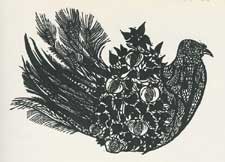
    Leonard Baskin’s art is on the Sibyl’s and Oracles page :’The Matriarchs’ and his ‘Abundant Bird’ is on the threads for Saturday Woman Poet. Sylvia Plath‘s ‘Purdah’ is mentioned in relation to The Restored edition of Ariel. ‘Sculptor’ is published in ‘The Collected Sylvia Plath’, Faber and Faber.

  • “An t’Éan Cuaiche” by Máire Nic Mhaoláin.

    June 6th, 2008

    Mhotaigh an scamallamán an teas
    trí chlúmh scáinte,
    Is scáil ghreine is scáth faoi seach
    sa duilliúr séimh,
    is siosarnach ghaoithe sa ghiolcach,
    is ceol srutháin faoi.
    Rith driuch fionnaidh tríd
    -bhí rud deoranta sa néid leis!
    Thar dhuibheagán an spáis
    is dhiamhair na gcianta
    tháinig an treoir
    Trí dhamha na réaltaí
    tríd an aigéad dí-ocsairíbeanúicléascach,
    ó aigne an Dúilimh,
    scairt an dúchas.
    Dhronn sé a dhroim íogair, cigilteach
    gur ardaigh an rud deoranta
    thar bhéal neide arnach.
    Plab!
    ón gcoill chraobhach
    tháinig guth a mháthar
    mar abheadh sí ag sclogaíl ghaire,
    agus glao na gcuach fireann ina diaidh.
    Shoiprigh sé é féin sa nead.
    Is chonaic an Dúilleamh
    Corp an ghealbhain
    Ag imeacht le sruth.

    Abundant Bird, Leonard Baskin.

  • Charlotte Salomon: Painter.

    June 5th, 2008

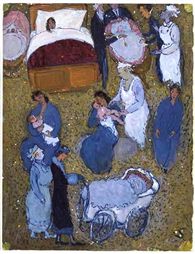
    The above image is by Charlotte Salomon, it came  courtesy of Susan V Facknitz who loves the work. The original conversation was about sibyls and oracles and the work of engagement by post-holocaust writers and poets.

    There are a few such artists and writers on the site, those would include: Nelly Sachs, RB Kitaj, Leonard Baskin , Simone Weil, and Paul Celan, whose lives and works formed a critical engagement with the Shoah.

    The image on the Sibyls page is of The Matriarchs by Baskin, whose work on women , on Judaica, on war and on poetry inspired a generation of writers – not least of whom was Sylvia Plath whose poem about Baskin’s  studio and disembodiment is in The Collected Sylvia Plath, Faber and Faber.

    Sylvia Plath’s Sculptor , excerpted here :

    “To his house the bodiless
    Come to barter endlessly
    Vision, wisdom, for bodies
    Palpable as his, and weighty.

    Hands moving move priestlier
    Than priest’s hands, invoke no vain
    Images of light and air
    But sure stations in bronze, wood, stone.

    Obdurate, in dense-grained wood,
    A bald angel blocks and shapes
    The flimsy light; arms folded
    Watches his cumbrous world eclipse”.

    (Sculptor , to Leonard Baskin, by Sylvia Plath from The Collected Plath, a Faber edition)

  • Earth Caves and Such.

    May 28th, 2008

    I was reading a translation of the Old English ‘A Woman’s Lament, from a book of translations by Burton Raffel: ‘Poems and Prose from the Old English‘.

    It is written in the Woman’s voice and from experience of the inner exilic condition (possibly imprisonment):

    ‘The valleys seem leaden, the hills reared aloft,
    And the bitter towns all bramble patches,
    Of empty pleasure. The Memory of parting
    Rips at my heart. My friends are out there,
    Savouring their lives, secure in their beds.
    While at dawn, alone, I crawl miserably down
    Under the oak growing out of my cave’.

    Of course very few surviving pieces of writing are ascribed to women writers of this period and elegies more often than not were about universality of experience-rather than actual experience. It reminded me of The Antigone, or the varied harvest myths , but am not really interested in doing a thesis on that particular question at the moment.

    It’s the symbolism and the unaccomodated voice that snatches the imagination.

  • ‘Form’ by Eva Gore-Booth

    May 24th, 2008
    The buried statue through the marble gleams,
    Praying for freedom an unwilling guest,
    Yet flooding with the light of her strange dreams
    The hard stone folded round her uncarved breast.
     
    Founded in granite, wrapped in serpentine,
    Light of all life and heart of every storm,
    Doth the uncarven image, the Divine
    Deep in the heart of each man, wait for form.

    Reprinted from The Oxford Book of Mystical Verse The Clarendon Press 1917. Eva Gore-Booth (1870-1926)

    .

  • Marguerite Porret, Marguerite of Porete, and Mrs Anna Livia Plurabelle.

    May 20th, 2008

    This morning, I was up very early and drinking tea at my window with John Moriarty’s Curlew book before me. The book, What the Curlew Said, describes lightning as emanating from a cloud of ducks or rather, the author who is bodily expecting lightning instead experiences what his body had not expected, ducks landing on a mirrored lake.

    Moriarty inserted into the body of his text the following paragraph by Marguerite Porret (Marguerite of Porete),

    “Being completely free and in command of her sea of peace the soul is nonetheless drowned and loses herself through God- with him  and in him. She loses her identity, as does the water from a river- like the Ouse or the Meuse- when it flows into the sea. It has done it’s work and can relax in the arms of the sea, and the same is true of the soul. Her work is over and she can lose herself in what she has totally become: Love. Love is the bridegroom of her happiness enveloping her wholly in his love and making her part of that which is. This is a wonder to her and she has become a wonder. Love is her only delight and pleasure.”¹

    Interestingly, philosophical ideas like these are an integral part of Eckhart and in the ied in Paul Celan’s Poetry. Porete was burned at the Stake during the French Inquisition for refusing to disclaim her book. Maybe the Inquisitors thought to meet her elemental dissolutions, in this case: Water, with their holy fire?  Happily, we have evolved since then, although unlike Eckhart, Porete was never posthumously rehabilitated from her excommunication, nor did anyone apologise for her torture and murder. Thus we have limited excerpts, free sites, and fought for scholarly articles: Fragments of an existence.

    I always think of Joyce’s washerwomen when I see the trees at the side of the River Liffey.  The mastery of imagery in Finnegans Wake is exposed in the beautiful Anna Livia soliloquy. If one alone reads and loses oneself in those images, it is enough. I have heard that the book is difficult, so I suggest breaking it down into small sections and thereby reading the entire.

    It is useful to compare the words of Anna Livia as she moves through her cycle, and those words written by the Beguine, Porete in 1306. I like comparative exercises. Though I find hard to believe that such ideas can be so dangerous to religious organisations.

    ¹ Le miroir des simples ames anienties et qui seulement demeurent en vouloir et desir d’amour by Marguerite of Porete.

    Additional links:

    • Marguerite Porete, Le Miroir des simples ames aneaties et qui seulement demourent envouloir et desir d’amour
    • John Moriarty ,‘What the Curlew Said, Nostos Continued’ John Moriarty .
    • James Joyce: ‘Finnegans Wake‘
    • Edit : 23/07/2012 . I am adding here a link to The International Marguerite Of Porete Society , http://margueriteporete.net/


  • Dream Machine at IMMA, Hans Christian Anderson and William S Burroughs

    May 14th, 2008

    The current exhibition of writers who do/did visual arts at IMMA is something people should  see.. and it’s travelling Europe!

    Curator Hendel Teicher has constructed an exhibiton of Paperwork by Hans Christian Anderson (1805-1875) and William S Burroughs (1914-1997).

    The basement area of the New Galleries at IMMA are given over to two major works,   ‘The Screen ‘ (Copenhagen) by Anderson and the other , Gysin/Burrough’s Dream Machine’ (1961). The Dream Machine is alone in a room, the soundtrack is of Shamanic  and Moroccan music ( I think) …..

    This  huge piece is set on an old motor with a big bulb in the centre, round  which cut-outs revolve in amber light.

    The viewer/participator goes up to the piece and standing quite closely their eyes, the  effect is tremendous.

    W.  Burroughs used it both out of his mind on drugs and clean, cataloguing the effect of His  visions from utilising the piece. It’s not as moving, say, as reading ‘Poem Rocket’  by Ginsberg or just doing the magic stuff yourself,  the effect is similar to being a kid on a moving car or in a train. I was watching people gingerly approach the piece and standing quite closely  to it with their eyes closed and mostly they had big sheepish grins on their faces when they stayed longer than a few minutes. I saw Greeny-blues and silver shapes (_ and movement_),  like moving at speed through a lit or forested landscape).

    There are vitrines on the upper floors with cut-outs  by both artists: works on paper and montages. Anderson did marvellous silhouettes of demons and chimeras, whilst Burroughs’  focus was on eye imagery (Aye).

    His 1992 ‘Creator of the Eye’ is visually disturbing, and monkeys abound on the walls. Take a look at Anderson’s ‘Two Pierrots Balancing on Swans +Two Dancers‘ , which is  of blue paper cut-outs against an album paper ground. The juxtapositions and similiarities of the two men’s expression, from differing eras and backgrounds is profound and the  well worth a visit.


    • Cut-Outs and Cut-Ups: Hans Christian Anderson and William Seward Burroughs

    Until June 29th 2008 @ The New Galleries. Irish Museum Of Modern Art.

  • “The Unnameable” by Lovecraft.

    May 11th, 2008

    There really is nowhere quite like Barcelona to sit and read horror stories. I didn’t get very far with Lovecraft ‘cos he was scary, though of a recognisable horror genre … I did not dwell long on the story, finding the atmosphere vaguely repressive and samey (everyone is after all entitled to response to literature and Poe always seems to do it best for myself.)

    But one paragraph which fell ill of old transcription propensities rang O so many bells; and has been subject of discussion in this repressive little island, and that is the subject of ‘approaches to Art’ (and artistic responsibility) .

    This short paragraph provided the preamble to the action and described the control ‘element’ in the story’s  tradition of horror..

    ‘It was his view that only our normal objective experiences possess any esthetic significance, and that it is the province of the artist not so much to rouse strong emotion by action, ecstasy and astonishment, as to maintain a placid  interest and appreciation by accurate, detailed transcripts of everyday affairs’

    I think the delineation of that character gets as close as possible to taking the absolute piss without quite losing the run of the story.

    and I gave up maybe three paragraphs later. There is a consistent fascination in us with mundanity,  but it does not make us get the bends– good writing always does that. Interesting that ‘Art’ is viewed as something separate and contained from ‘life’ . There are masters of the mundane and there are masters of astonishment, Lovecraft seemed to veer between the two without quite getting anywhere  near good scary bendy horror of the Grand Guignol type – it’d take a woman to do that.

←Previous Page
1 … 102 103 104 105 106
Next Page→
 

Loading Comments...
 

    • Subscribe Subscribed
      • Chris Murray
      • Already have a WordPress.com account? Log in now.
      • Chris Murray
      • Subscribe Subscribed
      • Sign up
      • Log in
      • Report this content
      • View site in Reader
      • Manage subscriptions
      • Collapse this bar