-
The Beaching
The pod of whales beached themselves on Rutland Island,
chose the isolated sweep of the Back Strand to come ashore.
My grandmother in her final years would have understood.Those long-finned pilot whales suffered some trauma,
became distressed and confused. And so for her that winter
when told her grownup daughter had died suddenly.Three years later, hearing that her eldest had also
passed on threw something within her off-kilter.
Sent her mind homing towards the Back Strand.The whales had wandered together, over thirty of them,
swam through Scottish waters to the Sound of Arranmore,
heading towards the crescent of shoreline and their ending.She would have understood, the Rutland-born woman
who had long left the island but yearned for that place; called
for it constantly, rose from her sickbed in the middle of the night.I need to go now. They will be waiting; it will soon be low tide.
She wanted to journey, follow those already gone,
float ashore, let grief beach her there on the Back Strand.
Crockery
An off-white cup with three blue stripes,
soggy tea leaves sunk into the last sup,
a side plate coated in brown toast crumbs,
knife with the blade splattered in butter
and red homemade jam, a sugared teaspoon.
Mum had placed them all on the plastic
drainer at the sink, beside my cereal bowl
with the remains of floating cornflakes.
We hurried out of the house silently,
as Dad and all the rest still slept upstairs.
The plan was to stop for Mass and a cuppa
in Monaghan, lunch would be in Dublin,
dinner with my uncle, aunt and cousins.
A whirl of women rushed in that afternoon,
hoovering, washing, tidying, for her wake.
The cup, the side plate, the knife, the spoon,
were scrubbed clean of her touch, placed
with the ordinary crockery in the cupboard.
Becoming Shepherds
The morning of our anniversary, and we are out
on our lawn in Ramelton. The freshness of air
has shocked me awake. My shoes and the ends
of my jeans are drenched from the dew.
7 a.m. Facing the Lennon in glorious light,
low tide has sanderlings on the salt-water banks.
All around us are sheep munching for all
they are worth. We don’t know what they are worth,
who owns this flock, where they came from,
how they came to stake a claim here; chomping bushes,
pulling leaves and leaving their mess everywhere.
Laurence laughs, little did we think…
This morning thirty years ago, my sister began
the wedding preparations. I remember leaving home
with my father, being driven in a white Mercedes,
the walk up St Eunan’s aisle, Laurence at the altar.
The line of a reading; let us grow to old age together
as sunlight streamed through stained-glass windows.
In sickness and in health, I never imagined us
surrounded by sheep; never saw us as shepherds.
I picture sheepdogs chasing them on vast fields.
There are fifty or more here, we’ll be working all day.
Then Laurence shouts. They run from all corners,
head in single–file down the grassy slope of the hill.
Now I see the truth in the cliché, as we follow them.
The air is filled with the sound of their bleating
and I am caught by the strangeness of it all.
Last month our youngest left home for University,
moving from rural Donegal to Halls in the city.
I hadn’t realised just how rural we are.Laurence hands me a stick, says stand there
so they don’t run past us. Neither of us know
what we are doing or where the sheep will go.
He whistles and like a scene from a dream,
they run to one place, rush over the bank,
onto the shore, down across the sandbar,
around the inlet’s corner, along the river’s flow.
Over fifty, in a long line, one following the other
like days following days, years following years,
until you wonder how it all passed so quickly.
Against Words
I’m opposed to words:
I told you so words,
You’ll get over it words,
When I was your age words,
That’s not the way it’s done words,
Welcome to my world words
I’m opposed to the words:
You still have your health
It’s only a job, it’s only a house
You’d need to pull yourself together
My cousin’s boyfriend’s sister had that
Sure, that’s nothing to be worrying about
Everything happens for a reason
Someday you’ll look back on this
It could be worse
You shouldn’t have
Why didn’t you
If I were you….
I’m opposed to them all. Give me
the silence that says: I’m listening.
Mother Goddess
Demeter: mother of Persephone, goddess of the harvest
and the cycles of life. The Universal mother whose daughter
went missing; who did not drink, eat or bathe until she found her.
Mother of grain and crop, the bountiful gift, blessings on
those who looked after her own. The curse of unquenchable
hunger on those who brought harm to the ones she had borne.
Mistress of the home, producer of life, she sent her cubs
through a darkened cave into immortality and a blessed afterlife.
As it was with her, it was with my grandmothers and my mother.
Good mother, blessed mother, working mother, fairy godmother.
Guardian angels; tooth fairy, baker of birthday cakes, lovelorn healer,
soother of hot fevers, stitcher of torn hems, night-time story teller
who taught us how to walk, talk, sing, dance, cry a river and then smile.
Mother Nature full of fresh berries, wild roadside flowers, lilac
filled fields. A lioness, black bear, white vulture, all-present mother.
Watch over my clan, watch over their future, watch over their care.
The Goddess mothers: Anu, Gaia, Toci, Rhea, Durga, my own;
a Cailleach and Bríghde, Glinda the good witch, moody woman, crazy
kitchen-dancer. Mommy, Mummy, Mum, Ma, Granny, a Mháthair.
Creator of cycles, unconditional love and hurricanes. The core of peace.
Give me guidance, nourishment and strength. Help me to hold on
and let go, be present and absent, wise and foolish, the past and future.
Help me to be the mother my own sons need, the person they will cherish,
and the woman who will warm a hollowed soul in those who need a mother.The Beaching and other poems © Denise Blake
 Denise Blake’s third collection, Invocation was published by Revival Press, Limerick Writers Centre. Her previous collections, Take a Deep Breath and How to Spin Without Getting Dizzy, are published by Summer Palace Press. Denise is a regular contributor to Sunday Miscellany RTE Radio 1. She has wide experience of facilitating creative writing workshops in schools through Poetry Ireland Writers in Schools Scheme, with teachers and artists as part of Artists in Education, CAP Poetry in Motion and with a variety of adult groups.
These poems are published,
Invocation, Revival Press, Limerick Writers Centre
The Beaching – The SHOp magazine of poetry, Numéro Cinq – Uimhir a Cúig
Becoming Shepherds – Sunday Miscellany
Mother Goddess – North West Words magazine, Numéro Cinq*useful links
www.deniseblake.com
http://www.limerickwriterscentre.com/books/invocation/ -
Excerpts from microliths by Paul Celan
translated by Pierre Joris
____________ [These are Celan’s first notes toward the conference project “On the Darkness of Poetry” which remained unfinished.] Pjoris 240 240.1 || Mysticism as wordlessness Poetry as form 241.2 The poem is inscribed as the figure of the whole language, but language remains invisible; what is actualizing itself — language — steps, as soon as it has happened, back into the realm of the possible.“Le poème,” writes Valéry, “est du langage à l’état naissant;” /“Poetry,” writes Valéry, “is language in the state of being born;”/ Language in statu nascendi, thus, language freeing itself. 241 241.1 Yesyes, not only the Geiger-, the “syllable-counters ” too, though despised by a literature that calls itself engaged, register something. ———————————— ↑ → 241.2 aesthesis is not enough; the … ;noesis is not enough; … ; what’s needed is personal presence, what’s needed is conversation; conversation and entertainment are different things; conversations are demanding, straining. 241.3 ——–——– Idea of the bracket (voicedness) syncope also the this vibrato of the words has se- mantic relevance 241.4 ______ The poet: always in partibus infidelium 241.5 ______ Das Kampaner Tal, p. 51, footnote: ↓ ||... “as on the Jews’ houses (in memory of ruined Jerusalem), something always has to be left unfinished.” to remember in the poem — remembrance as absence — 241.6 Language planes || Nationallibr.: Bühler — 241.7 ______ No syllogistic enriched with this or that theory of association, no logistic will ever be able to do justice to the fact of “poem” — the alleged thought- or language-scheme of the poem is never “finished.” ______ 241.8 syntactic (and other!) bracketings ______ 241.9 Oppositeness? ______ 241.10 Multivocity ______ 241.11 139. Psalm: nox illuminatio mea ... darkness is like the light 246 246.1 an uneasiness similar to that in “Lyrik-Dichtung) relation to the word → “Schrifttum / literature” The uneasiness Lyrik (which Heine the progress therein uses…) Tension between Lyrik = DichtungQuestionsLyric Poetry “Problems ofPoetry”246.2 We live in a brightly lit time, a time that illustrates everything; lyric poetry has a cosmopolitan trait: “Felice notte!” our so beneficially contradictory god poetizes. Benn… 246.3 _______ The secret marriage the word contracts in the poem with the real and the true is called “wild” mainly by those who do not want to forgo their lushly comfortable, well-guarded culture-harem and — especially — the eunuchal services that come with it. (Poetry certainly does not threaten this seraglio with any kind of abduction) 246.3 The — oh so wordily lamented — loss of tradition: the legitimism of those who “legitimize” themselves everywhere, so as not to have to justify themselves to themselves.
Excerpts from Paul Celan’s microliths (I) 162.1 It is part of poetry’s essential features that it releases the poet, its crown witness and confidant, from their shared knowledge once it has taken on form. (If it were different, there would barely be a poet who could take on the responsibility of having written more than one poem.)
162.2
—Poetry as event
Event = truth (“unhiddenness,” worked, fought for unhiddeness)
Poetry as risk
Creation = /poweractivity /Gewalttätigkeit (Heidegger)
Truth ≠ accuracy (i: consistency)§ Read at Excerpts from Paul Celan’s microliths
Further excerpts from Paul Celan’s microliths (II)
22 Hermeticism—
Certain “citizens” and the poem: They buy the surprise bag; one knows vaguely what’s in it, it won’t be much, but then it doesn’t cost much either, and if one happens to visit the fair and one has enjoyed the lady without lower- but with upper body, one’s amusement also demands this. And when what’s in it turns out — but here too the buyer’s superior humor can prove itself — to be even cheaper than cheap, there still remains the fun that all of that was “too.

§ Excerpts from Paul Celan, Microliths. These translations are © Pierre Joris
-
Home
I rub, and RUB my eyes;
Ferocious;
Don’t,
Don’t, sweetheart.Then the plane tips toward the cool thick Irish sea
So that I can face it
Gaze into it
From my seat.
Home!Clouds bubble over the razor wings
The light jumps into my tired gaze.
Home!Steel
There must be steel in women
Who say no.
I am made of utter fudge
Compelled, somehow, to reply and smile
And be grateful for the fleeting interest.This is exactly the kind of thing
A better me
Would never do.August
I have never been so hollow
I will never be so hollow
I just felt so hollow
When I refused to fix it
When you left that city a day too early
When you cried to your mother on the phone
She doesn’t even know me
I wish I could tell her I was sorry.Stucco
I want to build
I want to – I need to restructure
Gut my foundations
Cut into the old black brick below me
Throw it out onto the road –Let the neighbours have a look.
Let the dust cough up until
The air is easier to breathe.All I can do
Is cover with stucco.Since She Did That
Since she did that
We can’t walk through rivers the same way,
You know?
Hand in hand?
Guessing for the soft shells and pebbles
And hoping not to cross sharp rock.Since she did that
I don’t reach for her if I slip on the sloppy moss
I don’t shriek her name, laughing, while I crash underwater
I don’t grasp at her as we splash to the other sideWe just cross it
Together, and smiling, don’t worry –
But we cross it
Alone.2am
Why do I turn inside out and back again
And then!
Back AGAIN!
AT TWO AM!
Reading messages you last checked
In 2017.Since She Did That and other poems are © E.D. Hickey
 E.D. Hickey is twenty-four and living and studying law in Dublin. She most recently spent half a year in Vienna, Austria working for the United Nations and graduated from UCD Law with Philosophy in 2017. While at university she recorded, edited and produced a feminist discussion-panel podcast called Pink Void (episodes available on Soundcloud) with two friends.
 -
Shell shock
He built his laftehus in the old way,
As it should be done, using cured wood,
Beam on tremendous beam, an X joint
With interlocking notches at the seam.
Sweating over plans, permits, rights of way.
Helicopter drops in snow, cajoling
The bureaucrats, architects, authorities.
His wife, to just let him get on with it.
A truffle hog, he sniffed out each stick, churn
Implement, coaxing farmers, dealers,
Collectors to part with their cherished pieces
For him to enshrine in his sacred wooden space.
In the hard work it took to fell trees, drag them,
Haul them across the forest, dig foundations,
And shape the beams, he buried some memories.
Then he nailed a few more into the walls.
You can hear him up there still, pottering, fussing
By the woodpile, stacking tins of condensed milk,
Cod roe from Svolvær, provisions to last him
Until he is forced to cede to a new generation.
Already they come, screwing up his systems,
Logging their jaunts in his cloth-bound cabin book.
The shrieks of their blueberry-trampling children
Irk him as he reads his National Geographic.
Alone at night, calm from the cold earth seeps
Up through the well-crafted floorboards,
Contrives to soothe his shell-shocked sleep,
In the one place where he could find peace.
Only the pine marten, the snowy owls, the rut
Of elks to disturb him, at dawn mist clears slowly
As goats file past the stone steps to his door.
Outside, fjord and sky, ready to do his bidding.
Poetry Ireland Review (No 122, 2017)
Treacle
Tunnelling through treacle, trying to place –
To remember – a flat in Dublin,
In Baggot Street (or was it Portobello?)
On a June evening when we were young.
A room with a cracked ceiling in the flat
Of a friend, someone you knew in Harold’s Cross
Or somewhere around that part of the city
It was a balmy night and I saw the stars
From the open window of that dim room.
How could that have been possible?
With all the city lights reflected in the sky
Above that space, with its cistern crooning.
Nothing else sang. There were no nightingales.
No square below. But we had the stars.
We didn’t dwell on them, being young
Was enough for us on a June night.
You went out for fags. We all smoked then,
Finding a place that was open until 2 am,
Long before all-night petrol stations,
Back in half an hour to that crooked couch.
There was a fruit bowl on the kitchen table
With nothing in it. Apart from one rotting core.
There must have been a drip, the failing drone
Of a fly trapped somewhere in that flat.
It may have been near the Bleeding Horse,
Or The Barge. The crash of beer bottles,
Shouts, jeers, the crack of a broken nose,
Engines running into the jitters of dawn.
(Crannog Magazine)
Viksdalen
The deer caught in the headlights
On one late, last November evening,
The river running on as we stare
at the old television set reflect the fire
from the stove crackling against the cold.
The dusty surfaces we were never to disturb.
Instead, we sit draped, shrouded in silence
until an unexpected neighbour calls in with lefse.
Arriving by bicycle from the farm on the hill.
Warrior-like, hardy. She is the last of the Mohicans.
Rising at five to make dough for the long day’s
bread, sprinkling sugar on the unleavened treat.
She won’t change her habits until they carry
her down to be buried in the same graveyard
where your forebears lie. Isak, Magnus and Signe.
I am homesick for Viksdalen, sick for a home
That ever was and never will be my own.
(Hennessy New Irish Writing, 2014)
Vera
Up on the roof of the house,
Perched, or is it mending
The thatch before nightfall?
A step ladder against the gable.
Man or woman, it’s hard to say.
In a crow’s anorak, the cap a black beak.
It hardly matters now, much less to her,
She is gone beyond all that.
She’d wring a starling’s neck as quick
As she’d look at it – and often did –
Her beasts of cats trailing mangled
Trophies to her open door.
They found her outside one hard day
As darkness gathered at Leebitton
A heart attack – at eighty-six –
Emptying a hundredweight of coal.
“You can’t pick and choose,” she told me.
A flutter of the gap between hopes
And days at yarn and loom, holding out
Amid the cold stones above the sound.
I never did find out what she meant.
Promises breached, a lover lost, vicious talk
At town meetings, fences trampled down,
A much-cherished dog poisoned.
(Templar Poetry anthology Skein, 2014)
Travellers of the North
The hidden, hunted faces of the Sami,
Ripped from the blood warmth of the flames.
Their tools, their knives taken, their magic
Turned monochrome, flash-frozen to frame.
Scattered in the ash of black Novembers,
Their bones, their reindeer, their myths.
Unfolded in tapestries of colour
In lilted plumes of yoik – their lament.
Caught again as the light and dark etches
Upon the bare Kautokeino steppes.
Beautiful wild travellers of the North,
You’re crazy, you drink, and you fight.
Your spells, secret knowledge and sorcery
Waft still in the drifts of Arctic night.
Viksdalen and other poems are © Fiona Smith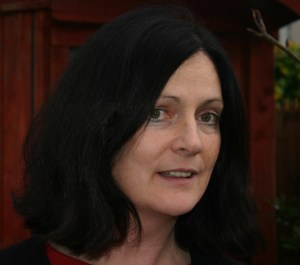 Fiona Smith won the poetry section of the 2012 Over the Edge New Writer of the Year competition. She was elected to read as an emerging poet at Cork Spring Poetry Festival 2013. She has had poetry published in Poetry Ireland Review Southword, Crannog, Hennessy New Irish Writing, The Galway Review, the Templar Poetry anthology Skein and Poetry Ireland Review (No.122).
 -
Now I am a Tower of Darkness
As a child I knew
How, beyond the lamp’s circuit,
Lay the shadow of the shadow
Of this darkness,
Waiting with an arctic kiss
In the well of the staircase,
Ready to drape the bed with visions
No eyelids can vanquish.
Now I am a Tower of Darkness © Freda Laughton from A Transitory House (Jonathan Cape, 1945).
From ‘Into the Light Blown Dark: Working with Freda Laughton’s ‘Now I am a Tower of Darkness’
Freda Laughton produced one book of poetry A Transitory House (Jonathan Cape, 1945). At the time of the book’s publication, Freda Laughton would have been 38 years old. Laughton’s chosen sphere was the female intimate, and within this context she was an expressionist of some ability. Her work presaged that of Eavan Boland and of Nuala Ni Dhomhnaill. There is a certain fragility and darkness in Laughton’s expression which imbues it with shadow. Her art was masterful, not least in the poem In a Transitory Beauty,
Maternal the shell
Cradling the embryo bird,
A transitory house,
Fashioned for brief security,
Of purposeful fragility,
A beauty built to be broken.
In a Transitory Beauty by Freda Laughton, from A Transitory House (Jonathan Cape, 1945)There is a surviving photograph of Freda Laughton, it shows the poet in three-quarter profile, she has applied fresh lipstick for the camera’s gaze, she looks content and somewhat wry. We begin to see the confident poet who had found her muse, collated a collection and was an essayist and reviewer for The Bell Magazine. These are some of the facts of her professional life that we know. Poetry is a revelatory act of participation in the world, yet unfortunately for us, Freda Laughton’s work was let slip from view. I deeply regret that I was not exposed to her work in college, or as part of my later reading and studies.
Read more at The North, Issue 61
Freda Laughton’s poetry on this siteThe North, Issue 61 was guest-edited by Nessa O’Mahony and Jane Clarke.

-
Dimples
I am the wind that sighs at night
through your bedroom window
making your lovely hairs take flight.They rest against your cheek like affectionate little arms,
and cling to your freckled flesh,
its rosy flush their one dimpled source of life.Those could be my arms, holding fast to that imperfect reservoir
into which I slip further each moment,
sliding towards that gentle dip at the centre of your smooth skin.there is one on each side,
To kidnap both mind and matter.The day I tumble into that tiny pool of love
I will drown.
and then I will float
in your falling tears that follow me downwhether those of sadness or joy, I will never know
but either will hold me captive.Colourful Language
your words are like flowers that come alive in a cold spring
shooting from the ground with a gentleness
that encumbers a hidden forcethey unearth their surroundings
and mask others with their wondrous scent
but sometimes
their beauty is only soil deepthe meaning tucked away between those pretty petals,
which sometimes are secretly colourful little blades.
they cause my heart to tremble and wither
as though it were a snowdrop made of glass,
and it will shatter.A guide to feel-good doom
Drowning in the waves of your hair
Would be a holy passing.
To flail and clutch at your neck
As breath deserts and eyes bulge
Would be a reluctant grasp at life.Smothering in the scent of your skin,
Choking on that poisonous perfume,
Would be the sweetest doom
And the most caressing of killers.Falling into the deep valley crested by your thighs
Would be a lovely tumble to a dark future,
Where the pearly gates or the flames of Hell
Are the freckles on your nose.Sleeping forever by your side
Would be a peaceful slumber.
So inflict yourself upon me
Until the Reaper hugs us both.J
Two spots of grass
and a carpet of autumn leaves on top.
A little haven of sunshine
where beautiful thoughts grow like crops.Smile basking in rays
that brighten my mind.
In a forest of towering trees,
the only one I could climb.Hands reflect heart
a touch from both makes me whole,
when your laugh lights up a room
it never forgets my soul.Crude strokes of my fingers on your face,
where worlds tease their tips.
They drag me further in each time,
and soon, happily, I will slip.Meeting Maker
I had the chance to meet Maker;
I fought it, I tried to.Their eyes grove wounds in my back,
Shaped rivers in my cheeks,
Reaching towards me with the menace of an obligatory offer.Their ritual crowded them into masses,
Into shadowy shapes
That I was scared of.
The beat of their drum to the beat of my shrinking heart,
Their grotesque form devouring its feeble fight.It stopped–
It silenced–Maker, satisfied and quenched,
Went on Maker’s way.Whole
If you try to fix it–
Well, I’d rather you didn’t.
It’s nice and impenetrable now, you see,There is no key.
Not even a door to house one.
In fact, nothing will be housed by it ever again
Shards and fragments cannot be used to build a house or a home,
Its fractured shell should simply be left alone.Oh, its fearsome, I swear!
Blood red like the mouth of a tiger
And twice as vicious when provokedIt is no longer vulnerable,
But if you want to try and approach it,
Best beware of its tendency to snap.My heart is a lone soul
And we don’t need you to make us whole.A Guide to Feel-Good Doom and other poems are © Lisa Ardill  Lisa Ardill is a twenty-something-year-old woman with a passion for feminism, human rights, neuroscience, literature and film (roughly in that order!). She writes poems and prose to entertain herself, cheer herself up on gloomy days, and keep the spark for creative writing in my brain alight.
 -
The Unfinished Poem
The house his mind once called its home
Has gaping roofs, and paint-cracked eaves,
Of forget-me-not blues
The frosted brittle skeletons of history and wit served now
As a porridge of forgetfulness, faint echoes haunt
Sweet gentle kisses of remembrance
Dementia’s wraiths roam shadowed emptied rooms,
Herald long laments for lonely roads where memories float
In space yet give no hope, no sense of place.
As Alice keeps on falling down the rabbit-holes of grief
The curtains close on last acts interrupted.
Observers weep at unfinished poems.1771 – The American Wake
(published by The Galway Review)
My firstborn child declared his independence,
Said he would choose to live, not die, by drought that stalked us all,
Or drown by workhouse shame.The death knell rang. America had called, cried freedom, hope.
He left our land, was pushed by fear, by poverty that gnawed his soul,
And pulled by hope, and images of greener lands than these.While on the hill, the landlord nodded, raised the rents
And watched our young ones leave forever, while theirs stayed safe and full
Behind closed doors in yon big houses.The winds of fear and loss drowned out the tears we cried at wakes,
Where we drank health and wealth to you, drank in your face;
No graves to visit; still, the keening echoes in my ears.That final day; that darkest morning, as you had hope held high in rags,
We walked with friends who carried heavy sighs, as I would carry now
Two worlds on shoulders, and lead in my heart.You walked the gangplank, bravely bridged the old and new,
Stood tall and waved, your long farewell that carried over waves,
And left me, as birds forsake their nest, on empty shores, bereft.February East Winds
Salt and pepper snowflakes
On hair, eyes, lips,
Eurus delivers last-gasp drama.
Frosted fingers breathe
Heartless, fierce red dawns
That slice through jackets,
Blow harsh winds bringing
Cries of Arctic terns
Huddled together for warmthTea and Sympathy
He left her fearful, lonely.
Tea and sympathy
No sweetener to
Her furious grief.Ghosts brushed past her;
Wrapped grey fog
Around her heart;
Buried it in thorns.She wakened, wrote her pain
In journals, powerful poems;
First aid to a broken heart,
First chapter of her new life.
Afterwards

She
Zipped		 her lips
With 	fine stitches;
The silent needle	 scarred.

She buried it 		deep
In the pocket 		of her handbag,
Stayed 		in her gilded cage

With a 		silent bird’s rage;
Her plumage 		a masterpiece
Masking 		her shame.
The Unfinished Poem and other poems are © Caroline Johnstone 
Caroline Johnstone is originally from Northern Ireland, now living in Ayrshire. Since 2014, she has been telling stories through her poetry, writing mainly on philosophical, political and life experience themes. She has been published in The Galway Review, Positively Scottish, The Scottish Book Trust, Belfast Life, the Burningwood Literary Journal, HCE Review, in The Snapdragon Journal, The Dove Tales Anthology, The Bangor Literary Journal and the latest Federation of Writers (Scotland) anthology Landfall. She was also shortlisted for Tales in the Forest, the Imprint Festival, and by People Not Borders.
She’s taken part in The Big Renga, a month-long collaborative poem, and was interviewed by Sara Cox on BBC Radio 2 about this. She is a Scottish Poetry Library Ambassador, a member of the Federation of Writers (Scotland), has been interviewed by children and parents in Dubai at a poetry workshop there, helps with the social media for the cross-community group Women Aloud NI, is part of the FreshAyr initiative and their poetry events, and she runs The Moving On Poetry Group weekly in Kilmarnock.
-
|The Girl in The Photograph|
I’ll take you by the hand
and show you what it’s like
to sit under neon signs
when the city goes to sleep
and you’ll have known
a little bit more
about what magic looks like
I’ll take you by the lips
and show you what it’s like
to taste the snowflakes
I caught on my tongue
and you might get to know
a lot bit more
about what dreams feel like
I’ll take you to places
you’ll forget to remember
I’ll show you things
your eyes won’t believe
until you start to wonder
if I am real;
if any of it isSo, I’ll let go of your hand
one final time
break away from your lips
one last time
wrap all the magic and dreams
around your little finger
and go back to being
the girl in the photograph
|Syria’s Daughter|
I am Syria’s daughter.
I will soon be just as forgotten as my name is.And when they come for me
rummaging through heaps of concrete,
sifting through blood and bones
looking for bodies
to add to their death toll,
tell them I tried.
Tell them I tried to live.Tell them
That I tried to breathe the poison that swirls across my country like a midsummer’s breeze
That I tried to match my heartbeat to the gunfires on the street so that I wouldn’t bite my lip
too hard out of fear
That I tried to sleep but my ears rang from the haunted screams that echoed all the way
from Damascus to Aleppo
That I tried to find a piece of land to bury my brother, his pale mouth still lined with blood
he’d been coughing for hours, but they had their guns ready for anything that moved
That I tried to shed tears when my father died in my arms but I couldn’t because my eyes
were as parched as my throat
That I tried.Tell them I tried.
Tell them I tried to live while they slashed open my land till the cracks brimmed over
with the blood of my people.
Tell them they won.I was Syria’s daughter.
Tell them that they can now have my mother.
|Victim’s Curse|
Last night
I found a girl murdered on the streets
and while her body grew cold
against the slush laden concrete
They wondered
if death had finally caught up,
having been beckoned time and again
by the dozen healed slits across her wrist
They checked
for signs of struggle
leaving room for doubt
that if she didn’t fight back
she was probably asking for it
They took
samples of her blood,
checking for drugs
because one less junkie off the streets
was no harm done
They rummaged
through her phone
looking for signs of provocation
since one shouldn’t make enemies
if they can’t afford to
They examined
the knife jutting out of her abdomen,
blood curdled around it
making sure that it wasn’t in fact her
who had somehow found a way
to twist it through her insidesLast night
I found a girl murdered on the streets
and it was sad
that I felt happy
about her not being alive
to witness that she was robbed of her life
in a world
where the tag of a victim
came with a price to be paid
and where dying
just wasn’t enough
|Serenading Through A Broken Heart|
I know now what people mean when they say that they can feel their heart breakingI know because I am breaking yours
and I can see the anguish with which
your pupils dilate when you look at me.
You unflinchingly carry the conversation on
but your voice breaks precisely eight times
in the past minute.
I try to inch my hand closer to yours
and your fingers shrink away
sensing my touch
which isn’t welcome anymore.
Your lips quiver ever so slightly
and I can hear the accusing words
that you try to hold back.
You look unchanged and unaffected
but the blood in your cheeks that
I have grown so fond of,
has slowly started to drain away.
You look away
and fixate your eyes at nothing at all,
letting your dry cappuccino grow cold
and with it,
your heartI know now what people mean when they say that they can feel their heart breaking,
because the entire time that I thought I was breaking yours, I was sucking the life
out of mine
|My Type|
He said he knew my type.He said, I was the spoilt kind
and if I slit my wrists
they would bleed out alcohol
four pints of Jameson, three of Miller Light
and ten shots of Calle 23
staining the skimpy dresses
and short skirts that I wear
to attract countless lusting eyes
in bars or the corners of dimly lit streets
where I much rather stick my tongue
down the throat of a beautiful redhead
who later finds herself in my bed
while I find myself in a white man’s arms
telling him made up stories
about the ink that I’ve used
to turn my body into an exhibit
fluttering my eyes, showing off my piercings,
teasing and taunting,
and spreading the smell of tobacco
splashed across my breath
into the many salivating mouths
that I’m too distracted to keep count
before heading back only to find
those captivating curls of red gone
and mourning her absence over
a perfectly rolled Malana
losing myself in smoke
and silhouettes of other conquests
that I allowed to get awayHe said he knew my type.
He couldn’t be more wrong.
He couldn’t be more right.|The Girl In The Photograph| and other poems are © Shreya Barua
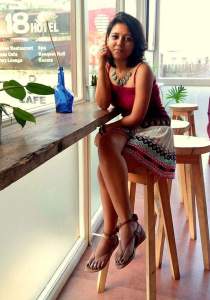 Shreya Barua is a recent Trinity postgraduate. She moved halfway across the world, from Delhi to Dublin to be able to indulge in the two things that have her heart: literature and travel. When she is not too busy daydreaming, one can find her hiking on the Wicklow mountains or sipping a glass of red by the grand canal.
 -
Fractyl Poem — Seeming, Appearance and Being
How the true was with world
Is sometimes bricked
Out with bangles,Sound and sight both alike.
Put your paint this
Side, put it thatSide, we talk a lot, like
Talkers. And face
This way, blink, brushThrough lashes, powder on
Powders, a look
For, or about,Female, they say, so too,
Some male, they say,
So too this orSewn to that. Or, some say
Wine is crossed best
In a vat, brains,Birds, nests like glowed on
Dendrytic leaves,
A state, or aSyntax, both one
And the same. Say
Most who say onWhat is seen and what is
Thought, and what it
Is that beingIs, and yet can sometimes
Be not, and then
Become again.
Fractyl Poem: Be Nothing That Is, Not
Hello is good, morning,
Evening, night,
We say Good to.How are you is peaceful
It brings glad and
Not angry thoughts.We listen, we hear things
The conversing
Has its ears told.Which is how televised
Religious yes
Religious noIs brought to table and
Brought to lowly
So we know some.
Fractyl Poem: Fruit from the Tree
Growing earthward, not sky
Bound, or even
Thinking skyWith the hair of the branch
That thin — and more
Thinning still does,To stretch and to store with
Storing done as women
Are known to storeUp skin and grain and cloth
To prune and ply
Some with as theyNeedle a strand over
And under and
On across, inWhere the earth is bound with
The rock and the leaves
And the watersThat run about, surface
Ridden, sky phased,
But forgotten —She is the gleaming on
Moon soft not I
Seeming as me.
Vase Painters
In the temple,
In finite,
Two opposites —Th’pokeberry crushing
Cosmographer,
Feather a’tilt,
Shadow tossed.Th’sea duct, eyebright
Singing Thinker
In sustained quiet
Waiting thought.___
A candle burns,
N’the coarse clay wall;
He sniffs, paints worlds —The philosopher’s
Eye emerged:A blink, nearly
To word, almost
Alike.He eyed, the map
Drawer, feed win
Whinnier,Him, thought him,
Of him, on him,
Himness,The thinker
Huffed at such, th’vase
Painter —Brushing there the
Divinity
To aLife t’live beneath
The palm that lifts
The grain,The wine, barley,
Such th’things we store.
ThinkingSalty thoughts,
Wounded like some
Yester’Great ache were born
Where thought, light leaned,
Said noThin, bird legg’ed,
Th’Philosopher
Pursed hisLip, scoffed at such,
The near Sophist —
Painter! —There like pulling
Her who the moon
Winks to,Who th’wine pink sea
Roves at, n’rides
Given’atThe low lay set’n
Rolled horiz-
On cupped.Between what
We see n’what we
See weSee. “Him” he scoff
Thought aloud, n’returned
To wait.The cosmographer,
Barb berried,
Dripped lines, he was, heWas questioning his
Sight, he, he was
Pluck berried
Quill dipped,Questioning him,
His sight, “Did he
Blot hisVase painting?” At
Artemis,
There nowSmeared, the whole of
Her virgin breast.
“Mistake!”Heraclitus
Recognized it with ease
From thereWhere he sat smug
Across th’temple room.
“All good?”He flung his words
Like the dark that
Flings rightOn shadows flicked
Out at snarked darkness
By wicksBid to dance, to
Linger, “Dear god
Maker?Are you quite well?”
Him pursed and him
Both pursed.Th’Cosmographer shim
Slimmered eyes drew
Out anInaudible “No.”
Thinker sound! Blast him!
He thought.The bow, curved long
The plumb vase belly,
FlickeredThere, could it, please,
Just th’slim candle
Light be?Vase Painters and other poems are © Magdalene Fry-Bigby
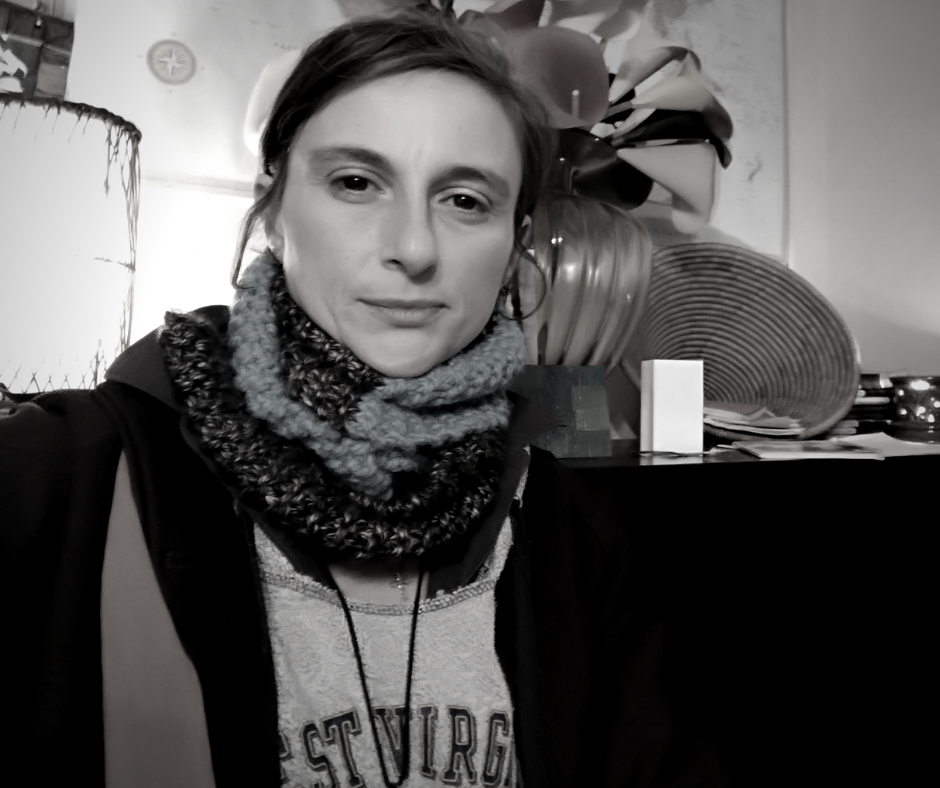
 Magdalene Fry-Bigby is an Appalachian Queer poet and Single Parent advocate from Wayne County, West Virginia. She was educated in Philosophy and Literature at Marshall and Anglia Ruskin Universities. Her poetry and nonfiction can be found in several online and print publications. She is the founder of the Grand Rapid’s Michigan press, Deciduous Imprint. She lives in Northern California where she works as a Peer neurodiversity, social and human services consultant. These poems are from her unpublished works Pocket Book Three and A Book of Poems: for Heraclitus, respectively.
-
Subscribe
Subscribed
Already have a WordPress.com account? Log in now.
 Chris Murray