• chris murray
  • journals – bibliography – publication notes
  • downloadable items – essays – media
  • copyright
  • Home

Chris Murray

  • ‘Grazing’ and other poems by Deirdre Daly

    October 23rd, 2017

    Indian Summer

     
    All neon invitations are ignored. No souls
    pass the threshold to buy a happy ring
    or waste an afternoon at shrill slot machines.
    We are left to ponder the question
    of our time – Why go Bald?
    A shop window implores me to buy
    a white latex nurse’s uniform and cap.
    Never has a scrub dress looked so unsexy
    and we all know stockings always fall down.
    Each street sucks at the sourness
    of the Liffey’s waters, but delights
    are still found in its twinkle as it eddies
    around wheelie bins and twisted bikes.
     
    This is the last lie we tell ourselves
    that Summer’s embrace still holds,
    until winter cripples the leaves
    of the blunted silver birches holding
    guard along O’Connell Street.
    No one will be smiling then.
    A preacher steals no crowd on a wooden
    fruit crate. Ginger hair matted by sweat,
    Jesus spittle on his lips. Just one woman
    stands. Hands held to the sky praise
    the guts of this guy for letting the world
    and God know he has two last believers.
     
    Dead Cleary’s clock still runs. A church
    hidden on a side street hits play
    on the Angelus. Some light candles
    and pray. Some lay down their shovels,
    pitchforks and pens. Some contemplate
    laying down their arms, then don’t.
    Some genuflect at the feet
    of their mistresses. Some devote
    their loins to their wife. Some wait
    by blacked-out windows
    for lovers to arrive, who never do.
    But somewhere in the world hips rise
    to greet mouths and entrap tongues.
     
    Indian Summer was first published in Banshee. Editors, Laura Cassidy, Claire Hennessy and Eimear Ryan
     

    Marionette

     
    lithe
    and taut
    until you reached up
    to that fine ivory neck
    unzipped yourself along
    the length of your spine
    turning cotton wool innards
    inside out
    ripping seams
    cutting threads
    cleaving wires slack
    tossing your copper
    horse hair wig
    to the floor
     
    I wanted no answers
    from your stuck red gash
    of a mouth scored
    into alabaster clay
    with a slight tilt of my hand
    and the dull twist of a wrist
    you whittled the vowels
    of my name down
    head bobbing
    limbs jerking
    a record jumping
     
    now no one notices
    when you move
    without me
     
    Marionette was first published in minnesota review. Editor, Janell Watson
     

    Dog Walk

     
    Dog, you act as though this is your first time in the world.
    But it’s not. Leash bound and squirming, your black nose
    cleaves the air. Left to right, then snuffle, as one would douse
    for water in the desert. We are hunters, Dog.
    Tracking tabby cats and chicken bones,
    stop to appraise only the ripest of turds.
     
    You divine the thread of each step that passed here.
    The air carries the past to you, sandwiches
    dropped at lunch, piss stains from Friday night.
    Hey Dog, those skunked faced youths shuffling
    and kicking cans against the bookie’s window,
    mind them. Side-eye, you are more suspicious
    of them than I. No worry, Dog. Humans too, are wary
    of young fellas in baggy tracksuits, peaks pulled low.
     
    Watch out Dog, the border terrier is running circles
    in his yard, digging trenches with his paws
    in advance of his battle with us at the rusting gate.
    He’s so angry with the world, Dog, but aren’t we all?
     
    An old man proclaims, Bet she wins big at the races,
    even though you’re just a leggy hound with
    a thick, bull head. His thick, hairy hands
    maul your haunches. That’s no way to treat a lady.
    Heckles surge and you jump to snap
    the cap from his head. He retreats.
    Shake it off, Dog. Good girl.
     
    Protesters line the traffic island
    waving placards. The dip of a tail.
    You drag me past.
    You have no interest in politics.
    But stop. Someone tossed a watermelon
    into the road, innards erupting pink flesh
    and black seeds too festive for winter.
    You’ve never seen anything as glorious before.
    Savour its flesh with a considered lick.
     
    To the church, Dog.
    There’s good grass there.
    Sniff, squat, shit.
     
    Packs of schoolgirls are out and roaming.
    Cower. The creep of tail between your legs.
    They are damp wool uniforms
    and the swish of skirts, the smack
    of grey chewing gum and squeals.
    You hate their pitch,
    the sway of their excitement.
    As do I, Dog. Clever Dog.
     
    Dog Walk was published in Room Magazine. Editor, Chelene Knight
     

    Une Nature Morte

     
    Dawn washes down over police tape flittering
    against the empty street. The idea of a stampede,
    the pounding feet, screaming bullets, speeding cars
    that left behind a crying wife seems obscene now.
    But war too, has its quiet times.
    By the gates of Ballybough House a photographer waits,
    but the blood is dry, shrapnel pocketed into plastic bags.
    Here flats blackened by the lick of flames flank balconies
    hung with baby clothes and pink skirts. A man stands
    and stares like a dog pinned in a corner. Life razored
    his eyes into flint. By the Tolka’s crawling water,
    two young boys waste time in a playground clad by iron bars.
    Without a ball they kick a half loaf of bread as seagulls
    circle overhead. One cocks a finger tense at the other.
    Pulls his thumb trigger. His friend dies writhing
    until resurrection or time for tea. A winter sunset
    low over the hedges, will temper the sight of limp, white trainers
    tied, thrown and looped around power lines in rose gold light.
    Look up. The skies look less like war and more like art.
     
    Une Nature Morte was published in A Level Crossing. Editor, Pat Boran
     

    Execution

     
    The jut of the pier is the end, the drop
    of colour into grey. Through salt crusted
    squints we search for the tug
    on a line to interrupt dull, flat cloud.
    Your flapping silver hooked
    from the steel capped waves,
    broken from the fight.
    Consider your death, but really,
    I know of only three ways to kill a fish.
     
    A toe of a boot against your curling body
    and lashing spine. A knife housed in leather
    cooked hard by salt water, its blade
    blackened by whetstone. An easy slice
    down below gasping, sanguine gills.
    A world ebbs.
    Your last glance will be rich with
    the redness of spilling innards
    painting concrete.
     
    Man fixes the world
    through the sharpness
    of planes colliding. The soft thud
    of your skull on an edge. A smart
    smack muted by squalling wind.
    This is no grand exit.
    Without the blast of a death blow,
    curt against the ear,
    you are no life to mourn,
    just a slow twitch beside the bucket.
     
    The barb hanging
    from your lip unhooked by slimy fingers.
    Your mirrored scales in the cracks
    of my palms. As one would lay an infant
    to sleep, I place you gently in water.
     
    Wait for the longest time,
    the struggle for breath begins.
    Mute confusion as you face
    the sky for the first time.
    I gaze at you in your plastic coffin.
    My world inverted
    in the arc of your dying eye.

    Execution was published in Magma. Editors, David Floyd and Lucy Howard-Taylor

    Grazing

     
    This is our angelus, though our timing is off.
    Pausing over a meal of charred meat,
    and verdigris leaves. A lush cream sauce
    coats the tongue with rich, ivory fur.
    Curdled blood spilling to the rim
    of two ceramic plates coats an argyle glaze
    in hues of rusty pink, culinary aesthetics
    deadened by the cheap pine of the table.
    Between the click and a pause of each second
    marked by the clock, we measure
    the shape of our world. It is a slow respite
    and we are waiting. Later I will plunge
    my hands into water churning glossy with fat,
    the globules creeping up the sides of the sink,
    onto my flesh, refusing to disappear with the dishwater.

    Grazing and other poems are © Deirdre Daly

     

    Deirdre Daly

    Deirdre Daly is a writer living in Dublin, Ireland. Her poetry has been published in Poetry Ireland Review, Magma, Banshee, The Penny Dreadful and The Irish Times amongst others. She was nominated for a Hennessy New Irish Writing award and received a special commendation in the Patrick Kavanagh poetry award in 2017.

  • ‘Magnificat’ (1917) by Geraldine Plunkett Dillon

    October 14th, 2017


    MAGNIFICAT

    by Geraldine Plunkett Dillon (1891 – 1986)


    1  (Untitled)

     
    While you are in Kilkenny town,
    I see your grace in every tree;
    Your hair is as the branches brown,
    The birches have your bravery.
     
    Your strength in mountain oaks I find,
    Eagles in this have built their nest;
    With supple sally twigs you bind
    My willing heart unto your breast.
     
    Cypress and cedar spreading wide
    Under your peace my heart will sleep;
    O rowan tree that grows beside
    My pool of love, your roots drink deep.
     

    2     June

     
    I fill my heart with stores of memories,
    Lest I should ever leave these loved shores;
    Of lime trees humming with slow drones of bees,
    And honey dripping sweet from sycamores.
     
    Of how a fir tree set upon a hill,
    Lifts up its seven branches to the stars;
    Of the grey summer heats when all is still,
    And even grasshoppers cease their little wars.
     
    Of how a chestnut drops its great green sleeve,
    Down to the grass that nestles in the sod;
    Of how a blackbird in a bush at eve,
    Sings to me suddenly the praise of God.
     

    3    The North Wind

     
    O rare North Wind whose cutting edge is keen,
    Joyfully brushing up the countryside,
    Tossing aloft the yellow buds and green,
    A little southward eddie creeps around
    When all the West is blushing like a bride,
    Sweet is the southward eddie near the ground.
     
    The heavy tide rolls in the billows blue,
    Save in the purple depth where seaweed lies;
    The seagulls out against the clouds are few,
    But O, the sea is white among the rocks;
    The whipped foam white in the North Wind flies,
    High in the sky are flung the North Wind’s locks.
     

    4    To Saint Francis

     
    O Francis, I have listened at your feet
    And tried to catch your quick humility,
    I caught the meaning of your counsels sweet
    And found the peace that is within your words;
    I’ve loved with you the fishes of the sea,
    I’ve been the little sister to the birds.
     
    I am in fellowship with all the world
    The rivers singing to me as they run,
    The flowers spoke to me as they unfurled
    The dumb earth sobs to me in earthquake jars;
    As you were little brother to the sun,
    I am the little sister of the stars.


    5      Gan Ainm

     
    Your gracious joy distils my heart, as dew
    Which your great love will gather to a whole
    And bind the waters to a stream anew,
    To wind among the gardens of your soul;
     
    The unthinkable sweetness of your kiss
    Has made my soul a flame, and up it goes,
    Finding its way among the stars in bliss
    To hide itself in the eternal rose.
     

    6    Magnificat

     
    A fold of Heaven’s curtain swung aside
    Splitting the blackness of the winter’s night,
    Blown by the breath of God it opens wide;
    I saw the holy ones in companies
    Led by archangels armoured for the fight;
    I heard the shrill eternal symphonies.
     
    I did not thrust my sorrow-twisted face
    Amongst the splendours of the heavenly town
    Nor walk misshapen with the forms of grace
    Girded for battle in celestial wars;
    And yet, my God, an angel has come down
    And crowned me with the glory of the stars.
     

    7    Si Quis Amat

     
    In my dream of peace,
    One sound breaks silence
    The sweetness of increase
    As honey downward drips
    Through the bars of sense
    Down to my soul’s lips.
     
    For whose joyous choice
    My heart sings of it
    Shouts with a loud voice
    No fear or regret
    Si quis amat novit
    Quid haec vox clamet
     
    [If a man loves, he will know the sound of this voice.]
     

    8    Before Her Judge

     
    In all my life, there happened things just three
    First I was born;
    Marriage came next to one who seemed like Thee
    I died this morn.
     
    My man, my babes, my life, I loved too well,
    To walk Thy ways.
    Must I now hate eternally in Hell
    Unending days?
     
    There is one plea beneath which I can hide,
    O Beauteous One!
    Your Father, Christ, forsook you; but I died
    To save my son.
     
    Magnificat is courtesy of and © Geraldine Plunkett Dillon’s great-granddaughter Isolde Carmody
     
    Image: Top of the wave by Geraldine Plunkett Dillon


    The text of Magnificat and images associated with Geraldine Plunkett’s Dillon’s historical and cultural work were kindly sent to me by her great-granddaughter Isolde Carmody and I am very grateful for them. I am delighted to add Geraldine to my indices at Poethead. I hope that this page will increase interest in her work. Excerpts from the Preface to the 2nd edition of All In The Blood, memoirs of Geraldine Plunkett Dillon, edited by Honor ÓBrolcháin,

    “My greatest regret throughout the process has been how little credit she gives herself, for example she does not mention a paper she gave in the Royal Irish Academy in 1916 or her contribution to the article on dyes in Encyclopedia Britannica or her volume of poetry, Magnificat, or contributing to the Book of St Ultan, or being a founder member of Taibhdhearc na Gaillimhe (the masks of Tragedy and Comedy she made for the Gate theatre are now on a wall in the Taibhdhearc) and the Galway Art Club, where she exhibited for years, or making costumes for Micheál Mac Liammóir in 1928, or being responsible for Oisín Kelly deciding to become a sculptor – he was one of very many who said that she enabled them to do the right thing for their own fulfillment. When she wrote it was in order to provide a history of her times and an insight into what made her family so strange. Like many of her generation she did not write much about her own feelings and her humourous and optimistic nature does not really come through in her writing. I would like to have been able to put that in but could not in all faith do so. “ It is also worth noting that Joe (Joseph Plunkett) named her as literary executor, and she edited his Collected Poems in 1916


    Other sources for Geraldine Plunkett Dillon’s work (online)

    The following brief biographical source for Geraldine Plunkett Dillon’s work is courtesy of Billy Mills at Elliptical Movements: Geraldine Plunkett Dillon (1891 – 1986) was born in Dublin. She published a single pamphlet of poems, Magnificat, from The Candle Press in Rathgar in 1917, which sold for sixpence. Her brother Joseph Mary was executed for his part in the 1916 rising. She was the mother of Eilís Dillon and grandmother of Eiléan Ní Chuilleanáin.
     

     100 Irish Women Poets at Elliptical Movements 

    Magnifact at the Internet Archive

  • ‘St. Brendan’s Floating Isle’ & other poems by Stephanie Conn

    October 11th, 2017

    Biding Time

     
    She sits by the split cottage door knitting
    a navy sweater on five thin needles –
    seamless, to resist salt water, biting
    winds, the neck tight enough to make ears bleed,
    no swell wild enough to strip it from skin.
    She knows the pattern by heart, each bobble
    stitch is a prayer, each basketweave a hymn
    to the deep. She ignores the new grumble
    from her swollen belly, thinks of the dropped
    stitch above the waist, a small gap in wool
    to identify the man she loved – loves.
    His worn boat has not been seen for days, caught
    perhaps on some other island’s rocks. Still
    time to return before the next storm hits.
     

    After the Storm

     
    Cyclone Nathan left behind six new islands
    and drowned one. When the sea stopped
    churning, she was the first to step
    onto the coral rubble outcrop,
    to press a size five footprint
    into the sand, and feel
    the warm grains filter
    through her fingertips.
     
    It was too early to tell
    if this land would last
    long enough to be mapped
    or sink back down into Holmes
    Reef before she’d had the chance
    to form its name on her chapped lips,
    but below in a hollow underwater cave
    flashlight fish create dozens of pinprick stars.
     
    First published in Bare Hands Issue 20
     

    St. Brendan’s Floating Isle

     
    Fed up to the back teeth
    trying to swallow my tail,
    I took to watching islands;
     
    small figures on the beach
    hauling nets, eating together
    on the sand; telling stories.
     
    It is not easy being at sea.
    Some days the sun makes
    my scales shine and quiver
     
    but in truth they are grey
    and there is nothing to do
    but dive into the ink swell
     
    feeling the currents’ tug;
    so when I saw them coming
    I paid attention –
     
    skin stretched over wooden ribs,
    tar smeared where the hides met
    and the strange scent of oak bark;
     
    voices carried like salt in the wind,
    making my eyes sting, the lilting
    sound was an unknown symphony
     
    and the sight of those men side
    by side, oars in their skelfed hands,
    was all it took to draw me in.
     
    I kept myself still, as though
    twisted roots held me to the sea bed,
    and lowered my head as if in prayer,
     
    longing to feel their feet on my bare
    back, exploring my shoreless edges
    to translate their talk into glorious kinship.
     
    I did not know it would burn;
    the warmth of their heavy limbs
    turned to fire and I cast them off.
     
    First Published in Copeland’s Daughter (Smith/Doorstep) June 2016
     

    Rough Island

     
    Below the locked tower
    Comber Estuary twists,
    rich enough in salt marsh
    and eel-grass to tempt
    Brent Geese from the sky.
     
    We are restricted by tides,
    must wait for the reveal
    of a narrow path, walk
    the concrete causeway
    still wet beneath our feet.
     
    The route is circular –
    a mile and a half round
    the island edge. Strangford
    Lough strung out for us
    like a blue silk ribbon
     
    or an old rope tightening
    around the neck. Time is short.
    Our joined hands have barely
    warmed but there is nothing
    to be gained by getting trapped.
     
    Our fingers come undone.
    I’m unaware this patch
    of disappearing land is named.
    We hurry into the dark,
    slip inside separate cars.
     
    First published in Honest Ulsterman June 2016
     

    What the Trees Whisper

     
    A rook clawed free an empty wooden house,
    took to the sky, content with the weight of rooms,
    left behind three apple trees, their shadows
    lengthening under a neon sky on the orchard floor.
     
    He dropped it into the sea at dawn and left
    to find a single storey house. The open windows,
    not accustomed to salt winds, slammed shut,
    wakening the ghosts and raising the roof
     
    five metres into the air. It is easy to imagine
    lightning cracking open the solid slate sky above
    this island house. Tropical birds emerge from sea-mist,
    squawking of turquoise pools and a distant sun.
     
    I’m not drawn in to their dripping pollen stories
    and try to dream myself back behind three apple trees,
    their shadows lengthening under a neon sky –
    but find myself staring at barbed wire, a corrugated
     
    iron fence, my own reflection. I never was content
    with the weight of rooms, tended towards open fields
    and paths I didn’t know, would happily catch a train
    into a black, forgotten tunnel. The track twists
     
    back on itself, clicks and creaks and groans
    in the record temperatures. On the grass bank
    an abandoned grandfather clock ticks and tocks;
    a child falls over it following the scent of a forest.
     
    First published in Abridged
     

    The Viewing

     
    I admit I came to lay it at your wooden door
    but stop to let the flaking fact sink in, as if
    it mattered; you haven’t painted the door in years.
     
    They called it Burning Ember on the colour chart.
    It’s sun-baked now but still reminds of the buttercup
    you held beneath my chin, nodding as it shone.
     
    I pretended you were right. For years, when you passed
    the little gold parcels across a coffee-shop table, I smiled.
    I learned to like the texture but never the salty aftertaste.
     
    The lock remains, the rim now freckled with rust. I must
    still have the key; could filter through the bottom drawer,
    feel for the grooved edge of a key, cut to mirror yours.
     
    I could check if you ever lifted the carpet in the hall
    to reveal blue mosaic tiles. Did you strip the paper
    from the wall? Let the roses drop in a soggy heap?
     
    If I climbed the stairs I’d be careful to miss out
    the sixth step in case it creaked; could pad softly
    to the spare room where the curtains are pulled
     
    to dip my head below a mobile of moon and stars;
    watch her breath rise and fall under brushed cotton.
    Her golden brows are yours. Her gorgeous lashes flit.
     
    Do you remember the Rijksmuseum in Amsterdam?
    How we argued over Vermeer and de Hooch, the former’s
    windows, the latter’s doors – dutch doors – horizontally
     
    divided, so the two halves could open independently,
    allow just enough light to illuminate a patch of terracotta
    tile. And how you laughed as I mistook A Mother’s Duty;
     
    saw only silk, not the leather shoes or the small head buried
    in her mother’s lap. I believed she was sewing, not picking
    nits from a mop of dark hair. I’ll leave the key beneath the mat.
     
    First published in Spontaneity
     
    St. Brendan’s Floating Isle & other poems are © Stephanie Conn


    Stephanie Conn’s first collection, The Woman on the Other Side is published by Doire Press and was shortlisted for the Shine/Strong Award for best first collection. Her pamphlet Copeland’s Daughter won the Poetry Business Pamphlet Competition and is published by Smith/Doorstep. Her new collection is due out in May 2018.


    ‘Lepus’ by Stephanie Conn
     
    ‘Delta’ and other poems by Stephanie Conn

  • The Gladstone Readings Anthology

    October 1st, 2017
     

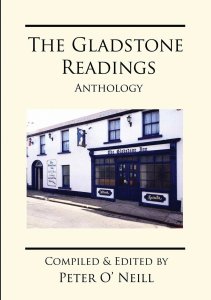
    The Gladstone Readings Anthology (Famous Seamus, UK, 2017) is an anthology of contemporary writing, though predominantly poetry, and which was compiled and edited by the poet, editor and translator Peter O’ Neill. This is O’ Neill’s second stab at editing an anthology, the first was published in conjunction with the French poet and editor Walter Ruhlmann and was published by Walter for mgv2>publishing ( France, 2015 ) And Agamemnon Dead, an anthology of twenty first century Irish poetry.

    Some of the same names appear in The Gladstone Readings Anthology that appear in And Agamemnon Dead. Michael J. Whelan, Christine Murray, Rosita Sweetman, Arthur Broomfield, John Saunders and Bob Shakeshaft, so there is a correspondence between both works which is immediately identifiable in the contents section.

    Thematically there are similarities between both works too. Violence, as indicated in the Yeat’s quote of the first book, is once again a recurring theme uniting this latest anthology, with a short story by Helena Mulkerns, taken from her debut collection Ferenji ( Doire Press, 2017 ) complementing Whelan’s visceral poems written many years after his experience touring the Lebanon and Kosovo as a Peacekeeper for the UN.

    Indeed O’ Neill, in an article published by The Irish Times ( May 12th 2015 ) was at pains to point out, after the publication of And Agamemnon Dead , that violence was the unifying element which connected all the pieces, but violence as understood in its most global way!

    For example the violence of Brendan McCormack’s Dublin poems, contained in The Gladstone Readings Anthology, are central to the anthology, with their anger and rage against the complacency of middle-class Ireland’s double standards, vis a vis religious indoctrination and embrace of hyper-consumerism. McCormack’s formal constructs, devoid at times of any punctuation, a physical manifestation on the very type face of his complete disdain for orthodoxy of any kind, such is his mistrust of authority; Caravaggio being a kind of avatar for the poet, a subject which he treats with real greatness, and worthy of the 17th century baroque master.

    Indeed Brendan McCormack, placed in the centre of the collection, preceded by work from John W. Sexton and the formidable Daniel Wade, could be seen to represent a school of current poetic exploration particular to this island, and which Whelan’s and Murray’s writing also echo; that of a return to modernism, with its insistence on formal exploration, historical accuracy and embrace of linguistic invention. As if to underscore the tension created by the above mentioned apocalyptic trio, Sexton evoking a demonic stiletto wearing Muse, My Love Came Riding, while Wade’s long poem on Savonarola, uncomfortably making parallels to Post-Celtic Tiger Ireland excess, and McCormack’s own inner-city howlings ( a city he has long since abandoned, living in exile as he does from the nation’s capital, in favour of the wild countryside of West Cork) are then carefully contrasted by the quieter introspective tones, of the American poet David Rigsbee whose poems masterfully explore the deeply personal with the public; in which such all too familiar topics such as homelessness A Certain Person, racism ’68, and Art Falsetto are so magnificently treated.

    John Saunders and Enda Coyle Greene then take up the baton, both similar to their American counterpart in that both, in their work, attempt to in both formal and informal register, explore, using rhyme, rhythm and alliteration, the conceit and metaphor of Living!


    The Gladstone Readings Anthology at Amazon
  • ‘Before My Mother Naked’ and other poems by Bernadette Ulsamer

    September 28th, 2017

    Before My Mother Naked

     
    I am showing off,
    at 9 months pregnant,
    how round I am,
    how my belly button
    is now a knot of skin.
     
    She feels for the hardness in my stomach,
    she rubs at the red marks,
    the heel of her hand kneads
    down my spine, presses firm
    into the strain of my lower back.
     
    I remember leaning against
    her warm full breasts, her thin legs,
    her dark hair when we would take a bath together,
    sing-songing made up rhymes
    until our fingertips raisined.
     
    I am the split-tailed fish
    from her body,
    and now, I too have
    an ocean inside.
     
    Originally published in Meat for Tea: The Valley Review vol 10 issue 3
     

    He Crumbles Old Newspapers for Kindling

     
    We roast hot dogs bought at Rock Run—
    the country store at the base of the mountain.
     
    My ’95 Buick Century almost didn’t make it up.
    We got stuck twice in rutted mud.
     
    I know how to set up a tent,
    but not start a fire. We smoke up
     
    before cooking the dogs, drink whiskey
    stolen from my mother.
     
    We’re here to get a little high,
    drunk and fuck on sleeping bags
     
    that smell like his attic.
    We watch the fire, no need to talk.
     
    I sleep in his fleece,
    reeking of pot and charcoal.
     
    In the morning I open a jug of water,
    wash my hands, face, and crotch
     
    then douse the fire pit
    with what’s leftover.
     
    Originally published in Meat for Tea: The Valley Review vol 10 issue 3
     

    Funeral On Nippenose Mountain

     
    Walking the hillside from church
    instead of riding with Charles M. Knoll & Sons,
    my black stilettos half an inch deep in wet grass,
    almost mud from morning rain.
    The November sky is still overcast, clouds shade
    the gravesite chairs, only enough for immediate family
    who bring up the end of the procession, pass the old grotto—
    Mary Our Mother of Sorrows.
    Hunters’ trucks carrying buck carcasses in the bed, slow down
    for the road’s trail of grey overcoats.
    My heels fully sink in the ground
    as Father Mano begins the Lord’s Prayer.
    Wearing rubber shoe covers over his priest loafers,
    he leads us to the amen.
     
    Originally published in Meat for Tea: The Valley Review vol 10 issue 3
     

    The Water Rose to the Underbelly of Slabtown Bridge

     
    Gasoline floated on top of the flood
    and telephone poles bowed down
    like deer drinking from a stream.
    With all the street signs washed away
    I feel the turn to take for church
    though the divider line
    now veers off into a wider river.
    In this new valley of mud coffins stick out
    from the slice of a new hillside
    once familiar as a groove in a stone
    as if I were 16 again,
    worn deeper each year
    out to prove I wasn’t ugly or awkward
    on a boy and a can of beer.
     
    Originally published in Voices from the Attic volume 20
     

    Telling My In-Laws I’m Pregnant

     
    His mother hugs her body hard against mine,
    and my breasts—so tender and heavy—
    feel every pound of her pressing in.
    She tells me of the maternity dresses she sewed
    from simple patterns with the seam stitched over the belly—
    everyone watches how much I eat.
     
    I used to picture my inside self like the model uterus
    —clear plastic ovaries and fallopian tubes from 10th grade health—
    Mr. Foote with his laser pen tracing the path of the egg.
     
    If I could unzip myself, I thought
    I’d see everything clearly,
    imagined a vast transparency in my body—
    a rounded, plastic, squeaky cave.
     
    In first trimester ultrasound photos
    it’s just a scratchy white speck
    in a pool of black, BABY printed in block letters.
    An arrow points toward this blob
    suspended in wet darkness.
     
    Originally published in Pittsburgh Poetry Review Issue 4
     
    Before My Mother Naked and other poems are © Bernadette Ulsamer

    This Unclean Spring 
    
    
    Wet snowfall in March—robins on a head trip:
    
    shrub, to branch
    
    to power wires


    	—PEEK!! tut tut tut tut—
    
    picking up bits of coarse grass, twigs, paper.
    
    		—seeech each-each-each—


    More grey than reddish-orange breasts
    (last summer’s freckles). 
    
    
    	These first robins dredge
    
    	half frozen ground, search 
    
    	for beetle grubs and caterpillars, 
    			smeared mud.    
    
    
    Even with winter boots standing ready by the front door, 
    
    I use the weather as an excuse to avoid people.
    
    		
    		Spots of green sprouted early despite the cold,
    
    				shudder in the wet wind.  
    					(this unclean spring)—

    Originally published in Meat for Tea: The Valley Review vol 10 issue 3
     

    Bernadette Ulsamer earned an MFA from Carlow University where she is a member of Madwomen in the Attic. She is the author of the chapbook Trestling published by Flutter Press. Her poetry has appeared in Pittsburgh City Paper, Cossack Literary Journal, Roar Magazine, The Broken Plate, Meat For Tea: The Valley Review, Pittsburgh Poetry Review, and has been anthologized in Voices from the Attic, and Along These. Her poem “ICU, Holy Thursday” was long-listed for the International Fish Poetry Prize 2013.

  • Talking Poetry at The Pan Review

    September 16th, 2017

    My thanks to Mark Andresen who took the time to ask me what it is I do in poetry, publishing women, and my interest in reclamation. You can read the interview in its entire here.
     
    “First, we must acknowledge the absence of the early modernists, the Irish language poets, and the experimentalists from the canon. This is incredibly difficult to do as it is embarrassing to note that most anthologies leave out these women poets of early modernism and their crucial dialogue within the development of the state. In many anthologies and companions to Irish Poetry, including the forthcoming ‘Cambridge Companion to Irish Poetry,’ (ed. Gerald Dawe) there is a desert from the foundation of the state until the 1970s’. The early modernists, the poet anarchists (like Dorothea Herbert) are absented from the canon.”

  • ‘All The Worlds Between’; a collaborative poetry project between India and Ireland

    September 16th, 2017

    All the Worlds Between is a collaborative poetry project bringing together poets from India, Ireland and in between. Their writing partnerships resulted in four strands—poems as conversations, poems at angles to one another, poems which speak out of turn to other poems in the group and, not surprisingly, stories of friendship.

    The poets looked at questions of home, belonging, identity, exclusion and homogenisation. From conversations about shoes and what they evoke to exchanges about parents, poems responding to the transgender experience, to inward angled poems and even chain poems created stanza by stanza over email and WhatsApp, through all of these the poets found themselves eavesdropping on the collective consciousness, ears to the ground listening for the beat of life.

    Contributing poets

    Adil Jussawalla, Aditi Rao, Áine Ní Ghlinn, Alvy Carragher, Anne Tannam, Arundhathi Subramaniam, BeRn, Christine Murray, Claus Ankersen, Daniel Ryan, Fióna Bolger, Maurice Devitt, Menka Shivdasani, Nandini Sahu, Nita Mishra, Ӧzgecan Kesici, Rizio Yahannan Raj, Sampurna Chattarji, Shobhana Kumar, K. Srilata, Sue Butler, Swarnalatha Rangarajan, R. Vatsala.
     
    Edited by Srilata Krishan and Fióna Bolger 

    Published by Yoda Press www.yodapress.co.in 

    Read more at Ó Bhéal

    All the Worlds Between is a collaborative poetry project bringing together poets from India, Ireland and in between. Their writing partnerships resulted in four strands — poems as conversations, poems at angles to one another, poems which speak out of turn to other poems in the group and, not surprisingly, stories of friendship.

    The poets looked at questions of home, belonging, identity, exclusion and homogenisation. From conversations about shoes and what they evoke to exchanges about parents, poems responding to the transgender experience, to inward angled poems and even chain poems created stanza by stanza over email and WhatsApp, through all of these the poets found themselves eavesdropping on a collective consciousness, ears to the ground listening for the beat of life. (read more here)


  • ‘Wild Fennel’ and other poems by Tess Barry

    September 4th, 2017

    Raspberries

    I started out in western Pennsylvania hills
    with wild raspberry and blackberry bushes
    and my mother’s apple field.
    Bread and ripe fruit and fresh milk.
    My mother cleaned the carpet right off the floor.
    My father was a Troy Hill boy who played piano
    and smoked Pall Malls and drank whiskey.
    He won my mother in a dance contest.
    Who wouldn’t learn to jitterbug for a prize like her?
    They took a train to Cape Cod for a honeymoon
    and bought hats for their mothers.
    They sailed all the way from the Cape to ten children.

    My whole life has been ripe with wild fruit.
    All the men I’ve loved had left feet. I was innocent
    until I got myself a good pair of rain boots.
    There is no point in wondering what I’ll come to.
    With my first words I wrote my own path
    straight to New York: all night accents, brick stoops.
    I left there like a mad dog running free
    like our Dusty who got himself killed down the street,
    chasing the neighborhood boys. He ran smack into a fender.
    We buried him up in the woods after a proper funeral.
    No amount of experience can shake
    the ripeness out of me, or my mother, or my father
    who didn’t just win a bride
    with his right feet and big shoes.
    He won a green thumb.


    Near the Ocean’s Edge

    The bus that took my mother to Atlantic City in 1945 was a Greyhound.
    She was fourteen, leaving home for the first time
    to visit Adeline and John Higgins, who used to live next door.
    They were childless and good to her.

    She traveled alone, a tiny solitary thing.
    A drunken sailor sat down next to her and stared then asked
    Can I suck a hickey on your neck?
    She had no idea what he meant, moved seats and sat alone.

    Seeing the ocean for the first time she wept.
    She couldn’t swim but walked the shore for hours.
    Near the ocean’s edge she first saw seahorses, a herd of them floating.
    They were beautiful and stationary, too magical to be living—

    she thought them shells. Packed her suitcase full of them,
    laid them gently between her worn cotton dresses
    and underthings. Arriving home she opened her case
    to show her treasures to a friend and they’d rotted.

    The stench so strong it dizzies her still.


    My Father’s Remains

    The moment he died,
    my father’s remains
    grew small in size, shaped
    by our hands and fingers.

    The faint and lingering scent
    of tobacco rose from
    our paging his hymnals
    and pawing his coats.

    His wallet was frayed,
    its outer-edges rawhide again
    from years of his palming.
    It held very little cash.

    We opened that wallet
    and found a fold-out tent,
    stitched together in plastic
    rows of worn faces.

    It unfurled easily and we
    fell down in steps. It held
    all ten of us and our mother.
    We found the wallet

    in his small sock drawer,
    the socks all uniform, all
    black. I took them all and he
    was laid to rest in borrowed.


    Wild Fennel

    render me yellow
    a little while longer
    bedside coast through sea window
    render me open
    scent my bedclothes with pollen
    in cupped water linger
    dusting May with your flavor
    render me axis
    stolen stalk of Prometheus
    wand of forethought
    weed-stem of longing
    perennial center
    render me umbel


    After Singing Midnight Mass

    The rest have gone ahead.
    Old enough now
    to walk the distance alone.

    In these short hours
    snow has fallen, just
    a dusting marks the streets.

    Cold air breathes all around.
    Here now.
    Wreathed doors beckon. Turning

    the corner to North Avenue
    the moon follows,
    white against the clear blue night.

    Up and down the sleeping mile
    choir voices
    echo still, the loft’s round staircase,

    filled with joyful noise, silent now.
    Our conductor’s wand
    waving, his final smile

    humming on. Already Christmas
    morning. The paved road
    ends, rough surface comes.

    Ground known so well.
    Almost there now.
    Quiet woods to one side,

    the tree trimmed before church
    glows in the window.
    Skating down the stone steps, one

    by one. Gliding on. Hands
    gloved, still warm.
    Sound and light within.


    Deciduous

     
    I am the seed that roots and spreads,
    I am the underbough unbearing.
    I am the meristem, the forest in refuge,
    the division in moss and the division in fern.
    I am the absence of sound in deep rise,
    in snow-buried mound, in matter-of-fact serration,
    the feeling of stillness, that widens
    and widens, then rustles and spills
    from forked tongue to tadpole-spitting stream.
    I am boundlessness of now, when it
    is good to bear nothing but the weight
    of its great vastness, while winters
    pass from absence to deafening gathering
    to absence again, many re-births
    and sprawling coverings, till the falling ahead
    becomes the falling behind, and half
    the short seasons of the day are sameness.
    Widening pools cast my perpetual echo,
    I am bark of skin dividing out,
    I am winged vertebrate weaving,
    I am cambium, the forest in refuge,
    the division in fern the place
    of meristem division.

    Tess Barry was shortlisted for the 2015 Manchester Poetry Prize (UK). Twice a finalist for North American Review’s James Hearst Poetry Prize and Aesthetica Magazine’s (UK) Poetry Award, she also was shortlisted for the 2014 Bridport Poetry Prize (UK). Most recently, her poems appeared in or are forthcoming in And Other Poems (UK), The Compass Magazine (UK), Cordite Poetry Review (Australia), Mslexia (UK), Mudfish, Pittsburgh Poetry Review, The Stinging Fly (Ireland), and The Woven Tale Press Literary and Fine Arts Magazine. Barry is a Fellow of the Western Pennsylvania Writing Project and teaches literature and creative writing at Robert Morris University in Pittsburgh. Website: Tess Barry

    Wild Fennel and other poems are © Tess Barry


    Publication Details

    Wild Fennel, My Father’s Remains, Raspberries, Near the Ocean’s Edge, and After Singing Midnight Mass were shortlisted for the 2015 Manchester Poetry Prize and previously published on the Manchester Writing School’s website as part of the press release announcing the shortlisted poets. 

    Deciduous was a finalist for North American Review’s James Hearst Poetry Prize and published in North American Review’s Spring 2014 issue.

  • ‘I Saw Beckett The Other Day’ and other poems by Órfhlaith Foyle

    August 31st, 2017

    Photograph of Her Brother’s Skull

     
    They give you to me,
    a numbered skull from a high shelf
    and in my hand you are
    a strange brute thing – a thing I hardly see
    -my brother.
     
    The clean smooth bone of you
    – the whole of you no longer with me.
    In this room of discovered skulls,
    I have lost my memories
    And the photographer fixes your dead stare
    for his lens.
     
    In this room of skulls,
    Your face is lost,
    my brother,
    and I grips hard to what is left.
     

    After Sunday Mass in Malawi

     
    After Sunday Mass they whispered:
    ‘he was a poet, perhaps.
    A dissident, yes.’
    He ignored the spies in his classroom.’
    Then someone else also remembered:
    ‘Of course, this is not our country.
    We are Whites, you see
     

    I Saw Beckett the Other Day

     
    I saw Beckett the other day
    in the doorway of that café
    where you took his photograph.
     
    You know the one…
    when he looked up at the lens
    and realised how he could
    haunt us all.
     
    ‘Hey Beckett,’ I said
    Rejoicing in my discovery of him;
    his hand on the door, his eyes
    skimming over the interior image
    of cigarette smoke and coffee.
     
    I stood beside him. He rubbed his face so
    he might recognise me. I smiled and
    said even I didn’t know what was
    happening these days.
    Even I could not stop the end.
     
    He nodded, coughed and looked sly; his teeth were
    yellow over the pink rim of his lips.
    He mentioned the photograph. He said his face
    had collected worms under the skin as if ready for
    death and he smiled to show them dance
    spasmatic with age-spots and veins.
     
    Someone entered the café. Someone left.
    Beckett touched the hair above my ear.
    I stood on tip-toe so he could whisper down.
    He said nothing. It was just a kiss
    with the cold wind at our feet and the
    smoke and egg friendly air
    released in draughts between
    the opening and closing of the café door;
     
    Which he stepped through to find his table
    and entered some other world,
    under greasy lights
    coupled with table shine and coffee cups,
    and thoughts of death, where she stood
    groomed for an entrance, were held back by
    the odd moments of life
    that still strung the useful breaths
    Beckett used to blow his coffee cool.
     
    ‘I Saw Beckett The Other Day’ and other poems are © Órfhlaith Foyle

    Órfhlaith Foyle’s first novel Belios was published by The Lilliput Press. Her first full poetry collection Red Riding Hood’s Dilemma (Arlen House) was short-listed for the Rupert and Eithne Strong Award in 2011. Arlen House published Foyle’s debut short fiction, Somewhere in Minnesota, in 2011; its title story first appeared in Faber and Faber’s New Irish Short Stories (2011), edited by Joseph O’Connor. Foyle’s second short fiction collection Clemency Browne Dreams of Gin (Arlen House 2014) was chosen as one the Irish Times books of the year. Her work has been published in The Dublin Review, The Wales Arts Review, The Manchester Review, and The Stinging Fly.


    Órfhlaith Foyle was born in Africa to Irish parents and now lives in Galway, Ireland.

  • ‘Sequence after Celan’ by Gillian Prew

    August 19th, 2017
    Sequence after Celan
    
    1
    
    Spring: trees flying up to their birds 
    
    where the sun is the seeds are freed
    their small sound a wound
    like death watercoloured and open
               each foliated lung with its breathing understory
                    the climb of springtime into the loud light
    sky filled with dove-coloured words
    
    2
    
    the climbed evening
    is thick with lung-scrub
    
    a nocturne of oxygen    of spring sillage   the raising of the dead 
    and their flowers
    the night deer with hooves of heather    the precision of an owl in 
    *rooted darkness
                                  in the tangled bramble
                                  a knot of blood
    
    3
    
    water needles
    stitch up the split
    shadow-he fights his way
    deeper down, free 
    
    rain wholly itself
    a breathing torrent
    hitting the half-lit
    a million microdazzles     a mouse
        mud-buried 
        a blinking scut
    the fluency of a softer death
    a spring nothingness
        a heart-smoke
    
    4
    
    in the air, there your root remains, there, in the air 
    
                    up
    the sky bitten open
    the sun exhumed
            clouds bud and bloom
            with roots of rain
    
    
    5
    
    All things,
    even the heaviest, were
    fledged, nothing,
    held back.
    
    weeds like wicks ending
                 long-edged 
    weighted by a bursting yellow
    re-bloom and climb
        a white tufted voile
    like breath solidifying
        the hung lungs letting go
    everything uprooted
    
    *
    
    after
    
    The green gardens are gone. What is left is a grief-bulb. 
    It has no smell or sound, just a dormant red. 
    So is the air with its salt and silence. 
    So is the hunter with his glacial ethics.

    Sequence after Celan is © Gillian Prew

    Born Stirling, Scotland in 1966, Gillian Prew studied Philosophy at the University of Glasgow from 1984 to 1988. Her chapbook, Disconnections, can be purchased from erbacce-press (2011) and another chapbook, In the Broken Things, published by Virgogray Press (2011). Her collection, Throats Full of Graves, has been published in 2013 by Lapwing Publications. A further collection, A Wound’s Sound, was released from Oneiros Books in April 2014.

    Her latest chapbook, Three Colours Grief, was published by erbacce-press in June 2016. She is online at https://gprew.wordpress.com/

    She has been twice short-listed for the erbacce-prize and twice nominated for a Pushcart Prize.

←Previous Page
1 … 24 25 26 27 28 … 106
Next Page→
 

Loading Comments...
 

    • Subscribe Subscribed
      • Chris Murray
      • Already have a WordPress.com account? Log in now.
      • Chris Murray
      • Subscribe Subscribed
      • Sign up
      • Log in
      • Report this content
      • View site in Reader
      • Manage subscriptions
      • Collapse this bar