• chris murray
  • journals – bibliography – publication notes
  • downloadable items – essays – media
  • copyright
  • Home

Chris Murray

  • “Magic Bullet” and other poems by Rus Khomutoff

    February 10th, 2017


    Untitled

    for Andre Breton
     
    Nostalgic sentiments and new wave nocturnes
    intersecting in a normal chaos of life
    an hourglass of neglected affinities
    idols of saturated phenomena
    night of filth, night of flowers
    the aporia of revelation
     

    Magic Bullet

    (for Tristan Tzara)
     
     Smell of death
    smell of life of embrace
    a medicine of moments
    semiquavers and sundial conductors
    of the postspectacle
    deposits of legitimacy left behind
    sortilege of the divine decree
    words in blood like flowers
     

    Grand Hotel Abyss

     
     Selenophilia of our being
    the obscuring of the queen
    vexed in your hollow divine
    incipience of the notable nonesuch
    like fragrant paperwhites in the
    corner of the transcendental frame
    pleasure ground of annulled pretext
    in hysterically real daymares
    everyday extraordinary
    grand hotel abyss
     

    Masque of the minutes

    for Adam Lovasz
     
     Masque of the minutes
    like a red psychotonic cry
    agnosia of the just interloper
    scarlet bellowing of the deep end
    excisions on vacuous origins
    temporal flight of the elemental route
     

    Hygge

     
     A sense of timelessness surrounds her
    mistress of malfunction
    platinum god afterbirth
    countdown to zero
    inferior rhyme over the threshold
    redux and progression
     
    Magic Bullet and other poems are © Rus Khomutoff.

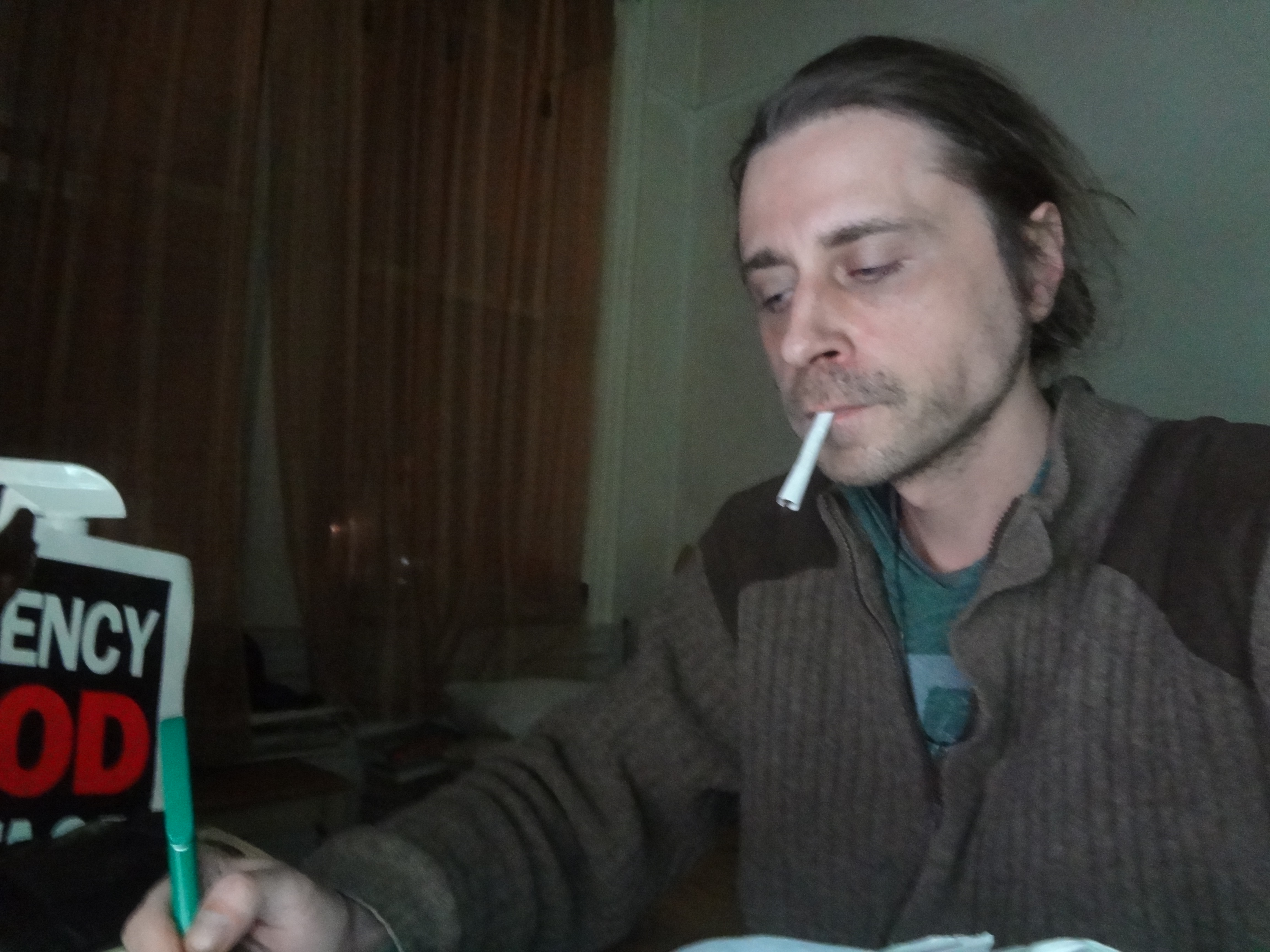
    dsc07827My name is Rus Khomutoff and I am a neo surrealist poet in Brooklyn, NY. My poetry has appeared in Erbacce, Uut Poetry and Burning House Press.Last year I published an ebook called Immaculate Days. I am also on twitter:

    • http://www.twitter.com/@rusdaboss
    • Immaculate Days
  • “Foraois Bháistí” and other poems by Doireann Ní Ghríofa

    February 5th, 2017

    Foraois Bháistí

     
    I mbreacsholas na maidine, leagaim uaim an scuab
    nuair a aimsím radharc nach bhfacthas cheana
     
    ag dealramh ar an mballa: fuinneog úr snoite as solas,
    líonta le duilleog-dhamhsa. Múnlaíonn géaga crainn
     
    lasmuigh na gathanna gréine d’fhonn cruthanna dubha
    a chur ag damhsa ar an mballa fúthu, an duilliúr ina chlúmh
     
    tiubh glas, an solas ag síothlú is ag rince tríothu.
    Fuinneog dhearmadta ar dhomhain eile atá ann, áit agus am
     
    caillte i gcroí na Brasaíle, áit a shamhlaím fear ag breathnú
    ar urlár na foraoise, ar an mbreacscáth ann, faoi dhraíocht
     
    ag imeartas scáile, dearmad déanta aige ar an léarscáil,
    ar an bpár atá ag claochlú ina lámh: bánaithe anois,
     
    gan rian pinn air níos mó, gan ach bearna tobann
    ag leá amach roimhe. Airíonn sé coiscéim
     
    agus breathnaíonn sé siar thar a ghualainn,
    mar a bhreathnaímse thar mo ghualainn anois,
     
    ach ní fheiceann ceachtar againn éinne.
    Níl éinne ann.


    Rainforest

     
    In morning’s piebald light. I set aside my duster
    on finding a view I’ve never noticed before
     
    surfacing on the wall, a new window, sunlight-snipped,
    filled with shadow-twist and leaf-flit. Branches shape
     
    the sunlight from outside, sculpting dark forms
    and setting them dancing on the wall, green-furred with foliage,
     
    light swaying and simmering through. I watch it become
    a window to some other world, a time and place forgotten,
     
    lost in a Brazilian forest, where I imagine a man stands, gazing
    at the forest floor, at the reflected speckle-shadow, enthralled
     
    by the play of shade he sees there, and he is forgetting his map,
    the parchment that is swiftly transforming in his hand, emptying
     
    itself now, until no trace of a pen remains and a sudden void
    stretches before him. He hears a footstep and his breath quickens,
     
    a gasp, a fast-glance back over his shoulder,
    as I glance over my shoulder now, too,
     
    but neither of us see anyone.
    No one is there.


    (Don Té a Deir nach bhfuil Gá le Bronntanas i mBliana)

     
    Tosaím i gcroí na Samhna. Cíoraim gach seilf,
    gach siopa, gach suíomh idirlíon. Caithim laethanta
    fada ag cuardach fuinneoga na cathrach ach fós,
    ní thagaim ar an bhféirín cuí.
     
    Tagann agus imíonn na seachtainí. Táim ar tí
    éirí as, in ísle brí, go dtí go ndúisíonn glór na gaoithe
    i lár na hoíche mé, freagra na faidhbe aici.
    Tabharfaidh mé boladh na báistí duit, a chroí.
     
    Meán oíche. Siúlaim síos staighre ar bharraicíní
    chun múnlán oighir a leagan ar leac fuinneoige.
    Oíche beo le báisteach atá romham,
    díle bháistí á scaoileadh sa ghairdín.
     
    Amach liom, cosnochta faoin mbáisteach.
    Bailíonn braonta na hoíche isteach sa phlaisteach,
    seomraí beaga bána ag borradh le huiscí suaite
    na spéire tite, dromchla gach ciúb ar crith le scáil
     
    na scamall tharstu, agus ina measc, blúirí den spéir
    réaltbhreac. Ritheann creatha fuachta tríom agus fillim
    ar an tigh, rian coise fliucha fágtha i mo dhiaidh.
    Sa reoiteoir, iompóidh an bháisteach ghafa ina hoighear.
     
    Cruafaidh scáileanna réalta ann, claochlú ciúin, fuar.
    B’fhéidir nach n-inseoidh mé an scéal seo duit riamh.
    I ngan fhios duit, ar iarnóin Nollag, b’fhéidir
    go líonfaidh mé gloine leis an oighear ar do shon,
     
    féirín uaim, cuimhneachán d’oíche nach bhfaca tú,
    nuair a d’éalaíos uait, chun braonta agus réalta
    a bhailiú duit. I ngloine, sínfidh mé féirín dúbailte
    chugat – boladh na báistí agus luas a titime araon.
     
    Scaoilfidh mé braon ar bhraon le titim tríot,
    báisteach na hoíche ag stealladh ionat, á slogadh
    scornach go bolg, titim réaltbhreac tobann.
    Bronntanas.


    (For One who Says that No Gift is Needed this Year)

     
    I begin in November, and search every shelf,
    every shop, every website. So many afternoons,
    spent peering through windows, and still
    I can’t find a gift for you.
     
    Weeks come, weeks go, and I become glum,
    I begin to think that I’ll have to give up. But tonight,
    the wind’s voice wakes me and her answer is clear.
    I will capture the smell of rain for you, my dear.
     
    At midnight, I tiptoe downstairs
    to place a plastic tray on the windowsill
    and find the night alive with rain,
    a flood-fall spinning in the garden.
     
    Barefoot, the rain lurching around me, I watch
    drops rush into the plastic cubes until all
    the small white rooms brim with storm-waters;
    between surface reflections of cloud,
     
    slivers of a vast dark speckled with stars.
    Shivering, I turn back home, drizzling damp
    footprints after me. In the freezer,
    this captured rain will turn to ice.
     
    Stars will harden and take hold in a transformation
    both silent and cold. Maybe I won’t tell you.
    Maybe on a Christmas afternoon, I’ll just
    fill your glass with these ice cubes, a silent gift
     
    from me to you, souvenir of a night you never knew,
    when I crept out to catch rain and stars and parcel them
    in ice for you. When I hand you a glass it’ll be a twin present –
    both the scent of rain, and the velocity of a fall.
     
    The drops will plunge again, a night-rain
    moving inside you, gullet
    to gut, a sudden, star-dappled plummet.
    A gift.
     
    Foraois Bháistí agus dánta eile le Doireann Ní Ghríofa & english translations by the poet


    Faoi Ghlas 
    
    Tá sí faoi ghlas ann        fós, sa teach        tréigthe, 
    cé go bhfuil          aigéin idir í          agus an teach 
    	a d’fhág sí         ina diaidh. 
    
    I mbrat uaine         a cuid cniotála,         samhlaíonn sí 
    	sraitheanna, ciseal glasa          péinte 
    ag scamhadh ón mballa         sa teach inar chaith sí — 
    
    	— inar chas sí          eochair, blianta
    ó shin,         an teach atá         fós ag fanacht uirthi, 
     ag amharc          amach thar an bhfarraige mhór. 
    
    Tá an eochair ar shlabhra        aici, crochta óna muineál 
    	agus filleann sí          ann, scaití,       nuair 
    a mhothaíonn sí          cloíte.          Lámh léi 
    
    ar eochair an tslabhra, dúnann sí     a súile agus samhlaíonn 
    	sí an teach úd          cois cladaigh, an dath céanna 
    lena cuid olla cniotála, na ballaí          gorm-ghlas, 
    
    teach       tógtha ón uisce,          teach tógtha       as uisce 
    	agus an radharc          ann: 
    citeal ag crónán,          gal scaipthe,        scaoilte 
    
    ó fhuinneog an pharlúis, na toir         i mbladhm, 
    	tinte ag scaipeadh          ar an aiteann 
    agus éan ceoil a máthair ag portaireacht       ina chliabhán, 
    
    ach cuireann na smaointe sin ceangal        ar a cliabhrach 
    	agus filleann sí arís          ar a seomra néata, ar lá néata 
    eile           sa teach 
    
    altranais,          teanga na mbanaltraí dearmadta      aici, 
    	seachas please agus please agus please, 
    tá sí cinnte de          nach          dtuigeann siad     cumha
    
    	ná tonnta ná glas. Timpeall a muiníl, 
    ualach        an eochair       do doras a shamhlaíonn          sí 
    faoi ghlas fós, ach          ní aontaíonn an eochair          sin 
    
    leis an nglas níos mó     tá an chomhla dá hinsí     i ngan fhios di 
    	an tinteán líonta          le brosna        préacháin 
    fós, fáisceann sí an chniotáil       chuig a croí 
    
    ansin baineann sí dá dealgáin       í, á roiseadh go mall arís, 
    arís, na línte scaoilte          ina ceann      agus ina gceann 
    	snáth roiste:          gorm-ghlas gorm-ghlas gorm-ghlas
    
    gorm-ghlas gorm-ghlas gorm-ghlas        amhail cuilithíní 
     cois cladaigh      nó roiseanna farraige móire.      Sracann sí 
    go dtí go bhfuil sí        féin          faoi 
    
    ghlas         le snáth        á chlúdach         ó mhuineál go hucht. 
    	Ansin,      ceanglaíonn sí      snaidhm úr, snaidhm      docht, 
    ardaíonn sí na dealgáin          agus tosaíonn sí         arís.
    
    
    	Under Lock and Green
    
    She is locked there 	still, in the empty 	house, 	
    despite 	   the ocean between her   and this house, 
    	the one	she left 	behind her.
    
    In the green sweep 	of her knitting	 she imagines
    	layers, green layers		of paint
    a wall peeling 		in the house where she spent –
    
    – where she turned 		a key, years
    ago, before,  the house that is 	still waiting for her
    gazing 			over a vast ocean.
    
    She wears the key on a chain 	that hangs at her throat
    and she returns 	there, sometimes, 	when 
    she feels 	weak.		With one hand
    
    over that chained key, she closes 	her eyes and daydreams
    	that house 	by the beach, the same colour
    as her wool, the walls 		blue-green, 
    
    a house		from water, a house 	of water
    	and the view 	there:
    a fretting kettle, 	its steam loose, 	leaving
    
    through the parlour window, where the furze is 	aflame,
    	fires swelling 		through the gorse,
    and her mother’s songbird chirping 	in its cage,
    
    but thoughts like these bind 	her chest too tightly
    so she lets go, and returns  	to this neat little room,  
    little day
    another		in this home
    
    this home for the elderly	where she forgot the nurses’ words 
    years ago 
    except please 	and please 		
    and please, and she’s certain
    that they	understand neither cumha 		
    
    nor tonnta 	nor the glas	at her throat,
    the weight of a key	   for a door 	she imagines	
    still locked, but 	   the key won’t slot 
    
    into her remembered lock	the door has fallen from its hinges	
    in her absence 
    the hearth fills	with the kindling 	
    of crows
    still, she nestles her knitting 	in near her heart
    
    then lifts it from the needles,    unravels it slowly again,
    again, the lines released	   one		by one
    unravelled, the thread:		blue-green blue-green blue-green 
    
    blue-green blue-green blue-green 		like little ripples 
    scribbling on the shore 		or immense ripping oceans. 
    She tears
    until 		she is		under
    
    lock and green again, 	with wool 	covering her	neck and chest.
    Then, 	a breath, and then,	she ties a new knot,
    lifts the needles 		and begins 	again.

    Doireann Ní Ghríofa is a bilingual writer working both in Irish and English. Among her awards are the Rooney Prize for Irish Literature, the Michael Hartnett Prize, and the Ireland Chair of Poetry bursary. She frequently participates in cross-disciplinary collaborations, fusing poetry with film, dance, music, and visual art. Doireann’s writing has appeared widely, including in The Irish Times, The Irish Examiner, The Stinging Fly, and Poetry, and has been translated into many languages, most recently to French, Greek, Dutch, Macedonian, Gujarati, and English. Recent or forthcoming commissions include work for The Poetry Society (UK), RTÉ Radio 1, Cork City Council & Libraries, The Arts Council/Crash Ensemble, and UCC. Her most recent book is Oighear (Coiscéim, 2017)

    .

    faoi-ghlas-le-doireann-ni-ghriofa-1

  • “Rosa” and other poems by Bernadette Gallagher

    February 1st, 2017

    Hanging #2

    (Things Fall Apart)

    For JL

    As I relax in Inchydoney
    reading ‘Things Fall Apart’
    by Chinua Achebe

    you encounter a real life
    hanging and with no time
    to think you scale the tree
    and save a man’s life.

    Twenty four hours later
    I could do nothing to save
    Okonkwo, only read to the
    end of his story.

    First published by HeadStuff.org
    as Poem of the Week on 11 November 2015; Editor – Alvy Carragher;

    Audio recording by the poet

    Shades

    (After ‘To Any Dead Officer’ by Siegfried Sassoon)

    In memoriam: J.J.J.

    Well, how are things in Heaven?
    Better than 1916 when you were born?
    Humans fighting humans.

    Are there quarrels amongst the shades?
    Does he who shouts
    loudest get heard?

    Have you met Robert Tressell
    whose book sustained you?
    He, who died a pauper, yet unpublished.

    How many others have you met
    who died unsung or poor?
    How are Rembrandt and El Greco?

    And how fares William Blake who was
    buried in an unmarked grave?
    Have you heard the music of Vivaldi or Mozart?

    Do those who died poor, genius or not,
    walk beside those wealthy, intelligent or not?

    Oh, if only the ways of Heaven, Hell and
    Purgatory were applied here, what a comedy
    it would make.

    First published in ‘Boyne Berries 1916’ special edition literary journal commemorating the centenary of the 1916 Rising published by Boyne Writers Group in Spring 2016;
    Editor: Orla Fay; [ISNN: 1649-9271]

    Video recording of the poet reading Shades at the launch of Boyne Berries 1916 in Trim, Co. Meath in March 2016 – https://drive.google.com/file/d/0B0WlfOxmvrkyLUZUMU5OZzdGbUE/view

    Young Urchins

    In memoriam Aylan (Alan) Kurdi

    We walked on the beach, heads down,
    to find the white heart shapes of the
    Sea Potato, light as a feather, delicate,
    empty of life, small holes in a precise
    pattern visible now that the soft
    spines to fend off predators
    are no longer needed.

    These young urchins washed
    up from their sand homes
    and thrown onto the beach
    already dead.

    First published in Issue #3 Picaroon Poetry, July 2016; Editor: Kate Garrett
    https://www.yumpu.com/en/document/view/55749481/picaroon-poetry-issue-3-july-2016

    The poet reading Young Urchins as part of the invited Ó Bhéal Closed Mic event during the Cork Winter Warmer Poetry Festival, November 2016 https://www.youtube.com/watch?v=z8sb-iF951Q

    Rosa

    Do not prune the roses said Vita Sackville-West,
    strung together let them grow to four feet at best.
    Dig the hole deep and fill with rotted waste
    filtered by worms to our taste.
    Flowers, white, red and colours
    in between decorate our food.

    The rose metamorphosed in Istanbul
    bringing squares of pale pink tossed
    in ice to tempt my love
    until death cuts off
    a branch dropping
    a single white
    flower
    below.

    Do not prune the roses said Vita Sackville-West.

    First published in Boyne Berries 20: Autumn 2016, Editor: Orla Fay; Published by Boyne Writers Group [ISSN: 1649-9271]

    Seeds

    After Derek Mahon’s translation of the poem ‘L’ignorant’ by French poet Philippe Jaccottet.

    My hair shows a hint of grey.
    Clouded lens, they call it cataract.
    Skin a little wrinkled.

    Garden of weeds, mint, parsley, sage, oregano.
    Seeds in my brain sprout into
    song, poetry, dance and a little gentleness.

    Surrounded by computers talking in bits.
    Still learning, still working, still digging
    as day turns into night and autumn into winter.

    A swing returns to my garden
    after many years, taunting me:
    What has changed?

    First published by Stanzas in Stanzas – Ekphrasia August Chapbook MMXVI;
    Editor: Shane Vaughan

    Video recording of the author reading Seeds at the launch of the Ekphrasia Chapbook in August 2016 in Limerick – https://www.youtube.com/watch?v=mxugA4iXJ8k&feature=youtu.be
     

    Father to Daughter

    For Rafiq Kathwari

    Do you realise there is a war
    going on? I didn’t.

    Used to being stopped
    at security checkpoints
    Strabane – Aughnacloy

    Sounds of war do not
    stifle a 22 year old.

    An Arab friend gently plucks
    stray hairs from my face
    working thread with fingers.

    High fashion – hand made
    from Burda patterns – covered
    for Mosque with Abaya.

    Five women dressed in black
    on our way to Gaylani Mosque.

    A letter goes astray to Tehran
    but finds me safe on Haifa Street
    Baghdad.

    “Rosa” and other poems are © Bernadette Gallagher.

    Bernadette Gallagher, one of eight children, was born by the seaside in Donegal in 1959 and now lives on a hillside in County Cork. At 22 years of age she accepted an offer of a job in Baghdad where she lived and worked for 2 years. Ever since she has had a special affinity with the people of the Middle East. While working full time Bernadette studied for a B.Sc. in Information Technology and an M.Sc. in Internet Systems and continues to work full time now as a project manager.

    Bernadette Gallagher has been writing a personal journal for many years and her poetry has been published in print in Boyne Berries, Ropes 2016 and Stanzas, and online at HeadStuff.org, Picaroon Poetry and The Incubator Journal.

    On most Monday evenings Bernadette reads at the Open Mic during the Ó Bhéal Weekly Poetry event in Cork.
    Bernadette Gallagher’s blog.

  • “Market Prayer” and other poems by Annemarie Ní Churreáin

    January 21st, 2017

    Laundry

     
    Here in the Indian foothills,
    I share a house with a man from Greece
     
    who speaks no English perfectly,
    disappears for days on a motorbike,
     
    leaves his laundry on the low make-shift line,
    grieving an absent sun.
     
    Side by side they hang: his shirt, my summer dress
    as if they know each other well
     
    and when he returns, smelling of engine oil,
    monsoon, rolled brown cigarettes,
     
    we have no formal language,
    to share our separate joy.
     
    Drip-drip on the balcony,
    a queer, white pool gathers below.
     
    He holds at a sleeve, looks to sky.
    I open my palm for signs of rain.
     

    Market Prayer

     
    It is the scent of hanging fruit
    more than roots pulled
    from lines of parallel dirt
    that lingers
    after all that has happened.
    I touch a pyramid of lemons
    and everything is new again.
    I pick one, and close my hand around it
    as if to test these immutable seeds
    glowing in my darkness.
    For what, I do not know.
    Pomona of Orchards, please:
    like the finder of a planet
    seeing for the first time
    an otherness, I am afraid
    the life I dream exists.
     

    Protest

     
    One cut and the hair worn since childhood
    fell upon the floor
    dead soft.
     
    A spear-thistle;
    her new, bald skull
    refused order.
     
    She belonged to heather
    and in tail-streams
    cupping frogs,
     
    delighting
    in the small, green pulse of life
    between palms,
     
    not here:
    at the dark centre of reunions, separations,
    starved of air.
     
    This was a protest of love, against love
    demanding
    sun, rain, wilderness.
     
    From a finger, she slid a band
    placed it underfoot,
    pressed down
     
    until the stone
    made the sound of a gold chestnut
    cracking open.
     

    The Scandal

     
    The villagers did not unite
    in outrage
    but instead, they set about their days as usual,
    posting letters, buying fruit, forming queues in the bank after lunchtime.
     
    They said little
    but within that little lay much;
    little was a gated field in which something extraordinary was buried.
     
    They held to their inner selves
    resilient
    in emergencies of projected light.
     
    And yet,
    over time, there happened a slow retreat from joyousness;
    a packing away of the Emperor’s new clothes, for good.
     
    Only the giant oaks
    would live to remember imagination.
     

    End of Girlhood

     
    The first time
    a tree called me by name,
    I was thirteen and only spoke a weave of ordinary tongues.
     
    It started with a leaf and next,
    a mist came down from the hills, beating a lone skin drum,
    looking for me.
     
    Scarlet pimpernels dropped hints
    that could not be ignored:
    no red is innocent.
     
    Badger trails called me aside for a word.
    Come underground, they said,
    see what we are made of.
     
    Market Prayer and other poems are © Annemarie Ni Churreáin


    Annemarie Ní Churreáin is a poet and writer from Donegal, Ireland. She has been awarded literary fellowships from Akademie Schloss Solitude (Germany), Jack Kerouac House (Orlando) and Hawthornden Castle (Scotland). In 2016, Annemarie was the recipient of a Next Generation Artists Award from the Arts Council of Ireland. In Autumn 2017, Annemarie’s debut collection ‘BLOODROOT’ is being launched by Doire Press, Galway. For more information, click here.

    Sign up for news here

  • “The Suitcase” and other poems by Breda Spaight

    January 14th, 2017

    Her Cross

    When I drink, it is always 1967.
    The dog lies still on the frozen grass, white blades bowed
    under blinking crystals; the chain
    from its neck to the conifer muddied and knotted
    like a root from which it draws life.
    I remember it as a pup, like all the pups
    my father ever brought home when drunk,
    the milky smell of its vigorous body, fonts of sorrow
    in sloe-black irises.
    What do we have here? What is this?
    He produces the pup from his inside coat pocket
    carefully as a birth, his face at its most wounded:
    he could cry, vomit, or even laugh, the pup held high
    like a boyhood memory beyond his reach
    yet as close as yesterday,
    alcohol collapsing time like time in a fairy tale.
    I am tired of my father; we’re all tired of him –
    a continuous season of storm upon storm,
    calm only the calm of the eye.
    And so the pup ends up tied to a tree, savage;
    the half-moon it inhabits no larger than ours, grass worn
    down like chewed fingernails, the verge jagged
    as the amber outline of piss stains
    on the bed-wetter’s sheets.
    To give my father his due, he never slaughters a dog
    that hasn’t first bitten him. He stands with a pitchfork at the edge
    of Rex-Prince-Spot’s sphere of mud,
    goading – a flagellant coveting his own blood,
    scourging his sin, craving a cure
    stronger than drink to kill
    another tomorrow;
    our mother’s mouth red as a cut, Christ, not in front of . . .!
    Lassie
    blares all around us in the kitchen.

     
    Runner up in the iYeats International Poetry Competition (2016).


    The Suitcase

    By now, I’m a collector of secrets.
    I seek mute corners,
    sift dream from the half-remembered,
    meaning from the half-known –
    staccato night whispers in the kitchen,
    the long silence. Bone-white elbow tip, all that’s seen of my father’s
    arm under my mother’s skirt in the orchard that sunny day, her toes
    clenching grass, the shudder in her voice, nettle-sting shock
    ripping between my legs.
    I move silently against the scent of their bedroom,
    against white light soaked from sheets
    stretched skin-tight, the black suitcase
    beneath the bed; the lining, blood-red as blood, dotted with dot-size,
    white stars, carnival in scale,
    my mother’s old dresses – blues, greens, pinks, black & white stripes, vital
    shades in a magician’s trick.
    I covet them,
    as though knowing the burn of a man’s hand
    on a body that looms in me, one I recognise in slim, belted shapes
    I drag from her raw self, a girl who flirted, jived,
    her dress the flared bloom of a foxglove, her core signalling its want for
    me in her womb,
    not knowing that in giving me life, I will seize everything
    from her
    time after time.
     
    Winner of the Boyle Arts Festival Poetry Competition 2016


    Bacon

    I still see her fold in half, one leg ballerina-
    raised for balance as she bows into the wooden
    barrel for next day’s flitch of bacon.
     
    My brother wears his cowboy suit – black hat,
    leatherette waistcoat with fringes across
    the chest; his gun holster buckle the Lone Star.
     
    Meat steeps in a bowl of water overnight.
    Salt liquefies, spume rises and floats while
    she sleeps in a house of thunder, moths’ furred
     
    bodies pattering the whore-red glow of
    the sacred heart lamp on the kitchen
    window, The Virginian’s gun under his pillow.
     
    She slices bacon with her loneliness, the air
    marbled various auras of sad – dawn, midnight,
    August, the long years of her love like
     
    starlight’s colossal dying, John Wayne
    at the kitchen door, I’m the sheriff ‘round here.
    Hands in the air, an’ nobody gets hurt.
     
    First published in Communion 2015 (Aus)


    That Man

    Mental asylum – my first big words, motherese
    for sad man and my mother drinking
    tea at the front wall, on summer Tuesdays.
     
    Her voice cords with his, words sung
    in each other’s face, spun out film noir
    mumbles, something late-night, Ingrid Bergman;
    sudden silence like the abrupt black
    of a blank television screen on a couple kissing,
    frisson between her and Father
    amid the kitchen smell of second-day stew,
    squandered flesh.
     
    On those heat hazed afternoons, chestnut horses
    in Madden’s furlong field tongue each other’s
    withers, neck, flank,
     
    tail-swish, swish,
    wind among pampas, swish,
    across steppe –
     
    two mugs in the sink,
    teardrop tea stains.
     
    First published in Orbis 2015


    Safe Period

    After her third child, X marks the forbidden
    days, and my mother sleeps in my bed, sour
    in her heat,
    summer Sunday odour of seaside, odd nights
    when she’s suddenly
    beside me, gasping,
    hiding underwear beneath the pillow
    after wiping herself, rosaries murmuring
    through damp fingers in birdsong dawn,
    prayer and seed coursing
    to her very womb, the Our Father,
    Hail Mary mumbled to the inner chant –
    I hope I’ve escaped,
    this time.

    Days when the house is a chorus
    to her strain; doors bang, pots clatter:
    she loathes her nature,
    not sex, but holding him, his whispered doubts
    pleasure to her heart, a fault before Christ
    the redeemer, the child a curse, mishaps buried like pups
    in dung heaps.
    They avoid each other
    in the evenings, the Please and Thank you
    of strangers, air crackling, the ferocity of
    unspent sex worrying every cell, bodies
    hunched over chairs, his voice leading hers in the Rosary,
    all of us clustered,
    as though the last people on a wreck,
    the round haunches of them both,
    the flesh of her
    rippling like any animal that runs.
     
    First published in Banshee 2016


    Final Cut

    The clash of shovel against stone
    carries from the haggard through the open
    kitchen window, where my mother and I
    watch television. Alone,
    we take the men’s seats
    beside the cream and black range, scent
    of baked bread seeps from the oven.
     
    Alone, we are women. She, forty-five,
    seven months gone, and I, menstruating,
    a Leaving Cert student, the first of my kind
    from bog-ignorant Ireland.
     
    The Mary Tyler Moore Show is on. With her career,
    apartment, and, apparently, no man,
    she is sheer pornography –
    arousing rebellion and regret between us,
    the fault line that of last comely maiden
    and first material girl.
     
    I’ve not slit a hen’s neck, my legs flecked
    with hot blood, a rite eclipsed when I stepped
    onto the free school bus, unembellished by my mother’s world –
    bar the memory of her knife-hand
    pulling the faithful cut,
    a violinist drawing the final note.
     
    First published in Skylight 47 2015

    © Breda Spaight
     

    bredas-photo-010Breda Spaight is a poet and novelist from Ireland. Her poems are published widely in Ireland and abroad, including The SHOp, Burning Bush 2, Banshee, Orbis, Envoi, Atticus Review (US), Communion (AUS),The Ofi Press, and others. She is the 2016 winner of the Boyle Arts Festival Poetry Competition, and runner up in the iYeats International Poetry Prize.
  • “Laughing at Funerals’” and other poems by Helen Burke

    January 13th, 2017

    Laughing at Funerals.

    Mam said you always should.
    laugh at funerals,
    that it was expected,
    well at least by the Bootle lot.
    Them being made of sterner stuff and all.
    And anyways death is only a flesh wound ain’t it?
    Its life that kills you, does the damage,
    kicks you in the guts and ups the anti.
    So, why not laugh?
    In fact, life falls into two camps, she said –
    Those who understand laughing at funerals, and those who don’t.
    So, choose your fellow mourners carefully.
    Sometimes, hearing the dead described – I cannot say I knew
    them at all. They are superheroes, saints, but their
    amazing save the world deeds, I do not always recall.
    I must have been in a telephone box myself, at the time
    – donning my save the world tights, and skin tight morals.
    That will be it.
    I look in the mirror and see a ghost in preparation.
    And will it be my finest hour – whose to say?
    I will bring Catwoman and Superman to my funeral so
    We all can have a laugh.
    And losing, thats another gift.
    Our family has a knack for it, mam muttered,
    take your grandfather’s arm at the Somme (well someone did)
    and your great granddad’s left eye & him just back from the Goldrush –
    down in the docks of Liverpool.
    They made him an overseer then, when he could barely see.
    Yes, you may as well laugh while you learn that living,
    its a game that may only be won, when all is lost.
    Two and two make ninety nine.
    The dead get to travel, and the living get to stay,
    and foot the bill for all the sandwiches that no one eats except
    the kids, playing tag next to the coffin.
    So break out your choppers, your very best false teeth
    and have a bloody laugh.
    You will feel the benefit, mam said.
    And her being a superhero – she was right.

    A Van Gogh Moment

    I am having a Van Gogh moment when
    all the flowers are leaping out from the soil
    and capturing the sun and the rain –
    and the blue flowers dance their way out of pain –
    Yes, Yes!  I am having a Van Gogh moment.
    I am in control, I tell myself, shout, in dribs and drabs
    but the fireplace keeps talking to me, and the dancer’s
    little hands (I brought her in from the rain )
    through the mirror,
    are laughing too.
    And the letter I write is a spiders revenge.
    I am having a Van Gogh moment.
    Surprise, surprise !! sings the café owners dog
    and the rippling corn of the green sea beckons me,
    and the stars in my eyes whirl like oysters and
    the clams Gaugin has brought us for tea
    are repeating their alphabet by twos and by threes.
    I am having a Van Gogh moment.
    And my old straw chair – is crushed by the storm
    in my head, and limps to the door.
    You call this art – and though I live it, and breathe it,
    every day that passes, I perceive it – as war.
    I hear everything – even the whisper of ants,
    the dance of the bees – the falling rain in the can at the door.
    It is all too much. This whirlwind, this dragonfly, this open road that I take.
    Over and over.
    This gunfire in my soul, this madrigal of paint.
    Yes, yes –
    I am having a Van Gogh moment.

    A Few Home Truths

    Trust – trust is what flies out the window
    when one man and two women walk in the door.
    Compassion – compassion is what you’re supposed to have
    when life has kicked you in the guts – usually
    by the people you care about most.
    Forgiveness – forgiveness is what you are advised to have
    usually by people who have more money, time, and a bigger
    house than you.
    Faith and Hope – these birds go hand in glove –
    and when one glove is lost – both are lost.
    Survival skills – these are learnt at great personal cost and at
    your own risk.
    Religion this is what we buy into when we have lost all hope.
    Humanity – this can be bought from any good drug store.
    Freedom – this is what we think we want until we get it.
    (then we cease to value it)
    Friendship – you can count real friends on the fingers of one finger.
    Beauty – If you have this – you do not need any of the above.
    being gorgeous will always be enough.
    Hypocrisy – this is a handy one to keep in the store cupboard,
    along with a ridiculous talent for flattery and feigned naivety.
    Breathing – try and practice this more every day –
    on the in breath think CALM on the out breath think CHOCOLATE – where did I hide it -?
    None of this will change the world.
    But it’s cheaper than having several affairs –
    one with an ex-monk and one with Bon Jovi’s second best herbalist.
    And then – having therapy downtown with a man who thinks
    he is a rhinoceros called Anthony.
    I hope this proves helpful – yours affectionately,
    -The friend I spoke about earlier –

    A Day Out At The Skip

    Used to be – You could have a good one.
    No – I’m serious!
    A really good day out at the skip.
    But now – how times have changed.
    They’ve made it so user aware, so people friendly –
    It’s a bore, a fucking nightmare.
    Once you could mosey on down – and have a picnic,
    arrange to meet a few friends there,
    make a few new ones,
    anything was possible at the skip.
    It was a wild inelegant rampaging – a jumble sale of people.
    It was a ragged hawthorn hedge – unkempt and carefree.
    You could bounce on an orange sofa and recall the woodentops.
    You could pat a flea-bitten dog and take him home.
    You could casually offer a banana to a passing gypsy –
    and trade in your fed-upness for someone else’s and realise
    life was really quite grand.
    Bring it back, bring it back – what have you done with my skip?

    I want to be Barney Rubble again and you can be Fred Flintstone,
    but, nothing doing.
    Now – its like a sterile ballet – with a dead eyed duck overseeing,
    and tarantula black coated women.
    Lanes of calm, precede an air of menace. And paperwork.
    You decide if your life is shredded or unshredded.
    There’s a bin to recycle your laughter and fourteen hoovers,
    all in a line like unwanted children.
    Where has it gone, the madness – the luxury madness – the de luxe madness of old?
    Once you could rummage and find a new set of fairy lights,
    some salad servers, ten football programmes, a video of The Prisoner,
    And a newspaper from 1944. All yours for the taking.
    Now – the tarantulas are on the prowl – and you’re lucky to find
    a crease free plastic bag with an Abba wig in – and that’s only
    if you ignore all the traffic and hurl yourself into the bin marked Christmas cards.
    Anything used to be possible at the skip.
    I want to be Fred Flintstone and you can be Barney Rubble.
    See my broken heart – which bin should I put it in ?
    Bring it back you bastards – What the hell have you done with my Skip?

    helen-bHelen Burke was born in Doncaster to Irish parents in 1953. A number of chapbooks, including Book of Beyond, Island of Dreams, Zuzus Petals, And God said Let There Be Chocolate, and Americana, are from Krazy Phils Press. Her full-length collections of poetry are The Ruby Slippers (Scarborough, Valley Press, 2011); and Here’s Looking at You Kid (Valley Press, 2014). She has won a number of awards, including the Manchester Poetry Prize, the Suffolk Poetry Prize, and the Ilkley Literature Performance Poetry Prize (twice). Also an artist, she has had poems set to music by an Australian orchestra and has performed with jazz, rock and folk musicians, with an especial reference to Irish folk musicians. (Profile: Irish Writers Online)

    Krazy Phils Press

  • “Fabric” and other poems by Kate O’Shea

    January 4th, 2017

    Fabric

    Italians hunt song birds, gawping silence,
    decaying rope from where a small girl hung
    in the rubber hoop of an old tractor tyre
    a lifetime ago, no limits on adventure
    growing up to carry the fire
    not knowing about box files,
    computer monitors
    the prescribed texts and reading lists
    that deformed desire
    replaced it with a constabulary of deception
    despite all this she did not dwindle
    into a wife and mother
    the spindle of life is cruel
    it twists and turns –
    one makes the other.
    The brushwood burns,
    watchmen flock together
    and camp in the open.


    The Night Watchman

    Love is not real estate
    expansive as flood plains
    intimate like silt
    destructive and constructive
    it is not for those who role play
    or get lost in the night
    led astray by bright lights
    and flesh turrets
    maidens with drawn out hair
    beefy knights.
    Love is insomnia of the soul
    and you are always watching
    it is more satisfying
    than breathing a little
    call that a life?
    to watch over, to be there,
    to suck out the poison
    to break down delusions
    delicate as spiderwebs
    surf the tsunami
    cradle the fragile skull
    like a Fabergé egg.
    Nursery rhymes house more truth
    than any ideology.
    Humpty Dumpty’s great fall
    makes martyrs of us all.
    Let us be grateful
    for the gargantuan effort
    it takes to stay awake


    The Last Rose

    a ball of cells vacuumed
    in the first trimester
    scarabs and virgins
    bore children alone
    became religious symbols

    the maternal ball is horse manure
    an oval-face on the wane
    blue babies and young beetles
    emerge

    housewives and whores
    are lower on the food chain
    the messy trade of sexual fluids
    wets our lips
    traitors speak about
    roses, love and birth
    as if we own this earth


    High-flier

    after Brueghel’s Icarus

    plop
    a small figure in the distance
    a pair of feathers

    the farmer continued to plough
    the angler taken by a scheme
    somehow did not register the boy
    the shepherd counted sheep
    as the sun fell in the sky
    ship rapt in glorious masts
    drew the eye

    a small figure in the distance
    a pair of feathers
    plop


    Deer

    Shattered ranunculus flowers
    petals like teeth from a dream
    the garden is not real
    wind prowls round
    a research station in Antarctica
    the sky is a hologram
    I don’t give a damn
    downing cup after cup of coffee
    complex as an orchid
    the death of insects
    one long-drawn funeral
    I tend flowerbeds
    dreaming of a mother
    Alice stands stock-still
    amongst butterflies
    moths with laughably
    long tongues probe
    eyes, velvet antlers

    © Kate O’Shea

    /unnamed
  • “One Has To Admire His Ability As A Poet” by Kevin Higgins

    January 3rd, 2017

    One Has To Admire His Ability As A Poet

    “I was struck by … his courage in speaking out to defend the memory of Charles Haughey”
    Vincent Woods, RTE website

    To defend the memory of Boris Yeltsin’s
    vodka bottle. To take money from both the late Benito
    Mussolini and, when pragmatism demanded it, those
    who spat on him when he was safely
    hanging upside down outside an Esso station.
    To put in the proper context of realpolitik
    as practised in parts of County Wexford
    the late Father Fortune’s harem of boys.
    To share a Ouija board with President Duvalier
    while supping rum from the skull of an infant
    who was always going to come to this
    because, in the words of W.H.Auden,
    ‘poetry makes fuck-all difference’.
    To share a roast leg with General Amin
    and not mind which of his enemies was being eaten.
    To recite even his longer poems
    to a musical accompaniment of Vladimir Putin
    twanging his jock-strap, like a rude balalaika.
    To roll around wrapped in the French flag
    with Marine Le Pen, whispering
    in her cockle shell the words ‘Barbie, Bormann,
    Goering’, because that’s the sort of thing
    an advocate for the arts must sometimes do.

    KEVIN HIGGINS

    kevin-author-photo-december-2013-1Kevin Higgins facilitates poetry workshops at Galway Arts Centre and teaches creative writing at Galway Technical Institute. He is also Writer-in-Residence at Merlin Park Hospital and the poetry critic of the Galway Advertiser. He was a founding co-editor of The Burning Bush literary magazine and is co-organiser of over the edge literary events in Galway City. His first collection of poems The Boy With No Face was published by Salmon in February 2005 and was short-listed for the 2006 Strong Award. His second collection, Time Gentlemen, Please, was published in March 2008 by Salmon. His work also features in the generation defining anthology Identity Parade – New British and Irish Poets (ed roddy lumsden, Bloodaxe, 2010). Frightening New Furniture, his third collection of poems, was published in 2010 by Salmon Poetry. Kevin has read his work at most of the major literary festivals in Ireland and at arts Council and Culture Ireland supported poetry events in Kansas City, USA (2006), Los Angeles, USA (2007), London, UK (2007), New York, USA (2008), Athens, Greece (2008); St. Louis, USA (2008), Chicago, USA (2009), Denver, USA (2010), Washington D.C (2011), Huntington, West Virginia, USA (2011), Geelong, Australia (2011), Canberra, Australia (2011), St. Louis, USA (2013), Boston, USA (2013) & Amherst, Massachusetts (2013). Mentioning The War, a collection of his essays and reviews was published in april 2012 by Salmon. (SALMON)
    It Was For This by Kevin Higgins
  • “The Wind of the World” & other poems by Müesser Yeniay

    December 16th, 2016
    The Wind of the World
                        For my grandmother
    
    you are under the earth
    I am on the earth
    
    with your body that is tired of carrying
    the wind of this world
    
    -a stone in the middle of my heart
    has been rolling without stop-
    
    I don't know where you have gone
    the only thing which is clear is that 
                                you are not here


    The Phenomenology of Writing
    
    
    Now you are 
            an empty page 
                       inviting
    
    writing 
              –maybe-
                    because of lust
    
    just not ready
    -your call is on my mind for quite a while-
    
    call me call me
    the flow of ink
    
                is a remedy
    for my wounds


    Illness
    
    
    You hit me
    like you were punching the wall
    
    woman
    isn't your cave
    in which whenever you like
    you can lie down
    
    you can't climb over her
    like a squirrel.
    
    not of his nectar
    but of his pee
    he lets inside
    
    he loves 
    like he shakes a tree
    
    manhood
    is a serious illness


    Rajm
    
    Outside is night
    inside is separation
    
    this must be the last day
    of the world 
              -I think of him-
    
    love ends (…)
    
    the heart 
    remains as a woman who was stoned to death
    in the middle of reality
    
    my heart is the biggest
    stone that God threw 
    at me
    'The Wind Of The World' & other poems are © Müesser Yeniay,
     translated into english by Müesser Yeniay
    muesserMÜESSER YENİAY was born in İzmir, 1984; she graduated from Ege University, with a degree in English Language and Literature. She took her M.A on Turkish Literature at Bilkent University. She has won several prizes in Turkey including Yunus Emre (2006), Homeros Attila İlhan (2007), Ali Riza Ertan (2009), Enver Gökçe (2013) poetry prizes. She was also nominated for a Pushcart Prize by Muse Pie Press in USA. Her first book Darkness Also Falls Ground was published in 2009 and her second book I Founded My Home in the Mountains a collection of translation from world poetry. Her second poetry book I Drew the Sky Again was published in 2011. She has translated the poems of Persian poet Behruz Kia as Requiem to Tulips. She has translated the Selected Poems of Gerard Augustin together with Eray Canberk, Başak Aydınalp, Metin Cengiz (2011). She has also translated the Personal Anthology of Michel Cassir together with Eray Canberk and Metin Cengiz (2011). Lately, she has published a Contemporary Spanish Anthology with Metin Cengiz and Jaime B. Rosa. She also translated the poetry of Israeli poet Ronny Someck (2014) and Hungarian poet Attila F. Balazs (2015). She has published a book on modern Turkish Avant-garde poetry The Other Consciousness: Surrealism and The Second New (2013). Her latest poetry book Before Me There Were Deserts was published in 2014 in İstanbul. Her poems were published in Hungarian by AB-Art Press by the name A Rozsaszedes Szertartasa (2015).
    Her poems have appeared in the following magazines abroad: Actualitatea Literară (Romania), The Voices Project, The Bakery, Sentinel Poetry, Yellow Medicine Review, Shot Glass Journal, Poesy, Shampoo, Los Angeles Review of Books, Apalachee Review (USA&England); Kritya, Shaikshik Dakhal (India); Casa Della Poesia, Libere Luci, I poeti di Europe in Versi e il lago di Como (Italy); Poeticanet, Poiein (Greece); Revue Ayna, Souffle, L’oiseau de feu du Garlaban (France); Al Doha (Qatar); Tema (Croatia); Dargah (Persia).
    The Anthologies her poetry appeared: With Our Eyes Wide Open; Aspiring to Inspire, 2014 Women Writers Anthology; 2014 Poetry Anthology- Words of Fire and Ice (USA) Poesia Contemporanea de la Republica de Turquie (Spain); Voix Vives de Mediterranee en Mediterranee, Anthologie Sete 2013 ve Poetique Insurrection 2015 (France); One Yet Many- The Cadence of Diversity ve ayrıca Shaikshik Dakhal (India); Come Cerchi Sull’acqua (Italy).
    Her poems have been translated into Vietnamese, Hungarian, Croatian, English, Persian, French, Serbian, Arabic, Hebrew, Italian, Greek, Hindi, Spanish and Romanian. Her book in Hungarian was published in 2015 by AB-Art Publishing by the name “A Rozsaszedes Szertartasa” She has participated in the poetry festivals like Sarajevo International Poetry Festival, September 2010 (Bosnia-Herzegovina); Nisan International Poetry Festival, May 2011 (Israel); Belgrad International Poetry Festival, September 2012 (Serbia); Voix Vives International Poetry Festival (Sete), July 2013 (France); Kritya International Poetry Festival, September 2013 (India), Galati/Antares International Poetry Festival, June 2014 (Romania), Medellin International Poetry Festival, July 2014 (Colombia); 2nd Asia Pacific Poetry Festival 2015 (Vietnam).
    Müesser is the editor of the literature magazine Şiirden (of Poetry). She is currently pursuing a Ph.D. in Turkish literature at Bilkent University, Ankara, and is also a member of PEN and the Writers Syndicate of Turkey.

    • Three Poems by Müesser Yeniay
    • An Index of Women Poets
  • “Trompe L’Oeil” and other poems by Patricia Walsh

    December 14th, 2016

    Trompe L’Oeil

    Tidied away, fast disappeared,
    what’s lost in the house isn’t lost.
    In a mid-sentence, blasting myths and fairytales
    I avoid the radiance of your eye.

    Hidden phallic symbols litter the test
    crunchy fallen leaves subdue the table
    reference books stand-offish, yet useful
    the clock, used to stares, reigns supreme.

    What escaped thought becomes you?
    What line unwritten begs attention?
    The trompe l’oeil of art crumbles
    a piece of fiction no longer necessary.

    It would do well to save ink and rest,
    watch Love/Hate till my eyeballs dissolve,
    or the TV licence man catches me. Anyway
    smartphones, smart bombs pave the way.

    Eyeball to eyeball, keeping in check
    a double decker bus is crashing into me,
    foolproof suicide, if you stand next to me,
    always having money to keep me sweet.

    Stuck in the village. You’re lost, after all.
    Winding through people, an avoidance strategy,
    cold calling my fantasies, standing aloof
    no eye contact can remedy this.

    Citrus Refresh

    Bruised flesh, eaten by spinsters’ cries
    calling for regional order.
    Sated for now, tomorrow might never arrive.

    No one spies without a purpose
    fearing for their own safety, paramount
    twitching the lens to a heart’s craving.

    The scented candle reverberates with intent
    for one’s own good, uncomfortable as it is
    being beaten or insulted is still normal.

    Choosing select friends for me,
    the more mature, the better, despite age.
    Sinking apples instead of sweets is approved.

    Identical dress, though hips not developed
    the smallest size bra fits to a tee
    knowledge of a curricular activity is key.

    Associating with local heroes
    falls flat, due to a lack of interest
    I am not part of this charade, as ever.

    Waiting for this mess to subside,
    my own freedom answering to itself
    scandal contained in pint glasses and pizza.

    Not caring for silent soldiers, speed bumps as such
    fattening lectures from betters all the time
    scented with envy, cries from another pillow.

    Skin on Skin

    It rubs me up the wrong way,
    this intermittent friction, hard graft
    producing nothing, save hard-won tears.

    Woken up by solid cold extension,
    I slowly realise things could be better,
    divorcing circumstance from comfortable creatures.

    I am not amused, or inspired
    to catch a structure of yours in my arms
    embracing a lifestyle already broken.

    Outlining separation procedures close to hand
    never realising this could be the end
    waking up to hubris, fashion condemned.

    Bloody finale, a pregnant conclusion
    signs away your status, folding a future
    declarations of convenience finish the task.

    You lie down, beyond reproach, not seen again
    until the Armageddon proves you right,
    living in pockets too rich to bother you.

    They croon in time to your desecration
    anal therapy, skin on skin not above their station
    serving them right, suburban whores.

    Open Wound

    A cooked nerve, gaping at nothing
    in particular, festers at will.
    Suppurates on demand, a carving of a foot
    a thorny lesson in kitten heels.

    Bespoke man-shoes don’t avoid the issue,
    mashed with sticking plaster for some hours
    blood, on occasion, washes out the gunk
    a moist challenge in another’s footwear.

    Dancing in time to excruciating pain,
    I can only offer up so much misery
    at a time, suffering has its limits
    caught in the heel, pouring out its filth.

    It will pass, I know. Avoiding gangrene is good,
    blood poisoning is the only comfort I know,
    respecting my privacy over all other causes
    not yelping at will, suffering under umbrage.

    Using my head for something, besides bright fantasy,
    pick off the scabs on its final journey,
    some satisfaction on its ultimate trip
    a limit to endurance, a finite walk.

    Fine Feathers Do Not Make Fine Birds

    By foul means or otherwise, I stake my claim
    on a grandmother’s cast-offs
    clearing slides, fastening hair, prettified.

    Not so much rebellion as assertion
    a desired scenario always in my head,
    a disco for one person, but where’s the joy in that?

    Is my eyeshadow too obvious?
    Does this hair cream scream usage?
    Or is this lipstick too red for your liking?

    Puberty drags its heels, so do I,
    take up the slack with cosmetics to go
    pound shop treats accumulated on the sly.

    My friends can’t figure me out.
    Innocence eroding away, but not quite,
    doll-faced presentations still ringing true.

    Invisible curfews taken as read
    cut and dried regulations rest weary heads
    a maturity missed, a freedom curtailed.

    Trompe L’Oeil and other poems are © Patricia Walsh, Patricia Walsh image © Linda Ibbotson

    Image © Linda Ibbotson
    Image Linda Ibbotson

    Patricia Walsh was born in Mourneabbey, Co Cork, Ireland. She was educated in University College Cork, graduating with an MA in Archaeology in 2000. Previously she has published one collection of poetry, titled Continuity Errors (Lapwing Press, 2010) Her poetry is published in The Fractured Nuance; Revival Magazine; Ink Sweat and Tears; Drunk Monkeys; Hesterglock Press; Linnet’s Wing, Narrator International, and The Evening Echo, a local Cork newspaper with a wide circulation. She was the featured artist for June 2015 in the Rain Party Disaster Journal. In addition, She has also published a novel, titled The Quest for Lost Eire, in 2014.

←Previous Page
1 … 28 29 30 31 32 … 106
Next Page→
 

Loading Comments...
 

    • Subscribe Subscribed
      • Chris Murray
      • Already have a WordPress.com account? Log in now.
      • Chris Murray
      • Subscribe Subscribed
      • Sign up
      • Log in
      • Report this content
      • View site in Reader
      • Manage subscriptions
      • Collapse this bar