• chris murray
  • journals – bibliography – publication notes
  • downloadable items – essays – media
  • copyright
  • Home

Chris Murray

  • “The Reading” and “The Back Bedroom” by Sarah O’Connor

    April 23rd, 2016


    The Reading

     
    In the mock parlour room, people come and go.
    No one speaks of Michaelangelo.
     
    The words are thin and the wit is dull.
    Arrogance saturates the air. No lull.
     
    The Liffey water turns green, olive, matt black.
    The lights upon it are buttered mosaic, forth and back.
     
    The moment of grace is brief and it is bright.
    It is sign-posted by no hot spotlight.
     
    I want to drum heels, point and shout:
    Talent is here; talent is out.
     

    The Back Bedroom

     
    It lurks lonely, like a figurine
    It smells stuffy, like a chintz quilt
     
    The wardrobe full.
     
    Its faded finery, guests long gone
    Its pillows thin and soft, clean like powdered snow
    Its pincushion, still spikily sharp
    Its duckling wallpaper, growing yellowed
     
    The window fogged.
     
    It smells of old, like winter silt
    It sings of old, inexorable guilt
     
    The door closed.
     
    The Reading and The Back Bedroom are © Sarah O’Connor

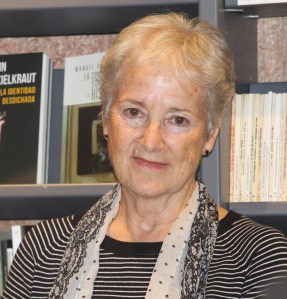
    img_4751Sarah O’Connor is originally from Tipperary. She studied in UCC and Boston College, and she now lives in Dublin. She previously worked in publishing and now works in politics. She is 34. She is working on her first novel and on a collection of poetry. She has been published by Wordlegs and The Weary Blues.
     
    Sarah O’Connor blogs at The Ghost Station & tweets at @theghoststation.
    Poemín and other Poems by Sarah O’Connor


  • “The Pathologist’s Wife” and other poems by Natalia Spenser

    April 23rd, 2016

    For Sylvia-Down in Adoration

     
    You were Fulbright a seismic enigma
    the fleet foot hare rising in pastel dusk.
    It stalked like crows in the breast of a man
    who sold your head for hapless wanderlust.
    Your damage was like splintering of glass.
    Could he not understand what it is to be
    a milk jug, wasted lipstick, the outcast
    shadow hung from a star-struck hemlock tree.
    But a quiet voice is so more loquacious
    than a risen phoenix roaring through air.
    Maybe now is the time for tempered hush
    time to weave your bridal crown through red hair.
    He brought Devon sea shells to your headstone
    you were his lotus his night passage glow.
     

    For Jane Kenyon

     
    Ten years on, while storm buffets glass and juniper,
    snowflake tiers inside my porch
    finger an army of miniature baubles.
     
    The plastic robins perch lopsided. Even
    that new star, a rushed afterthought, curtseys
    on its axis where a black one legged doll should be.
     
    Dear Jane I never met you. But I guess your mother
    was at the station with pasteboard suitcases—ready
    to sew broken limbs together again.
     
    Now as I make end to season,
    with more than a single strand of tinsel,
    I nest plywood angels and churches
     
    for a woman who breathed cypress and pondered why
    only nightjars or silver fish
    knew how to take shadowless flight.
     

    The Pathologist’s Wife
    
    Taken as a whole she is like any other woman 
    one heart four chambers one brain eight lobes
     
    If I place them in your gloved hands	her weight
    is less than a pre-term infant
    
    this woman	mute monkey on one shoulder
    zealous cat on the other
    
    At the edge of night she wears a cowl of thorns 
    the spines draw blood if I forget to soften my touch
    
    Whatever moves between bright thought & Tahitian body
    Gauguin’s veneer is noted	full mouth
     
    broad nose	hair above her lip	the nest
    of a bird humming at her wishbone		& if
    
    you crystallise sadness	look close 
    under a microscope	you find
    deep sea brittle stars	in that one rare tear
    Natalia - CopyNatalia Spencer B.A lived in North Africa at the start of her life & now inhabits a quiet niche of South West England. Like most writers she knows, she has family, cats, many books. Her flash fiction has appeared in Kissing Frankenstein and other Stories, & Flash Frontier. In 2015 she won The MSF Silver Award for Best Poem from Visual Stimulus. More recently she has poems published in The Poetry Shed & various magazines. She is working towards her first collection.
  • “Tea with Akhmatova’s Cat” and other poems by John Sexton

    April 23rd, 2016

    Tea with Akhmatova’s Cat

     
    I’m having tea with Akhmatova’s cat
    who purrs in English passable enough
    that half-wit mice can follow what she’s at.
     
    She speaks in metres forcible but flat:
    a mix of Milton, Keats, hairballs and fluff.
    I’m having tea with Akhmatova’s cat.
     
    Quite bored, I count the fibres on the mat,
    pretend I’m listening, fake attention, cough.
    The half-wit mice can follow what she’s at.
     
    Her ginger body trembles in its fat,
    remembers pogroms, deaths, and other stuff.
    I’m having tea with Akhmatova’s cat.
     
    The truth is, I’m not worthy of her chat,
    miss the point, even though it’s not so tough
    that half-wit mice can’t follow what she’s at.
     
    The cat consumes the mouse and that is that;
    in canine jaws the cat will know its worth.
    I’m having tea with Akhmatova’s cat;
    the half-wit mice can follow what she’s at.
     
    John W. Sexton
    From the collection Petit Mal (Revival Press, 2009)
     

    The World under the World

     
    It is midnight with no moon. The sky is dulled
    with cloud and the stars burn above unseen.
    The old woman carries a lantern and swings it
    over the long grass; the grass reveals its own tangle
    of shadows. She is looking for the seam of the hill,
    where it was sewn tight before her mother’s mother’s
    mother’s time. She was told of it when she was a child,
    but neglected the task of unpicking it. Unpick the seam,
    she was told, and the true world will be able to get out.
    An owl passes overhead and she looks up. In the gleam
    of the lantern the owl’s work is clear. It is weaving the air
    tight, so that the true sky is held back. Her bones are stiff
    and a tumour is growing in her brain. From the woods below
    a dog barks three times, three bites of the night. Her mind
    will soon be tangled thick as a kittened skein. In the hilly
    meadow she finds a thick ridge under the grass; the ridge
    travels the height of the hill. This is the seam she seeks.
    Setting the lantern carefully down in the uneven ground
    she bends to her task. But she knows she is far too old
    for it now. A snake passes under her and follows the ridge,
    and she knows it is tacking an extra thread into the seam.
    She falls exhausted. The lantern gutters and everything
    is dark. The owl passes overhead once more. The true sky
    has no hope of returning. The true world will remain
    deep in the hill. The old woman drifts into sleep. If she
    can sleep a thousand nights through, her true mind
    might return. In the morning her lantern will be found,
    cold in the grass. There’ll be no sign of herself, not even
    a thread from her shawl. She’ll be searched for, the entire
    height of the hill. But in sunlight she’ll be too frail
    to be seen. Eventually she’ll become a story; then
    a mere rumour. Some dusk perhaps, or on many dusks,
    her voice might be heard in the meadow. If it’s ever her
    then the hearer will know that it is merely the complaint
    of one who is waking before a thousandth night is up.
     
    John W. Sexton
     
    First published in The Stony Thursday Book #14, Edited by Mary O’Donnell
     

    A Father Escapes by Rain

     
    Daddy’s grassy fields had been driven in
    by the feet of cattle; a stone-black bull,
    throating complaint, shone from the rainy hill.
    She took nine steps up steps of exposed stone,
    slippery rocks that jutted through the grass,
    until she stood before the bull, his head
    massive, his hide grazed where earlier he’d shoved
    his way out of the bull-shed. The bright brass
    ring, like an ouroboros of golden snot
    pinched through his nostrils, hung with a milk
    of lesser snot. The bull puffed rancid breath,
    stepped through her as if she was fog, a silk-
    nothing like the rain itself, sopping rot.
    Daddy’s constant rapes would keep their secret.
     
    John W. Sexton
     

    A Matching Coat for Her Man

     
    With each step her bare feet
    un-silvered the dewy grass.
    The blossoming furze, buds
    tipped with rust, unwound
    in bursts of birdsong. With
    a long pointed twig she gathered
    a skein of spider’s silk, dismantling
    web after web onto her stick.
     
    Under the flickering dust-light
    of moths, her shadow seated
    beside her, she made a coat
    from the gathered strands. Made
    a coat for her one true man, one
    he could wear for the fog, stepping
    visibly invisible as smoke, one
    that would be lit by the sun.
     
    Or, lit by the moon, one he could
    wear to be bright as the stars, one
    he could wear stepping out
    with the hares; light as the air
    he’d take her hand, and down
    by the long lane they would walk,
    their long grey coats a-stuck,
    moth-light bleeding around them.
     
    John W. Sexton
     
    First published in Sixty Poems for Haiti (Cane Arrow Press, 2010)
    Edited by Ian Dieffenthaller and Maggie Harris
     

    The Witch

     
    With a laugh like a clattering shutter
    the magpie flew into the bedroom, knocked
    bottles of perfume from off the dresser,
    scattered her underwear all over, picked
    one fine golden ring from out of its box,
    then out through the billowing curtains, out
    into the trees that had escaped the axe,
    the border of willow yet to be cut,
    and flinging the ring straight into its craw
    began to shout like a jester gone wild.
    So when she came wet from the bath and saw
    the perfume spilling from jars, the unpiled
    clothes and mess, she slipped the latch of her tongue
    and cursed the bird, who withered bone by bone.
     
    John W. Sexton
     
    First published in Cyphers #46,
    Edited by Leland Bardwell, Eiléan Ní Chuilleannáin, Pearse Hutchinson & Macdara Woods

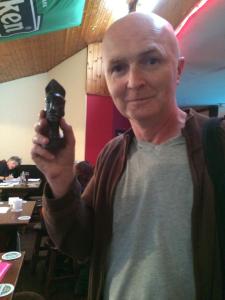
    John W. Sexton is the author of five poetry collections, the most recent being Petit Mal (Revival Press, 2009) and The Offspring of the Moon (Salmon Poetry, 2013). His sixth collection, Futures Pass, is forthcoming from Salmon. Two novels for children have been published by the O’Brien Press: The Johnny Coffin Diaries and Johnny Coffin School-Dazed, which have been translated into Italian and Serbian. Under the ironic pseudonym of Sex W. Johnston he has recorded an album with legendary Stranglers frontman, Hugh Cornwell, entitled Sons Of Shiva, which has been released on Track Records. He is a past nominee for The Hennessy Literary Award and his poem The Green Owl won the Listowel Poetry Prize 2007. Also in 2007 he was awarded a Patrick and Katherine Kavanagh Fellowship in Poetry. Recent poetry has appeared in The Irish Times, The Edinburgh Review, The Ogham Stone and The Stony Thursday Book 2015.

    John is a pagan and Muse poet, believing in the Goddess of Complete Being. His poetic process encompasses the literary traditions of Metaphoricism and Magic Realism.

  • “We Did Not Choose The Sea” and other poems by Philo Ikonya

    April 18th, 2016

    Unrecorded

    Stone music
    When your music rises
    from your grave in flower
    and some stones quiver
    and sing notes musical
    I hear your voice

    When music pricks the air
    from a needle in friction
    and touches the first traction
    molecule of air-kissing your ear
    I have memories

    When your words attach a molecule
    of air to another and in you we
    breathe, sing and live in hope
    when we cannot forget we rise
    I sing my soul your language

    Our hair is proud and sings on air
    When loving is truly spoken
    It is in your ear in seconds
    in your heart and mind and soul

    Add warmth and fire to it
    Your own interpretation original
    Your body moves in dance
    Still you rise, still you rise, dance
    and fall and rise from the grave in flower.


    Weave your joy

    With the tips of your fingers
    And all of you like the
    Orchestra conductor knows that music
    Know your body:
    Its heart drum
    Piano toes…

    The epic of weavers undaunted
    the road to the market is mine
    my head is a carrier of universes
    I know my step is in space
    and those arrows you see on my cloth
    have known many lights…
    nights and colors

    Recognition that ignites
    when that face you see again out of nowhere comes
    Suddenly feelings surge
    blow and rage a real storm
    inside
    Heart shaken like a vessel love-filled bubbles
    Feel every nerve awake
    Blood rush blush…
    Something lost now
    rare since a screen touch keeps
    telling where and how you are
    Soon surprise will be ancient human feeling…ouch!


    trembling dreams

    You wake me up each time
    but I dream on with hope
    You tell me children cannot
    eat dreams in a poem
    But when I look I see them
    only clad in dreams
    the only pants they wear
    that you cannot tear

    I have sat and mended endlessly
    and washed with tears
    things mention would tear this paper
    things surfing in my soul

    Come again, enlarge my spirit
    into dreams and let me sleepwalk
    and stalk in my talk so many ghosts
    Until I ring my bell of peace
    and you fall out of your fantasy
    and see saints sainting without fainting.


    We did not choose the sea

    philo 6.1.2014

    When we found them washed ashore
    they were barely alive but still breathing
    We spoke for the voiceless they
    said, many times, and now speak to us
    and for us and with us share this breath

    We shuddered at life’s turns and twists
    when the madding crowd kicked them hard
    They slave them again, they do, their voices
    deadly drilling the stones so alone intone.


    Longing

    Solitary times teach
    so loudly that silence
    grows so deep and speaks
    a new language: And now
    Let me see my love, let me
    hear my hope, touch my faith
    Let me taste our belonging in fragrance
    It has been so long and I have
    a new alphabet to share with life.


    Come

    You come closest
    to my chest and tell
    me in my own tongue
    that you are my latest thought
    the fount sings unending
    the ocean rises as the rivers dry
    and we see the stones still
    washing and washed

    Humans never understood
    color then, never not in
    all those matches in design
    Not in all those pastels in
    cake and bathroom tiles

    Not in all that whiteness
    and darkness in the broods of life
    We so challenged by the sun
    without which we wither
    think
    color must be bright
    and I know
    that we have not understood color
    Cold
    We have not got it in color
    We attach to it not the warm sound
    that leave our mouths to cut the air
    frightened of it we are when it rains
    purple
    and now we know that sign
    like we have worshipped the rainbow
    for years.


    Round the rock

    Roots then finding
    their way blindly down
    trying you
    to pass they go this way
    and that
    through soil finding you
    and hugging you

    You sing to them the
    song of beginnings you
    play for them the sound
    of the music of their birth
    the sign of life
    Do not be sad you are
    not in a foreign land you tell
    them as they move

    Rain
    falling finds those still
    thrusting roots

    Yours of stone
    you have them
    and the roots of a tree
    carrying generations into
    this other freedom so hidden from
    our eyes
    that the place of gray we think
    but we never understood

    Here to go, everyone has a visa
    given by the first cry, your life and
    friction before in your forbearers
    Here to go, everyone, is in song

    Hug us rock and break us
    as we broke you, break our wood
    and if we are ashes, kiss us rock
    and let your hardness be the crook
    of Our Mother’s arm, so soft

    We Did Not Choose The Sea and other poems © Philo Ikonya


    Philo Ikonya is a writer, lecturer and human rights activist. She is the President of PEN Kenya. She taught semiotics at Tangaza College and Spanish at the United States International University in Nairobi. She graduated in Literature and Linguistics (The University of Nairobi) before reading philosophy in Spain and Italy. She worked as an editor for Oxford University Press (Eastern Africa). Born in Kenya, Philo speaks Kiswahili, Gikuyu, English, Spanish and some Norsk. She has a grasp of Italian and French. Philo is a mother of one. She is currently living in exile in Norway.
    .
    Her fiction includes two novels, Leading the Night and Kenya, will you marry me? She has published three poetry anthologies: This Bread of Peace, (Lapwing) Belfast, Ireland, and Out of Prison- Love Songs translated into German (Aus dem Gefangnis Liebesgesange). Philo is a Pan-Africanist.

    • http://www.pen-international.org/who-we-are/board/philo-ikonya/#sthash.tasg0SKN.dpuf
    • Barefoot and Boldly Kenyan
    • Nightbird
  • “Imitation” and “Tattooed Girl” by Maggie Breen

    April 12th, 2016

    Tattooed Girl

     
    She had wings,
    big and black,
    tattooed on her back.
     
    They reached up
    above her flimsy top,
    as if she might take off any second.
     
    They looked strong, powerful;
    I envied her conviction,
    her dedication.
     
    Did it hurt much?
    Did she feel the blood bead on her young skin,
    with every touch, every prick of the needle?
     
    A modern Cleopatra clad in black
    with dark, dark eyes, she intertwines
    her silver-laden fingers with another, I presume her lover.
     
    I never saw her leave but could have sworn
    I felt cold on the back of my neck,
    a shiver and then nothing.
     
    (Tattooed Girl appeared in The Stony Thursday Book in 2015)
     

    Imitation

     
    I trudge through the winter sales
    trying on one coat after another
    but none look right on me.
     
    In the mirror
    I see myself,
    younger,
    flat-chested,
    ugly,
    in Mammy’s
    good, wool coat,
    too big for me,
    the weight of it
    and the smell
    of her Tweed perfume,
    familiar, reassuring.
     
    I remember her
    putting her coat on
    over normal clothes,
    on her way out the door
    to a funeral,
    brushing her short,
    greying hair roughly
    in the antique mirror
    over the fire.
    I imagine her
    at the grave,
    respectable,
    her gold peacock brooch
    pinned to the front,
    shaking hands,
    sorry for your troubles.
     
    I soldier on,
    determined
    to look like
    a proper woman
    should.
     
    (Imitation was published in The Stinging Fly in 2012)

    Pic: John Walsh Maggie Breen, author of 'Other Things I Didn't Tell' pictured with her parents Rose and Paddy and her boyfriend Liam McMahon at the launch of her Poetry Collection in the National 1798 Centre.
    Pic: John Walsh

    Maggie Breen’s debut collection of poetry, Other Things I Didn’t Tell, was published in 2013. She was long-listed for the Fish Poetry Prize in 2015. Her poems have been published in The Stony Thursday Book, The Stinging Fly, Crannóg and Southword, among other publications. She was guest editor for The Scaldy Detail 2013. She has performed readings at the White House, Cáca Milis Cabaret, Kildare Readers’ Festival and Ó Bhéal, among others. Her short radio documentary Murt’s Eggs was broadcast on RTE Radio One in September 2014. She is currently working on a second collection of poetry, as well as other projects. Born in Wexford, Maggie lives in Dingle, Co. Kerry.
    .

    Maggie Breen’s website

  • from “breath(en) flux ” by Michael McAloran

    April 9th, 2016
    I

    #

    .…silence yes/ silenced yes/ as if to ever
    having done with it/ stripped solace no/
     
    vital lapse in all depth of becoming-un/ as if
    because it were unto/ ash unto/
     
    no/ pure as never was/ ever was/ given to
    yet it cannot/ asks of dust what climb or
    other than /
     
    dry reach in catascopic/ hence shadow never
    vital/
     
    all traces then forgotten/ yet given to un-
    forgot/ blind edge laughter/ afar/ no/

    #

    clamours afar/ yet nothing to it/ in banquet
    of nothing no not a/

    hence shadow’s dissolve in bit night balm/
    well-spoken silenced/

    of ghost-limbed rapture no/ call cards as if
    to/ dissolve yet surface of what to it/

    spit in eye of eye of it/ no/ traipse till yet
    un-afar a-light unlit light of silhouette dark
    what dark/

    yet for as if to/ not a sense of all’s retrace/ of
    fading nullity/ ever only of it/ spliced no
    not ever…

    #

    …further echo further no/ as if to say that
    no/ non further yes/ silenced in stripped
    silence of/

    rapture suffocate in which a-dream/ not a/
    vibrates yes yet lack of sounding all colours
    clear/

    waste upon waste/ useless forage/ nothing
    that ever was/ ever was or if/

    what will in-speak derivative of what or
    else/ blood can only ever be/ what can be/

    unspoken detritus desire demarcate/ dim
    light of eyes all dredged/


    #

    speaks yes or no no answer collapse of/

    fallen flourish/ being in/ silence in/ yet not
    a trace there is yet / silenced/ two three
    what can be/

    opens up in head of time spent forgotten/
    fade of five steps/ back or forth no matter if/

    dries eyes with waxen what bodily volatile/
    reduction of all/ bind bite what what/

    time rotting within skull of gild/ meat
    locked to/ breath silencing allwhile…

    II
    #

    …in breathless of/ all suffocate’s desire in
    realm/ forgotten closure fissure fissure ice
    until/

    drag of tilt till shear of open spasm/ flail
    naught un-sky/ dressage vortice no/

    yet given of until/ reduct blind forage
    empty emptily/ walls seep solace rupture
    eye/

    eclipt drags out all what once was once or
    ever other than in if/ ashen dislocate/

    resurgence/ resurgence no/ head drowns in
    bloody latrine clear glass/

    #

    ruptures rails in absent sense derail/ cracks
    blind all shadow deft until/ light snap
    stone/

    dirt in trace reduct/ fallen/ haven yes or no/
    price of elective/

    price of unsung what reach of purpose
    strips death cloud from eye/ frozen breath
    collapse/

    juggernauts too/ two or four/ fore/ of a/ not
    a/ resurgence nothing cracks here or ever
    unto/ dead head disarm/ rolls dice around
    on lacerate of tongue/ spits lest dawn…

    #

    …expels from out of which/ desire silence
    breathless overtures/

    oceanic collapse/ drags din wind collision
    of/ sun forgotten/ worthless/

    in click-clack steel bone drag hilt no/ rots
    clap hands/ drained ever/

    ever on yet what from purchase present
    nothing was whatever was/

    cold walls in which to/ collapse un-dread re-
    dread/ head in vice of cold colours/
    trick of light/

    #

    blood from out of forage ever-no/ steers eye
    unto further no further distance/

    screams out from it/ visage no/ warped
    bones ever all/ all lies all present and
    correct/

    bitten white light silence breakage point
    was once spoken or was not/ bites again/
    rain rain in obsolete pulse bulb/

    there is spit/ there is shadowing untold/
    light’s corrode/ dead laughter realm/
    bruised/ tacit/ stammers once more as if it/
    silence silence/ rotting colours abound…

    III
    #

    …in-dreamt capacity/ trades meat for
    absent shores/ given less/ shadowed no/

    nothing dreamt of furtherance become yet it
    cannot/ furtherance of which in else of other
    lessened/

    meat trade in opulent unsound it trace
    nothing/ unsound retrace un-meat of fallen
    ash/

    of prism pillage traces/ yet drains of/ there
    or other/

    collapsed purpose unfelt in an un-sky of
    shatter-glass abattoir/

    .

    #

    distances that never were unforgotten/ in
    stench reek to abound one step shit flow in
    veins/

    it is cold it is not/ collected from/ wayward
    sentence as flies gather in/ if said what once
    was never once/

    opulence/ circling skulled veins what
    matter (the) vultured teeth of it/ scar tissue
    un-livid/

    naught a closed wound apathetic/ apathetic
    stretches boundary tint/

    collapse still yet nothing pressed to the
    bone’s collision/ unspoken of…

    #

    …echo erased that never heard was not of a/
    design utter violet sheer/ cold cast a bitter
    a/
     
    longing stretched/ meat solace of which of
    eye in-dream/ else collision solace final/
     
    redeem non-touch meat cold as ever was
    before lapse eye a sleight of hand/
     
    nothing to follow yet cannot/
     
    etches from out of nothing furtherance
    undone resolve forgotten/ rotted meat a
    blister here/
     
    #
     
    solace fracture/ another’s density/tomes
    cast dead no sentence in only of ever-like
    fettered resound/
     
    yet cannot sense/ un-sensed/ a locket/ in-
    breath of sarcophagus eye given to fall/
     
    long foreign hours never to be proven/ yet
    what what longing/ else of none/
     
    till dense approximate/ crumbling
    measurements/ trace cold dead teeth a sneer
    at the unutterable/
     
    pressure point of long non-stir/ into utter/
    cold meat as ever was before/
    before having…

     
    from breath(en) flux & © Michael McAloran

    Michael Mc Aloran is Belfast born. He is the author of a number of collections of poetry, prose poetry, poetic aphorisms and prose, most notably Attributes (Desperanto, NY, 2011), The Non Herein & Of Dead Silences (Lapwing Publications, 2011/ 2013) Of the Nothing Of, The Zero Eye, The Bled Sun, In Damage Seasons (Oneiros Books (U.K)–2013/ 14); Code #4 Texts a collaboration with the Dutch poet, Aad de Gids, was also published in 2014 by Oneiros. He was also the editor/ creator of Bone Orchard Poetry, & edited for Oneiros Books (U.K 2013/ 2014). A further collection, Un-Sight/ Un-Sound (delirium X.) was published by gnOme books (U.S), and In Arena Night is forthcoming from Lapwing Publications. EchoNone & Of Dissipating Traces were also recently released by Oneiros Books. breath(en) flux, a chapbook, was recently released by Hesterglock Press.
  • “Satellite” and other poems by Roisin Kelly

    April 1st, 2016

    To a Writer

     
    You write of raspberries and snow
    of the mimosa flower’s scent
    of how it makes you feel to put on lipstick
    and heels. Of how it feels to wander home
     
    below the stars, drunk but not too drunk
    how you always like to show a little cleavage
    though you never undo more
    than the top two buttons of your shirt.
     
    But there’s so much else I’d give to you
    like the full pale weight of your breasts
    bared to the world and wild.
    During menstruation, don’t stay in
     
    breaking chocolate before a laptop screen:
    dip your fingers between your legs
    and stain your face with red.
    Write down all of last night’s dream
     
    not just the parts with crystal seas
    but the parts you’d rather not think about.
    Drink whiskey until you vomit.
    Stand on a beach in your bare feet
     
    and cry about the guy who betrayed you
    but comfort yourself also
    with thoughts of his drowned body
    his groin now a home for nibbling fish.
     
    For the last time, I give to you one
    of our mornings at the Claddagh
    where we used to meet and drink coffee.
    Take this pain-au-chocolat
     
    in your hands, tear it in half
    and devour its fragrant cloud
    down to what you so desperately desire:
    the dark liquid heart of things.
     

    The Morning After

     
    She leaves the holiday cottage early
    thinking we’re all still asleep. I hear the latch’s rise
    and fall, the click of the closing door.
     
    Lying in bed, I picture her walking down the lane
    past fields of wheat, and tiny gardens already vivid
    with islanders’ clothes hung out to dry.
     
    I imagine her on the beach, shading her eyes
    against the sea’s neon-green, stabbed here and there
    with the black knives of sea-stacks.
     
    A gull circles, its cry like an accusation.
    I know she’ll have knelt where waves crawl to foam
    and have started digging a hole.
     
    The tide will rush into the hole as many times
    as I poured wine into her glass last night
    while the others drank at the harbour pub.
     
    She’ll bury the things that weren’t hers to keep:
    the wine-cork, the used matchsticks, the candle-stub.
    Later, when she returns, the kitchen is filled
     
    with the smell of frying bacon, its red hiss.
    Someone’s made tea, they call for a towel
    to swaddle the pot and keep it warm.
     
    I keep my back to where she stands at the door
    and crack eggs one by one in a bowl.
     

    Unforgiven

     
    The sun sinks blood-red beyond the plain.
    My horse continues towards its closing eye
    step by weary step. Between my hands I grip
     
    the saddle’s leather, feel at my hip
    a pistol. A coyote howls a warning to the space
    between the setting of the sun and the rising
     
    of the bone-white moon, and you are unforgiven.
    I will find you, my lover, my condemned sinner
    and when I hunt you from your hidey-hole
     
    even the familiar stars will show no mercy.
    I know every rock and twisted tree that marks
    this barren place. I know my way in the dark.
     

    Satellite

     
    On the bench where we first kissed, I sit alone
    above the city. The scent of roasting hops seems to come
    not from the brewery but from the Plough’s
    starry saucepan tilting in the sky. I trace
    its crooked handle, and remember how you cooked for us,
    standing at the stove’s heat and stirring onions—
    your movements as tender as you wanted them to become.
     
    I stood beside you, watched the slivers turn translucent.
    Last winter, when infatuation spread through me
    like a cancer, I could have stayed on this hill
    forever, where you put your downy Canada Goose coat
    around my shoulders, and rolled joints
    with your cold hands. Clusters of orange streetlights
    on the opposite hills dazzled my eyes,
     
    stuttering here and there with the stray, rogue cell
    of a traffic light changing from green to red.
    These city lights no longer trap you in their honeyed glow
    but my stars are still the same as yours. From your country
    do you see that satellite drifting through the sky
    like the ghost of you growing fainter by the minute?
    I follow its patient path until it vanishes,
     
    slipping butter-smooth past the horizon.
    How long until it returns? Passing and passing
    over the world, over my city replicated in miniature: bars,
    cafés, cathedral spires, this hill, this bench.
    Will you spend Christmas alone? If you shook the globe
    containing the perfect scene you left me in
    I’d feel the earth move, but it wouldn’t snow.
     

    Laundry

     
    It was one of life’s thoughtless routines,
    lifting your clothes from my floor.
     
    When I find some of your old shirts again
    I hold them as gently
     
    as if they’re fragile eggshells, the warm
    yolk of life gone from them.
     
    I know what it’s like to feel as empty
    as a man’s unwashed shirt.
     
    For the last time, I wash your clothes
    with my own; for the last time
     
    I perform that domestic ritual of love.
    Our clothes hang side by side
     
    once more: mine bright, yours dark.
    Damp cloth, the scent of floral detergent.
     
    Cherry blossoms in April,
    two people caught in a sudden shower.
     

    Christmas, Cork City

     
    Our first date was on Christmas Eve
    when we wandered the streets, past candlelit cafés and bars.
    On the courthouse steps we cracked open beer cans
    like a precious clutch of eggs, drained their cold yolks.
     
    A traffic light swung like a bauble in the liquid black
    of your pupil—the red of a single, dangerous berry.
    You struck a match for your cigarette. At the same moment
    my mother lit the window’s candle back home
    so Mary and Joseph would know they were welcome.
     
    Oh lonely orbit of stars and traffic lights.
    I waited in the city’s desert darkness
    for the glimpse of gold beyond your drawn curtains—
    for the promise of a threadbare sofa to lie on,
    of bread and wine on the table. Of the three gifts
    of your eyes, your hands, your lips.
     
    That night, the earth would slow in its turning
    before a new sun began to rise,
    tearing itself into existence between the old, known world
    and some fiery entrance to elsewhere.
     
    Satellite and other poems are © Róisin Kelly

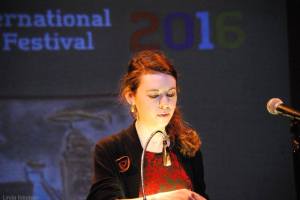
    Picture © Linda Ibbotson
    Picture © Linda Ibbotson

    Roisin Kelly is an Irish poet who was born in Belfast and raised in Co. Leitrim, and has since found her way to Cork City via a year on a remote island and an MA in Writing at the National University of Ireland, Galway. Her poems have appeared in Poetry Chicago, The Stinging Fly, The Timberline Review, The Irish Literary Review, Synaesthesia, Aesthetica, The Penny Dreadful, Bare Fiction, The Baltimore Review, Banshee, and Hallelujah for 50ft Women: Poems about Women’s Relationship to their Bodies (Bloodaxe 2015). More work is forthcoming in Best New British and Irish Poets (Eyewear 2016).

  • An Excerpt from “Delicate” at MarsPoetica (HiRISE), Single Poems

    March 29th, 2016

    tumblr_o4ruyviVrt1rlz4gso1_1280

    Delicate

    A sea snail, most precious egg, as if
    it had touched the ruby feather of a
    bluebird. A most precious thing,
    bird-egg-shattered, dust in my pores.
     

    This excerpt from “Delicate” is © Christine-Elizabeth Murray.

    When we widen the lens, the bigger picture can be divorced from the reality that we think we may have momentarily grasped. The above poem is an excerpt from “Delicate” which is being submitted to an Irish Journal at the present time. I expect I will publish the poem in its entire at some later point. BUT here the poem is performing an imagistic collaborative function and I am very grateful to Ari who notified me of the #BeautifulMars and #MarsPoetica project via the Poethead Contact form. I hope to have more news on #MarsPoetica for readers and contributors to the blog soon !
    About HiRISE (HIGH RESOLUTION IMAGING SCIENCE EXPERIMENT): The HiRISE camera onboard the Mars Reconnaissance Orbiter is the most powerful one of its kind ever sent to another planet. Its high resolution allows us to see Mars like never before, and helps other missions choose a safe spot to land for future exploration.

    NASA’s Jet Propulsion Laboratory, a division of the California Institute of Technology in Pasadena, Calif., manages the Mars Reconnaissance Orbiter for NASA’s Science Mission Directorate, Washington. Lockheed Martin Space Systems is the prime contractor for the project and built the spacecraft. The HiRISE camera was built by Ball Aerospace & Technologies Corp. and is operated by the University of Arizona.

    ♥Delicate at MarsPoetica

  • “The Aunties” and other poems by Josephine Corcoran

    March 15th, 2016

    Honeymoon

     
    I wouldn’t call it a honeymoon,
    those muffled nights in mothballed rooms.
    With cake in the boot we pilgrimmed north,
    taking a young marriage to old widows,
     
    my father’s brothers dead,
    their crucifixes still hanging.
    In each house we were given the double bed,
    my aunties inviting us to fornicate
     
    on concave mattresses holding dead men’s
    seed. Had we come one week before,
    you would have been given nothing
    but dusty blankets on a downstairs floor,
     
    and I would have sunk, alone and deep,
    into the mildewed sponge of a cousin’s bed.
    My aunties would have spread
    as wide as angels in their marital sheets,
     
    their doors ajar, the solemn whispers
    of their night-time prayers beating
    as sweet as deathbed love-making.
    But our wedding vows were said,
     
    so we sipped tea on upright chairs
    still dimpled from Brylcreemed heads,
    and rolled like screws in sideways jars
    on shelves in locked-up sheds.
     
       Seven years,
    one son, one daughter later,
    Jesus has been sent to us.
    (The aunts are gone, their houses stripped)
    His legs are broken (long marriages skipped,
     
    thrown into landfill) and we laugh
    when our little children ask about our honeymoon.
    I see you dreaming down our garden path
    as you hold the broken body in your hands.
     
    He was nailed to the Anaglypta. You are picturing
    the twist of wire you’ll use to bind his legs;
    the nail, the hammer, the spirit level, the pencil
    mark the place he’ll eternally outstare us.
     
    I love the way our daughter sings
    as her finger traces our wedding rings.
     

    Dead Sisters

    Maria and Elizabeth Brontë, died aged 11 and 10
     
    So young to be marooned here,
    we spend our pain on travelling
    dreams, skating over frozen seas,
    following their inky maps,
    our boats to Gondal trapped
    on battered moors. We straddle
    the backs of galloping hares,
    fly flat on the wings of marble-
    eyed hawks grown dragon-sized,
    since in our dreams we are
    as tiny as toy soldiers.
    We cry for them to carry us
    beyond mountains and frog-filled lakes.
     
    They shake in their beds.
    The travelling box lies waiting.
    We tiptoe on lopsided floors,
    watch the news from Angria
    ripple over them in sleep, whisper
    We mustn’t keep you any longer.
     
    They have laid out shadows
    and attics and mists.
     
    We disappear.
     

    The Aunties

     
    Brewing tea in our kitchen
    we snort, remembering you screaming
    to your mother we were witches.
    Behind her back
    we flew to fetch biscuits,
    you said. We were trees in the dark
    who followed you home,
    the lampposts that tiptoed after you
    to blind your unclenched eyes.
     
    We fed you trifle, persuaded you
    we hadn’t eaten your mother,
    that shadows were not black blood
    against a sunlit wall. You understood
    she was drinking wine,
    there was no hole in her side
    where we’d ripped you from her,
    and you knew that knives were for cake
    and the crusts of sandwiches.
     
    You threw careless waves to your mother,
    ran into our house like a spring tide,
    the seagulls laughing;
    the old tricks had worked again.
     

    Gasps and Sighs

     
    Is it because
    we fell from our nests
    before we knew
    we had wings?
    that we remember
    our heads crowned
    in pain? our upended
    legs? is it because
    our wombs are
    falling? a lament?
    does all this explain
    the gasps and sighs
    we hear on landings,
    through half-opened
    doors, when we are
    burglars at the top
    of the stairs,
    imagining ourselves
    beating through
    rooms, stealing
    nothing?
     

    Thanks for Not Switching Me Off

     
    I’ll have no concept of time
    so, no rush, and I may fail to respond
    to painful stimuli,
    and to sound, but don’t let that stop you
    from playing me The Three Degrees
    singing When Will I See You Again?
    because even though I may be oblivious
    to the doctor tipping light in my eyes
    from her sterilised torch,
    that doesn’t mean I won’t see again
    Miss Travis,
    Miss FitzSimons
    and Mrs Cuthbertson,
    or rather, three sixth-form girls on the stage,
    done up as them, in gabardine raincoats,
    sturdy shoes, clear plastic rain bonnets,
    doing the moves, singing
    hooo_ooh, haar_aarr,
    precious mo_ments!
    (The Three Degrees Fahrenheit! came the shout)

     
    and wheeled to the daylight
    I’ll shake again,
    a laughing girl again
    in a sea of other laughing girls –
    when the future flung open
    the world’s windows,
    our lives soared in.
     
    I’ll fly again with oxygen in my blood –
    that was the first time I understood love
    when I dared to look at the three of them
    on the day of their retirement.
    They laughed too,
    their rock-hard curls trembling,
    tears bright
    on their bat-wing glasses.
    We never knew
    if they liked the carriage clocks,
    if they ever set
    their hearts ticking.
     

    I Remember the Fear of Forgetting

     
    I remember the fear of forgetting
    the Austro-Hungarian Empire
    under the cuffs of my school blouse.
    Archduke Franz Ferdinand
    and Sophie, his pregnant wife, are hiding
    in my pencil case. The Black Hand,
    Bosnia-Herzegovina and Serbia
    aren’t visible until I creep
    my skirt three inches up my thigh
    and Sarajevo, 28 June
    1914 is folded so small
    it’s a blister on the sole of my foot.
     
    I take Gavrilo Princip to my lips;
    I would rather swallow ink
    than hand him over.
     
    The Aunties & other poems are © Josephine Corcoran

    downloadJosephine Corcoran left school early with few qualifications. She returned to full-time studying when she was 30 which was when she started writing and submitting her work for consideration. She has two BBC Radio 4 credits, for a play and a short story, and one of her plays was produced at the Chelsea Centre Theatre in London. She has been writing poetry seriously since 2010 when she was a runner-up for the Bridport Prize. She has been published or is forthcoming in, among other places, The Rialto, Under the Radar, The Manchester Review, New Walk and Poetry Wales. Her pamphlet The Misplaced House was published by tall-lighthouse in November 2014. She edits the poetry site And Other Poems.

    • http://www.josephinecorcoran.wordpress.com
  • “Mother’s Cradle” and other poems by Maria Wallace

    March 15th, 2016

    On the Great Blasket

    The wild rose briar scorns
    the garden rose,
    and jutted from the deep,
    this island scorns, defies life
    from sunrise to the midnight moon.
     
    Certain of approaching
    endings, in a lamp-lit room
    bean a’ tí Peig voices island stories.
     
    I sit alone
    on a sun-warmed stone, hear,
    entangled in the west wind,
    the whirl of her spirit
    hug this grassy hillside,
    those bleached dwellings below,
     
    and below that,
    rock-battering ocean waves
    ride off
    with particles of that past.


    Under the shadow of birds

    Black birds,
    she thinks they are ravens,
    hover over her
    for the past eighteen years.
    Their coarse croaking cries
    drown all other sounds;
    dark plumage shines
    as they circle around
    ready to destroy
    the little she still has:
    a neat house for two. Neat.
    For two. Even under attack.
    Not a speck of dust –
    the aroma of fresh baking
    rejoicing through the house,
    though, the birds’ shadows stab,
    their long bills tear her innards.
     
    One May afternoon in the cul-de-sac.
    Her toddler son in a group
    playing Simon Says,
    and Hop, Skip and Jump
    a few feet from them.
     
    A screech of tyres always tells a story.
     
    Her doctor said
    another baby would help the healing.
    The first flock of black birds swooped down
    when her husband said:
    Another baby?
    No way! You couldn’t look after
    the one you had
    !


    Morning sounds

     
    My waking is not
    to electric saw sounds,
    hammering, voices and timber clatter.
     
    In absence of the familiar,
    I hear seagulls’ noisy squall
    from opposite ridge-tiled terracotta roofs.
     
    Sunlight chinks filter through
    the window shutters’ wooden lattice.
    I remember a shaft on mounds
    of delicate wood shaving curls,
    a man talking about grain, knots,
    plywood, ash, pine, sawdust under
    finger nails, caught in eyelashes.
     
    I open the window.
    Faint sobbing from room below tells
    his tree of life has taken the final blow.
     
    On wrought-iron rail
    last night’s raindrops tremble,
    begin to dry under sunlight.
     
    The seagulls fly away.
    I face the day,
    reluctant.


    No death in the afternoon

    i.m E. Hemingway. Sunday, July the 2nd 1961
     
    You woke before the sun
    showed over the mountains
    east of Ketchum, before it had time to touch
    a greeting on your window.
     
    With bathrobe and slippers, ghostly silent
    walking by your wife’s bedroom door.
    In the storeroom familiar gun oil and leather smells
    reaffirming your decision.
     
    Were you, that day, the old man of the sea trailing behind
    nothing but fish bones, a defeated carcass unable to feel
    the unloving contact of cold metal? Or, in that padlocked
    plaza de toros, did you battle with,
    run away from the beast? Heat like embers,
    hot even the sand under your feet, faced
    with a raging bull, black back glistening with blood
    that would be repaid with blood. No spectators
    to applaud last faena for bull and matador.
     
    No death in the afternoon. Crisp dawn,
    and the bells toll for you.


    The Meenybradden Bog Woman

    (from the late medieval period,
    uncovered in 1978 in county Donegal)

     
    Peat brown hours
    turned to centuries,
    toughened
    your skin with the soft touch
    of nature’s forgatherings.
    A lullaby the drip and squelch
    of wet leavings,
    the gossip of grasses,
    the winnowing wind
    and occasional bird song
    rippling over you
    like the deepest, final note
    of a cello.
    And you listening
    to all that muted music,
    stilled in the hold of roots,
    under the brown-veined roof
    of your dark sky,
     
    hating the silent tongue
    of time.


    Mother’s cradle

     
    She gathered our days
    in her strong apron
    the way she gathered autumn
    apples in it,
    a scoop of maize to scatter
    among clucking hens,
    fresh mint in flower,
    stolen from burbling bees,
    her fragrance for days.
     
    She would sit to pod
    an apron full of peas, peel
    a bowl of potatoes,
    rest darning a pile of socks,
    knitting to pale winter chills.
     
    Her pockets always bulged
    with mysteries.
    The sound of a few coins
    promised toffee sweets,
    a strip of liquorice.
     
    In her lap rainbows were held,
    and moon slivers and stars.
    Twice held a dead child.

     
    Mother’s Cradle and other poems © Maria Wallace.

    Maria Wallace (Maria Teresa Mir Ros) was born in Catalonia, but lived her teenage years in Chile. She later came to Ireland where she has now settled. She has a BA in English and Spanish Literature, 2004, an MA in Anglo-Irish Literature, 2005. She won the Hennessy Literary Awards, Poetry Section, 2006. Her work has been published widely in Ireland, England, Italy, Australia and Catalonia. Winner of The Scottish International Poetry Competition, The Oliver Goldsmith Competition, Cecil Day Lewis Awards, Moore Literary Convention, Cavan Crystal Awards, William Allingham Festival. She participated in the ISLA Festival (Ireland, Spain and Latin America), 2015, and has published Second Shadow, 2010, and The blue of distance, 2014, two bilingual collections (English – Catalan), a third one to come out within the year. She has taught Spanish, French, Art and Creative Writing. She facilitates Virginia House Creative Writers, a group she founded in 1996, and has edited three volumes of their work.
←Previous Page
1 … 33 34 35 36 37 … 106
Next Page→
 

Loading Comments...
 

    • Subscribe Subscribed
      • Chris Murray
      • Already have a WordPress.com account? Log in now.
      • Chris Murray
      • Subscribe Subscribed
      • Sign up
      • Log in
      • Report this content
      • View site in Reader
      • Manage subscriptions
      • Collapse this bar