• chris murray
  • journals – bibliography – publication notes
  • downloadable items – essays – media
  • copyright
  • Home

Chris Murray

  • Four voices confront the absence of women in Irish poetry

    March 10th, 2016

    Dorothea Herbert


    I have endured the scholastic training worthy of someone of learning.
    I am versed in the twelve divisions of poetry and the traditional rules.
    I am so light and fleet I escape from a body of men without snapping a twig,
    without ruffling a braid
    of my hair, I run under branches as high as my ankle and over ones high as my head, I scrape thorns from my feet
    (not mine) while I run, I dance backwards away from myself, these rites
    are quite common among primitive nations,
    I am seldom admitted into the companionship of the older, the full privilege of the tribe, without them.

    from: “A Meditation on Ireland, Women, Poetry and Subversion” by Kathy D’Arcy at The Honest Ulsterman

    There is a narrative gap in Irish poetry that appears to the woman poet, her reviewer, and the poet essayist as ‘absence’, indeed as a type of intellectual privation. That a new generation of women writers are confronting Irish women poets absence from the canon, along with its previous attendant tokenism, is truly delightful to me. We are busily exploring emergent genealogies in Irish Poetry, or it could be stated that we are unhappy with what Eavan Boland refers to as a suppressed narrative.

    To bring forward a skewed national cultural narrative that disavows the woman poet’s place in the canon is to my mind culturally damaging. Not alone is it culturally damaging to present part of a narrative that claims the intellectual impetus in the imaginative creation of a nation, it is personally and professionally damaging to women poets and to nascent writers who are now devoid of their narrative heritage.

    Alex Pryce confronts the absence of Northern Irish women poets in her thesis “Ambiguous Silences ? Women in Anthologies of Contemporary Northern Irish Poetry” I read about Pryce’s worthy thesis in Moyra Donaldson’s blog under The Influence of Absences sometime ago. I was so interested in what Pryce had to say that I downloaded the PDF from her Academia.edu account. At the same time, I was in conversation with Emma Penney who had sent me a copy of her thesis Now I am a Tower of Darkness: A Critical History of Poetry by Women in Ireland. Penney and Pryce are investigating and confronting the constructed heroic post-colonial narrative that has really has done its time by now. The post-colonial narrative beloved of some critics who would view the whole world as an extension of their ideation has been flogged to death. It’s over darlings. I grew up not knowing or studying any Irish women poets. The women writers that I read in college were Elizabeth Barrett-Browning (in epic poetry and quasi-feminism) and Virginia Woolf. It was as if women poets did not exist in Ireland.

    Irish women poets have never quite left us however, despite their historical absence from anthologies and from third level academic study. There has been a slight recent improvement in the publication of women poets and in their critical review, but it is not enough. Our women poets emerge whole and singing in essays, in current blogs like in Billy Mills Elliptical Movements, and in lines of melody put through mine and others’ search engines. It is time to celebrate our absent poetry foremothers and to confront the indignity conferred upon Irish women poets who were thrown to the side in the search for a heroic poetry to express our chosen political-cultural narrative.

    In her thesis, Now I am a Tower of Darkness: A Critical History of Poetry by Women in Ireland, Emma Penney challenges the critical reception of Eavan Boland and the restrictive criteria, developed in the 1970s, under which poetry by women in Ireland has been assessed. She considers the subversive nature of women’s poetry written between 1921 and 1950, and calls into question the critical assumption that Eavan Boland represents “the first serious attempt in Ireland to make a body of poems that arise out of the contemporary female consciousness”. In Object Lessons, Boland concluded that there were no women poets before her who communicated “an expressed poetic life” in their work. Emma’s thesis reveals how this view has permeated the critical landscape of women’s poetry, facilitating an absurd privation of the history of poetry by women in Ireland and simplifying it in the process. Emma Penney’s work centres around the poet Freda Laughton, her thesis was picked up by Jacket2 Magazine and The Bogman’s Cannon blog.

    Kathy D’Arcy looks at the absence of Irish Women Poets in anthologies, and at literary feminism, in her “A Meditation on Ireland, Women, Poetry and Subversion” at the Honest Ulsterman,

    Once there was a woman – no, two women. Then they became beasts, then trees, then stones then even stars. How they fought! And that woman was Cú Chulainn.[4] And that woman was Fionn Mac Cumhaill, daughter of Cumhall. And that woman was Queen Maeve. And that woman was Brian Boru. And that woman was Eibhlín Dubh Ní Chonaill, and that woman was her husband Airt Uí Laoighire. And that women was Pope John Paul the Second. And that woman was Declan Kiberd.

    In Catriona Crowe’s Testimony to a flowering, a marvellous essay on the erasures, faults, absences and blindness exposed for all to see in the first Field Day Anthology,

    “When confronted about the near absence of women from the book, Seamus Deane stated that ‘To my astonishment and dismay, I have found that I myself have been subject to the same kind of critique to which I have subjected colonialism. I find that I exemplify some of the faults and erasures which I analyze and characterize in the earlier period.’ It is perhaps possible to compress these sentiments into ‘I forgot’, but he did not say the words. He said that documents relating to feminism would be his first priority for inclusion in the revised paperback edition of the anthology, expected to appear in one or two years.

    And yet, privations occur and recur in poetry lists, in national celebrations, and in other media or tourist-led strategies that consistently and poorly neglect the woman literary artists’ voice. I do not know if it is intellectual laziness, or if it is that the cultural narrative is so engrained that no-one questions the historical absence of women in Irish poetry? Indeed also in the theatre arts, as can be seen in the recent Waking the Feminists debacle. Maybe it is time to look closely at the Irish view of women that is set in stone in the Constitution and confront the idea that women literary artists fought for our cultural heritage just as hard as men did, but for some lazy and elusive reason, we refuse to celebrate their work.


    • “A Meditation on Ireland, Women, Poetry and Subversion” by Kathy D’Arcy at The Honest Ulsterman
    • Alex Pryce on “Ambiguous Silences ? Women in Anthologies of Contemporary Northern Irish Poetry”
    • Catriona Crowe’s Testimony to a Flowering at The Dublin Review
  • A Celebration of Women’s Poetry for International Women’s Day 2016

    March 3rd, 2016
    Both a page and performance poet, Anne Tannam’s work has appeared in literary journals and magazines in Ireland and abroad. Her first book of poetry Take This Life was published by WordOnTheStreet in 2011 and her second collection Tides Shifting Across My Sitting Room Floor will be published by Salmon Poetry in Spring 2017. She has performed her work at Lingo, Electric Picnic, Blackwater & Cúirt Literary Festival. Anne is co-founder of the Dublin Writers’ Forum.
     

    “The World Reduced to Sound” by Anne Tannam

     
    Lying in my single bed
    a childhood illness for company
    the world reduced to sound.
     
    Behind my eyes the darkness echoed
    inside my chest uneven notes
    rattled and wheezed.
    Beyond my room a floorboard creaked
    a muffled cough across the landing
    grew faint and faded away
     
    My hot ear pressed against the pillow
    tuned into the gallop of tiny hooves
    then blessed sleepy silence.
    In the morning
    steady maternal footsteps
    sang on the stairs.
    I loved that song.
     
    The World Reduced to a Sound is © Anne Tannam and was published in ‘Take This Life’ (WordOnTheStreet 2011)

    Nicki Griffin grew up in Cheshire but has lived in East Clare since 1997. Her debut collection of poetry, Unbelonging, was published by Salmon Poetry in 2013 and was shortlisted for the Shine/Strong Award 2014 for best debut collection. The Skipper and Her Mate (non-fiction) was published by New Island in 2013. She won the 2010Over the Edge New Poet of the Year prize, was awarded anArts Council Literature Bursary in 2012 and has an MA in Writing from National University of Ireland, Galway. She is co-editor of poetry newspaper Skylight 47.
     

    “Nantwich Dusk” by Nicki Griffin

     
    The canopy of dark stars
    stretches low across the rooftops,
    half a million
    tiny heartbeats.
     
    We watch from the bay window,
    my father and I,
    as church bells ring
    for evensong
    and darkness closes.
     
    Starlings tighten,
    fold into clouds,
    shapes of smoke
    convulse and change
     
    as though a magician,
    wand attached
    to the tail of the flock,
    has flicked her wrist.
     
    Across the road
    birds break rank,
    funnel into trees,
    a diving platoon
    of black handkerchiefs.
     
    Nantwich Dusk is © Nicki Griffin

    Lorna Shaughnessy was born in Belfast and lives in Co. Galway, Ireland. She has published three poetry collections, Torching the Brown River, Witness Trees, and Anchored (Salmon Poetry, 2008 and 2011 and 2015), and her work was selected for the Forward Book of Poetry, 2009. Her poems have been published in The Recorder, The North, La Jornada (Mexico) and Prometeo (Colombia), as well as Irish journals such as Poetry Ireland, The SHop and The Stinging Fly. She is also a translator of Spanish and South American Poetry. Her most recent translation was of poetry by Galician writer Manuel Rivas, The Disappearance of Snow (Shearsman Press, 2012), which was shortlisted for the UK Poetry Society’s 2013 Popescu Prize for translation.
     

    “Moving Like Anemones” by Lorna Shaughnessy


    (Belfast, 1975)
     
    I
     
    I cannot recall if you met me off the school bus
    but it was winter, and dark in the Botanic Gardens
    as we walked hand in hand to the museum.
    Too young for the pub, in a city of few neutral spaces
    this was safe, at least, and warm.
    The stuffed wolfhound and polar-bear were no strangers,
    nor the small turtles that swam across the shallow pool
    where we tossed pennies that shattered our reflected faces.
    We took the stairs to see the mummy
    but I saw nothing, nothing at all, alive
    only to the touch of your fingers seeking mine,
    moving like anemones in the blind depths.
     
    II
     
    Disco-lights wheeled overhead,
    we moved in the dark.
    Samba pa ti, a birthday request,
    the guitar sang pa mí, pa ti
    and the world melted away:
    the boys who stoned school buses,
    the Head Nun’s raised eyebrow.
    Neither ignorant nor wise,
    we had no time to figure out
    which caused more offence,
    our religions or the four-year gap between us.
    I was dizzy with high-altitude drowning,
    that mixture of ether and salt,
    fourteen and out of my depth.
     
    III
     
    The day was still hot when we stepped
    into cool, velvet-draped darkness.
    I wore a skirt of my sister’s from the year before
    that swung inches above cork-wedged sandals.
    You were all cheesecloth and love-beads.
    I closed my eyes in surrender
    to the weight of your arm on my shoulders,
    the tentative brush of your fingers
    that tingled on my arm, already flushed
    by early summer sun.
    Outside the cinema I squinted,
    strained to adjust to the light
    while you stretched your long limbs like a cat.
    You were ripe for love and knew it;
    I blushed and feared its burning touch.
     
    “Moving Like Anemones” Is © Lorna O’Shaugnessy

    Maria Wallace (Maria Teresa Mir Ros) was born in Catalonia, but lived her teenage years in Chile. She later came to Ireland where she has now settled. She has a BA in English and Spanish Literature, 2004, an MA in Anglo-Irish Literature, 2005. She won the Hennessy Literary Awards, Poetry Section, 2006. Her work has been published widely in Ireland, England, Italy, Australia and Catalonia. Winner of The Scottish International Poetry Competition, The Oliver Goldsmith Competition, Cecil Day Lewis Awards, Moore Literary Convention, Cavan Crystal Awards, William Allingham Festival. She participated in the ISLA Festival (Ireland, Spain and Latin America), 2015, and has published Second Shadow, 2010, and The blue of distance, 2014, two bilingual collections (English – Catalan), a third one to come out within the year. She has taught Spanish, French, Art and Creative Writing. She facilitates Virginia House Creative Writers,’ a group she founded in 1996, and has edited three volumes of their work.
     

    “Under the shadow of birds” by Maria Wallace

     
    Black birds,
    she thinks they are ravens,
    hover over her
    for the past eighteen years.
    Their coarse croaking cries
    drown all other sounds;
    dark plumage shines
    as they circle around
    ready to destroy
    the little she still has:
    a neat house for two. Neat.
    For two. Even under attack.
    Not a speck of dust –
    the aroma of fresh baking
    rejoicing through the house,
    though, the birds’ shadows stab,
    their long bills tear her innards.
     
    One May afternoon in the cul-de-sac.
    Her toddler son in a group
    playing Simon Says,
    and Hop, Skip and Jump
    a few feet from them.
     
    A screech of tyres always tells a story.
     
    Her doctor said
    another baby would help the healing.
    The first flock of black birds swooped down
    when her husband said:
    Another baby?
    No way! You couldn’t look after
    the one you had!

    Kimberly Campanello was born in Elkhart, Indiana. She now lives in Dublin and London. She was the featured poet in the Summer 2010 issue of The Stinging Fly, and her pamphlet Spinning Cities was published by Wurm Press in 2011 . Her poems have appeared in magazines in the US, UK, and Ireland, including nthposition , Burning Bush II, Abridged , and The Irish Left Review . Her books are Consent published by Doire Press, and Strange Country Published by Penny Dreadful (2015) ZimZalla will publish MOTHERBABYHOME, a book of conceptual poetry in 2016.

    Poems from “Strange Country” by Kimberly Campanello

    1
    2
    3
    2013meatpn1

    Katie Donovan has published four books of poetry, all with Bloodaxe Books, UK. Her first, Watermelon Man appeared in 1993. Her second, Entering the Mare, was published in 1997; and her third, Day of the Dead, in 2002. Her most recent book, Rootling: New and Selected Poems appeared in 2010. Katie Donovan’s fifth collection of poetry, Off Duty will be published by Bloodaxe Books in September 2016. She is currently working on a novel for children.

    She is co-editor, with Brendan Kennelly and A. Norman Jeffares, of the anthology, Ireland’s Women: Writings Past and Present (Gill and Macmillan, Ireland; Kyle Cathie, UK, 1994; Norton & Norton, US, 1996). She is the author of Irish Women Writers: Marginalised by Whom? (Raven Arts Press, 1988, 1991). With Brendan Kennelly she is the co-editor of Dublines (Bloodaxe, 1996), an anthology of writings about Dublin.

    Her poems have appeared in numerous periodicals and anthologies in Ireland, the UK and the US. She has given readings of her work in many venues in Ireland, England, Belgium, Denmark, Portugal, the US and Canada. She has read her work on RTÉ Radio One and on BBC Radio 4 and BBC Radio 3. Her short fiction has appeared in The Sunday Tribune and The Cork Literary Review.


    “Off Duty” by Katie Donovan

     
    Is my face just right,
    am I looking as a widow should?
    I pass the funeral parlour
    where four weeks ago
    the ceremony unfurled.
    Now I’m laughing with the children.
    The director of the solemn place
    is lolling out front, sucking on a cigarette.
    We exchange hellos,
    and I blush, remembering
    how I still haven’t paid the bill,
    how I nearly left that day
    with someone else’s flowers.
     
    Off Duty is © Katie Donovan first published in The Irish Times, 2014, by Poetry Editor Gerry Smyth

    1456039_316415438541653_2773727763533986971_nAlice Kinsella is a young writer living in Dublin. She writes both poetry and fiction and has been published in a variety of publications, including Headspace magazine and The Sunday Independent. She is in her final year of English Literature at Trinity College Dublin and currently working on her first novel.
     

    “Pillars” by Alice Kinsella

     
    There were seven
    if I recall correctly
    in our townland
    When we were young
    three now
    or there were anyway
    last time I was home.
     
    You’ll find them in any house
    round those parts
    with the leaky roof and the mongrel
    who tore open the postman’s leg.
     
    There’s Paig who lives by the sun
    after the ESB charged him too much
    ao he ripped the wires out
    of his six generation old shell of stone.
    Whose rippled forehead
    and bloody eyes gestured
    as we flew by on our rusty bikes.
    We never stopped
    so’s not to be a bother.
     
    There’s Jon Joe then with the single glazing
    and the tractor older than any child
    he might have had
    would be now
    had he had one.
    He’s the one we all know has the punts
    stuffed under the mattress.
    The one that never sponsored our sports days.
     
    And then there’s Tom.
    Old Tom not as old as you may think.
    who lost his namesake
    to a kick of the big blue bull.
    They weren’t talking
    at the time
    but he sold the bull afterwards
    and the money went on the bachelor pad
    because She kept the house.
     
    You’ll find them anywhere around those parts
    at the right time
    once you know the right time
    that is.
     
    They’re the shadows of the women
    these men.
     
    They’re the welcome and g’afternoon
    at the church doors
    holding up the walls
    later holding up the bar
    (Neither in nor out)
     
    You’ll know them by the cut of their turf
    and the cut of their jip
    by the stretch of their land
    and the hunch in their backs.
    There’s the grit in their voice
    and the light in the eye.
     
    And when they die
    they’ll be called pillars
    of the community
    but we didn’t notice them crumble
    and we’ll soon forget they’re gone.
     
    “Pillars” is © Alice Kinsella

    An Index of Women Poets
    Contemporary Irish Women Poets
  • “Whistleblower” and other poems by Nicki Griffin

    February 27th, 2016

    The Last Jewel

     
    From under the willows a startle of blue.
    I lift my paddle from black water,
    let the current take the kayak and watch
    the kingfisher jink down the river
    pulsing turquoise luminescence,
    flashes of your Lapis Lazuli ring
    as you lift your hand to a flare
    of sunlight through the kitchen window.
     
    My thoughts linger on this morning’s churchyard,
    the hollowness of earth on coffin,
    and how we’d sit by the water’s edge
    on those faded cane chairs,
    their bindings unwinding,
    me watching damsel flies fizzle among bulrushes,
    you staring into bended reeds
    on the distant bank.
     
    Together we used to walk through the park,
    you in your battered mink coat,
    gaze fixed ahead as hoodied boys
    scooted past on skate boards,
    telling me I should be proud of my blood,
    that I’m better than the people here.
    I’d stare at the ground, scuff my shoes:
    your words corroded me.
     
    The last time, you told me again
    of the house with its avenues of oak,
    the lake where your brothers fished for pike,
    and the rain-sodden day
    in that jittery time before the war
    when your soon-to-be lover
    slid a blue-stoned ring
    on your wedding finger.
     
    I take up my paddle, slice black water,
    follow the kingfisher downstream.
     

    Unbelonging

     
    The black bamboo I planted is thrashing about
    as though trying to uproot itself, return
    to its native land, or get warm
    in this cold damp country.
     
    Perhaps it has bamboo-memory,
    a form of collective consciousness.
    Phyllostachys Nigra from subtropical China
    rooted beside my pond in slow growth,
    difficult to dislodge now, so keenly settled,
    though not invasive, not spreading unwanted
    as others have, but acting with discretion
    as an outsider must
    when seeking to assimilate.
     
    I tried to root myself as fast as the bamboo,
    but everything was too shallow,
    it was hard to get a grip in a place
    where family history defines who you are.
    I was thrashing about, afraid to speak,
    a foreigner without the forgiveness of exotic.
     
    It wasn’t the land that didn’t forgive:
    the rules of growth were the same as before,
    chaffinches sang the same songs, trees
    sprang the same leaves. Silently
    I planted a garden in the hungry earth
    but it was thirteen years before I found my voice
    in the patterns of a poem,
    named myself through acceptance
    of unbelonging.
     

    East Clare Musicians

     
    Attuned to each other, like the strings of a harp,
    They are making mesmerising music,
    Each one bowed at his dried bony profile, as at a harp.
    Singers of a lost kingdom.    Crown Point Pensioners, Ted Hughes
     
    They sit on benches in the neon-lit corner,
    crevaced faces, false-teeth smiles,
    eyes hooded as though in prayer,
    facing inwards to gather notes
    eased from calloused crooked fingers
    that an hour ago delivered a calf
    or mended breaks in the barbed wire fence.
    One lifts an eyebrow and they change
    to a different reel in a different key, wordless,
    attuned to each other, like the strings of a harp.
     
    Cigarette smoke drifts in wraiths round
    collective memories that pull their talk
    to house dances battering on til dawn,
    the fiddler with only one reel
    who played the night through
    and the years-old feud between flute-playing cousins.
    They take up their bows, start into a jig,
    wild melody stirs dust in the rafters.
    Bent to each other like fingers arched on strings
    they are making mesmerising music,
     
    jigs their mothers played at the hearth
    taken by uncles to tenements in Boston
    where lonesome notes filled narrow back streets,
    floated scents of the bog into stuffy dark rooms
    before travelling home on seventy-eight records cut
    in New York to be listened to in Galway and Clare
    extending the repertoire before rock and roll
    made traditional tunes into music
    for old men playing in kitchens on dying-out farms
    each one bowed at his dried bony profile, as at a harp
     
    plucked by death’s bony fingers beside the grave.
    Resurrected, the last of their breed,
    they play in the old style –
    no frills nor fancies, no new compositions.
    A hush of tourists listens in awe
    to this pure rough drop of sound
    from men who weave yarns between the tunes
    that unfurl from the fields and stone-walled houses
    of a past become distant, musicians passed on,
    the singers of a lost kingdom.
     

    Nantwich Dusk

     
    The canopy of dark stars
    stretches low across the rooftops,
    half a million
    tiny heartbeats.
     
    We watch from the bay window,
    my father and I,
    as church bells ring
    for evensong
    and darkness closes.
     
    Starlings tighten,
    fold into clouds,
    shapes of smoke
    convulse and change
     
    as though a magician,
    wand attached
    to the tail of the flock,
    has flicked her wrist.
     
    Across the road
    birds break rank,
    funnel into trees,
    a diving platoon
    of black handkerchiefs.
     

    Whistleblower

     
    This time the sparrowhawk’s aim is good
    or the goldfinch too brave, alone at the feeder
    taking no heed of warning calls,
    scarlet and black bullseye face
    drawing the hawk to snatch
    with purpose-built claws.
     
    Any lonely finch that dares poke
    its head above the parapet
    to un-secret a hawk’s cache of confidentials
    becomes the target for reptilian claws
    that prey upon the powerless,
    snatch and tear them bone from bone.
     
    Whistleblower and other poems is © Nicki Griffin

    Nicki Griffin grew up in Cheshire but has lived in East Clare since 1997. Her debut collection of poetry, Unbelonging, was published by Salmon Poetry in 2013 and was shortlisted for the Shine/Strong Award 2014 for best debut collection. The Skipper and Her Mate (non-fiction) was published by New Island in 2013. She won the 2010 Over the Edge New Poet of the Year prize, was awarded an Arts Council Literature Bursary in 2012 and has an MA in Writing from National University of Ireland, Galway. She is co-editor of poetry newspaper Skylight 47.
  • “How to Rid Yourself of Election Canvassers” by Kevin Higgins

    February 19th, 2016
     
    Ask them where they stand on the urgent
    need for a Greater Serbia.

    Tell them nothing has been right
    since the Treaty of Versailles,
    for which you hold each
    and every one of their kind
    personally responsible.

    Tell them the council’s been promising
    to chop down that tree for the past
    twenty five years, six months and two days;
    that you’re certain
    your next door neighbour is a Satanist,
    with dead animals buried under his patio.

    Start throwing down chicken feed
    to apparently non-existent hens,
    and wander about your front garden, chanting
    their preferred candidate’s name,
    as if in some sort of trance.

    If a lady over the age of eighty,
    or a child less than twelve,
    tell them: no thank you,
    you’ve given up sex for lent.
    If a middle aged male,
    come to the door panting
    and red faced, with a semi-clad
    woman strategically placed
    behind you, and say you have
    more urgent business
    to which you really must attend.

    Tell them you’re pretty sure
    your most intimate bits
    are an unusual shape,
    that you’d like them
    to take a look and tell you
    what their policy is
    in cases like this.

    © KEVIN HIGGINS

    kevin-author-photo-december-2013-1Kevin Higgins facilitates poetry workshops at Galway Arts Centre and teaches creative writing at Galway Technical Institute. He is also Writer-in-Residence at Merlin Park Hospital and the poetry critic of the Galway Advertiser. He was a founding co-editor of The Burning Bush literary magazine and is co-organiser of over the edge literary events in Galway City. His first collection of poems The Boy With No Face was published by Salmon in February 2005 and was short-listed for the 2006 Strong Award. His second collection, Time Gentlemen, Please, was published in March 2008 by Salmon. His work also features in the generation defining anthology Identity Parade – New British and Irish Poets (ed roddy lumsden, Bloodaxe, 2010). Frightening New Furniture, his third collection of poems, was published in 2010 by Salmon Poetry. Kevin has read his work at most of the major literary festivals in Ireland and at arts Council and Culture Ireland supported poetry events in Kansas City, USA (2006), Los Angeles, USA (2007), London, UK (2007), New York, USA (2008), Athens, Greece (2008); St. Louis, USA (2008), Chicago, USA (2009), Denver, USA (2010), Washington D.C (2011), Huntington, West Virginia, USA (2011), Geelong, Australia (2011), Canberra, Australia (2011), St. Louis, USA (2013), Boston, USA (2013) & Amherst, Massachusetts (2013). Mentioning The War, a collection of his essays and reviews was published in april 2012 by Salmon. (SALMON)
     
    It Was For This by Kevin Higgins
  • Canto 1 of Dante’s Inferno, a transversion by Peter O’Neill

    February 10th, 2016

    Canto 1 of Dante’s Inferno

     
    In middle-age I found myself
    in an obscure wood,
    for the straight road had long since been lost.
     
    Christ, how hard it is for me now
    to even contemplate how harsh and savage
    a place it was, without renewing my old fears!
     
    It is a place so bitter that death might come as a relief;
    But to speak of the good
    I will tell of the other things too that I found.
     
    I don’t know how I can begin to describe how I entered,
    having been so drugged in a kind of sleep
    that I had long since abandoned the straight way.
     
    But, when I reached the foot of the hill,
    there where the valley ends,
    and where my heart had been seized with such anguish,
     
    I looked up, and I saw its shoulders
    dressed in the rays of the planet
    which directs us all to where we need to go.
     
    Then the fear was a little quieted,
    which had endured well into the night
    in the lake of my heart.
     
    And like someone trying to find his breath
    on the bank after surfacing from the depths,
    looking back over the perilous waters;
     
    So my soul, still reeling,
    looked back at the pass,
    which had never before let anyone through alive.
     
    Then, after I had rested my weary body,
    I looked up once again on the deserted hill,
    my left foot treading heavily behind me.
     
    Almost as soon as I had started
    a stealthy and light moving leopard appeared,
    his fur covered by those distinctive spots.
     
    It did not depart on seeing me,
    but instead impeded my movements, blocking my way.
    So I had to beat a retreat, over and over again.
     
    It was early in the morning,
    the sun was rising with the stars still out,
    a sight which still evokes the divine
     
    and that almost mythic time before the big bang;
    so I no longer feared the beast as much,
    with all it signs of debilitating luxury,
     
    from that hour onto the sweet season.
    But, not so much that I didn’t fear
    the lion, which next appeared.
     
    He approached me, coming towards me
    with his head held high. He had a hungry look,
    so much so that the very air about him seemed affected.
     
    Next a she-wolf with all its ravenousness,
    seeming to eat into its own need,
    and the cause of much misery for so many on earth.
     
    So much heaviness and fear did I feel,
    at the sight of her, that I seemed to lose all hope
    of ever reaching the summit.
     
    And so, like one just on the brink,
    yet time catches up causing them to lose heart,
    so who in all thoughts weep, and becomes even more wretched.
     
    So she made me, this restless wolf,
    who kept approaching me, little by little,
    forcing me back to where the sun sinks,
     
    and while I descended to a very low place,
    it was then that my eyes were offered the sight of one
    who, as if originating from a great silence, appeared hoarse to me!
     
    When I saw him in that great wilderness
    I cried out, ‘ O for Pity’s sake, HELP ME!
    Whatever you might be; shade or certain man!’
     
    And he responded: ‘ Not man, but man once
    was I. My parents were from Lombardy,
    Mantuans both by birth.
     
    I was born sub Julio, though it was late,
    and so I also saw Rome during the good Augustus’ reign;
    a time of both false and dying gods.
     
    A poet was I, telling principally of that man who was
    known as Aeneas, and who came from Troy,
    from where the great Iliad come to us.
     
    But why do you turn your back so?
    Why don’t you climb that mountain
    which is the reason and cause for all possible joy?
     
    ‘Are you really the same Virgil who created
    that fountain of discourse which flows out like a river?’
    I asked, with sudden shame upon hearing my own words.
     
    ‘All honour and light to other poets, yet loving
    study, and great love, had me searching
    through your volumes…
     
    You are my Master, my author.
    You alone are to be credited with the
    beautiful style, which has brought me great honour and fame.
     
    But, do you see this beast which has been forcing me back?
    Please help me, great sage,
    for she makes the very blood in my veins tremble.’
     
    ‘Ah, you must take another road,’
    he replied, when he saw my tears,
    ‘If you want to escape from this savage place.
     
    For this beast which makes you cry out
    will never let you pass by this way,
    such is its force that it would murder you in the end.
     
    She has such an evil and malignant nature,
    so that when her greed and desire are momentarily
    appeased, her fierce appetites are once again renewed.
     
    Many are the animals which she further mates with,
    and many more, no doubt, will come. Until, finally
    the grey hound will come and put an end to her.
     
    This hound doesn’t feed on anything else found upon the earth
    but love, wisdom and virtue;
    her estate being built on human emotions.
     
    It alone can be the salvation of the humble Italy
    for whom the virgin Camilla died,
    Euryatus, Turmus and Nisus, among others…
     
    Only it can chase this ravenous beast out of every town,
    until it has been sent back to hell,
    where envy alone spawned it.
     
    So, I think it best that you should
    follow me, I will be your guide,
    taking you far from here to an eternal place
     
    where you will hear desperate shrieking,
    coming from the ancient spirits in pain,
    and who always cry out, at their second death.
     
    And you will see also those happy to be in the flames
    because they believe that hope will still come,
    whenever it is the moment to be, to those beatified.
     
    And then, in your own time you will rise up,
    a soul more worthy than I,
    and with her I shall leave you, taking my leave.
     
    For the Emperor who so reigns, where I will take you,
    was unknown to me, my mere birth being an act of rebellion.
    So that he doesn’t wish for my kind to be even seen in his city.
     
    In every place there he reigns, and he alone.
    There in his city he sits on his high throne,
    And happy are they who are chosen.’
     
    And I said to him: ‘ Poet, I beg you.
    In the name of the God whom you did not know,
    so that I may flee this evil, and worse.
     
    That you might take me to where you spoke of,
    so that I may see the gates of Saint Peter,
    and all who are assembled there.’
     
    And than he moved, and I followed him.
     
    This transversion is © Peter O’Neill

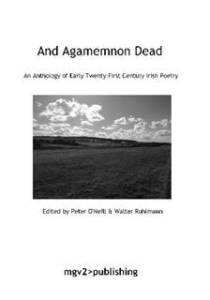
    And Agamemnon Dead An Anthology of Early Twenty First Century Irish Poetry Edited by Peter O'Neill & Walter RuhlmannPeter O’ Neill (1967) was born in Cork where he grew up before moving to live in France in the nineties. He returned to Dublin in 1998, where he has been living ever since. He is the author of five collections of poetry, most notably the Dublin Trilogy: The Dark Pool (mgv2>publishing, France, 2015), Dublin Gothic (Kilmog Press, New Zealand, 2015) and The Enemy, Transversions from Charles Baudelaire (Lapwing Press, Northern Ireland, 2015). In his review of The Dark Pool, the critically acclaimed American poet David Rigsbee wrote: Peter O’ Neill is a poet who works the mythical city of Modernism in ways we do not often see enough.’ (A New Ulster )

    He holds a degree in Philosophy and a Masters in Comparative Literature, both awarded by Dublin City University. In 2015 he edited And Agamemnon Dead, An Anthology of Early Twenty First Century Irish Poetry with Walter Ruhlmann for mgv2>publishing, and mg 81 Transverser. He also organised Donkey Shots; Skerries First International Avant Garde Poetry Fest in May, this year. He is currently hosting The Gladstone Readings once a month in his home town of Skerries.    

    Janus- His Mistress Responds and other poems by Peter O’Neill from Dublin Gothic (Kilmog Press, 2015)
    “The Elm Tree” by Peter O’Neill
    “The Elm of the Aeneid” and “Spadework” by Peter O’Neill.

  • Poems from “Strange Country” by Kimberly Campanello

    February 5th, 2016
    1
    2
    3These poems were first published by Tears in The Fence and are © Kimberly Campanello
    4

    Kimberly Campanello was born in Elkhart, Indiana. She now lives in Dublin and London. She was the featured poet in the Summer 2010 issue of The Stinging Fly, and her pamphlet Spinning Cities was published by Wurm Press in 2011 . Her poems have appeared in magazines in the US, UK, and Ireland, including  nthposition , Burning Bush II, Abridged , and The Irish Left Review . Her books are Consent published by Doire Press, and Strange Country Published by Penny Dreadful (2015) ZimZalla will publish MOTHERBABYHOME, a book of conceptual poetry in 2016.


    5

    Strange Country can be bought from Penny Dreadful Publications
    Sanctus by Kimberly Campanello
    We Protect The Weak by Kimberly Campanello

  • Poems from “Off Duty” by Katie Donovan

    January 24th, 2016

    Wedding

     
    “Hasty,” the judge mocked
    until he read the letter
    from the consultant,
    his jaded face changing to pity.
    We got the green light then,
    to marry in a hurry.
     
    We turned up in our jeans
    and limped through the ceremony –
    upsetting the officiating lady,
    determined to make this
    a special occasion.
     
    Outside the registry office
    we inked a shadow
    on the next couple:
    the bride, glowing in her plumage,
    her robust young groom,
    their flower girls fidgeting.
     
    My brother and his wife
    had used their lunch hour
    to be our witnesses.
    They went back to work,
    and my new spouse
    rode off on his bike:
    the big triumph that,
    with six months to live,
    he could still cycle.
     
    I had to collect our children –
    the paltry nuptials would have been
    disappointing – no frocks, no fun –
    just this boring signing thing,
    and so I kept it secret,
    left them with Gran.
     
    I sloped off to the train.
    It was bright, a May day,
    and I was forty-seven –
    finally, improbably
    a married woman.
     
    Wedding is © Katie Donovan first published in the November 2015 issue of Cyphers Magazine, edited by Eilean Ni Chuilleanain, Macdara Woods and Leland Bardwell
     

    Operation

     
    In the hospital,
    gowned in gauzy cloth,
    he is prepped;
    his limbs so thin,
    his head bursting with the tumour,
    with knowing that wrestling
    the thing out may kill him.
     
    All day the cutters and stitchers
    are at work, slicing from lip
    to clavicle, sawing bone,
    careful not to snick an artery,
    gouging a flap from his thigh,
    to patch the gap
    where the tumour hid
    thriving in its secret lair.
     
    When it’s out –
    and they have fixed the jaw
    with a steel plate;
    rivetted the long L-shape
    of the wound –
    he lies arrayed
    with tubes and drains.
    He floats in the shallows
    of the anaesthetic,
    his breath echoing eerily
    from the hole in his throat,
    his face utterly still.
     
    The night before the operation
    he read “Peter Pan”
    to our children,
    and in the morning
    he surrendered;
    waving from the trolley,
    as if to clutch a last particle
    of the life we figured for him,
    as if to let it fall.
     
    Operation is © Katie Donovan first published in Irish Pages, The Heaney Issue, 2014, Vol. 8, No.2, edited by Chris Morash and Cathal O Searcaigh
     

    Off Duty

     
    Is my face just right,
    am I looking as a widow should?
    I pass the funeral parlour
    where four weeks ago
    the ceremony unfurled.
    Now I’m laughing with the children.
    The director of the solemn place
    is lolling out front, sucking on a cigarette.
    We exchange hellos,
    and I blush, remembering
    how I still haven’t paid the bill,
    how I nearly left that day
    with someone else’s flowers.
     
    Off Duty is © Katie Donovan first published in The Irish Times, 2014, by Poetry Editor Gerry Smyth
     

    Katie Donovan has published four books of poetry, all with Bloodaxe Books, UK. Her first, Watermelon Man appeared in 1993. Her second, Entering the Mare, was published in 1997; and her third, Day of the Dead, in 2002. Her most recent book, Rootling: New and Selected Poems appeared in 2010. Katie Donovan’s fifth collection of poetry, Off Duty will be published by Bloodaxe Books in September 2016. She is currently working on a novel for children.

    She is co-editor, with Brendan Kennelly and A. Norman Jeffares, of the anthology, Ireland’s Women: Writings Past and Present (Gill and Macmillan, Ireland; Kyle Cathie, UK, 1994; Norton & Norton, US, 1996). She is the author of Irish Women Writers: Marginalised by Whom? (Raven Arts Press, 1988, 1991). With Brendan Kennelly she is the co-editor of Dublines (Bloodaxe, 1996), an anthology of writings about Dublin.

    Her poems have appeared in numerous periodicals and anthologies in Ireland, the UK and the US. She has given readings of her work in many venues in Ireland, England, Belgium, Denmark, Portugal, the US and Canada. She has read her work on RTÉ Radio One and on BBC Radio 4 and BBC Radio 3. Her short fiction has appeared in The Sunday Tribune and The Cork Literary Review.

     
    Entering The Mare and other Poems by Katie Donovan

  • ‘Moving Like Anemones’ and other poems by Lorna Shaugnessy

    January 8th, 2016

    Crystal

     
    The blower adds breath to heat,
    turns and blows within the mould
    until he finds precise form.
    Molten glass vibrates.
    It takes ten years
    to learn how deep you can cut
    before the glass shatters,
    how deep you have to go
    to catch the light.
    Mistakes pile up
    waiting for the furnace,
    a second chance,
    instability anchored
    by the weight of lead.
     

    Río Tinto

     
    We cannot enter the Roman graveyard.
    The gates are padlocked and chained
    so we press our faces to the wire,
    squint at the skewed angles of mossed stones,
    the departed minions of enterprise and empire.
    Behind us the mines, where pulleys and sidings
    punctuate strata of centuries-old endeavour.
    Rock and mineral are bared in russets and ochres
    too raw for peopled places. Their cratered wounds
    fill with water so deep you could drown there.
    Today is Sunday. In the high, hushed
    absence of trucks to rumble up the hill
    we try to hear beneath the wind,
    listen for the sound of stone,
    touch the injured past, its fissured heat.
     

    Moving Like Anemones

    (Belfast, 1975)
     
    I
     
    I cannot recall if you met me off the school bus
    but it was winter, and dark in the Botanic Gardens
    as we walked hand in hand to the museum.
    Too young for the pub, in a city of few neutral spaces
    this was safe, at least, and warm.
    The stuffed wolfhound and polar-bear were no strangers,
    nor the small turtles that swam across the shallow pool
    where we tossed pennies that shattered our reflected faces.
    We took the stairs to see the mummy
    but I saw nothing, nothing at all, alive
    only to the touch of your fingers seeking mine,
    moving like anemones in the blind depths.
     
    II
     
    Disco-lights wheeled overhead,
    we moved in the dark.
    Samba pa ti, a birthday request,
    the guitar sang pa mí, pa ti
    and the world melted away:
    the boys who stoned school buses,
    the Head Nun’s raised eyebrow.
    Neither ignorant nor wise,
    we had no time to figure out
    which caused more offence,
    our religions or the four-year gap between us.
    I was dizzy with high-altitude drowning,
    that mixture of ether and salt,
    fourteen and out of my depth.
     
    III
     
    The day was still hot when we stepped
    into cool, velvet-draped darkness.
    I wore a skirt of my sister’s from the year before
    that swung inches above cork-wedged sandals.
    You were all cheesecloth and love-beads.
    I closed my eyes in surrender
    to the weight of your arm on my shoulders,
    the tentative brush of your fingers
    that tingled on my arm, already flushed
    by early summer sun.
    Outside the cinema I squinted,
    strained to adjust to the light
    while you stretched your long limbs like a cat.
    You were ripe for love and knew it;
    I blushed and feared its burning touch.
     

    Dogged

     
    The injured past comes back like a mangy dog.
    It hangs around, infecting my doorstep with its sores
    and the smell of neglect, trips me up when I venture out,
    circling my legs, ready for the next casual kick.
    If I feed it, it’ll never go away.
    If I ignore it, it’ll never leave
    but press its scabby skin against the door-pane,
    crouch in the corner of my eye, licking its paw,
    or cower in the wing-mirror as I drive away
    and limp out to meet me when I come back,
    loyal and unwelcome as disease.
     

    The Watched Phone

     
    Her son is out there somewhere
    the rain beats his jacket seeps through his jeans
    runnels of water travel from nape to chin
     
    somewhere out there her son in seeping jacket
    beaten from nape to chin
    travels through runnels of water
     
    out there the rain seeps nape to chin
    water runnels down jeans and jacket
    her beaten son is travelling
     
    he seeps through jeans and jacket
    runnelling out somewhere
    rain beats
     
    water seeps and her son
    travels rain-runnelled nape to chin
    beaten out
     

    Pain has a shaved head

     
    and no eyebrows. It stands on one leg,
    one foot, the side of one foot,
    afraid to take up too much space,
    knows the meaning of nothing
    and the provisional nature of everything,
    knows in a split second it could plunge into something worse
    but has no tongue to cry out, only a beak that opens
    and closes without sound. The soles of its feet are charred,
    toenails thick as claws and a grey-green mould
    grows slowly up its legs to bloom in the moist places
    of the groin and under arms. Spasms
    contort the torso into impossible forms
    but its eyes never leave the pitiless ground
    that thrusts frangipani, oleander, passiflora,
    bird of paradise, hibiscus and royal palm
    up and up, relentless,
    till the nerve-ends of fronds
    touch blue sky.
     
    ‘Moving Like Anemones‘ and other poems is © Lorna Shaugnessy

    t4_-491194348Lorna Shaughnessy was born in Belfast and lives in Co. Galway, Ireland. She has published three poetry collections, Torching the Brown River, Witness Trees, and Anchored (Salmon Poetry, 2008 and 2011 and 2015), and her work was selected for the Forward Book of Poetry, 2009. Her poems have been published in The Recorder, The North, La Jornada (Mexico) and Prometeo (Colombia), as well as Irish journals such as Poetry Ireland, The SHop and The Stinging Fly. She is also a translator of Spanish and South American Poetry. Her most recent translation was of poetry by Galician writer Manuel Rivas, The Disappearance of Snow (Shearsman Press, 2012), which was shortlisted for the UK Poetry Society’s 2013 Popescu Prize for translation.

  • ‘The World Reduced to a Sound’ and other poems by Anne Tannam

    January 6th, 2016

    Unfinished Business

     
    On their wedding day his father said
    I’ll forgive you everything if you do right by this girl
    the unfinished education
    the empty table setting at Christmas
    the family name unpolished, unloved.

     
    I never met my grandfather
    a man who lived under the glare of his wife
    but I remember my grandmother, a small woman
    her mouth eternally disappointed with life.
    Dad bringing us down to visit her
    to the small dark house on Bulfin Road
    where the furnishings took themselves too seriously.
     
    Later in that same house, I found a studio photograph
    of the polished family; my grandfather, something familiar
    in the way he’s leaning against the table
    my dad, a beautiful child about three years old
    sitting beside his brothers and sisters, and there
    my grandmother upright and disapproving
    staring into the camera, daring it to blink.
     
    That blonde haired little boy
    the man who loved his wife for sixty years
    couldn’t wait to cycle home from work
    gave up his wages every week
    cooked our fry on Saturday mornings
    scrubbed our nails, polished our shoes
     
    still wonders if he did enough
    still wonders if he’s been forgiven.
     
    Published in Spring 2015 Edition, Skylight47. Editors Kevin O’Shea, Susan Lindsay and Nicki Griff
     

    At Sea

     
    I’m watching a film.
    There’s a scene at the end
    where the leading lady gets into her car and drives.
    The camera, a bird’s eye view of highways and roads
    follows her progress until the journey slows
    curves along the edge of sunshine and sea
    before braking to standstill on gravel and sand.
     
    I’ve seen this film before, a light-hearted affair
    no hidden meaning or sudden twist at the end
    but this time, I’m sitting on the couch, trying not to cry
    wondering why the sight of the ocean at the end of a film
    feels like someone close just died.
     
    As the credits roll, I let the waves run in to shore
    until my breathing calms and I am more myself again
    forty six years old and counting
    acknowledging the sadness
    of continents and planets unexplored
    of a single self who got side-tracked early.
     
    I think of childless friends
    who speak of emptiness and longing
    the inconsolable sea inside
    and that defining moment
    whether through age or circumstance
    when only one reality remains
    and grief shows up to fill the void.
     
    Published on-line on HeadStuff website Poem of the Week, June 17th 2015, Editor Alvy Carragher.
     

    Groundhog Day

     
    I laugh at 1950’s woman
    tied to the kitchen sink
    hair in curlers, head filled
    with cleaning products
    and ways to please her husband
    after his long day’s work.
     
    Yet sometimes
    lying awake
    juggling roles
    adding items
    to a list of never ending tasks
    to be completed
     
    I hear in the darkness
    the kitchen sink
    shuffling towards me
     
    and her laughter
    as she applies coral pink
    lipstick to her smiling mouth.
     

    South Wall

     
    We walked the full length
    sat on rocks
    backs to the lighthouse
    looking out at the lazy sea.
     
    The air hummed dusk and evening
    water turning from gloss, to satin, to matt
    sky and breath descending.
     
    Headed back in silence
    footfall into the arms of Dublin bay
    its familiar outline softening
    night, a short car journey away.
     

    The World Reduced to Sound

     
    Lying in my single bed
    a childhood illness for company
    the world reduced to sound.
     
    Behind my eyes the darkness echoed
    inside my chest uneven notes
    rattled and wheezed.
    Beyond my room a floorboard creaked
    a muffled cough across the landing
    grew faint and faded away
     
    My hot ear pressed against the pillow
    tuned into the gallop of tiny hooves
    then blessed sleepy silence.
    In the morning
    steady maternal footsteps
    sang on the stairs.
    I loved that song.
     
    Published in collection ‘Take This Life’ (WordOnTheStreet 2011)
     

    Consolation

     
    In a claustrophobic room
    just off intensive care,
    he outlined the facts.
     
    ‘She only scored four
    on the Glasgow Scale.
    It’s not looking good.’
     
    Even as he said it
    I knew this moment
    defined ‘before’ and ‘after’.
     
    I hyperventilated.
    My mind looked on
    as my body drowned.
     
    We sat by her bed.
    The word ‘coma’
    came and sat beside us.
     
    That evening she awoke.
    Everything had changed.
    She saw her daddy cry.
     
    But a lifelong disease
    is so much better
    than no life at all.
     
    When we got home
    the house has moved
    to another galaxy.
     
    Published in The Moth Issue 2 Editor Rebecca O’Connor

    Both a page and performance poet, Anne Tannam’s work has appeared in literary journals and magazines in Ireland and abroad. Her first book of poetry Take This Life was published by WordOnTheStreet in 2011 and her second collection Tides Shifting Across My Sitting Room Floor will be published by Salmon Poetry in Spring 2017. She has performed her work at Lingo, Electric Picnic, Blackwater & Cúirt Literary Festival. Anne is co-founder of the Dublin Writers’ Forum.
    .
    Anne Tannam’s website
  • “Pillars” and other poems by Alice Kinsella

    December 19th, 2015

    Sea walk.

     
    A grey day
    Bitter winter
    Biting wind
    And there was us
     
    We got our shoes
    Wet and our toes
    Wrinkled
    In our socks
     
    The sand clumped
    Our fingers curled
    And I tasted salt
    Coating your lips
     
    Goose bumps rose
    On our arms
    And the hairs stood stiff
    Like tiny white flags
     
    The air licked wet
    We bundled coats tighter
    And your fingertips put
    Bruises on my skin
     
    You said we’d come back
    When the weather
    Turned
    And Wade barefoot.
     
    The weather turned all right.
    But we never did,
    Did we?
     

    Tea Leaves

     
    Amongst the ghosts
    Of coffee dates
    Gone by
    Two old friends met
    to share a brew and some moments.
    They sat on rickety chairs
    out of doors in sticky rain.
    Shredded tobacco with shaking hands
    Into thin bent rollies
    And tugged on them to fill their mouths
    with anything but words.
    Coffee for her and a green tea for him
    A long repeated order
    a rehearsal of a memory
    And do you remember when?
    He did.
    And how we used to?
    She did.
    They were great times weren’t they?
    They agreed they were.
    He tells her he remembers
    when she bought those earrings
    a flea market wasn’t it?
    No it wasn’t she tells him
    These were a gift.
    Oh.
    They were sitting still.
    But they knew where they were going.
    The cups emptied
    the butts smouldered like late night peat
    They waited a bit longer
    Before paying the bill
    Spilling coins on the table like a flood of tears
    that just wasn’t coming.
    They rose with silent mouths to say
    Well
    Good luck then
    And thanks for it all.
    Before dividing paths
    They looked smiled again
    A shallow curve that didn’t reach the eyes
    They brushed hands instead of lips
    trading nods instead of love.
     
    Tea Leaves was originally published in The Sunday Independent.
     

    After the storm

     
    The dress I wore was black
    Every day for a month
    In and out
    My mother would steal it as I slept
    To run it through the wash
    Scrub away the musty smell of sleep
     
    Each day announced itself with light
    Breaking through at 5.15, 5. 05. 4.55.
    Reaching in, it did not brush the hair from my eyes
    With love, a gentle reminder of the world beyond dreams
    No, it pushed through with a silent scream
    And bolted me awake in one shocking leap of heart
     
    Every day in and out
    Wake, shower, walk,
    Eat, read, sleep
    Repeat
    Repeat
    Repeat
     
    “take your pill did you remember?”
    Yes
    “did you remember to take your pill?”
    Yes
    “don’t forget to take your pill”
    I won’t
     
    At night I sit by the window let air in
    To merge with Turf and tobacco scent in my hair
    Shorter than before
    “less hassle now isn’t it?”
    Eyelids droop “no more caffeine or vodka now no”
    But they didn’t take my fags at least
     
    There is a calm not before but after
    Unlike any other
    No longer an anticipation of release
    Lacking the fire, the fury, the fear
    Now there’s a deathly droll of life
    On repeat- on repeat- on repeat.


    The Stranger.

     
    The daisies in her hair wept
    Each petal curling at the end
    A flick of a goodbye to the day
    The sea licked her little toes
    And her mum watched on
    Half distracted
    As mums must be.
     
    Her blonde plait
    Jolted and darted
    Down her back
    Like a snake.
    Her new teeth like tiny fangs
    Jabbed through gums
    Her tooth fairy money
    Still jingled in her
    First big girl purse.
     
    The sun lay heavy
    dropping towards the sea.
    He watched from his perch of a rock
    And thought how nice it was
    To see the young
    Enjoying the beach.
     
    “Mister why are you wearing shoes?”
    “I’m not going into the sea.”
    “and what’s that stick for?”
    “it helps me when I walk.”
    She showed him the shells
    That she’d collected
    “do you know their names?”
    She shook her head
    So he told her the names of all the shells
    And the creatures who used to live in them
    He thought of his daughter
    And how she’d learned
    The names of the birds
    Out on this beach
    So long ago
    When she was small too.
     
    Her mother almost dropped her phone
    And hurried over.
    She couldn’t believe
    How little attention
    She’d been paying
    To her little girl.
    “come away from that man
    You’re not to talk to strangers.”
    Her mother didn’t look him in the eye
    Just scowled
    And muttered the word
    All parents fear.
     
    He tried not to take it to heart.
    He had a daughter too.
    He’d been the same
    When she was that age.
    He’d been a police man.
    Back in his day.
    He knew the things all parents knew.
    He loved his daughter.
    She lived in Australia now.
    Her picture was above the mantel at home.
    He loved his own daughter.
    He’d never hurt kids.


    Pillars

     
    There were seven
    if I recall correctly
    in our townland
    When we were young
    three now
    or there were anyway
    last time I was home.
     
    You’ll find them in any house
    round those parts
    with the leaky roof and the mongrel
    who tore open the postman’s leg.
     
    There’s Paig who lives by the sun
    after the ESB charged him too much
    ao he ripped the wires out
    of his six generation old shell of stone.
    Whose rippled forehead
    and bloody eyes gestured
    as we flew by on our rusty bikes.
    We never stopped
    so’s not to be a bother.
     
    There’s Jon Joe then with the single glazing
    and the tractor older than any child
    he might have had
    would be now
    had he had one.
    He’s the one we all know has the punts
    stuffed under the mattress.
    The one that never sponsored our sports days.
     
    And then there’s Tom.
    Old Tom not as old as you may think.
    who lost his namesake
    to a kick of the big blue bull.
    They weren’t talking
    at the time
    but he sold the bull afterwards
    and the money went on the bachelor pad
    because She kept the house.
     
    You’ll find them anywhere around those parts
    at the right time
    once you know the right time
    that is.
     
    They’re the shadows of the women
    these men.
     
    They’re the welcome and g’afternoon
    at the church doors
    holding up the walls
    later holding up the bar
    (Neither in nor out)
     
    You’ll know them by the cut of their turf
    and the cut of their jip
    by the stretch of their land
    and the hunch in their backs.
    There’s the grit in their voice
    and the light in the eye.
     
    And when they die
    they’ll be called pillars
    of the community
    but we didn’t notice them crumble
    and we’ll soon forget they’re gone.


    Making Pies

     
    We would pick black berries
    Every day after school
    For three weeks before
    Dressing up and dreading
    Pooka’s poison spit.
     
    We’d munch as we gathered
    be left with only half our winnings
    lick our fingers dry of juice
    and always come home late.
     
    To protect their labours
    the briars would attack
    and tear into soft finger tips.
    I’d delve delicately into
    the gushing wound,
    lap up the coppery flow
    and suck out the hidden prick.
    I’d always say it didn’t hurt.
     
    There was an orchard in my back garden
    there we could pick our second ingredient
    Apples.
    Six a piece to make a pie
     
    They were high up
    And buried in the auburn curls of autumn
    You’d give me a boost
    And half the time we’d fall over
    Stain our trousers
    With the dewy evening lawn.
    You’d always say it didn’t hurt.
     
    One year they were sparse
    “a bad year” my mother said
    So she bought cooking apples
    From the new Tesco in Town
    And I had to peel the stickers
    Off before she skinned them.
    That was the year I learned to
    Use the sharp knives
    And we didn’t go trick or treating
    Anymore.
     
    “Pillars” and other poems are written by and © Alice Kinsella.

    Alice Kinsella is a young writer living in Dublin. She writes both poetry and fiction and has been published in a variety of publications, including Headspace magazine and The Sunday Independent. She is in her final year of English Literature at Trinity College Dublin and currently working on her first novel.
←Previous Page
1 … 34 35 36 37 38 … 106
Next Page→
 

Loading Comments...
 

    • Subscribe Subscribed
      • Chris Murray
      • Already have a WordPress.com account? Log in now.
      • Chris Murray
      • Subscribe Subscribed
      • Sign up
      • Log in
      • Report this content
      • View site in Reader
      • Manage subscriptions
      • Collapse this bar