• chris murray
  • journals – bibliography – publication notes
  • downloadable items – essays – media
  • copyright
  • Home

Chris Murray

  • What Kind of Love Leaves a Cunt-scar? by C. Murray

    March 28th, 2015

    the wasp-sting

    I arise to close
    the heavy window
    against cold fog

    her woods are littered
    with little death,

    sucked out corpses,
    desiccate(d) fruit flies

    I feel my scars —
                      lacerations
    snaking
                     ridged
                                  against

    spider scatters into
    her charnel house
    fast-as-light

    her webs,
    an ocean of exoskeletons,

    my feet on bare wood,
    I am becoming my wounds —


    © Chris Murray, a version of this poem appeared in And Agamemnon Dead: An Anthology Of Early Twenty First Century Irish Poetry. The official launch of the anthology will be take place in Skerries, Ireland on the 23rd May during the Donkey Shots, Skerries First International Avant Garde Poetry Festival
    Christine Murray
    Christine Murray

    Christine Murray is a graduate of Art History and English Literature (UCD, Belfield, Dublin 4). She is a City and Guilds qualified restoration stonecutter (OPW). Her chapbook Three Red Things was published by Smithereens Press in June 2013. A collection of poems Cycles was published by Lapwing Press in Autumn 2013 . A dark tale The Blind was published by Oneiros Books late in 2013. Her second book length poem She was published in Spring 2014 (Oneiros Books). A chapbook Signature was published in March 2014 by Bone Orchard Press.

  • ‘Crystal Clear’ and other poems by Eileen T O’Neill

    March 28th, 2015

    Crystal Clear

     
    She sits alone within her own cocoon,
    Shrouded from her entire surroundings.
    Eyes stare without seeing today’s world,
    The sound of talking is silent in her mind.
    Her crystal lamp is abandoned from care,
    All belongings are deserted from attention.
    Her perspective is internally facing forever,
    Her gaze is transparent in its sad emptiness.
    This journey is taken in isolation and alone,
    Farewells too late as her departure had gone.
    Her dementia deteriorated in a sneaky fashion,
    Only memories enliven her past participation.
     
    © Copyright Eileen T O’Neill 20/02/2015
     

    Solitude’s Soliloquy

     
    Loneliness is an outpost endured,
    Alone in isolation bereft of friends.
    A far flung niche deserted in tundra,
    Or lost in the coldness of city living.
    It shrouds demeanour and self-belief,
    Belonging is seemingly for all others.
    Unattached except for wishful dreaming,
    Solitude does not placate a lonely mind.
    Seclusion is at times a necessity of desire,
    Its calmness affords tranquillity to muse.
    Reflections gaze and ponder their silences,
    In this solitudinous mode one draws breaths.
    A soliloquy considered in quiet contemplation,
    This position sits well in the stillness of being.
     

    © Copyright Eileen T O’Neill 19/02/2015
     

    Rebirth and Opportunity

     
    Making that first bold move takes much courage,
    The contemplation and the deliberation were easy.
    Stepping away from what was life’s familiarity then,
    Every worldly possession uprooted and packed away.
    Closing doors of the old abode was a surreal moment,
    Pulling the garden gate shut and not daring to look back.
    Nearest and dearest confused in the midst of changes,
    Looking beyond the confines of what had been home.
    Promise and dreams awaited in a flight of sixty minutes,
    The arrival revealed an environment of boring normality.
    Leafy slumbers of countryside living in a haven of safety,
    Opportunities grasped at every turning point of direction.
    One could sit and contemplate the nothingness of something,
    Or simply taste life free from the scourges of its daily violence.
    That momentous date of departure remains in minds forever,
    Yet a rebirth evolved from the perspective of fresh beginnings.
     
    © Copyright Eileen T O’Neill 14/01/2015

    XdxI_-Ln_400x400Eileen T O’Neill was born in Belfast, Northern Ireland. She lives in Cheshire, England. Mum to four wonderful and loving children and one beautiful grandchild.
     
    Eileen’s Website
  • AND AGAMEMNON DEAD : An Anthology of Early Twenty First Century Irish Poetry

    March 27th, 2015

    Thanks to Michael J Whelan for this post on ‘And Agamemnon Dead: An Anthology of Early Twenty First Century Irish Poetry’ 

    michaeljwhelan's avatarMichael J. Whelan – Writer

    Hi everyone, I’m really happy to announce that a brand new anthology of contemporary Irish poetry has been published today (St Patrick’s Day) in Paris and I am also delighted to say that I have five poems included in the collection alongside a number of exciting and interesting new voices coming out of Ireland in the these early years of the 21st Century.

    And Agamemnon Dead An Anthology of Early Twenty First Century Irish Poetry, Edited by Peter O’Neill & Walter Ruhlmann is published by Muavaise Graine (Paris 2015) –

    see https://www.facebook.com/mgversion2datura

    and among its 187 pages you will find poetry from

    Michael McAloran — Amos Greig — Dylan Brennan — Christine Murray — Arthur Broomfield — Peter O’ Neill — Rosita Sweetman — Michael J. Whelan — Anamaría Crowe Serrano — Peadar O’ Donoghue — Strider Marcus Jones — Colm Kearns — John Saunders — Kevin Higgins — Paul Casey…

    View original post 208 more words

  • Let’s Hear Irish Poets Speak; the need for a poetry audiobank in Ireland

    March 24th, 2015

    The fact that a new generation of emergent writers must await vehicles like Poetry Ireland Introductions to find an audience stinks of a paternalistic approach to poetic works that sees a few dominant poets stand between the reader and the work, as if it were radioactive. The poetry audience is not remedial and they like to go searching, hence from Ireland they will go to where accessibility is respected, to UBUWEB, to PENNSound, to Jacket2, to The Electronic Poetry Center.

  • ‘Demeter Does Not Remember’ and other poems by Mary Madec

    March 21st, 2015

    Tumble

    I land in you unexpectedly,
    down and something silky like new grass
    scattering
    and it is soft and I fit perfectly
    like in memory foam
    and maybe it is a memory
    and it is silky like a caress, your fingers
    stroking me
    and new, I have never come here before
    and green somehow like soft summer
    warming me
    down deeper than I have ever known
    and maybe you heard the whimper
    as I gave myself to
    the comfort of you concave
    as a moon but not cold or blue
    and I gave myself as a child
    extends her little arms wide
    and trusting on the world
    the edge between inside and outside
    blurred like tears blur
    eyes that still see
    and your arms wrap around me and I am satisfied.


    Hades to Persephone

    Your hand is so close it could touch mine
    but you pull it away in time
    tracing the boundary
     
    any closer and I step
    into your shadow
    you into mine
     
    and rather than disrupt
    affection’s awkward reach
    we play at catch the plural pronoun,
     
    go round and round each
    of our language islands,
    eddies of meaning in the delta.
     
    This vertigo of words
    could throw us into each other’s arms,
    leave us confused
     
    about how to distribute
    endings on verbs,
    as their tense, their mood come to light.


    Demeter Does Not Remember

    Persephone, her shadowed daughter
    in the portico, peeping through the cracked wall.
    Or what she said to keep her away.
     
    Or what she gave her to dam her legs
    when blood flowed,
    red into the underworld.
     
    Demeter cannot remember her first smile or teeth,
    the words she made.
    Persephone would have liked to know.
     
    Now, a woman, she looks into the still lake of her dreams,
    filled by the purlings of the Styx.
    What does she see?
     
    She walks away heartbroken
    from the quivering reflection.
    Cries out, ‘Demeter is not me.’


    Soon It Will Be Winter

    And Demeter does not know what she hates most
    about the change-her straw hair, her broken nails,
    a shrivelling up inside, no blood rain,
    insomnia as she tosses her tired head this way and that.
    She thinks of Persephone, the daughter she fed
    and is jealous of those pert little breasts,
    those eyes, reminding her of another bed
    where she was desirable as a wife.
    She can feel her hardening arteries, her sagging eyes
    stretched to crows’ feet as she smiles.
    There is no sap inside her anymore, a greyness
    rising up through her thighs.
     
    Persephone is wet with smiles
    her soft legs parting for Hades.


    Demeter: Coming of Age

    As I bathe alone, I wonder
    what would be a good outcome.
     
    This time I let my head
    below the level of the water
     
    and my hair spreads out
    like thong weed in the sea.
     
    My middle-aged body lops
    and the water makes
     
    tides around my hips
    and breasts.
     
    My legs with their varicose veins
    the legacy of maternity
    I embrace
     
    I let it all hang out.
    It makes no difference now
    that this man or that
     
    loved this body
    rested on it like summer sun
    on grass
     
    Just as the grass barely notices
    the creatures who crawl on the earth
     
    just as the earth itself is indifferent
    to movements on its surface
     
    waits for boiling magma
    to rise up to its thin skin.
     
    It will take something like this
    to shift the tectonic plates
    reunite the old continents.


    Forecast

    You turn me around and change the frame.
    You’re sorry and winded.
     
    There’s some awkward readjustment of limbs,
    like trees that find their branches
    when the wind dies down.
     
    We go back the way we came, the cloud breaking up
    as it comes in from the sea.
     
    Everything from this angle looks different,
    you take out your thermometer,
    barometer, wind vane:
     
    The outlook is good, you say:
    Cumulonimbus calvus, your favourite,
     
    a sky filled with narrative,
    great big faces puffed,
    playfully portentous.
     
    You say they will be tipped
    with red and gold at sunset.
     
    © Mary Madec

    74755Mary Madec was born and raised in Mayo. She studied at NUI, Galway (B.A., M.A., H.Dip Ed.) and at the University of Pennsylvania from which she received a doctorate in Linguistics in 2002. She has published widely (Crannóg, West 47, The Cuirt Annual, Poetry Ireland Review, the SHOp, The Sunday Tribune, Southword, Iota, Nth Position, Natural Bridge and The Stand Orbis, The Fox Chase Review,The Recorder among others. Her first collection, In Other Words, appeared with Salmon Poetry in 2010 ; her second collection, Demeter Does Not Remember also with Salmon Poetry at the end of 2014. She has received several awards and prizes most notably the Hennessy XO Prize for Emerging Poetry in 2008. She co-founded a community writing project and she teaches a residential course at Kylemore Abbey every summer. She works for Villanova University in Ireland.
  • ‘When You Are Old’ by Kevin Higgins

    March 17th, 2015

    When You Are Old

    .
    after William Butler Yeats

    When you are old and bald and full of crap
    and sitting there in threadbare rags,
    reach across to your old bookcase
    for a dusty old copy of a girlie mag.

    Fondle it, then, a little sadly
    in your withered veiny hands.
    If you can manage to pull the pages apart,
    take one last glad glance at a naked tart.

    Remember how once you could get it up,
    before your pecker just shrivelled up.

    © KEVIN HIGGINS

    kevin-author-photo-december-2013-1Kevin Higgins is co-organiser of Over The Edge literary events in Galway City. He has published four collections of poems: Kevin’s most recent collection of poetry, The Ghost In The Lobby, was launched at this year’s Cúirt Festival by Mick Wallace TD. His poems also features in the anthology Identity Parade – New British and Irish Poets (Bloodaxe, 2010) and one of his poems is included in the anthology The Hundred Years’ War: modern war poems (Ed Neil Astley, Bloodaxe May 2014). His poetry was recently the subject of a paper titled ‘The Case of Kevin Higgins: Or The Present State of Irish Poetic Satire’ given by David Wheatley at a symposium on satire at the University of Aberdeen; David Wheatley’s paper can be read in full here http://georgiasam.blogspot.ie/2014/05/the-case-of-kevin-higgins-or-present.html . Mentioning The War, a collection of his essays and reviews, was published by Salmon in April, 2012. Kevin’s blog is http://mentioningthewar.blogspot.ie/ . and has been described by Dave Lordan as “one of the funniest around” who has also called Kevin “Ireland’s sharpest satirist.”
  • Dear Freda Laughton, your poems are being discussed at Jacket2 Magazine

    March 16th, 2015

    Emma Penney has verified Freda Laughton’s date of death as having occurred in 1995. Freda Laughton (1907-1995). This is Laughton’s current archive at RASCAL (Special Collections at Queen’s University Belfast) (EDIT, May 2019)

    Dear Freda Laughton, Your Poems are being discussed at Jacket2 Magazine

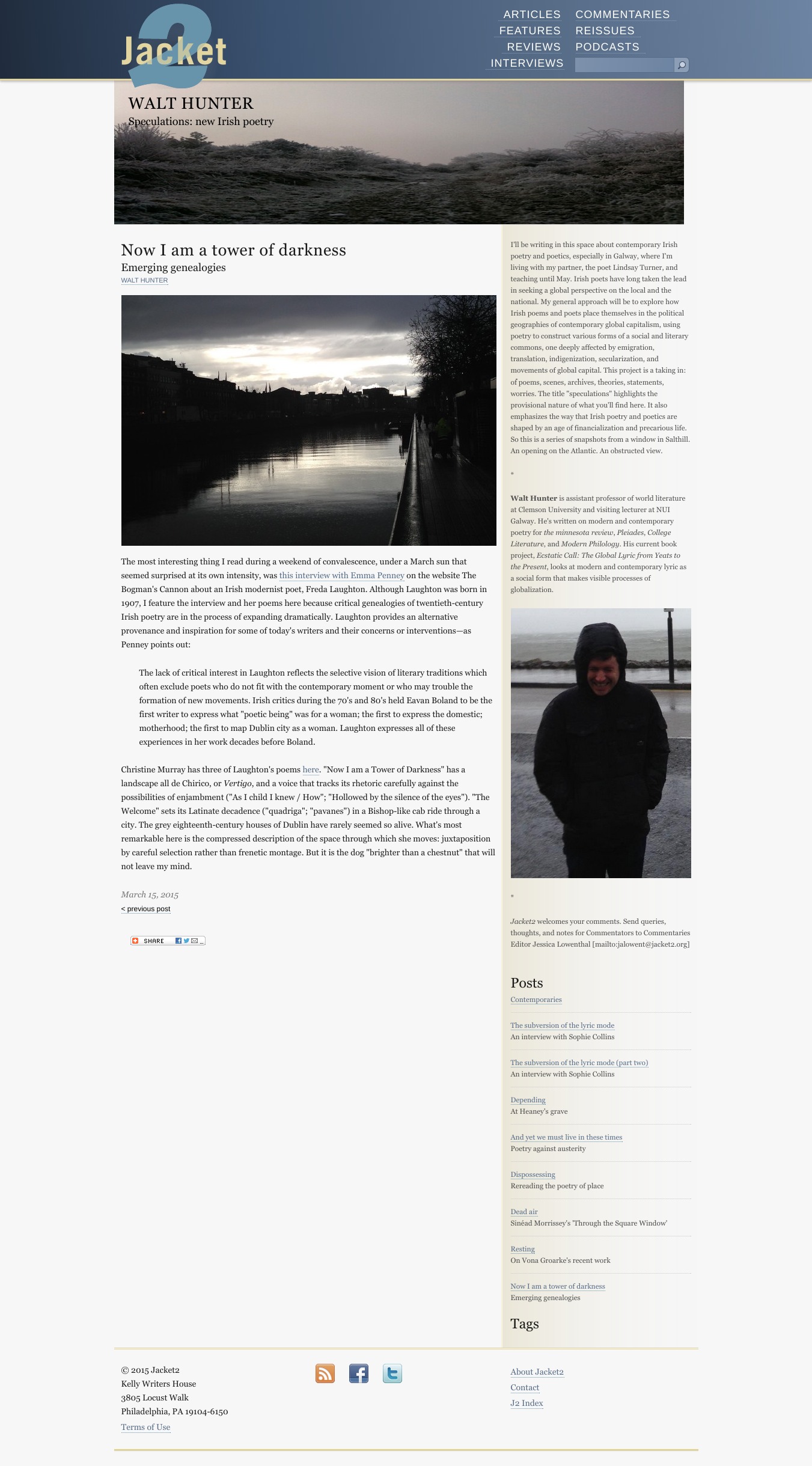
    Walt Hunter writes for Jacket2 on Dave Lordan’s interview with Emma Penney about the modern Irish woman poet Freda Laughton. Freda Laughton was born in Bristol in 1907 and moved to Co. Down after her marriage. She published one collection of poetry A Transitory House in 1945, but little else is known about her life and work. She may have lived in Dublin for some time, as her poem The Welcome details the textures of Dublin City and its suburbs, and suggests she knows the city by heart. Her date of death is unknown. There are some Freda Laughton poems published on Poethead here. 

    The most interesting thing I read during a weekend of convalescence, under a March sun that seemed surprised at its own intensity, was an interview with Emma Penney on the website The Bogman’s Cannon about an Irish modernist poet, Freda Laughton. Although Laughton was born in 1907, I feature the interview and her poems here because critical genealogies of twentieth-century Irish poetry are in the process of expanding dramatically. Laughton provides an alternative provenance and inspiration for some of today’s writers and their concerns or interventions—as Penney points out:

    The lack of critical interest in Laughton reflects the selective vision of literary traditions which often exclude poets who do not fit with the contemporary moment or who may trouble the formation of new movements. Irish critics during the 70’s and 80’s held Eavan Boland to be the first writer to express what “poetic being” was for a woman; the first to express the domestic; motherhood; the first to map Dublin city as a woman. Laughton expresses all of these experiences in her work decades before Boland.

    You can read the full article at Now I am a tower of darkness | Jacket2.

    FireShot Capture - Now I am a tower of dark_ - http___jacket2.org_commentary_now-i-am-tower-darkness
  • “Birth Partner” and other poems by Lindsey Bellosa

    March 14th, 2015

    Becoming a Woman

     
    The first time: my underwear,
    stained and crumpled, squashed
    into our bathroom cupboard and I am paged
    to the nurses’ office at school where the nurse
    asks in hushed tone if something has happened—
    we have watched the videos and been shown
    the diagrams, and my mother has called the school,
    having found my underwear, asked: voice
    full of pride and worry…so I nod as though
    I know something the other girls don’t,
    that the boys snicker at: still small; squeaking—
    and I am so tall and so soft : already in a bra,
    sprouting hair; already not a child but still
    wanting to be a child, and something so tender
    is lost and bleeding in me. Now, there is a secret
    I am keeping but I can’t tell what it is—
    something to be careful of; something
    to be concealed and I am given plastic razors
    and perfumes and pads and I am afraid, afraid, afraid
    like a child in the dark, not knowing of what.
     

    Conception

     
    First there is a lush, quiet sky: sea
    filled with anticipation. Then something
    is released, and time grows fingers.
     
    The moon cycles, triggering our cycles
    and the cycles of fish, feeding; turtles
    emerging to shore
     
    egg-laden; heavy as moonlight.
     
    Life is mostly waiting: on possibilities,
    on hope. There are chances—
    shadows that never become.
     
    But this is not hope; this is the one,
    definite thing, the only thing
    that reaches and it is inside of me—
     
    sea hovering around the start
    of unseen stirrings.
     

    Birth Partner

     
    I saw what was your world
    spin away from you in moments.
    It was replaced by a body.
     
    The body was yours but also not yours.
    It had its own limbs, its own cries
    and also your limbs and cries.
     
    I saw how the sea opened its mysteries—
    slipped gleam of grey curve.
    I saw your dreams emerge.
     
    When you woke up, you were crying
    and laughing. Death had tumbled you;
    finally you knew pain.
     
    You clasped your new life in your arms,
    seeing love for the first time. You murmured:
    It was you. It’s you.
     

    Motherhood

     
    The wild landscape of love,
    moon-soaked and ragged plain.
    All the edges too clear; animals
    ruthless. The barren moon rules,
    bald in its light, which illuminates
    writhing Earth: swill of fertility,
    pain and want. A squall, a mass
    of tails: spinning and spinning. Now,
    the heart fixes like a hook to a cry.
    It is plaintive and true. Nothing
    was ever so clear. Like stars
    on a winter night, piercing
    the uncovered universe black
    and white. This is life.
    This is how time keeps itself.
     

    The Tree of Time

     
    (based on Maria Rizzo’s painting of the same title)
     
    Time grows in branches,
    one moment very like the other:
     
    Second son, I have been here before.
    This is a dark time; your cries are waves
     
    colliding with my dreams. Reality
    is twisting into something new,
     
    and my life is changing color….
    The view of the night sky boxed,
     
    like a window. But your eyes
    are stars, constant—
     
    shining, bright yellow,
    at corners of my nights
     
    as I wake to feed you:
    obsessed with numbers—
     
    the ounces you drink, weight.
    My face is clouded moonlight:
     
    less than slivering light. Little son,
    shadows are waves on water.
     

    This is a magical time.
    We will put down new roots,
     
    but not now. Not here. Now the sea
    races like a heart, your hand
     
    presses my face, in sleep.
    Now nights are like days,
     
    and every day is a ladder rung
    reaching to a brand-new life.
     

    Portrait

     
    The eyes: hooded sky
    the rest of the face hangs from—
    little crescent moon.
     
    Now you cast them to me:
    ask your questions, make pleas,
    defy with your white scowl.
     
    Your lips are mine, drooping
    roses; the pink shape of wonder
    and the slope of your cheeks, mine,
     
    but whitewashed of flaws; white
    and pink, translucent as light
    and thin-skinned as an egg.
     
    Blue trails beneath the surface,
    lines of a map, where eyelashes
    linger: catching, giving depth.
     
    Every day you grow arms and legs
    and more looks, like light—
    from me but not mine.
     
    Like my mother in an old video—
    I see me as I see you in me. She sees herself;
    in the mirror, sees her mother.
     
    The fourteen-year-old me in the video:
    wiggling, excited for something I didn’t know
    yet: bursting from my pink swimsuit—
     
    My mother knew. Lips stitched into a line:
    eyes on the horizon, as mine are now.
    The past comes in like the tide—
     
    and our faces swallow themselves.
    We shrug in and out of them
    like a borrowed sweater;
     
    like the two imprints, potter’s
    thumb slips just under your eyes:
    up go the pupils,
     
    up knit the eyebrows—
    always up and away.
    This is the way love travels.
     
    © Lindsey Bellosa

     lindseyLindsey Bellosa lives in Syracuse, NY.  She has an MA in Writing from the National University of Ireland, Galway and has poems published in both Irish and American journals: most recently The Comstock Review, The Galway Review, IthacaLit, Crannog, Emerge Literary Journal and The Cortland Review.  Her first chapbook, The Hunger, was  published with Willet Press in 2014.

    .

    • Lindsey’s Site
  • Freda Laughton and the Critical History of Women’s Poetry: an Interview with Emma Penney

    March 13th, 2015

    You can read a sample of Laughton’s work here.

  • A Celebration of Women’s Poetry for International Women’s Day 2015

    March 7th, 2015

    Role reversal by Nessa O’Mahony

     
    after Eavan Boland
     
    There will come a time, mother,
    when the transformed spring opens up
    and the charioteer holds out a hand;
    he might have my father’s face, might not;
    his gestures might be gentle or rough
    as he eases you into a space made ready
    and shows you the pomegranate.
    And you will take the seed and eat,
    willingly perhaps, not caring
    that every bargain has its cost,
    or will your hand be stayed
    by the sun’s ray on your face?
    I will not have time to catch up,
    to forestall the nine long days,
    the nine long nights of wandering.
    And I’ll have no deal to strike;
    no backward glance, no waiting
    for the seasons to turn back to me.
     
    © Nessa O’Mahony from Her Father’s Daughter (Salmon Poetry)
     
    NessaNessa O’Mahony was born in Dublin and lives in Rathfarnham where she works as a freelance teacher and writer. She won the National Women’s Poetry Competition in 1997 and was shortlisted for the Patrick Kavanagh Prize and Hennessy Literature Awards. She was awarded an Arts Council of Ireland literature bursary in 2004 and 2011. She has published four books of poetry – Bar Talk, appeared (1999), Trapping a Ghost (2005) and In Sight of Home (2009). Her Father’s Daughter was published by Salmon in September 2014. She completed a PhD in Creative Writing in 2006 and teaches creative writing for the Open University. She is a regular course facilitator at the Irish Writers Centre in Dublin.


    Grianstad by Aoife Reilly

    .

    Swirls of starlings
    absail between sun and moon
    hurl themselves into a dance
    through ghosts of trees
    they go where they need to go.
    winter shrouds
     
    Long nights slide in
    embers empty the land
    dying woods wait for the earth to turn
     
    In the betwixt and between
    I am a still frame in the granite glow
    and leaves are twisted silver songs
     
    Stars gasp, turf smoke curls
    Crisscrossing the place where love was exhausted
    and blankets way down in the moment before light
     
    Ready now, I follow the starlings and birth another year.
     
    © Aoife Reilly
     
    aoife reillyAoife Reilly is living in County Galway and is originally from County Laois. She is a teacher and psychotherapist. She has been attending poetry workshops with Kevin Higgins at the Galway Art Centre since September 2013 and has read at open mike of the Over The Edge Series at Galway City Library.
     

    The Golden Hare by Mary Cecil

     
    Where wild flowers cling
    And heather sweetly grows
    The magic hare reclines
    With fur of glowing gold
     
    His spirit of quiet magnificence
    In lands of legends born
    Where unicorns are dreamt of
    And fairies sport in human form
     
    To catch a fleeting glimpse
    Against the burning sky
    A moment in a lifetime
    A flash of mystery goes by
     
    Where came his golden sheen
    That gift from other realms
    To add a glowing wonder
    Hidden in the ferns
     
    So swift he flees
    With graceful lops he leaps
    Transporting us to mystical lands
    To dream of when we sleep
     
    © Mary Cecil
    Rathlin Island

    profile for poetry picMary Cecil is the mother of large family and Grandmother to eleven. The widow of Rathlin Island’s famous campaigner, diver, author (Harsh winds of Rathlin) Thomas Cecil. Lover of Rathlin Island, Northern Ireland’s only inhabited island. Mary enjoys community development and current events. She has been writing poetry for several years. Enjoys writing a variety of poems, spiritual, war, romantic, protest and nature. Keen to compose more poems based on Rathlin Island’s myths & legends. She worked in owning andmanaging tourist facilities both on and off Rathlin Island. Public Appointment as Lay Member, The Appropriate Authority, Criminal Legal Aid Board.


    .

    The Brightest Jewel by Christine Murray

     
    The perfume of rosemary for remembrance.
     
    Little botanic flower baptised in Glas Naíon,
    the stream of the infants.
     
    I see the pink flower of your hand
    reaching up to your blind mouth.
    I breathe your name so you will live.
     
    The stream of the infants.
     
    Cymbidium Minuets, the flowers that you loved
    grow in a house of orchids near a dark still pool
     
    quiet by the stream of the infants.
     
    The Brightest Jewel is © Chris Murray and was first published in V4, Issue #4 of The WomenArts Quarterly Journal. (2014)
     

    Christine Murray
    Christine Murray

    Christine Murray is a City and Guilds qualified restoration stonecutter living in Dublin, Ireland. Her Chapbook Three Red Things was published by Smithereens Press in June 2013. A collection of poems Cycles was published by Lapwing Press in 2013. A dark taleThe Blind (Poetry) was published by Oneiros Books in 2013. Her second book-length poem. She was published in Spring 2014 (Oneiros Books). Her second chapbook Signature was published in March 2014 by Bone Orchard Press.

    Mastectomy by Shirley McClure

     
    You get given
    certain things in twos –

    love-birds, book-ends,
    matching china tea mugs –

    and even though
    on any given morning

    it is all you even think of
    to hook one fine china

    top designer
    duck-blue tea-mug

    from your dry beech
    draining rack

    to boil and pour and stir
    and watch Darjeeling towers spiral;

    there are still the days
    when there is company for breakfast,

    and on these fine mornings
    let me tell you

    it is good to know
    that there are two

    extra special, same but different
    unchipped breakfast blue mugs

    ……..made to grace
    your table.

    © Shirley McClure From Who’s Counting?
     

    ShirleyPhotoBoyle12_smallLiving in Bray, Co. Wicklow, Shirley McClure won Cork Literary Review’s Manuscript Competition 2009 and Listowel Writers’ Week Originals Poetry Competition 2014. Her collection, Who’s Counting? is available from Bradshaw Books or via http://www.thepoetryvein.com/ She facilitates creative writing courses and workshops.

    Geyser by Alice Lyons


    You e-mailed your whole desktop, which is typical
      .the blue of it Scrovegni chapel blue
    a smile I’ve never seen before it is aware of smiling
    reveals itself to the camera in the computer.
    Squared-off angels, no they are JPEGs, hover
    over a faux Polaroid you switched to sepia mode
    so I wouldn’t look like a geyser
    a river of years to reach such tender self-regard
    for a moment you are unencumbered
    by the monster critical eye (you meant geezer)
    scissored hair blunt and sister-like and merciful
    your entire kitchen liquid in the glossy Frigidaire.

     
    It puts me in mind of Fra Angelico, those tricky frescoes
    (I seem to translate everything to quattrocento time)
    Christ in a blindfold, eyes like poached eggs gazing
    down and inward, the gathered regal robes
    the marble throne all white and pouring up, yes
    like a geyser pouring up while Roman soldiers
    unencumbered by their bodies beat and spit and mock.
    I have always loved those arrested gestures
    the mute green rectangle beautiful as your computer
    in Philadelphia where Safari’s compass points
    permanently Northeast and the Finder icon smiles
    twice and benevolently straight on and in profile.
     
    from Poetry Ireland Review 100 (ed. Paul Muldoon)
     
    Note:  Versions of ‘The Boom & After the Boom’, ‘Developers’ and ‘Reverse Emigration’ first appeared in Poetry(Chicago), December 2011.

    • A Poetry Foundation Podcast The Woman Who Quit featuring work by Alice Lyons.

    Alice_Lyons_sepiaAlice Lyons was born in Paterson, New Jersey and has lived in the West of Ireland for fifteen years. Her poems have appeared in publications such as Tygodnik Powszcheny (Kraków) and POETRY (Chicago), as public installations in Staircase Poems at The Dock in Carrick-on-Shannon and as poetry films in cinema and gallery screenings worldwide.

    She is the recipient of the Patrick Kavanagh Award for Poetry, the Ireland Chair of Poetry Bursary, an Academy of American Poets Award and multiple bursaries in literature and film from An Chomhairle Ealoine/The Arts Council. Her poetry film, The Polish Language, co-directed with Orla Mc Hardy, has screened in competition in over 30 film festivals worldwide and garnered numerous awards including an IFTA nomination. Her new poetry film, Developers, premiered at Oslopoesie, Norway in 2013. She has lectured in English and Fine Art at Boston University, Maine College of Art, the Galway-Mayo Institute of Technology and Queen’s University, Belfast. She holds a Ph.D. from the Seamus Heaney Centre for Poetry, Queen’s University, Belfast. She is currently curator of Poetry Now, Dun Laoghaire.


←Previous Page
1 … 40 41 42 43 44 … 106
Next Page→
 

Loading Comments...
 

    • Subscribe Subscribed
      • Chris Murray
      • Already have a WordPress.com account? Log in now.
      • Chris Murray
      • Subscribe Subscribed
      • Sign up
      • Log in
      • Report this content
      • View site in Reader
      • Manage subscriptions
      • Collapse this bar