• chris murray
  • journals – bibliography – publication notes
  • downloadable items – essays – media
  • copyright
  • Home

Chris Murray

  • ‘Reverse Emigration’ and other poems by Alice Lyons

    December 20th, 2014

    Reverse Emigration

     
    When I boarded the plane, everyone looked like Uncle Tom
    ruddy, some were empurpled
    grey hair or auburn in terrier thatches
    pale blue of eye
    a smidgen of resignation:
    the tribe.
    I thought We are driving to the interior
    I thought, holy god
    the airline upholstery
    was Kavanagh, Ní Dhomhnaill and Heaney
    handwriting. I thought
    holy shit, this is the maw.
    The maw.
     

    The Boom and After the Boom

     
    The Shannon when it washes
    the shoreline in the wake
    of a cruiser slurs
    exactly like the Polish
    language you hear in LIDL
    on Friday evenings, seven p.m.
    payday. That’s what
    Gerry says.

    ❧

    The river surface offers
    space to the song:
    hammer taps of Latvians
    and Poles nailing planks
    of a deck. The place
    between water and sky
    holding sound. It is underloved
    and an amphitheater.

    ❧

    Latvians and Lithuanians
    are nailing planks
    of grooved decking.
    It will be a nice feature
    of that riverside property.
    ! Their tap-tapping
    underscores the distance
    between this side and that.

    ❧

    Winter gales have made swift work
    of the billboard proclaiming
    42 LUXURY BUNGALOWS ONLY TWO
    REMAINING Crumpled up
    on the roadside now
    two-by-four legs akimbo
    a circus-horse curtsy
    or steeplechase mishap.
     

    Developers

     
    Greed got in the way. We built a fake estate.
    Levinas said to see ourselves we need each other yet
    doorbells, rows of them, glow in the night village
    a string of lit invitations no elbow has leaned into
    (both arms embracing messages). Unanswered
    the doors are rotting from the bottom up.
    It’s another perplexing pothole in our road, loves.
    Hard core from the quarry might make it level,
    hard core and cunning speculation into matters
    concerning love and doubt, concerning want and plenty.
    O the places where pavement runs out and ragwort
    springs up, where Lindenwood ends but doesn’t abut
    anywhere neatly, a petered-out plot of Tayto tumbleweeds,
    binbags, rebar, roof slates, offcuts,
    guttering, drain grilles, doodads, infill, gravel !
    A not-as-yet nice establishment, possessing potential
    where we have no authorised voice but are oddly fitted out
    for the pain it takes to build bit by bit.
    When the last contractions brought us to the brink
    of our new predicament, we became developers.
     

    Geyser

     
    You e-mailed your whole desktop, which is typical
      the blue of it Scrovegni chapel blue
    a smile I’ve never seen before it is aware of smiling
    reveals itself to the camera in the computer.
    Squared-off angels, no they are JPEGs, hover
    over a faux Polaroid you switched to sepia mode
    so I wouldn’t look like a geyser
    a river of years to reach such tender self-regard
    for a moment you are unencumbered
    by the monster critical eye (you meant geezer)
    scissored hair blunt and sister-like and merciful
    your entire kitchen liquid in the glossy Frigidaire.
     
    It puts me in mind of Fra Angelico, those tricky frescoes
    (I seem to translate everything to quattrocento time)
    Christ in a blindfold, eyes like poached eggs gazing
    down and inward, the gathered regal robes
    the marble throne all white and pouring up, yes
    like a geyser pouring up while Roman soldiers
    unencumbered by their bodies beat and spit and mock.
    I have always loved those arrested gestures
    the mute green rectangle beautiful as your computer
    in Philadelphia where Safari’s compass points
    permanently Northeast and the Finder icon smiles
    twice and benevolently straight on and in profile.
     
    from Poetry Ireland Review 100 (ed. Paul Muldoon)
     
    Note:  Versions of ‘The Boom & After the Boom’, ‘Developers’ and ‘Reverse Emigration’ first appeared in Poetry (Chicago), December 2011. A Poetry Foundation Podcast The Woman Who Quit featuring work by Alice Lyons.

    Alice_Lyons_sepiaAlice Lyons was born in Paterson, New Jersey and has lived in the West of Ireland for fifteen years. Her poems have appeared in publications such as Tygodnik Powszcheny (Kraków) and POETRY (Chicago), as public installations in Staircase Poems at The Dock in Carrick-on-Shannon and as poetry films in cinema and gallery screenings worldwide.

    She is the recipient of the Patrick Kavanagh Award for Poetry, the Ireland Chair of Poetry Bursary, an Academy of American Poets Award and multiple bursaries in literature and film from An Chomhairle Ealoine/The Arts Council. Her poetry film, The Polish Language, co-directed with Orla Mc Hardy, has screened in competition in over 30 film festivals worldwide and garnered numerous awards including an IFTA nomination. Her new poetry film, Developers, premiered at Oslopoesie, Norway in 2013. She has lectured in English and Fine Art at Boston University, Maine College of Art, the Galway-Mayo Institute of Technology and Queen’s University, Belfast. She holds a Ph.D. from the Seamus Heaney Centre for Poetry, Queen’s University, Belfast. She is currently curator of Poetry Now, Dun Laoghaire.


    Alice Lyons

    Curator | Poetry Now 2015

    Mountains to Sea Book Festival

    Dun Laoghaire, County Dublin
    IRELAND
    www.mountainstosea.ie

    Curator | The Dock
    Carrick-on-Shannon, County Leitrim
    IRELAND
    www.thedock.ie
  • ‘Evensong’ and other poems by Cherry Smyth

    December 13th, 2014

    Evensong

     
    The way evening comes in
    (or on or down)
    brings the word closer
    than it’s ever been:
    the blue levelling deeper,
    evening to a fade
    that seems to make the colour
    brighter, the best possible
    way to age. I keep watching
    its beauty as if I could learn it,
    shaking a month’s dust from
    a carpet out of the top window,
    my face paused in the cold air,
    joining indigo,
    the lidless city,
    invulnerable,
    the universe heard.
     

    Where it Led You

    (for John Maggio)
     
    You say the wind in the trees brought it.
    Your grandmother’s house nested by woods,
    a cabin more like, with an outside toilet
    and the smell of fallen apples masking it.
    It isn’t the rotting, sweet thickness but where
    it leads you: into the woods, where small
    creeping shadows called to city boys who
    could play lost, jungle commandoes.
     
    You followed your brother into a clearing.
    There lay something you knew but didn’t,
    something that should move but couldn’t
    – a heap of smattered fur, even before the flies
    knew, a litter of puppies, the texture tangy
    in your mouth, a fruit bruise, the pelts asking
    to be petted, the bloodholes where the pellets
    entered. Around you circled the knowledge of BB
    guns, the deadly capable forest boys and the rustling
    that shocked a new silence into you both.
     
    When you say you want more space in the
    maze of your paintings, I hear whimpering
    in the trees, the pop-pop-pop of boyhood, see
    a mound of warm heads. You will paint a path
    out of the woods, making room for each and
    every one, in fathering light. Your world is
    kinder, figuring the dense, bewildering mass,
    the face-down side of the bright apple.
     

    Anniversary Poem

     
    Dark barely lifts from
    the rooftops, winter casting
    its poorly washed sheet down.
    January, the time of year I am least,
    I stop on the stairs, refocus on
    plum branches where green
    nodes are clustering,
    unwinding the clock of sap.
     
    One year on, her warmer
    hand taking mine has made me
    almost immune – here’s the
    very second, the hill of snow,
    our sex-bright skin that graphs
    a cycle beyond the usual lustrum;
    look at her fingers fanning out
    the count from her thumb;
    hear the click of the abacus,
    promising something foolproof
    in calling love a number.
     
    Evensong, Where It Led You and Anniversary Poem are © Cherry Smyth


    Cherry on beachCherry Smyth is an Irish writer, living in London. Her first two poetry collections, When the Lights Go Up, 2001 and One Wanted Thing, 2006 were published by Lagan Press. The Irish Times wrote of this collection: ‘Here is clarity and realism, couched in language that is accessible and inventive. The title poem carries all Smyth’s hallmarks: precision, linguistic inventiveness and joy.’ Cherry’s work was selected for Best of Irish Poetry, 2008, Southword Editions and The Watchful Heart: A New Generation of Irish Poets, Salmon Press, 2009. Her third collection Test, Orange, 2012, was published by Pindrop Press and her debut novel, Hold Still, Holland Park Press, appeared in 2013. She also writes for visual art magazines including Art Monthly. She is currently a Royal Literary Fellow.

    Poetry by Cherry Smyth
    Water, Shine On Sarah Lucas, and other Cherry Smyth poems on Soundcloud

  • “Silt Whisper” and other poems by Ailbhe Darcy

    December 6th, 2014

    Silt Whisper

     
    That summer one-eyed jacks were wild:
    we learned new rules, left tea to brew.
     
    Smoke stilled air. Leaves lay unturned.
    Unemployment was another high.
     
    I had been a storm in a polystyrene cup,
    seeking scald, steam, instance, but now
     
    we drew up lists; mapped out desire lines; skipped
    interviews to collect blooms; paused before flight.
     
    The only record of that time the silt of prophecy,
    the memory of weight in our cupped hands.
     
    For a short while we held the one breath:
    I could never set it down.
     
    Silt Whisper appears in Imaginary Menagerie(Bloodaxe, 2011) and has been the Guardian poem of the week.
     

    Poles

     
    When the Poles came to the National Gallery
    I lowed at a painting by this Edward Okún,
    and what I was thinking was that was me below
    your drop-gemmed black coat all winter, wind
    around us beating like wings, chests pressed together.
    I had put down roots right there in the street
    and told you this now is home and you
    said now we can go anywhere. I hear now
     
    that they’re finished building Dublin up
    the side of a mountain, the Poles have hied
    home and put up signs: No Irish;
    and no one blames them. A slow flight;
    the old crone creeping; the cupped flower;
    his wife looking at him and not around her.
     
    Poles was originally published in Salamander and appears in Imaginary Menagerie (Bloodaxe, 2011.)
     

    Panopticon

     
    “Only don’t, I beseech you, generalise too much in these sympathies and tendernesses – remember that every life is a special problem which is not yours but another’s, and content yourself with the terrible algebra of your own”
    – Henry James, in a letter to a friend.

     
    We are up to our pits in Sunday papers
    when my father says that things never used to happen
    when he was growing up. He means
    the black crawly crawly Darfur fly, man
    on a leash, girl with burns, crumpled machinery
    at Inishowen; and he means Matthew,
    who died last night at last of madness.
    My father and I at the eye of the panopticon,
    two of Prometheus’ descendants, bound
    at the centre of a shrinking globe. Sometimes
    he used to turn the television off, newspapers
    would grow angular holes
    where bloodshed had been. Now it’s I
    want to fold cranes of the papers for him,
    build bonfires of TV sets.
    It circles us, the noise, all the same. When people ran
    from the falling towers, they stopped
    to buy cameras, stood
    with their backs to the towers to watch
    the cards fall over and over
    on shop window screens. No wonder
    that you with your too much of gentleness
    wanted out, and we did not stop you.
    Your friends expect to weigh forever
    what we could have given
    against what we could not change.
    What kind of algebra would it take?
    Matthew, love, I carry myself with care on Mondays.
    I lie to hairdressers. I walk. I carry a notebook
    to write down feelings
    in case I need them again. I pretend
    to be someone else at traffic lights. I stay clear
    of mirrors, newspapers sometimes. I live
    as best I can. I do the awful maths.
     
    Panopticon was originally published in The Cortland Review and appears in Imaginary Menagerie (Bloodaxe, 2011.)
     

    After my son was born

     
    Grit shone on the surfaces
    of my bedazzled eyes.
     
    Flesh pooled about me,
    so that it was difficult to run.
     
    Disease squeaked an entrance
    at the corners of window frames,
    the gap beneath the door, my
    shut mouth.
     
    There was noise.
     
    I wished you all dead.
     
    After my son was born,
    my mother came to me
    and was gentle.
     
    After my son was born was originally published on wordlegs.com.
     

    Shift

     
    They shipped Donegal workers into Dundrum
    in 2001. I worked in the Dundrum House all summer,
    lumping sods of peaty scurf from there to here.
     
    Those lads ordered with a nod or lifted star
    of dark-skinned feelers, not a nay, not an aye.
    “They must talk among themselves, they
     
    must,” a Cantonese colleague of mine
    hissed as we swiped the ashtrays to wipe.
    We vied between us to be the first to kiss
     
    one of those black Northern men. I got
    closest when, once, a man stood and took
    a too-heavy tray from my arms and moved
     
    ahead of me to the bar. He leaned in
    to empty his hod to the barman, turned
    and let drop his chin to raise a remark.
     
    What emerged then was a bubble as large
    as a brick, slick with aurora borealis,
    viscous and globular, spinning slowly forth
     
    over the tables of drinkers, the Norners
    in their nighted corner, blinking cigarette machines,
    locals blinking at that unidentified word.
     
    Local was originally published in Connotations.
     

    Service Not Included

     
    Who’s to thank for the buckets of lavender thrown open beside us,
    for the foam-clouds on twin cappuccinos,
    for the carved boxes that hold sugar,
    for the child telling reams about superheroes,
    for the darkening sky of the waiter,
    at a café in the shopping centre
    when you cannot speak for your tears?
    Hospital coffee was never so kindly, so quick to make believe.
    On the morning I wed, you and I
    came here to the shopping centre
    and scented women pared our nails in a scented room.
    Who’s to thank for their cool hands
    working away in our memories? Here, your hands
    are out of my reach. You must have thought it but,
    when my son was born howling and writhing
    and thrust to my skin, how your own son left the room
    and the snap they left you to hold of him. Your hands
    are smaller than mine, and neat.
    How they told you the hospital name and you thought
    that dun square of Monopoly board,
    made your way there by a route you’d score
    into your palms by the end; saved change
    for the car park; packed a Thermos, perhaps.
    Now families glide about the shopping centre
    in neons fresh from invention, eyes shiny with gratitude,
    music tasteful and tender.
    You must have thought, when my son has made strange,
    raged at being made come asunder,
    of all the times you had to leave the hospital
    and drive home to your daughters.
    Of all the skin we need to touch and are not touched,
    of all the starving to the touch, the familiar injustices.
    Spread coins thick across the tables,
    go about the shopping centre,
    praise the coffee, the kindness of the escalator, haircuts,
    the beautiful, the beautiful, the familiar,
    the comfortable weather. Who’s to thank? Who’s to
    praise for your hands, who sits up there in head office
    taking our minds off the past waiting rooms and coffee docks?
     
    Service Not Included was originally published in Eire-Ireland.

    Image by Matt Bean
    Image by Matt Bean

    Ailbhe Darcy was born in Dublin in 1981 and grew up there. Her first full-length collection, Imaginary Menagerie, was published by Bloodaxe Books in 2011 and shortlisted for a Strong Award. A poem from the collection was chosen by the Guardian newspaper as their “poem of the week.” Selections of work appear in a chapbook, A Fictional Dress (2010) and in the anthologies Identity Parade, Voice Recognition and If Ever You Go.
     
    Ailbhe has published scholarly work on the poet Dorothy Molloy in Contemporary Women’s Writing and regularly reviews new poetry for The Dublin Review of Books, The Stinging Fly and The Burning Bush 2. In 2014 she took part in “Yes, But Are We Enemies?”, a reading tour of Ireland and London, presenting experimental writing in collaboration with Patrick Coyle, S.J. Fowler and Sam Riviere. With S.J. Fowler, she is working on a book-length project entitled Subcritical Tests. She lives in Germany.

  • ‘The Price’ and Other Poems by Jane Clarke

    November 29th, 2014

    Every life

    She fills the days with movement, cuts back
    on coffee and wine, eats blueberries, red peppers,
    broccoli, kale, writes down the words she won’t
    let herself say, like arid, fallow, barren, ache.

    The man on the radio says every life is laced
    with loss, that’s what makes us whole. She reads
    a book about Buddhism to learn how not to
    want, adds to the list of places it’s best to stay

    away from; supermarkets, coffee shops, beaches,
    hospitals, parks. She pretends the temperature charts
    haven’t taken the pleasure away, stops herself
    thinking of names, Oisín, Molly, Sinead,

    won’t let herself hope when she’s a few days late,
    lists her consolations and tries to avoid the questions,
    like how did this happen to them, what was it they did
    or didn’t do, how will they know when it’s time to stop.

    by Jane Clarke

    First published in Mslexia, 2012


    Against the flow

    One day you knew you must turn,
    begin to swim against the current,

    leave the estuary waters, brackish
    with sediment, head upstream

    through riffles and deeps,
    millraces that churn in spate,

    over sheets of granite, across weirs,
    into rapids that thunder-pound,

    squeeze between boulders,
    to the upper reaches of the river,

    those waters of blanket-bog brown,
    where you’d find a place in gravel and silt

    to hollow a dip,
    to spawn a life of your own.

    by Jane Clarke

    First published in Ambit, 2013


    The Price

    You could fit my father’s farm
    into two of my husband’s fields,
    that’s why I left, a girl of eighteen,
    for the arms of an old man.

    Four counties south of the shore
    where my mother heaved armfuls
    of kelp and carrageen into a creel,
    I folded my life into his,

    bore him four girls and a boy.
    I scrubbed his floors, kneaded his bread,
    carried water from his well.
    In his wordless way, he was kind

    but what price two ponies for a trap,
    rooms lit by gas, books on shelves?

    by Jane Clarke

    First published in Ambit, 2013


    The Suitcase

    As a child I didn’t understand
    that despair was a neighbour
    of love and if you were lucky
    it stayed beyond the garden gate,
    just visiting from time to time
    to borrow sugar, test faith.

    As a child I didn’t understand
    that when my mother showed me
    the nightie, toothbrush, nylons,
    miniature bible and summer dress
    she kept packed in the suitcase
    under their bed, it was herself

    she was telling, I can go, if I want to.
    Sometimes I checked
    had she emptied it yet, sometimes
    I wanted to shout, go if you’re going,
    why wait? I didn’t understand
    it was the suitcase that helped her to stay.

    by Jane Clarke

    First published in Poetry Wales, 2013


    On the Boat

    On the boat we were mostly virgins,
    we talked about who we were going to be –
    waitresses, seamstresses, nurses,
    we didn’t talk about why we had to leave.

    We talked about where we were going to be,
    the wooden frame house with a picket fence,
    but we didn’t talk about why we had to leave
    as we touched the lockets around our necks.

    The wooden frame house with a picket fence
    led to talk of lost villages, lost streets
    as we touched the lockets around our necks.
    We didn’t foresee tenements that grew thick as trees

    when we talked of lost villages, lost streets
    and the diligent men we were going to marry.
    We didn’t foresee tenements that grew thick as trees,
    the suitcase of memories we would have to carry

    to the diligent men we were going to marry
    when we were waitresses, seamstresses, nurses
    nor the suitcase of memories we would have to carry
    from the boat, where we were mostly virgins.

    by Jane Clarke

    First published in the Irish Times, 22nd November 2014

     

    © Jane Clarke


    Jane ClarkeOriginally from a farm in Roscommon, Jane Clarke now lives in Co. Wicklow. She holds a BA in English and Philosophy from Trinity College, Dublin and an MPhil in Writing from the University of South Wales. She has a background in psychoanalytic psychotherapy and combines writing with her work as a management consultant in not-for-profit organisations. Her poems are widely published in journals, newspapers and anthologies, including The Irish Times, The Irish Independent, The Rialto, The North, Poetry Wales, Mslexia, Agenda, Ambit, Abridged, The Interpreter’s House, Envoi, The Stinging Fly, Cyphers, The Shop, Crannog and The Stony Thursday Book; Tokens for the Foundlings Anthology, ed. Tony Curtis (Seren Books, 2012), Anthology for a River, ed. Teri Murray (River Shannon Protection Alliance, 2012), The Fish Anthology, ed. Clem Cairns and Jula Walton (Fish Publishing, 2012) Listowel Writers’ Week Winners Anthology, (Writers’ Week Listowel, 2007 & 2014), The Roscommon Anthology, ed. Michael & John O’Dea (Roscommon Literary Heritage Group, 2013), International Baccalaureate Theory of Knowledge Course Companion, (Oxford University Press, 2013), A Telmetale Bloomnibus, ed. Clodagh Moynan (Irish Writers’ Centre, 2013), The Hippocrates Prize Anthology, (The Hippocrates Press, 2013), Leaving Certificate Higher Level English Course Papers, (Educate.ie, 2014); She received the Listowel Writer’s Week Poetry Collection Prize in 2014 and has won a number of other prizes including Trocaire/Poetry Ireland Competition (2014), Poems for Patience (2013), iYeats (2010), Listowel Writers Week (2007). Runner-up in the Poetry Ireland/Trocaire Competition (2013) and the Listowel Writers Week Poetry Collection Competition (2013), she was also shortlisted for the Patrick Kavanagh Poetry Competition 2013, the Hennessy New Irish Writing Literary Awards 2013 & 2014, the Hippocrates Prize (2013), Mslexia Poetry Competition (2012), Fish Poetry Prize (2009 & 2012). In 2009 she was selected for the Poetry Ireland Introductions Series and was awarded an arts bursary by Wicklow County Council. Her first collection will be published by Bloodaxe Books in 2015.

    • http://www.janeclarkepoetry.ie
    • http://www.dromineerliteraryfestival.ie
    • http://andotherpoems.wordpress 
  • Recours au Poème; Poésies & Mondes Poétiques

    November 21st, 2014

    Chris Murray's avatarPoethead by Chris Murray

    My thanks to Matthieu Baumier, editor at Recours au Poème, and to Elizabeth Brunazzi, who published and translated four poems from my collection, Cycles (Lapwing Publications, 2013).
     
    I am adding here Elizabeth’s translation of i and the village (after Marc Chagall)

    moi et le Village

     
    (d’après Marc Chagall)
     
    Version française, Elizabeth Brunazzi
     
    La rosée découle en jade une lune aux trois quarts
    L’Amour O l’amour! Ta fleur arrachée embaume
     
    De son parfarm ma main, bientôt
    bientôt me rappelant une certaine musique-
     
    Mon destin a toujours été de quitter le lieu
    où la lune dansait avec la subtile Neptune!
     
    Tout se dissout-
    sauf le souvenir de ton visage,
    ton rire en pleine rue et ta danse pour la lune!
     
    Tes bagues de jade et ta fleur sont mes bijoux,
    nuançant toutes choses d’une teinte de vert, de pourpre, d’un…

    View original post 169 more words

  • Un-Sight/ Un-Sound (delirium X.)

    November 19th, 2014

    An excerpted section from Un-Sight/Un-Sound is available on my Open Salon Blog

    Gnome Books's avatargnOme

    front coverM. Un-Sight/ Un-Sound (delirium X.). ISBN-13: 978-0692334799. ISBN-10: 0692334793. gnOme. 2014. 130 pp.

    un-sight un-sound/ yet/ in vacuum of doubt’s expel/ clamouring for beyond flesh what meat as if/ yet forage no/ not a/ eye crushed within fist of none/ echoing chamber of nothing/ never dispelled

    Un-Sight/ Un-Sound (delirium X.) is a prose-poetic work in three sequences: “delirium X,” “Meat Sequence (after Francis Bacon),” and “Ghost-Limb Tongue.” In the first, quotations from various authors (Bataille, Beckett, Luca, Popa et al.) are used as springboards for surreal imagistic fragmentation. The second section, inspired by Deleuze’s Francis Bacon, deals with the subject of flesh/ meat and explores the concept of the human object divulged of identity/ place, stripped of ego, and viewed from an externus. The third section addresses the conflict between sense and the real and concludes with a collection of aphorisms written with regard to words becoming a bankrupt form…

    View original post 138 more words

  • ‘Fable’ and ‘Oh Cherry Trees You are Too White For My Heart’ by Doris Lessing

    November 17th, 2014

    Chris Murray's avatarPoethead by Chris Murray

    Fable

    When I look back I seem to remember singing.
    Yet it was always silent in that long warm room.

    Impenetrable, those walls, we thought,
    Dark with ancient shields.The light
    Shone on the head of a girl or young limbs
    Spread carelessly. And the low voices
    Rose in the silence and were lost as in water.

    Yet, for all it was quiet and warm as a hand,
    If one of us drew the curtains
    A threaded rain blew carelessly outside.
    Sometimes a wind crept, swaying the flames,
    And set shadows crouching on the walls,
    Or a wolf howled in the wide night outside,
    And feeling our flesh chilled we drew together.

    But for a while the dance went on –
    That is how it seems to me now:
    Slow forms moving calm through
    Pools of light like gold net on the floor.
    It might have gone on, dream-like, for ever.

    View original post 238 more words

  • There will always be singing; an appreciation of Doris Lessing

    November 16th, 2014

    Fable

    When I look back I seem to remember singing.
    Yet it was always silent in that long warm room.

    Impenetrable, those walls , we thought,
    Dark with ancient shields. The light
    Shone on the head of a girl or young limbs
    Spread carelessly. And the low voices
    Rose in the silence and were lost as in water.

    Fable is © Doris Lessing (1919-2013)

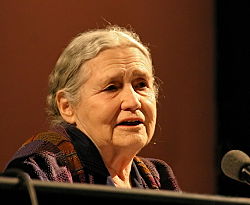
    Author and Poet Doris Lessing
    Author and Poet Doris Lessing (1919-2013)

    Nobel Laureate Doris Lessing (1919-2013) was  a novelist, poet, and sci-fi writer. This appreciation of Doris Lessing was first published on the Women Writers, Women’s Books Site  in 2013 with thanks to Anora McGaha, and to Barbara Bos who live edited the piece at the time of writing. Thanks to Olivia Guest at Jonathan Clowes Ltd who has allowed me carry Poems by Doris Lessing here at Poethead.

    When a person of great age dies, there are many responses about the richness of their life and how we have been blessed by their presence for so long in our world. Yet for me there was and is profound sorrow at the loss to us of Doris Lessing Nobel Laureate, author, philosopher and poet. I do not delude myself that my sorrow is one of intimate connection to her, a whole generation of women writers have that connection to her voice.

    My connection to Doris Lessing’s writing began in my twenties when I first read The Golden Notebook, I read almost all her work after that. I am unsure of where the gut tear occurred with my reaction to her work, but here was a writer who did things that I admired. It was difficult to locate her effect on me, but I knew it and recognised it as important to my writing.

    Living in Dublin city, I often retreat to a small house in Mayo, where my now deceased friend, Michael McMullin, a philosopher and jungian, had retained a library. His Doris Lessings were collected on the top shelf of his library, alongside some images of Chartres Cathedral, and his Yeats collection. Like Lessing he had attained a great age and had a voracious thirst for knowledge, he was born in Ceylon in 1916.

    Michael’s assidious collecting of Doris Lessing was winsome, and he often referred to her. His nomadism had taken him from Ceylon, to Cambridge, to escape from Hitler’s invasion of Paris, to Finland, to Canada, and at the end his life, a hillside In the North-West of Ireland. I did not meet Doris Lessing, but I had met in Michael that intellectual and questing spirit that seems to inflame the diasporist writer. It can only be described as a great and humble presence, their being present to everyone who he/she encounters all the time.

    Doris Lessing’s death brought back my own recent loss with a punch. I saw the rumours of her death emerging from early Sunday morning and waited to hear if it were true. My decision to go ahead and link the Lessing poems was an urgent need to show people that there was more to her output, although it is sadly unavailable.

    Two years ago while re-reading Lessing in the Mayo library awaiting a death, the Lessing poetry began to make me a bit more than curious. On returning to the city, I thought to do some searches of her writing, as I was aware that she like Ted Hughes, had elements of Sufism in her writing. I was aware that she had written poetry but couldn’t find much. The place to look for the mythological, esoteric, and philosophical mind of the writer is in their poetic output. Poetry is the revelatory act of participation in the world.

    Doris Lessing had written a small collection Fourteen Poems in 1959, published by The Scorpion Press, and she had contributed to the Inpopa Anthology (2002). Her poetry isn’t available online. The Scorpion Press Archive is housed at the McFarlin Library (Special Collections) at the University of Tulsa.

    Alison Greenlee, Librarian at the McFarlin Special Collections Library located for me a copy of the book in my Alma Mater, University College Dublin. I made an appointment to go in as soon as I could and transcribed a selection of the poems for myself. The next step was to contact Jonathan Clowes Ltd, who are Doris Lessing’s agents.

    Olivia Guest at Jonathan Clowes Ltd, Doris Lessing’s Literary Agents, worked on my behalf to bring Doris Lessing’s poetry back online. We corresponded initially by letter and I procured a temporary 12 month licence to add Lessing to my index of women poets. I wanted her to be recognised for her entire body of work and not alone the novels. After the initial permissions to carry the Lessing poetry were given, the first letter went awol and had to be re-issued, I put them up and shared them regularly across multiple social media platforms including FB, Twitter, Salon.

    I wrote about the poems on Open Salon. There were 3,000 hits on the poetry over the two blogs. People contacted me to say that they wanted to read the books, that they had no idea that she was a poet, and that they were heartened to see a woman poet of great age appearing on their computer screens, as there is often a problem with having older women visible in the media.

    The following year, I sent Olivia Guest a synopsis of the reaction to Doris Lessing’s poetry and we agreed to extend the licence for another 12 months. She was surprised that the reaction to lessing’s poetry had been so widespread and curious. I sent her screenshots of the data and emails regarding the works.

    This year of 2013, I again contacted Olivia and reminded her that my licence to carry the poetry was about due to end and that it gave me great sorrow to take the poems off my index, people were always looking for them, they accounted for a lot of searches for women writers, alongside Dorothy L. Sayers and Nelly Sachs.

    last week I received an email that made me sadder. Doris Lessing had little confidence in her poetry and her agents were happy to allow me keep them indefinitely because they did not see the possibility of a re-issue.

    This is the email that Olivia Guest sent me recently,

    Dear Christine

    We’d be delighted for you to host the poems for longer especially if you’re getting such good reactions. Doris Lessing was never very keen on her poetry and didn’t think it was any good so I doubt we will see a re-issue but at least this way, they are available in an alternative form.

    Many thanks and best wishes

    Olivia

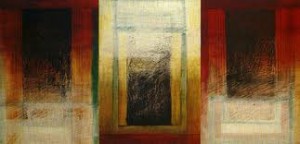
    The Megaliths Series, by Ann Madden (Irish Artist)
    The Megaliths Series, by Ann Madden (Irish Artist)

    I wondered then if Doris Lessing knew over these years that I had the poems and that they had caused such a reaction on the Poethead ? I still do not know if she did. Last week I announced on Poethead that I would be retaining the poems for sometime, and that I had received the above letter, blogged it in absolute delight, because it is a small but profound part of her writing jigsaw and it allows us to call her a poet.

    To a mind like Lessing’s, death is a transformation and not an ending. Yesterday, after I decided to honour her writing and look again at the story of the poems, I closed up my blog for the day and took a walk with my daughter. When I got home, I saw that there were upward of a thousand hits on the Lessing letters, articles, posts and poems.

    Today there is a similar amount building up. People want to know that questing intellect and they are searching. If I could say one thing to Doris Lessing, it would be that her poetry is the source and cause of joy and many, many people feel her loss in this world.

    RIP Doris May Lessing (1919-2013)


    Christine Murray is a City and Guilds qualified stone-cutter. Her poetry is published in a variety of print and online publications. Her poem for three voices, Lament, was performed at the Béal Festival in 2012. Her Chapbook Three Red Things was published by Smithereens Press in June 2013. A collection Cycles was published by Lapwing Press in September 2013. A dark tale The Blind (Poetry) was published by Oneiros Books in  October 2013. Since time of writing this appreciation She (Oneiros Books) and Signature (Bone Orchard Press) were published in 2014.


  • “I Was Swallowed by a Harry Clarke Window” and other poems by Niamh Boyce

    November 8th, 2014

    I was swallowed by a Harry Clark window.

     
    All that flesh. So exquisitely etched.
    Decked in magenta, Prussian, cobalt, lemon
    even the halos are mandarin. And, oh
    so sweet are those cool palms that peek
    from viridian pashminas to pray and bless.
     
    I’m on the side altar, reverent, gazing
    mouth open, keeping clear of the sacristy
    (old habits die hardest) when
    the scalding tangerine of Saint John’s robe
    pours down my throat. Burnt, I douse my
     
    tongue in a panel of inky night. Graze stars,
    how they bite! And bite, and bite…
     
    Fully digested, I stretch
    on a glass horizon that peaks like a breast.
    Oh, all here is holy, and all here is sex.
     
    I Was Swallowed By A Harry Clarke Window was published by New Irish Writing Magazine


    Frida Kahlo

     
    Eyes me from the blue wall of my semi d
    in bare necked upbraiding majesty.
     
    How luscious is my pain, she exclaims
    and I, can produce it, for you, again and again and again.
     
    Prefer me bleeding in the red dress
    or the yellow one? Like a bone for a token?
     
    Just love the way I left absolutely nothing
    unspoken? My torment glued to tin votives
     
    for eternity. My pudenda pushing its way
    through a bouquet of bad memories.
     
    Pray gringo, pray for me.
    Pick me clean but pray for me.
     
    Frida Kahlo was published in The Poetry Bus


    The First Time She Painted Me

     
    She done me in my blue dress
    She done me in my pale blue dress
    and the wall about the door sang blue too
     
    like the breast of a beautiful bird – soar, soar
    then I saw the light, the light pour in
    thought of church, candles, the Virgin
     
    Mary with a snake underfoot
    I saw her smile and move that foot
    let the serpent wind round her ankle
     
    till she swooned and dropped the infant
    he shattered without a sound.
    Oh Mary, said I, what’ll you do now?
     
    Woman, keep your hair on, says the virgin
    there’s plenty more where he came from.
     
    The First Time She Painted Me is previously unpublished
     

    Auld Lang’s

     
    Play us an old tune Harvey!
    Get on with you Cecil!
     
    Why are all these people in my dream?
    Have I died and gone to the BBC?
    Is this what god meant by purgatory?
    Cut glass accents splintering under hoof?
    Ties tight enough to strangle Adams fruit?
     
    And there’s the sweet lord
    lifting a Daz white shirt
    like a flasher in the park
    as dry lips get to grips
    with cigars off which
    teeny tiny ladies
    plunge, flashing
    regions nether
    and sausage gut
    suspenders.
     
    Guts, I’ll have yours for garters
    says uncle Toff, as he sucks his teeth
    with a short shnup
    like a rubber glove
    coming off.
     
    And all the men grow pink cheeked and sprout wings,
    tiny things, that wouldn’t carry a budgie across a kitchen,
    but they rise and rise and their bellies hang sky high,
    there must be a dozen or so of them,
    overblown milk fed men,
    their navels like punctures ready to happen,
    and drown us all,
    drown us all who waltz
    across the parquet floor
    paired and in time, mouthing Auld Lang’s Syne
     
    as the piano woman doubles
    to set herself against the clock, and the count
    (of ten, nine, eight…) down, towards midnight
     
    and I look again and see she’s not bent,
    that her spine curves with intent
    under the daisy dashed taffeta
    hailing down her back,
     
    five, four, three,
    the fat men go cerise,
    and two, and one,
    and the year
    bursts open.
     
    Auld Langs was published in The Poetry Bus
     

    Petronella

     
    Sleepless under hotel sheets I summon
    the sleeping child pose of my sleeping child
    the wild raspberries on the saucer beside him
     
    that tired mother this morning, her twins
    sucking slim wedges of melon, those two
    tanned magpies who speared all the fruit.
     
    Then Alice’s maid, who preys on my dreams
    climbs in, with herb fingers and hot breath
    clutching a sack cloth dyed red, whispering
     
    whoever needed a scapegoat as much
    as Alice? Four greedy husbands hoping
    for the deeds? Step-children planting seeds?
     
    I drift off under thin sheets, sensing poetry
    in these walk on parts, the after charge
    of a passing heavy goods vehicle
    my heart that will someday stop beating.
     
    Note: Petronella was the maid of Alice Kyteler and was burnt as a witch in 1324.
     
    Petronella was published in The Moth Magazine
     

    Night

      
    Blue-black fur skims every part of me that moves
    and I move quickly, from mother bed to a maze
    of paths, glazed with scattered crumbs of glass.
    A creature whose voice I can’t hear, whose face
     
    I can’t see, is teaching me to read with my feet.
    This is a time, not to think. Travelling deep
    is tough. It’s always winter. No. Love isn’t enough
    in the tinker palace of memory. Bird women squawk
     
    overhead, a carnival of forgotten babble.
    Baubles swing from their claws, clear spheres
    pregnant with sea, moon and sky. They swoop.
    Their eyes are yellow with history. Look back!
      
    Who knew there were so many of us? I see beasts
    unfettered freaks. Feathered, furred and taking
    corners until undergrowth gives way to cliff face.
    Blinding sapphire waves break, plunge us
      
    one by one into an amniotic ice blue sea
    where we settle to an alert rest. If
    you look now, I’m still. Except for a fishy
    under-lid flicker. Sleeping. Not
      
    bottom of the ocean, breathing water.
    Permeable. Suckling the rushes of some
    early second. When a secret runs past
    my fingertips, I listen.
     

    Night was published in Southword Literary Journal

    Niamh Boyce
    Niamh Boyce

    Niamh Boyce’s novel The Herbalist (Penguin Ireland) won 2013 Newcomer of the Year at the Irish Book Awards. She won Hennessy XO Writer of the Year for her poem Kitty in 2012 and her unpublished poetry collection, The Beast Is Dead, was highly recommended in the 2013 Patrick Kavanagh Poetry Award.

  • “Precarious Migratory Spectacular” by Christine Murray

    November 4th, 2014

    A poem from my first collection ‘Cycles‘ (Lapwing Publications, 2013)

    Chris Murray's avatarPoethead by Chris Murray

    Stone weighting my palm
    has sprung a cathedral

    heart jumps
    walking in the flesh of its surpassing grace
    groin-vaulted and high as

    no bird ever escaped to soar this
    high-up—
    seamless and

    there is no blood
    no feather
    no bone—

    stone cannot make the bird.

    © C. Murray

    • A version of Precarious Migratory Spectacular  by C. Murray is one of two poems published recently in the Galway Review. This poem was collected in Cycles at Lapwing Publications (2013)

    View original post

←Previous Page
1 … 42 43 44 45 46 … 106
Next Page→
 

Loading Comments...
 

    • Subscribe Subscribed
      • Chris Murray
      • Already have a WordPress.com account? Log in now.
      • Chris Murray
      • Subscribe Subscribed
      • Sign up
      • Log in
      • Report this content
      • View site in Reader
      • Manage subscriptions
      • Collapse this bar