• chris murray
  • journals – bibliography – publication notes
  • downloadable items – essays – media
  • copyright
  • Home

Chris Murray

  • Poems from ‘Vocal Chords’ by Maeve O’Sullivan

    March 22nd, 2014

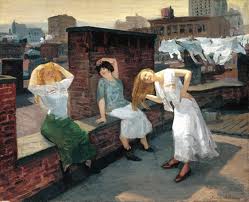
    Sunday, Women Drying Their Hair

     
    Bare-legged, in light, pale clothing,
    three young women stand on an urban rooftop;
    New York, probably, or some other big city.
    They are letting the wind dry their hair
    while white garments sway on a line behind them,
    and the chimney beside them casts a long shadow.
     
    It is 1912, and Sloan’s subjects could be sisters:
    one redhead in a green skirt, one brunette, one blonde.
    The brunette looks approvingly at the redhead,
    while the blonde brushes her hair which hangs
    like a curtain, her head titled to the right,
    the left hand on her hip for balance.
     
    I imagine they are chatting about the night before;
    what they did, who they saw dancing, girl talk.
    One of them could be softly humming
    After The Ball or something jazzy;
    no World War to bother them yet, and no Depression,
    this year forever marked by a ship called the Titanic.
     
    This is how I would like my three sisters to be;
    close, relaxed, hanging out happily,
    the brunette smiling at the redhead, the blonde
    still long-haired and carefree, and me,
    the youngest girl, looking on
    from the gallery, taking it all in.
     
    Sunday, Women Drying Their Hair is © Maeve O’Sullivan.
    sloane

    Heartwood

    West African proverb:’When an old man dies, a library burns to the ground.’
     
    Book by book, a library burns down
    when someone dies in Africa; the fire
    consumes the memory, the sensorium.
     
    And when he lights his robes of orange-brown,
    the monk rejects the puja, picks the pyre
    as, book by book, his library burns down.
     
    Three hundred people in a Midwest town
    were burnt alive like blossoms on a briar,
    with loss of all those memories,sensoriums.
     
    Before he left,prognosis barely known,
    my father trudged his way through the quagmire;
    then, book by book, his library burned down.
     
    The seeds of our dejectedness were sown
    when that disease took hold and made a liar
    of her clouding memory, her sensorium.
     
    And when at last I’m put into the ground,
    or else cremated, ashes back to Gaia,
    book by book, my library will burn down,
    consuming, then, my memory, my sensorium.
     
    Heartwood is © Maeve O’Sullivan


    White Star

    the majestic steamer
    slips into the sea-
    first voyage

    spinning his top…
    the child who survived
    to die three years later
     
    she goes back in
    for the hat from her mother-
    makes the lifeboat
     
    the pills in her pocket
    eventually identifying
    the lost Irishwoman
     
    anchor, propeller
    side-scuttle…
    these rusticles
    a hundred years
    in the making

    White Star is © Maeve O’Sullivan


    untitledMaeve O’Sullivan works as a media lecturer in the further education sector in Dublin. Her poems and haiku have been widely published and anthologised since the mid-1990s, and she is a former poetry winner at Listowel Writer’s Week. Initial Response, her debut collection of haiku poetry, also from Alba Publishing, was launched in 2011, and was well-received by readers and critics alike. Maeve is a founder member of Haiku Ireland (www.haiku-ireland.com) and the Hibernian Poetry Workshop. She also performs at festivals and literary events with the spoken word group The Poetry Divas. Her poem Leaving Vigo was recently nominated for a Forward Prize for a Single Poem by the Limerick-based journal Revival (http://poetry-24.blogspot.ie/2013/08/leaving-vigo.html).

    vc

    Vocal Chords

    Poetry

    by Maeve O’Sullivan

    ISBN 9780957526587

    Paperback. 64pp
    Published: February 2014

    £10 / €12 / $16

    To order, email: info@albapublishing.com

  • Opening

    March 13th, 2014

    Opening

    A black feather
    from her
    black feather tree

    sways down

    she has spread
    her red and blacks out
    for carrion lovers

    lace their moons with trawling nets
    bird-pecked crabbed and sweet apple
    windfalls

    roll them into grass
    bamboo worms a curve into flared ground

    black feather sways down

    through dream
    to this waking place
    of stones

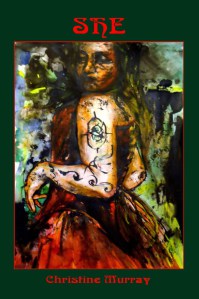
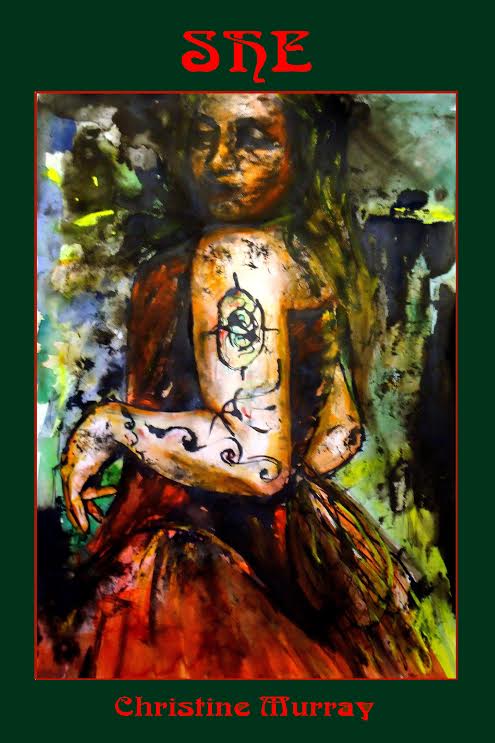
    A black feather from her black feather tree is the opening poem of SHE, published 12th March 2013.
    © C. Murray


    she-painting“I do not expect anyone will believe me, but I know that my dreaming life is as real as my waking life. Indeed, I have learnt not to call these sleeping narratives anything other than a different part of my reality.

    When I first encountered the entity that appears on the towpath I was afraid for She seemed hardly human to me. I had gone little by little into this dreaming place over the course of twenty years, and I had explored it almost wholly. I do not know what my encounter with this lady means, I intend to find out.”

    With She Christine Murray explores the spaces between waking and dreaming, that we all inhabit yet are so rarely revealed to us in this day and age. Part shaman part Sybil,she takes us on a Jungian odyssey to meet the archetype that stands at the crossroads of birth and death, one whom we are all destined to encounter sooner or later.

    Thanks to Dave Mitchell at Oneiros Books, To Michael McAloran, and to Anastasia Kashian who painted her beautiful cover.

    Support independent publishing: Buy this book on Lulu.

  • A Preview of My New Book ‘She’.

    February 22nd, 2014
    sheThe first edition of SHE was published by Oneiros Books in 2014.
    82 Pages

    Perfect-bound Paperback.

    The cover painting image is © Anastasia Kashian, with great thanks to David Mitchell for design, and to Michael McAloran for accepting the book on behalf of Oneiros Books.

    Two poems from The Island Sequence of ‘She’

    sea is a womb

    sea is a womb
    dip and flow the small boat

    rock and rock,
    rock the black black

    gold lace a-glitter
    and rocks – the
    rocks scrape her timbers

    beneath the carved wave
    lie monsters clawing at her base


    black the inky waves lap to

    black the inky waves lap to
    and black they suck the shale
    
    and if birds swoop
    they are the mere shadows of birds
    
    there are hands there to disembark you
    to hold you over the rocky black
    
    those hands that will arc you onto the comfort of stone
    
    this is the sea/
          this inky black
    
    it does not smell of sea
    
    the gap between the boat and the shore is awesome
    the wood laps the water dragging it out /
    and
    
    bobbing it back again
    the chasm at the heel
    and one step forward
    to land to stone comfort.

    Poems from The Island Sequence of ‘She‘ are © C. Murray

    black the inky waves lap to was published in The Burning Bush VI

    Contents Page

    (i) A letter found in the box that contained this narrative, being addressed to the cousin of a former patient, Miss Constance Byrne.

    (ii) A note attached to the file of Miss Constance Byrne (now deceased).

    Part I

    Standing Stones
    Grove
    Lake
    Serpentine The Alleyway
    A Ruined Church at the Precipice
    Burnt Hill
    Descent

    Part II

    The Island
    She


    Cousin -,

    The narrative that follows here is a faithful rendering of my wanderings from the time of my retirement to the dawn. It is always the same. I do not expect anyone will believe me, but I know that my dreaming life is as real as my waking life.

    Indeed, I have learned not to call these sleeping narratives anything other than a different part of my reality. When I first encountered the entity that appears on the towpath I was afraid for She seemed hardly human to me. I had gone little by little into this dreaming place over the course of twenty years, and I had explored it wholly in her company. I do not know what my encounter with this lady means, I intend to find out. In my exploratory times there I have never yet met another person. Although there were signs of life (or of creaturely habitation).This landscape seemed to me to be ruined by war and by heat. What else could make marble of glass shards?

    It is bleak there. At every dawn, there occurs a throb of colour and I know that somehow I am back here in this world. I do not believe that my nightly explorations are a dream, for I have found tears upon my slippers, and a rend in the lace of my dress. She wants to show me something. She has indicated for me a bridge. I intend to cross over it, and thereby to continue to explore the geography of its unknown terrain.

    I travel now alone. I am unencumbered by family, nor by tradition. I leave to you this letter and some small tokens of my esteem. Know that I am safe, and although I undertake this journey with trepidation, I remain always yours,

    Constance.

    Cover image by Anastasia Kashian
    Cover image by Anastasia Kashian. Cover design by David Mitchell at Oneiros Books.
  • Notes on the half-hidden: “Thimblerig” by Annette Skade

    February 15th, 2014

    Annette-Cover-1-212x300

    Thimblerig by Annette Skade

    Bradshaw Books 2013

    63 pages


    Notes on the half-hidden

    Annette Skade’s debut collection Thimblerig was published by Bradshaw Books in 2013. Thimblerig is a collection of some 53 poems on themes of family, familial history, and on the poetic striving for voice. Skade’s sub-thematic flow, her buried themes, are brought out using the symbolism of light,  and of the natural world that surrounds her.

    Skade is at her best as a writer and recorder of history and tale, her preoccupations are carried through the text as light-maps. She uses the symbols of the caul, the moth, and the cord (as rope, umbilicus, even as muscle ). Her symbols often denote boundary both in the  physical and in the emotional sense.  

    Women play an important role in Skade’s familial tracery, her bloodline. Thimblerig is dedicated to Skade’s mother and to her daughter. In Thimblerig Skade’s grandmother forms the apex of the matrilineal pyramid, appearing in The Caul

    The Caul

    She was born with a caul on her face.
    The mid-wife said it was good luck,
    cut away the membrane,
    examined its milky translucence
    and placed it in tissue to be kept.
    Her father sold it to a sailor
    as a charm against drowning.

    …

    All her life she loved chiffon scarves.
    Its my belief she missed
    part of herself sold away.

    p 11 Thimblerig

    Family tales are held together with fine wisps of poetry which will transmogrify into light. Annette Skade uses light to map her history and to create boundaries of safety in which to enclose and keep family safe. There is an element of ephemeral about her use of light which she has developed into a fine sense in the beautiful Oak Grove,

    Oak Grove

    I draw a ring
    around this house:

    snail shell
    harbour
    omphalos

    Strophe, antistrophe:
    from oak to oak,
    bin to bench,
    winter green to herb,
    washing line, shed.

    Tread the seasons,
    serve the sickle moon,
    observe it spring,
    orange, low on a dark sea.

    A rope of days, twined strong,
    to ward off the stranger,
    the letter come to dispossess.

    Oak Grove answers to A Map of My House In Terms Of Light, where the poet shows her reader the physical interior of the home traced with light: as impermanent, subject to deep loss and to necessary change. The exterior ring of protection and enclosure traced by the poet belies the move to drift of the lives of those she means to protect and to keep. those that are within the home:

    To plot all changes
    from dawn to dusk
    and through each season,
    I need many such maps
    an atlas of light.

    from  A Map of My House In Terms Of Light, Thimblerig.

    Skade is always striving to make her meaning through her use of symbol. In one poem here she has capped a false tail onto the work Papyrus Fragment forcing her ending too soon. Skade deserves a broader canvas for her imaginative play, which she will follow through with in her next collection.

    Two moth poems occupy the ground where the poets strives to examine the vulnerability of her existence. I wanted to look at these closer because they form the penates and laertes of the collection and of the poet’s thematic concerns. These are Papyrus Fragment and Restless.

    Restless

    A hundred moths made a lattice
    on blue-black window pane,
    some the size of wrens
    others torn corners of paper:
    a nightly frantic race of wings.

    Papyrus Fragment

    It darts, bares a blaze
    of underwing to plain sight;
    this endless fragile need
    to make a mark,
    to come to light.

    Skade’s investigation of nature is where she triumphs as in Solstice Rose. This poem and Oak Grove in particular show a poet who is  an imagist. A perfect image is accomplished in thirteen brief words,

    Solstice Rose

    Thorn switches
    cage
    a single yellow bud,
    clenched
    against wind whips:
    a sundrop.


    • Thimblerig
    • Annette Skade on Poethead
  • Poems from ‘The Blind’

    February 9th, 2014
    These series, published at A New Ulster #10, Ditch Poetry, and The Southword Journal are from my book The Blind (Oneiros Books, 2013)

    sans

    I.

    it is all ceremony
    it is all the cloths
    all gathered-in

    it is white tailor’s chalk
    in a neat triangle
    it is the blanket-stitch
    before the machine

    it is the neighbour woman
    with her bone-pick
    pulling stitches
    one by one
    from the curtain lining

    the [bone-pick] is ivory coloured
    a little larger than a [tooth-pick]
    nubbed to cradle under the silks

    and lift them up
    so she can snip it at the ties

    II.

    the little knot hidden in back of the material stretched out across her knees is silver
    the thread is doubled-to

    the material is some floral-stuff on white laid onto a cream skirting
    she will rinse it out in cold water later

    and hang it on the monday line the blue-blue rope of the monday line
    the length of material

    is clean / sweaty from her handiwork
    she will hang it over the gauze of her nets which are always immaculate

    her effort is blind/
    she does not need eyes to feel her work her gathering-to of the pleats

    ‘Sans’ published The Southword Journal

    hunger

    outside the ragged bird tears
    dead flies from window nets

    and it is not clothed right
    – it claws the glass

    suspend I

    from the mirror architrave
    float down silken threads
    they are not blackened yet

    from the branches they reach down
    laden with fruit
    out on the limb
    birds beat them for desiccated meat

    making sweetmeats for desperate bills
    a man is clipping the edges with steel
    season’s treachery

    suspend I

    from the mirror architrave
    float down silken threads
    they are not blackened yet

    from the ceiling hooks
    float down wisps of
    red thread – almost

    cobweb light she is
    arched back unsure
    whether to suspend

    burnt orange silks
    cover the shutters
    there are children in the street

    she is nonetheless
    quite bound-up
    in red ropes

    from loop at nape
    and length of torso
    it is peaceful

    being spider-rolled
    webbed-in and arched
    as if a

    bird swoops down
    behind the orange silks

    shiftshape-in

    suspend I

    as if
    she were an exotic fruit
    a seed caught in breeze

    from the mirror architrave
    float down silken threads
    they are not blackened yet

    cobweb light she is
    arched back unsure
    whether to suspend

    in the red threads
    that loop at her nape
    down the length
    of her torso

    dividing and opening
    her out achingly
    if she moves the
    threads will tighten

    the harpies are perched in the suicide-trees

    Hunger, published Ditch Poetry

    hooks

    a hook for an eye
    this ribbon for a slip

    there’s a pigeon in the pot
    and tree makes the room

    your foot on the boards
    your head in the sky

    no mind if your stockings snag
    are splinter-caught

    the red thread
    frayed or snag

    walk now on swollen feet
    on feet that are bound-in

    with red and orange
    with stocking threads

    these can be mended
    these can be made whole again

    you wouldn’t even
    notice the tear

    we are so good
    at what we do

    neat and tight
    no pain no gain

    for the ragged flower

    hooks

    gauze dries into the stitched wound
    where the tender-care of hands tug
    to redress to change to douse stitches
    with a brown liquid stuff

    it dyes the skin a type of clinical colour
    but with so tender a care –

    the split wound of vaginal mutilation
    is less easy to care for
    no gauze can be safe at depth of
    and thus submersion-in salt baths

    whilst the jagged edges gather to
    as mended sails, as canvas-stuff
    as linen-stuff

    you can tell at a distance that
    a woman has a scar that snakes up
    by the cast of her foot
    the heel-down look

    those stitches are insoluble
    hold-to
    the birth passage
    for the next opening

    hooks

    the feather-hook is a seed spiralling in the breeze,
    a false signal

    it mocks the mayhem of the caught moth down to
    its nub stone

    its plane is a shell network of dried skin, veined even
    – it has a spine of sorts

    it mocks the mayhem of the caught moth down to
    its nub stone

    ‘Hooks’ published in ANU #10

    The Blind is a contemporary poem-tale about The Furies. The themes and symbols of The Blind are entirely interdependent from beginning to end. The Blind is set out as a tale and employs experimental poetic methods throughout, including cut-up, repetition, symbol and internal rhyme. I did not make use of poetic prose, as I felt that it would be a challenge to tell a tale poetically. I am delighted that the book is now available. I have found it easier to employ these methods in conceiving book-length poem-tales since I began working in this manner, and to this end I have initiated another project in a similar vein.

    Christine Murray is a City and Guilds Stonecutter. Her chapbook, Three Red Things was published on June 4th 2013 by Smithereens Press, Dublin, Ireland. Her collection, Cycles was published by Lapwing Press (Belfast) in August 2013. THE BLIND is her latest collection.

    1-front-200x300

    ISBN 9781291577105

    Purchase Link for The Blind
    Previews of The Blind at Ditch Poetry

    Publications acknowledgements for The Blind

    Thanks to David Mitchell , publisher at Oneiros Books and to poetry editor Michael McAloran, who guided me through publishing my second poetry collection, The Blind.

    • Thanks to Amos Gideon Grieg , publisher at A New Ulster Magazine, who previewed some of the poems from The Blind this past summer. The series published at A New Ulster was entitled Hooks, Ceremony and Hunger.
    • Thanks to Ditch Poetry, who featured Suspend I from The Blind in their magazine.
    • Thank you to the editor of Southword Literary Journal (Munster Literature Centre) who will publish poems from The Blind in the Winter 2013 issue of Southword.
  • Poems from Crown Of Thorns by Bethany W Pope

    February 1st, 2014

    Joy:Thorns

     
    Growing flesh around the darkened hole death springs from,
    the bark hardens around the hollow in the bole,
    the secret place you love for no known reason.
    Dressed in a chiton, playing the role of nymphic
    servant to unseen Pan, you slide into the loamy darkness,
    your wood-rot scented hide. Adolescent haunches
    squat in soft soil. You have a shepherd’s pie you bought
    with two week’s allowance. Treated bamboo and garish
    dyed bands, producing a sound your mind makes melodious.
    The tree speaks with the borrowed breath of a wounded girl.
    Saturday is for hiding, drawing strength from the earth.
    Sundays still belong to grampy, his evil, elderly
    entitlement; right of patriarchy to penetrate
    beyond the heart of innocence, which grows no armor-bark.
     
    Joy:Thorns is © Bethany W Pope

    Crown 3: Alchemy

     
    13.
     
    The corridors run, binding us together
    Out of glistening red and blue wires. I begin to
    Understand the composition of my body,
    Generated from matrices of history and flesh.
    Here are my mother’s breasts, they rise from my chest,
    Retaining the form they had in her lost youth. My
    Eyes are my fathers; they entered the stream through his
    Father’s mother. Flesh and brain, spirit, soul, an internal
    Unending source that mingles past and future, feeding me.
    Salvation from misery, the remnants of an
    Aching jaw, is found in reviewing the struggle. My
    Life, redeemed through recognition of its features in
    The faces, the stories of the ancestors who
    Owned my blood in the beginning. I am myself, and them.
    .
    from Bloodlines; An Emperor’s Crown © Bethany W. Pope

    • Purchase Link for Crown Of Thorns

  • Crown Of Thorns by Bethany W Pope

    January 30th, 2014

    Crown of Thorns by Bethany W. Pope

    Oneiros Books 2013

    Crown Of Thorns by Bethany W. Pope is published under the Oneiros Books imprint. This is not an easy book to read. Ultimately it is a tale of triumph against war, where  war is child sexual abuse, rejection, and alienation. Throughout Crown Of Thorns there is a sense of profound hope and strong unshakeable faith.

    Bethany Pope uses an imagery and symbolism in Crown of Thorns that is bloody, battered, estranged, and sometimes terrifying. Corridors, umbilici, and torn flesh form the vast part of the imagery, with water and earth less spoken but always present. Crown Of Thorns is a testament of survival and endurance sited in a complex construction that requires some explanation.

    Divisions in Crown Of Thorns

    There are four major divisions in Crown Of Thorns, Crown of Thorns, House Of Masks, Rabbit Trap, and Bloodlines: An Emperor’s Crown. Within each division are series of poems excavating both familial and personal history. The series are broken into sonnet groups, some of which are acrostic.

    The opening section of the book eponymously titled Crown Of Thorns comprises two separate threads (or cords) Joy and John. The section is 15 sonnets long, alternating between two groups of seven sonnets under each heading that become entwined in Sonnet #15. Crown Of Thorns forms the foundation of the book proper. The major themes of survival and abuse are herein introduced.

    The themes of this opening section of the book are taken up throughout the other previously named divisions, House of Masks,  Rabbit Trap and Bloodlines. Pope maintains a careful balance in the foundational and introductory parts of her book. She explores and ultimately accepts the damage of war on the body, and its survival in the final part of the book Bloodlines: An Emperor’s Crown.

    Pope has intricately embroidered her major themes throughout the fabric of the book. She will pick up and repeat phrases in different sonnets, most especially in  Bloodlines: An Emperor’s Crown, which is more assured and deftly handled than the earlier sections. Bloodlines is cumulative, thus the most difficult set of themes to render poetically.

    The achievement of this book is for the writer, who has honed her craft to attain her mature poetic voice. This, she achieves through her use of structure, structural underpinning in the form of acrostic sonnets, and a developed use of symbolism that interweaves its way through each titled or numbered section. The use of  the symbolism of the umbilicus, the corridor, the tunnel, the eye , and water is very evident in the final section of the book through Crown 2: The Ancestors, Crown 3: Alchemy, and Blood Jewels. These named sections form the final part of the book, titled Bloodlines, An Emperor’s Crown.

    Symbols In Crown of Thorns

    Crown Of Thorns is set out as a Bildungsroman, or more properly a pilgrimage. The book is confessional, as it is a testament of victory over war. War is the torn body and soul of the victim of child abuse, war in the experience of neglect and poverty. The deepest victory is in Pope’s admittance to herself that the battle is never entirely won. It begins anew each day with the ‘Dream that bursts when eyelids open.’

    Some of Pope’s material is traumatic to read and to think about. Her most intense victory therefore is in how she has achieved compression of her traumatic themes through her use of poetic form, and in how she has explored and set out those themes through sure use of symbol.

    Soil, earth, water and the dark blood of birthing mingle their acids into an existence that is always questing for right and truth. The umbilicus, that dark binding cord of ancestry binds the victims of family through change of place and of time,

    13.

    ‘The corridors run, binding us together
    out of glistening blue and red wires.’

    Crown 3: Alchemy (Bloodlines)

    Bloodlines makes liberal use of the acrostic form spelling out a history, which I read as an SOS. Bethany is born, only purity is my tough refusal to, sell my poor soul, and so on. It is a morse-code of distress hammered into sonnets of sure structure and strong voice. I found myself trying to avoid the acrostics as much as possible to get to the meat of the work, although the acrostic sonnets form the tough outer skin of the poetry- the rind.

    Joy: Thorns

    Growing flesh around the darkened hole death springs from,
    the bark hardens around the hollow in the bole,
    the secret place you love for no known reason.
    Dressed in a chiton, playing the role of nymphic
    servant to unseen Pan, you slide into the loamy darkness,
    your wood-rot scented hide. Adolescent haunches
    squat in soft soil. You have a shepherd’s pie you bought
    with two week’s allowance. Treated bamboo and garish
    dyed bands, producing a sound your mind makes melodious.
    The tree speaks with the borrowed breath of a wounded girl.
    Saturday is for hiding, drawing strength from the earth.
    Sundays still belong to grampy, his evil, elderly
    entitlement; right of patriarchy to penetrate
    beyond the heart of innocence, which grows no armor-bark.

    by Bethany W Pope

    • Crown Of Thorns 

    • An Index Of Women Poets

  • ‘Cup’ and ‘New Trees’ by C. Murray

    January 25th, 2014

    Cup


    nest rests
    her cup

    (heart, feather)

    into wood
    winds
    capillary

    In air (above)
    sky is a heart caught
    red, its amber spilling

    nest stills
    her dust
    and moss

    breathe out 

    underground, wet roots stir
    the sleeping house up

    soften
         the softening rain

    my veins answer tree

    .

    Cup is © C. Murray

    .

    New Trees,


    there are three –
    two crows dance 
    steel-beaking the mounds round

    New Trees is © C. Murray


    Image is © Mick McAloran
    Image is © Mick McAloran
  • The Co. Durham Miner’s Granddaughter’s Farewell to the Harlan County Miner’s Grandson

    January 18th, 2014
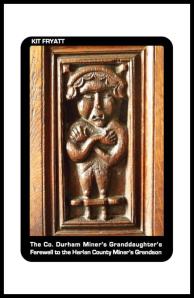
    screenshot201310aThe Co. Durham Miner’s Granddaughter’s Farewell to the Harlan County Miner’s Grandson by Kit Fryatt
     
    Published 2013 Knives Forks and Spoons Press
    Pages 61

    New Words to the Tailor’s Air

     
    Rome, you barely inveigh
    when governments settle
    traders’ gaming debts
    with money stolen
    from the sick and children.
    Instead you spew sermons
    on the evils of condoms
    to AIDS victims:
    better die holy, Joe Slim
    than fill a rubber
    with a drachm of sperm.
     
    Rome, your hypocrites
    cant their pro-life spiel
    (what touching pride
    in avoiding homicide!)
    but they’ll skewer
    any born soul ever.
    Life is a fig-leaf
    Rome, for your kink:
    convincing people
    their desires & bodies stink
    as bad as your shit
     
    (…)
    Rome, if I thought
    you’d got a tithe
    of your due, I’d lay off
    you poison pit, werewolf
    in faux-lambskin
    black widow of a viper
    I’d not take your pardon
    if it came baked in
    all your dough. Go home,
    Rome, seek consolation
    where the devil knows his own.
     
    Excerpt from New Words to the Tailor’s Air © Kit Fryatt

    A loose adaptation of Guilhem Figuera’s ‘D’un sirventes far composed in 1229, during the siege of Toulouse by papal crusaders. Guilhem’s original attacks not just the recent crusade but clerical corruption and the avaricious imperialism of the papacy.


    In The Co. Durham Miner’s Granddaughter’s Farewell & Kit Fryatt is a musical Ariadne who weaves her learning into her coat. She jauntily engages her reader with her major themes of exile, loss, camaraderie, and she throws in some linguistic cardiovascular workouts for good measure too. The basic structure of The Co. Durham Miner’s Granddaughter’s Farewell & is conveniently bipartite. The poems are read aloud for the most part, and you can hear some of them performed here.


    Here or there in Section I glints a word originating in the Anglo-Saxon. Fryatt eventually and wholeheartedly gives way and devotes the entire of Section II to an exploration of her themes through adaptations of medieval, Early Irish, and Anglo-Saxon poetic forms. Fryatt uses lament, polemic, and subtly provocative pieces on contemporaneous corruption remodelled on 13th century texts, as in New Words to the Tailor’s Air adapted from Guilhem Figuera’s ‘D’un sirventes far‘. I suppose that corrupt practice and its effect has  an unchanging quality.


    Fryatt weaves the universal themes of camaraderie and exile into Sections I and II of The Co. Durham Miner’s Granddaughter’s Farewell &. Exile is written as a full and complete isolation from a former life, a season in hell. Be the protagonist the wife of The Wife’s Lament (here written as a youth), or even The Wanderer. To lose one’s thane (or lord) who functioned as the hierarchical leader of a group, is to lose one’s very life and the meaning derived therefrom. These themes are borne lightly into our modern consciousness by Fryatt’s subtle approach to her writing, and no academic sense of the era is necessary to the understanding of the general reader.

    The Wife’s Lament is a well know text from The Exeter Book. Its author is unidentified , but the exile is likely written from the perspective of the sinning woman. She may or not be speaking from the realms of death, lamenting her earthly loss and her exile. 


    from The Wife’s Lament 

    While at dawn, alone, I crawl miserably down
    Under the oak growing out of my cave.
    There I must squat the summer-long day,
    There I can water the earth with weeping
    For exile and sorrow, for sadness that can never
    Find rest from grief nor from the famished
    Desires that leap at unquenched life.

    by Unidentified


    Three From The Exeter Book

    (ii) Coneycote

    As I was told I stay in this brakebrush holt
    bunkered beneath an oak
    old earthwork. I am taken up with longing.
    Shadow valley unswept moor
    bitter pale of briars my houseless home.’

    Coneycote is © Kit Fryatt

    Fryatt writes coneycote as a boy or youth who is honouring the wishes of his thane. There is a type of equality inherent in Fryatts treatment of the theme which she achieves by reducing the high-tone of the language in the original (Exeter Book) to a more robust vernacular. This poem is a jewel in the book.  It sits well in Section II,  whilst picking up and re-threading the theme of exile  inherent in the language of Section I.

    I have excerpted a small section of Three From The Exeter book above, and I  refer the  interested reader to Burton Raffel’s Poems And Prose From The Old English.

    Fryatt well knows how to use her symbols,  Vis her reference  to the use of the oak  as symbol of a place of exile or punishment. The tree was associated with death, in the very least it was associated with societal disgrace, and a rabbit hole image refers to the disgrace of adultery. Interestingly the symbol play also ties in with the story of the women in the wall , or to the burial of women alive in regeneration myths such as in Sophocles Antigone or the story of Demeter. One supposes the pain of exile, or indeed the death of the individual to be necessary to their symbolic rejuvenation.

    The voice of  lamenting is present in this book , yet one feels a powerful energy in Fryatt’s use  of  words that belie any sense of weakness. The preview section of KFS Press includes an excerpt of the first section of the book.

    The eponymous title-poem of The Co. Durham Miner’s Granddaughter’s Farewell & sets the tone for the entire text, which is playfully vicious. Fryatt doesn’t seem interested in the issue of gendering,  she inhabits a poetic world of boyish and delighted charm along with a unique acerbically infused sweetness.

    from, The Co. Durham Miner’s Granddaughter’s Farewell to the Harlan County Miner’s Grandson

    Swiftly, my chancer, to the temple they danced you
    dead leaves in your pocket and a mouthful of vine.
    I thought I should slight you, but go where you might you
    will come back to green grass, air and sunshine.
     
    Darling, my hazard boy, I thought to have you
    your body as straight and keen as a blade,
    your mouth soft as eiderdown, stay you or hie you,
    you’re bloodsworn to Fortune’s helpless parade.

    • Nanna Slut’s Long Close Summer
    • KFS Press
  • “Poems from In Between Angels and Animals” by Emily Cullen

    January 11th, 2014

    EMBODIMENT

     
    1.

    Maternal

     
    I lie on the bed in darkness,
    wary of sudden toddler jerks
    (your innocent, erratic strength).
    Instead, you lay your head upon my cheek
    and in that momentary tenderness,
    a universe of visceral wisdom.
    I am held by this intuition:
    love
    free of all condition.
     
    2.

    Marital

     
    We grasp each other.
    Words surrender
    to spoor of pore.
    You kiss my collarbone.
    Sacred contours
    underscore
    quibbles and stresses.
    Our limbs recall
    a geography
    of catharsis;
    the lee of my back,
    the lie of your land.
     
    Embodiment is © Emily Cullen
     

    GALWAY MOULD

     
    We take the damp for granted here.
    Blinds draw back to reveal
    colonies of galaxies:
    tiny black holes
    in our new collective space.
     
    ‘It’s only condensation,’
    Next Door concedes,
    ‘the weather’s too wintry
    to open the windows.’
    My wooden bangle by the sill
    slips into a mildewed coat of green.
     
    For fun, I bought you mouldy cheese.
    Last night, it took revenge on me,
    inducing a vivid dream
    of a white chandelier of mould
    that slowly lowered
    through our kitchen ceiling:
    a lichen lantern,
    till its lattices became milky spores,
    mouths that started to open and close.
     
    Then I awoke, vowing to spray
    our wall of condensation,
    diffuse for good my fascination
    with Galway mould.
     
    Galway Mould is © Emily Cullen
     

    INCENSE

     
    Wisps of opium:
    boa constrictors
    curl into curtains
    of late afternoon.
    Milky ribbons tantalise
    like the soft, deliberate motion
    of the belly dancer you admired
    in Turkish solitude.
    I remember you burning sandalwood
    in Illinois to set the mood.
    Now smoky arabesques
    tease then evanesce
    while broken trails of ash,
    like fossilized worms announce
    seduction as but a crumbling dream:
    brittle, grey, ephemeral.
     
    Incense is © Emily Cullen

    Incense’ was published in No Vague Utopia (Ainnir Publishing, 2003) ‘Galway Mould’, ‘Embodiment’ and ‘Playing House’ were published in Emily Cullen’s second collection, In Between Angels and Animals (Arlen House, 2013).

    Author-pic-Emily-Cullen

    Dr. Emily Cullen is an Irish writer, scholar, harpist and arts manager. Her first poetry collection, entitled No Vague Utopia was published by Ainnir in 2003. In 2004 she was the national Programme Director of the Patrick Kavanagh Centenary celebrations and was selected for the Poetry Ireland Introductions series. Emily was awarded an IRCHSS Government of Ireland fellowship for her doctoral study on the Irish harp. She is a qualified teacher of the harp who has performed throughout Europe, Australia and the United States. A former member of the Belfast Harp Orchestra, she has recorded on a number of albums and also as a solo artist. In addition to writing poetry, short stories and feature articles, she publishes widely on aspects of Irish cultural history and music.

    • Things Being Various
    Out now! Emily Cullen In Between Angels and Animals (Arlen House, 2013) 
    ISBN: 9781851320790  Paperback 96 pp 12 EURO
    Available from Kennys Bookshop, The Book Depository and many good book stores.
    More Information:
    The Book Depository: http://www.bookdepository.co.uk/Between-Angels-Animals-Emily-Cullen/9781851320790
    Kennys: http://www.bookshop.kennys.ie/book/IE/9781851320790/In_Between_Angels_and_Animals


←Previous Page
1 … 47 48 49 50 51 … 106
Next Page→
 

Loading Comments...
 

    • Subscribe Subscribed
      • Chris Murray
      • Already have a WordPress.com account? Log in now.
      • Chris Murray
      • Subscribe Subscribed
      • Sign up
      • Log in
      • Report this content
      • View site in Reader
      • Manage subscriptions
      • Collapse this bar