• chris murray
  • journals – bibliography – publication notes
  • downloadable items – essays – media
  • copyright
  • Home

Chris Murray

  • Pantoum for Limerick National City of Culture 2014

    January 7th, 2014

    Pantoum for Limerick National City of Culture 2014

     
    I will be taking stock of resourcing requirements
    in the light of everyone else having resigned.
    I am determined to hit the reset button.
    I am moving on in a calm and deliberative way.
     
    In the light of everyone else having resigned,
    I’m absolutely satisfied we have the capacity.
    I am moving on in a calm and deliberative way.
    I would like to thank those who ran screaming from the building.
     
    I’m absolutely satisfied we have the capacity.
    It’s been a challenging start but we need to draw a line under this.
    I would like to thank those who ran screaming from the building.
    I may turn out to be a blessing in disguise.
     
    It’s been a challenging start but we need to draw a line under this.
    I am humbled by what I’ve heard here tonight.
    I may turn out to be a blessing in disguise.
    This is a lot more complicated than what actually happened.
     
    I am humbled by what I’ve heard here tonight.
    I am determined to hit the reset button.
    This is a lot more complicated than what actually happened.
    I will be taking stock of resourcing requirements.

    © KEVIN HIGGINS


    whitehouse

    Kevin author photo December 2013 (1)

    Kevin Higgins facilitates poetry workshops at Galway Arts Centre and teaches creative writing at Galway Technical Institute. He is also Writer-in-Residence at Merlin Park Hospital and the poetry critic of the Galway Advertiser. He was a founding co-editor of The Burning Bush literary magazine and is co-organiser of Over The Edge literary events in Galway City. His first collection of poems The Boy With No Face was published by Salmon in February 2005 and was short-listed for the 2006 Strong Award. His second collection, Time Gentlemen, Please, was published in March 2008 by Salmon. His work also features in the generation defining anthology Identity Parade – New British and Irish Poets (Ed Roddy Lumsden, Bloodaxe, 2010). Frightening New Furniture, his third collection of poem, was published in 2010 by Salmon Poetry. Kevin has read his work at most of the major literary festivals in Ireland and at Arts Council and Culture Ireland supported poetry events in Kansas City, USA (2006), Los Angeles, USA (2007), London, UK (2007), New York, USA (2008), Athens, Greece (2008); St. Louis, USA (2008), Chicago, USA (2009), Denver, USA (2010), Washington D.C (2011), Huntington, West Virginia, USA (2011), Geelong, Australia (2011), Canberra, Australia (2011), St. Louis, USA (2013), Boston, USA (2013) & Amherst, Massachusetts (2013). In November and December 2013 Kevin also read his work in Basel, Switzerland and Phoenix & Tucson, Arizona. Mentioning The War, a collection of his essays and reviews was published in April 2012 by Salmon. Mentioning The War has been described by Clare Daly T.D as “a really good and provocative read. It will jolt you; it will certainly touch you; make you laugh; maybe make you snarl a little bit as well, depending on where you come from or what your background is.” Kevin’s poetry has been translated into Greek, Turkish, Spanish, Italian, Japanese & Portuguese. The Ghost In The Lobby is Kevin’s fourth collection of poetry will be launched early Spring 2014.

  • Regarding the void through the lens of The Zero Eye

    January 7th, 2014


    ‘In the realm of suffering, affliction is something apart, specific, and irreducible.’

                                                                                      Simone Weil.

    • The text of The Zero Eye can be read in its entirety in the January 2014 issue of Ygdrasil, A Journal of The Poetic Arts.

    I equate Michael McAloran’s use of imaging in The Zero Eye with the concept of necessity propounded in Weil’s essay on affliction which I have quoted above here. There occurs a layering of image in The Zero Eye which explores at once the dissipation of language and the voidal space wherein a voice explores the themes of perception and the stripping down of conscience. In typical McAloran fashion a structural element is inserted into the book which undermines the preceding text,  in this instance he uses a coda at #10.

    #10

    the zero eye fails/ cannot/ can or cannot only in/ barren vice of obsolete/ of film upon eye in glimmer tide/ of cataract projectile upon/ itches to be gone in eye of/ absurd of/ zero else of black/ no nothing of/ zero eye not feel/ unblinking black/ gallows none/ razor none/ (+0)/ skeletal as if/ no not infinite/ yes infinite

    Weil describes affliction through her construction of the image of a hammer hitting the nail in the exact dead centre of the wood, that the reverberating echo would traverse all space and time. McAloran’s dead-centre is the black lens of the death-eye, over which pass worlds. Eye’s monologue occurs in a space peripheral to where voice’s bodily humanity lies.

    #2

    crafted in absence of voice/ here or there a nothing of/ claimed yet ever-fading/ yet silenced ever/ still yet/ breakage upon rock of night’s forever distance/ motion of which feeds flame of/ yet ever to rage against/ shift unto/ remnants in midst/ shadowed by final yes/ once absence births/ hands cold/ search through weight of cold/ silhouettes of/ cannot lacks cannot or cannot/ hence proliferation of/ sound upon distance/ and of echoing/ undoing…

    The Zero Eye is 24 pages long and it represents a step away from the grief-scape that McAloran created through his recent books, none is closer (or further) from his present  intent than the Lapwing Press published ‘The Non Herein-’. The created space developed in that book has given way to intimate space, be it a shack,  a room, or the artificial space of the stage.

    #1

    in shed of flame that was never light/ better yes never of it/ bite down upon edge-solace of/ trade anguish for oblivion/ yet naught as ever/ final as/ less or more/ ever was/ remnants of then or nothing left to/ no/ no breaking forth/ no never again/ let it/ decline of/ yes death of/ yet will not/ clings unto/ as if to say/ the zero eye/ un-scattered none/ falls unto or not/ utters without pause for/

    McAloran’s instinct as a writer is to bring the reader into the created space, and then to turn their expectation on the head by radically altering the pace of the piece,  which he achieves in his coda.

    The major carrying image of this book is the eye/I. The eye/I occurs as symbol throughout McAloran’s work, but in this case it represents a shift in focus from the universal to the particular, or the intimate.

    #2

    the zero eye will ever be/ shape without form/ density of rind branded by sting of inescapable/ rots through unto/ until/ yet given to silence/ scatters breath of nocturne/ clasp of weight/ says nothing more of I/ clean break/ subtlety of design/ crafted in absence of voice/ here or there a nothing of/ claimed yet ever-fading/ yet silenced ever/ still yet/ breakage upon rock of night’s forever distance

    There is a subtextual violence throughout The Zero Eye, which I read as lament. Words occur and re-occur, they voice a violent out-rooting of the sense of moment, spliced, rixt , marrow of spliced, ….translucent carrion ,  density of rind, deformed, empty, shadowless, rupture.

    #9

    zero black pupil of/ of what/ (question once in text/ believed)/ no matter/ erase/ recommence where there is naught/ raging blindly/ hop-scotch…

    Here voice, or voice’s echo is knitting together themes in a manner that prepares the reader for the coda, where a nihilist rejection of the almost sweet lament that occurred in the preceding ten pieces is shot through with a clownish repetition and cut-up technique turning the book onto its head and abruptly ending it.

    Coda

    (…text no/ this is not a/ this is not/ not this/ is/ a text not/ not this a/ this/ this is not text/ not a text/ text not this is not/ a/ this/ not a/ text no this is a/ not a text this/ this is not a/ this not a text is/ this not a/ not a this a text is not/ not/ not this/ a text/ not a/ text not this is a/ this is not a text this is not a text this is not a text this is not a text this is not a text this is not a text/ text no this is not a/ text no/ a text not this/ not a/ text not this is not a…ad infinitum).

    Kicking to the kerb of the subtle beauty of the lament, McAloran forces the reader to remove herself from the hypnosis of the previous text, and address the worthlessness of human-suffering. The Zero Eye represents a culmination point and a watershed in McAloran’s work as a writer. His use of structure and symbol is highly developed in all his recent books, yet inherent in this book is a cool limpidity not heretofore noticed by me.

    McAloran’s excavation of his psychic depth in books like All Stepped/Undone and The Non Herein- led to the creation of a huge internal landscape. Here there occurs a reduction of the claustrophobic element of  his previous books, and a movement towards a smaller and more intimate space, wherein voice in the form of soliloquy or monologue is given freer reign.


  • Poems by Christine Broe

    January 4th, 2014

    Breakfasting with Dreams

    Birdsong.
    Scraps of dreams remembered.
    I place one foot, then the other, on the floor.

    Outside in the first light of breaking day
    dew lies on the discarded squashed remains
    of suppers bought from greasy chipper vans,
    and mist will blend with fumes of car exhausts
    as workers crawl from sleepy dormer towns.

    But dew and mist are genes of water words
    like drip and drop and rain and flood and sea
    so comforted I make some toast and tea
    humming words like seed and sow and yellow wheat
    and grind and flour and bake and break and eat.

    I slipper round the kitchen with these words
    and on the window sill leave crumbs for birds,
    carbohydrates to augment the early worms.

    Then as the sun shines through the marmalade
    I butter toast with golden spreads of dreams,
    image fragments I have salvaged from the night

    so I can go and face the world once more,
    put one foot, then the other, out the door.

    Breakfasting with Dreams is © Christine Broe

    A Decent Full Stop

    There are enough words in the world,
    more than enough,
    when all that is necessary
    communicates itself in silence.

    Should the sparkle of a sapphire speak
    Or be some window in your eye
    that tells of love?

    The script is done.
    You have said all you will say.
    I listen to the pregnant silence
    for sudden intakes of breath.
    Sighs.

    Silent mother
    I am learning
    to live with the absence

    with a language beyond
    even that between the lines.

    We walk together,
    I synchronise my steps to yours,
    From garden gate to garden gate
    Sealed with cobwebs.

    You touch the locks.

    Scents of flowers caress us,
    sitting in the sun
    when your hand unbidden reaches out,
    catches mine
    and we are joined to everything.

    A Decent Full Stop is © Christine Broe

     
    Christine Broe 001 (2)Christine Broe, born and still lives in Dublin. She has worked as an art teacher, arts facilitator, and art therapist while looking after family of seven. She has been writing poetry since the 1990’s winning the inaugural Brendan Kennelly Award in 2001 and gained international recognition when awarded the Premio Cittá di Olbia prize in 2002. Swan Press published her debut collection Solas Sólás in 2003. She is a long time member of Rathmines Writer’s Workshop and has facilitated creative writing workshops using art media as inspiration for generating work.
  • Mike Begnal’s review of ‘Three red things’

    December 30th, 2013

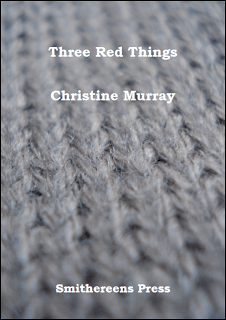
    Three red things
    Three red things

    With thanks to Michael Begnal for his astute reading of my 2013 chapbook, Three red things (Smithereens Press, 2013)

    The chapbook is readable here, Three red things


    From, Murray & McCardle, Smithereens chapbooks

    One section I particularly like is “reed songs I-IV,” set at Trá an Dóilín in the Connemara town of An Cheathrú Rua. Trá an Dóilín is a coral beach that is often also covered in maerl (reddish seaweed/algae). A beautiful spot. Here, the colors of the beach in one section merge into the colors of a horse in another:
     
    She had tumbled down the stone walls in flight
    in frenzy
    the men caught her
     
    amongst the strife the orange flame
     
    the yellow strife
    the white
     
    white grey and cream : her
    mane and tail is against the wall
     
    There are so many ways to read this; it suggests something about oppression, specifically in the gendering of those involved. Also running through it are themes relating to the muse in poetry, music (“your double-flute’s song”), the Famine, and the “noise” of mannered civilization. (Michael Begnal)

    The review in its entire can be read here.


    Michael Begnal

    Poetry collections: Future Blues (Salmon Poetry, 2012), Ancestor Worship (Salmon Poetry, 2007), Mercury, the Dime (Six Gallery Press, 2005), The Lakes of Coma (Six Gallery Press, 2003). Anthologies: Avant-Post: The Avant-Garde under “Post-” Conditions (Litteraria Pragensia, 2006). As editor: Honeysuckle, Honeyjuice: A Tribute to James Liddy (Arlen House, 2006), The Burning Bush literary magazine (1999-2004).

    future.blues.square

  • ‘Crinoline’ and ‘sans’ by C. Murray

    December 28th, 2013

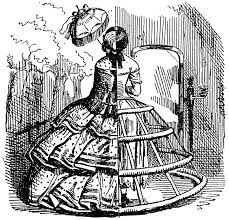
    Crinoline

    The grief synesthete bears her horsehair dress heavy
    as the rose haw throbs its orange glow,

     
    through forest or stream, each time a visit to the griefscape is necessitated,                                                                     (and it will be)
    dress gathers a little more.
     
    Contracting centimetre slow, She
    begins to weight her
    brocades as web-work / a tatter of lace /
    a smear of pollen (gold)
    and, yes,

    sequined embonpoint (tears too, always).
     
    That throbbing orange (big as a head) is a flower that will not sit in its Bed.
    her train drags past, load-bearing its leaf and moss/ its loamy grain/ its fray/
     
    its thread(ing).
     
    The only response is wonder,
    the only way is still
     
    and still –
     
    Crinoline is © C. Murray

    Crinoline was first published at When Women Waken, Fall 2013, from a forthcoming book called She.

    sans

    I.

    it is all ceremony
    it is all the cloths
    all gathered-in

    it is white tailor’s chalk
    in a neat triangle
    it is the blanket-stitch
    before the machine

    it is the neighbour woman
    with her bone-pick
    pulling stitches
    one by one
    from the curtain lining

    the [bone-pick] is ivory coloured
    a little larger than a [tooth-pick]
    nubbed to cradle under the silks

    and lift them up
    so she can snip it at the ties
    II.

    the little knot hidden in back of the material stretched out across her knees is silver, the thread is doubled-to

    the material is some floral-stuff on white laid onto a cream skirting
    she will rinse it out in cold water later

    and hang it on the monday line the blue-blue rope of the monday line
    the length of material

    is clean, sweaty from her handiwork
    she will hang it over the gauze of her nets which are always immaculate

    her effort is blind,
    she does not need eyes to feel her work her gathering-to of the pleats
    ©2013 Christine Murray

    sans

    Published Winter 2013 at  The Southword Journal . The poem is from The Blind, published Oneiros Books 2013

    crinoline
  • Poems from ‘Of Dead Silences’ by Michael McAloran

    December 17th, 2013

    Of The-

    Head of death

    The seasons dissipate as if they
    Had never collected tears

    A dissolving sky
    Soil sieved through fingers

    The silent laughter of the blood

    Nothing More-

    Ruins of the foreign sky
    From which point all are dead

    Smears of dying animals upon clear glass
    The flies will gather, nothing more

    100_2738

    Ignites-

    A blindfold of congealed earth
    The dead drown of inverted tears

    Lacking the light
    By which the night ignites the living

    Upon-

    Brute flesh shocks the nothing back
    Into resolve

    And is then pissed upon

    100_2754

    Silences-

    Heart of desolate
    In a vice of flesh

    Nowhere else/ nowhere/ nothing less
    The winds erased having tasted ashes

    Echoes of non-being
    Inexplicable silences

    Champion-

    Dark hollow
    The sky unearthed

    One final breath to champion the infinite

    100_2757

    Ever-

    Haven to begin from
    Scarlet striking out striking the dirt

    With liquid hands
    As if it could have ever begun otherwise

    II

    #9-

    Echo within echo within shadow of…
    Absence/ walls/ flames/ still breath alone

    Pantheon of carousel/ of vertigo/ of absences

    Night’s undoing was never night
    Hence the laughter forever ceases to be

    #14-

    Danse of polka winds…night undone/
    Night flourishing…

    Silent retrace of bone/ vapours/ memories

    Immense sky of non-death/ nothing lessened
    Razor absences/ peeling away the bloodlessness

    #15-

    Hollowed tongue…winds dealt/ silenced
    Dread lest the fingers break/ (only the elapsed)

    Sing elixir of non-speech/ mouth full of dry sands
    Leaving behind the drapery of skinned tide

    #18-

    Adrift…a visage of mists…(dead unto breath)/ arbitrary
    Vault of wasps/ colours/ discoloured skin/ emptily

    Night of vague breathing/ unheard voices/ voices heard

    Stillness of forgotten sky/ there or here again/ cast aside
    Buried sun/ sky/ sun of ashen waste/ teeth of nothingness

    #19-

    Waste ground/ flies of haste/ silver voices/ decay
    Black tongue of…wasted wounds of…soundless again

    Arise dead/ so much the/ dread/ silenced/ birthed
    Evaporating tongue of/ erased/ better never/ never to have been

    100_2738

    • Lapwing Store link for Of Dead Silences
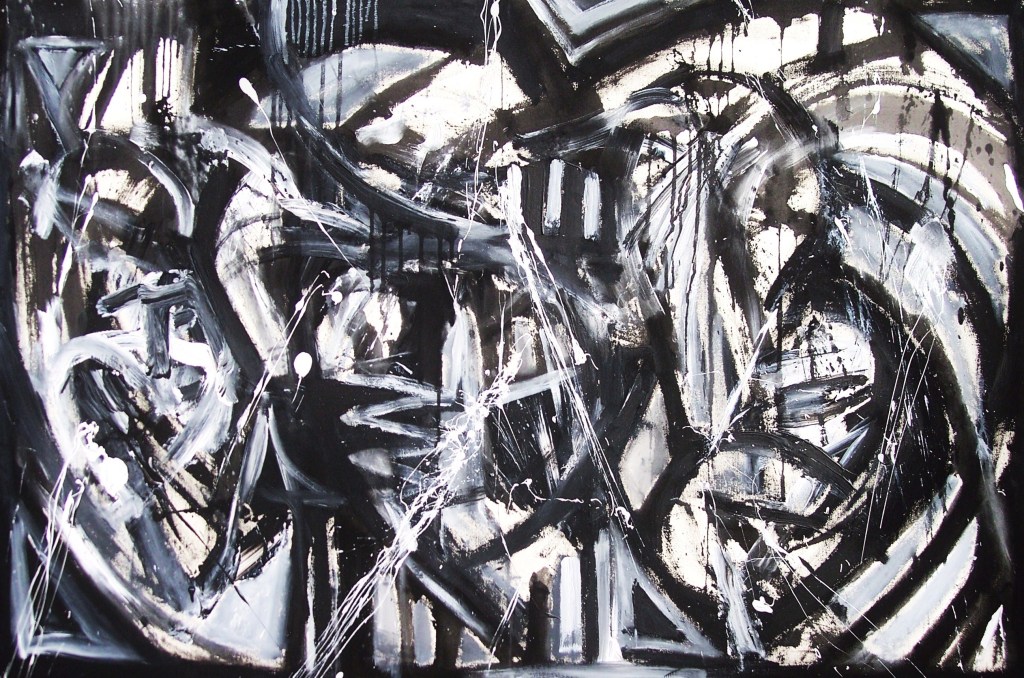
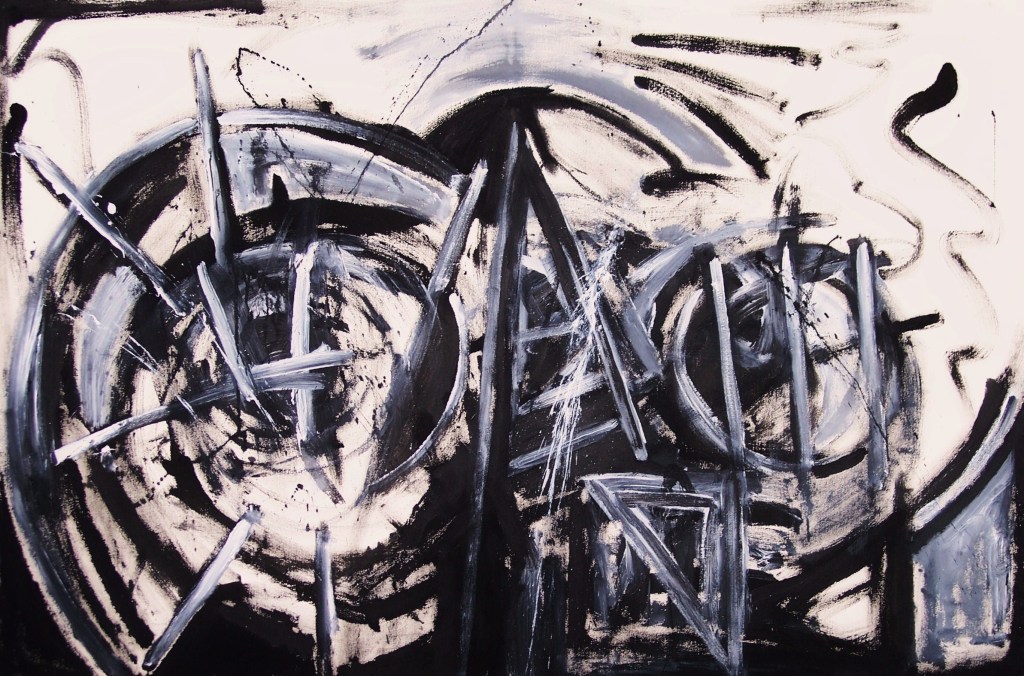
    All the images accompanying the poems from Of Dead Silences (Lapwing 2013) are © Michael McAloran (Acrylic on unprimed canvas, 2012)
    Michael Mc Aloran was Belfast born, (1976). His work has appeared in various print and online zines, including Carcinogenic Poetry, Calliope Nerve, The Recusant, PMI, Sex & Murder Magazine, Full Of Crow, Media Virus, In Between Altered States, Horror, Sleaze & Trash, Negative Suck, Graffiti Kolkata, Pratishedhak, Prathamata, Danse Macabre, amphibi.us, The Plebian Rag, Full of Crow, Gloom Cupboard, Gutter Eloquence, 1000th Monkey, Fashion For Collapse, Fragile Arts Quarterly, Clockwise Cat, Sein Und Werden, Peripheral Surveys, Milk Sugar Literary Journal, Psychic Meatloaf, Cannoli Pie, The Medulla Review, Counterexample Poetics, Heavy Bear, Indigo Rising, Widowmoon Press, Nothing, No-one, Nowhere, Mastodon Dentist, Gobbet, Ink Sweat & Tears, Ygdrasil, Establishment, Stride, A New Ulster, Primal Urge Magazine, Can Can, etc.He has authored a number of chapbooks, including ‘The Gathered Bones’, (Calliope Nerve Media), ‘Final Fragments’, (Calliope Nerve Media), & ‘The Death-Streaked Air’ (Virgogray Press), ‘Debris’, (Erbacce-Press),‘The Rapacious Night‘, (Calliope Nerve Media),’, & ‘Unto Naught’, (Erbacce-Press). A full-length collection of poems, ‘Attributes’, was published by ‘Desperanto’, (NY), in May 2011, & ‘The Non Herein’ was published by Lapwing Publications in 2012. An ekphrastic text/ image book, ‘Machinations’ was published in 2013 by Knives, Forks & Spoons Press (U.K). More recently, two further collections, ‘In Damage Seasons’ & ‘All Stepped/ Undone’ were published by Oneiros Books. Lapwing Publications also recently published a collection of imagistic aphorisms, ‘Of Dead Silences’
  • “The Caul” and other poems by Annette Skade

    December 14th, 2013
    The Caul
    
    I get it from my Grandmother:
    head in hands, chin resting
    in the heel of an upturned palm,
    skin over mouth and nose,
    fingers a mesh to sift
    the cruel sight, hard word,
    embarrassment.
    
    She was born with a caul.
    The midwife said it was good luck,
    cut away the membrane,
    examined its milky translucence
    and placed it in tissue to be kept.
    Her father sold it to a sailor
    as a charm against drowning.
    
    She saw the worst in others,
    but her eye for us was softened
    by the tender veil of her birth.
    All her life she loved chiffon scarves,
    It’s my belief she missed
    part of herself sold away.


    Papyrus Fragment
    
    A buff-brown moth hovers
    on temperature controlled neon,
    displays paper thin wings,
    ragged margins of ancient grass
    speckled with alpha, omega, nu.
    
    It darts, bares a blaze
    of underwing to plain sight;
    this endless, fragile need
    to make a mark,
    to come to light.
    

     Luck
    
    Corded wrist, thick fingers
    set down the pint glass, snatch again
    at the coil of rope round his ankle
    as it drags him over the side.
    
    This is how we live through survival,
    telling and retelling: how the gear
    swept him into chest-piercing water,
    left him helpless from the jolt.
    
    How he swung in thick dark,
    worked his hand loose,
    worked out  which way was up,
    freed his foot from the noose
    
    and climbed up to the surface:
    the side of the boat like a building,
    faces of mates high on the rail,
    waiting for his body to come up.
    
    He told them how he did it:
    the plans in bunk
    for every type of escape;
    luck.

    
    Riot
    
    Break, break, break
            On thy cold gray stones O Sea,
    And would that my tongue could utter
            The thoughts that arise in me.
                               Alfred, Lord Tennyson
    
    Concrete blocks,
    bricks, bottles,
    car batteries,
    old televisions
    get tipped
    from this kitchen ceiling.
    
    When the dust settles
    I’m still here,
    scattered in the debris:
    infill
    for the next
    smoothing over.

    
    Garden Geometry
    
    I planted love-in-a-mist to fool the carrot fly,
    find myself taken in
    by the fuzz of unsteady green
    lolling among strict lines of vegetables.
    
    Foil satellite dishes of pink and titanium-blue
    quiver on flexing stems,
    crook sepal filaments at the sun:
    an irresistible signal to pick.
    
    On the kitchen table their green haloes crack,
    charge little screws of colour
    to hover on a net of spiny fractals:
    more lightening strike than carrot top.


    High Line
    
    If he were a train he would be idling,
    if he were a train he would drown traffic,
    if he were a train he would shed
    heavy bars of shadow onto West 16th Street,
    draw the eye, shunt forward,
    pick up speed, chop back room,
    backyard, back street, aircon,
    gutter, central heating pipe,
    shutter, dark overlaying light.
    
    He paces it out above car stitched streets:
    americ- ONE WAY –no stopping anytime-
    spans a subtle Hudson, snaps
    ornamental grasses, railway sleepers
    rearing into benches, girders and rivets
    rhythms of windows and bricks,
    adjuncts, angles, precincts, abutments.
    Picture him on the High Line;
    contained, reaching into distance.


    Reading Poetry in a Car outside the Trafford Centre
    
    I've tried to explain the strangeness of
    working without the sun, bundled
    with countless others down consumer cataracts,
    all seeking their own seeking:
    Netbook; IPod; BlackBerry;
    a token; a statement; a trophy.
    No east or west, no horizon,
    small wonder I read to the last second.
    
    Words rise as I cross the car park;
    the tread of feet
    on pink marble is a heartbeat,
    the weaving in and out
    a dance that we all know
    and this shopping mania a gathering.

    
    Thimblerig Cover Best

    Thorston Merz ColourAnnette Skade is an award-winning poet, and teacher, living and writing on the Beara peninsula on Ireland’s south-west coast.  Her first collection Thimblerig was published following her receipt of the Cork Review Literary Manuscript prize in 2012.
    She has a degree in Ancient Greek and Philosophy from Liverpool University and she has just completed an MA in Poetry Studies from Dublin City University, where she read everything from Anne Carson to the York Mystery Plays, Elizabeth Bishop to Maurice Scully.

    Her poems have recently appeared in the SHOp poetry magazine, Abridged and the Cork Literary Review . She won the Poets meet Painters Competition in 2010 and was placed second in 2012 and her work appears in those anthologies. In October 2013 she won the Bailieborough Poetry Festival & Cara Poetry Competition


    • www.annetteskade.com
  • Small Press Poetry and Indies

    December 9th, 2013

    A moveable feast of blogs and websites dedicated to poetry as literary form necessarily lacks an authoritative critical hub, which is an excellent thing. Current literary critique lends weight to fictional work and celebrity biography as ‘cultural’, thus levelling newspaper inches at some phantasmagoric hybrid audience of child/woman now perceived as the Irish  literary market.

    Those of us who have left the nursery and have achieved literacy may require less saccharine fare. The following is a list of some indies and small-press publishers that caught my eye in 2013.

    Indies for working poets fit well alongside small press publishers

    pickled bodysouthwordstingingPIcrannogbb2pbsAnnette-Cover-1-212x300

    Left to Right

    • The Pickled Body
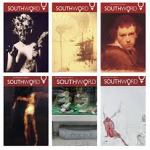
    • Southword Literary Journal
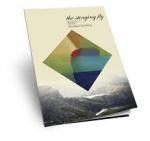
    • The Stinging Fly
    • Poetry Ireland Review
    • Crannóg Literary Journal
    • The Burning Bush Online
    • The Poetry Bus Magazine
    • Bradshaw Books


    Poets that are much missed 2012-2013

    The-Outnumbered-Poet (2) 150px-Human_Chaindkofi

    • Dennis O’Driscoll
    • Seamus Heaney
    • Doris Lessing
    • Ahmed Fouad Negm
    • Kofi Awoonor

    Talking about Books Ireland losing its Arts Council grant  is unseemly

    Talk about Books Ireland losing its Arts Council grant
    Talk about Books Ireland losing its Arts Council grant

    Commentators are employed by newspaper editors, they all talk about the same books in one form or another across multiple newspapers, which I no longer care to buy. Heaven forfend that an editor would employ someone to review, edit and discuss poetry. Newspaper editors and list-contributors play their part here by blurring the lines between culture and entertainment, coming out with some type of lifestyle fiction based in the simple and unchallenging precepts of accessibility, simplicity and passivity.

    Books Ireland lost its Arts Council grant and was threatened with closure, as this is Ireland, protest was confined to a few letters in the paper and a Facebook group. Well done to those who protested, many just sat down and counted their lottery cash, not thinking of Irish writing as a diversity. Books Ireland has a new publisher and will recommence publishing in January 2014.

    Poetry that caught my little eye in 2013

    eleanorgillianmcleandarcy

    Left to Right

    • The Shadow Owner’s Companion by Eleanor Hooker
    • Throats Full Of Graves by Gillian Prew
    • Nobody Wants To Go TO Heaven… But Everyone Wants To Die by David McLean
    • The Wild Pupil by Kathy D’Arcy
    mick1 meehankfszinger

    Left to Right

    • All Stepped/Undone by Michael McAloran
    • Mysteries Of The Home by Paula Meehan
    • The County Durham’s Miner’s Grandaughter’s Farewell To The Harlan County Miner’s Grandson by Kit Fryatt
    • Zinger by Alan Jude Moore

    Disposable crap sells Newspapers , fact

    couchPoetry is clearly not a disposable form, like so much semi-literate fiction destined for B movies or for chat-couches on daily tv. It is a literary form that requires the reader to drop off their passivity and complacency. This presents a difficulty to the general editor, who relies on passive consumption as many of us rely on oxygen.

    The drop-off in newspaper purchases is only matched by the immense growth in blogs and websites that fill the void left by this magnetic pull to homogeneity expressed in an approach to arts that is based in arts as entertainment/arts as product.

    Anti-poetry is now culture in Ireland’s market-driven media.

    mileyselfieca

    The issues of the day provide fodder for the chattering classes in much the same manner as fast-food fills an endless hole and thereby generates obesity. Fiction and gossip are the disposable trans-fat of the entertainment world. But like trans-fats they glut, and end up distorting the shape of the body, in this instance the body of Irish literature. The shape of literature in Ireland is becoming simplistic and disposable and indistinguishable indeed from Hello Magazine! It has morphed into fiction and chick-lit comestibles, the easy hitters.

    Contemporary Irish Arts : anyone can get an artist exemption

    rosannaI suppose that someone has to pimp poetry and to blog about what goes on at the nether end of the literary spectrum, whilst awaiting for decent reviews and discussion on arts , as opposed to fashionable edutainment. Literally anyone can apply for and get tax exemptions for their artwork, go on and apply.

    Poetry Ireland deleted the PI Forum from their servers in 2013

    PISince I started blogging about poetry in 2008, I have noted more international poetry editors opening out magazines and writing spaces to the committed poet. Although in Ireland, Poetry Ireland has been busily closing down their 2000-2013 poetry forum which housed an area for peer-review of original work. Poetry Ireland announced this in short-form and then proceeded to delete a lot of original work from their servers. I await with bated breath their new web-development ideas.

    In the meantime, I suppose that Irish poets can use groups on Facebook or Linkedin and consign their copyrights to Mark Zuckerberg who may be more sensitive to the provision of working spaces than PI. The Irish editor appears to be less generous about creating accessible archives and working-spaces to the emergent writer than his international counterparts.

    revivalRevival Literary Journal ceased operation this year of 2013, as did Doghouse Books in Kerry. Books Ireland was recently threatened with closure after the Irish Arts Council pulled their grant. Books Ireland has a new publisher, but these issues go largely undiscussed as really there is no place where poetry is discussed in Ireland. Just as we, a poetic nation (apparently), have no Poetry Foundation. Our colleges do not adequately index our poetry history, or provide accessible archives to the reading public.

    Poetry in Ireland is paltry feast left to the wit and wisdom of individual publishers and bloggers who must construct a cloak of holes and moths to illuminate Irish poetic work. There is no provision made or the poetry reader that is centred in a semblance of respect for poetic form, or for its growing variety.

    Avant-garde is a dirty word in Ireland, like grief, sex, or poverty

    kate and mollyskylight 471 frontmickagain

    anuirish pagesmickeyegillian

    Left to right

    • Crack Poet by Kate O’Shea
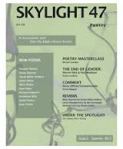
    • Skylight 47
    • The Blind by C. Murray
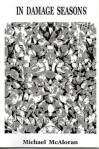
    • In Damage Seasons by Michael McAloran
    • A New Ulster Magazine
    • Irish Pages
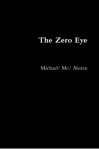
    • The Zero Eye by Michael McAloran
    • Throats Full of Graves by Gillian Prew

    Irish Poetry Imprints and Websites

    • A New Ulster
    • Abattoir Whispers
    • Aine MacAodha
    • Éigse Michael Hartnett
    • Ó Bhéal
    • Belfast is my Mojo
    • Bone Orchard Poetry
    • Bradshaw Books
    • Burning Bush 2
    • CanCan
    • Cló Iar-Chonnachta
    • Crannóg Literary magazine
    • Dedalus Press
    • Doireann Ní Ghríofa
    • Elizabeth Kate Switaj
    • Elliptical Movements
    • Gallery Press
    • Gorse Journal
    • Irish Pages
    • Kate Dempsey
    • Lapwing Press
    • Lapwing Publications
    • Michael J Maguire
    • Munster Literature Centre
    • Nuala Ní Chonchúir
    • Partial Shade
    • Poetry Ireland Review Newsletter
    • Post
    • QS Press
    • Return to DEFAULT
    • Revival Literary Journal
    • Salmon Press
    • Smithereens Press
    • tender journal
    • The Burning Bush Revival Meeting
    • The Columba Press
    • The Dolmen Press
    • The Gallery Press
    • The Galway Review
    • The Metre Archives
    • The Moth Magazine
    • The Penny Dreadful
    • The Poetry Bus
    • The SHOp , Poetry Magazine
    • The SouthWord Journal
    • The Stinging Fly
    • Wurm in Apfel
    lyre

    Apparently Poetry has little significance to those who collate end of years lists. Poetry tokenism is become a joke. I would rather not read some attempts at poetry book review unless they are in poetry journals. Having often wondered at newspaper editors’ tendency to dislike poetry , I came to the conclusion that it is down to two issues, money and ignorance.

    When the literary arts are approached as product, as opposed to artistic process, a whole lot of crap floats up. Poethead is about poetry as process, and likes to show poets working.

  • “The Smells” by Kira A

    December 7th, 2013

    THE SMELL OF IRON

     
    The moon asleep in the well under
    The surface of the blackwater, four
    Stars of steel and a badly done
    Impersonation of my-
    Self,
    Erase and compensate
    Repeated his voice from the bottom
    Of the glass, you
    Were shining
    You said it again
    In Neverland there’s no more room
    For the Lost Boys
    And she – the moon in the well – had
    Lost her lips, removed
    Her cuticles
    One after the other, she had
    Consumed a few names
    From the wings of the doves, there
    Was no more vision, no more dreams, it was
    A realm of shadows, no
    Lament was rising
    To the ceiling, blood was coming
    Back modulating itself in clots, no
    Punches
    Only water
    A lot of water inside
    The well, where the moon asleep used to
    Lie
    Staring at the sky
    The bars
    The coins
    You were shining, locked outside
    Collecting
    The smell of iron, the colour of dice
    A heart broken in a thousand valuable gems, a small
    Horse, fragments of coal, your rubbish
    The moon in the well was drowning, was crying, it
    Couldn’t be done,
    Here is what.
    It couldn’t be done.


    THE SMELL OF SMOKE

    The smell of iron at 9:19 am, disgusting
    Unresolved, I
    Would have given you the palm of my hands, there
    Was a parade of objects in hibernation, and
    The wire was made of plastic
    I couldn’t
    Walk, Tiburtina
    Railway station blew up around me, the
    Upside-down lilies hanging and dangling, you
    Were sewn inside
    My chest and pushed
    Broken
    You were breaking my ribs, shrieked, I
    Was thinking about your hair
    The embrace
    The window
    The cat
    On the other windowsill
    (As if he knew)
    And you
    Moving forward in the smell
    Of the smoke, expanding
    And she
    Keeping on, she was filling up
    All the cans
    Was labelling and talking and talking
    Pretending she had never
    Existed, she
    Had been
    Transfigured
    Hidden inside the white, she
    I miss you, you kept saying, it
    Couldn’t be done.
    Don’t you understand?
    It couldn’t be done.
     

    THE SMELL OF RUM

     
    All is well except
    That the wall is made
    Of perspex, transparent
    And her wings hit against it without
    Making any sound
    While
    The rift she treasures on her sternum is
    Cicatrizing under the sun at seven o’clock
    In the morning, while
    The smell of flowers is piercing through the path
    Of cold and
    The smell of rum, the memory of the stolen candle, twenty
    Meters running under the pouring rain, inside
    My ears, the city is swimming in
    The dark
    And it’s ours.
    Dismantled.
    It hurts.
    The taste of the broken tooth, the
    Badly stitched dream, and no need to say it:
    The waiting.
    While the hand is pushing, the shouts
    Are drawing strange vortexes
    Under the hair and
    The air continuously recycled
    Is ingesting
    Massive amounts of
    Darkness
    As
    You advance
    Defying the butterflies
    Adjusting your heel
    From time to time.

    THE SMELL OF FLOWERS

     
    The city was turning
    Into a mirror.
    You were trying to move as little as possible
    Fearing variations more than anything.
    The essential — now —
    Consisted in not disturbing.
    The cold was eating your legs, your cheeks
    You were calm and wanted to go away
    What was left to hold you back?
    Your heart was burning and nightmares were
    Surrounding your hair.
    You were looking down, looking
    For your own ankles
    You were paying attention to the echoes,
    Searching for
    Someone who would grab your arm
    You only wanted to hear a no
    — and it was not coming.
    You were hoping for some
    It’s not true
    — and it was not coming.
    The dart had been shot
    Punctual and similar to bees
    Poison
    It was getting you sick
    You were struggling to survive
    While hoping, however, to die of it.
    It would have never killed you.
    The smell of flowers was vanishing,
    The city had turned into a mirror.
    Now you could only cover your eyes.
     
    The Smells , a series is © Kira A
    Image is © Monna Lisa Forni
    KiraA

    sept_06_lakeKira A was nineteen when she started to write poetry and post it on Italian websites. More than a decade later, she decided to translate her own poems to English and post them on her Tumblr blog. Her work has been published on several italian ezines and American blogs, such as UUT Poetry. Lately, a poem of hers has been published on Issue 18 of Bare Hands Poetry.
  • “The Salted Woman” poems by Chris Allen

    November 30th, 2013

    Root Stock

    After P.W. Joyce

     
    I am the Little Bush of the Dancing
    near to the Little Village of the Whortleberries
    not far from the Speckled Mountain
    if you go by the Stepping Stones of Shadow
     
    you find the Old Tree of the Cave
    lying just beyond the Castle of the Wind
    where a path on the Raven’s Mother
    leads to the Shrubbery of the Streamlet
     
    take the River Holm of the Buck Goat
    when you meet the Round Hill of the Worms
    in the Oak Grove of the Milk
    as the trees skirt the Chalky Mountain
     
    and just before Slipping to Hell
    you arrive on a White Little Hill
    after the Hill of Truth
    where you see the Little Mountain of the Wind.
     

    The Snuff Box

    After Chekov

     
    Every importance occupies your silence
    No more than when I heard it yesterday
    There is not a word for the same silence –
     
    The snuff box is thrown from the stage
    The ear attends far in excess of reason
    To prove reality is constant in the wing –
     
    Still we have not heard the trinket fall
    While still the act portrays the sequent
    Words rolled out to mingle into logic –
     
    There is no mention of an errant force
    So must we assume the catcher’s hand
    And absent worlds exist to haunt us.
     

    .

    The Salted Woman

     
    “Rohecrad do gemmaib glainib, gním ronglen-ón;
    ba samail trá adaig ocus lá ‘na medón.”
    – Flann Manistrech
     
    To dwell in a house so brightly gleaming
    It was as if day and night were the same
     
    Reality as history reduces to a pale script
    With ordinary characters forgetting that
     
    Well branched more ways feeding water
    In its undisputed tides sweet and salted
     
    Running clear until the lakes and rivers
    Streamed in whole and mystical floods
     
    The legendary abundance of oak and elk
    Trout and salmon fed in the imagination
     
    Wings folded over her thatched palaces
    Now kept safe her quartered provinces
     
    And a Holy Scripture in a riotous tongue
    Curled about the names of the forgotten
     
    Rings eerily in the psyche as real as want
    Paced forgivingly for the old pagan flaws
     
    Like a Sheela na Gig engorged in sub text
    As a salty woman found before real gods
     
    Her primordial salinity keeps to beginnings
    The anonymous introspection of its muse
     
    Her dividing cell among the hybrid script
    Of curious constructions in historical lots
     
    The bony exoskeleton invites the sweet
    Vermillion of a stave and its divided line
     
    Hoists a portal shadow on two outcast feet
    Where the deft squat delivers of its people.
     

    Root Stock, The Snuff Box, and The Salted Woman are © Chris Allen.

    These poems are from a forthcoming collection The Salted Woman by Chris Allen. The poems are orphans from a forum once maintained by Poetry Ireland, until a decision to delete the forum was taken recently. I am delighted that these root poems from Allen’s collection have been rehomed with me on Poethead.  My thanks to Chris Allen for her generous gift. I am adding here a link to Forms; A Sampler by the poet.

    Poetry Ireland Forum 2000-2013 

    527px-Caspar_David_Friedrich_018


←Previous Page
1 … 48 49 50 51 52 … 106
Next Page→
 

Loading Comments...
 

    • Subscribe Subscribed
      • Chris Murray
      • Already have a WordPress.com account? Log in now.
      • Chris Murray
      • Subscribe Subscribed
      • Sign up
      • Log in
      • Report this content
      • View site in Reader
      • Manage subscriptions
      • Collapse this bar