Once a year, to mark our birthday, we at Sabotage like to give out some awards to the publications we’ve most enjoyed during the year. This year, we want YOU to vote for the winners in twelve different categories.
After over 2000 votes, voting is now closed! Winners will be announced on 29th May at the Book Club, London. It’s going to be a big celebration of indie lit in all its glory and we’d love it if you could attend. There’ll also be performances, a mini-book fair, music from LiTTLe MACHINe and our very own critique booth.
Here’s what happens next:
Voting is now closed!
Buy a ticket to the awards ceremony/birthday bash.
Please find the shortlist below, which consists of the top 5 nominations in each of the 12 categories, with links to their reviews…
whistle-in sing the hollow-pipes of bird-bone or leg-tube jointed to. leech into soil’s black trauma a double-reed will always carry down its muffled tune from contort of leaf to nub of root there is bone substance to the fallen bough as there is to the winged-bird both perfume.
a maerl of barely encloses both the feathered and the not,
I place a jug of lavender on the table to mask the smell of mould from under the fridge while you draw nails to hammer with your fist. Then I draw a hammer, and watch as you try to lift it from the page. by day it’s Mr Men, Mad Men, by night, your father and I wishing we could be so bold. you have no such wants, though sometimes I wonder as you try to peer into Jack and Jill’s well or climb the tiny ladder of your toy farm to mend the roof of your miniature barn.
Life After Death
My thoughts are all opposed to that streak of red fox in the field, black clods of thought that cling to the spade that lifts them to throw them back into the hole they made. The fox is an apposite thing, lived in without reluctance, as is the greenfinch, even as it hits the window and knocks itself out cold. My child knows this. He won’t allow himself forget his father warming the bird’s wings with his breath, its sudden swift flight as two foxes trot through Fayre’s Field ahead of the hearse.
Rebecca O’Connor edits The Moth Magazine and organises the Ballymaloe International Poetry Prize. She worked as a commissioning editor of literary fiction at Telegram Books in London before returning to Ireland with her family in 2008. She won a Geoffrey Dearmer Prize in 2004 and her chapbook Poems was published by the Wordsworth Trust, where she was a writer in residence in 2005. Her poetry has been published in, among other places, The Guardian, Poetry Review and The Spectator.
And what is death, he asked, your mother’s or yours or my own? – James Joyce
I.
At the English pub in Indianapolis, we discuss technology. He says he can already hear the robot’s footsteps on his grave. In the worst neighbourhoods, the prairie is coming back. Cattails are pushing up through old sidewalks and nearly all the important species of sparrows have returned. A Future Farmer of America—in other words, a 14-year-old white kid from the pesticide-drenched heartland—slips backwards from a mall railing and falls to his death among the Super Pretzels and Dippin’ Dots down in the food court. I get reminded of incest dreams and the two I’ve had, one for each parent. My mother calls and gives me the run-down on which of her friends is on a morphine drip and which is in remission, and she tells me that when I get back to Miami I should get a job and always keep a full tank of gas. The homilitic style of evangelical Christianity is the same in Ghana, San Diego, Little Havana, and on Ellettsville, Indiana’s Hart Strait Road where in the abortion scene of the Halloween morality play she yanks a skinned squirrel soaked in beet juice from the screaming girl’s crotch and holds it up with food-service tongs before tossing it on a cookie sheet. You’ll have a clean slate if you accept Jesus, right now. We’ll all have a clean slate, if you accept Jesus, now. The body of Christ. Amen. The body of Christ. Amen. The body of Christ. Amen. Don’t drop it. Use a metal plate with a handle that could guillotine a communicant’s neck. And on the third day, I drank poitín at an Irish pub in Bloomington, Indiana, in fulfillment of the scriptures. Take this, all of you, and drink it. This is the bloodshine of the newest and most everlasting covenant. Don’t drop it.
II.
Death is a real bummer. We live through and for our parents and still Freud was wrong. You should hurry up and put your face right in it for an hour and that is definitely a sacrament, more so than that night in Garrucha at the misa flamenca, though the music was nice. Even the Sanctus didn’t offend me. Finally, I would add that the world is falling apart, always has been, ubi sunt qui ante nos fuerent, etc., and that my favorite sounds are when you say things like, Everything is fine, or, That cunt is mine. I hear them and I clench and unclench and I. love. you.
Tell me it’s too much. Amen. Tell me it’s too much. Amen. Tell me it’s too much. Amen.
Let us kneel down facing each other, holding razors. Lather up my head and I will lather yours. I am worthy to receive you. I am your mirror. On which a razor lay crossed. We’ll shave it all off. If our knees can handle it, let’s stay like this until it grows back, softer than before. If they can’t, let’s make love, and say, These are our bodies, which will not be given up for any of you. Let us say our own word and we shall be healed.
Kimberly Campanello was born in Elkhart, Indiana. She now lives in Dublin and London. She was the featured poet in the Summer 2010 issue of The Stinging Fly, and her pamphlet Spinning Cities was published by Wurm Press in 2011. Her poems have appeared in magazines in the US, UK, and Ireland, including nthposition, Burning Bush II, Abridged, and The Irish Left Review. MOTHERBABYHOME was published by Zimzalla in 2018. Pic by Brian Kavanagh
Kelly Creighton is a poet and writer with work currently and forthcoming in literary journals Ranfurly Review, A New Ulster, Electric Windmill Press,Inkspill Magazine, The Galway Review, Saudade Review, PEN Austria’s Time to Say: No! e-book, Recours au Poeme and other numerous other publications. She has recently finished editing her historical fiction novel Yielding Fruit. Kelly is working on her second poetry collection.
The weft of Margaret Atwood‘s The Penelopiad is contained in and revealed through the chorus voiced by the twelve maids hung by Telemachus (on Odysseus’ orders) just after the men returned from their manly adventures. Margaret Atwood runs the chorus line throughout her Penelopiad, the executed maids sing their songs at ten intervals in the book. I was struck by a comment that Atwood makes in her notes about the maids. She stated that:
‘The Chorus of Maids is a tribute to such uses of choruses in Greek Drama. The convention of burlesquing the main action was present in the satyr plays before the main drama.’ (Margaret Atwood, Author Notes for The Penelopiad pp. 197-198)
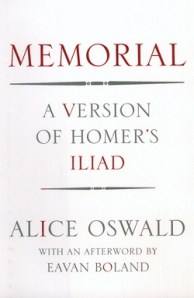
I am always interested in how women writers burlesque the heroic perception of the classics through use of device and structural underpinning. In this instance I have been reading Atwood’s The Penelopiad and Alice Oswald‘s Memorial. Both Atwood and Oswald approach Homeric themes in a sidelong fashion to get to the meat of the oral tradition, their poetic focus is decidedly on the lament. Atwood gives voice to the subversive and unquiet maids of The Odyssey. Oswald creates a dirge through interweaving the names of fallen warriors of The Iliad. Both Atwood and Oswald use the lament as the kernel for their thematic variations from and approaches to Homeric mythos. The poets use repetition to add texture to their laments thereby shaping and focusing the small forgotten voice toward expressing a universal grief. This is a not heroic poetry, it is a poetry of keening and loss.
Oswald’s Memorial has drawn quite divided critique. I mention in particularJason Guriel‘s reductionistic approach to the book in which he refers to it as ‘a rose-fingered yawn’. This slighting throwaway remark does little to evoke interest in how women poets actually write, nor does it sufficiently disguise Guriel’s critical ennui. I would point the general poetic-reader to Michael Lista’s critique of Memorial in order to garner a more balanced view of the work.
Atwood’s twelve maids defiantly do not not burlesque the main action of The Penelopiad. They are the main action of the book. Penelope reveals herself to be a tedious bore whose lack of wit and guile are vaguely repellent. I wanted Atwood to get her toe out of the water and focus on the maids who enliven the text with their songs and shanties. The central pivot of The Penelopiad revolves round the nasty relation between Penelope and Helen rather than on the texturing of the maids burlesquing. In this, Atwood’s approach to Homer is a bit of a missed opportunity. The strength of the book is in its sub-theme which Atwood had not developed into a fuller rendering.
Oswald did not make a similar mistake in her approach to Homer’s The Iliad. She has broken down the book and re-made it a powerful dirge. The fact that this has led to an inability by her critics to get to what she is doing only strengthens the work in my view. The index for Memorial comprises an unnumbered litany of names from The Iliad. Oswald weaves their names into the text whilst interspersing their histories with individual laments for the warrior-groupings. These laments vary in length, they are devices to allow the mourning voice through. They are not separate to the main action of the book but are organically interleaved into and caught up in the theme and direction of this epic poem-dirge.
‘Like a man put a wand of olive in the earth And watered it and that wand became a wave It became a whip a spine a crown it became a wind-dictionary It could speak in tongues It became a wobbling wagon-load of flowers And then a storm came spinning by And it became a broken tree uprooted It became a wood pile in a lonely field.Like a man put a wand of olive in the earth And watered it and that wand became a wave It became a whip a spine a crown it became a wind-dictionary It could speak in tongues It became a wobbling wagon-load of flowers And then a storm came spinning by And it became a broken tree uprooted It became a wood pile in a lonely field.’Page 31, Memorial, by Alice Oswald
It interests me that contemporary women poets are approaching Homer through the use of the lament. They are voicing the silent mourning that occurs when the glory of battle is over. Atwood is giving voice to the abused girls whose life experiences are of enslavement and of misuse. Oswald does not state that the mourning voice in Memorial is that of a woman, but the cadence of the mourning poems that intersperse her text suggests the chorus, the lament.
In terms of contrast in poetic approaches to direct engagement with classical literature, one could point to how Ted Hughes re-told the twenty-four Tales From Ovid (Metamorphosis) or look at Heaney’s Beowulf. The fact that critique ignores the poetic engagement of women with the classics of literature only points to critical-disengagement, or at best to a narrow conservatism. It is time that The Chorus (that most pertinent part of Epic) is re-read, and given its place in the overall texturing of great poetic works. What would T.S Eliot’s Murder in the Cathedral be without the integrity of the women’s voices?
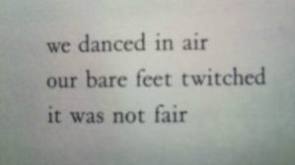
‘…he took a cable which had seen service on a blue-bowed ship, made one end fast to a high column in the portico, and threw the other over the round-house, high-up, so that their feet would not touch the ground. As when the long-winged thrushes or doves get tangled in a snare…so the women’s heads were held fast in a row, with nooses round their necks, to bring them to the most pitiable end. For a little while their feet twitched, but not for very long.’ The Odyssey, Book 22 (470473)
It has grown, not darkly, like mould, that sunless green. Sitting provides the habit of air. Children – trees, coats, limbs, the bounce of long hair as they troop the school road –
means stillness, expansion, despite unspeakable radio news on the murder of infants in temperate suburbs. Muffled, gloved, I grow in a car at the end of an eight-year planting, half of me
mulling the latest distant shooting. I would like to book a flight, transplant skills, solutions, get there fast. Instead, I wait, the smell of cooked dinner impregnating denims, boots, my cap, which she
inhales as she steps inside the car. I hold myself together beneath iced winter branches in grey couteur, feel an invisible frieze of buds stirring slowly, steady in deep cold.
Mary O’Donnell is the author of eleven books, both poetry and fiction, and has also co-edited a book of translations from the Galician. Her titles include the best-selling literary novel “The Light-Makers”, “Virgin and the Boy”, and “The Elysium Testament”, as well as poetry such as “The Place of Miracles”, “Unlegendary Heroes”, and her most recent critically acclaimed sixth collection “The Ark Builders” (Arc Publications UK, 2009). She has been a teacher and has worked intermittently in journalism, especially theatre criticism. Her essays on contemporary literary issues are widely published. She also presented and scripted three series of poetry programmes for the national broadcaster RTE Radio, including a successful series on poetry in translation during 2005 and 2006 called ‘Crossing the Lines‘. Today, she teaches creative writing in a part time capacity at NUI Maynooth, and has worked on the faculty of Carlow University Pittsburgh’s MFA programme in creative writing, as well as on the faculty of the University of Iowa’s summer writing programme at Trinity College Dublin.

 Rebecca O’Connor edits The Moth Magazine and organises the Ballymaloe International Poetry Prize. She worked as a commissioning editor of literary fiction at Telegram Books in London before returning to Ireland with her family in 2008. She won a Geoffrey Dearmer Prize in 2004 and her chapbook Poems was published by the Wordsworth Trust, where she was a writer in residence in 2005. Her poetry has been published in, among other places, The Guardian, Poetry Review and The Spectator.




 Chris Murray