• chris murray
  • journals – bibliography – publication notes
  • downloadable items – essays – media
  • copyright
  • Home

Chris Murray

  • ‘That Broken Pot’ by Kate Dempsey

    May 12th, 2012

    There is a new moon
    and the heavy clouds are calm,
    the wind has dropped,
    yet there is still a tap-tapping
    on your window.
     
    Does it bother you?
    That shiver, as if something’s breath
    has grazed, raised the hairs on your neck.
    Why do you rise and draw the curtains
    tight across the chink?
     
    Look out –
    the shadows steal towards you.
    What is it startles next door’s dog,
    its barking, sudden to start, sudden to cease?
    Not the cat,
    she’s hissing beneath your bed.
     
    Who- or what – is watching ?
    Believe what you will,
    that crunch of gravel,
    that scuffle at your sill
    is not a fox or swooping owl.
    Did you lock the back door ? Are you sure ?
     
    The crows are roosting in high branches,
    it is not they who claw through your bins
    for numbers, dates, addresses,
    leaving scattered shreds,
    knocking that broken pot
    you find in the morning.
     
    .
    © Kate Dempsey , all rights reserved.

    from Some Poems,  Published 2011. Some Poems ,a Moth Little Edition.

    Image , Portrait of Maud Cook by Thomas Eakins, 1895

  • “Earthly Terror” a sonnet by Louise Glück

    May 5th, 2012

    Earthly Terror

     
    I stopped at the gate of a rich city.
    I had everything the gods required;
    I was ready; the burdens
    of preparation had been long.
    And the moment was the right moment,
    the moment assigned to me.
     
    Why were you afraid ?
     
    The moment was the right moment;
    response must be ready.
    On my lips,
    the words trembled that were
    the right words. Trembled-
     
    And I knew that if I failed to answer
    quickly enough, I would be turned away. 
      

    Durham Cathedral engraving by William Miller after J M W Turner, published in Picturesque Views in England and Wales. From Drawings by J.M.W. Turner, engraved under the superintendence of Mr. Charles Heath with descriptive and historic illustrations by H.E. Lloyd. London: Longman, Orme, Brown, Green, and Longmans, 1838. Rawlinson 297

    Earthly Terror, by Louise Glück , from The Making of a Sonnet,  eds.  Edward Hirsch and Eavan Boland

    Image from Wikimedia Commons

  • ‘Calling a halt to killings in Syria’: Irish Times 28/04/2012.

    April 28th, 2012
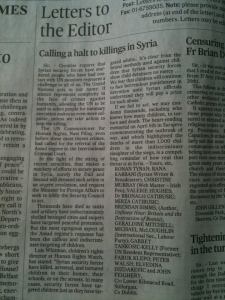
    Calling a halt to killings in Syria

    • Sir, – Credible reports that Syrian security forces have murdered people who have had contact with UN monitors represent a challenge to all of us. The United Nations acts in our name. If silence represents complicity in the face of crimes against humanity, allowing the UN to be used to select people for summary execution makes us even more culpable, unless we take action to stop the killing.The UN Commissioner for Human Rights, Navi Pillay, even before these most recent crimes, had called for the referral of the Assad regime to the International Criminal Court.In the light of the string of recent atrocities, that makes a mockery of efforts to secure peace in Syria, surely the Dáil and Seanad will demand such action in an urgent resolution, and request the Minister for Foreign Affairs to seek to lobby the Security Council to act.Thousands have died as tanks and artillery have indiscriminately shelled besieged cities and snipers have targeted peaceful protesters. But the most egregious aspect of the Assad regime’s response has been the callous and indiscriminate targeting of children.

      Lois Whitman, children’s rights director at Human Rights Watch, has stated: “Syrian security forces have killed, arrested, and tortured children in their homes, their schools, or on the streets. In many cases, security forces have targeted children just as they have targeted adults.. It’s clear from the brutal methods used against children that Syrian security forces show child detainees no mercy . . . We fear that children will continue to face horrendous punishment in detention until Syrian officials understand they will pay a price for such abuse.”

      If we fail to act, we may condemn thousands, including who knows how many children, to torture and death. The heart-rending memorial on April 6th in Sarajevo commemorating the outbreak of war, and which highlighted the deaths of more than 1,000 children in the indiscriminate slaughter of the siege, is a compelling reminder of how real that threat is in Syria. – Yours, etc,

      RONAN TYNAN; RANA KABBANI (Syrian Writer Broadcaster); CHRISTINE MURRAY (Web Master – Irish Pen); VALERIE HUGHES; Dr BRONAGH CATIBUSIC; MIRZA CATIBUSIC; BRENDAN SIMMS, (Author, Unfinest Hour: Britain and the Destruction of Bosnia); GERALDINE MITCHELL; MICHAEL McLOUGHLIN (International Sec., Labour Party); GARRET TANKOSIC-KELLY (Former UN Resident Representative); FARUK KLEPO; PETER WALSH; ELVEDINA DIZDAREVIC and JOHN FEIGHERY.

      (from ,  The Irish Times , 28/04/2012)


      The following two links are about Tal Al-Mallouhi and are related to campaigns by PEN International to raise awareness of her plight  and her ongoing imprisonment..


    Regular readers of this blog will know that I have mentioned Tal Al-Mallouhi in two posts recently. Tal is a poet imprisoned in Syria. I am adding a link to the PEN International appeal on her behalf, along with a link to her poem , You will remain an example .

    I thought to edit one of these existent posts to include a letter published in today’s Irish Times (28/04/2012) which details the plight of those victims of the Assad regime , and the need for U.N intervention in increasing violences against the people of Syria.

  • Two sestinas

    April 21st, 2012

    ‘Sestina’ by Dante Alighieri

    I have come, alas, to the great circle of shadow,
    to the short day and to the whitening hills,
    when the colour is all lost from the grass,
    though my desire will not lose its green,
    so rooted is it in this hardest stone,
    that speaks and feels as though it were a woman.

    And likewise this heaven-born woman
    stays frozen, like the snow in shadow,
    and is unmoved, or moved like a stone,
    by the sweet season that warms all the hills,
    and makes them alter from pure white to green,
    so as to clothe them with the flowers and grass.

    When her head wears a crown of grass
    she draws the mind from any other woman,
    because she blends her gold hair with the green
    so well that Amor lingers in their shadow,
    he who fastens me in these low hills,
    more certainly than lime fastens stone.

    Her beauty has more virtue than rare stone.
    The wound she gives cannot be healed with grass,
    since I have travelled, through the plains and hills,
    to find my release from such a woman,
    yet from her light had never a shadow
    thrown on me, by hill, wall, or leaves’ green.

    I have seen her walk all dressed in green,
    so formed she would have sparked love in a stone,
    that love I bear for her very shadow,
    so that I wished her, in those fields of grass,
    as much in love as ever yet was woman,
    closed around by all the highest hills.

    The rivers will flow upwards to the hills
    before this wood, that is so soft and green,
    takes fire, as might ever lovely woman,
    for me, who would choose to sleep on stone,
    all my life, and go eating grass,
    only to gaze at where her clothes cast shadow.

    Whenever the hills cast blackest shadow,
    with her sweet green, the lovely woman
    hides it, as a man hides stone in grass.

    .
    Sestina by Dante Alighieri

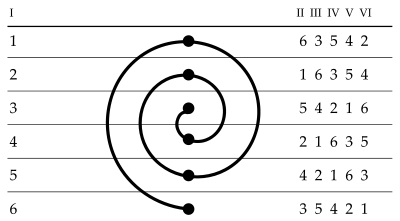
    The image at the base of this post is from the Wikipedia Site discussion on the Sestina form . I am adding here a  Poets.org discussion on the form used by both poets in the above post . I wanted to focus on content , which is after all what poetry is about (that and adaptions/metamorphosis/shape-shifting and code !).

    ‘Sestina’ by Elizabeth Bishop

    September rain falls on the house.
    In the failing light, the old grandmother
    sits in the kitchen with the child
    beside the Little Marvel Stove,
    reading the jokes from the almanac,
    laughing and talking to hide her tears.

    She thinks that her equinoctial tears
    and the rain that beats on the roof of the house
    were both foretold by the almanac,
    but only known to a grandmother.
    The iron kettle sings on the stove.
    She cuts some bread and says to the child,

    It’s time for tea now; but the child
    is watching the teakettle’s small hard tears
    dance like mad on the hot black stove,
    the way the rain must dance on the house.
    Tidying up, the old grandmother
    hangs up the clever almanac

    on its string. Birdlike, the almanac
    hovers half open above the child,
    hovers above the old grandmother
    and her teacup full of dark brown tears.
    She shivers and says she thinks the house
    feels chilly, and puts more wood in the stove.

    It was to be, says the Marvel Stove.
    I know what I know, says the almanac.
    With crayons the child draws a rigid house
    and a winding pathway. Then the child
    puts in a man with buttons like tears
    and shows it proudly to the grandmother.

    But secretly, while the grandmother
    busies herself about the stove,
    the little moons fall down like tears
    from between the pages of the almanac
    into the flower bed the child
    has carefully placed in the front of the house.

    Time to plant tears, says the almanac.
    The grandmother sings to the marvelous stove
    and the child draws another inscrutable house.

    Sestina by Elizabeth Bishop

    Listen to the poem here , Sestina . Sestina  by Elizabeth Bishop is published in Questions of Travel,  which is discussed here in Modern American Poetry

    The following tables are from Poets.org and Wikipedia showing the Sestina  form in its essence,

    1. ABCDEF
     2. FAEBDC
     3. CFDABE
     4. ECBFAD
     5. DEACFB
     6. BDFECA
     7. (envoi) ECA or ACE
  • Dorothy L. Sayers’ translation of ‘The Divine Comedy’

    April 14th, 2012

    Herein follows an incomplete list of book-links related to Dorothy L. Sayers’ translation of  The Divine Comedy by Dante Alighieri.

    Readers of the poethead blog will note that I dedicate Saturday mornings to the work of women writers, editors and translators. The translation of The Divine Comedy undertaken by  Dorothy L. Sayers  was completed in part by Barbara Reynolds.

    Dorothy L. Sayers considered her translation of The Commedia to be her most important work,  and yet only one copy of the book was available through the Dublin Library Service last week. The Guardian Newspaper devoted just a single line to the fact that this work of translation was undertaken by Sayers. In the same instance both The Guardian and the Dublin library service suffer a surfeit of Sayers’ genre or detective stories.

    The Divine Comedy translated by Dorothy L. Sayers ( some useful links)
    • The published works of Dorothy L. Sayers
    • Biography of Dorothy L. Sayers
    • Wikipedia Bibliography of the works of Dorothy L. Sayers
    • Guardian biography page , gives one line to Sayers‘ translation of The Divine Comedy, www.guardian.co.uk/books/2008/jun/11/dorothylsayers
    • The Divine Comedy, Part I, Hell (Penguin Classics) 
    • The Divine Comedy, Part II, Purgatory (Penguin Classics) 
    • The Divine Comedy, Part III, Paradise (Penguin Classics) Sayers and Reynolds (Introduction)


    Bibliography for Barbara Reynolds (Wikipedia)
    • Dante: The Poet, the Political Thinker, the Man. London: I.B. Tauris. 2006. ISBN 978-1845111618.
    • Dorothy L. Sayers: Her Life and Soul. London: Hodder & Stoughton. 2002 [1993]. ISBN 0-340-72845-0.
    • Radice, William; Reynolds, Barbara, eds. (1987). The Translator’s Art: Essays in Honour of Betty Radice. London: Penguin Books. ISBN 0140092269.
    • The Passionate Intellect, Dorothy L. Sayers’s Encounter with Dante. Kent, Ohio:. 1989. ISBN 0873383737. 

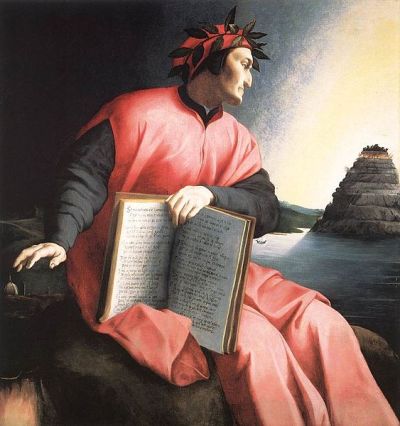
    Alegorical portrait of Dante, Agnolo Bronzino, c. 1530 The book he holds is a copy of the Divine Comedy, open to Canto XXV of the Paradiso.
    Allegorical portrait of Dante, Agnolo Bronzino, c. 1530 The book he holds is a copy of the Divine Comedy, open to Canto XXV of the Paradiso.

    Dorothy L. Sayers produced a classic translation of Dante’s Hell and Purgatorio which is still read. The problem with media and literary journals not citing Sayers or Glasscoe, appears to be based in an institutionalised sexism which is a contributory factor in the invisibility of women editors. Evidently, The Guardian Newspaper and the Dublin library service give more attention to Sayers’ genre works than they do to her translation and other works.

    It does not seem to pose great difficulty for male editors and writers to consistently cite what they feel are the definitive texts when the writer happens to be a dude. I believe that women editors and writers must begin to cite the works of women when quoting classical works of literature. If nothing else it may help those women journalists who seem incapable of taking women’s literature seriously.

    Note : Recent attacks on Dante’s Commedia delineated  in this article show a lack of critical discernment and appreciation by those who would chose what anyone may read.


    Some related texts

    Further Papers on Dante

    The Lost Tools of Learning

    Are Women Human ?

    A.N Wilson Dante in Love


  • “Chaplet” by C. Murray

    April 7th, 2012

    Chaplet

    I.

    A conversation among trees

    I cannot hear what they are saying, that young girl and the tree,
    their whispers are intimate, ceaseless.

    I am sunk into a conifer hedge, tamped into a wall,
    threaded into the blue ivy.

    This is a warm chaplet against the rain,
    I would lie here if it wasn’t for the sky—

    the sky will not skew to my vision,
    body conspires with green-leaf to thrust me forward


    II.

    Bower

    I am become aware that it is time for this to cease,

    a mead of daisies whiten on the windward side
    of a grove. Trees,
    daisies, are blown white beneath a silver beech.

    Those hues balance
    for once —

    And,
    and If I step at once from the shelter of this close bower,
    will I hold?

    © C. Murray


    chaplet

    The image Chaplet is by Alice Maher and is used for this poem courtesy of Alice Maher and the Green on Red Gallery, Dublin, Ireland. 

    Chaplet © C Murray


  • ‘The Storm’ , by Rainbow Reed

    March 31st, 2012

    The Storm

    “On granite rock,
    The woman sat.
    Damp hair trickled down her back,
    Azure highlights glimmering,
    Golden curls shimmering.
    Seaweed sparkled; waving wildly
    White foam horses rear and pound,
    Surging through the rocky mound.
    Crashing against the sleeping stone.
    Woman sits and
    Stares alone.
     
    Black cloud glares,
    Fog horn blares,
    Lightning screams across the sky.
    Green eyes pierce through crushing waves,
    As raging waters tumble by,
    Swirling through the hidden reef.
    Sharp fanged rocks, lurk just beneath.
    Hungry for their prey….
     
    Fisherman caught
    In the storm.
    Spies cast off lover all forlorn.
    His heart pounds with fear and shock,
    Demon lover clinging to demon rock,
    Soaked in sea spray but shining still
    Fisherman feels a surging thrill,
    Pulls rudder across hard and fast,
    Sails moan and flap against the mast.
    Fishing boat thrown up and down,
    Fishermans’ face creased with frown.
     
    Woman sits in silence
    Undertones of
    Violence.
    Green eyes glowing at her lovers face,
    Thinking of happier times and place.
    These eyes melt his heart of stone,
    How could he have left her all alone?
    Fishing boat drops from wave on high,
    For a minute caught, seeming to fly.
    Then falls and smashes into the foam,
    Broken, drifting forever to roam.
     
    Woman smiles and sings her song,
    Waiting for another to come along….”

    By Rainbow Reed ©2009  http://wickedpoetry.jigsy.com/AboutUs

    Thanks to Rainbow  for the poem and the site-link. This is the fourth poem in the Poethead  New Poetry category. These women writers are mostly published poets who use blogs and multimedia to publish their works. Each writer has allowed me to choose one or two poems for this blog. The poetry comes with a blog or website link to their work and sometimes an image or a bio. Poets published in this category are Teresa Edmond, Brittany Hill , Rainbow Reed and Kitt Fryatt. I would also include some pre-publication tasters by Sarah Clancy and one or two of my own about to be published poems here too.

  • Dreaming poems; editing “Julian of Norwich” and ‘The Dream of the Rood’

    March 24th, 2012

    1. ‘Lo! I will tell of the best of dreams,
    what I dreamed in the middle of the night,
    after the speech-bearers were in bed.
    It seemed to me that I saw a very wondrous tree
    5. lifted into the air, enveloped by light,
    the brightest of trees.’
    .
    from The Dream of the Rood (electronic edition),  created by Mary Rambaran-Olm.
    .

    A few weeks ago my attention was called to an annotated electronic edition of the Dream of the Rood , created by Mary Rambaran-Olm.  I thought to link this edition on Poethead  to compliment some of my earlier posts about women editors and writers. There are an amount of works on the blog dedicated to the poetry of the mystic-writer, these posts deal specifically with the woman’s mystic voice rather than approaches to contemporary editing by women.

    The sole exception to the above is based in a few scattered posts that allude to Marion Glasscoe’s magnificent editing of Julian Of Norwich’s  A Revelation of Divine love. Glasscoe’s Julian is in my opinion a seminal text, and I have retained my copy since I studied it in UCD some years ago. There are many modern versions of Julian’s Revelation which attempt to bring her luminous writing toward a contemporary audience, however, mostly the texts that I have read go nowhere near the Glasscoe for clarity of expression. I have referenced ideas and images from the Glasscoe in a couple of  Poethead posts , which I am adding here and here. 

    To my mind a masterpiece is a work of art that has the ability to generate interest and to inspire derivatives in the visual and musical arts. The work that has gone into the creation of the electronic edition of The Dream of the Rood allows for a contemporary audience to access it’s unique quality of expression. Here, in Mary Rambaran-Olm’s pages are her transcriptions, translations and notes from the original manuscript. The translation pages  run along the left-hand column of the Rood home page and are subdivided to allow for easier reading. There are also extensive images of the Vercelli Book (Folios 104v-106r).  It’s an online treasure-trove.  The poem is available on the right-hand of the home-page under the heading of Translation and Original Poem.

    I did question whether I should write a post about Julian of Norwich and the Dream of the Rood for this Saturday, and I hope my regular readers enjoy the piece. I believe that poets are inspired across a variety of modes of expression and that the contemporary modes of dissemination can ameliorate access to masterpieces such as the two above-mentioned triumphs of editing by both Glasscoe and Rambaran-Olm.  Dreaming and vision-poems have an agelessness about them that defies time.

    I am wary of some translations which I have discussed before now, but there is an endurance in this writing which has influenced many a writer. One quick search for Julian’s writing uncovers a vast array of related works. It is really up to the reader in how they wish to access the works mentioned above, but I’d feel somehow that I’d have let down my readers if I did not acknowledge the trojan work by these two women editors in their creation of accessible translations for modern readers.

    Note. It’s rather alarming that  a dreaming poem such as  Dante’s The Divine Comedy has been subject to an attempt at evisceration and censorship at this moment.  If there is a loss anywhere in this issue it is in the Gherush92 campaign.   I have said online and elsewhere this past week that this campaign is about getting into newspapers in the most risible  fashion, rather than about  any offense caused by a  poem that continues to inspire  a great deal of visual and literary art.

    • http://ibnlive.in.com/news/italian-group-wants-racist-divine-comedy-banned/239472-40-100.html

    Beati in Apocalipsin libri duodecim 900-950 (Spain)

  • ‘Roxy’ and ‘Nanna Slut’s Long Close Summer’ by Kit Fryatt

    March 17th, 2012


    Roxy

    Bonny Sandy breaks my heart
    no coming to couch the night
    & his blade red wine

     & his thrapplejammer white wine
    bonny Sandy brooks my hurt
    this ae night

     ilka night
    & the horns of young green wine
     bonny Sandy brakes his hart.

     Love whinges & crines. The bonny knight
    in ague sweat & his ain shite, unhurt.

    © Kit Fryatt, all rights reserved.


     nanna slut’s long close summer

    Dance the lamb
                                  ra-ra
                                             lamb
                                                     ra-ra
    mutton hunks
    It’s a shame the way we carry on 

    The streets stink tonight; my skullpan’s pounding
    for rain or riot, I’m not so young, scarred from mound
    to sternum, childless pale citadel of bravado and competence;
    though if it gets too tasty I’ll hitch my mobile home
    and flit this meatpacking warehouse district
    but for now I’m hanging in there, for a sniff at the grinding bliss
     the brazen looter children have, this year’s corn kings─
    with sordid cold, blanket, galvanise tray, comes the morning in.

    Dress the lamb
                                rare-rare
                                             
                                                         rare-rare
    mutton bird
    It’s a shame the way we carry on

    Come sisters, these Lammas shiftless we could use, straw
     men to our hags, the blintering braggarts will fight our wars
    and decorate our palaces, symbolize in their dying
    everything that comforts people, and stupefies.
    The estate we lost thirty grand years ago, tonight we take
     ground, we rise, inhale, we’re scary cunts, tonight we tear
    spoil through locked wards, mindless, knowing that
    our chicken limbs may splinter, falter; like, a freedom act
    like, do whatever you want
     mate
                                do
                                                  the mutton flap
    It’s a shame


    © Kit Fryatt, all rights reserved.


    Kit Fryatt writes and performs poems at Spoke, Wurm in Apfel and Can Can. I met her at the Mater Dei launch of Post III Magazine and being well-impressed with a card-carrying poet, I begged some poems for my Saturday Woman Poet blog. I got three unpublished poems , which would be considered over-generous, so I am publishing two of them today and returning the third with the proviso that if they are published online, they are Published work. Thanks to Kit for her generous contribution to Poethead. Copyright of the above poems remains with the author.

    Creative Commons Licence
    Two Poems by Kit Fryatt is licensed under a Creative Commons Attribution-NonCommercial-NoDerivs 3.0 Unported License.
    Based on a work at wurmimapfel.net.

  • ‘The Mermaid in the Hospital’ by Nuala Ní Dhomhnaill

    March 5th, 2012

     
    She awoke
    to find her fishtail
    clean gone
    but in the bed with her
    were two long, cold thingammies.
    You’d have thought they were tangles of kelp
    or collops of ham.
     
    ‘They’re no doubt
    taking the piss,
    it being New Year’s Eve.
    Half the staff legless
    with drink
    and the other half
    playing pranks.
    Still, this is taking it
    a bit far.’
    And with that she hurled
    the two thingammies out of the room.
     
    But here’s the thing
    she still doesn’t get —
    why she tumbled out after them
    arse-over-tip . . .
    How she was connected
    to those two thingammies
    and how they were connected
    to her.
     
    It was the sister who gave her the wink
    and let her know what was what.
    ‘You have one leg attached to you there
    and another one underneath that.
    One leg, two legs . . .
    A-one and a-two . . .
     
    Now you have to learn
    what they can do.’
     
    In the long months
    that followed
    I wonder if her heart fell
    the way her arches fell,
    her instep arches.
     
    © by Nuala Ní Dhomhnaill, all rights reserved. from The Fifty Minute Mermaid (Gallery Books, 2007) The Irish language original is here.

    Thank you to Suella Holland from Gallery Press for allowing me to use this poem to celebrate Irish Women’s Poetry and translation on International Women’s Day 2012.

    Clonfert Cathedral Mermaid by Andreas F. Borchert
←Previous Page
1 … 59 60 61 62 63 … 106
Next Page→
 

Loading Comments...
 

    • Subscribe Subscribed
      • Chris Murray
      • Already have a WordPress.com account? Log in now.
      • Chris Murray
      • Subscribe Subscribed
      • Sign up
      • Log in
      • Report this content
      • View site in Reader
      • Manage subscriptions
      • Collapse this bar