• chris murray
  • journals – bibliography – publication notes
  • downloadable items – essays – media
  • copyright
  • Home

Chris Murray

  • ‘Socrates in the Garden’ by Enda Wyley.

    November 19th, 2011

    Socrates in The Garden

    In his world he moves, 
    January light fooling
    this place into beauty – 
    broken glass glittering 
    on the flats’ side lane, 
    white graffitti translucent
    on the school wall; 
    Pushers out!…Egg head… 
    Fuck off…Wanker Meehan.
    Old shoes, their laces tied, 
    dangle over electricity wires,
    beside pulled-apart phones
    flung there, high above 
    burnt mattresses, gutted cars 
    and rusting bikes –
    used needles jabbing the way 
    the children go to school.

    Parents yell,
    their calls like cigarette ash
    billowing out
    in front of their washing
    hung from shabby balconies,
    the grandmothers busy below
    with Moore Street prams piled
    with fruit, football hats, lighters
    fireworks and wrapping paper –
    all the stolen seasons trundling
    their way to the market
    down roads Matt Talbot roamed
    with drink, then manic prayer,
    his chains the size of a horse’s trace
    wrapped around his body
    one hot June day,
    where he fell on Granby lane.

    And in this world, 
    Margaret goes to get married
    in a horse- drawn carriage 
    around Stephen’s Green.
    All skin and bone, 
    pneumonia choking 
    her final days,
    her name will become a ribbon 
    and light, on the Christmas tree,
    an embroidered square 
    on a patch-work quilt 
    hung in a vast, cold place, 
    where the young priest 
    talks only to old women, 
    the wind outside blowing litter –
    caged pigeons set free from rooftops,
    rising up oblivious as Liffey gulls.

    In his world he moves, 
    his head slanted 
    against doorways, 
    his cheeks bruised 
    with the cut of a city night. 
    Hearing the cathedral chime 
    hourly, cheeky, melodic –
    Three Blind Mice… 
    In Dublin’s fair city,
    he queues at the soup kitchen’s door 
    choosing food 
    over the bell-ringer’s charm. 
    His hunger slouching 
    in second-hand clothes
    against the city wall, 
    is so acute it sends 
    early morning nightmares –

    How the stained glass 
    in Nicholas of Myra cracks,
    how Major Sirr rises from his grave
    pulling St Weburgh’s apart, 
    strutting  down Thomas Street to watch 
    Emmet’s delirium beheaded!
    And sometimes into his world 
    you move, cooling his fever,
    wetting his mouth
    with fresh basil leaves
    of hope, lifting his thoughts,
    so that far away,
    over the copper domes, lifting his thoughts, 
    so that far away, over the copper domes, 
    the shut-up, run-down flats, 
    he can see in the garden
    Socrates –

    His toes cracked, his robe 
    thrown across shoulders
    chipped with neglect, 
    part of his nose fallen lost 
    among polite glass-houses, 
    herbaceous borders
    and Victorian signs. 
    But his stare is deep-eyed
    and his thoughts are river sounds 
    original like rain 
    on this bright day.
    He is finding a space for you both 
    in the otherwise wild

    of your mid-lives, letting 
    your hard city fall way
    with each push of the gate 
    inwards to his green heaven.

    Run to his shape
    the willow trees whisper,
    Pull our leaves,
    like hair from his face –
    find his eyes staring,
    questioning you.

    from  Socrates in the Garden, Dedalus Press, 1998.

    imageEnda Wyley is poet and children’s author. She was born in Dún Laoghaire, Co Dublin 1966 and currently lives in Dublin. She has published five collections of poetry: Eating Baby Jesus (1993), Socrates in the Garden (1998), Poems for Breakfast ( 2004), To Wake to This (2009), and Borrowed Space, New and Selected Poems (2014).

    Her poetry has been widely broadcast, translated and anthologised including in, The Harvard Anthology of Modern Irish Poetry, USA (2010), The Wake Forest Book of Irish Women Poets, USA (2011), Femmes d’Irlande en Poésie, 1973-2013, ed Clíona Ní Ríordáin, Lines of Vision, The National Gallery of Ireland, 2014.

    She holds a B.Ed with a distinction in English Literature, was the recipient of an M.A in Creative Writing from Lancaster University, was the inaugural winner of the Vincent Buckley Poetry Prize and has received many Arts Council Literature Bursaries for her writing. In 2014 she was the recipient of a Patrick and Katherine Kavanagh Fellowship for her poetry. In recent years she has been Poet- at -Work in the Coombe Maternity Hospital, Dublin and Writer in Residence at The Marino Institute of Education, Dublin.

    Enda Wyley’s books for children from O’Brien Press are Boo and Bear and The Silver Notebook. Her book I Won’t Go to China ! was awarded a Reading Association of Ireland Special Merit Award 2011. Enda Wyley was elected to Aosdána in March 2015.

    Enda Wyley Reviews

    ‘New and Selected’ seems the perfectly suited appellation for the work on offer here. Ms. Wyley’s poems are perpetually fresh, utterly scrutinized, marked by vigor and virtuosity, arriving on the page as accomplished things, like settled law, fit for the long haul language calls us to.’Thomas Lynch, Poet, 2014.

    ‘Enda Wyley’s poems are remarkable for the way they communicate warm feeling through their lightness of touch and clarity of colour.’
    The trustees of the Patrick and Katherine Kavanagh Fellowship, 2014.

    ‘Enda Wyley is a true poet. To Wake To This articulates a subtle, dreamy apprehension through a diction and an imagery all the writer’s own.’
    Fiona Sampson, The Irish Times.

    ‘Her imagery, honesty and insight make this a first rate work.’
    Poetry Ireland Review.

    • http://aosdana.artscouncil.ie/Members/Literature/Wyley.aspx
    • http://dedaluspress.com/authors/wyley-enda/

    Published with the kind permission of Dedalus Press , Dublin  http://www.dedaluspress.com/poets/wyley.html

  • ‘Fable’ and ‘Oh Cherry Trees You are Too White For My Heart’ by Doris Lessing

    November 16th, 2011

    Fable

    When I look back I seem to remember singing.
    Yet it was always silent in that long warm room.

    Impenetrable, those walls, we thought,
    Dark with ancient shields.The light
    Shone on the head of a girl or young limbs
    Spread carelessly. And the low voices
    Rose in the silence and were lost as in water.

    Yet, for all it was quiet and warm as a hand,
    If one of us drew the curtains
    A threaded rain blew carelessly outside.
    Sometimes a wind crept, swaying the flames,
    And set shadows crouching on the walls,
    Or a wolf howled in the wide night outside,
    And feeling our flesh chilled we drew together.

    But for a while the dance went on–
    That is how it seems to me now:
    Slow forms moving calm through
    Pools of light like gold net on the floor.
    It might have gone on, dream-like, for ever.

    But between one year and the next – a new wind blew?
    The rain rotted the walls at last?
    Wolves’ snouts came thrusting at the fallen beams?

    It is so long ago.
    But sometimes I remember the curtained room
    And hear the far-off youthful voices singing.


    Oh Cherry trees you are too white for my heart

    Oh Cherry trees you are too white for my heart,
    And all the ground is whitened with your dying,
    And all your boughs go dipping towards the river,
    And every drop is falling from my heart.’

    Now if there is justice in the angel with the bright eyes
    He will say ‘Stop!’ and hand me a bough of cherry.
    The bearded angel, four-square and straight like a goat
    Lifts a ruminant head and slowly chews at the snow.

    Goat, must you stand here?
    Must you stand here still?
    Is it that you will always stand here,
    Proof against faith, proof against innocence?

    Oh Cherry Trees You Are too White For My Heart, from Fourteen Poems, by Doris Lessing.


    Oh Cherry Trees You Are Too White For My Heart and Fable, two Poems 1959  © Doris Lessing are reprinted by kind permission of Jonathan Clowes Ltd., London, on behalf of Doris Lessing.

    .


    •  Doris Lessing’s Little Known Poetry
    • http://poethead.wordpress.com/2011/11/12/i-have-been-reading-doris-lessings-fourteen-poems-this-week/
    Author and Poet Doris Lessing
    • http://poethead.wordpress.com/2011/10/29/doris-lessings-poems/
  • John Felstiner, a translation of ‘Todesfuge’ by Paul Celan

    November 15th, 2011
    Black milk of daybreak we drink you at night/
    we drink you at morning and midday we drink you at evening/
    we drink and we drink/
    A man lives in the house he plays with his vipers he writes/
    he writes when it grows dark to Deutschland your golden hair Margareta/
    Your ashen hair Shulamith we shovel a grave in the air where you won’t lie too cramped/

    from  Todesfuge/ ST 2 in Paul Celan, Poet, Survivor, Jew . Author John Felstiner (Yale University Press, 2005 )


    0_0_480_350The above poem is excerpted from John Felstiner’s biography of Paul Celan, Paul Celan, Poet, Survivor, Jew (published 2005, Yale University Press).  I lived with the poem for a week in Mayo recently, where I transcribed it a number of times in order to get to its music. 

    During my transcriptions, I came across another rendering of the poem on YouTube, which I am adding here.  The Youtube reading is by Gerald Duffy. I am unhappy with the recording, possibly because I think it is read too fast, and maybe in this case some of the music feels lost. 

    John Felstiner devotes a considerable amount of his text discussing the reasons for his choice of words in his translation of the poem. For that reason  I would recommend the book and his notes on the difficulty the poem presents to the translator. I do not know if the book is online but the relevant chapter of the book is  A Fugue After Auschwitz (1944-45 ) /your ashen hair Shulamith.

    Felstiner discusses the state of the poet who had lost both parents to the camps, his MS work and Todesfuge as the Guernica of post-war European literature.

    Todesfuge is immense, challenging and multi-layered as a work. The story of the Death Tango is known to many people, there are images available to us. Celan composed the work in 1944, when information was beginning to emerge about the Final Solution. Well over a decade later Sylvia Plath would struggle with those images and convert them into her tropes and archetypes. Nelly Sachs and Ingeborg Bachmann struggled with words and images to convey the horror.

    Celan wrote “Todesfuge” in 1944 with immediacy and utter control. The poem was published in 1945. Felstiner admits that it took him years to render as faithfully as possible the movement and symbols within the poem. His discussion of the problems with the poem is worth the book alone. Here in this poem is encapsulated the fear and helplessness of the final solution. I have read and listened to the poem over and over but nothing quite brings it right home than its transcription (in Felstiner’s translation).

    “He shouts play death more sweetly this Death is a master from Deutschland/
    he shouts scrape your strings darker you’ll rise up as smoke to the sky/
    you’ll then have a grave in the clouds where you won’t lie too cramped/ ”

                                                                                                                 (Todesfuge /ST 5)

    The entire poem is at the following link ,though I would recommend the Felstiner chapters for a discussion on the translator’s art and Paul Celan’s poetry: http://www.celan-projekt.de/todesfuge-englisch.html

    • http://www.barnesandnoble.com/w/paul-celan-john-felstiner/1022714270?cm_mmc=borders-_-sku-_-na-_-na&ean=9780300089226&redir=borders

    felstiners-celan

    .


  • I have been reading ‘Fourteen Poems’ by Doris Lessing this week.

    November 12th, 2011

    In a recent post, I referred to my curiosity about Doris Lessing’s poetry, in some ways this curiosity has been sated. Alison Greenlee, special collections librarian in Tulsa University assured me that Ms. Lessing’s Book, Fourteen Poems was accessible in a Dublin College. Last Monday morning I went out to UCD to access the book and to transcribe two poems from it for use on this site.

    Jonathan Clowes literary agents have agreed that the Poethead site can publish two poems from the Fourteen Poems book for a period of twelve months. The getting permission process is necessarily slow, and Poethead readers who wish to read the two chosen poems are relying on my transcriptions! Two Things about the above statement, my transcriptions are generally ok, even when they occur in climate-controlled premises (which make me sleepy) and I chose the poems (sight unseen) from a list! I like the two Lessing poems that I have chosen and I do hope that the permissions, which are winging their way to London as I write,  will allow their publication here in the next week or two.

    Fourteen Poems is a pamphlet, it is card-bound and is in immaculate condition. I am reproducing here the image of the copy that is included in UCD special collections. There were 500 prints, and numbers 1-50 are signed by the author. UCD does not have a signed copy. I am adding here the names and contacts of those people who have very generously facilitated a writer’s curiosity, with many thanks. I have decided to publish the poems by title, together, as part of the regular A Saturday Woman Poet articles that I have been posting for over three years.

    'Fourteen Poems' Thanks are due to the following people for their courtesy and attention in facilitating my reading of the book :

    •  Olivia Guest at Jonathan Clowes literary agents  http://www.jonathanclowes.co.uk/permissions/ 
    • Alison Greenlee at the McFarlin Library, Special Collections,  http://www.utulsa.edu/mcfarlin/speccoll/collections/lessingdoris/index.htm
    •  Evelyn Flanagan at UCD Library Special Collections  http://www.ucd.ie/library/finding_information/special/

    I have discovered a great interest in reading some of J.B Priestly’s Three Time Plays during this week also, but I have decided to write about reading the poetry as it was a lovely privilege to find that there was a copy available in Dublin, and to get access in such a timely manner! I have the two chosen poems and they are all ready to go.

    • http://poethead.wordpress.com/2011/11/16/fable-and-oh-cherry-trees-you-are-too-white-for-my-heart-two-poems-by-doris-lessing/
  • A link to a VIDA conversation with poet Jane Hirshfield.

    November 5th, 2011

    “I discovered sexism’s glass walls—which do exist still, to a shocking degree—later rather than earlier. A great blessing, that belatedness. As a young person, I felt the world’s heritage of art and literature was mine to forage.” (Jane Hirshfield)

    This week’s blog post contains just two small links because family duties had called me away from  my desk. While I was away I got totally enraptured by Paul Celan‘s Todesfuge, translated by John Felstiner, which I am writing about elsewhere. For today I am adding a conversation about Women and Poetry which is related to two published posts here at Poethead.

    To preface my first excerpt and link, I want to say  that the VIDA interview resonated with me in relation to a  letter by Anne Hays which I published in January of 2011. The letter has been hit 4,819 times, it details a lack in women’s literary publication which I can only describe as a deadener. I am adding the letter here.  I thought to publish excerpts from the VIDA interview and link in the context of the Hays letter.

     “We each need the speech of reason and we need the speech of feeling. And when I’m asked the unanswerable question about the origins of poetry, my speculation is similarly multiple: prayer, courtship, work song, grief song, rituals of passage and of harvest, war song, lullaby, memory-keeping mnemonic. Each of these must have pulled poetry onto early human tongues. Most are experiences shared by both men and women, and if war-making’s drum cry has more often been the domain of men, that’s counterbalanced by the murmur that sends an infant to sleeping. If one had to guess which came first, lullaby’s as plausible a guess as any.” (Jane Hirshfield)

    I wonder often about how we dream a poet, I imagine that in Ireland, we think of him as a speaker of our truths.

    The above paragraph is so critical to our understanding that there are areas in poetic experience in which the gender of the poet cannot be ignored, and that is hugely important to emerging women poets to see and to read other women. If  all we think about are our great male-poets when we imagine our singer of tales, then the  experience of the woman-poet achieves an invisibility, a chorus. Think of T.S Eliot‘s chorus from Murder in the Cathedral,  Atwood’s serving girls from The Peneliopad, or the mother nodding beside the cot in Sylvia Plath‘s art. Those are the voices of the harem, the brothel, the nursery and of the chorus-line.

    Poetic invisibility becomes not a diminishment of the voice of woman but a nowhere for a woman writer  to hang her hook,  or to  resonate with women’s experiences of war, of birth, of death. VIDA alluded to this issue in The Count, which I have linked here.  Eavan Boland spoke of this lack in our imagining here .

    Links to the Jane Hirshfield and Eavan Boland  interviews are here,

    • http://vidaweb.org/human-lives-a-conversation-between-jane-hirshfield-and-leslie-mcgrath
    • Exploring Poetry’s Lesser Space ,Interview with Eavan Boland http://www.boston.com/ae/books/articles/2007/03/11/exploring_poetrys_lesser_space/
  • Poems by Doris Lessing.

    October 29th, 2011

    Fable

    When I look back I seem to remember singing.
    Yet it was always silent in that long warm room.

    Impenetrable, those walls, we thought,
    Dark with ancient shields.  The light
    Shone on the head of a girl or young limbs
    Spread carelessly. And the low voices
    Rose in the silence and were lost as in water.

    Yet, for all it was quiet and warm as a hand,
    If one of us drew the curtains
    A threaded rain blew carelessly outside.
    Sometimes a wind crept, swaying the flames,
    And set shadows crouching on the walls,
    Or a wolf howled in the wide night outside,
    And feeling our flesh chilled we drew together.

    But for a while the dance went on –
    That is how it seems to me now:
    Slow forms moving calm through
    Pools of light like gold net on the floor.
    It might have gone on, dream-like, for ever.

    But between one year and the next – a new wind blew ?
    The rain rotted the walls at last ?
    Wolves’ snouts came thrusting at the fallen beams ?

    It  is so long ago.
    But sometimes I remember the curtained room
    And hear the far-off youthful voices singing.

    .

    Fable is © Doris Lessing, and is reprinted here by kind permission of Jonathan Clowes Ltd, London, on behalf of Doris Lessing. Olivia Guest from Jonathan Clowes Ltd


    Pictured are two books of published poetry by Nobel Laureate and writer Doris Lessing (1919-2013). I am intrigued by each of the books. I thought to add some information on the status of the books and their current locations, but information is quite scanty. Thus I will be blogging the process.

    Fourteen Poems by Doris Lessing , published 1959 by Scorpion Press, is  unavailable, although I have located a copy in a library in a university library in Dublin.

    The Scorpion Press closed in the 1970s, according to this Wikipedia  entry. 

    Some  articles from the press were obtained by the McFarlin Library, Special Collections at the University of Tulsa. I am adding here the link.

    The original link (Lessing’s  Scorpion/ Northwood titles) details the names of the Fourteen Poems which  were published in 1959, 

    •  Under a Low Cold Sky
    • Older Woman to Younger Man (1)
    • Older Woman to Younger Man (2)
    • Plea for the Hated Dead Woman
    • Bars
    • Dark Girl’s Song
    • New Man
    • Night-Talk
    • Song
    • Exiled
    • Oh Cherry Trees you are too white for my heart’
    • Fable
    • In Time of Dryness
    • Jealousy

    McFarlin obtained Lessing’s correspondence in relation to the pamphlet: Lessing, Doris Correspondence in reference to Fourteen Poems.

    .

    Inpopa Anthology

     The list of poems from The Inpopa Anthology 2002 are:

    The Wolf People 

    • In the Long Dark
    • The Misfit
    • As If They Had Always Known It
    • Cave Wolves
    • Something Speaks
    • The Sky-fire
    • The Ice Comes
    dorisBoth sets of  poems from Ms Lessing’s Opus are listed in her published works, I for one, am incredibly curious to read her poetic writing and have applied for more information to the special collections at the McFarlin Library at Tulsa University.   I will update this post when I get  more information about the poems.
    I am adding here Lessing’s list  of published works
    • http://www.dorislessing.org/herbooksalphabetically.html
    • Additional papers of John Rolph/Scorpion Press
    • Scorpion Press Archive  
    • Doris Lessing’s Little Known Poetry
    .
    Since it is Saturday and the day that I generally highlight the work of a woman writer, editor or translator. I thought to link to a story by Doris Lessing from the New Yorker Magazine, as a special treat:
    •  The Stare , Doris Lessing.  
    • Fourteen Poems by Doris Lessing .
    • The poems are published here

    .
    Thanks to Alison Greenlee,  Special Collections Librarian at the University of Tulsa, for information about the Scorpion Press archive.

  • Some little books.

    October 22nd, 2011

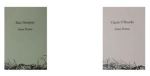
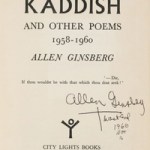
    The pictured editions carry a huge poetic punch, though it would be unfair to compare them as like. The Moth Little Editions were released this month, the Ginsberg is pre-1960 and Hannah Weiner’s books as objects of art were made in the 1970/80s. They are all serious books in small form, a virtue of City Lights and other makers of accessible arts books.

    This post was advised by a brief Twitter discussion on portable poetry, such as the carrying  of  T.S Eliot‘s Four Quartets about for reading.

    Quite recently I was genuinely amazed  to receive four poetry books nestled  within one (white) standard office-sized envelope from Moth Editions , and although the books are small they each contain 32 poems.  This post is about physical books  rather than about code , or indeed the storage and the dissemination of poetry through sites like Kenneth Goldsmith’s UBUWEB, which I have referred to before now here. I carry books around in a variety of bags, in fact ,  the type of bag I will choose for a day is never dependant  on as a fickle a thing as fashion , but upon how big a bag I will require for a notebook , diary, boo , ( mostly poetry or  biography), and pencil-case and letters  (yes  letters , I write those).

    Poets Dermot Healey, Kate Dempsey, Ted McCarthy and Ciarán O Rourke form the quartet of poets that make up the first of the Moth Little Editions, I had introduced two of Dempsey’s Poems from the series quite recently.

    Of course distillation and new formats can lead to the strangest of  visual concentrations, such as using QR  Code to bring a whole new audience to writers, including  to Herman Melville and James Joyce. In  the fictional sense, the creation of a Babel Library has it’s own interest and weird beauty. This post is about  the mobility and adaptability of small texts, and how wonderful it is to be able to choose a good book  like the Four Quartets  to bring out with one to read !

    The beauty of poetry is that it is highly adaptable to both book and technology formats and thus very versatile.

    moth magazine’s ‘little editions’
    Ginsberg’s Kaddish (City Lights)
    ‘Little Books/Indians’ by Hannah Weiner
  • A Saturday Woman Poet, Adrienne Cecile Rich

    October 15th, 2011

    Adrienne Cecile Rich has been nominated for the 2011 National Book Award , so no better time to link to her opus. Adrienne is 82 years old and a poet of force. I thought to add a  poem and biography here to celebrate.

    Adrienne Cecile Rich, pic from Google images/JWA
     

    Diving Into the Wreck by Adrienne Cecile Rich.

    First having read the book of myths,
    and loaded the camera,
    and checked the edge of the knife-blade,
    I put on
    the body-armor of black rubber
    the absurd flippers
    the grave and awkward mask.
    I am having to do this
    not like Cousteau with his
    assiduous team
    aboard the sun-flooded schooner
    but here alone.

    There is a ladder.
    The ladder is always there
    hanging innocently
    close to the side of the schooner.
    We know what it is for,
    we who have used it.
    Otherwise
    it is a piece of maritime floss
    some sundry equipment.

    I go down.
    Rung after rung and still
    the oxygen immerses me
    the blue light
    the clear atoms
    of our human air.
    I go down.
    My flippers cripple me,
    I crawl like an insect down the ladder
    and there is no one
    to tell me when the ocean
    will begin.

    First the air is blue and then
    it is bluer and then green and then
    black I am blacking out and yet
    my mask is powerful
    it pumps my blood with power
    the sea is another story
    the sea is not a question of power
    I have to learn alone
    to turn my body without force
    in the deep element.

    And now: it is easy to forget
    what I came for
    among so many who have always
    lived here
    swaying their crenellated fans
    between the reefs
    and besides
    you breathe differently down here.

    I came to explore the wreck.
    The words are purposes.
    The words are maps.
    I came to see the damage that was done
    and the treasures that prevail.
    I stroke the beam of my lamp
    slowly along the flank
    of something more permanent
    than fish or weed

    the thing I came for:
    the wreck and not the story of the wreck
    the thing itself and not the myth
    the drowned face always staring
    toward the sun
    the evidence of damage
    worn by salt and away into this threadbare beauty
    the ribs of the disaster
    curving their assertion
    among the tentative haunters.

    This is the place.
    And I am here, the mermaid whose dark hair
    streams black, the merman in his armored body.
    We circle silently
    about the wreck
    we dive into the hold.
    I am she: I am he

    whose drowned face sleeps with open eyes
    whose breasts still bear the stress
    whose silver, copper, vermeil cargo lies
    obscurely inside barrels
    half-wedged and left to rot
    we are the half-destroyed instruments
    that once held to a course
    the water-eaten log
    the fouled compass

    We are, I am, you are
    by cowardice or courage
    the one who find our way
    back to this scene
    carrying a knife, a camera
    a book of myths
    in which
    our names do not appear.


    This poem is for lovers of poetry, for those who read women poets and wonder at the gender-imbalance in literary publication. I have decided to keep it simple and to add my favourite Rich , alongside a reading list. This site has always been about encouraging poetry writers and readers to research books that they enjoy and bringing the amazing words of women writers into view. We have a visibility issue which is deeply questionable in my view. There are  now 62 Saturday Woman Poets published here since 2008.

    Link Bibliography for Adrienne Cecile Rich.

    •  Arts Of the Possible ,  Essay and Conversations of Adrienne Cecile Rich  http://www.powells.com/biblio/1-9780393050455-6
    • National Book Award  http://www.boston.com/ae/books/articles/2011/10/12/adrienne_rich_among_national_book_awards_finalists/
    • Wikipedia:  http://en.wikipedia.org/wiki/Adrienne_Rich 
    • Jewish Women’s Archive: http://jwa.org/encyclopedia/article/rich-adrienne-cecile

    The Poem Read by Rich.

  • A poet-companion; Tess Gallagher translates Liliana Ursu.

    October 5th, 2011

    There are two posts on this blog which link to short poems by Lilian Ursu.  The poems are from the Poetry Book Society Recommended Translation of The Sky Behind the Forest, by Liliana Ursu. The volume had two translators, Adam J Sorkin and Tess Gallagher. Interestingly, the volume does not initial the translators work beneath the text , so  it is very hard to identify which poems were translated by Gallagher. This blog is dedicated to the work of women writers, editors and translators, so I thought to examine Gallagher’s approach to the poet and to her work.  I am referring to  the  published notes on the translations throughout.

    Liliana Ursu is Romanian, she was born in Sibiu in 1949 and  lived in Bucharest during the Ceaucescu regime. She graduated in English at Bucharest University and taught part-time there for ten years. Ursu has published two books of short stories, six books of translation and  books of poetry. She travelled as a  visiting professor to Pennsylvania State University on a Fulbright Grant in 1992-1993. I have decided to include here a Bloodaxe page about Ursu, as well as a link to Lightwall.
    .

     Tess Gallagher describes herself as “a poet-companion” in her preface to the Poetry Book Society edition of Ursu’s The Sky Behind the Forest. It is an apt description for a fellow-traveller in the arts.Bad translation has been a bugbear of mine for some years, given that  wide internet dissemination has  sometimes led to appalling and quite inflexible machine-spewed translation. The ability to translate  from an academic, collaborative or empathetic base is what wholly contributes to the poetry reader’s pleasure in coming as close as it is possible to the spirit of the poem and to the intent  of the author.

    I chose The Gallagher translation of Ursu as an exemplar of collaborative translation, but I could just as easily point to Hugh Maxton’s wonderful  translations of Ágnes Nemes Nagy’s Between , or Marion Glascoe’s edition  of Julian of Norwich. Gallagher is a collaborator  both  as a poet and as a woman, and her ability to communicate the Ursu text , along with Sorkin, hinge on collaborations and on  poetic sympathy.

    Her approach is not solely academic but  occurs at a  level of universality, which is indicated in her approach to the work here ,

    In the Dusk.

    In the dusk the statues smile more enigmatically.
    Not a breath of wind troubles their gaze.
    You look at me and know how autumn makes its way.
    In the dusk, under our bodies the hill sinks to ruin –

    weightless, at last.


    from The Sky Behind the Forest. Publ. Bloodaxe ,  1997.

  • ‘Yes, Minister’ a poem by John Walsh

    October 4th, 2011

    While brushing my teeth
    I stop to think of the Minister’s words
    and I feel how lucky we are indeed
    to have a Green Minister like him to tell us
    not to be wasting water running it
    while brushing our teeth.

    And I wonder if he’s noticed
    that it’s been pissing the rain for weeks
    and the eco-warriors are up to their eyes in muck
    in their flooded dugouts on the Hill of Tara.

    But he says he is not in a position to go there
    for he is afraid of getting his hands dirty
    and he’ll have to go washing them all over again,
    wasting everyone’s time and energy,
    including his own.

    Seamus Heaney thinks it’s a disgrace,
    but sure nobody listens to him.

    Thanks to John Walsh. This poem is from Chopping Wood with T.S Eliot, Publ. Salmon Poetry 2010.

←Previous Page
1 … 63 64 65 66 67 … 106
Next Page→
 

Loading Comments...
 

    • Subscribe Subscribed
      • Chris Murray
      • Already have a WordPress.com account? Log in now.
      • Chris Murray
      • Subscribe Subscribed
      • Sign up
      • Log in
      • Report this content
      • View site in Reader
      • Manage subscriptions
      • Collapse this bar