• chris murray
  • journals – bibliography – publication notes
  • downloadable items – essays – media
  • copyright
  • Home

Chris Murray

  • Two pieces for discussion regarding Gender and Publication: Publication Bias ?

    October 12th, 2010

    With thanks to Judith Buckrich (ex-Chair) of The International PEN Women Writers Committee, and Vice-President of The PEN Centre in Melbourne. I am attaching a linked Paragraph from : Women left on bottom bookshelf (Emma Young, full article at the base of this piece. (link#1)

    “It’s hard to deny that this is a part of life in fiction. It’s a popularly condoned idea that novels written by men are neutral and on the shelves to be enjoyed by anyone but novels written by women can excite lower expectations and are looked at as exclusively feminine: a female voice for a female audience. In other words, books written for women are chick lit, while books written for men are just books. This idea also has legs in the world outside fiction.” (link#2)

    Oh ! back to the vexatious Chick-lit question, where consumer-choice and empty lifestyle pretends to an Austen-like inch of ivory, and where in Ireland (at least ) vacuity is rewarded with attempts by certain media-types to include disposable novels on our children’s examination certificate syllabi!! Sure police-helicopters are sent in hunt for Jonathan Franzen‘s bifocals and this tittle dominates media-time. It appears one must have a testicular style to become the luvvie, though I expect it also helps to be a writer of merit, which cannot be denied . This doesn’t explain why women writers and makers of literature are shoved into the shadows, critically, academically and historically , until they acquire the label specialisation.

    Further to the discussion, VIDA have recently published a forum on Gender and Publishing, excerpted here and linked beneath Dr Buckrich’s Website and Emma Young’s Piece here as third link. it is worth the read:

    Tracy Bowling: “I do believe that bias is present in the publishing world such that women writers are underpublicized and undersold after their work is published, but it’s not a bias I feel very qualified to speak to. The more distressing evidence of a gender bias I see comes before publication, in that women writers often seem pressed to fit themselves very neatly into categories, to define a space for their work or to proclaim whose footsteps they’re following in. In the wake of Jonathan Franzen’s glowing reception, many writers have discussed the infrequency with which the word “genius” is applied to women writers; I’d be curious to see if the same is true of words like “breakthrough,” “innovative,” and “new.” I think that in order to attain success, especially in mainstream publishing, women often have to (often artificially) join a particular group or cohort of other women writers in order for their craft to be perceived as serious and studied. I’ve seen this a lot among women who write fantastic or fairy tale fiction, where, for example, no matter how little one’s work resembles or echoes that of Angela Carter, that work rarely gets discussed without heavy reference to Angela Carter. The really unfortunate side effect of having to strategize and situate oneself as one among many others, I think, is that women become less likely to write the Franzen-esque literary epics, simply because there is less precedent–less of a niche within which their work can be easily framed.” (link#3)

    Personally, I expect that if you are a man, its easy to have a blind-spot on the under-representation of women in Government, in the Literary Arts and in Media. The fact that many (many) people do not equate media-time (luvvieness) and column inches with that strange heeled penile-worship of modernism and that frisson of tokenist gender-equality doesn’t mean that the issue of discrimination does not occur. It occurs, it is celebrated and it is a part of our lives wherein meritocracy is just another by-word for male dominance.

    EDIT : (VIDA discussion re-posted this morning on the Web)

    “I soon discovered that a lot of women writers routinely perform their own version of “the count” when surveying anthologies, journals, book reviews, and awards. At the time I was unaware of Juliana Spahr and Stephanie Young’s essay “Numbers Trouble”; nearly all of the women I was in dialogue with directed me to it. I was astonished to discover that a sub-genre of poetry (which I’ll refer to by shorthand as “experimental”) I’d have assumed would most fairly represent the sexes may be as biased as the more “traditional” sub-genres in poetry, as well as the more commercial venues for prose. I would later be struck by the fact that women writing in all genres are affected by this disparity.

    This experience was akin to peering over a very high wall to gaze upon a neighbor’s backyard—a neighbor I’d always assumed was living the good life—and discovering that this neighbor’s life was, in fact, quite similar to my own.”
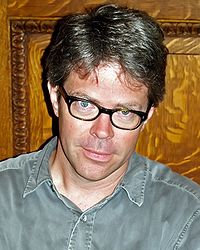
    Jonathan Franzen, whose lost glasses sparked a cop-hunt and media-dominance.

    Judith Buckrich Website

    Emma Young Piece ‘Women Left on the Bottom Book-shelf’

    Vida Article on gender and Publication

  • Exilic Conditions

    October 10th, 2010

    One of my favourite poems is The Seafarer , it is linked at the end of this short piece in translation by Ezra Pound. The edition that I own is the Exeter University Press Seafarer ( I will add notes, translation, editor and ISBN later as I am away from my Poetry library). In the meantime, whilst playing with a very elderly book of school-french this morning, I happened upon the phonetic transcription section of the edition which I enjoyed so much that I am adding here a little poem called , Mon Bateau. Though I would gladly add La Cerise and Nocturne also, because they are of such light.

    Alone

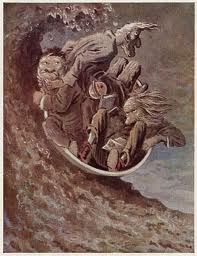
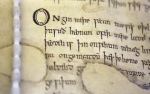
    ‘The Oldest Joke’ from the Exeter Cathedral Folio

    (Georges Rodenbach)

    To live as in exile, to live seeing no one
    in the vast desert of a town that is dying,
    where one hears nothing but the vague murmur
    of an organ sobbing, or the belfry tolling.

    To feel oneself remote from souls, from minds,
    from all that bears a diadem on its brow;
    and without shedding light consume oneself
    like a futile lamp in the depths
    of dark burial vaults.

    To be like a vessel that dreamed of voyage,
    triumphal, cheerful, off the red equator
    which runs into ice flows of coldness
    and feels itself wrecked without leaving a wake.

    oh to live this way ! All alone…. to witness
    the wilting of the divine soul’s white flowering,
    in contempt of all and without prediction,
    alone, alone, always alone, observing
    one’s own extinction .

    Translated from the French by Will Stone.

    Interestingly, I met a returned exile today who does not recognise Ireland anymore. He says there is a gentleness that has left the state, I tend to agree with him there.

    “The heart’s thought that I on high streams
    The salt-wavy tumult traverse alone.
    Moaneth alway my mind’s lust
    That I fare forth, that I afar hence
    Seek out a foreign fastness.
    For this there’s no mood-lofty man over earth’s midst,”

    excerpted : The Seafarer  , translated by Ezra Pound

    {Exeter University Press edition to be added}

    Mon Bateau

    Quand mon bateau
    S’en va sur l’eau
    Poussée gaiment
    par le bon vent,
    je voudrais tant
    Etre dedans!

    mais quand la bise
    la voile brise,
    Que le navire
    Soudain chavire,
    j’aime bien mieux
    Lui dire adieu.

    A. de Montgolfier

    • Ezra Pound’s Seafarer from the Anglo-Saxon text.
  • ‘Aviary’ by Tom MacIntyre.

    October 7th, 2010

    Aviary (I – excerpted)

    By Tom MacIntyre

    Spirit-birds love
    black of the bog,
    banks loaded,
    juice on the spade,
     
    from nowhere gather
    in celebration,
    taste the action,
    call it home.
     
    You venture close :
    pacey echoes
    stir and murmur
    names forgone,
     
    Whimbrel, Whinchat,
    Grebe, Merganser,
    the names don’t fit
    quite, the birds mind
     
    their own business,
    a heron shows,
    lifts, departs,
    you’ve met before,
     
    that’s the hero
    nicked your cap
    and will not, will not
    give it back…..

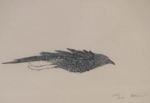
    ‘Bird in the Sun’ by Leonard Baskin
    • Aviary , from A Glance Will Tell You And A Dream Confirm,Tom MacIntyre. Dedalus Press, 1994, Dublin.
    • ‘The Philosopher and The Birds , Wittgenstein at Rosroe’
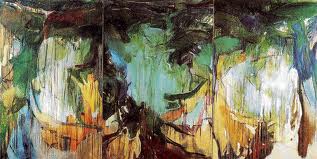
    Barrie Cooke ‘Big Forest’ (Irish Times)
  • Anne Sexton, The Art of Poetry No. 15 (Paris Review)

    October 4th, 2010
    Wikipedia Image of Ann Sexton , by Elsa Dorfman

    I just saw this interview link which has been released today by The Paris Review to celebrate Ann Sexton’s Birthday and I have added it to my Facebook page. I thought to add it through an excerpted paragraph and hyperlink onto the Poethead blog also.

    There is an existent link to Ann Sexton’s Transformations also available on the Poethead blog which will be carried at the end of this short piece, along with the Paris Review Interview on ‘The Art of Poetry No 15’ by Barbara Kevles.

    ” Until I was twenty-eight I had a kind of buried self who didn’t know she could do anything but make white sauce and diaper babies. I didn’t know I had any creative depths. I was a victim of the American Dream, the bourgeois, middle-class dream. All I wanted was a little piece of life, to be married, to have children. I thought the nightmares, the visions, the demons would go away if there was enough love to put them down. I was trying my damnedest to lead a conventional life, for that was how I was brought up, and it was what my husband wanted of me. But one can’t build little white picket fences to keep nightmares out. The surface cracked when I was about twenty-eight. I had a psychotic break and tried to kill myself. “

    (excerpted Interview with Ann Sexton , The Paris Review )

    A Scene from ‘The Company of Wolves’ from Angela Carter’s Tales (Directed by Neil Jordan)

    Briar Rose

    Consider
    a girl who keeps slipping off,
    arms limp as old carrots
    into the hypnotist’s trance,
    into a spirit world
    speaking with the gift of tongues.
    She is stuck in the time machine,
    suddenly two years old sucking her thumb,
    as inward as a snail,
    learning to talk again.
    She’s on a voyage.
    She is swimming further and further back
    up like a salmon,
    struggling into her mother’s pocketbook.

    Briar Rose , by Ann Sexton (Transformations)

    The Art of Poetry No.15
     ‘Transformations’ , Ann Sexton’s Fairy-tales by Poethead

  • Marcel Duchamp : Alpha-Bets and Words.

    October 2nd, 2010

    ” Paroi parée de paresse de paroisse
    A charge de revanche et a verge de recharge
    sacre de printemps, crasse de tympan
    Daily lady cherche démelés
    avec Daily Mail .”

    indeed- (Marcel Duchamp)

    first letter of the Alpha-bet
  • Protected: A personal anarchist manifesto

    This content is password-protected. To view it, please enter the password below.

  • “Mark My Words” by Eilis Ní Dhuibhne

    September 28th, 2010

    My Angel of a Secretary

    by Eilis Ní Dhuibhne, From Mark my Words.

    I was sitting at my desk
    Outside the boss’s office
    Replying to emails
    From candidates for places
    On the courses we offer;
    The effective saint;
    Managing eternity efficiently Level Two;
    Create the world workshops (NB Seven Day Course).
    Then what happens?
    This black yoke comes in
    With a thousand questions
    In its beady eye.
    It has wings like me
    But otherwise
    We’ve nothing, nothing
    In common. Have we ?
    I gave him the standard line.
    I regret that on this occasion we have
    No vacancies for crows or artists.
    We wish you every success
    In your future career.

    The creature stayed however.
    I did not call security
    (Because I am security!
    I do everything around here)
    And so the loser stayed.

    Forever.


    Mark My Words with illustrations by Alice Maher was published in conjunction with The Night Garden exhibition by Alice Maher and lives in a little black folder with pieces by Maher entitled The Bestiary.

    Bower Poems with Image Courtesy of Alice Maher


  • Writers Urge U.N. to Abandon Efforts to Prohibit Defamation of Religions, Concentrate Instead on Respect-Building Initiatives

    September 19th, 2010

    “Human rights are attached to individuals, not to states or organized groups or ideas,” said International PEN President John Ralston Saul, who chaired the two-hour session entitled Faith and Free Speech: Defamation of Religions and Freedom of Expression. “When governments attempt to limit the rights of citizens, they are not seeking to protect faith or belief. They are seeking increased power over the citizenry.”


    It worries me that the Irish Government sought to restrict free expression by introducing a blasphemy criminalisation into the Irish Statute on the 1st of January 2010 under the aegis of the 2006-2009  Defamation Bill and more so that this will not be reversed through Referendum until at least 2011. For information on the Blasphemy legislation in Ireland which sites Blasphemy in the ability to ‘Outrage’ please see the second attached link at the end of this piece.

    Oh and of course Poethead has a search engine , into which Blasphemy can be entered , therein some links to the Irish situation and the wonderful Blasphemer’s Banquet , by Tony Harrison.

    How Squalid censorship is !!! The realm of the small-minded hypocrite.
    • Defamation and Religion , Press Release by International PEN
    • Blasphemy In Ireland : ‘We use Defamation Laws to attack free speech’
    • The 2006-2010 Defamation Bill #Ireland
  • Pidgie and Katey, two girls written by Mary Lavin

    September 18th, 2010

    …….

    ‘Scylla and Charybdis‘ and ‘A Glimpse of Katey’, by Mary Lavin.

    The two short stories named above in the title refer to Mary Lavin’s  writing of girls, Katey, from A Glimpse of Katey, and Pidgie, the heroine of Scylla and Charybdis. Both stories were published in Lavin’s The  Patriot  Son, although there is a vast array of Lavin books to choose from.

    Mary Lavin is today’s Saturday Woman Writer on Poethead. The Patriot Son edition that the excerpts are taken from is a 1956 Hardback, publ. Michael Joseph 1956. Other recommended reads by Lavin include In a Café and Tales from Bective Bridge. This treasured edition contains within it my favourite Lavin story The Chamois Gloves, which I referred to in the Island Women piece (which is linked to at the base of this post).

    A Glimpse of Katey .

    “In the elms the birds were making preparations for the night; circling around the tree-tops as if about to settle there, and then darting away again capriciously to take a last flight in the glowing clouds. But each time the flock circled down on the trees a number of birds settled down for the night, and every time they flighted away again there were less and less of them, until soon only one or two rose from the branches, and these only ventured a short distance, and came back with nervous fluttering and a great amount of nervous chirruping. When the last bird seemed to have settled down and the leaves were no longer fluttered by shaken wings , there was silence everywhere, except for occasional faint and single notes that broke the air at random and which seemed to come from the sleepy throat of some sleepy bird already hovering the air of dreams. Katey lay and listened, and then her own day suddenly slipped away from her , and left her body lying on the old four-poster bed, as the feathered bodies of the birds clung upon the damp tree-boughs, while her spirit with theirs was gliding away into the branchy lands of dreams.”

    Katey, like Pidgie is a stubborn and spirited little girl , whose beautiful dreaming is abruptly shattered by her need for food at midnight. The preceding tale had outlined her refusal of sustenance before going off to bed and her awakening into the bright, boisterous land of the older women of the house as a result of the hunger pangs.

    Scylla and Charybdis 

    Pidgie, much like Katey is a spirited and obstinate child whose trials and adventures bring her right down from her fantasy world to the station in her life that she had rejected. She is Cotter’s daughter , a servant-girl , whose natural ability and intelligence is not recognised by the golden birds of the house whose light-shattering tendencies as they seek her out of the basements draw her Prosperine-like into the sunlight of the world ‘above-stairs’, only to have her catapult back again when the rite which will equalise the servant and the lady is utterly shattered forever,

    ” out they went into the passage, Miss Gloria first, and Pidgie fluttering after her. And although the passage was dead level, as Pidgie’s little feet flew along after Miss Gloria it seemed to her that every minute she was being borne upward , out of darkness and cold into ever higher and higher reaches. The very air seemed to waft warmer around her until they flashed out into the main hall, where the doors stood open on all sides, showing the gilt and white rooms with their sparkles of mirror and splashes of flowery chintz”.

    Gloria is described variously as a golden bird, Pidgie lives in the dark-dungeon and experiences her self as being snatched into the beak of the bird. Lavin’s women and girls are often described thusly, she adores and gently coaxes her characters into their freedoms , only to smack their little hands and put them right back into their places as they deal with their choices. Both girls , like the Heroine of The Chamois Gloves get their epiphanies and mostly the knowledge they bring isn’t welcome to them. Katey dreads the morning and Pidgie retreats to the dungeon but regains her cheeky character as a result of her brush with the reality of her life.

    •  From Mary Lavin’s The Patriot Son  Publ 1956, Michael Joseph
    •  Related Link : Lavin’s Island Women

  • ‘Simile’ by Ágnes Nemes Nagy.

    September 16th, 2010
    ……

    Simile

    The one who has been rowing while the storm
    Approaches near, who strains with every limb
    Against the trusty footboard’s rigid form
    And finds a sudden absence from the rim

    Of the broken oar, weightless hand, and
    Falling propulsion, falling
    With the loosened, dropping shaft and
    Whose whole body sags –

    He knows what I know.  by Ágnes Nemes Nagy

    Jorge de Aguiar Compass rose from Wikipedia.

    I have recommended before now the reading of Ágnes Nemes Nagy in both poetry and poetic prose. The image I had chosen to illustrate the above poem was initially an adorable illustration from The Exeter University press edition of The Seafarer but the Aguiar Compass Rose suffices. There are some Poethead references to elegy in the Old English on the site and I may wish to link to the Seafarer image again.

    The Poem above comes from the Corvina & Dedalus Edition of Between by Ágnes Nemes Nagy , in translation by Hugh Maxton and published in 1988. I recommend Maxton’s afterword discussion on Nagy’s Poetics.

    Between , Selected Poems of Ágnes Nemes Nagy, Trans, Hugh Maxton.
    Corvina Press (Budapest) and Dedalus Press (Dublin) 1988.

←Previous Page
1 … 75 76 77 78 79 … 106
Next Page→
 

Loading Comments...
 

    • Subscribe Subscribed
      • Chris Murray
      • Already have a WordPress.com account? Log in now.
      • Chris Murray
      • Subscribe Subscribed
      • Sign up
      • Log in
      • Report this content
      • View site in Reader
      • Manage subscriptions
      • Collapse this bar