• chris murray
  • journals – bibliography – publication notes
  • downloadable items – essays – media
  • copyright
  • Home

Chris Murray

  • “The Immortal” by Elisaveta Bagryana

    December 5th, 2008
    Elisaveta Bagryana.
    Elisaveta Bagryana.

    The Immortal

    Now bloodless and almost fleshless
    unmoving , unbreathing, voiceless.
    With eyes half closed and sunken,
    what matter if -Anna or Maria,
    the fine lids will never rise,
    the clenched lips will not move or ever
    again utter a moan or sigh.
    And look how already white and strange is
    that ring upon her hands, crossed forever.

    But do you hear her innocent child
    crying in a cradle nearby.
    There is her immortal blood, transferred
    and her soul now resident in this world.
    days will pass by, years, centuries
    and the yielded lips of two young lovers
    will again whisper ‘Anna’ or ‘Maria’,
    at night amidst the fragrance of spring.
    The great-granddaughter will bear everything: name,
    eyes, lips, locks of the other invisible one.

    1925.
    Selected Poems of Elisaveta Bagryana; Penelope of the Twentieth Century
    Trans, Brenda walker, Valentine Borrisov and Belin Tonchev. Forest Books.

    For Sinead with the Rainbows in her eyes, RIP

  • Face at the Bottom of the World: Hagiwara Sakutaro.

    December 4th, 2008
    from the Chester Beatty Library. Dublin.
    Yoku Go No Onna from the Chester Beatty Library. Dublin.

    Duel

    Both earth and sky are greenesses,
    Greens that explode and expand:
    Shoes flash like fish as I tread the seas
    And hang like fish when I stand,
    And happiness swims in the shadow of trees
    As the light blade hangs from my hand.

    Moonlight and Jellyfish

    I swim in the moonlight, swim to snare
    Jellyfish swarming, flocks of phlegm.

    My hands stream out, forgoing me:
    Further and further they extend
    Among those moving mirrors where,
    Coiling, the seaweeds cumber them;
    Where, in the mooned alembic sea,
    My flesh turns glassy, glassily.

    A thing transparent, a chilly thing,
    Flows in the water, knows no end…

    My soul near frozen, shivering,
    Sinks in the sea, is almost drowned,
    Drowned in its very trance of prayer
    While swarming everywhere around,
    Swarming round me everywhere,
    The jellyfish in trembles of pure blue
    Swim out, swim through
    That moonlight they are turning to….

    I shall have to balance these excerpts from  The Face at the Bottom of the World with a woman poet, when I get two minutes. In the meantime the edition I read these in is from the UNESCO Collection, Published by Charles E Tuttle and Company 1969.

    Here, In Ireland our jellyfish are small and brown with electric blue veins in the top. I made a poem about a whole lot of them beached and rotting In Irishtown a number of years ago.There were hundreds lining the beach after a wild storm.

    I am publishing this in Images, tagged with Visions.

  • “Lazarus” by Ágnes Nemes Nagy.

    November 29th, 2008

    Round his left shoulder, as he got up slowly
    every day’s muscle gathered in agony
    His death was flayed off him like a gauze.
    Because second-birth has such harsh laws.

    From: Between by Ágnes Nemes Nagy.Trans, Hugh Maxton. Dedalus Press , Dublin and Corvina Press, Budapest.


  • The Perils of Indulging in Cosmetics ; ‘Il Libro dell’ Arte’.

    November 28th, 2008
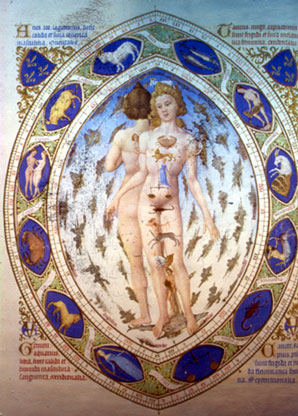
    Anon Manuscript
    Anon Manuscript

    I thought I would put a small excerpt from Cennini’s excellent Il Libro dell’ Arte on the blog today:

    “You would have occasion in the service of young ladies, especially those of Tuscany to display certain colours to which they take a fancy. And they are in the habit of beautifying themselves with certain waters. But since the Paduan women do not do so; and so as not to give them occasion to reproach  me; and likewise because it is contrary to the Will of God and Our Lady; because of all this I shall keep silence. But I will tell you that if you wish to keep your complexion for a long time; you must take a practice of washing in water-spring or well or river: warning you that if you adopt any artificial preparation your countenance soon becomes withered, and your teeth black; and in the end ladies grow old before the course of time; they come out the most hideous old women imaginable. And this will have to be enough discussion of the matter.”

    (!)

    Quite reminds me of my grandmother’s woe at freckles. Il Libro Dell’ Arte is still studied for its excellence in technique in painting,from grinding colours through creating fresco. If one can ignore the jaundiced approach to women… its always best to keep in mind the artistic instruction books were written solely for the benefit of young men hoping to be apprenticed to masters, but he does some pretty good facial and cosmetics advice therein.

    The Craftsman’s Handbook , ” Il Libro dell’ Arte “. Cennino d’Andrea
    Cennini, Trans, Daniel V. Thompson Jr. Dover. 1960

  • Two poems by Liliana Ursu.

    November 21st, 2008

    Poem with a Griffin, a Pike and Peacocks.

    I am reading a poem while it rains.
    The day blinks
    through windows guarded by a griffin; its talons
    flex, its tail switches.
     
    Do you remember those summer showers high in the mountains?
    The dull pop of a toadstool beneath your bare foot
    in the dew-covered grass?
     
    Under a crystal bell jar, the still life-fleshy ripe bananas,
    cherries, lemons and the silver knife you bargained for in the bazaar
    as the Bhosphorus sparkled at the feet of the one you loved.
    On the wobbly kitchen table, with that very knife,
    you slit open a pike.
     
    And the hunting rifle, propped against stuffed peacocks-
    has it turned into a lapdog
    licking the other woman’s hands
    as she weighs my pearls…?


    In the Forest

    I wrote the essential poem on an oar
    just before setting out.
    Perhaps long ago it’s been erased
    or maybe the sea
    knows it now
    by feel.

    Like the woman in Rousseau’s painting
    I shudder
    at the sound of footsteps
    -when the fear comes on too strong.

    The path I follow
    is a knife blade.
    maybe this is why
    the sky behind the forest
    is now so red.

    I wrote the essential poem on an oar
    just before setting out.


    These two poems are taken from the Bloodaxe published book,  The Sky Behind the Forest by Poet Liliana Ursu. It is translated by Tess Gallagher and Adam Sorkin.

    I really like the book, but I always make one suggestion when recommending it, and that is to read and absorb the beautiful writing before reading the introductory and translators essays. The essays are highly important in establishing the appalling context of censorship under which the poet suffered, but one can feel it also in the powerful writing.

    The Sky Behind the Forest, Liliana Ursu. Trans, Liliana Ursu, Tess Gallagher,
    Adam J Sorkin. Bloodaxe Books. 1997.


  • A Saturday Woman Translator, Sheema Kalbasi.

    November 15th, 2008
    Reporting a  Lunar eclipse in Babylonia.
    Reporting a Lunar eclipse in Babylonia.

    With You by Mehri Rahmani

    Your tender revolt
    Contained by the illicit apple
    Pounds in red
    And your eye’s shattered diamond
    A woman in seclusion
    Revolves into a star
    With you
    On the surface of water
    I am thirsty
    Place the skies in your eyes
    Blaze out the star
    So that I can see you
    The sea is peaceful
    Silent…

    from : The Seven Valleys of Love, trans Sheema Kalbasi Poet ,
    A Bilingual Anthology Of Women Poets from Middle Ages Persia to Present

    Today I was reading more of Farideh Mostavi who features on the blog in two sections, her poetry can be accessed by using the search engine to the right of this post. The issue of Translation has been a part of this site since I started it up, Including the works of Mostavi, Tess Gallagher, the translators of Nagy and of Ursu. The sympathetic work of the translator being grossly undervalued in terms of what is actually available for people to purchase in bookshops. The IPWWC and translators committees have done tremendous work in funding and bringing to the reader some of our most incredible women writers.

    In Ireland there is a wonderful tradition of writers and poets translating works; and bringing them to an interested readership.

    There is a small post somewhere on the blog of a Marianne Agren Mc Elroy translation of Comes Somebody , by Nelly Sachs, it had fallen out of a Paul Celan book which I had been  casually mooching at a friend’s house. It was one of three small and old pieces from a now defunct Irish newspaper. It really is an excellent poem, thus I am going to stick it beneath this post on the blog if I can. (the tech occasionally mystifies).

  • Protected: Santa Maria del Mar.

    This content is password-protected. To view it, please enter the password below.

  • Work and Contemplation- by EBB

    November 8th, 2008

    ” The woman singeth at her spinning- wheel
    A pleasant chant, ballad or barcarolle;
    She thinketh of her song, upon the whole,
    Far more than of her flax; and yet the reel
    is full, and artfully her fingers feel
    With quick adjustment, provident control.
    The lines, too subtly twisted to unroll,
    Out to a perfect thread. I hence appeal
    To the dear Christian Church, that we may do
    Our Father’s business in these temple’s Mirk,
    Thus swift and steadfast ; thus, intent and strong:
    While, thus, apart from toil, our souls pursue
    Some high, calm, spheric tune, and prove our work
    The better for the sweetness of our song.”

    This is a good evening, it rains (it pours) but political change is in the air and I am glad for that.. cos sometimes it seems that Women’s Work is ignored (and it is often hard work.)

    The above is by Elizabeth Barrett Browning, one of my favourite writers.

  • The Poetics of Engagement: Marianne Moore.

    November 7th, 2008

    Ballade Von der Judenhure Maire (1991)

    This Book Of Marianne Moore‘s Prose is entitled  The Poetry Of Engagement, edited by Grace Schulman, University of Illinois Press 1986.

    I have printed one other piece by Moore on this blog. I tend to ignore critique except to contextualise the social and historical life of the poet, those movements that brought the writer to settle into her voice. There is a resonance in Moore’s poetry that is hooking, despite the best efforts of Ted Hughes to underrate her contribution, or whatever it was that provoked the nasty little Moore Poem in Birthday Letters

    I am adding in this little excerpt along with the title of the book in the hope that more readers will come to look at women writers:

    There never was a war that was
    not inward; I must
    fight till I have conquered in myself what
    causes war, but I would not believe it.
    I inwardly did nothing.

    When I read Birthday Letters, long before I had read anything by Moore, I must confess that the imagery that Hughes used to talk of the woman put me right off wanting to read her. The issue emanated from a particular episode in which he accused her of putting shards of glass into an acerbic note she sent Plath,  or the image of her in her hat looking for the grave on which to lay her little wreath. It irritates me beyond belief that Hughes exploited his power in such a wholly provocative manner, and that be celebrated by other poets including Seamus Heaney. For what Hughes did in Birthday Letters was to make himself unanswerable, neither Moore nor Plath can respond to his work. It must have been great that the mostly male critical and academic establishment refused to note this in their reviews. It did not occur to Heaney, for instance to note that Hughes took an opportunity to settle old scores/scars.

    For me, a writer of prose and a poet, the issue has always been about engagement with themes and symbols that evolve over time, but that somehow retain their shape and essence no matter what. I am still trying to understand how a voice as strong as Hughes is capable of honing those particular traumas so artfully decades indeed after the episode. Thats Poetic Engagement and can give reviewers the equivalent of the bends; and yet effect another writer’s historical place in our consciousness by sleight of hand (or with deliberate intention).


  • ‘A Cold Coming’ by Tony Harrison

    November 5th, 2008

    The poem A Cold Coming was first published in protest against the First Gulf War. It was re-published on February the 14th 2003. It is by the magnificent anti-war writer and poet Tony Harrison. 

    This morning I am hoping that other routes to global understanding are sought. It feels like a whole generation of kids have been effected by War, by Propaganda, by violent and intolerant language. The included poem (above) is also linked in the blogroll on the right hand side of this page. I have decided not to excerpt it here but would encourage anyone who is interested in the realities of war to read. Tony visited the frontline and is a deeply political poet of great integrity.

    A Cold Coming (excerpted)

    I saw the charred Iraqi lean towards me from bomb-blasted screen, 
    his windscreen wiper like a pen ready to write down thoughts for men, 

    his windscreen wiper like a quill he’s reaching for to make his will. 
    I saw the charred Iraqi lean like someone made of Plasticine 

    as though he’d stopped to ask the way and this is what I heard him say: 
    “Don’t be afraid I’ve picked on you for this exclusive interview. 

    Isn’t it your sort of poet’s task to find words for this frightening mask? 
    If that gadget that you’ve got records words from such scorched vocal cords, 

    press RECORD before some dog devours me mid-monologue.” 
    So I held the shaking microphone closer to the crumbling bone: 

    “I read the news of three wise men who left their sperm in nitrogen, 
    three foes of ours, three wise Marines with sample flasks and magazines,

    three wise soldiers from Seattle who banked their sperm before the battle. 

    • The Mysteries 
    • http://www.guardian.co.uk/theguardian/2003/feb/14/features11.g2

←Previous Page
1 … 94 95 96 97 98 … 106
Next Page→
 

Loading Comments...
 

    • Subscribe Subscribed
      • Chris Murray
      • Already have a WordPress.com account? Log in now.
      • Chris Murray
      • Subscribe Subscribed
      • Sign up
      • Log in
      • Report this content
      • View site in Reader
      • Manage subscriptions
      • Collapse this bar