A woman gets the news, drops to the chair, floor – further, the quick in her bleeds out. She is liquid now, leaching away, this hour, this day, day-on-day. At the back of her eyes a face ebbs and flows: his lop-sided smile makes room for her touch, the tilt of his head calling drinks at the bar, wide arms swinging his kit, their young child, onto working-man shoulders.
Can God breathe underwater?
Each year a sacrifice: the man in blue overalls, flower-blue eyes, who loved his wife at first sight; the ready-laugh man collecting glasses in the pub in off times; the dancer bending into sound like a squall; the dare-devil larking about first night back, caught up in the dizziness of breathing; the ones who tread water, the ones who don’t know what hit them, the ones dragged down in sight of shore. All lost.
They slipped from sight like water through our hands; our hands are empty of them, our mouths are empty of them, our chests are hollow, our eyes are expanses to search.
Fishermen search. Mates, fathers, brothers, in-laws, cousins, make late night calculations where the body might wash up, rake inlets and coves along this torn coastline, fishboxes are body blows, spars are pins in their eyes. On stormy days they are too big for their own kitchens, too restless for the hearth, gaze ever on horizon, for a break in the weather to renew the search.
What else is there?
Bringing in the Washing
Rain whips window like flex, we break mid-sentence, head out. At the side the washing line takes off in wild geese formation, the prop tethers and leads the V.
Hands snatch at shirt flaps grown strong against grey sea, shape shifters we pin by one cuff: blue cliff, chough’s wing, white strand, creased headland, tattered island.
We fold them fast into us, tuck away, the bundle swells under elbow, rain-spotted. And in before they’re soaked, pile all on the chair while we finish our tea. I take my leave of you -as usual, arms full.
Harbour’s Mouth
There are people here so much part of the place that they are named after headlands. They have the look of the raw-boned earth about them, hair the colour of dillisk, eyes taking on the changing shades of the sea.
The rich morning sun draws us out. We check the storm’s leavings: pebbles salt the boreen, bladder wrack drapes the harbour wall, gobs of sea-spume float in the air. The Lough is still choppy, made into peaks by the wind’s flat blade.
Neighbours untie shed doors, clamber into tractors, hammer fence posts. The fisherman has been up for hours, meets me at the pier, a coiled rope in hand. We talk of the weather, face away from each other, watching the harbour’s mouth.
Between sheer sides of rock, a glass dam is piled with boiling layers of saltwater. Lines of blue and white snap and curl, lash some high invisible wall, threatening to shatter whatever power holds them back. He tells how once
a great wave came thundering, crested over this broken ring of hills. Came in the night − 1966 it was − they all heard the roar of it. He points to a spot up the hill, a field away, the place where a boat was hurled that time, hefted by the force of the Atlantic.
Current
The gulf stream makes a micro-climate here, nurtures palm trees and New Zealand ferns.
The current is born in the isthmus of Mexico, awash with the energy of two great Oceans
almost meeting. It leaves us with a deep-rooted thrill, like the quick intake at the glimpse of a lover,
flip in the gut as hands nearly touch, breath exchanged between mouths.
Meeting William Blake in the Library 1980
Unfinished. I hold the weight of paper, the lightest sketch, a man in a crown, clown’s hat, hair streaming.
Wonder came first. The tip of the brush found its place, dropped wild yellow to leap from the head over pencil strokes,
onto page after page on this serviceable desk, to skim along roads, cover the sleeping child, charge the muscles of man, stars and moon.
A grain of colour rubs off on my hand, passes over time into bloodstream, works its way up slowly to my soul.
Annette Skade is from Manchester and has lived on the Beara peninsula, West Cork, Ireland for many years. She is currently in her final year of a PhD on the work of Canadian poet Anne Carson at Dublin City University. Her poetry collection Thimblerig was published following her receipt of the Cork Review Literary Manuscript prize in 2012. She has been published in various magazines in Ireland, the U.K., the U.S. and Australia and has won and been placed in several international poetry competitions.
‘Secrets of a cartographer’s wife’ by Katrina Dybzynska
The cartographer’s wife never told him about her contributions to his maps. A few tiny islands hidden in the middle of an archipelago in the name of symmetry. Some borderline moved to resemble a face shape. The territory of England shortened slightly, in personal revenge.
One time, she renamed an insignificant river in Bangladesh after her lover. She felt pity for the cartographer that he was more furious about the affair than about her intervention in the world order. She knew that romances were ephemeral, while naming things was changing them forever.
Katrina Dybzynska poet, shortlisted for Red Line Poetry Prize 2019. Author of „Dzień, w którym decydujesz się wyjechać” (The Day When You Decide To Leave), Grand Prix of Rozewicz Open Contest 2017. Laureate of national competitions in Poland. She has been publishing short stories, concept book, science fiction, reportage, and poetry, but feels most attracted to genre hybrids. Polish Non-Fiction Institute graduate. Activist. Currently a member of Extinction Rebellion Ireland.
‘Correnti’ by Viviana Fiorentino
Ora è questo un manto di alghe e sale sotto il vento atlantico o è corrente marina del fondo della mia vita e della tua vita ora è sogno o perla luccicante.
‘Currents’ (English trans. by Maria McManus)
This is a shawl of salt and seaweed against the Atlantic wind the ocean currents on the sea bed of my life, your life a dream, a burnished pearl.
Viviana Fiorentino was born in Italy. After obtaining a PhD, she travelled across Europe, from Switzerland to Germany, England and finally to Belfast where she teaches Italian Literature. Since 2018 she has taken part to literature festivals in Italy and in Ireland. She was involved in the poetry project ‘LabeLLit’. She has been awarded or mentioned in various Italian poetry prizes (i.e. Arcipelago Itaca Edizioni & Bologna in Lettere Dislivelli). Her poems appear on Litblogs, international magazines (Brumaria, Works #9’, 2018) and in the Arcipelago Itaca Anthology of Italian contemporary poets. In 2019 she published her poetry collection In giardino (‘In the garden’) for Controluna Press and her first novel Tra mostri ci si ama (lit. trasl. ‘Monsters love each other’) for Transeuropa Press.
Maria McManus lives in Belfast. She is the author of Available Light (Arlen House, 2018), We are Bone (2013), The Cello Suites (2009) and Reading the Dog (2006) (Lagan Press), she has collaborated extensively with others to put literature into public spaces. She is the artistic director and curator of Poetry Jukebox and an active organiser and founder member of Fired! Irish Poets.
‘Genetics’ by Roberta Beary
Your eyes are big and round like your father’s
but while his are the color of the Irish Sea
yours are the color of the muddy fields
on my father’s land
fit only for the peasants who worked them.
abortion day
a shadow flutters
the fish tank
Publication credit: Rattle #47, Spring 2015 (ed. Timothy Green)
Roberta Beary identifies as gender-expansive and writes to connect with the disenfranchised, to let them know they are not alone. She is the author of Deflection (Accents, 2015), nothing left to say (King’s Road Press, 2009) and The Unworn Necklace (Snapshot Press, 2007, 5th ed. 2017) which was a finalist in the Poetry Society of America annual book awards. Beary is the editor of the haiku anthologies Wishbone Moon (Jacar Press, 2018), fresh paint (Red Moon Press, 2014), 7 (Jacar Press, 2013), dandelion clocks (HSA, 2008) and fish in love (HSA, 2006). Her work appears in Rattle, KYSO Flash, Cultural Weekly, 100 Word Story, and Haiku In English The First Hundred Years (Norton, 2013). Beary’s work has been nominated for Best of the Net and multiple Pushcart Prizes. She lives in County Mayo, Ireland where she edits haibun for the journal Modern Haiku.
‘Dying Lover’ by Anora Mansour
Trace my lips In low whispers As I once wept psalms over my dying lover.
Threaten that man You will murder for me – For my heart is a cadence of silence.
I can only love you if you creep through this life dangling dangerously as a ravenous red kite.
When we both become one lonesome night. And rub up to love up as a fight.
Oh, how I might love you, bitter citron basket on my lap Slumberly trusting me as a child. I would open my thighs to you – a snap trap.
Anora Mansour is a graduate of the University of Oxford. She lives between Oxford and Dublin. She has been published in a collection of Jazz Poems, various online sites, and has her own published collection of poetry and blog. She is African-American and Irish.
‘Clutch’ by JLM Morton
for h.l.
in the nest of my fist, a fledgling scooped up from the lane
her soft unfinished beak her shining eye a buoy ringing in the green cathedral of trees
a single yellow feather wisps across my knuckle there is a twitch of elephant digits
and I think about keeping her
raising her as my own feeding her worms
but I let her go
chirring for the ones I could not save.
JLM Morton lives in Gloucestershire, England, snatching as much time as she can to write between caring for a young family, renovating a house and staring up the barrel of a demanding day job. Her first set of poems was recently published by Yew Tree Press for the Stroud Poets Series and she is currently working on a collection.
Though the civility of civilisation frightens me, I visit somewhere populated. A graveyard made squirrel territory. One squirrel for every gravestone. They mount lichen-covered peaks and keep lookout. They claim the trees, the abandoned church. Nobody will make them leave.
That night, I dreamt the answer to the universe. It was blue, inside a conch shell. Spiraling in and out of crystal moments. Eggshell blue. In and out of images of the hospital bed, and these dreams.
Polly Roberts grew up in Devon. Three years studying Creative Writing at the University of East Anglia left her with an inextricable link to the landscape, compelling her to continue to write about the creatures and habitats encountered there.
Observations of both the non-human and human world continued whilst living on a houseboat on the River Avon near Bristol while completing her MA in Creative Writing at Bath Spa University.
Polly has run creative writing workshops for refugees, detainees, and young people and curated two exhibitions in response to her writing, both displayed at the Norwich Arts Centre.
In 2018, the British Council awarded Polly a Writers by Nature scholarship, during which she wrote this debut poetry collection, Grieving with the Animals. ( 2019, Dempsey and Windle)
‘Beochaoineadh Máthar Maoise’ by Ellen Nic Thomás
A dhílleachta linbh gan ainm, gan athair, Do chraiceann ar aondath le humha an nathair, A lúbann timpeall do thaobhán uiríseal, Mar bhata ceannródaí is sníomhanna sisil.
Is trua liom ciseán do dhóchas a fhíochán, Do dhán a chaitheamh i bpoll an duibheagáin, D’eiseadh a chruthú ar bhunús baill séire, ‘Nois tá tú chomh cotúil leis an gCailleach Bhéarra.
A iníon, a mhiceo, a ógfhlaith bocht, A leanbh truaillithe, maith dom mo locht, Imigh anois leat, ná bí do mo chrá, Le smaointe ciúinchiontacha ó mhaidin go lá.
Ellen Nic Thomás is a bilingual poet from Dublin. She graduated from Trinity College with a BA in English and Irish. Her work has been published by headstuff.org, Tales From the Forest and The Attic.
'On watching a lemon sail the sea' by Maggie Harris

1
and I’m singing ‘You are my sunshine’ thinking
of my childhood across the sea of incubation
go Honey go
you self-contained cargo ship you
with your sealed citrus juices and pitted panacea of seeds
braving the collision of tankers and illicit submarines

                 they called me scurvy.       the lemonade
                 my mother made was iced and sprinkled with
                                           Demerara
 (of course)

and I’m wondering, did they grow you there, o lemon     mine
you
for your juices
a lemon plantation, not to be confused with
a plantain plantation even a banana just don’t mention sugar
stack you in the gloom like hereto mentioned bananas
green and curtailed in their growing  or even
those force-ripe mangoes with girls’ names
nobody knows here and who leave their sweetness behind
bare-assed on the beaches
come
to the marketplace
comatose.

I do not remember lemons, but limes.


       M
    I         E
L                S.

Piled high in their abundance. Limes.
Acid green pyramids on market pavements
holding their secrets beneath their reptilian skins.

And there is my aunt, her arms thin as bamboo
gathering the fallen from the yard, sweeping
their dried leaves into the remembrance of herself
whilst the black maid slips slivers of lemon into a split
-bellied fish whose eyes glaze up at the sun.

‘Gauguin, you can come in now; remember Martinique ...?
hue the native in all her harnessed beauty
the slack –jawed fish, browning blood
the textured landscape in shades of  pawpaw and indigo.’

But, liming is what my lemon is doing now,
(in the West Indian sense), hey ho
over the waves at Aberporth, there he blows.


2
I set you free
to take to the sea again
on a high tide, with breakers rushing the beach
like warriors.
They pummel the sand, scythe
a four foot chasm into the mouth
of a lonely river
beat the rocks’ submerged heads
batter the cliffs again
                                        and again
                                                     and again.
The sea, beyond its charge, was waiting -
a winter morning sea, a Twelfth Night sea
tumultuous and moody

                                       waiting.

A strange gift, you
a large, perfect lemon
fresh and sharp as the sun-bright
wind-cut winter’s day. But I
unsure of your heritage
refused you.


3
Dear Voyager,
I cupped you
in my palm
desire urging my possession
how easy it would be – a lemon drizzle cake
a Martini iced, an accompaniment
to plaice or sole – and here I am playing with words
the resonance of belonging, of immortality –
but the devil played tricks with my mind
an injection of poison perhaps, a needle prick
into your  pristine, nobbled skin – but we are running ahead here
thinking of cargo – you may simply have fallen from a Tesco
carrier bag whose owner, fearing a lonesome home-coming
went walking on these very sands contemplating - life.

But there you were anyway, settled on the sand like a crab
then comfortable in the palm of my hand.


4
Finders are not necessarily keepers. Some
will do well to remember that. Vixens
circling misunderstood husbands in bars. Frag
ments from the fallen.
Oh but, how strong is the desire
to hold close, keep tight
smother your darling, your little nut-baby
in soft gloves, hard love, the kind that makes
you want to bite, bite! Rip flesh and bone. Swallow.
                     I could have accepted
your sacrifice
that gift of yourself, thank the universe
for its benevolence.
But the universe is not benevolent.
Stars are exploding missiles in a panther-black night.
Saturn doesn’t give two fucks. It’s chaos
out there.
But I guess you didn’t have time
for star-gazing in your ocean-going lumbering
over the hey-ho waves. And if I had sunk my vampiric teeth
into the you of you, you would be no more
than a bitter taste, a withering lump of citrus
on my kitchen table. Far better to remember you
the obsidian walnut weight of you
and these questions you have gifted me
and that last sight of you
rolling away on the tide.
Maggie Harris is a Guyanese writer living in the UK. She has twice won The Guyana Prize for Literature and was Regional Winner of the Commonwealth Short Story prize 2014, with ‘Sending for Chantal’. She has worked for Kent Arts and Libraries, Kent University and Southampton University as International Teaching Fellow.
Beauty adorns virtue, my Father says. To save the family, and me, from the shame of my disfigurement, he orders a corridor to stretch from here to Santa Annunziata. I beg forgiveness from the Holy Mother at a hidden chink beside the altar. Her perfect face is turned from me, I am to reflect upon her piety. My bedchamber floor maps out the world. Every day I pace its length and breadth, dip toes in oceans, trace the course of rivers, trample the towers of the powerful, reach the very edge, the land of monsters, half-made things, strange and magical. I slide down the wall, squat in this place, feel light from the high window on my face.
The Garden of the Fugitives
These castings from the space where flesh and bone used to be, the moment fixed in gypsum. Head tilts back, eyes roll, mouth loosens. The mould presses replay of the same death throe, sends one to London, another to New York. No grave goods, no funeral. Lost at sea, the remains must fetch up to grant a burial. The ones left behind scout and pray for anything to wash on shore, hope ebbing with each acrid tide. Years back, his body at the pier- still himself- he held the spark for hours. I wasn’t there when it left him, came back to find a shell. In less than a day his skin a husk, to cover what had once been radiant. Here is a zero, an indent in black sand, ablaze with presence. I pour handfuls of lava dust on this never-living kernel, put words on the frozen tongue, in place of a coin for Charon.
Annette Skade is an award-winning poet and teacher, living and writing on the Beara peninsula on Ireland’s south-west coast. Her first collection Thimblerig was published following her receipt of the Cork Review Literary Manuscript prize in 2012.
She has a degree in Ancient Greek and Philosophy from Liverpool University and she has just completed an MA in Poetry Studies from Dublin City University, where she read everything from Anne Carson to the York Mystery Plays, Elizabeth Bishop to Maurice Scully.
Her poems have recently appeared in the SHOp poetry magazine, Abridged and the Cork Literary Review.
Annette Skade’s debut collection Thimblerigwas published by Bradshaw Books in 2013. Thimblerig is a collection of some 53 poems on themes of family, familial history, and on the poetic striving for voice. Skade’s sub-thematic flow, her buried themes, are brought out using the symbolism of light, and of the natural world that surrounds her.
Skade is at her best as a writer and recorder of history and tale, her preoccupations are carried through the text as light-maps. She uses the symbols of the caul, the moth, and the cord (as rope, umbilicus, even as muscle ). Her symbols often denoteboundary both in the physical and in the emotional sense.
Women play an important role in Skade’s familial tracery, her bloodline. Thimblerig is dedicated to Skade’s mother and to her daughter. In Thimblerig Skade’s grandmother forms the apex of the matrilineal pyramid, appearing in The Caul
The Caul
She was born with a caul on her face. The mid-wife said it was good luck, cut away the membrane, examined its milky translucence and placed it in tissue to be kept. Her father sold it to a sailor as a charm against drowning.
…
All her life she loved chiffon scarves. Its my belief she missed part of herself sold away.
p 11 Thimblerig
Family tales are held together with fine wisps of poetry which will transmogrify into light. Annette Skade uses light to map her history and to create boundaries of safety in which to enclose and keep family safe. There is an element of ephemeral about her use of light which she has developed into a fine sense in the beautiful Oak Grove,
Oak Grove
I draw a ring around this house:
snail shell harbour omphalos
Strophe, antistrophe: from oak to oak, bin to bench, winter green to herb, washing line, shed.
Tread the seasons, serve the sickle moon, observe it spring, orange, low on a dark sea.
A rope of days, twined strong, to ward off the stranger, the letter come to dispossess.
Oak Grove answers to A Map of My House In Terms Of Light, where the poet shows her reader the physical interior of the home traced with light: as impermanent, subject to deep loss and to necessary change. The exterior ring of protection and enclosure traced by the poet belies the move to drift of the lives of those she means to protect and to keep. those that are within the home:
To plot all changes from dawn to dusk and through each season, I need many such maps an atlas of light.
from A Map of My House In Terms Of Light, Thimblerig.
Skade is always striving to make her meaning through her use of symbol. In one poem here she has capped a false tail onto the work Papyrus Fragment forcing her ending too soon. Skade deserves a broader canvas for her imaginative play, which she will follow through with in her next collection.
Two moth poems occupy the ground where the poets strives to examine the vulnerability of her existence. I wanted to look at these closer because they form the penates and laertes of the collection and of the poet’s thematic concerns. These are Papyrus Fragment and Restless.
Restless
A hundred moths made a lattice on blue-black window pane, some the size of wrens others torn corners of paper: a nightly frantic race of wings.
Papyrus Fragment
It darts, bares a blaze of underwing to plain sight; this endless fragile need to make a mark, to come to light.
Skade’s investigation of nature is where she triumphs as in Solstice Rose. This poem and Oak Grove in particular show a poet who is an imagist. A perfect image is accomplished in thirteen brief words,
Solstice Rose
Thorn switches cage a single yellow bud, clenched against wind whips: a sundrop.
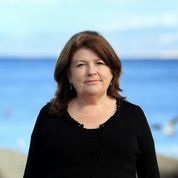 Annette Skade is from Manchester and has lived on the Beara peninsula, West Cork, Ireland for many years. She is currently in her final year of a PhD on the work of Canadian poet Anne Carson at Dublin City University. Her poetry collection Thimblerig was published following her receipt of the Cork Review Literary Manuscript prize in 2012. She has been published in various magazines in Ireland, the U.K., the U.S. and Australia and has won and been placed in several international poetry competitions.




 Chris Murray