Enmesh

I knew when I hung the black dress at Michaelmas.

My garden is alight. Light flows, a
slow transmogrification from blackish
grey to a popping green. Every little
thing is in its place, nothing is too small.
A blade of grass, dew-atop, is an amber
bead, an ornate knife blade.

The work of darknesses are done, for there
is more than one darkness in any life.
Mine has been the violence of men.
I could feel yours feathering inches from my face.
I fell into your darkness like Alice through her glass.
There's a storm-polished red apple high, high
in the neighbour's tree. Is it for me?

I thought of you, of her,
of the 'endless possibilities of love'—decided, no more!


Enmesh first published Washing Windows V, Women Revolutionise Irish Poetry 1975-2025. Editors, Nuala O' Connor and Alan Hayes.
Online URL: https://booksupstairs.ie/product/washing-windows-v/
Tag: Arlen House
-
-
Christmas Box
There is honey and chocolate on our doorstep
since Christmas—sweet box and coral flower—
one on either side. The heuchera with ruffled
cocoa-coloured leaves hunkers in the corner but
the sarcococca or sweet box is where we step
inside by design so that on nights as dark as winter
and full of storm we brush the bluff, squat, shrub
and boots and coat trail the scent of summer
into the hall. Its flowers are what are left of flowers,
petals blown away—spindly threads ghostly in the leaves,
the odd early blood-berry that follows.
Its genus confusa is right—from so frail a bloom
a scent so big, as if the bees have nested in it
and are eager for their flight.Thrushes In The Rowan Tree
The very day the rowanberries ripen, thrushes fly in,
stately and speckled, as if summoned there.
They turn the tree to illustration, an autumn square
in an illuminated script, or a sultan’s tree of singing birds.
Acrobats in motley, they swing, making lithe lines
of branches, stretching—somersaulting out to reach
the berries—each red drop held in the beak before
it falls to add to the marble bags of their bellies.And, just as quickly, by timing only they can tell,
they leave at once to their own applause
to come again and work their stripping circus act
one level at a time, methodical, exact,
until the tree is bare and they have left
another square: a silhouette of winter.Put Out The Light
i.m. Robert McCrea, 1907-1990
The entrails of a salmon flower in the sink
in the picture I have of you
teaching me to gut fish.You have lifted it from the river
at the foot of our house,
the Mourne filled with Sperrin waterand now its insides stream
like river weed running in the current—
something of the river brought home.You handle it tenderly, call it she,
a hen, and are saddened when you find the roe
that will not have a chance to spawn.Another time, the weather in the window different,
you show me how to clean out a hen bird,
a turkey, that will hang in the cold till Christmas.The lesson is serious, you say. You must take out the lights
the lungs that hide in the dark of the turkey’s vaulted belly.
Put out the light and then put out the lightOn ordinary days, you mush up Mother’s Pride
to feed the Rhode Island Reds, the smell of wet bread
filling the scullery for hens that scare my mother.Those days, you had finished with the Mill
and the blizzard of the scrutching room that gave you
Monday fever. How cruel that the weekend seemed to
mend you, only to begin again.Proust’s father gave it another name, byssinosis
from the fine linen you were dying to produce
but would never wear.At weekends, you would make a rosary of the village lanes
up High Seein, spitting into hedges with the other men,
knowing the name of every plant it landed on.The Visit Of The Wren
Annaghmakerrig, October 2011
On a dripping day that never really wakens
when the sun is weak behind the line of Gothic firs,
flaring through the clouds sometimes like the flames
from a distant winter war, my head is in Fallada’s Berlin
and there are lights needed for reading in the afternoon,
the old glass of my window becomes a focus for the birds.There are blackbirds landing in a lichened birch—
the branch giving under them to hand them
delicately to a lower ledge like a dancer
passing on a lift, then coming down to the ground
to scuffle, tail up, in the gravel and the wet leaves.Suddenly from a lamppost a spray of little passerines
flow like a wave from tree to tree—from the ash
with its ghostly white berries and the spindly birch—
wenny and mouldy with lichen. A giant Irish jay
prances on the lawn—too big and colourful to be real—
like one of Hoffman’s mechanical toys he’ll make a lesson
from.I have been a happy hermit here
and when the wren visits the windowsill, a great tit
hangs on the stone and stares in; a chaffinch,
lemon-grey and then the rosey male dip their heads
into the coppery gutters that splutter with rain.
The old house is lit from the outside in.Thrushes In The Rowan Tree and other poems are © Maureen Boyle

Image: by Malachi O’Doherty Maureen Boyle lives in Belfast. She began writing as a child in Sion Mills, County Tyrone, winning a UNESCO medal for a book of poems in 1979 at eighteen. She studied English and History in Trinity in Dublin and did postgraduate work in UEA and UU. In 2005 she was awarded the Master’s in Creative Writing at Queen’s University Belfast. She has won various awards including the Ireland Chair of Poetry Prize in 2007; the Strokestown International Poetry Prize in the same year and in 2013 she won the Fish Short Memoir Prize. She has received support from the Arts Council of Northern Ireland in the form of Individual Arts, Aces and Travel Awards. In 2008 she was commissioned to write a poem on the Crown Bar in Belfast for a BBC documentary and some of her work has been translated into German. In 2017 she was awarded the Ireland Chair of Poetry’s Inaugural Travel Bursary for work on Anne More, the wife of John Donne. In November 2018 her poem, The Nunwell Letter, was runner-up in the Coast-to-Coast Single Poet Competition for a stitched limited edition, by artist Maria Izakova-Bennett in Liverpool. In January 2019 a long poem on Strabane will be broadcast on Radio 4 in Conversations on a Bench. Her debut collection, The Work of a Winter was published by Arlen House Press, Dublin and has just come out as a second edition. She taught Creative Writing with the Open University for ten years and teaches English in St Dominic’s Grammar School in Belfast.
-
from ‘Émigrés’
3.
What is going on in your heart?
Prisoners of war live here
Throw off your gaudy vestments,
spring’s best and brightest fig
and let me see you naked
and then, more naked still —Put your heart
in my hearts cavity.
Slip it in.Bring your worry beads if needs be.
It’s not too late
to shred all documents
of denunciation..
5.Now we must
hunt by ear and
put our trustin gossiping swallows,
the hooded crows, the herring gulls,the wryneck’s potent drum.
7.
Between silences
take notice
of the imago
of your stolen self.Sold back
but at what price?10.
Collect wishbones,
place them in charnel houses,
quarter the ground
to make sure and certain
none are missing –
these things bring a plan to grief.11.
The song-birds are drowning,
the sea is now a cemetery.
The song-birds are drowning,
the sea is now a cemetery4.
Life’s comforts
are honeycombed
and treacherous,and moths
appear to drink your tears
while you are sleeping
from ‘The House That Stood For Happiness’
3.
This nest offers its mouth
to the sky. Blades of grass
imprinting against the limits,
fresh as linen. The house
that stood for happiness was lost–
but the heart beats on
for that which curves
and holds,returning its call,
its sound.4.
Where there is light,
I want this place –
between heaven and earth,
a high place for dreaming,
a marriage of moss and down
cupped just out of reach,
given form from my breast,
pressed out with my body,
a dress to fit, breathed into.I made good
these un-helpable
palpitations—I put them to work,
searching out the place that knows
the choreography of forest-love,
where the world and its hostilities
are muffled, suffocating, far away –
beyond the trees’ cordoning
I have found a place
to sing.
 Maria McManus lives in Belfast. She is the author of Available Light (Arlen House, 2018), We are Bone (2013), The Cello Suites (2009) and Reading the Dog (2006) (Lagan Press), she has collaborated extensively with others to put literature into public spaces. She is artistic director and curator of Poetry Jukebox and an active organiser and founder member of Fired! Irish Poets.
 -
Parlour
A bolthole, a room half elsewhere
adrift in distant grandeur,
where breath condenses between damask drapes
and the wing of a mahogany table.
Where an ear might catch the scratch
of a pen, a girl trawling the depths of an inkwell
pouring words, slippery as a river of fish
spilling loose of their net,
slapping their wet tails on the brocade.
What to do with such riches —
feed them to her mother’s wedding gifts,
pile them into fluted dessert dishes,
fling their blue-black panic into the belly
of the lamp ravening on the sideboard,
the soft spill of innards silvering her fingers
cracking their verbs and consonants
the way her mother cracks
the necks of chickens.
The Three Card Trick Man
After a line by Tom Duddy
The reason I come here is not the horses,
though bookie shops abound and a litter of crushed slips.
It is always sunny and work is over for the weekend
and the girl in the red dress has just stepped out –
not exactly a carnival atmosphere, more
a thoroughfare of anticipation, the mood buoyant,
a painter’s delight,
the air still holding the day’s warmth.
There he is just off a side-street,
part of a circle hunched around a makeshift table.
The scrubbed nape,
an odour of soap and aftershave.
The picture steadies, the table is swept,
and the look when he turns to her
pales the red of her dress.
Impossible to say what passes between them –
a wager of innocent measure,
the small treacheries of love and its necessities.
Here I will leave them with everything still to play for.
Prime
It is midwinter.
Your hands are chilled.
I lift you,
gather your first whimpers onto my pillow,
knowing as much by instinct as touch of skin.
We lie here amazed at the dark,
aware of the house sleeping around us,
the quiet patterns of breath.
Outside, the snow lies thick.
In this landscape of wild skies
and running tides,
and mornings lit with rapture,
I think
I must have been falling most of my life
to land here temple to temple
in this pre-dawn calm,
this kinship
of breath with breath
your hands cupped in my palms.
Early Delivery
What had us on the road
that early May morning
when the Ballisodare bread van
slalomed past
and dropped two wax-wrapped, sliced-pans
on the tarmac
warm and fragrant
as two babies
tossed from their cradle.
The van sped on
swing-doors unbolted
like a run-away train
or a liberated pony
lifting its tail.
Prime and other poems are © Peggie Gallagher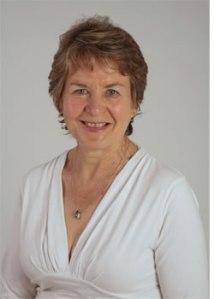 Peggie Gallagher’s collection, Tilth was published by Arlen House in 2013. Her work has been published in numerous journals including Poetry Ireland, Force 10, THE SHOp, Cyphers, Southword, Atlanta Review, and Envoi. In 2011 she was shortlisted for the Gregory O’Donoghue International Poetry Competition. In 2012 she won the Listowel Writers’ Week Poetry Collection. In 2018 she is the only Irish poet on the Strokestown International poetry competition shortlist. Peggie Gallagher’s work was facilitated by Paul O’Connor.
Author image: Southword / Arlen House
-
Photograph of Her Brother’s Skull
They give you to me,
a numbered skull from a high shelf
and in my hand you are
a strange brute thing – a thing I hardly see
-my brother.
The clean smooth bone of you
– the whole of you no longer with me.
In this room of discovered skulls,
I have lost my memories
And the photographer fixes your dead stare
for his lens.
In this room of skulls,
Your face is lost,
my brother,
and I grips hard to what is left.
After Sunday Mass in Malawi
After Sunday Mass they whispered:
‘he was a poet, perhaps.
A dissident, yes.’
He ignored the spies in his classroom.’
Then someone else also remembered:
‘Of course, this is not our country.
We are Whites, you see
I Saw Beckett the Other Day
I saw Beckett the other day
in the doorway of that café
where you took his photograph.
You know the one…
when he looked up at the lens
and realised how he could
haunt us all.
‘Hey Beckett,’ I said
Rejoicing in my discovery of him;
his hand on the door, his eyes
skimming over the interior image
of cigarette smoke and coffee.
I stood beside him. He rubbed his face so
he might recognise me. I smiled and
said even I didn’t know what was
happening these days.
Even I could not stop the end.
He nodded, coughed and looked sly; his teeth were
yellow over the pink rim of his lips.
He mentioned the photograph. He said his face
had collected worms under the skin as if ready for
death and he smiled to show them dance
spasmatic with age-spots and veins.
Someone entered the café. Someone left.
Beckett touched the hair above my ear.
I stood on tip-toe so he could whisper down.
He said nothing. It was just a kiss
with the cold wind at our feet and the
smoke and egg friendly air
released in draughts between
the opening and closing of the café door;
Which he stepped through to find his table
and entered some other world,
under greasy lights
coupled with table shine and coffee cups,
and thoughts of death, where she stood
groomed for an entrance, were held back by
the odd moments of life
that still strung the useful breaths
Beckett used to blow his coffee cool.
‘I Saw Beckett The Other Day’ and other poems are © Órfhlaith Foyle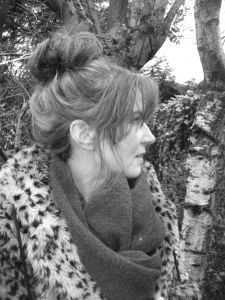 Órfhlaith Foyle’s first novel Belios was published by The Lilliput Press. Her first full poetry collection Red Riding Hood’s Dilemma (Arlen House) was short-listed for the Rupert and Eithne Strong Award in 2011. Arlen House published Foyle’s debut short fiction, Somewhere in Minnesota, in 2011; its title story first appeared in Faber and Faber’s New Irish Short Stories (2011), edited by Joseph O’Connor. Foyle’s second short fiction collection Clemency Browne Dreams of Gin (Arlen House 2014) was chosen as one the Irish Times books of the year. Her work has been published in The Dublin Review, The Wales Arts Review, The Manchester Review, and The Stinging Fly.
Órfhlaith Foyle was born in Africa to Irish parents and now lives in Galway, Ireland.
-
The death of Eavan Boland (1944-2020) occurred on 27/04/2020 in Dublin, Ireland. Condolences to her family, friends, and colleagues. You can read a collation of tributes and obituaries to Eavan at this link.
EAVAN BOLAND
INSIDE HISTORY(Arlen House, 2016)
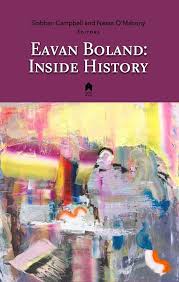
Eavan Boland: Inside History, a new volume of essays and poems in response to the work of the internationally-renowned Irish poet, will be published by Arlen House on 1 December 2016. Edited by poets Siobhan Campbell and Nessa O’Mahony, Eavan Boland: Inside History is a reappraisal of Boland’s influence as a poet and critic in the 21st century and is the first major commissioned collection of essays to be published on Boland.
The volume includes critical essays on, and creative responses to, her work by leading writers, thinkers and scholars in Ireland, the UK, Europe and the US and reappraises Boland’s influence as a poet and critic for the 21st century. The fresh and diverse approaches provide a new frame for a critical engagement that crosses continental and aesthetic boundaries. The book, therefore, repositions Boland scholarship with a focus on the most important aspect: the poems themselves.
Contributions include a foreword by Mary Robinson, former President of Ireland, as well as essays by Jody Allen Randolph, Patricia Boyle Haberstroh, Siobhan Campbell, Lucy Collins, Gerald Dawe, Péter Dolmányos, Thomas McCarthy, Nigel McLoughlin, Christine Murray, Nessa O’Mahony, Gerard Smyth, Colm Tóibín and Eamonn Wall. There are also poems from Dermot Bolger, Moya Cannon, Katie Donovan, Thomas Kinsella, Michael Longley, Paula Meehan, John Montague, Sinead Morrissey, Paul Muldoon, Eileán Ní Chuilleanáin, Nuala Ní Dhomhnaill, Jean O’Brien and Nessa O’Mahony. The volume concludes with A Poet’s Dublin, a reissuing of the conversation that took place between Eavan Boland and Paula Meehan on the occasion of her 70th birthday in 2014.
“Eavan Boland worked as an editor with Arlen House in the 1970s and 1980s and did extraordinary work in developing new Irish writing and broadening the boundaries of Irish literature. We are pleased to publish this collection on her work,” said publisher Alan Hayes.
“As editors, we’ve been delighted to be part of the conversation that this volume has begun,” said Siobhan Campbell. “It’s been a privilege and an honour to work on this collection particularly as both Nessa and I feel poetically in Eavan Boland’s debt, as do so many of our contemporaries.”
978–1–85132–140–7, 368 pages, paperback, €25
978–1–85132–150–6, limited edition numbered and signed hardback, €55ARLEN HOUSE LTD, 42 Grange Abbey Road, Baldoyle, Dublin 13.
Phone: 086 8360236: Email: arlenhouse@gmail.com- US & International Distribution: Syracuse University Press www.syracuseuniversitypress.syr.edu
- The Book Depository: http://www.bookdepository.com/Eavan-Boland-Inside-History-Siobhan-Campbell/9781851321407?ref=grid-view
-
From Parvit of Agelast
'Your face is ridiculous: O. . . . . leeeeee ugly 🙂❤ / thanks,
sure i know !’ :L’ – Ciara Pugsley, ask.fm

net
whn th little lite shinin frm abve doesnt
n younguns mad fr luv r spected 2 b home
thumbs go drum on magic pads n open windows
so they travel in thr dreambots huntin souls
they go weft upon th crystal warp unshuttled
hookin up witout a plan 2 build a planet
trances risin tru th base n snare of ask n tell
wot u c is wot u feel n wot u feels rite
tho snot a total giggle when th trolls r out
—no1 knows th cause like with any freakin demic—
bitch please u aint jesus wots wit all the posin
howd u like my cock up ur ass, u cross-eyed ho

som1 feelin tiny in the sprawlin fabric
hauls back in2 her drum for a re-birth much 2 brite
bodys blinded so her double takes it weepin
2 th woods
		to be an hero
				wit a reel
						hank
							o rope


(Verse Fantasy, published by Arlen House in 2016.
The poems are aspects of the ‘real’ world.)
‘…the body of Wafa became shrapnel that eliminated despair and aroused hope.’ – Adel Sadew
The Key to Paradise
You will be snatched back from the place of no landmark,
where you wander, scapegoat, under the frozen hot eye,
blister-backed, hairy, and crunching backward to beast.You will regain the unrivalled kingdom of your source,
your beauty will be unsurpassed, and you will sit
on the right knee of a virtuous king, all-powerful but
for his abject love of you. There will be bright-plumed birds
and four undying springs of milk, honey, oil and wine.Your lover will adore you under the great tree, and there
will never be a touch without the perfect ecstatic end
that leaves you weak and wed to the grass you collapse on.
There will be no argument and never pain. Balm will drip
from every leaf in this catchment of considerate sun.Best of all, you will be thought wise, not inessential.
So gird your waist with red rockets and blow your littler self
to the garden of infinite fecundity. Do it. In one starry bang.
Sleep is the only escape I have. When I don’t dare think, I dare to dream.’ – Jaycee Dugard
Pine
Each autumn, in Lake Tahoe, El Dorado county, CA,
the kokanee salmon turn from silver-blue to vermilion.
After spawning they die and their carcasses are meat for mink,that some unabused women sport as symbols of perhaps love.
The kokanee is not a native, arrived in 1944, so a mere child
compared to the happy-birthday lake two million years old.Jaycee’s eleven were a tiny tint to that time spread,
and the moment when her fingertips touched the pine cone—
print to Fibonacci imprint, whorl to spiral—a netsuke eye.That darkened in the backyard in the small shed where sleep
was the best activity and a gnarled man made her pine and desire
the woody grenade that was the last thing she had touched before.A pine can last a thousand years, an eye much less; Jaycee eighteen
in the pulp of a small brain, twisted in and round, not knowing
what would sprout when a forest fire melted the resin
and out fell, in hazardous liberation, winged seeds.From: Imbolg
(Unpublished Collection)
Your Grace
You are alone in what they would call a new life. What they don’t know is
that for you nothing is old. A morning is always a question, as if you were
a web living each day in a different cell of itself, seeking.Seeking maybe nothing, but in that mode, hiatus behind and before. It has
seemed true to take a sable cloth to the slate of fact and not only wipe
but cover, occlusion of the frame removing the form entirely.Entirely it might seem, but like minerals that leave a trace in water, small
events make change. Tonight you have remembered a Columbian dress you bought
on impulse at a Fairtrade sale, undyed, handwoven.Woven into your consciousness now like most of your clothes, but you wore this
slinky to a wedding and people remarked. For the first time you thought your
body taut and that of the normal, not a flop. You flaunted.Flaunting was your wont in a sub-chador sort of way. Exclusivity was the bait,
the prospect of private vice. But you see in the mirror tonight a shape that
could turn heads. There’s a Grecian curve at the base of your back.Back to where you sat huddled in a lone hut by a struggling fire, watching the small
yellow flame fight the red. You had crammed a bush into each windy gap of the hedge.
Beyond, how could you know several had gathered to your grace.Grace was a false thing, you said, being rustic. But many thought you walked like
a careless queen. They took the switch in your hand for a sceptre, wielded fiercely
against the meek, shaken at the indifferent.Indifferently endowed, you thought you were, and hardly cared, except for the
faint sense of an untried trail. It occurs to your image now that you could have
kept your own counsel, sat straight-backed and been petal-showered.Showering in what was given, you might have made some plans, not waited for
a suitor to tear at the bushes and tell you your mind.climacteric in the extreme
the room darkens. foetal faces draw
	spotlights from the dense matrix. she kneels.
not a whimper but centrifugal quake and strain.
	ovular potentials huddle in lines for stringing
	crowded and frozen onto a tight choke.
she hugs her shoulders, surrogate, unconsoled,
	and a creature leaps out, trailing chains,
	snarls and spits, goes surfing the tidal walls.
he will not come again to her bucking bounty,
	her bawdy talk, her raucous primitive yells;
	she will not be the bright-haired goddess of the barstool,
	fabled and revered in ten parched villages.
hail of the ripped legend falls in blades,
a thing of flesh flames in the mouth of the monster
and she recalls a hard prophesy told in the spring grass.
	lincolns rev on the melting brick
	informants crouch in a lonely copse and beg for mercy
	in the torture room the air sparks and yellows
	black seeps into old pictures
	and the girl with the lank dead hair creeps blindly from
the screen.
she probes her body and finds a silent blowhole.
	her fingers return a thousand red messages
	that pool and brindle in the cradle of her palms.
if she screams she doesn’t know, but colours
	curry the weather pumpkin, desert and vulva,
	lunatic yellow, bum-in-the-gutter green.
she crashes, glass and glint flinging themselves too,
	watches her eyes picked to the veined bone.
	girl, crook and goblet smithered on the lizard-
	dark floor.
history
(from ‘the second of april’) I walk. Where is home except in repeated kisses of foot and ground. I am having affairs. With, for one, the bonded pavement, complicit as a slice of river. I glide on ice, step lightly on the unreflecting glass panel of a foyer floor. Nakedness is rare. I don’t tell how I used to take off my shoes and mesh my toes with sand. But even that was a skim. I slyly stepped on a rock and, recalcitrant, took off. I pause at running water and watch its inscrutable fingers take sun to rock in a work of art, then abandon it, dissatisfied. Among a tree I become a stretch of soil and burnt grass and harden. There are always tears. They seem to come from outside and wash me down until, like ivy, I am again rambling. On a tarred path my jaw is jolted by hard, inexplicable haste. My ankles wound each other. I bleed and wonder if I should spancel myself to slow. There are creatures who only pace the one field. Even a hobbled route finds knowledge. I look at my feet and don’t know them. Too long with my eyes on a misted goal has cost me my body. Happenings are always outside. Strange, when I see no walls. Where is the place of occurrence? I thought life was movement. Coming to gravel I have less ground and that brings thoughts of release. Water is too deep and I fear high places. To walk is the freest I can do and I wipe my tracks. What will pass is the breeze of a small body, non-native, a light touch on a puzzled cheek.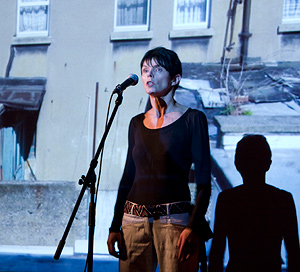 Máighréad Medbh was born in County Limerick. She has six published poetry collections, and a prose work, Savage Solitude: Reflections of a Reluctant Loner, was published by Dedalus Press in 2013. Since her first collection, The Making of a Pagan, in 1990, she has become widely known as a performance poet. She likes to explore themes, which led her to write a sequence on the famine, Tenant, published by Salmon Press, and a sequence inspired by astrology, Twelve Beds for the Dreamer, published by Arlen House. Her work has appeared in many journals and anthologies, and has been translated into German and Galician. She has performed widely, in Europe and America as well as Ireland, and on the broadcast media. Máighréad has written three novels and a fantasy sequence for children. The novels are online as ebooks. She has also written for radio, and publishes a monthly blog/essay on her website. A verse fantasy, Parvit of Agelast, is to be published by Arlen House in 2016.
 -
Warning Shots
When you live on the edge
of an ocean, you cannot pretend
you did not see it coming.
The leaves are still, birds
chatter, the sea is a sheet
of steel. But out west
where last night the sun
left a sky illumined
like stained glass
dirt heaps up,
someone else’s dustpan
emptied on your doorstep
and a magpie
rattling gunfire
at first light.
First published in Cyphers and subsequently in Of Birds and Bones
Flotilla
‘Heaven Scent’ Magnolia
They tack in, full rig, under cover of darkness,
dock before dawn in cement-paved ports
at wharves of picket fence. The voyage
has been long through winter’s bald estates,
gusting grit and dust have shred their sails
to votive rags, bound now to every leafless branch.
Waxen petals blood-tinged white
glow like manna at first light.
First published in Abridged and subsequently in Of Birds and Bones
Left Luggage
This morning I woke with seawater
in my mouth. My eyes felt rinsed,
like after crying, my veins were
scoured, my limbs wrung out.
I was beached on a fogbound bed.
Adrift. Missing the aquatics.
Nothing is lost, just out of reach.
Everything that ever was, is –
somewhere – if only we can
get there, find the key, remember
the encrypted PIN, be brave enough
to jump. Know how to swim.
If only our feet have not been bound
at birth, our wings trimmed back
like wicks to suit our mothers, or
cobbled to a gooey mess by fathers,
confusing the discrete powers of
son and sun, deluded and controlling.
As long as no-one changed the locks
along the way and didn’t tell us, or
dropped the keys or, worse still, built
a breeze block wall – a suicide bunker –
performing hara-kiri on our dreams. Left
bag and baggage rotting on the floor.
This morning I was reminded
by a taste of salt that we do not waste
those supine hours spent sprawled
unconscious in an oarless bed;
that we are all at sea, our time well spent
diving, back and back, to unpick locks, find home.
First published in The Stinging Fly and subsequently in World Without Maps
Le Jardinier Vallier
after Cézanne
There is an ease slips through the body
after work well done. The heart
minds its own business, leaves alone
the slack repose of limb and bone.
On summer days we’d find him there,
still as a lizard by the orchard wall,
hat over his eyes, his hands asleep
on his thighs. The chair
was never moved. C’est la chaise
de Monsieur Vallier, we were told.
As if this explained everything—
the silence of his deer-like tread,
his loping gait. The way he came
and went unseen. How the garden
sang with light and shade.
First published in Small Lives (Poddle Publications) and subsequently in Of Birds and Bones
The Suitcase of Bees
She brought it with her everywhere,
its silver, dimpled surface effervescent
with the whirr of wings within. In public
she would spread her skirt’s thick folds
to mute the angry drone, paint a smile
across her face, hope no-one would notice.
Once inside her own four walls
the vibrations grew so shrill
she held her head and hummed.
The ambulance crew was gentle
as they led her owl-eyed through the gates,
bees still rustling taffeta in her head.
The case was silent, a ruse
in sly collusion with the doctor
who swore she was an expert,
knew all there was to know
of stings and swarms, their stridency,
how to outface the queen.
They built a wooden beehive,
surrounded it with lemon balm, sweet basil, mint.
And now, except for mild tinnitus, she is calm.
A version first published in The Interpreter’s House; subsequently in World Without Maps
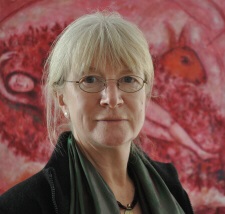 Dublin-born Geraldine Mitchell lives on the Co. Mayo coast, overlooking Clare Island. She won the Patrick Kavanagh Award in 2008 and has since published two collections of poems, World Without Maps (Arlen House, 2011) and Of Birds and Bones (Arlen House, 2014). She is also the author of two novels for young people and the biography of Muriel Gahan, Deeds Not Words.
 -
EMBODIMENT
1.Maternal
I lie on the bed in darkness,
wary of sudden toddler jerks
(your innocent, erratic strength).
Instead, you lay your head upon my cheek
and in that momentary tenderness,
a universe of visceral wisdom.
I am held by this intuition:
love
free of all condition.
2.Marital
We grasp each other.
Words surrender
to spoor of pore.
You kiss my collarbone.
Sacred contours
underscore
quibbles and stresses.
Our limbs recall
a geography
of catharsis;
the lee of my back,
the lie of your land.
Embodiment is © Emily Cullen
GALWAY MOULD
We take the damp for granted here.
Blinds draw back to reveal
colonies of galaxies:
tiny black holes
in our new collective space.
‘It’s only condensation,’
Next Door concedes,
‘the weather’s too wintry
to open the windows.’
My wooden bangle by the sill
slips into a mildewed coat of green.
For fun, I bought you mouldy cheese.
Last night, it took revenge on me,
inducing a vivid dream
of a white chandelier of mould
that slowly lowered
through our kitchen ceiling:
a lichen lantern,
till its lattices became milky spores,
mouths that started to open and close.
Then I awoke, vowing to spray
our wall of condensation,
diffuse for good my fascination
with Galway mould.
Galway Mould is © Emily Cullen
INCENSE
Wisps of opium:
boa constrictors
curl into curtains
of late afternoon.
Milky ribbons tantalise
like the soft, deliberate motion
of the belly dancer you admired
in Turkish solitude.
I remember you burning sandalwood
in Illinois to set the mood.
Now smoky arabesques
tease then evanesce
while broken trails of ash,
like fossilized worms announce
seduction as but a crumbling dream:
brittle, grey, ephemeral.
Incense is © Emily CullenIncense’ was published in No Vague Utopia (Ainnir Publishing, 2003) ‘Galway Mould’, ‘Embodiment’ and ‘Playing House’ were published in Emily Cullen’s second collection, In Between Angels and Animals (Arlen House, 2013).

Dr. Emily Cullen is an Irish writer, scholar, harpist and arts manager. Her first poetry collection, entitled No Vague Utopia was published by Ainnir in 2003. In 2004 she was the national Programme Director of the Patrick Kavanagh Centenary celebrations and was selected for the Poetry Ireland Introductions series. Emily was awarded an IRCHSS Government of Ireland fellowship for her doctoral study on the Irish harp. She is a qualified teacher of the harp who has performed throughout Europe, Australia and the United States. A former member of the Belfast Harp Orchestra, she has recorded on a number of albums and also as a solo artist. In addition to writing poetry, short stories and feature articles, she publishes widely on aspects of Irish cultural history and music.
Out now! Emily Cullen In Between Angels and Animals (Arlen House, 2013)ISBN: 9781851320790 Paperback 96 pp 12 EUROAvailable from Kennys Bookshop, The Book Depository and many good book stores.More Information:The Book Depository: http://www.bookdepository.co.uk/Between-Angels-Animals-Emily-Cullen/9781851320790 -
 Nuala Ní Chonchúir
is a writer and poet, who has contributed poems and translations to the blog over sometime. I am linking here to her poetry collections page
La Pucelle
In the hush of my father’s house,
before dusk rustles over the horizon,
I take off the dress my mother made
-it’s as ruby red as St Michael’s cloak-
and with a stitch of linen, bind my breasts.
By the greasy light of a candle,
I shear my hair to the style of a boy,
in the looking glass I see my girlhood
swallowed up in a tunic and pants,
I lace them tightly to safeguard myself.
My soldiers call me ‘Pucelle’, maiden,
they cleave the suit of armour to my body,
and know when following my banner
over ramparts into Orléans, that
there will only ever be one like me.
When the pyre flames fly up my legs,
I do not think of the Dauphin,
or my trial as a heretical pretender,
but see my mother, head bent low,
sewing a red dress for her daughter to wear.
As Tatú, le Nuala Ní Chonchuir, Arlen House, 2007.http://poethead.wordpress.com/2009/06/13/la-pucelle-by-ni-chonchuir/
 Eithne Strong
“(née Eithne O’Connell) (1923-1999), poet and writer of fiction. Born in Glensharrold, Co. Limerick, she was educated at TCD. She worked in the Civil Service, 1942-3. Her first collection, Songs of Living (1961), was followed by Sarah in Passing (1974), Flesh-the Greatest Sin (1980), Cirt Oibre (1980), Fuil agus Fallaí (1983), My Darling Neighbour (1985), Aoife Faoi Ghlas (1990), An Sagart Pinc (1990), Spatial Nosing (1993) and Nobel (1999). The Love Riddle (1993) was a novel.”
from http://www.answers.com/topic/eithne-strong#ixzz1xr4mc0lx
Strip-Tease.
A poet
must talk in riddles
if he will not risk himself
for fear
of public eye and tongue
blaspheming privacies :
a host
of leeches sucking parallels
carnivores to strip his shivering secrecies
wrapped
intricately. he should be
silent or speak out.
No one
asked for
his arbitrary offerings.
from Sarah in Passing , by Eithne Strong. Dolmen Books 1974.http://poethead.wordpress.com/2011/03/19/strip-tease-by-eithne-strong/
 Sarah Clancy
Phrase Books Never Equip you for the Answers
On the morning of the fifteenth time we went through
our sleep-with-your-ex routine, I had the usual optimism
thing about mistakes is to not keep repeating the same ones
I said disregarding the government health warning
on the cigarettes I was sucking, crossing the road without
stopping speaking or looking, ignoring the red man pulsing
on the lights at the junction, I was wired direct and I said;
I know, I’ll write you the definitive user manual for me.
You said I was arrogant that we should make it up as we go,
and I said; well could I do a mind map then? With
here be dragons marked clearly in red, so we won’t flounder
like last time end up washed up dehydrated and drained
well I was, fairly wired, I said ‘in each shipwreck we’re lessened
embittered, come on, let me at least try to fix it, I can write us
a blueprint for the new improved version, and you laughed
and said well damn you for a head-wreck, go on then and do it.
So I wrote, but it came out all stilted, like a work in translation
see when I say, let me fix that or give it here and I’ll do it
it means I need you, and if I tell you for example how
I’ll re-arrange the universe to your liking it doesn’t mean
I’m superior in fact, translated it’s about the same as the last one-
‘can you not see, how I need you? And when I come out with all those
‘you-shoulds’ that drive you demented, there’s no disrespect in ‘em
verbatim they’re whispering I’d be desolated without you
and when you call me control freak, the tendencies you’re describing
are inherently rooted in my fear of you leaving and how I’ll react.
Less-wired more hopeful I brought you my phrase book
on our very next meeting but you kissed my cheek and said
let me stop you a minute and then those awful words that never
signify good outcomes, listen I’ve been thinking… I know
we’ve got this weird cyclical attraction thing going and I’m sorry
for my part in it but really I can’t see it working, the problem
for me is how you just don’t need anything and my phrase book
had nothing listed under that heading.© Sarah Clancy
Thanks to Sarah Clancy for the poem, Phrase Books Never Equip you for the Answers , which is taken from Thanks for Nothing Hippies . Published Salmon Poetry 2012.
 Kate Dempsey
Kate Dempsey’s poetry is widely published in Ireland and the UK including Poetry Ireland Review,The Shop, Orbis and Magma. Kate blogs at Writing.ie and Emerging Writer .
You can catch her on Twitter at PoetryDivas.
It’s What You Put Into It
For Grace
On the last day of term
you brought home a present,
placed it under the tree,
a light, chest-shaped mystery
wrapped in potato stamped paper
intricate with angels and stars.
Christmas morning
you watched as we opened it,
cautious not to tear the covering.
Inside, a margarine tub, empty.
Do you like it? eyes huge.
It’s beautiful.
What is it, sweetheart?
A box full of love, you said.
You should know, O my darling girl,
it’s on the dresser still
and from time to time, we open it.”
© Kate Dempsey, all rights reserved.
 Celia De Fréine
Celia de Fréine is a poet, playwright and screenwriter who writes in Irish and English, her site is at http://celiadefreine.com/
An Bhean Chaointe
Taim ag caoineadh anois chomh fada
agus is chumhin liom
ce gur dócha go raibh me óg trath-
seans fiú amháin gp mbinn ag súgradh.
Ni cuimhin liom an t-am sin
ná an ghruaim a chinn an ghairm seo dom.
Ni cuimhin liom ach oiread
éinne den dream
atá caointe agam-
ní dhearna mé taighde ar a saol
ná nior léigh mé cur síos orthu
i gcolún na marbh.
Ach is maith is eol dom
gach uair a sheas mé
taobh le huaigh bhealschoilte,
gur chomóir me gach saol
go huile is go hiomlán,
gur laoidh mé éachtaí
na nua-mharbh
is gur eachtaigh mé
lorg a sinsear.
Tigím anois
go bhfuil na caointe seo
tar éis dul in bhfedhim orm.
Dá mbeadh jab eile agam
ba bhreá liom bheith im scealaí-
sui le hais na tine is scéalta a insint.
D’éistfeá liom- tharraingeodh
d’Eddifon asam iad
á n-alpadh sa treo is go slanofaí mé.
Faoi Chabáistí is Ríonacha, Published by Clo Iar-Chonnachta, indreabhán, 2001.


 Chris Murray