Strip-Tease
|
Tag: Arts
-
-
Purdah I
by Imtiaz Dharker.
One day they said
she was old enough to learn some shame.
She found it came quite naturally.Purdah is a kind of safety.
The body finds a place to hide.
The cloth fans out against the skin
much like the earth that falls
on coffins after they put dead men in.People she has known
stand up, sit down as they have always done.
But they make different angles
in the light, their eyes aslant,
a little sly.She half-remembers things
from someone else’s life,
perhaps from yours , or mine –
carefully carrying what we do not own:
between the thighs, a sense of sin.We sit still , letting the cloth grow
a little closer to our skin.
A light filters inward
through our bodies’ walls.
Voices speak inside us,
echoeing in the spaces we have just left.She stands outside herself,
sometimes in all four corners of a room.
Wherever she goes , she is always
inching past herself,
as if she were a clod of earth,
and the roots as well,
scratching for a hold
between the first and second rib.Passing constantly out of her own hands
into the corner of someone else’s eyes…
while doors keep opening
inward and again
inward.Imtiaz Dharker “grew up a Muslim Calvinist in a Lahori household in Glasgow and eloped with a Hindi to live in Bombay”. This poem is taken from The Bloodaxe Book of Contemporary Indian Poetry (Ed, Jeet Thayil.) I will be linking the review of this book onto the about Poethead page, when it is published.
The image is from The Torture of Women, images by Nancy Spero and is linked at the bottom of this post.The most interesting thing about the Thayil edition is that women writers are collected and represented in that book. Those women poets’ voices are quite clear and lovely , rather than providing a simple passive objectification for someone else to write.
- Siglio Press edition of Nancy Spero’s ‘Torture of Women’ , reviewed by Guernica Magazine
- Guernica Magazine Homepage
- Women writers on Poethead 2010

Nancy Spero ‘The Torture of Women’ ( image Siglio Press) -
‘This week’s Budget, of course, represents the Coalition Government’s thinking on the role of the arts. Both Fine Gael and Labour, who are likely to form the next government, are due to issue cultural policy documents in coming weeks. The fact that they are putting the arts on their pre-election agenda indicates that both parties have taken note of the case that has been made for the relevance of the arts in any recovery programme – both economically and in the re-establishment of national identity.’
By Gerry Smith (Irish Times 10/12/2010)This is the ultimate paragraph of The Irish Times article Do arts cuts hit the right note? I am adding it in here , along with a link to my post on Fianna Fáil Arts policy, Scribbling in the Margins. It’s my opinion that something other than attrition is what is required in terms of cultural support, including a review of the 2003 Arts Act, which has brought the work of Government too close to what should be a naturally evolving area of concern. I am looking forward to seeing oppositional party papers on the issues of arts, conservation and heritage over the coming weeks, and I will of course link them in these pages.
‘in only a few years Culture Ireland has become something of cornerstone of arts policy and it would appear that into the future, the potential for a company or artist to represent Ireland abroad could become a consideration in how well they are funded.
If such a criterion were to be cast in stone, the danger is the formation of an elite with advantaged access to State support and a loss of the risk-taking that is needed in the case of those who are only beginning their careers.’
The Full Irish Times article link is attached, along with my critique of Fianna Fáil’s policy in this area since the 2003 Arts Act.
- Do Arts Cuts hit the right note ? , Irish Times 10/12/2010
- Scribbling in the Margins , Fianna Fáil’s arts policy
- Ionad scribhneoirí Chaitlín Maude , The Western Writer’s appeal

Campaign for Arts -
The title of this small post and book recommendation is somewhat misleading, the post is not wholly about Patrick Kavanagh‘s poetry. I have been reading No Earthly Estate in conjunction with poetry by Padraic Colum and Eithne Strong during this week. Having today published a poem by Eithne Strong, and indeed there a few of the Poet’s Circuits (Padraic Colum) on Poethead, I decided to link these posts at the end of this short piece about earthly estates, land, and language .
Given the appalling situation that Irish Arts are in due to a combination of short-termism and the inclusion of a blasphemy amendment into our legislation this year (2010) , I thought to add in the sometimes robust words of artists whose relation to words, landscape and the soil have accompanied me this week in awful weather. I will draw attention to the new links and imprints on the Poethead front page, which are a celebration of the small independent presses, their poets and their bloggers. These writers and presses have an honesty and expression that just about anchors one in the storm of drivel that forms the political approach to Irish Arts, that seems wholly dedicated to the destruction of the root of arts in Ireland. Regular readers of the blog are aware of the problems, which include the Arts Act 2003 , the savage planning system, which is not balanced with legislation dedicated to conservation, the blasphemy amendment, and the insidious cuts to independent Writer’s Centres, who work very hard to nurture literature and avant-garde web usage.
The wordsmiths mentioned above , Kavanagh, Strong and Colum are but a tiny example of the triumph of art and literature against what amounts to a repressive and regressive approach to the arts. They are not contemporary poets but provide for the new writer the amazing root-system which forms Irish Literature in all its wonderousness. Would only that those who claim to lead us politically were aware of their cultural heritage , story-telling, and indeed the violence of words that make up this rich history of multifaceted voice and poetry !

The Devil
by Patrick Kavanagh.
I met the devil too,
and the adjectives by which I would describe him are these:
Solemn,
Boring,
Conservative.
He was a man the world would appoint to a Board,
He would be on the list of invitees for a bishop’s garden-party,
He would look like an artist.
He was the fellow who wrote in newspapers about music,
Got into a rage when someone laughed;
He was serious about unserious things;
You had to be careful about his inferiority complex
For he was conscious of being uncreative.from , No earthly Estate, God and Patrick Kavanagh . (Ed, Tom Stack . Columba Press , 2004).
Epic
by Patrick Kavanagh .
I have lived in important places, times
When great events were decided : who owned
That half-rood of rock , a no-man’s land
Surrounded by our pitchfork-armed claims.
I heard the Duffy’s shouting ‘Damn your soul’
And old McCabe stripped to the waist, seen
Step the plot defying blue cast-steel –
‘Here is the march along these iron stones’
That was the year of the Munich bother. Which
Was more important ? I inclined
To lose my faith in Ballyrush and Gortin
Till Homer’s ghost came whispering to my mind
He said : ‘I made the Iliad from such
A local row. Gods make their own importance.Bibliography for ‘No Earthly estate : Patrick Kavanagh , Padraic Colum and Eithne Strong
- ‘ Forever Eve’ by Eithne Strong
- Dedication by Padraic Colum
- The Old King, Ireland’s Blasphemy Amendment January 2010
- No Earthly Estate , God and Patrick Kavanagh . Ed Tom Stack, Publ. Columba Press, 2004
- The Poet’s Circuits , Collected Poems of Ireland. Padraic Colum (Centenary edition,Prefaced by Benedict Kiely, Dolmen Press)
-
My Angel of a Secretary
by Eilis Ní Dhuibhne, From Mark my Words.
I was sitting at my desk
Outside the boss’s office
Replying to emails
From candidates for places
On the courses we offer;
The effective saint;
Managing eternity efficiently Level Two;
Create the world workshops (NB Seven Day Course).
Then what happens?
This black yoke comes in
With a thousand questions
In its beady eye.
It has wings like me
But otherwise
We’ve nothing, nothing
In common. Have we ?
I gave him the standard line.
I regret that on this occasion we have
No vacancies for crows or artists.
We wish you every success
In your future career.The creature stayed however.
I did not call security
(Because I am security!
I do everything around here)
And so the loser stayed.Forever.
Mark My Words with illustrations by Alice Maher was published in conjunction with The Night Garden exhibition by Alice Maher and lives in a little black folder with pieces by Maher entitled The Bestiary. -
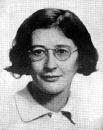
Simone Weil Le Personne et La sacré Whilst awaiting this morning for a sheaf of three poems from my Saturday Woman Writer, I thought to add in an excerpt from the Notebooks of Simone Weil, whose Necessity is the most sought after poem on the Poethead blog. I will include at the end of the excerpt a link to Necessity in stand alone format (without comment). Here follows an excerpt from Le Personne Et Le Sacré :
“Beauty is the supreme mystery in this world. It is a brilliance that attracts attention but gives it no motive to stay. Beauty is always promising and never gives anything; it creates a hunger but has in it no food for the part of the soul that tries here below to be satisfied; it has food only for the part of the soul that contemplates. It creates desire, and it makes it clearly felt that there is nothing in it [beauty] to be desired, because one insists above all that nothing about it change. If one does not seek out measures by which to escape from the delicious torment inflicted by it, desire is little by little transformed into love and a seed of the faculty of disinterested and pure attention is created.“
I have used this paragraph before as a static text in this blog, because it epitomizes Weil’s writing. It was the centenary of her birth in 2009 and some of those notebooks made their way into general publication. Weil is placed with Paschal in terms of her philosophical and writing output, but it incredibly difficult to locate texts in ordinary bookshops in Ireland. I have quoted from Thinking Poetically, ed Joan Dargan.
I suppose that it is an approach to art that encapsulates the purity of the relationship between the individual and the transcendent work that I find attractive, living in a country (as one does) where people must fight to bring to Government the necessity and importance of the arts: in their funding, archiving, presentation and their preservation. There is always hope that the necessity of the arts in developing the intellect will be recognised and supported in Ireland.
-
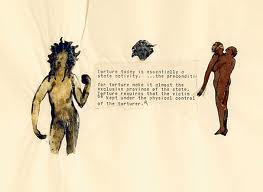
Still from Torture of Women by Nancy Spero . .
Torture of Women , Nancy Spero. Publ 2010, Siglio Press.
The latest edition of Guernica Magazine includes a review of the Spring 2010 publication of Torture of Women by Nancy Spero. I am linking this review at the bottom of this small piece, along with a link to the publication notes.
There is a Nancy Spero image on the site already, accompanying another piece. It is from the 1976 series of Torture of Women , based on the 125 ft piece by Spero. This Spring 2010 , Siglio Press published the work in book form in a 126 page cloth bound edition which is reviewed at link by Guernica Magazine.
“With an essay “Fourteen Meditations of Torture of Women by Nancy Spero” by Diana Nemiroff; “Symmetries,” a story by Luisa Valenzuela; and an excerpt from The Body in Pain: The Making and Unmaking of the World by Elaine Scarry. ”
(from the Siglio Site)
The Guernica Magazine slide show opens with references to Pinochet, a byword in torture and repression . It interests me greatly as a writer that the names of the disappeared get lost in our histories whilst the name of the Torturer gains a notoriety and cachet which seems to point to a great attraction to fear. I wrote an obituary for a great woman writer who spent her life investigating and resisting Pinochet and was nominated for a Nobel prize. She collected testimony and wrote works of fiction and non-fiction based in the Pinochet era, her name, Patricia Verdugo is mostly ignored in Western Media ! We recognise and rationalise the work of torturers thus giving them a validation that they ill-deserve. Thatcher notoriously invited him to tea in England.
Women artists and writers like Frida Kahlo, Anna Politkovskaya, Patricia Verdugo and Mirjam Tuominen have grappled with the themes of torture and have attempted to redress the balance. This volume of Spero’s artwork will continue with that work of engagement at visual artistic levels. There seems to be little in artistic analysis and dialogue in this most pressing of feminist engagements.
-

John Hurst s Interesting books (with suit of armour). EDIT : 13/12/2010 : John Hurst died last night . Rest in Peace.
As always a visit to John Hurst’s Interesting books shop is a delight, a real treasure-trove, indeed, I have spoken of the shop before now. I thought to add a picture of the frontage (with the suit of armour) and though it cannot be seen in the pic, a foot acts as a door-stop!John has a good range of rare and interesting books that is not tailored to the tourist but to the local population, the writer and miscellaneous visitors, which is refreshing. Lots of contemporary bookshops require desperate rooting time to uncover a jewel but that’s not necessary here. Theres a well-stocked poetics and drama section and the rest of the shop is worth a mooch too.
The children’s area is guarded by a carved boar of indeterminate age, complete with bristles and moveable jaw. Books for children are wide in range but always of literary interest, a nice copy of Old Possums Book of Practical Cats was obtained along with a Three shillings and sixpence copy of Irish Classical Poetry (!!!) (which only publishes excerpts but provides food for thought and research).
On returning home from a very brief visit to Mayo , there was a book-offer on my email. I await the fruit of that one with some delight, as it involves the exchange of my address for a new imprint of Daragh Breen’s Latest book. His last book; Across the Sound is searchable on Poethead , along with a lovely Paul Henry painting to illustrate.
Whilst visiting the house and library of my old friend, I enjoyed some Francis Bacon essays and the music of Alphonse the Wise. It would be great to have a more extended visit sometime quite soon.
I am adding in the link to Daragh Breen’s book Review here :
‘Writing the Loved Word’.
Daragh Breen’s ‘Whale’ , with thanks to Daragh -
Todtnauberg
Arnica, eyebright, the
draught from the well with the
star dice above,in the
hut,in the book
(whose name is recorded
before mine?)
the written line
in the book
speaks of hope, today,
about a thinker
arriving
word
in the heart,forest grass, unlevelled,
orchid and orchid, separate,crude things, later, in passing,
clear,he who drives us, the man,
he who overhears,the half-
trodden beaten
paths in the high moor,moist,
much.Now that the prayer benches burn,
I eat the book
with all its
regalia.translation, Pierre Joris
In Heidegger’s Germany there’s no Place for Paul Celan
There is a lot to ponder upon in the essay Translation at the mountain of death, in terms of dramatis personae and created image, so I am linking it here as part of the PH Translation and Linguistics series. The link is from Nomadics Joris’ early online blog, which is also linked in Manifesto beneath the Todtnauberg essay.
Whilst searching out the Nomadics links (Pierre Joris is currently writing Homad) I found his link regarding the creation of the Nomadics Manifesto, which is also of interest in terms of Outsider Poetry. Those readers interested in the areas of Nomadics and Outsider Poetry should continue their reading at the P. Joris Homad site.
Excerpt from Joris’ essay here :
“Celan, like many other poets, is concerned with thought, with philosophy, and in his work we find, as Pöggeler puts it, Auseinander-setzungen with a variety of philosophers and thinkers: with Democritus in the poem “Engführung”; with Spinoza in the poems “Pau, nachts,” and “Pau, später” ; or with Adorno in his single prose work, Gespräch im Gebirg. It is therefore not surprising to find Celan concerned with the figure of Martin Heidegger. This concern is ambivalent, to say the least, involving both attraction and repulsion. Pöggeler reminds us that as far back as 1957, Celan had wanted to send his poem “Schliere” to Heidegger, but also, that, when somewhat later Heidegger had his famous meeting with Martin Buber in Münich, Celan felt very uneasy and was not ready to give Heidegger a “Persilschein”, a “Persil-passport” i.e. did not want to whitewash the politically compromised philosopher. Celan, at that time, was reading Heidegger’s Nietzsche as well as Nietzsche himself, and seems to have thought highly of Heidegger’s interpretations. Nietzsche’s thought is also, albeit liminally, present in Celan’s poetry, for example in “Engführung,” where the line “Ein Rad, langsam, rollt aus sich selbst”, is a formula used by Nietzsche in the chapter “Von den 3 Verwandlungen” in Zarathustra. Heidegger himself was intermittently interested in Celan’s work and came, whenever possible, to the rare public readings Celan gave in Germany.

 Chris Murray