morning in the garden

O heart !

My tree is full of small birds,
red flowers.

I am below the level of the bee,
the wingbeat of the wren.

A new robin dapples through his
never-ending blue, green.

My tree flowers
                  beat red like hearts
in warm rings.

 © Chris Murray 2016, 2020

Published ANU #48 (ISSUU)
Online URL https://issuu.com/amosgreig/docs/anu_48, Edited by Amos Grieg
Published in translation Şiirden #37, Turkish translation, Müesser Yeniay
Collected Empty House Anthology, Doire Press, 2021, Edited by Nessa O'Mahony, Alice Kinsella.
Online URL https://bit.ly/3m4R9gE
Tag: doire press
-
-
Poem for the Female Unspoken
Perhaps you’ll excuse my lateness…I’m on my period.
– MP Danielle Rowley to the House of Commons, July 2018This poem goes out to generations
who had to keep confidences
about the curse, clots, bloodstains,
cotton wool bulk between their legs,
menstruating in harsh climates
with minimal comforts.This poem flies in the face
of centuries of social mores,
honours loose pelvic floors,
the sanctity of feminine secrets,
universal female fear of leaking
crimson through smalls, seeping intojeans, onto crisp white linen. How many
women through history have shared this
worry when they slept on foreign sheets?
This poem bears witness to small,
hidden woes endured in silence: that
morning she inserted her first tamponin anticipation of a rough sea crossing,
her acute unease, swaying back and forth
above a choppy ocean; her mortification
about that fourth-degree tear after the birth
of the baby, the soreness and weak bladder
she’s suffered ever since, secreting justenough urine, as she coughs or sneezes,
to force her home from functions too soon
and those perimenopausal bleeds: a Red Sea
deluge that borders on a haemorrhage,
leaves her on the brink of going to A&E.
Today a fearless MP has announcedto her peers in the House of Commons that
she was late because she was on her period.
Good on her. If men had menses I venture
they would be leaning over bars and fences,
chatting about the relative merits
of moon cups, pads and Tampax.Daphne’s Riposte
Apollo, you made me
a laureate of sorts,
sentenced for all time
to be trophy wife,
to crown the heads
or deck the necks
of your chosen jocks
and dilettantes.Listen up Lord of Delphi,
so you think you can
define my destiny?
I’m no accessory
to festoon the victor,
delight your eye,
heighten your appetite,
garnish whatever is on
your plate, or placate
your mounting desire.I was the huntress, not the prey,
freely scaling forest and glade
under the freight of your gaze
until I cried out to my father
and Peneus heard my pleas,
hid me in this bark, these reeds.You couldn’t possess me,
yet still you snatched my bloom,
just as I found myself rooted.
How could you read my swaying
branches, shimmering foliage,
as consent to thieve my leaves?“Poem for the Female Unspoken” and “Daphne’s Riposte” are © Emily Cullen
 Emily Cullen teaches Creative Writing with the School of English at NUI Galway. For the past two years, she served as Programme Director of Galway’s annual Cúirt International Festival of Literature. Emily’s third collection of poetry, Conditional Perfect, will be published by Doire Press at the end of this month (September 2019).
 -
I. The Other Side of Things.
from the sequence Sky Gladiatorials
Captain John Alcock and Lieutenant Arthur Whitten Brown made the first non-stop aerial crossing of the Atlantic, Newfoundland to Ireland, 1919.Previous to that, they both flew for Britain in World War I. Alcock ‘was the first man to bomb Istanbul’; then, with plane trouble, crashed-landed near Suvla, 1917. He was imprisoned in Kedos, Turkey.
Air is crisp in the cockpit and seeded with summer
when he flies toward that once powerful city.
Constantinople, desired, mysterious, Mimar Sinan’s
mosques of exquisite geometry defining its shape.
Libraries bulge with rare illuminated books.
A city lovely in both poetry and Churchill’s dreams
sits unaware of the bombs Alcock clutches under his planeThe boy Irfan Orga is nine, father taken to the war,
never to return, his small brother ill from hunger,
grandmother sharing their two rooms, hampered by
new poverty, their home burned out by fire,
everything of beauty gone. In Mahmut Paşa Street,
his mother struggles through the crowded market to forage,
unused to being in public, to being touched like that.She barters her family wedding gifts and silk-woven rugs
for any food possible. She sells them slowly, daily.
That day Irfan is carrying haricot beans and dried peas,
when just behind the station on the cobbled street,
across the Golden Horn three planes appear.
He never saw such a thing, wings and whirring. He wishes
he could fly. His mother is rooted into the stone street.Deranged by fear, she grabs him to cower under a tattered
shop-awning she believes will hide them from the eyes
of pilots, field mice under a hawk’s gaze.
A roar, a shattering explosion, shaken earth and dust pall,
the mutilation, cartloads of lolling heads, limbs akimbo,
disconnected flailing stumps and the surprised wounded,
the de-limbed, faceless, the horses speared with their own carts.This was the first bomb. They meant to hit the war office
but the bombs went wide, a man said. No-one believed him.On the Beach
Bozcaada Island, Turkey
There is a bride in glorious white froth, laughing,
her black Turkish hair a net of breeze,
new husband stumbling on the rocks grinning, because
after the photographer leaves, she holds a selfie-stick.There are two women friends, Meral and İlknur,
ambling, chatting, looking for deep-sea fossils set in stone
to embellish İlknur and Şefik’s home he builds nearby,
its stone and tiled beauty emerging from his dream.I trail behind, head down for the small shells,
Trivia levantina found only here on Bozcaada,
exquisite false cowries, tiny ridges ringing them,
their tail canals rose-pink or purple.There is a giant ship beached, Egyptian, looming
into a white sun streaking the sky pink with ebru clouds
trawling across the tankers far out and strobing towards us.
The ship’s name is Mercy God, a kind of hopeful prayer.Shipwrecked last winter, fierce winds drove it sideways
ashore onto this beach, a grimace of cold sand.
Its cargo of onions was rotting for months,
a stench to banish all but the desperate.Such strong women, we joke as I film my two slight
friends leaning on the ship like tiny ants pretending
to push it out, its hulk now home to crabs, birds
Up near its prow you can just make out Arabic for Allah.Tiny shoots are rising like small green wings
out of the golden dunes nearby. Watermelon, Meral tells me,
someone’s been having a picnic and yes, they will grow
and the fruit will come for summer. You will be here.On the way back past the darkening hull there lies a faded lifeboat.
Seal-grey with orange fluoro trim, it is half-buried now.
I had almost missed it, so much sand on its torn belly.
I quiz my friends – From the ship, I imagine?No. Syrians, Meral instructs me, suddenly grim, and the way
she accents it – Surians – takes me a minute to absorb the facts,
sea now swallowing a sun burning orange with its last breath.
They tried the sea. They did not make it to Lesvos.I am told like a child barely able to grasp meaning.
Beside the wreckage sits just one shoe, a man’s walking shoe,
faded brown suede, its many laces salt-stiff. My eyes are
pegged to it, cannot leave it. I am glad there is nothing else.Across the narrow Mytilini Strait on Lesvos, women
are beachcombing too. They collect children’s clothing washed up.
They itemise, they clean it for those who might still come,
who survive crossing the sea of death that gulps them by the boatload.Included in debris from three thousand dead in the Mediterranean –
a tiny pink long-sleeved shirt with boat neck, for a girl, size three months;
small black stretch pants with nylon sequined bows, size two years;
a pair of sky-blue heavy fleece pants, for a boy, aged five.I. Family Catalogue August 1880
from the sequence Touchstones
for Annie Harding Lambert and Joseph Lambert, married in Kilmallock in 1861,
cursed with scarlet fever 1880That year the Observatory in Armagh for the first time recorded
bright sunshine data using a Campbell-Stokes sunshine recorder.
Loving Katharine O’Shea met married Charles Parnell. History changed.
Susan Kate Lambert was 14, fate a flush in her bright-cherry lips,
when August 22 she died of scarlatina. The windows were already boarded.That year the Irish Land League refused to harvest potatoes for
Captain Boycott and England paid ten million pounds
to get the crop in. Maria Jane Lambert was 10, still snuggling up
when crimson fuchsia dropped its silent bells, August 11.
and ill, her strawberry tongue peeled. No boycott for this.Rebel bushranger in Australia, Ned Kelly had been captured. Joseph Lambert
named for his father, died at 4, August 21, fever burning brighter than turf
in the grate. Irish Renaissance began its flowering, women entered
medical schools. The red mist snuffed out Charles Edward Lambert aged 1,
August 5. Ned was 25. Such is life, he said, before they hanged him.Contagion slunk deep into the corners of the house. Feral, it scuttled
across beds, breathing down sleeping throats, to bloom scarlet from inside
and all the love that exhausted itself in holding and mopping, wasted
by the upturned sods in the graveyard. Famine was still lurking,
a bad year in the West. Joseph, heart failing, was pensioned out.Her own namesake at 7 months had coughed her way out of life in ’75.
But four children dead in a month. Too many for headstones. Fear carved
into Annie’s face, whittled her youth. How to keep the last three alive –
8, 13, 16 – boys she needed to become men? Big windows, clean air. Yes.
Big fields to run. Not a damp turf-smoked room, sun scratching at the glass.II. Annie Harding Lambert Limerick, 1880
Four children dead to scarlatina, August 1880
Razored my long hair.
Hung it in shreds
at the windows.
Started on my arms.
Want them slit,
splintered glass.
Rough, spiky shards
that pierce right in.
Violent madness.
Strong.
Maybe I can terrify him too.
Frighten him off
with my banshee pain,
mighty howling grief.
Hold him back
in my sharpened arms,
all spikes.
Bleed him.
Old Red Breath.
Old greedy bastard.
I think – Red is it?
I can give you Red!
I tore myself, tore myself
till Joe stopped me.
Bound my talons back
with his tears.Moon Dreaming
Bone white, the full moon
threads itself round curtain cracks,
through the lace cloth of my heart,
the same moon that lays itself
on your sheet of water
harboured below your window,
far away in space, in time,
both of us on islands, decades apart.
You placed a shell ring on my finger.
The sea gave it to you for me.
Solid twist knotted where a gem might be,
its interior is softly polished, the inside
of an oyster, from which the pearl fell.that together, we went
(also published in Poetry Ireland)
that we went out, the neighbours,
one deaf since birth, alive to music and words,
chock-full of imagination,
the other intelligent and curious.that we went out, friends,
along the Connemara shoreline with its jagged hurt,
its timeless stories of lost roofs off houses,
stone-walled gables standing alone now.that we went out
to the local hotel, new and about to struggle
that held its opening, and we went,
past the ragged houses and the early evening.that coming home, together with a glass too many,
road along the shoreline bending and swaying
like old Dylan songs they had played,
and against the still-high sun at late eveningone cow stock-still on the ridge of hill near home
a glaze of tangerine sky on its rump
and behind all blue, like that’s what heaven is.
and knowing that this is the feeling that’s best,fluid old-fashioned thanks, almost in tears
for the friendship and the slow ways home
and the twilight, dripping orange and blue
under a three-quarter moon before summer.All poems are published in Mosaics from the Map (Doire, 2018).

Robyn Rowland is an Irish-Australian citizen living in both countries. She regularly works in Turkey. She has written 13 books, 10 of poetry. Her latest books are Mosaics from the Map (Doire, 2018) and her bi-lingual This Intimate War Gallipoli/Çanakkale 1915 – İçli Dışlı Bir Savaş: Gelibolu/Çanakkale 1915 (Five Islands, 2015; repub. Spinifex Press, Australia, 2018), Turkish translations, Mehmet Ali Çelikel. Robyn’s poetry appears in national and international journals and in over 40 anthologies, including 8 editions of Best Australian Poems. She has read and taught in Ireland for 35 years and has been invited to read in India, Portugal, Ireland, the UK, the USA, Greece, Austria, Bosnia, Serbia, Turkey and Italy, where, along with Canada, Spain and Japan, she has also been published, sometimes in translation. An extended interview with her appeared in Agenda Poetry, UK, December 2018. She has two CDs of poetry, Off the Tongue and Silver Leaving – Poems & Harp with Lynn Saoirse.She has been filmed reading for the National Irish Poetry Reading Archive, James Joyce Library, University College Dublin.
-
(i) Woman, Fragmenting


Out of reach of Bach's Rescue Remedy,
she free-falls
          through 2, 1, G
                  to the basement.

Wifemask says she's fine,
hides behind her Prozac smile,
offers cake and tea, nods and nods.
        Wearing her disguise,
             she lies

While chemicals scramble signals,
sparks refuse synaptic gaps,
        the machine
              malfunctions,

cables snap,
she swallows despair,
       takes what's on offer
              for toxic sorrow,

peels her skin down
to the raw child at the core
of her unhinged matryoshka.
Things can only get worse
       if nobody Zolofts her
             back to the surface.

She tries to grip
the creature—is it she?—
sinking through air, land, water,
         submerging,
                   seabedding.


(ii) Woman, Defragmenting

She searches for handholds
inside her head, climbs her hair
through a blizzard
on the north slope.
Choking on terrors
of high unguarded places,
she fights the urge
to step off into nothing,
give in to gravity, plunge
through the sea-skin,
then fly, half-cormorant, down
to oblivion's seabed.
Spiralling riptides
draw her under, she rides
an undertow down,
down where dolphins drown,
     stars nail the lid
           on her sea-coffin.

She floats in darkness, hears
voices call; a bright light
hauls her anchor.
She breathes clearer air, glimpses
a split of sky, blue,
the blue of healing,
of veins unopened,
their steady pulse
the beat
       of her twelve-bar
              blues
Ceramica
After Ceramic artworks by Helen Quill
this white ceramic demi-sphere brimful of the cries of seagulls,
at the tipping point
balanced on blackthorns—
half-moon bowl of light
downy white feather
from the wing of the holy ghost—
downward spiral
strung on a single hair a louse-egg pearl
cochlear swirls thrum
with the sound of waves
weaving an ocean Breda Wall Ryan grew up on a farm in Co. Waterford and now lives in Co. Wicklow. She has an M. Phil. in Creative Writing (Distinction) from Trinity College, Dublin. Her awarded fiction has appeared in The Faber Book of Best New Irish Short Stories 2006 – 07 and The New Hennessy Book of Irish Fiction. Her poems have been widely published in print and online journals, broadcast on community and national radio and translated into several languages. She has read at poetry events throughout Ireland, in the United Kingdom and USA. Among her more recent awards are The Gregory O’Donoghue International Poetry Prize and The Dermot Healy Poetry Award. Her collection In a Hare’s Eye (Doire Press 2015) was awarded the Shine/Strong Poetry Award. Raven Mothers (Doire Press 2018) is her second collection.
 -
Aleph to Taf
The magpie uses a rudder to steer by.
I watch the long feathers of its tail
turn according to its needs.
The women here swear they see them singly
for weeks before a death, but that
is only said after the fact and I know
you can see as many as you wish
wherever you look. Now there are seven
moving about this field; I think nothing
of it. I hunker the tip of the long drill
which runs to the North and is ghosted
by frost in winter’s milky light.
The dibber is in hand. It is not a strong name
but I know it carries force,
carries the moment of force in its twist.
Torque it is called and the dibber
forms the T of that turn.
It is a brand in my hand which separates
death from life, beginning from end,
from Aleph to Taf as the Hebrews say
and I rotate the taf, the true cross,
opening the ground with its shaft
and turning the raw soil with membranes
of unlifted root; the worm’s excretions
all split and bound in the hollow’s walls.
It is the constant light and the constant dark.
I force it down and feel its force.
Into the earth’s gape I place the seed.Originally published in the Community Arts Partnership anthology Matter 2017
Hera and Persephone
My eyes stare out from the fanning peacock’s tail;
she is wilfully unaware of the silver thread
which binds us by blood, or whichever familial bonds
the Hellenic gods possess to recognise their tribe.I preside over the marital bed of her winter hibernation
fallow, with her legs spread wide, waiting for Spring.
She has forgotten the pomegranate was held in my hand
long before she spat its seeds to the earth and claimed it as her ownand now she has ordinance in her chthonic kingdom
my peacocks wailing about her feet, my fruit split and scattered,
my watching her, my niece, as she blithely dances
along the terminus between the dark and the light.Originally published in The Rag Tree Speaks (Doire Press)
Beyond the Mussel Banks
On the Lough’s shore it is possible to find partially knapped flints,
rejected as arrow heads when the line of fracture
was not right -a misjudged strike by the knapping stone.
The chippings have been ground to sand by the tides,
lost as varying shades of grit compress in the damp,
unnoticed when trailing across the beach by the tideline –
picking a path carefully in May to avoid the ragworm’s
death throes above their hidden eggs, and in August
when the lea shimmers with dissolving corpses of jellyfish.
There is no liberty found here mixed with splinters of shells
and rotting sea brack, the soft parts of dying things
and the broken fragments of what was intended to fly –
but beyond the mussel banks I have ridden the wake
of the ferries, astride the prow of the fishing boats
shoulders untensed and neck unbowed in the lash of the brine
where, from the dissipating crest of each wave, my cry was barbaric.published in The Honest Ulsterman
Patagonia
I have read there is a tribe living in the mountains
and lakes of Patagonia who can barely count beyond five,
yet have a language so precise there is a word for;
the curious experience of unexpectedly discovering
something spherical and precious in your mouth,
formed perhaps by grit finding its way into the shellfish
(such as an oyster) you have just eaten.
Or something like that. I identify with this conceptual position.
And as I listen to my children debate on the train
as to which is the greater – googolplex or infinity –
whilst knowing they still struggle with their 4 times table,
I can’t help but reflect that maybe we should be
on a small canoe at great altitude, trailing
our semantic home spun nets behind instead.published in The Compass Magazine
Wind Phone, Otsuchi, Japan
In Japan, on the north eastern coast, there is a phone box still,
with few windows if any left, although it is swept clear of leavesand dust each morning. It stands on the lip of a hill from where the sea
can be seen, and the village, which is mostly rebuilt by now.A stuttered trail of pilgrims is received to its door, to spin the rotary dial
although it is unconnected to any source. They whisper small things;the weather, the spring blossom, the seizing up of joints, to the wind
in the mouth piece before setting it gently back in its cradle,and they walk down to the village, or to the bus stop for a bus
to take them to the larger inland towns where they have been rehomed.published in Banshee

Emma McKervey is a poet based in Holywood, County Down. Over the last few years her writing has been published in a number of journals and anthologies including Honest Ulsterman, Abridged, The Compass Magazine, and The Emma Press Anthology of Urban Myths and Legends. She has work forthcoming in the next editions of Southword and Coast to Coast to Coast. Her debut collection The Rag Tree Speaks was published in Autumn 2017 by the Doire Press, and she was a featured poet on the recent Intersections tour of the island of Ireland sponsored by the Arts Councils of the North and South. In 2016 she was shortlisted of the Listowel Writers Week Irish Poem of the Year in the Bord Gais Irish Book Awards, and in 2017 two of her poems were highly commended in the Seamus Heaney Award for New Writing. Damian Smyth recently described her writing as ‘tiny, ordinary miracles‘ and Carolyn Jess-Cooke has said Emma is a ‘dazzling new voice in Northern Irish poetry.’
‘Aleph to Taf’ and other poems are © Emma McKervey -
Laundry
Here in the Indian foothills,
I share a house with a man from Greece
who speaks no English perfectly,
disappears for days on a motorbike,
leaves his laundry on the low make-shift line,
grieving an absent sun.
Side by side they hang: his shirt, my summer dress
as if they know each other well
and when he returns, smelling of engine oil,
monsoon, rolled brown cigarettes,
we have no formal language,
to share our separate joy.
Drip-drip on the balcony,
a queer, white pool gathers below.
He holds at a sleeve, looks to sky.
I open my palm for signs of rain.
Market Prayer
It is the scent of hanging fruit
more than roots pulled
from lines of parallel dirt
that lingers
after all that has happened.
I touch a pyramid of lemons
and everything is new again.
I pick one, and close my hand around it
as if to test these immutable seeds
glowing in my darkness.
For what, I do not know.
Pomona of Orchards, please:
like the finder of a planet
seeing for the first time
an otherness, I am afraid
the life I dream exists.
Protest
One cut and the hair worn since childhood
fell upon the floor
dead soft.
A spear-thistle;
her new, bald skull
refused order.
She belonged to heather
and in tail-streams
cupping frogs,
delighting
in the small, green pulse of life
between palms,
not here:
at the dark centre of reunions, separations,
starved of air.
This was a protest of love, against love
demanding
sun, rain, wilderness.
From a finger, she slid a band
placed it underfoot,
pressed down
until the stone
made the sound of a gold chestnut
cracking open.
The Scandal
The villagers did not unite
in outrage
but instead, they set about their days as usual,
posting letters, buying fruit, forming queues in the bank after lunchtime.
They said little
but within that little lay much;
little was a gated field in which something extraordinary was buried.
They held to their inner selves
resilient
in emergencies of projected light.
And yet,
over time, there happened a slow retreat from joyousness;
a packing away of the Emperor’s new clothes, for good.
Only the giant oaks
would live to remember imagination.
End of Girlhood
The first time
a tree called me by name,
I was thirteen and only spoke a weave of ordinary tongues.
It started with a leaf and next,
a mist came down from the hills, beating a lone skin drum,
looking for me.
Scarlet pimpernels dropped hints
that could not be ignored:
no red is innocent.
Badger trails called me aside for a word.
Come underground, they said,
see what we are made of.
Market Prayer and other poems are © Annemarie Ni Churreáin Annemarie Ní Churreáin is a poet and writer from Donegal, Ireland. She has been awarded literary fellowships from Akademie Schloss Solitude (Germany), Jack Kerouac House (Orlando) and Hawthornden Castle (Scotland). In 2016, Annemarie was the recipient of a Next Generation Artists Award from the Arts Council of Ireland. In Autumn 2017, Annemarie’s debut collection ‘BLOODROOT’ is being launched by Doire Press, Galway. For more information, click here.
-


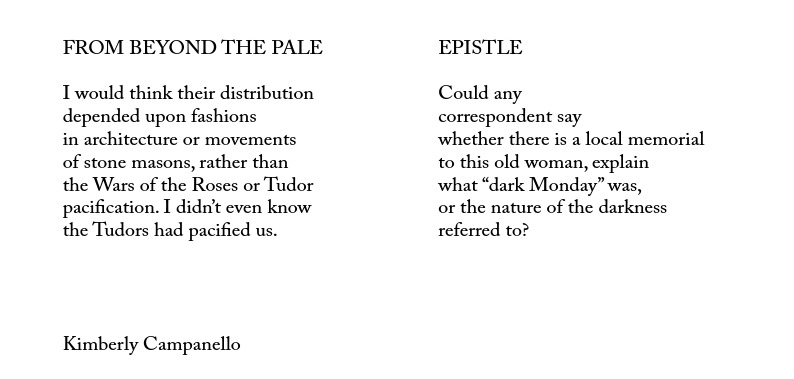 These poems were first published by Tears in The Fence and are © Kimberly Campanello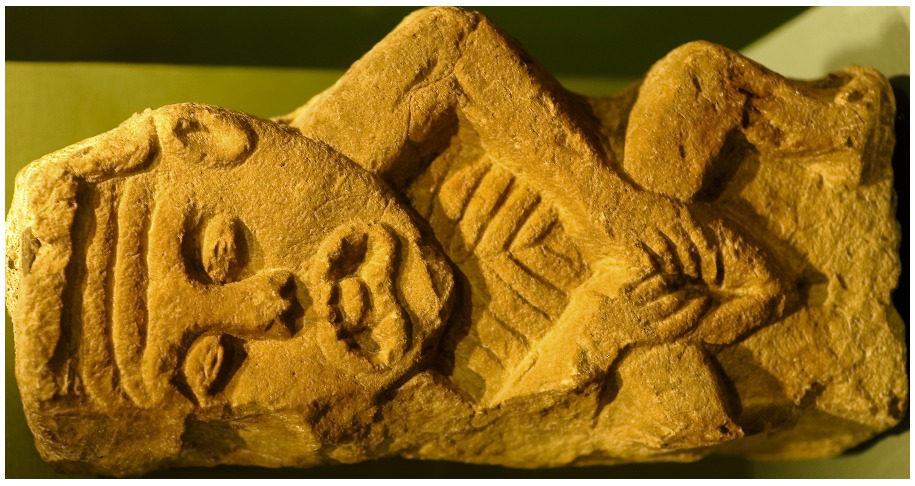
Kimberly
 Campanello was born in Elkhart, Indiana. She now lives in Dublin and London. She was the featured poet in the Summer 2010 issue of The Stinging Fly, and her pamphlet Spinning Cities was published by Wurm Press in 2011 . Her poems have appeared in magazines in the US, UK, and Ireland, including nthposition , Burning Bush II, Abridged , and The Irish Left Review . Her books are Consent published by Doire Press, and Strange Country Published by Penny Dreadful (2015) ZimZalla will publish MOTHERBABYHOME, a book of conceptual poetry in 2016.
Strange Country can be bought from Penny Dreadful Publications
Sanctus by Kimberly Campanello
We Protect The Weak by Kimberly Campanello -
Essence
Do you get that smell? Sweet sour hops drift upwind,
mists ripple the Liffey, ghost the quays,
ruffle three buskers on O’Connell Street.
Beshoff’s chip papers batter takeaway lattes.
There’s fresh oranges on Mary Street,
fresh words, fresh sprayed on concrete walls.
Port containers sigh out in a diesel cloud;
sea-salty air sloshes a swill of spills in gutters.
The brutal stink of bins in puddled alleys
mingles with stale heat stealing from pub doors,
the flare of matches, a cigarette catches
and someone somewhere soothes a honey saxophone.
Essence is © Kate Dempsey, published in The Space Between (Doire Press, 2015) KATE DEMPSEY is from Coventry and studied Physics at Oxford University. She lived and worked in the UK, Nijmegen, The Netherlands and Albuquerque, New Mexico before settling in Ireland. She has lived in Maynooth, County Kildare with her family for more than twenty years. Prizes for her writing include The Plough Prize, Cecil Day Lewis Award, shortlisting for the Hennessy New Irish Writing Award for both Poetry and Fiction and two commendations for the Patrick Kavanagh Award. She was nominated for the Forward Prize and selected to read for Poetry Ireland Introductions. She runs the Poetry Divas, a collective of women poets who blur the wobbly boundary between page and stage at events and festivals all over Ireland. The Space Between is her debut full-length poetry collection.(Doire Press)
-
DELIVERANCE
In the orphanage a child
cowers from cursing men outside.
She wants to climb back into
her dead mother’s womb
and hide inside its warm, soft,
un-edged safety,
where no explanation is needed
or reason to hide under splintered
staircases or run the gauntlet to basement
bomb shelters, existing minute to minute
with strangers until the dawn arrives with her
deliverance and she refuses to be born.© Michael J. Whelan (Published in Cyphers, Nov 2011)
GRAPES OF WRATH
It happens on a Thursday, just after 2pm,
when ancient cultures and beliefs conspire
and vultures spiral above a peacekeepers’ camp,
where cedars age slowly and the Litani River
caresses the ground where Jesus turned water
into wine, where artillery salvos rip the air
on their long flight and bite deep, deep into
that place of safety vaporizing its concrete
walls and burning and blistering and tearing
apart the mass of terrified flesh and innocent blood
seeking refuge from the hate of man.A soldier climbs from the rubble limbs
and discarded faces, his eyes caked black with tears,
his hands at arm’s length clutching the newborn baby
that looks like a headless doll.© Michael J. Whelan
(Qana Massacre April 18th 1996)
During ‘Operation Grapes of Wrath’ Israeli Defence Force artillery shells strike a Fijian UN compound in South Lebanon protecting 800 civilians fleeing the fighting, approx 120 died. Published in the Galway Review 2013 & The Hundred Years War – Anthology of 2Oth Century War Poems, (Bloodaxe 2014)BROKEN SPADE
You lay in your frozen field, slack-jawed at how you
came to be there, your mouth caked in last year’s mud,
limbs twisted about your body as if in the midst of some
remembered dance or tempered at your rotting crops,
bent over in disgust, yielding in the half light and startled
at the cold – they have never felt.
This harvest, un-reaped and yet reaped upon you
hides the stale shoe and crushed spectacles,
the broken spade that hastily covered you in the soft
clay you loved, now steeled hard against the sharp sky.I imagine the fears of your kin as they searched the high
golden horizon that summer day.
They might have felt the distant calamity that took you
following the bullet casings along the beaten track,
and I wonder if they found you,
then I see the scars of cluster bombs and scorched
stalks of your petrified labours and there, there in the shrapnel
of this bitter harvest I behold your seed,
torn apart but reaching out to the one who bore them.© Michael J. Whelan
Published in And Agamemnon Dead – An Anthology of Early 21st Century Irish Poetry Edited by Walter Ruhlman & Peter O’ Neill (Paris, 2015)
RENDEVOUS
The sodden fields are bleak, the road
is broken and I am tired.
Rain shoots off my weary face,
its cold tears count the ribs
that cage my distant heart.
At night I make my rifle safe,
fling this conflict to the floor,
it gathers round the worn-out boots
that tread in miseries of a war.
But I have a rendezvous,
a memory in a future place.
That short black dress, golden hair
tumbling to her shoulders.
Laying foetal, arms wrapping
her soft body, kissing the curve of her
neck, I breathe her in, capturing her.© Michael J. Whelan
TREAD SOFTLY
It’s raining, always is,
that sticky hazy rain that gets down your neck,
behind your ears and saturates your face, your hair
as soon as you step from the vehicle
even though the uniform is multilayered,
your boots get soggy straight away
and the pistol grip on the rifle resting in your arms
slips in your fist.You’re not really afraid – for yourself,
though your heart is racing approaching
the recently finished mass grave- their hurting ground
covered in fresh clay, flags and wreaths,
you’ve just driven over the ancient village cemetery as you entered
like it was a cross country speed test on rough terrain,
the old grave markers are long gone.No, you’re not afraid for yourself,
the fear comes when no adult arrives to greet you
or check out your party as a possible threat
save for the elderly ones corralling young children
behind hedges and outhouses on the high ground,
who watch you as you watch them
barefoot and half dressed in the rain
and you taking photographs of yourselves
at the place of their parents.You – the uniforms that stormed into their hurting place
feeling like liberators but to them resembling conquerors,
you who come to help but instead bring memories of terror
and usher a fear they keep from the last time
soldiers conquered this place,
you who tread softly then when you realize what you have done,
when you see the muddied feet of innocence and the future in their eyes
peering down.© Michael J. Whelan
Published in Three Monkeys, online magazine, Feb 2013
PARADOX OF THE PEACEKEEPER IN THE HOLY LAND
I am forever walking upon the shore
betwixt the sand and the foam.
The high tide will erase my footprints,
and the wind will blow away the foam,
but the sea and the shore will remain foreverKahlil Gibran
In Lebanon I sought redemption
like the pilgrim at the crossroads of Heliopolis,
on the Bekaa’s great range where Bedouin caravans met
and Romans laid their bodies down in supplication to their gods,
to Aphrodite and Jupiter, and long before this peacekeeper came
on what seemed a fools errant, whose only armour
was the feeble weave of a blue flag,before these wars for modernity and religion
where the new city’s shadows fall like dead soldiers
on the broken steps of Astarte’s Temple,
where the priests of Baalbek burned incense,
lay themselves prostrate with tribute and homage
beseeching fertility over the land and on warriors on the eve of battleand the same priests parcelled out her favours to believers
who built new columns to the sun god on her ruins,
before all this there was blood on the stones and in the dust
of Tyre, of Sidon and in Byblos,
and the gods looked down from the heavens and laughed
for they knew that man knew not of their fallibilities,
their eyes kept the storms that belief constructed –the defence of Masada by Jewish zealots
against ramparts, siege-towers and battering rams of enemies – never giving in,
the caliphs who ordered the conquests of Bilad al-Sham,
Helen who setting forth from Constantinople to Jerusalem
in search of the Cross set beacons ready to burn along the way
and Constantine, her son, converted his empire in promise to his motherwho lit the path for Crusaders and the burial places of a thousand years
under these skies of mumatus clouds that hang like fronds of fruit
above the hills at dusk, who rest like relics with Saracens
and Mamluks, the swords of east and west,
the holy books of Abraham, Mohamed and Byzantium,
where Gilgamesh cleaved the cedars for his shipsand where now the free man might dig with trowels once more,
adjure in the Temple of Baachus, revere the flake-bones of gladiators
under the triumphal arch of Al-Minah – the hippodrome at Tyre,
where fishermen still cast their nets on the same Phoenician shore
in Galilee beneath the stirring sands of Jordan
and camels sometimes carry scholars through the Quadisha Valley
like in the old days passing slopes of red anemone, wild tulip, oleander and poppyand young girls might seek the damask rose in the gorges of forgotten ambushes,
where sultans and kings slaked their pious thirsts – slew their enemies
and exiled the youth of many futures – those pawns who lay penitent at the altars,
who laid down in the Temple of Aphrodite like the peacekeepers lay down now,
yes we who lay down with our wives and lovers like knights with sacred talismans
and far away they lie down with us under the same different moons,they wait and pray looking up upon the many faces of the gods
who see us only as a fleeting moment on the pages of passing civilizations,
the rising and setting of the sun and we know the signal fires are burning,
the funeral pyres rise up in pillars of ash in the marches between the watchtowers
along the border wire and we know that so much metal has been fired in this cauldron
from arrowheads and spears to icons and the corrupted jagged shards of bombs,
shrapnelled landmines and bullets. On a rainy day we can almost smell it
weeping through the red mud tracks of an army and we must watch our step.© Michael J. Whelan
Published in A New Ulster, issue 32, May 2015
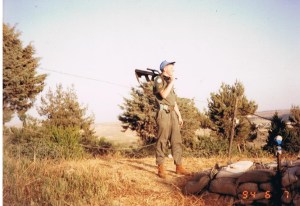 Michael J. Whelan is a soldier-poet, writer & historian (Curator – Irish Air Corps Aviation Museum) living in Tallaght County Dublin. He served as a peacekeeper in South Lebanon and Kosovo during the conflicts in those countries in the 1990s, which inspires much of his work. He was 2nd Place Winner in the Patrick Kavanagh Poetry Award 2011, Shortlisted in 2012 with a Special Commendation in 2013. He was 3rd Place Winner in the Jonathon Swift Creative Writing Awards 2012, shortlisted in the Doire Press and Cork Literary Manuscript Competitions and selected for the Eigse Eireann/Poetry Ireland Introductions 2012. His work has appeared in the Hennessy New Irish Writing 2013, Poetry Ireland Review, the Red Line Book Festival and many other literary magazines and newspapers. His poems were recently published in a new anthology titled The Hundred Years War published by Bloodaxe UK in May 2014.
Michael blogs at https://michaeljwhelan.wordpress.com/
-
Lepus
Their collective noun is ‘drove’
though they mostly live alone,
content with a solitary life,
or become one of a pair
growing brave in the spring;
chests puffed out, as if
fluid has filled the cavities
and dropsy has caused a long-forgotten
frenzy, that gives rise
to a meadow dash in daylight
or a moonlit boxing match
below the moon hare’s dark patches;
that ancient celestial ancestor,
as a distant cousin is driven south
by the hunter and his dogs.
Lepus is © Stephanie Conn (first published in Burning Bush II) Stephanie Conn was born in Newtownards, Co. Down, in 1976. Her poetry has been widely published. She was shortlisted for the Patrick Kavanagh Prize, highly commended in the Mslexia Pamphlet Competition and selected for Poetry Ireland Introductions Series. She is a graduate of the MA programme the Seamus Heaney Centre. Stephanie is a recipient of an Arts Council Career Enhancement Award and recently won the inaugural Seamus Heaney Award for New Writing. Her first poetry collection is due to be published by Doire Press in autumn 2015.
Delta and other poems by Stephanie Conn


 Chris Murray