Eavan Boland (1944-2020)

Break the glass
that holds morning's flame.
Proceed from your room—

I have become so aware of my hands,
their folding of things

of too-sweet smelling fabrics
  (washing machine is crocked)
their patting of panes, pain,
counter-pane,
administering drugs or massages to
a dying cat—
I chose not to believe your death.

Homebound,
 gardenbound,
the pitch of kids’ voices subdued
by the old ancient
box-hedge. They are out-sung

by sparrows and
wrens jaunting through,
skitting overhead,
fearless.
They are always present in
the halls,

their halls.

There is a bright
bright moon tonight.
Blackbirds are always last to sing,
to sound the alert

 It is night,
 it is night.

I lit a purple candle for you.
It smells of berries,
of hot-house pinks—


© C. Murray
27.04.2020
Tag: Eavan Boland
-
-
They and I,
O how far we have fallen!
Just to burn here.You can now order bind viaTuras Press

bind cover photograph is © Christian Caller, original artwork Bound / Boundless © Salma Ahmad Caller
from theIrish Times
I am a poet without a landscape, a woman poet without a narrative heritage. I began tracing the huge startling landscape of US and European women’s poetry while in college. I could not find its equivalent here in Ireland. bind reflects the facts of absence and fragmentation in my poetry landscape, and the absence of women poets in our cultural narrative. bind is a book-length poem loosely divided into chapters. These chapters act as boundaries within the action of the poem and provide gateways to differing aspects of the processes inherent in bind. The title of the book takes its name from the triple hyphenation that occurs…
View original post 309 more words
-
They and I,
O how far we have fallen!
Just to burn here.You can now order bind via Turas Press

bind cover photograph is © Christian Caller, original artwork Bound / Boundless © Salma Ahmad Caller
from the Irish Times
I am a poet without a landscape, a woman poet without a narrative heritage. I began tracing the huge startling landscape of US and European women’s poetry while in college. I could not find its equivalent here in Ireland. bind reflects the facts of absence and fragmentation in my poetry landscape, and the absence of women poets in our cultural narrative. bind is a book-length poem loosely divided into chapters. These chapters act as boundaries within the action of the poem and provide gateways to differing aspects of the processes inherent in bind. The title of the book takes its name from the triple hyphenation that occurs irregularly within the first chapter. bind explores movement, objects, and colours that occur in a no-place or a stasis, the fragmented landscape,
bind
if there are birds here,
they are of stone.
draughts of birds.
the flesh-bone-wing
of ‘bird’(from bind – Chapter One)
read more here
bind (Turas Press, 2018) was launched in Dublin on October the 8th 2018. I include here, with thanks, some details from artist Salma Caller’s response to the text. This is a note of thanks and appreciation to those people who have supported the book from the outset. Liz McSkeane, at Turas Press has written an introduction here She has taken me through the process beautifully, including a visit to the type-setter, discussions on the visual art aspect of the book, and at all times she has kept me up to speed with the process. Turas is a new press, I urge poets to explore the possibility of publishing there. Eavan Boland very kindly read the text and provided an endorsement for me. I have published the coda to the book and a short poem wing above. The book is not consciously oblique, it charts a progression through a territory that defies description. It might even be said that the book is very simple, although I have tested that theory!
Acknowledgments are due to the editors of Persian Sugar In Indian Tea, York Literary Review, Levure Litteraire #12, The Honest Ulsterman, The Penny Dreadful Journal and Compose Journal, who have all published excerpts from “bind”
Wing

mercury pool shatters
and,
a-black-wing

the challenge
of           wing.

bird skims black
ice bird skiffs
the tree pool

bone-blood

the
actual bird,
the image of a bird

the real thing of it,
grasps onto a branch.

             the iron of its grasp
-
The death of Eavan Boland (1944-2020) occurred on 27/04/2020 in Dublin, Ireland. Condolences to her family, friends, and colleagues. You can read a collation of tributes and obituaries to Eavan at this link.
EAVAN BOLAND
INSIDE HISTORY(Arlen House, 2016)

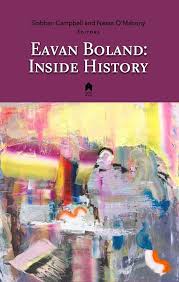
Eavan Boland: Inside History, a new volume of essays and poems in response to the work of the internationally-renowned Irish poet, will be published by Arlen House on 1 December 2016. Edited by poets Siobhan Campbell and Nessa O’Mahony, Eavan Boland: Inside History is a reappraisal of Boland’s influence as a poet and critic in the 21st century and is the first major commissioned collection of essays to be published on Boland.
The volume includes critical essays on, and creative responses to, her work by leading writers, thinkers and scholars in Ireland, the UK, Europe and the US and reappraises Boland’s influence as a poet and critic for the 21st century. The fresh and diverse approaches provide a new frame for a critical engagement that crosses continental and aesthetic boundaries. The book, therefore, repositions Boland scholarship with a focus on the most important aspect: the poems themselves.
Contributions include a foreword by Mary Robinson, former President of Ireland, as well as essays by Jody Allen Randolph, Patricia Boyle Haberstroh, Siobhan Campbell, Lucy Collins, Gerald Dawe, Péter Dolmányos, Thomas McCarthy, Nigel McLoughlin, Christine Murray, Nessa O’Mahony, Gerard Smyth, Colm Tóibín and Eamonn Wall. There are also poems from Dermot Bolger, Moya Cannon, Katie Donovan, Thomas Kinsella, Michael Longley, Paula Meehan, John Montague, Sinead Morrissey, Paul Muldoon, Eileán Ní Chuilleanáin, Nuala Ní Dhomhnaill, Jean O’Brien and Nessa O’Mahony. The volume concludes with A Poet’s Dublin, a reissuing of the conversation that took place between Eavan Boland and Paula Meehan on the occasion of her 70th birthday in 2014.
“Eavan Boland worked as an editor with Arlen House in the 1970s and 1980s and did extraordinary work in developing new Irish writing and broadening the boundaries of Irish literature. We are pleased to publish this collection on her work,” said publisher Alan Hayes.
“As editors, we’ve been delighted to be part of the conversation that this volume has begun,” said Siobhan Campbell. “It’s been a privilege and an honour to work on this collection particularly as both Nessa and I feel poetically in Eavan Boland’s debt, as do so many of our contemporaries.”
978–1–85132–140–7, 368 pages, paperback, €25
978–1–85132–150–6, limited edition numbered and signed hardback, €55ARLEN HOUSE LTD, 42 Grange Abbey Road, Baldoyle, Dublin 13.
Phone: 086 8360236: Email: arlenhouse@gmail.com- US & International Distribution: Syracuse University Press www.syracuseuniversitypress.syr.edu
- The Book Depository: http://www.bookdepository.com/Eavan-Boland-Inside-History-Siobhan-Campbell/9781851321407?ref=grid-view
-

I have endured the scholastic training worthy of someone of learning.
I am versed in the twelve divisions of poetry and the traditional rules.
I am so light and fleet I escape from a body of men without snapping a twig,
without ruffling a braid
of my hair, I run under branches as high as my ankle and over ones high as my head, I scrape thorns from my feet
(not mine) while I run, I dance backwards away from myself, these rites
are quite common among primitive nations,
I am seldom admitted into the companionship of the older, the full privilege of the tribe, without them.from: “A Meditation on Ireland, Women, Poetry and Subversion” by Kathy D’Arcy at The Honest Ulsterman
There is a narrative gap in Irish poetry that appears to the woman poet, her reviewer, and the poet essayist as ‘absence’, indeed as a type of intellectual privation. That a new generation of women writers are confronting Irish women poets absence from the canon, along with its previous attendant tokenism, is truly delightful to me. We are busily exploring emergent genealogies in Irish Poetry, or it could be stated that we are unhappy with what Eavan Boland refers to as a suppressed narrative.
To bring forward a skewed national cultural narrative that disavows the woman poet’s place in the canon is to my mind culturally damaging. Not alone is it culturally damaging to present part of a narrative that claims the intellectual impetus in the imaginative creation of a nation, it is personally and professionally damaging to women poets and to nascent writers who are now devoid of their narrative heritage.
Alex Pryce confronts the absence of Northern Irish women poets in her thesis “Ambiguous Silences ? Women in Anthologies of Contemporary Northern Irish Poetry” I read about Pryce’s worthy thesis in Moyra Donaldson’s blog under The Influence of Absences sometime ago. I was so interested in what Pryce had to say that I downloaded the PDF from her Academia.edu account. At the same time, I was in conversation with Emma Penney who had sent me a copy of her thesis Now I am a Tower of Darkness: A Critical History of Poetry by Women in Ireland. Penney and Pryce are investigating and confronting the constructed heroic post-colonial narrative that has really has done its time by now. The post-colonial narrative beloved of some critics who would view the whole world as an extension of their ideation has been flogged to death. It’s over darlings. I grew up not knowing or studying any Irish women poets. The women writers that I read in college were Elizabeth Barrett-Browning (in epic poetry and quasi-feminism) and Virginia Woolf. It was as if women poets did not exist in Ireland.
Irish women poets have never quite left us however, despite their historical absence from anthologies and from third level academic study. There has been a slight recent improvement in the publication of women poets and in their critical review, but it is not enough. Our women poets emerge whole and singing in essays, in current blogs like in Billy Mills Elliptical Movements, and in lines of melody put through mine and others’ search engines. It is time to celebrate our absent poetry foremothers and to confront the indignity conferred upon Irish women poets who were thrown to the side in the search for a heroic poetry to express our chosen political-cultural narrative.
In her thesis, Now I am a Tower of Darkness: A Critical History of Poetry by Women in Ireland, Emma Penney challenges the critical reception of Eavan Boland and the restrictive criteria, developed in the 1970s, under which poetry by women in Ireland has been assessed. She considers the subversive nature of women’s poetry written between 1921 and 1950, and calls into question the critical assumption that Eavan Boland represents “the first serious attempt in Ireland to make a body of poems that arise out of the contemporary female consciousness”. In Object Lessons, Boland concluded that there were no women poets before her who communicated “an expressed poetic life” in their work. Emma’s thesis reveals how this view has permeated the critical landscape of women’s poetry, facilitating an absurd privation of the history of poetry by women in Ireland and simplifying it in the process. Emma Penney’s work centres around the poet Freda Laughton, her thesis was picked up by Jacket2 Magazine and The Bogman’s Cannon blog.
Kathy D’Arcy looks at the absence of Irish Women Poets in anthologies, and at literary feminism, in her “A Meditation on Ireland, Women, Poetry and Subversion” at the Honest Ulsterman,
Once there was a woman – no, two women. Then they became beasts, then trees, then stones then even stars. How they fought! And that woman was Cú Chulainn.[4] And that woman was Fionn Mac Cumhaill, daughter of Cumhall. And that woman was Queen Maeve. And that woman was Brian Boru. And that woman was Eibhlín Dubh Ní Chonaill, and that woman was her husband Airt Uí Laoighire. And that women was Pope John Paul the Second. And that woman was Declan Kiberd.
In Catriona Crowe’s Testimony to a flowering, a marvellous essay on the erasures, faults, absences and blindness exposed for all to see in the first Field Day Anthology,
“When confronted about the near absence of women from the book, Seamus Deane stated that ‘To my astonishment and dismay, I have found that I myself have been subject to the same kind of critique to which I have subjected colonialism. I find that I exemplify some of the faults and erasures which I analyze and characterize in the earlier period.’ It is perhaps possible to compress these sentiments into ‘I forgot’, but he did not say the words. He said that documents relating to feminism would be his first priority for inclusion in the revised paperback edition of the anthology, expected to appear in one or two years.
And yet, privations occur and recur in poetry lists, in national celebrations, and in other media or tourist-led strategies that consistently and poorly neglect the woman literary artists’ voice. I do not know if it is intellectual laziness, or if it is that the cultural narrative is so engrained that no-one questions the historical absence of women in Irish poetry? Indeed also in the theatre arts, as can be seen in the recent Waking the Feminists debacle. Maybe it is time to look closely at the Irish view of women that is set in stone in the Constitution and confront the idea that women literary artists fought for our cultural heritage just as hard as men did, but for some lazy and elusive reason, we refuse to celebrate their work.
- “A Meditation on Ireland, Women, Poetry and Subversion” by Kathy D’Arcy at The Honest Ulsterman
- Alex Pryce on “Ambiguous Silences ? Women in Anthologies of Contemporary Northern Irish Poetry”
- Catriona Crowe’s Testimony to a Flowering at The Dublin Review
-
 “
“I wanted to read or hear the narrative of someone else – a woman and a poet – who has gone here and been there. Who had lifted the kettle to a gas-stove. Who had set her skirt out over a chair, near to the clothes dryer, to have it without creases for the morning. Who had made the life meet the work and had set it down.
Eavan Boland , from Object Lessons. publ. Carcanet 1995.
As ever, thanks to my readers who keep coming back to read, to make suggestions, and to send poems. My feeling is that overall 2012 has been a good year for women poets. There have been the usual scant begrudging reviews, there is still a visibility issue in terms of how many women are published, but poets like Alice Oswald, Ros Barber, Carol Ann Duffy, Eavan Boland, and all the women here published have most definitely placed the woman-poet in her room, on the street, and in the bookshop where young women and upcoming poets may find her if they care to look.
I have added a list of blogs, journals, reviews and interesting sites to the end this post. I often link to my favourite blogs and sites directly in the posts. This year, I mention in particular Bone Orchard Poetry, CanCan, and WurminApfel. My perennial favourite websites are Jacket2, Guernica, The Harriet Blog (Poetry Foundation), Lemon Hound and Poetry Ireland
The easiest way to do this is to link the poets and translators published this year of 2012 as they were published. There is a handy monthly (2008-2012) archive to your right (and up the page a wee bit)
The image is ‘Life or Theatre’ by Charlotte Salomon
-
‘I am an Irish poet. A woman poet. In the first category I enter the tradition of the English language at an angle. In the second, I enter my own tradition at an even more steep angle. I need to be candid about this because, of course, these two identities shape and re-shape what I have to say today. The authority of the poet – that broad and challenging theme – is really, in my case, a series of instincts and hunches. The difference in my case, is that while many poets look to the past for the story of that authority, I no longer do so. I have stopped listening to the story which grants automatic authority to the poet and automatic importance to the poem. Instead, I have come to see a suppressed narrative.’ (Eavan Boland)
I have often wondered at the angle that Eavan Boland speaks of in this excerpted speech from the PN Review. The speech entitled Gods Make Their Own Importance was delivered in 1994 under the auspices of the Poetry Book Society. Eavan Boland revisited a variation on this theme in 2007 when she interviewed with the Boston Globe. I know that its a bit impertinent to extract a blog post from the two linked pieces, but I thought to examine the idea of contemporary women poets taking on larger themes, rather than those small and domestic things so indicative of the lesser space which Eavan Boland discussed.
The Boston Globe article, Exploring Poetry’s Lesser Space (2007) is as relevant now as it was at the time and maybe more so. A critical review of poetry is either absent or confined to particular little corners here in Ireland. I can take some recent examples of this absence which I have published here on the blog, the Irish Times Books of 2011 did not allow for a single poetry publication, for instance. I have (to date) not seen a review of Oswald’s Memorial in our papers of note, or indeed in any of the Irish newspapers. Lucky then that good reviews are available elsewhere for lovers of poetry and non-fiction. Some people take the idea of a non-fiction readership seriously and cater then to a less limited spectrum of reading tastes and experiences. I am linking Michael Lista‘s National Post Review of Oswald’s Memorial.
If a male author of our very small writing establishment had stripped down The Iliad and had written a powerful dirge as Oswald has undoubtedly achieved in Memorial, would it have made it to the end of year book lists? I do not think that the issue regarding the provision of space for readers of non-fiction and poetry is the problem, the problem appears to be based on the marketing of books. Oswald’s withdrawal from the T.S Eliot prize was noted in the Irish Times and indeed in the Irish Independent, but there is as far as I can see no review of the actual book on either website. Is it considered unladylike for women poets to take on vast themes that are decidedly not domestic celebratory, and thus not interesting to reviewers?
In 2010 VIDA (Women in the Literary Arts) published The Count, which showed a truly abysmal lack in critical review of women literary writers and poets. I feel that 2011 has been better for women in literature, although there are as yet no published figures available. I have to wonder if a lack of critical and intellectual reviews of poets like Alice Oswald is based within the same confined dogmatic parameters that Boland alluded to in the linked lecture and interview. The small poems of the domestic, the novels, and some genres seem open to review and discussion, but the larger themes are passed over and ignored. There appears to be a lack of balance inherent in how certain genres are presented to readers of literature, which reflects a small coterie of male-writers and their special interests. Although, it just might represent how poetry is perceived and marketed in Ireland and the UK.
Of course, it could be simply a matter of impatience on my part to see what reviewers make of books by women writers that exist outside of the poetic lesser space and its artificial confines. I do not see contemporary women reviewers or women critics asking the questions that Eavan Boland did in 1994 or indeed in 2007. My assumption that the issue of how we look at women literary writers and poets in Ireland must have been resolved satisfactorily without my noting it,
Or
it could be entirely presumed that women reviewers really do not give much of a fuck about Irish literature unless it exists within the cut-out pattern that they are entirely comfortable with. Reviewing the same consistent group of books within the same confining parameters that please their mostly male bosses for a small group of writers who accept a formulaic critique as a matter of course. The same publishers in the tiny stagnant pool of Dublin-centric art luvviedom: how boring, how narrow – how idiotic. How utterly failed is Irish literature when critical reception amounts to cut-out doll pattern that attempts market influence. Serious poetry and non-fiction readers may have to look elsewhere for cogent and interesting reviews of poetry books written by women.
Related Links
-
Sonnet
I can’t sleep in case a few things you said
no longer apply. The matter’s endless,
but definitions alter what’s ahead
and you and words are like a hare and tortoise.
Aaaagh there’s no description — each a fractal
sectioned by silences, we have our own
skins to feel through and fall back through — awful
to make so much of something so unknown.
But even I — some shower-swift commitments
are all you’ll get; I mustn’t gauge or give
more than I take — which is a way to balance
between misprision and belief in love
both true and false, because I’m only just
short of a word to be the first to trust.by Alice Oswald from The Thing in the Gap-Stone Stile (Oxford 1996).
I am adding here the Library Thing link for The Thing in the Gap-Stone Stile by Alice Oswald. I wrote a brief polemic last week about the decision of the two poets , Alice Oswald and John Kinsella, to leave the T.S Eliot Prize, but I do hope that people will do their own reading on the issues surrounding their decisions. There are a some sonnets on this blog and a few of these are taken from the magnificent Norton Anthology, The Making of a Sonnet , edited by Eavan Boland and Edward Hirsch , which I’d recommend to lovers of the sonnet form.

-
“I discovered sexism’s glass walls—which do exist still, to a shocking degree—later rather than earlier. A great blessing, that belatedness. As a young person, I felt the world’s heritage of art and literature was mine to forage.” (Jane Hirshfield)
This week’s blog post contains just two small links because family duties had called me away from my desk. While I was away I got totally enraptured by Paul Celan‘s Todesfuge, translated by John Felstiner, which I am writing about elsewhere. For today I am adding a conversation about Women and Poetry which is related to two published posts here at Poethead.
To preface my first excerpt and link, I want to say that the VIDA interview resonated with me in relation to a letter by Anne Hays which I published in January of 2011. The letter has been hit 4,819 times, it details a lack in women’s literary publication which I can only describe as a deadener. I am adding the letter here. I thought to publish excerpts from the VIDA interview and link in the context of the Hays letter.
“We each need the speech of reason and we need the speech of feeling. And when I’m asked the unanswerable question about the origins of poetry, my speculation is similarly multiple: prayer, courtship, work song, grief song, rituals of passage and of harvest, war song, lullaby, memory-keeping mnemonic. Each of these must have pulled poetry onto early human tongues. Most are experiences shared by both men and women, and if war-making’s drum cry has more often been the domain of men, that’s counterbalanced by the murmur that sends an infant to sleeping. If one had to guess which came first, lullaby’s as plausible a guess as any.” (Jane Hirshfield)
I wonder often about how we dream a poet, I imagine that in Ireland, we think of him as a speaker of our truths.
The above paragraph is so critical to our understanding that there are areas in poetic experience in which the gender of the poet cannot be ignored, and that is hugely important to emerging women poets to see and to read other women. If all we think about are our great male-poets when we imagine our singer of tales, then the experience of the woman-poet achieves an invisibility, a chorus. Think of T.S Eliot‘s chorus from Murder in the Cathedral, Atwood’s serving girls from The Peneliopad, or the mother nodding beside the cot in Sylvia Plath‘s art. Those are the voices of the harem, the brothel, the nursery and of the chorus-line.
Poetic invisibility becomes not a diminishment of the voice of woman but a nowhere for a woman writer to hang her hook, or to resonate with women’s experiences of war, of birth, of death. VIDA alluded to this issue in The Count, which I have linked here. Eavan Boland spoke of this lack in our imagining here .
Links to the Jane Hirshfield and Eavan Boland interviews are here,
- http://vidaweb.org/human-lives-a-conversation-between-jane-hirshfield-and-leslie-mcgrath
- Exploring Poetry’s Lesser Space ,Interview with Eavan Boland http://www.boston.com/ae/books/articles/2007/03/11/exploring_poetrys_lesser_space/
-
The Mona Van Duyn Poem that I am adding today is from The Making of a Sonnet, edited by Edward Hirsch and Eavan Boland. I will be adding in here a link to an online page of Van Duyn poety from Modern American Poets the Amazon Link to her collected poems and a Wikipedia page about the poet.
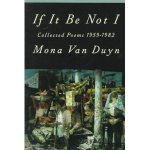
‘If it be Not I’ , Van Duyn A selection of Mona van Duyn’s online poetry is available here . There follows a brief excerpt from Letter from a Father ,
Bet you’d never guess
the sparrow I’ve got here, House Sparrow you wrote,
but I have Fox Sparrows, Song Sparrows, Vesper Sparrows,
Pine Woods and Tree and Chipping and White Throat
and White Crowned Sparrows. I have six Cardinals,
three pairs, they come at early morning and night,
the males at the feeder and on the ground the females.
from Modern American Poetry , Mona Van Duyn online Poems.Double Sonnet for Minimalists.
The spiral shell
apes creamhorns of smog,
Dalmatian, quenelle
or frosted hedgehog,
yet its obsessed
by a single thought
that its inner guest
is strictly taught.
When the self that grew
to follow is rule
is gone, and it’s through,
vacant, fanciful,
its thought will find
Fibonacci’s mind.
That fragile slug,
bloodless, unborn,
till it knows the hug
of love’s tutoring form,
whose life, upstart
in deep, is to learn
to follow the art
of turn and return,
when dead, for the dense
casts up no clue
to the infinite sequence
it submitted to.
May its bright ghost reach
the right heart’s beach.
by Mona Van Duyn
from The Making of a Sonnet, edited by Eavan Boland and Edward Hirsch. Norton.

 Chris Murray