|
1. ‘Lo! I will tell of the best of dreams, A few weeks ago my attention was called to an annotated electronic edition of the Dream of the Rood , created by Mary Rambaran-Olm. I thought to link this edition on Poethead to compliment some of my earlier posts about women editors and writers. There are an amount of works on the blog dedicated to the poetry of the mystic-writer, these posts deal specifically with the woman’s mystic voice rather than approaches to contemporary editing by women. The sole exception to the above is based in a few scattered posts that allude to Marion Glasscoe’s magnificent editing of Julian Of Norwich’s A Revelation of Divine love. Glasscoe’s Julian is in my opinion a seminal text, and I have retained my copy since I studied it in UCD some years ago. There are many modern versions of Julian’s Revelation which attempt to bring her luminous writing toward a contemporary audience, however, mostly the texts that I have read go nowhere near the Glasscoe for clarity of expression. I have referenced ideas and images from the Glasscoe in a couple of Poethead posts , which I am adding here and here. To my mind a masterpiece is a work of art that has the ability to generate interest and to inspire derivatives in the visual and musical arts. The work that has gone into the creation of the electronic edition of The Dream of the Rood allows for a contemporary audience to access it’s unique quality of expression. Here, in Mary Rambaran-Olm’s pages are her transcriptions, translations and notes from the original manuscript. The translation pages run along the left-hand column of the Rood home page and are subdivided to allow for easier reading. There are also extensive images of the Vercelli Book (Folios 104v-106r). It’s an online treasure-trove. The poem is available on the right-hand of the home-page under the heading of Translation and Original Poem. I did question whether I should write a post about Julian of Norwich and the Dream of the Rood for this Saturday, and I hope my regular readers enjoy the piece. I believe that poets are inspired across a variety of modes of expression and that the contemporary modes of dissemination can ameliorate access to masterpieces such as the two above-mentioned triumphs of editing by both Glasscoe and Rambaran-Olm. Dreaming and vision-poems have an agelessness about them that defies time. I am wary of some translations which I have discussed before now, but there is an endurance in this writing which has influenced many a writer. One quick search for Julian’s writing uncovers a vast array of related works. It is really up to the reader in how they wish to access the works mentioned above, but I’d feel somehow that I’d have let down my readers if I did not acknowledge the trojan work by these two women editors in their creation of accessible translations for modern readers. Note. It’s rather alarming that a dreaming poem such as Dante’s The Divine Comedy has been subject to an attempt at evisceration and censorship at this moment. If there is a loss anywhere in this issue it is in the Gherush92 campaign. I have said online and elsewhere this past week that this campaign is about getting into newspapers in the most risible fashion, rather than about any offense caused by a poem that continues to inspire a great deal of visual and literary art.
|
Tag: Julian of Norwich
-
-
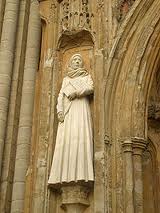
Julian at Norwich Cathedral Middle English is not so Difficult…
I thought I had found a treasure today whilst browsing in my local bookshop and coming upon a ‘modernish’ version of the Revelations (shewings of ) Julian of Norwich. Not so!! The book is a 1987 imprint which seeks (or sought) to bring the writings of the Anchoress at Norwich Cathedral to a wider audience, whilst sacrificing the beauty of her poetry to a clunky co-option of her unique expression. I am not opposed to the book per se, but would question the use of an editor (or set thereof) rather than working from the beautiful editing of the definitive book on Julian which captures her voice in all its sublimity,
Julian of Norwich, A Revelation of Love. University of Exeter Press, Ed Marian Glasscoe.
I thought for a while about how I would present what is my opinion on the matter of loss in translation, and in how wide dissemination of literature can sacrifice so much in what is an attempt to frame a book and reach an audience that may be unused to the language of Julian. It is highly beneficial for the reader to attempt to read some work in the original.
The Glasscoe version has an excellent introduction and glossary , which aids in one’s ability to work through this highly original work of a woman from the Middle Ages. The clunky and appalling book which I actually bought and will not name here had somehow managed to take the light right out of this seminal work of literature, so I am not going to name the version, editors or imprint. There are two pieces on Poethead about Julian already, both of which I will attach as link at the end of this piece. One is a discussion on the use of the word Shewings, which is how Julian of Norwich described her visions (in the language of the mid-wife), the other is an excerpt from the Glasscoe. To demonstrate the cause of the headache the book caused in me, I am excerpting two short pieces here. The first are from the UEP (Glasscoe Edition, 1976), the second is a modernist version of Julian which fills out her words to accomodate a modern audience who may not want to bothering themselves with attempting to read in the original adapted version.
” And when I was thirty yers old and halfe God sent me a bodely sekeness in which I lay iii days and iii nights ; and on the fourth night I tooke all my rites and wened not a levyed till day. And after this Iangorid forth ii days and ii nights. And on the iii night I wened oftentimes to passyd and so wened they that were with me. And in youngith yet, I thought great sweemeto dye; but for nothing [that] earth that me lekid to levin for .”
Revelation 3, Julian of Norwich, A Revelation of Love. University of Exeter Press, Ed Glasscoe,
“Then when I was 31 years old God sent me a physical illness and I lay in its grip three days and three nights. On the fourth night I received all the rites of the holy church and did not expect to see the next day. I Lingered on for two more days and nights and on the third night I was convinced that I would die and so were all those around me.”The example is not the best because it is not her visions but the structuring of the editing of the second version is pretty obvious. The first link attached herein gives a longer excerpt of Julian’s writing :
-
Women translators and editors form the basis of much of what is published on Poethead. Mostly they have a Western (English Language bias), although not always , (in the cases of Levertov, Ursu, Weil, Hassanzadeh, Nagy, amongst others for example ) though I do think that as readers and writers many women underestimate the small presses, the dedicated presses and the university presses. The areas of poetry that are translated are not necessarily specialisation; but represent modes of communication of those texts that are sorely neglected, and they are a virtual babel-tower of richness in literary inheritance.
Along with online resources, mentioned in the two short pieces on ethnopoetics and translations, which I will include as links at the end of this piece are book resources, in which sometimes Amazon can be your friend, though you can do worse than checking out the college bookshops, the specialist bookshops, and at the posher end those shops that deal in first editions and artistic editions.
I have also found some beautiful artistic and poetic collaborations published here in Ireland as part of art exhibitions or in reviews such as PIR. In essence, it’s not always in regular bookshops that there are treasures to be had, indeed some of them present a paucity in choice unfortunately, though that depends largely on the buyer’s skill.
Two presses that I enjoy are the Exeter Press and SUNY, whose rendering of Julian of Norwich and of Simone Weil are faultless and are both edited by women writers, who have that empathy of learning essential to their job. I am not going about quoting them this morning, because both of them appear on Poethead in various guises, although probably Julian is more neglected than Weil because the effort of concentration in reading requires more free time than I have currently available. There are two posts on the site which feature Marian Glasscoe’s translations of Julian of Norwich (in relation to the Penelopiad) and Weil’s Necessity translator , Joan Dargan appears frequently throughout the blog.
On a short note, the PH ephemera section needs updating because for some undiscussed reason the dot’s spot, later the Mostly Art blog have been cut (along with all blogs) from Politics.ie I dislike when such irrational decisions occur and it was for this reason that I decided to build up this blog, allowing (for once) my output to be self-determined. Decisions like adapting and censoring items are also outside the pale when it comes to choice of moderator , thus reducing and relinquishing all personal control of material to total strangers.
I think writers must become extremely careful about what type of site they publish on and look out for how their linked material is protected and disseminated when they sign up to the varieties of boards and foras that are available right now. This is especially relevant to material that one may wish to one day publish. I will be doing a post on this at a later date.
Ethnopoetics and Translations.
Translation and Linguistic Rights.
Atwood and Julian of Norwich

 Chris Murray