I was sitting at my desk Outside the boss’s office Replying to emails From candidates for places On the courses we offer; The effective saint; Managing eternity efficiently Level Two; Create the world workshops (NB Seven Day Course). Then what happens? This black yoke comes in With a thousand questions In its beady eye. It has wings like me But otherwise We’ve nothing, nothing In common. Have we ? I gave him the standard line. I regret that on this occasion we have No vacancies for crows or artists. We wish you every success In your future career.
The creature stayed however. I did not call security (Because I am security! I do everything around here) And so the loser stayed.
Forever.
Mark My Words with illustrations by Alice Maher was published in conjunction with The Night Garden exhibition by Alice Maher and lives in a little black folder with pieces by Maher entitled The Bestiary.
The one who has been rowing while the storm Approaches near, who strains with every limb Against the trusty footboard’s rigid form And finds a sudden absence from the rim
Of the broken oar, weightless hand, and Falling propulsion, falling With the loosened, dropping shaft and Whose whole body sags –
He knows what I know. by Ágnes Nemes Nagy
Jorge de Aguiar Compass rose from Wikipedia.
I have recommended before now the reading of Ágnes Nemes Nagy in both poetry and poetic prose. The image I had chosen to illustrate the above poem was initially an adorable illustration from The Exeter University press edition of The Seafarer but the Aguiar Compass Rose suffices. There are some Poethead references to elegy in the Old English on the site and I may wish to link to the Seafarer image again.
The Poem above comes from the Corvina & Dedalus Edition of Between by Ágnes Nemes Nagy , in translation by Hugh Maxton and published in 1988. I recommend Maxton’s afterword discussion on Nagy’s Poetics.
Between , Selected Poems of Ágnes Nemes Nagy, Trans, Hugh Maxton. Corvina Press (Budapest) and Dedalus Press (Dublin) 1988.
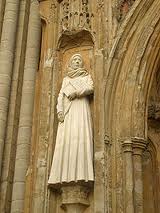
I thought I had found a treasure today whilst browsing in my local bookshop and coming upon a ‘modernish’ version of the Revelations (shewings of ) Julian of Norwich. Not so!! The book is a 1987 imprint which seeks (or sought) to bring the writings of the Anchoress at Norwich Cathedral to a wider audience, whilst sacrificing the beauty of her poetry to a clunky co-option of her unique expression. I am not opposed to the book per se, but would question the use of an editor (or set thereof) rather than working from the beautiful editing of the definitive book on Julian which captures her voice in all its sublimity,
I thought for a while about how I would present what is my opinion on the matter of loss in translation, and in how wide dissemination of literature can sacrifice so much in what is an attempt to frame a book and reach an audience that may be unused to the language of Julian. It is highly beneficial for the reader to attempt to read some work in the original.
The Glasscoe version has an excellent introduction and glossary , which aids in one’s ability to work through this highly original work of a woman from the Middle Ages. The clunky and appalling book which I actually bought and will not name here had somehow managed to take the light right out of this seminal work of literature, so I am not going to name the version, editors or imprint. There are two pieces on Poethead about Julian already, both of which I will attach as link at the end of this piece. One is a discussion on the use of the word Shewings, which is how Julian of Norwich described her visions (in the language of the mid-wife), the other is an excerpt from the Glasscoe. To demonstrate the cause of the headache the book caused in me, I am excerpting two short pieces here. The first are from the UEP (Glasscoe Edition, 1976), the second is a modernist version of Julian which fills out her words to accomodate a modern audience who may not want to bothering themselves with attempting to read in the original adapted version.
” And when I was thirty yers old and halfe God sent me a bodely sekeness in which I lay iii days and iii nights ; and on the fourth night I tooke all my rites and wened not a levyed till day. And after this Iangorid forth ii days and ii nights. And on the iii night I wened oftentimes to passyd and so wened they that were with me. And in youngith yet, I thought great sweemeto dye; but for nothing [that] earth that me lekid to levin for .”
Revelation 3, Julian of Norwich, A Revelation of Love. University of Exeter Press, Ed Glasscoe,
“Then when I was 31 years old God sent me a physical illness and I lay in its grip three days and three nights. On the fourth night I received all the rites of the holy church and did not expect to see the next day. I Lingered on for two more days and nights and on the third night I was convinced that I would die and so were all those around me.”
The example is not the best because it is not her visions but the structuring of the editing of the second version is pretty obvious. The first link attached herein gives a longer excerpt of Julian’s writing :
There among the roots and trunks with the mushrooms pulsing inside the moss he planned how to eat them both, the grandmother an old carrot and the child a sly budkin in a red red hood. He bade her to look at at the bloodroot, the small bunchberry and the dogtooth and pick some for her grandmother. And this she did. Meanwhile he scampered off to Grandmother’s house and ate her up as quick as a slap.
The image which accompanies this short introduction to Ann Sexton’s book Transformations is from that other mistress of the dark tale/fairy tale’s pen, Angela Carter. The image is from the Neil Jordan produced movie, The Company of Wolves , which Carter scripted based in her collection of Fairy Tales and Wolf stories of transformation and Metamorphoses. The tales did not include those which sit outside of the theme of the movie and are among her classic writing, so I’d generally urge readers who like women’s novels, fiction, prose and critique to seek out Ms Carter’s opus which is available in book shops and on Amazon. High on my list of personal recommendations isThe Bloody Chamber (Bluebeard), The Lady of the House of Love (Vampire) and her essays Expletives Deleted.
I bought Transformations on Friday morning to read on the way home from a brief holiday in my usual haunt, The Rare and Interesting Bookshop, in Mayo, as I have given up on Newspapers doing anything but horrifying me (and not in the delightful Carteresque manner).
Here are Briar Rose, Cinderella, wicked step-mothers, Rumpelstiltskin, The Little Peasant and the coterie of Grimm falling out of the slim but packed volume of tales of transformations and metamorphoses. The twist is in the language and schemes, as opposed to the twists and turns in Carter’s feminist and microscopic eye in her versions.
Briar Rose
Consider a girl who keeps slipping off, arms limp as old carrots into the hypnotist’s trance, into a spirit world speaking with the gift of tongues. She is stuck in the time machine, suddenly two years old sucking her thumb, as inward as a snail, learning to talk again. She’s on a voyage. She is swimming further and further back up like a salmon, struggling into her mother’s pocketbook.
Briar Rose, by Ann Sexton.
Do read the book, it isn’t by any means a new book , but all books are new when discovered , bought or found. And no-one can really tell how one will react to the images, content or stories therein. Always new books are something critics and interpreters forget are an adventure to the mind.
I have included at the end here the name of a collected Carter, the title of the Sexton and a link to another Ann Sexton poem which is on Poethead.
“The boy asking – in a swing travelling to the moon through curled ice of the spinney frozen with flowers- ‘The bery old man in the moon, does he wear a beret?’ The poet in the glassy office doorway, unable to remember the Professor’s Christian name; and the man I love, in another glass seeing his looks of delight as an unlikeable face and his eloquence as a hum, surprised at our prizing, had such humility I think they cannot be wounded, their unmeant sweetness makes them a safe place. Next when I kill them in my heart for harms I think they do me, and next when am raging, this remembering, let it save my mind from the hell-go-round of the grievance-ridden save the fool turkey-cock into love.”
Chess Theory , Max Ernst.
Taken from : Modern Verse 1900-1950, chosen by Phyllis M Jones, Geoffrey Cumberlege, Oxford University Press 1940,1941,1943,1955
Indeed possibly a Standard text from TCD/Oxford/UCD… though I am rather unsure of its provenance , being in the habit of picking up poetry books all over and sometimes they form a gift or bequest. Little gems.
Because it tells me most when it is most alone, I hold myself at bay to watch the world regain it’s level-headedness, as harbours do when keels are lifted out of the in autumn. This is not unconsciousness. Seen from above, the trees are guanoed sea-stacks in a greeny cove full of gulls’ primeval shrieks and waves’ extinctions. Here birds safely crawl between the bushes, wearing their wings like macs with fretted hems. The air’s a room they fill to bursting with their songs. All day the common warblers wing it up and down the scale , see-saw, hammer-and-tongs. This is not aimlessness. It is something industrial. A starling cocks its head at the blackbird’s coppery notes. All I hear of them in the hide reminds me that the body must displace itself for music, as my body has, inside this six inch slot of light. What converses in a thrush’s throat, burnished, tarnished ? It’s news endures no longer than the day does.
Catríona O Reilly ; Hide taken from The New Irish Poets, publ Bloodaxe, 2004, Ed Selina Guinness.
The cycle of days in the deserted sky turning In silence watched by mortal eyes Gaping mouth here below, where each hour is burning So many cruel and beseeching cries; All the stars slow in the steps of their dance, The only fixed dance, mute brilliance on high, In spite of us formless, nameless, without cadence, Too perfect, no fault to belie; Toward them, suspended our anger is vain. Quench our thirst if you must break our hearts. Clamoring and desiring, their circle draws us in their train; Our brilliant masters, were forever victors. Tear flesh apart, chains of pure clarity. Nailed without a cry to the fixed point of the North, Naked soul exposed to all injury, May we obey you unto death.
This poem from Poetry and Poetics ed Joan Dargan, Simone Weil; Thinking PoeticallySUNY, 1999 was first published on Poethead on March 8th 2008 to celebrate International Women’s Day and is republished here to mark the nearing end of Weil’s Centenary year.
I will look at the images in notes attached to comments but just want it read by those inclined to poetics. There is a 180 degree turn from Verse 1 to Verse 3 (line 3, V3.3) . I will look at it in relation to a poem by Paul Celan in notes.
I have referred here before to the book that creeps me out the most,The Fifth Child,indeed I took down my copy again last night to read up for today’s post; but I ended updeweeding the garden where my tree was being invaded by a parasitic alien Clematis, and myrose’s roots being pushed up out of the ground by rogue bamboo shoots. I Am sore andembattled after taking up the roots. I digress, read Doris Lessing for intricate mature writing.
I am not so fond of the sci-fi stuff but do adore also The Golden Notebook, which I have not read in a small while.
Very few readers get to enjoy that peculiar attention to detail of the real writer, indeed in Plath, Lessingand Lavin it is most evident. Plath referred to it as The thinginess of things , it is a fine lacemakers attention todetail, which we mostly miss in an era of mass-media noise . I have read many books but this unique quality ismost evident in women writers, I think I’ll throw in Julian of Norwich there whose unique use of description haslasted centuries. I suppose I do get amazed whilst reading media and other modernist pap tha the woman’s voiceand attentiveness is so wholly absent, except maybe in some historical writing – most notably in Lady Fraser’s writing.
So, on a busy morning I wanted to recommend the writing of Doris Lessing, the Poetry of Sylvia Plath, the shortstories of Mary Lavin and the historical writing of Antonia Fraser. There is an excerpt linked at the base of thisshort note, along with an image by Ann Madden, whose Megaliths series seemed appropriate to the content.
The woman worked all her youth on Lost Mountain marking trees to be cut, and gave birth to five children. Now, old and a widow, she takes care of her orchard, When her daughter brought the poet from Provincetown to visit, the old woman was proud to show him her oldest tree : pinus aristata- the one never marked for cutting- that is, the deathless one– she added. The poet doubted this; ‘I am afraid you are mistaken. The oldest tree in the world is metasequoia
glyptostroboides– (also known as the Dawn Redwood) and it has more lives to live. Well, what do you think? Which one of us is right, madam?’ She answered: ‘A man lives as long as his life, mister, but a poet lives as long as your tree with a strange name.’ He liked her answer so much that on her birthday he sent by telegram to a nursery, then by truck to her doorstep, his own tree, the Dawn Redwood, and a card : ‘May this tree grow near yours. Let their shadows annul each other reciprocally so in your orchard light will grow free forever’.
I have mentioned Liliana Ursu’s book The Sky Behind the Forest before, it is translated by Tess Gallagher and Adam Sorkin. Bloodaxe 1997.




 Chris Murray