feast of figs I immediately search for headstones feast of figs is © Candi V. Auchterlonie from Impress. Published Punk Hostage Press 2012. |
Category: 25 Pins in a packet women creators
-
-
A Kind Of Rescue
Can’t inhale any more
of his boulder-sized words,
droops, like a fox’s tail caught
in a shower of rain.
His rage has turned her upside down,
bringing out the other one,
who launches
like a whale leaping from the ocean,
while she disappears
into nothingness.
Later, comes to, to find herself
carried in a cradle of human arms,
panic hitting her in the throat,
bruises blooming;
tries to cover them, looks up
to see a corridor
of huge trees peering down,
green faces leaning.
Across the sky, a white arc
wakes the beginning of memory…
then a mighty uprush, burning;
his smiling mask,
finger beckoning
casually, as though talking
of the weather, or moving house,
yet
eyes fixed as poignantly
as a bridegroom waiting for his lover.
Arms release her at the door,
and she ducks behind it,
fragments of a hide-and-seek self
flicking into place
like a coin into a slot.
On the camber of her hips, evidence
of thumb-prints.
A kind of Rescue is © Afric McGlincheyYes
(after Molly Bloom in James Joyce’s Ulysses)
…yes and then
I touched my finger to his lips
to stroke away the cider,
and put it to mine
and our tongues went plunging
– such a lush sweetness –
the grass so springy-soft on the cliff
and the waves crashing below
and I had to catch my breath
and the night’s perfume drowned
that tang of lamb
and I thought of my first kiss
– what was his name? Johnny? – yes,
his tongue so unexpected,
wriggling like an eel,
but this time it felt different,
and even his silence didn’t matter
when he stared, stared at my breasts
and I let my hair slip loose
like that Cape Town girl,
and you have moonlight in your eyes, he said
so I took him in my hand
and he whispered, would I,
ma petite phalène, he said
and I thought I may as well,
as well him as another,
and the sea was swirling below us in a froth
the sky gorgeous with stars
and I suggested with my eyes
that he ask again
and I knew he would
and I wondered if I’d say yes
and then I urged him down
and he found his way
through all my layers
and I might, I thought, yes
I think I will
say yes.
Yes is © Afric McGlinchey.
First appeared in The Lucky Star Of Hidden Things, published by Salmon (2012) Afric McGlinchey’s début poetry collection, The Lucky Star Of Hidden Things was published by Salmon Poetry in 2012. She was highly commended in the Magma 2012 competition, shortlisted in the Bridport 2012 and won the Northern Liberties Poetry Prize (USA) in 2013. She won the Hennessy poetry award in 2011. Her poems have been published in Ireland, England and the States, in numerous print and online journals.
-
 Impress by C.V Auchterlonie. Published Punk Hostage Press 2012
nest
1.
I see us
as if we’re not us at all
as if we’ve let our body suits already
slipped off and skinny dipped under some glass blown
lake
one in /one out
we walk the same /we drown the same.’
nest is © Candi V. Auchterlonie from Impress (Amazon)Impress is Candi V. Auchterlonie’s second poetry collection, published by Punk Hostage Press 2012.
Candi V. Auchterlonie is a woman of the landscape. She is a poet of the open vista and of the outdoors. One feels that the house and the hearth are an alien skin that somehow do not fit her. The house functions as doors and windows that lead to water and wide open spaces. There is an obsidian thread running as a deep cleft through and under her expression. She mines this vein revealing a controlled sure craftsmanship in her approach to poetic form.
Auchterlonie’s writing approach to her poetry is singular. Whilst she takes on themes of motherhood, alienation, beauty and violence, the aforementioned obsidian vein reveals a linguistic nomadism inherent in her expression and it runs through the whole of Impress. Sometimes the words she seeks to communicate the depth of her experience are lost to her pen. This does not give her pause, nor does it reveal a desperate clutch for the right image or symbol. In fact, Auchterlonie shows herself prepared to wait for her poetic imagery to develop.
Auchterlonie handles poetic series and inter-related themes with extreme care and she will extend them without losing control of the symbols she has assembled to voice her poetry. There are series of poems with interlinked themes throughout Impress: terrarium, chambers, walnut, woman without a landscape, and ghost hands the ultimate poem of the collection are in series.
The pivotal part of Impress occurs in the series woman without a landscape:
woman without a landscape
it still startles her
the way old pain does.
she remembers it well, every hurt that tamed her
irises.
it hits her like a thousand paper cuts
to her fragile vellum skin.’
woman without a landscape is © Candi V. AuchterlonieThe tropes and symbols Auchterlonie has assembled for herself are dominated by water, rock, ocean, blue,and metallurgy. The home represented by the house sometimes feels imprisoning or unsafe in the poems of Impress :
terrarium 1.
should you remember
in retrospect
the gossamer, or
the ghostly silence
of her
the glass house in the hills
tiny crystal knobs over brass
secret kept,
unbroken stave, marble smooth
terrarium 1. is © Candi V. AuchterlonieHouse is not a place of safety from storm and almost exists alone to provide metaphor or symbol. Houses have cellars and doorways that are like a magic kingdom into well-guarded memory
rock-a-bye
rocked-you-wildly
middle of the night storm
so very turbulent
that this house of mine
began to caw and creak like a flock/
like antique brass hinges flittering off like fairies.
the old house rattled right
down to its foundation.
I could hear its old belly aching
discomfort and some superficial seething pain.
3 am.
dozed
only to be woken
by the violent husbandry
of the shaking of my walls/my bed.
I began conversations
with the trees outside.
from rock-a-bye by Candi V. Auchterlonie
Objects and Auchterlonie’s perception of them are made new when she observes her child in his world. In her poems about motherhood there is a tsunami of tenderness and of self- recognition, and of her own engagement with the small and miraculous world of her son.
The experience of birthing reflects the sex that created the small boy _whose silence /goldfish gasp _ are the poet’s own. The child in Impress is the keystone of the arch that supports her epic structure. He is a window to the world and his visual language and gesture is a learning curve for the poet.
once upon a time ago
his tiny peach hands
distorted blur under lemon white
the glow of animate life
his, the digits of newness still
over worthless relics broken
ever storyless, he carefully cleans and collects them
from around the yard, ‘
from once upon a time ago by Candi V. Auchterlonie
Often there is a sense of total alienation from the domestic world, and that nomadism or will to unfold the world is of the utmost importance. Domestic ties and a tying to objects is secondary to unravelling a feeling of her place in the world.
The importance of place and one’s relation to it through the observation and study of talismanic objects, natural objects which speak of mystery are always subject to the poet’s minute investigation, as if the huge is presently too much to handle. She holds in her own hands small symbols of the enormity of place, these are shards of wonder and not remnants or leavings from. There is a questing curiousity about Auchterlonie which bodes well for her future work , as it is allied with a subtle craftsmanship in her approach to form.
Alienation from is a still evolving in Auchterlonie’s forms and tropes. Stone (or crystals) / the walnut/ water, and sub-total immersion provide useful tools for a sense of powerlessness or littleness in the utter vastness of nature.
That thread of obsidian running through the book which belies the poet’s statement of beauty as encompassing all and everything. There is a determined desire to find her place in a world which is hers – an almost childlike beligerence and desirousness to make sense of it all. This may be a linguistic disconnectedness, a nomadic inherence , or an endless wanting that is eternally restless. Restive even.feast of figs
ravens are rare here
I find when I fumble stumble across one
should I be so lucky
I fall onto my knees searching for
the stars, Corvus!
I think of the greeks and Babylonians
the hydras tail, the raven and adad
the story of apollo’s raven
and the feast of figs, the punishment
of being stuck in the sky, thirsty for all time.
the cost was high, I recoil.
I immediately search for headstones
marble carved eyes
cemeteries
that’s where the stars live these days
onyx forms
perched and crooning over
named and muted pale stones
under storms of rusty steel wool.’
feast of figs is © Candi V. Auchterlonie
-
Nightmare
A cobalt night in blue relief
and the hunt begins.
The green grass black
and the talking baby frightens me.
Bug eyed horrors hover in
our shadows, lingering, carnivorous.
Wailing now to let him stay,
He stumbles after, the talking baby.
Drop under the yickety yackety
picket fence. A treacherous fork
in the road. I know well the dangers.
Where I go the baby follows. I urge him
back to the black green grass, behind the
yickety yackety picket fence.
“You’ll be safer there” I promise.
He crawls back under with pleas
to follow. We neither saw the pit
that he fell in, in velvet silence. A
small hand held the edge but
slipped away beneath my grip.
A cobalt night in blue relief and
And the hunt begins.
Nightmare is © Eleanor Hooker
First published in The Stinging Fly and subsequently The Shadow Owner’s Companion
The Fall
Oh she bared her soul alright; it fell from a star cloud
Reigned by Canis Major. They knew it was authentic,
It whimpered like an unknown set loose inside a crowd
Of urban predators: fierce curs and savage sceptics
That roamed in packs. A few select gave shelter in
The telling, clad the naked soul in their protection,
Made suspect bargains to house her in a harlequin
that masked and silenced looked like her, even wore her skin.
But being undressed is like an honest thought, it cannot
Lie with dogs; it is the thing in itself, nothing more.
The truth is beastly but does not wag the tale. No, that
Is the subplot tellers invent when they call her whore.
And though her flesh is marked by canines, they strain to blame
Her first fall; judging original sin her true shame.
The Fall is © Eleanor Hooker
First published in The Shadow Owner’s Companion, February 2012 Eleanor Hooker’s debut collection of poems The Shadow Owner’s Companion, published by the Dedalus Press in February 2012, has been shortlisted for the Mountains to Sea dlr Strong/Shine award for best first collection in 2012. Her poem A Rite won the Trocaire/Poetry Ireland competition in June 2013.
Her poetry has been published in The Irish Times, Poetry Ireland Review, The Stinging Fly, The SHOp, Agenda, POEM: International English Language Quarterly, Southword (forthcoming), CanCan, Wordlegs, And Other Poems, ink sweat and tears (forthcoming).
She is a founder member and Programme Curator for the Dromineer Literary Festival. She is a helm and Press Officer for Lough Derg RNLI Lifeboat. -
Swallows
The knitting needles
drew melodies from silence
as stitches seemed to follow
one another like swallows
alighting upon a wire,
watching the tiny dress
of softest yellow wool
grow like a sunrise
waiting for she
who waited within.She, who came
and left
all too soon.Stretched and stitched,
I lie empty, raw, alone
In the cold corridor of the hospital
grey knot of my mind
grasping blindly for meaning
I hold the soft brightness to my cheek,
then unravel the stitches
one
by
oneSwallows of hope
disappearing at sunset
to some unfathomable,
faraway land.My grief grows, like wound wool.
Dull. Full.Swallows is © Doireann Ní Ghríofa
Recovery Room, Maternity Ward
(for Savita Halappanavar)
The procedure complete,
I awaken
alone, weak beneath starched sheets.
As the hospital sleeps, my fingers fumble
over the sutured scar, a jagged map
of mourning stitched into my skin —
empty without and empty within.
Beyond these white curtains,
stars shine bright as Diwali
in a cold night sky.
Someday, within these walls,
I will hear my baby cry.
Cradling my hollowed womb,
I trace this new wound and weep.
The only sound I hear now is the fading retreat
of a doctor’s footsteps, echoing my heartbeat.Recovery Room, Maternity Ward is © Doireann Ní Ghríofa
Rusted Relic
Drifts of dust muffle the old typewriter’s surface
each dead key is encrusted with rust—
a forgotten Gaelic font
of blurred syllables and bygone symbols.
Muted music. Smothered percussion.Rusted Relic is © Doireann Ní Ghríofa
 Doireann Ní Ghríofa’s poems have appeared in literary journals in Ireland and internationally. Her Irish language collections Résheoid and Dúlasair are both published by Coiscéim. The Arts Council of Ireland has twice awarded her literature bursaries (2011 and 2013). In 2012, she was a winner of Wigtown Gaelic poetry contest— the Scottish National Poetry Prize. Her short collection of poems in English Ouroboros was recently longlisted for The Venture Award (UK).
 -
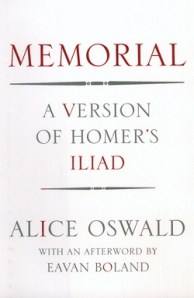

The weft of Margaret Atwood‘s The Penelopiad is contained in and revealed through the chorus voiced by the twelve maids hung by Telemachus (on Odysseus’ orders) just after the men returned from their manly adventures. Margaret Atwood runs the chorus line throughout her Penelopiad, the executed maids sing their songs at ten intervals in the book. I was struck by a comment that Atwood makes in her notes about the maids. She stated that:
‘The Chorus of Maids is a tribute to such uses of choruses in Greek Drama. The convention of burlesquing the main action was present in the satyr plays before the main drama.’ (Margaret Atwood, Author Notes for The Penelopiad pp. 197-198)
I am always interested in how women writers burlesque the heroic perception of the classics through use of device and structural underpinning. In this instance I have been reading Atwood’s The Penelopiad and Alice Oswald‘s Memorial. Both Atwood and Oswald approach Homeric themes in a sidelong fashion to get to the meat of the oral tradition, their poetic focus is decidedly on the lament. Atwood gives voice to the subversive and unquiet maids of The Odyssey. Oswald creates a dirge through interweaving the names of fallen warriors of The Iliad. Both Atwood and Oswald use the lament as the kernel for their thematic variations from and approaches to Homeric mythos. The poets use repetition to add texture to their laments thereby shaping and focusing the small forgotten voice toward expressing a universal grief. This is a not heroic poetry, it is a poetry of keening and loss.
Oswald’s Memorial has drawn quite divided critique. I mention in particular Jason Guriel‘s reductionistic approach to the book in which he refers to it as ‘a rose-fingered yawn’. This slighting throwaway remark does little to evoke interest in how women poets actually write, nor does it sufficiently disguise Guriel’s critical ennui. I would point the general poetic-reader to Michael Lista’s critique of Memorial in order to garner a more balanced view of the work.
Atwood’s twelve maids defiantly do not not burlesque the main action of The Penelopiad. They are the main action of the book. Penelope reveals herself to be a tedious bore whose lack of wit and guile are vaguely repellent. I wanted Atwood to get her toe out of the water and focus on the maids who enliven the text with their songs and shanties. The central pivot of The Penelopiad revolves round the nasty relation between Penelope and Helen rather than on the texturing of the maids burlesquing. In this, Atwood’s approach to Homer is a bit of a missed opportunity. The strength of the book is in its sub-theme which Atwood had not developed into a fuller rendering.
Oswald did not make a similar mistake in her approach to Homer’s The Iliad. She has broken down the book and re-made it a powerful dirge. The fact that this has led to an inability by her critics to get to what she is doing only strengthens the work in my view. The index for Memorial comprises an unnumbered litany of names from The Iliad. Oswald weaves their names into the text whilst interspersing their histories with individual laments for the warrior-groupings. These laments vary in length, they are devices to allow the mourning voice through. They are not separate to the main action of the book but are organically interleaved into and caught up in the theme and direction of this epic poem-dirge.
‘Like a man put a wand of olive in the earth
And watered it and that wand became a wave
It became a whip a spine a crown
it became a wind-dictionary
It could speak in tongues
It became a wobbling wagon-load of flowers
And then a storm came spinning by
And it became a broken tree uprooted
It became a wood pile in a lonely field.Like a man put a wand of olive in the earth
And watered it and that wand became a wave
It became a whip a spine a crown
it became a wind-dictionary
It could speak in tongues
It became a wobbling wagon-load of flowers
And then a storm came spinning by
And it became a broken tree uprooted
It became a wood pile in a lonely field.’Page 31, Memorial, by Alice OswaldIt interests me that contemporary women poets are approaching Homer through the use of the lament. They are voicing the silent mourning that occurs when the glory of battle is over. Atwood is giving voice to the abused girls whose life experiences are of enslavement and of misuse. Oswald does not state that the mourning voice in Memorial is that of a woman, but the cadence of the mourning poems that intersperse her text suggests the chorus, the lament.
In terms of contrast in poetic approaches to direct engagement with classical literature, one could point to how Ted Hughes re-told the twenty-four Tales From Ovid (Metamorphosis) or look at Heaney’s Beowulf. The fact that critique ignores the poetic engagement of women with the classics of literature only points to critical-disengagement, or at best to a narrow conservatism. It is time that The Chorus (that most pertinent part of Epic) is re-read, and given its place in the overall texturing of great poetic works. What would T.S Eliot’s Murder in the Cathedral be without the integrity of the women’s voices?
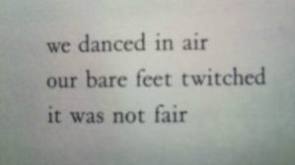
‘…he took a cable which had seen service on a
blue-bowed ship, made one end fast to a high
column in the portico, and threw the other over the
round-house, high-up, so that their feet would not
touch the ground. As when the long-winged thrushes
or doves get tangled in a snare…so the women’s
heads were held fast in a row, with nooses round
their necks, to bring them to the most pitiable end.
For a little while their feet twitched, but not for very long.’ The Odyssey, Book 22 (470473)

Transverse threads, women poets and Homer by C. Murray is licensed under a Creative Commons Attribution-NoDerivs 3.0 Unported License.
-
Marriage Advice, 1951
Glossy women made her tremble,
every word shiny and sure,
we’re going to give Jenny a make-over,
Jen, the decaying building,
the clueless relic.
They made her sweat, even more,
those women with Dior skirts
and nipped-in waists, who warned
the night before the wedding
about being prepared.
But it was 1951. Next day,
she tried not to faint at the altar
although the neighbours whispered,
later forced herself to stuff
some morsel of the wedding breakfast
through her lips, like bad language
or something a woman never did
masticate, masticate, chew, chew, swallow,
the fist of the still-hidden child
walloping her gorge as the best man rose,
twinkle-eyed, yellow card in hand,
a twist of jokes she’d be bound to appreciate.
Marriage Advice, 1951 is © Mary O’Donnell
Waiting
It has grown, not darkly, like mould, that sunless green. Sitting
provides the habit of air. Children – trees, coats, limbs,
the bounce of long hair as they troop the school road –
means stillness, expansion, despite unspeakable radio news
on the murder of infants in temperate suburbs. Muffled, gloved,
I grow in a car at the end of an eight-year planting, half of me
mulling the latest distant shooting. I would like to book a flight,
transplant skills, solutions, get there fast. Instead, I wait, the smell
of cooked dinner impregnating denims, boots, my cap, which she
inhales as she steps inside the car. I hold myself together
beneath iced winter branches in grey couteur, feel an invisible
frieze of buds stirring slowly, steady in deep cold..
Waiting is © Mary O’Donnell

Mary O’ Donnell Mary O’Donnell is the author of eleven books, both poetry and fiction, and has also co-edited a book of translations from the Galician. Her titles include the best-selling literary novel “The Light-Makers”, “Virgin and the Boy”, and “The Elysium Testament”, as well as poetry such as “The Place of Miracles”, “Unlegendary Heroes”, and her most recent critically acclaimed sixth collection “The Ark Builders” (Arc Publications UK, 2009). She has been a teacher and has worked intermittently in journalism, especially theatre criticism. Her essays on contemporary literary issues are widely published. She also presented and scripted three series of poetry programmes for the national broadcaster RTE Radio, including a successful series on poetry in translation during 2005 and 2006 called ‘Crossing the Lines‘. Today, she teaches creative writing in a part time capacity at NUI Maynooth, and has worked on the faculty of Carlow University Pittsburgh’s MFA programme in creative writing, as well as on the faculty of the University of Iowa’s summer writing programme at Trinity College Dublin.
-
Stone weighting my palm
has sprung a cathedralheart jumps
walking in the flesh of its surpassing grace
groin-vaulted and high asno bird ever escaped to soar this
high-up—
seamless andthere is no blood
no feather
no bone—stone cannot make the bird.
© C. Murray
- A version of Precarious Migratory Spectacular by C. Murray is one of two poems published recently in the Galway Review. This poem was collected in Cycles at Lapwing Publications (2013)
-
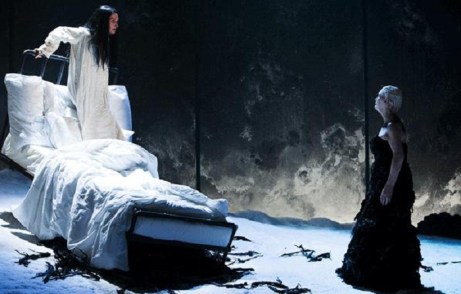
Excerpt from Woman and Scarecrow by Marina Carr Enter the thing in the wardrobe, regal, terrifying, one black wing, cobalt beak, clawed feet, taloned fingers. It is scarecrow, transformed. Stands looking at woman, shakes itself down, woman stares at it.
Scarecrow takes woman’s hand, pierces vein in her wrist, a fountain of blood shoots out. Scarecrow dips quill into woman’s wrist. A cry of pain from Woman.
Woman We don’t belong here. There must be
another Earth. And yet there was a moment when
I thought it might be possible here. A moment
so elusive it’s hardly worth mentioning . . . an
ordinary day with the ordinary sun of a late
Indian summer shining on the grass as I sat in the
car waiting to collect the children from school.
Rusalka on the radio, her song to the moon,
Rusalka pouring her heart out to the moon, her
love for the prince, make me human, she sings,
make me human so I can have him. And something
about the alignment of sun and wind and
song on this most ordinary of afternoons stays
with me, though what it means is beyond me and
what I felt is forgotten now, but the bare facts, me,
the sun, the shivering grass, Rusalka singing to
the moon. And I wonder is this not the prayer
each of us whispers when we pause to consider.
Make me human. Make me human. And then
divine. And I wonder is it for these elusive
prayers we are here, these half sentences that
vanish into the ether almost before we can utter
them. Living is almost nothing and we brave
little mortals investing so much in it.Scarecrow You’re determined to go with romance on your lips.
Woman I know as well as the next that the arc of
our time here bends to tragedy. How can it be
otherwise when we think where we are going?
But we must mark those moments, those
passionate moments, however small. I looked up
passionate in the dictionary once because I thought
I had never known it. And do you know what passion
means ?Scarecrow It comes from the Latin, pati, to suffer
© Marina Carr , all rights reserved
Excerpted from *Woman and Scarecrow, published Gallery Press, 2006.

Gallery Press celebrated their 43rd Anniversary in publishing this week of February 2013. Marina Carr is a playwright known to us for the excellence of her work. I was incredibly privileged to witness Marina read from her play Woman and Scarecrow in Galway during Gallery Press’ 40th Anniversary celebrations three years ago. I blogged about Carr’s reading here. I am interested in how writers use the theatrical-space to create image and symbol, as much as I am interested in how poets use the theatrical-space for poetic works. Gallery Press publish both poetry and drama, thus I wanted to look at Marina Carr’s use of structure and symbol in Woman and Scarecrow. Thank you to Suella from The Gallery Press who has helped me to find the relevant sections of the play, and who has often aided me in the past with regard to permissions for hosting Gallery poets on this blog.
- Images from Woman and Scarecrow can be found at the SecretSpaces blog
-
The Wild Pupil
I have spent my life
squeezing my fingers between
vibrating leaves of costal bone,
insistently scraping fascia
from muscle from nerve,
unhooking your sternum
from your throat,
prizing apart
the wedges of your spine
to reach that precious bag of blood,
to quell its chaotic pulse;
to jump back
as your thorax springs open
like an eye,
your heart
the wild pupil.‘The Wild Pupil ‘ is © Kathy D’Arcy, from The Wild Pupil, published by Bradshaw Books.
.

Kathy D’Arcy is a poet, workshop facilitator and youth worker based in Cork city. Originally trained as a doctor, she is currently writer in residence with Tigh Fili Cultural Centre. Her second collection, The Wild Pupil, was recently launched in Dublin by Jean O’ Brien and in Cork by Thomas McCarthy. She has just been awarded an Arts Council Artists’ Bursary to support the future development of her work.
info at http://www.kathydarcy.com/
 Chris Murray