The event was bi-partite in structure, with readings by three poets and story-tellers to begin, a brief interval filled with music was quickly followed by three more readings by three more women writers. The first half was decidedly poetic, with readings in English and Irish by Celia de Fréine, Nuala Ní Dhomhnaill and Eilis Ní Dhuibhne.
Celia De Fréine read In Relation to Each Other, Dearbhail , Celia Óg , and Ophelia. Dearbhail was indeed heart-breaking, the tale of the murder of Dearhbailby jealous women.
Eilis Ní Dhuibhne read two tales , The Man Who Had No Story and The Blind.
Music flowed along with wine as Jane Hughes on cello & Ellen Cranitch on flute played a selection fromCarolanand Tchaikovsky, including the much giggled upon Fanny Power.
Interval over, the business of literature reared it’s head in the shape of Mary O Donnell,who read from a WIP about Northern Ireland , alongside two poems which were tremendous and indicate a wonderful talent in two quite distinct areas of writerly discipline.
Sarah Clancy charmed the crowd with her Argument Poems , which included Ringing in Sick To Go Mermaid-Hunting, Cinderella Backwards , and Riot Act.
Mia Gallaghertopped the evening off with some reading from her upcoming book.
This should not have been a unique evening in the calendar. There are hints of more such evenings being planned, the audience was mixed between the sexes and they were always interested. It was utterly charming, eclectic and beautifully balanced. I expect that people who wish more detail on the music and books can contact the Irish Writer’s Centre directly. Kudos to the board, volunteers and organisers for a great evening.
Learn. The winter trees. Hoarfrosted crown to root. Immovable curtains. And learn too of the zone where a crystal steams and trees merge into mists, as the body in recollection of it. And behind the trees, the river mute wings of the wild duck the whiteblind blue night of hooded objects standing: it is here we must learn the trees’ inexpressible deeds.
Trees by Ágnes Nemes Nagy, from Between , Selected Poems of Ágnes Nemes Nagy, translated by Hugh Maxton, Corvina Press , Budapest and Dedalus Press , Dublin. 1988.
Má chuirim aon lámh ar an dtearmann beannaithe, má thógaim droichead thar an abhainn, gach a mbíonn tógtha isló ages na ceardaithe bíonn sé leagtha ar maidin romham. Tagann aníos an abhainn istoíche bád is bean ina seasamh inti. Tá coinneal ar lasadh ina súil is ina lámha. Tá dhá mhaide rámha aici. Tairrigíonn sí amach paca cartaí, ‘An imréofá brieth?’ a deireann sí. Imrímid is buann sí orm de shíor is cuireann sí de cheist, de bhreith is de mhórualach orm Gan an tarna béile a ithe in aon tigh, ná an tarna oíche a chaitheamh faoi aon díon, gan dhá shraic chodlata a dhéanamh ar aon leaba go bhfaighead í. Nuair a fhiafraím di cá mbíonn sí, ‘Dá mba siar é soir, ‘a deireann sí, ‘dá mba soir é sior.’ Imíonn sí léi agus splancacha tintrí léi is fágtar ansan mé ar an bport. Tá an dá choinneal fós ar lasadh le mo thaobh. D’fhág sí na maidi rámha agam.
Geasa le Nuala Ní Dhomhnaill, as Pharaoh’s Daughter. Gallery Press. 1990. This poem is from Pharaoh’s Daughter by Nuala Ní Dhomhnaill, 1990, Gallery Press (Editor Peter Fallon). With thanks to Gallery Press for permission to reproduce here. I have added poet Medbh McGuckian‘s translation atlink
The Bond, by Nuala Ní Dhomhnaill, translated by Medbh McGuckian.
In a recent post, I referred to my curiosity about Doris Lessing’s poetry, in some ways this curiosity has been sated. Alison Greenlee, special collections librarian in Tulsa University assured me that Ms. Lessing’s Book, Fourteen Poems was accessible in a Dublin College. Last Monday morning I went out to UCD to access the book and to transcribe two poems from it for use on this site.
Jonathan Clowes literary agents have agreed that the Poethead site can publish two poems from the Fourteen Poems book for a period of twelve months. The getting permission process is necessarily slow, and Poethead readers who wish to read the two chosen poems are relying on my transcriptions! Two Things about the above statement, my transcriptions are generally ok, even when they occur in climate-controlled premises (which make me sleepy) and I chose the poems (sight unseen) from a list! I like the two Lessing poems that I have chosen and I do hope that the permissions, which are winging their way to London as I write, will allow their publication here in the next week or two.
Fourteen Poems is a pamphlet, it is card-bound and is in immaculate condition. I am reproducing here the image of the copy that is included in UCD special collections. There were 500 prints, and numbers 1-50 are signed by the author. UCD does not have a signed copy. I am adding here the names and contacts of those people who have very generously facilitated a writer’s curiosity, with many thanks. I have decided to publish the poems by title, together, as part of the regular A Saturday Woman Poet articlesthat I have been posting for over three years.
Thanks are due to the following people for their courtesy and attention in facilitating my reading of the book :
I have discovered a great interest in reading some of J.B Priestly’s Three Time Plays during this week also, but I have decided to write about reading the poetry as it was a lovely privilege to find that there was a copy available in Dublin, and to get access in such a timely manner! I have the two chosen poems and they are all ready to go.
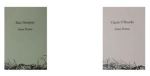
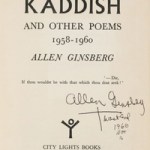
The pictured editions carry a huge poetic punch, though it would be unfair to compare them as like. The Moth Little Editions were released this month, the Ginsberg is pre-1960 and HannahWeiner’s booksas objects of art were made in the 1970/80s. They are all serious books in small form, a virtue of City Lights and other makers of accessible arts books.
This post was advised by a brief Twitter discussion on portable poetry, such as the carrying of T.S Eliot‘s Four Quartets about for reading.
Quite recently I was genuinely amazed to receive four poetry books nestled within one (white) standard office-sized envelope from Moth Editions , and although the books are small they each contain 32 poems. This post is about physical books rather than about code , or indeed the storage and the dissemination of poetry through sites like Kenneth Goldsmith’s UBUWEB, which I have referred to before now here. I carry books around in a variety of bags, in fact , the type of bag I will choose for a day is never dependant on as a fickle a thing as fashion , but upon how big a bag I will require for a notebook , diary, boo , ( mostly poetry or biography), and pencil-case and letters (yes letters , I write those).
Poets Dermot Healey, Kate Dempsey, Ted McCarthy and Ciarán O Rourke form the quartet of poets that make up the first of the Moth Little Editions, I had introduced two of Dempsey’s Poems from the series quite recently.
Of course distillation and new formats can lead to the strangest of visual concentrations, such as using QR Code to bring a whole new audience to writers, including to Herman Melville and James Joyce. In the fictional sense, the creation of a Babel Library has it’s own interest and weird beauty. This post is about the mobility and adaptability of small texts, and how wonderful it is to be able to choose a good book like the Four Quartets to bring out with one to read !
The beauty of poetry is that it is highly adaptable to both book and technology formats and thus very versatile.
Adrienne Cecile Rich has been nominated for the 2011 National Book Award , so no better time to link to her opus. Adrienne is 82 years old and a poet of force. I thought to add a poem and biography here to celebrate.
Adrienne Cecile Rich, pic from Google images/JWA
Diving Into the Wreck by Adrienne Cecile Rich.
First having read the book of myths, and loaded the camera, and checked the edge of the knife-blade, I put on the body-armor of black rubber the absurd flippers the grave and awkward mask. I am having to do this not like Cousteau with his assiduous team aboard the sun-flooded schooner but here alone.
There is a ladder. The ladder is always there hanging innocently close to the side of the schooner. We know what it is for, we who have used it. Otherwise it is a piece of maritime floss some sundry equipment.
I go down. Rung after rung and still the oxygen immerses me the blue light the clear atoms of our human air. I go down. My flippers cripple me, I crawl like an insect down the ladder and there is no one to tell me when the ocean will begin.
First the air is blue and then it is bluer and then green and then black I am blacking out and yet my mask is powerful it pumps my blood with power the sea is another story the sea is not a question of power I have to learn alone to turn my body without force in the deep element.
And now: it is easy to forget what I came for among so many who have always lived here swaying their crenellated fans between the reefs and besides you breathe differently down here.
I came to explore the wreck. The words are purposes. The words are maps. I came to see the damage that was done and the treasures that prevail. I stroke the beam of my lamp slowly along the flank of something more permanent than fish or weed
the thing I came for: the wreck and not the story of the wreck the thing itself and not the myth the drowned face always staring toward the sun the evidence of damage worn by salt and away into this threadbare beauty the ribs of the disaster curving their assertion among the tentative haunters.
This is the place. And I am here, the mermaid whose dark hair streams black, the merman in his armored body. We circle silently about the wreck we dive into the hold. I am she: I am he
whose drowned face sleeps with open eyes whose breasts still bear the stress whose silver, copper, vermeil cargo lies obscurely inside barrels half-wedged and left to rot we are the half-destroyed instruments that once held to a course the water-eaten log the fouled compass
We are, I am, you are by cowardice or courage the one who find our way back to this scene carrying a knife, a camera a book of myths in which our names do not appear.
This poem is for lovers of poetry, for those who read women poets and wonder at the gender-imbalancein literary publication. I have decided to keep it simple and to add my favourite Rich , alongside a reading list. This site has always been about encouraging poetry writers and readers to research books that they enjoy and bringing the amazing words of women writers into view. We have a visibility issue which is deeply questionable in my view. There are now 62 Saturday Woman Poets published here since 2008.
There are two posts on this blog which link to short poems by Lilian Ursu. The poems are from the Poetry Book Society Recommended Translation of The Sky Behind the Forest, by Liliana Ursu. The volume had two translators, Adam J Sorkin and Tess Gallagher.Interestingly, the volume does not initial the translators work beneath the text , so it is very hard to identify which poems were translated by Gallagher. This blog is dedicated to the work of women writers, editors and translators, so I thought to examine Gallagher’s approach to the poet and to her work. I am referring to the published notes on the translations throughout.
Liliana Ursu is Romanian, she was born in Sibiu in 1949 and lived in Bucharest during the Ceaucescu regime. She graduated in English at Bucharest University and taught part-time there for ten years. Ursu has published two books of short stories, six books of translation and books of poetry. She travelled as a visiting professor to Pennsylvania State University on a Fulbright Grant in 1992-1993. I have decided to include here a Bloodaxe page about Ursu, as well as a link to Lightwall. .
Tess Gallagher describes herself as “a poet-companion” in her preface to the Poetry Book Society edition of Ursu’s The Sky Behind the Forest. It is an apt description for a fellow-traveller in the arts.Bad translation has been a bugbear of mine for some years, given that wide internet dissemination has sometimes led to appalling and quite inflexible machine-spewed translation. The ability to translate from an academic, collaborative or empathetic base is what wholly contributes to the poetry reader’s pleasure in coming as close as it is possible to the spirit of the poem and to the intent of the author.
I chose The Gallagher translation of Ursu as an exemplar of collaborative translation, but I could just as easily point to Hugh Maxton’s wonderful translations of Ágnes Nemes Nagy’s Between , or Marion Glascoe’s edition of Julian of Norwich. Gallagher is a collaborator both as a poet and as a woman, and her ability to communicate the Ursu text , along with Sorkin, hinge on collaborations and on poetic sympathy.
Her approach is not solely academic but occurs at a level of universality, which is indicated in her approach to the work here ,
In the Dusk.
In the dusk the statues smile more enigmatically. Not a breath of wind troubles their gaze. You look at me and know how autumn makes its way. In the dusk, under our bodies the hill sinks to ruin –
weightless, at last.
from The Sky Behind the Forest. Publ. Bloodaxe , 1997.
(To Gandhi) I will walk with all walking people And no I will not stand still Just to watch the passers-by This is my Homeland In which I have A palm tree A drop in a cloud And a grave to protect me This is more beautiful Than all cities of fog And cities which Do not recognise me My master: I would like to have power Even for one day To build the “republic of feelings.”
Translated from the Arabic by Ghias Aljundi. Tal Al-Mallouhi
This is a reposting of Tal Al-Mallouhi’s You will remain an example, dedicated to Gandhi. Tal’s story is linked here.
There is another post which I wish refer to in brief, it is called Books written , ‘The Library of Babel‘ and it is by Borges. This short fiction from Borges’ Labyrinths, describes a mythological library of great density, proportion, and uniform. The library exists ab aeterno , from the eternal.
It contains everything ever written, expressed , or conceived in all languages, including , ” false catalogues and the demonstration of the fallacy of those catalogues.” The link I have included in the second short paragraph of this post looks at the design of the fictive Babel Library.
I like to think of it as an almost entirely true tale , as so many books of wisdom have been destroyed or made inaccessible by people who find human thought to be an inconvenience to their wishes and plans. The narrator of the library is an old man, who intends to die there amongst the books, he recounts his searches, his attempts to translate the orthography of the library and his relation to books in the piece.
A good friend in Catalunya once wrote an amazing piece on book-burningcentred in the celebration of St Jordi’s Day, when people give to each other books and roses. I have not his excellent writing ability, but I do tend to believe that the books not written in this instance, will not stop her words emerging or her book from existing.
Words when uttered and written cannot not be taken back and must have their effect. There is something wholly infantile about banning and brutalising a youthful poet, I think it may be because the words used to commit the brutalisation have become empty of their validity and symbolism for a great many people. The same goes for those people who wish to censor the great Walt Whitman from classrooms in CA, you do not encourage critical discernment by labelling books of genius as ‘bad’ because the singer of the poems was gay!




 Chris Murray