First of all we want to say well done. We achieved a lot this year. An unprecedented effort was made to meet as many local and national politicians face to face to explain why the arts are vital and why public funding is needed. More than 85 TDs were met. Presentations were made to Oireachtas Committees, local councillors, as well as a variety of conferences, seminars and university groups. Members of the public and many of us who work in the arts sent nearly 12,000 emails to their TDs.
Thanks to those of you who helped make this happen. You have helped the arts in Ireland.
Funding will be down in 2011. The impact on individual artists and organisations won’t be known until next year. However we made the case. We were listened to. The cuts at national level are nothing like as bad as many had feared. (We won’t know how much local funding is cut by until later next year). Here’s the initial news we have about the Budget and the arts:
* The cuts are biggest on the capital side rather than current spending.
* Culture Ireland got a big increase of 71%.This huge increase is to roll out its programme Imagine Ireland in the USA next year.
In terms of how the constituent parts of the Department break down, see below.
Department Breakdown
2010 €m
2011 €m
Change 2011 over 2010
Tourism
€153,120
€147,827
-3.46%
Culture
€153,177
€136,891
-10.63%
Sport*
€117,721
€86,525
-26.50%
Administration costs of Department
€11,282
€11,002
-2.48%
*Sports funding dropped significantly because some of the major sports infrastructure projects e.g Aviva Stadium, National Sports Campus etc are completed. But elsewhere an additional €5 million is allocated in grants to sporting bodies.
NOTE: This post will be archived and migrated onto the Poethead Campaign for Arts page in a short time. It helps to keep all related materials near each other so that the reader can trace exactly how FF/GN have consistently undermined and eroded Arts Development in Ireland.
Savings of €76 million need to be made by 2014 : NCFA Response to the NRP 24/11/2010.
The NCFA has issued a very restrained response to the proposed Governmental cuts in Arts andHeritage (Including Cultural Institutions), So it’s linked here, whilst I examine the faulty RSS feed:
These are being frontloaded in 2011 with a cut of €26 million. Final figures will be announced on Budget Day.€50 million will be saved over the remaining 3 years.
Only €5 million of this €26 million will come from a reduction in allocations to cultural institutions and cultural projects. See below:
* Reduced allocations to cultural institutions and cultural projects €5 million
* Reduced funding for sporting bodies and agencies including Irish Sports Council and National Sports Campus €3 million
* Reduction in tourism expenditure through operational efficiencies, prioritisation of activities and more focused tourism marketing investment €5 million
We checked with the Department today and we understand that the €5 million cut to culture covers Budget Lines D1-D10 in the annual budget . In other words €5 million has to be saved from across the following budget lines. How much each will be reduced by will be announced on Budget Day on Dec 7th.”
Slight Rant : Fianna Fáil Planning 2000-2010 and how it effects Ireland’s natural and built heritage.
Unfortunately , the issue here is of trust. The jaundiced and repellent Fianna Fáil approach to Arts, Heritageand Culture (including Gaelteacht Affairs) does not allow for green shoots, but presents instead a hackneyedand twee vision of Ireland. I do not think there will be a radical change in policy without a change in Government. Other Poethead Posts and Pages on this issue include petitions for Independent Writers Centresfunds not to be cut, the PH links to Save Tara and include the truly illiterate Blasphemy Criminalisation intoIrish law in January 2010. Even when the country was rolling in money , Fianna Fáil heritage policy involvedswapping actual Heritage centres for interpretative Centres, and under-funding the National Library archives tothe point of not providing them with heat, climate-control or decent storage spaces.
The Irish Green Party : ‘If you sup with the divil, best bring a long spoon made of Asbestos’.
Its pretty obvious that I have been opposed to Governmental policy in the Arts since the 2003 Arts Act,and since 2000 in relation to Fianna Fáil’s consistent negligence in heritage affairs, which have seen araft of planning bills introduced into the Dáil which have been not balanced with Bills that focus onConservation of Ireland’s natural and built Heritage. I suppose that when the EU , banks and planninginvestigations complete , the current Green party will hold up its hands and admit they didn’t know aboutwhat has been blindingly obvious to everyone else all along. The fact that we are and have been inBreach of EU Directive does not bother individuals or party members , because they have not beencriminalised and/or brutalised for pointing out years of abject failures or profit-centred planning, including the National Monuments Act 2004, The SIB 2006, The Housing (Miscellaneous Provisions) Act 2002which is delightfully known as the Trespass Law . In the period between 2000-2006 , Fianna Fáil did notpresent a single Act wholly focused on conservation, one can see where their priorities lie quite clearly and itmust be said those of their junior coalition partner too.
III. White Nights Furrow-plodders in spats and bright-clasped brogues Are cradling bags and hoisting beribboned drones As their skilled neck-pullers’ fingers force the chanters
And the whole band starts rehearsing Its stupendous, swaggering march Inside the hall. Meanwhile
One twilight field and summer hedge away We wait for the learner who will stay behind Piping by stops and starts,
Making an injured music for us alone, Early-to-beds , white-night absentees Open-eared to this day.
Note : I am attaching to this short post a link entitled : Feis Teamhar , a Turn at Tara because I was there to hear the poets and musicians on that day. I believe that the Newspapers under-reported the day and did not attend to Mr Heaney’s words. He was there to celebrate Tara as a cultural centre and to support the Campaign to Save Tara . He was also there to support his nephew who was and is a Tara Campaigner .
Since that time , there have been other feiseanna at Tara, this was the inaugural one organised by ” Paul Muldoon, Pulitzer prize-winner, will read his poetry to celebrate and honour Tara and will be joined by musicians: Grammy award-winner Susan McKeown, Laoise Kelly, Aidan Brennan and others “.
I did my first post on the Take Back the Tech Campaign in 2006 , this year’s campaign is being promoted now.
“Take Back The Tech! is a collaborative campaign that takes place during the16 Days of Activism Against Gender-based Violence (25 Nov – 10 Dec). It is a call to everyone – especially women and girls – to take control of technology to end violence against women. “
This is a short note calling attention to the Campaign and a link to the Take Back the Tech 2010,
With thanks to Judith Buckrich (ex-Chair) of The International PEN Women Writers Committee,and Vice-President of The PEN Centre in Melbourne. I am attaching a linked Paragraph from :Women left on bottom bookshelf (Emma Young, full article at the base of this piece. (link#1)
“It’s hard to deny that this is a part of life in fiction. It’s a popularly condoned idea that novels written by men are neutral and on the shelves to be enjoyed by anyone but novels written by women can excite lower expectations and are looked at as exclusively feminine: a female voice for a female audience. In other words, books written for women are chick lit, while books written for men are just books. This idea also has legs in the world outside fiction.” (link#2)
Oh ! back to the vexatious Chick-lit question, where consumer-choice and empty lifestyle pretendsto an Austen-like inch of ivory, and where in Ireland (at least ) vacuity is rewarded with attempts bycertain media-types to include disposable novels on our children’s examination certificate syllabi!!Sure police-helicopters are sent in hunt for Jonathan Franzen‘s bifocals and this tittle dominatesmedia-time. It appears one must have a testicular style to become the luvvie, though I expect italso helps to be a writer of merit, which cannot be denied . This doesn’t explain why women writersand makers of literature are shoved into the shadows, critically, academically and historically , untilthey acquire the label specialisation.
Further to the discussion, VIDA have recently published a forum on Gender and Publishing, excerptedhere and linked beneath Dr Buckrich’s Website and Emma Young’s Piece here as third link. it is worth the read:
Tracy Bowling: “I do believe that bias is present in the publishing world such that women writers are underpublicized and undersold after their work is published, but it’s not a bias I feel very qualified to speak to. The more distressing evidence of a gender bias I see comes before publication, in that women writers often seem pressed to fit themselves very neatly into categories, to define a space for their work or to proclaim whose footsteps they’re following in. In the wake of Jonathan Franzen’s glowing reception, many writers have discussed the infrequency with which the word “genius” is applied to women writers; I’d be curious to see if the same is true of words like “breakthrough,” “innovative,” and “new.” I think that in order to attain success, especially in mainstream publishing, women often have to (often artificially) join a particular group or cohort of other women writers in order for their craft to be perceived as serious and studied. I’ve seen this a lot among women who write fantastic or fairy tale fiction, where, for example, no matter how little one’s work resembles or echoes that of Angela Carter, that work rarely gets discussed without heavy reference to Angela Carter. The really unfortunate side effect of having to strategize and situate oneself as one among many others, I think, is that women become less likely to write the Franzen-esque literary epics, simply because there is less precedent–less of a niche within which their work can be easily framed.” (link#3)
Personally, I expect that if you are a man, its easy to have a blind-spot on the under-representation ofwomen in Government, in the Literary Arts and in Media. The fact that many (many) people do notequate media-time (luvvieness) and column inches with that strange heeled penile-worship ofmodernism and that frisson of tokenist gender-equality doesn’t mean that the issue of discriminationdoes not occur. It occurs, it is celebrated and it is a part of our lives wherein meritocracy is just another by-word for male dominance.
EDIT : (VIDA discussion re-posted this morning on the Web)
“I soon discovered that a lot of women writers routinely perform their own version of “the count” when surveying anthologies, journals, book reviews, and awards. At the time I was unaware of Juliana Spahr and Stephanie Young’s essay “Numbers Trouble”; nearly all of the women I was in dialogue with directed me to it. I was astonished to discover that a sub-genre of poetry (which I’ll refer to by shorthand as “experimental”) I’d have assumed would most fairly represent the sexes may be as biased as the more “traditional” sub-genres in poetry, as well as the more commercial venues for prose. I would later be struck by the fact that women writing in all genres are affected by this disparity.
This experience was akin to peering over a very high wall to gaze upon a neighbor’s backyard—a neighbor I’d always assumed was living the good life—and discovering that this neighbor’s life was, in fact, quite similar to my own.”
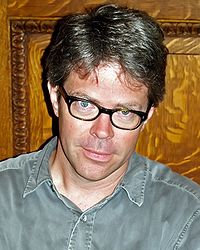
Jonathan Franzen, whose lost glasses sparked a cop-hunt and media-dominance.
“Human rights are attached to individuals, not to states or organized groups or ideas,” said International PEN President John Ralston Saul, who chaired the two-hour session entitled Faith and Free Speech: Defamation of Religions and Freedom of Expression. “When governments attempt to limit the rights of citizens, they are not seeking to protect faith or belief. They are seeking increased power over the citizenry.”
It worries me that the Irish Government sought to restrict free expression by introducing a blasphemy criminalisation into the Irish Statute on the 1st of January 2010 under the aegis of the 2006-2009 Defamation Bill and more so that this will not be reversed through Referendum until at least 2011. For information on the Blasphemy legislation in Ireland which sites Blasphemy in the ability to ‘Outrage’ please see the second attached link at the end of this piece.
Oh and of course Poethead has a search engine , into which Blasphemy can be entered , therein some links to the Irish situation and the wonderful Blasphemer’s Banquet , by Tony Harrison.
How Squalid censorship is !!! The realm of the small-minded hypocrite.
Whilst awaiting this morning for a sheaf of three poems from my Saturday WomanWriter, I thought to add in an excerpt from the Notebooks of Simone Weil, whose Necessity is the most sought after poem on the Poethead blog. I will include at the end of the excerpt a link to Necessity in stand alone format (without comment). Here follows an excerpt from Le Personne Et Le Sacré :
“Beauty is the supreme mystery in this world. It is a brilliancethat attracts attention but gives it no motive to stay. Beauty is always promising and never gives anything; it creates a hunger but has in it no food for the part of the soul that tries here below to be satisfied; it has food only for the part of the soul that contemplates. It creates desire, and it makes it clearly felt that there is nothing in it [beauty] to be desired, because one insists above all that nothing about it change. If one does not seek out measures by which to escape from the delicious torment inflicted by it, desire is little by little transformed into love anda seed of the faculty of disinterested and pure attention is created.“
I have used this paragraph before as a static text in this blog, because it epitomizes Weil’s writing. It was the centenary of her birth in 2009 and some of those notebooks made their way into general publication. Weil is placed with Paschalin terms of her philosophical and writing output, but it incredibly difficult to locate texts in ordinary bookshops in Ireland. I have quoted from Thinking Poetically, ed Joan Dargan.
I suppose that it is an approach to art that encapsulates the purity of the relationship between the individual and the transcendent work that I find attractive, living in a country (as one does) where people must fight to bring to Government the necessity and importance of the arts: in their funding, archiving, presentation and their preservation. There is always hope that the necessity of the arts in developing the intellect will be recognised and supported in Ireland.
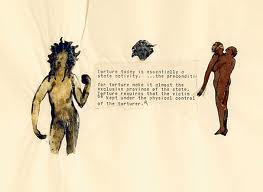
Torture of Women , Nancy Spero. Publ 2010, Siglio Press.
The latest edition of Guernica Magazine includes a review of the Spring 2010 publication of Torture of Women by Nancy Spero. I am linking this review at the bottom of this small piece, along with a link to the publication notes.
There is a Nancy Spero image on the site already, accompanying another piece. It is from the 1976 series of Torture of Women , based on the 125 ft piece by Spero. This Spring 2010 , Siglio Press published the work in book form in a 126 page cloth bound edition which is reviewed at link by Guernica Magazine.
“With an essay “Fourteen Meditations of Torture of Women by Nancy Spero” by Diana Nemiroff; “Symmetries,” a story by Luisa Valenzuela; and an excerpt from The Body in Pain: The Making and Unmaking of the World by Elaine Scarry. ”
(from the Siglio Site)
The Guernica Magazine slide show opens with references to Pinochet, a byword in torture and repression . It interests me greatly as a writer that the names of the disappeared get lost in our histories whilst the name of the Torturer gains a notoriety and cachet which seems to point to a great attraction to fear. I wrote an obituary for a great woman writer who spent her life investigating and resisting Pinochet and was nominated for a Nobel prize. She collected testimony and wrote works of fiction and non-fiction based in the Pinochet era, her name, Patricia Verdugo is mostly ignored in Western Media ! We recognise and rationalise the work of torturers thus giving them a validation that they ill-deserve. Thatcher notoriously invited him to tea in England.
Women artists and writers like Frida Kahlo, Anna Politkovskaya, Patricia Verdugo and Mirjam Tuominen have grappled with the themes of torture and have attempted to redress the balance. This volume of Spero’s artwork will continue with that work of engagement at visual artistic levels. There seems to be little in artistic analysis and dialogue in this most pressing of feminist engagements.
I have little success getting my poor letters published in the Irish Times, so I have decided to publish it here in toto. It comprises a response to a throwaway comment regarding the responsibility of poets during this post Mythical-Celtic Tiger era.
Re : ‘From the Poetic to the Prosaic’ 20/08/2010
Madam,
This comment from the letter entitled “from the Poetic to the Prosaic” ( Friday August 20th 2010) is quite clearly woefully misguided; ” The role of poets should be respected, but the attempts of politicians to root out the rot and restore order in the State are equally worthy.”
Whilst Poets may be accused historically of being ‘Love-Trips’; and subject to the vagaries of the Taoiseach’s speech-writer , they quite clearly have not beggared the country.
It’s not funny that the Taoiseach would have recourse to writers to disentangle us from this mess.
It is , however, quite hilarious that the very people who have taken the brunt of Fianna Fáil arts policy and cuts would want to extol the virtues of the mythical Celtic Tiger era, in its scenes of cultural devastation from Tara, through cutting to ‘zero’ funds to two of our three major writer’s centres ! ( 0 funds)
Maybe Mr Cowen could ask elsewhere for the extolling of Irish Art. I suggest that he start with the Ahern Family who are getting the tax breaks and are considered to be ‘Artists’ in this benighted state.
your’s etcetera (letter ends)
I reckon that O Donoghue’s 2003 Arts Act is responsible for Taoisigh going where angels fear to tread myself. The Arts should be as independent as possible from the operations of the State- that does not prevent the writer/poet/satirist from commenting on Blasphemy, cultural destruction or the fact that an ex-Taoiseach and his family member are getting tax breaks under the artist’s exemption scheme.
Since new artists have been created under this government, I think that they should be the ones singing the praises of Ireland abroad, even if one of the books was allegedly ghost-written.




 Chris Murray