Trompe L’OeilTidied away, fast disappeared, Hidden phallic symbols litter the test What escaped thought becomes you? It would do well to save ink and rest, Eyeball to eyeball, keeping in check Stuck in the village. You’re lost, after all. Citrus RefreshBruised flesh, eaten by spinsters’ cries No one spies without a purpose The scented candle reverberates with intent Choosing select friends for me, Identical dress, though hips not developed Associating with local heroes Waiting for this mess to subside, Not caring for silent soldiers, speed bumps as such Skin on SkinIt rubs me up the wrong way, Woken up by solid cold extension, I am not amused, or inspired Outlining separation procedures close to hand Bloody finale, a pregnant conclusion You lie down, beyond reproach, not seen again They croon in time to your desecration Open WoundA cooked nerve, gaping at nothing Bespoke man-shoes don’t avoid the issue, Dancing in time to excruciating pain, It will pass, I know. Avoiding gangrene is good, Using my head for something, besides bright fantasy, Fine Feathers Do Not Make Fine BirdsBy foul means or otherwise, I stake my claim Not so much rebellion as assertion Is my eyeshadow too obvious? Puberty drags its heels, so do I, My friends can’t figure me out. Invisible curfews taken as read Trompe L’Oeil and other poems are © Patricia Walsh, Patricia Walsh image © Linda Ibbotson |
Category: Contemporary Irish Women Poets
-
-
The death of Eavan Boland (1944-2020) occurred on 27/04/2020 in Dublin, Ireland. Condolences to her family, friends, and colleagues. You can read a collation of tributes and obituaries to Eavan at this link.
EAVAN BOLAND
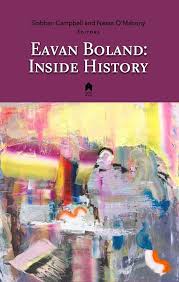
INSIDE HISTORYEavan Boland: Inside History, a new volume of essays and poems in response to the work of the internationally-renowned Irish poet, will be published by Arlen House on 1 December 2016. Edited by poets Siobhan Campbell and Nessa O’Mahony, Eavan Boland: Inside History is a reappraisal of Boland’s influence as a poet and critic in the 21st century and is the first major commissioned collection of essays to be published on Boland.
The volume includes critical essays on, and creative responses to, her work by leading writers, thinkers and scholars in Ireland, the UK, Europe and the US and reappraises Boland’s influence as a poet and critic for the 21st century. The fresh and diverse approaches provide a new frame for a critical engagement that crosses continental and aesthetic boundaries. The book, therefore, repositions Boland scholarship with a focus on the most important aspect: the poems themselves.
Contributions include a foreword by Mary Robinson, former President of Ireland, as well as essays by Jody Allen Randolph, Patricia Boyle Haberstroh, Siobhan Campbell, Lucy Collins, Gerald Dawe, Péter Dolmányos, Thomas McCarthy, Nigel McLoughlin, Christine Murray, Nessa O’Mahony, Gerard Smyth, Colm Tóibín and Eamonn Wall. There are also poems from Dermot Bolger, Moya Cannon, Katie Donovan, Thomas Kinsella, Michael Longley, Paula Meehan, John Montague, Sinead Morrissey, Paul Muldoon, Eileán Ní Chuilleanáin, Nuala Ní Dhomhnaill, Jean O’Brien and Nessa O’Mahony. The volume concludes with A Poet’s Dublin, a reissuing of the conversation that took place between Eavan Boland and Paula Meehan on the occasion of her 70th birthday in 2014.
“Eavan Boland worked as an editor with Arlen House in the 1970s and 1980s and did extraordinary work in developing new Irish writing and broadening the boundaries of Irish literature. We are pleased to publish this collection on her work,” said publisher Alan Hayes.
“As editors, we’ve been delighted to be part of the conversation that this volume has begun,” said Siobhan Campbell. “It’s been a privilege and an honour to work on this collection particularly as both Nessa and I feel poetically in Eavan Boland’s debt, as do so many of our contemporaries.”
978–1–85132–140–7, 368 pages, paperback, €25
978–1–85132–150–6, limited edition numbered and signed hardback, €55ARLEN HOUSE LTD, 42 Grange Abbey Road, Baldoyle, Dublin 13.
Phone: 086 8360236: Email: arlenhouse@gmail.com- US & International Distribution: Syracuse University Press www.syracuseuniversitypress.syr.edu
- The Book Depository: http://www.bookdepository.com/Eavan-Boland-Inside-History-Siobhan-Campbell/9781851321407?ref=grid-view
-
Dowsing/ RABDOMANTICA & other poems is © Daniela Raimondi, the english translations are © Anamaría Crowe Serrano DOWSING
Mother pregnant with rain.
Mother of virgin sounds,
with music in your marrow
and the chirping of a bird in your mouth.
Mother sewing and unsewing the waters and the tides
holding between your teeth the source of all rivers,
the alphabet that gushes on the tongues of poets
and leaves damp traces,
the imprint of a lamb wet from birth.
Mother of the dark-dark
Mother of the black-black night.
Moved by a primitive thirst,
the same need to flee from light
that pushes the hare deep into the scrub.
Touch me with your clear fingers
oil my lips with your blind love.
Like a heavenly valley where only light falls.
Your blue within another blue,
the intense azure breath of your sky.
RABDOMANTICA
Madre pregna di pioggia.
Madre di suoni vergini,
con un midollo di musica
e sulla bocca il gorgheggio di un uccello.
Madre che cuci e scuci le acque e le maree
che tieni stretta ai denti l’origine dei fiumi,
l’alfabeto che sgorga sulla lingua dei poeti
e lascia tracce umide,
l’impronta di un agnello bagnato dal suo parto.
Madre del buio-buio
Madre del nero-nero della notte.
Ti muove una sete primitiva,
la stessa fuga dalla luce
che spinge la lepre nel fitto della macchia.
Toccami con le tue dita chiare
ungimi le labbra di un amore cieco.
Come una conca celeste e senza ombra.
Blu dentro un altro blu,
azzurrissimo respiro del tuo cielo.
LOT’S WIFE
“But Lot’s wife
looked back and was turned into a pillar of salt.”
Genesis 19, 26
Tonight I’ve set my horses free.
I fed the blind dogs
then came through the mountains to find you.
I walked barefoot,
with flaming sunflowers in my arms.
I can no longer be what you wanted.
I’m just a body closed tight,
the sum of a thousand daily failures.
But how am I to survive the winter
or keep ignoring the brightness of your face.
Now I’m left with the absurd pride of losers:
stopping time with a hand gesture,
proudly challenging his fury at never bending me
to his will or ever reading my heart.
Death doesn’t bother me.
It’s just a subtle change in the air,
a breath that trembles over the earth
and disappears without the faintest sound.
Being deserted is what frightens me.
Your abandonment is what hurts the most
while your gaze burns
and turns me to salt.
Tell me:
did you hear me scream while my blood turned to stone?
Did you find enough rage in me to feed your heart?
How could my eyes meet yours and not tremble
how could I stare at the sky and not be destroyed.
And despite everything
I was still clinging to your hands
those horrible hands of yours, so big and empty.
There’ll be time now to forget.
A time without limits, like childhood.
And then I’ll remain still among the sheaves of wheat,
with this useless pride shining in my eyes,
with the ivy tightening round my wrists, and my hips.
LA MOGLIE DI LOT
“Ora la moglie di Lot
Guardò indietro e divenne una statua di sale.”
[Genesi 19, 26]
Stanotte ho liberato i miei cavalli.
Ho dato cibo ai cani ciechi
poi sono venuta fra i monti per cercarti.
Ho camminato scalza,
stringevo fra le braccia girasoli accesi.
Non so più essere come tu volevi.
Sono soltanto un corpo chiuso,
la somma di mille fallimenti quotidiani.
Ma come sopravvivere l’inverno
o ignorare ancora la luce del tuo volto.
Ora mi resta la fierezza assurda dei perdenti:
fermare il tempo con il gesto di una mano,
sfidare a testa alta la furia di chi non sa piegarmi
né ha mai saputo leggermi nel cuore.
La morte, sai, non mi spaventa.
Non è che un mutamento impercettibile nell’aria,
un respiro che trema sulla terra
ma poi si acquieta, senza il minimo rumore.
È l’abbandono che mi fa paura.
È il tuo abbandono quello che fa più male
mentre il tuo sguardo brucia
e mi trasforma in sale.
Dimmi:
sentisti le mie grida mentre il sangue si faceva pietra?
Trovasti in me la rabbia per nutrire il cuore?
Come incontrare i tuoi occhi e non tremare
come fissare il cielo e non esserne distrutta.
E nonostante tutto
ancora mi tendevo alle tue mani
quelle tue mani grandi, orrendamente vuote.
Ci sarà tempo adesso per dimenticare.
Un tempo senza limiti, come nell’infanzia.
E poi restare immobile fra le spighe di grano,
con questo orgoglio inutile a brillarmi dentro agli occhi,
con l’edera a stringere i miei polsi, ed i miei fianchi.
TRADESCANTIA VIRIDIS
The kitchen is a sanctuary in disarray.
There are relics of enamel in the sink,
copper lids hanging on the walls.
(Can you make poetry
talking about kitchen roll toppled on the table,
or wine stains that tarnish the edge?)
Take a piece of chalk
draw the perfect outline of a circle.
Belong to winter
and be its gift,
surrender to its white fringes.
She’s the type who forgets money and her keys,
who leaves things unresolved.
She believes in the watery sound of childhood.
Something inside her never learned to relax.
A piece of white chalk and she redraws the circle.
Removes the empty space she’s hiding
in her cage of bones.
She’s gone down to the street.
Buried six shadows in the field.
A voice called from the top of a crane,
from a vanilla sky without the flavour.
There was some greenery in the pots.
The voice called somewhere far away,
from a red box hanging in mid air.
Sometimes a voice is the simple formula
for a breath that tunes your lips,
warms your fingers.
Sometimes a voice draws perfect curves,
even on the slimmest of hips.
TRADESCANDIA VIRIDIS
La cucina è un santuario in disordine.
Ci sono reliquie di smalto nel lavello,
coperchi di rame appesi alle pareti.
(Si può fare poesia
parlando del rotolo di carta rovesciato sul tavolo,
o delle macchie di vino che macchiano il bordo?)
Prendere un gesso
tracciare il profilo perfetto di un cerchio.
Appartenere all’inverno
e dell’inverno essere dono,
concessi al suo margine bianco.
Lei è di quelle chi si scordano i soldi e le chiavi,
che lascia i quesiti irrisolti.
Crede nel suono infantile dell’acqua.
Dentro ha qualcosa che non sa riposare.
Un gesso bianco e ridisegna il cerchio.
Sconfigge lo spazio vuoto
che tiene nascosto in una gabbia d’ossa.
È scesa per strada.
Ha sepolto sei ombre nel campo.
Una voce chiamava da in cima a una gru,
da un cielo color di vaniglia ma senza il sapore.
C’era un poco di verde nei vasi.
La voce chiamava da un punto lontano,
da una scatola rossa appesa nel niente.
A volte una voce è la formula semplice
di un respiro che affina le labbra,
che ti scalda le dita.
A volte una voce disegna curve perfette,
persino sui fianchi più magri.
DECEMBER
Put the coloured baubles in the box.
And the little bells, the Christmas lights
in sheets of tissue paper.
Now look at the light on the lake:
swans cutting the silence,
leaving the imprint of evening on water.
There’s a hidden place in the darkness of flesh.
A space with no nerves that presses on the bones.
But it’s time to burn the old clothes,
to call the night standing still at your door
and then say – there it is, look.
(Your eyes like coins in the dark.)
I’ll choose an auspicious sky:
the curve of stars between Ursa Major
and the hill where the hares live.
It’ll be a simple gesture like
combing knots out of hair,
the slight act of untying a shoelace.
Remember that a woman’s patience
has the fragrance of whiteness.
It gathers pain and stores it in the dark,
in large water jars.
DICEMBRE
Metti le sfere colorate nella scatola.
E i campanelli, le luci di Natale
in fogli di carta velina.
Ora guarda la luce sul lago:
i cigni tagliare il silenzio,
lasciare sull’acqua il segno della sera.
C’è un posto nascosto nel buio della carne.
Uno spazio senza nervi che preme sulle ossa.
Ma è tempo di bruciare i vestiti vecchi,
chiamare la notte ferme sulla tua porta
e poi dirti – è là, guarda.
(I tuoi occhi come monete nel buio).
Sceglierò un cielo fortunato:
la curva di stelle tra l’Orsa Maggiore
e la collina delle lepri.
Sarà un gesto semplice come
lo snodare i capelli,
l’atto leggero di slacciarsi una scarpa.
Ricorda che la pazienza della donne
ha il profumo del bianco.
Raccoglie il dolore e lo conserva nel buio,
in grandi vasi d’acqua.
Dowsing/ RABDOMANTICA & other poems is © Daniela Raimondi, english translations are © Anamaría Crowe SerranoFurther Reading
- Robert Sheppard’s EUOIA (European Union of Imaginary Authors) Project (http://robertsheppard.blogspot.ie/2016/european-union-of-imaginary-authors.html).
- modern art and other poems by Anamaría Crowe Serrano
- Mindskin by Antonella Zagaroli
- Selection of poems by Daniela Raimondi From Inanna, Available on Kindle from Amazon: https://www.amazon.com/Inanna-Daniela-Raimondi-ebook/dp/B01MCSS7L8/ref=sr_1_1?ie=UTF8&qid=1476647206&sr=8-1&keywords=daniela+raimondi
-
Selfie With Thelma
after Thelma and Louise
In the Southwest desert
shedding turquoise on an old man’s palm
she trades time
for a beat up Stetson hat.
Only a day or two
since she posed with rose red lips
black sun glasses
and Audrey Hepburn headscarf
marking the start of their journey
with the big Polaroid held at arm’s length.
A snapshot of two smiling faces
left lying on the backseat
of a convertible
loaded down with all the stuff
they thought they needed
pencilling in borders
shoring up boundaries
soon smudged with ochre earth
lost in the dust from a stampede of stars.
Everything looks different now
doused with dirt they are part of place
gunning the engine
before flooring it for the canyon cliff.
Out here at Dead Horse Point
there are no shallow graves
wooden markers or name plates
only a thunderbird
still whipping up storms
suspended in a high solitary leap of faith.
Disarticulation
in memory of E M
For them the grave gave no rest.
Solely a spot to have and hold
not visit on stormy nights
with avellana and white lupin.
Their beloved kept above
the inscrutable depths.
Each light riddled skeleton
dispersed near and far
along slender paths
in groves of mountain thorn
among the forest’s earth stars.
Scattered bone shrines
leaving the departed free to wander
across space and place and time.
Out there in the raven Mesolithic
would they have buried you
with ochre and antler
deer teeth, flint and amber?
Far from settlement
on an island low in brackish water
would they have fanned flames
to seal the grave’s scarlet lips?
Back in our un-velveted sixties
dying the wrong death
your own was dug in liminal land.
Striking distance
of font and altar and magenta
gold and indigo glass
the tract where they lowered you
our dangerous dead.
But soon unearthed bones
will gleam in a blue Bedouin moon.
Humerus ulna radius
set on the valley’s wind scoured floor.
Femur fibula tibia
high on dry northern chalk.
Mandible and skull
without blessing stone or feather
here above bog and pine
and old ghost trains.
Alone where the watch bitch walks.
Whittling
From boyhood he had an eye for wood
reading sycamore and sitka spruce against the grain
he knew where to dip his hands into the shallows
scooping out rainbow trout and salmon.
It was all about patience, he said
kings of the orient and stars and lambs and shepherds
coaxed to surface with small short strokes.
Knife more buff than blade
guiding stag out of oak that wanted to be deer.
Disappeared on august sixteenth nineteen eighty one
his was a long wake
push and pull motion paring flesh to bone
laid out in half bog half quarry three miles from home.
Twenty nine years of Sunday searches
brought her a graveside
to shadow with time and worry whittled skin.
Thin as each and every syllable they chip in granite –
it wasn’t authorised by the leadership.
Shergar’s Groom Wonders
What friends would think
if they knew
history is filtered
through the eye
of a horse
other times would have buried
in a bridle of brass
with grave goods at his muzzle.
Shergar’s groom wonders
if those rebels
would have emptied a Mauser
into the river running down his face
or turned him loose
on mountain or meadow
slapping his rump
just for the hell of seeing him run.
Shergar’s groom wonders
if his bright boy
expected car-lined afternoons
bookies shouting odds
a jockey punching air
being led up that rickety ramp
night a soul-shaped thing
was glimpsed in frosted breath.
Shergar’s groom wonders
if Equus could really be attuned
to the rhythms
of the human heart
his dark pulsings
the last
the horse heard
no other could have gotten so near.
Shergar’s groom wonders
to this day where his bones lie
knowing they thought
him the perfect hostage
free from blood
they thought wrong
the horse
more brother than his father’s son.
And he would have been made lovely
for the earth.
“Disarticulation” and other poems are © Clare McCotter
-
The Light Dancing
When I close the door
my father’s coat slow-dances
against the dark wood.
It is old, this coat,
marked by many winters,
labours of a lifetime done.I imagine him in the front yard
screening sand for the new extension,
coat collar upturned against the breeze,
a cigarette ashing towards his lip.
There’s a light in his eyes
when I stop during play
to prattle and hear him say
“you’re the best woman in the house”Now coming from the Big Field,
the day’s farming done,
his great hands in deep pockets.
Dark shoulders that bear a darkness coming,
the last of the light
dancing on his wet boots.(first published in Ropes 2015. Issue 23)
Lizzie
I had a child’s view of her,
black stockinged legs
without shape of calf or ankle
at my grandmother’s hearth,
the fire shining in her laced-up shoes.
Balls of wool from an old shopping bag,
and her tongue like the clappers
as she looped and purled.
Her needles took up the light,
flew like red spokes
in the garment cradling her lap.She measured me
in the breadth of her childless arms
and grew me a shawl the colour of flame.
Its touch to kindle her memory
to set old fires dancing.(first published in Skylight 47. Issue 5 )
The Light Dancing” and “Lizzie” are © Catherine Conlon
-
Nurture
In the nine months I didn’t nourish you,
I made notes, I studied the seasons
for ingredients to encourage your growth.
Scraps of paper, post-its hidden
in case anyone would view my thoughts,
pity my trivia of leaves and berries.
A mom yet not a mother,
a woman yet not a woman.
My preparation took place in private,
not in maternity wards or hospital corridors,
but in the hallways of my mind
where I could put up pictures, time lines,
fill cork boards with plans.
As the folic acid built your brain stem
I collated ideas to stimulate it further,
mapped journeys for us,
paths we could walk together,
a staggered relay to start
when your other mother
passed your tiny form to me.
And I could see myself holding your hand,
using my limbs to scaffold the structure
your mother put so beautifully in place.
I am your mom without the biology of mothering.
All I have for you is my heart, my brain, my lists of things,
all but those nine months when I was waiting.
(first published in New Irish Writing in The Irish Times)
Juno
I gave you a warrior name.
Brazen, audacious,
a statement of intent.
After the third scan,
I set out across the world’s mythologies
to uncover the name to herald you.
I found you in the pages
of an old hardback,
barely two inches in a row of columns.
Sensible, poised,
waiting for me to arrive and collect you
at the obvious conclusion,
assured that this is where you had always been.
For weeks after our first meeting
you kept me company.
Your name fell in ink from my pen
until that sturdy bulk of letters
came as familiar as my own.
The shape of you rolled around my mouth
like a boiled sweet,
pushing taste to unreachable corners,
forcing my buds awake until I had a full sense of you.
Your vowels whispered through my lips,
soft as the steam after a kettle click.
And when you arrived, emergent, slow to pink,
but quickly, so quickly,
your name gushed out of my mouth
like your first breath,
triumphant,
your first victory,
your battle cry.
(first published in New Irish Writing in The Irish Times)
Ashes
When I die, bring me to the lake
and pour me in. Don’t scatter.
I want my toes to mingle
with the clay at the bottom.
I will become part of the sediment,
constant and forgotten.
Fish will nibble on my innards
and transport me to tables
all around Boluisce,
as a reminder to torchlight
poachers that they can never know
exactly what they’re eating.
My hair will sway among the rushes,
caressing the soggy shore.
My shoulders will fall into holes
left by bedraggled cattle
trying to water themselves.
My heart, I want you to lob
into the middle of the lake
like a stone wrapped in a love letter,
where a salmon will find it
and make it its own.
All this, love, so when you sit
in the damp, my hair will
brush your hand and my heart
will graze your hook.
and the wind will carry
my mouth saying
“catch me, I’m yours.”
(first published in The Galway Review, Vol 1)
Rite
There will be a changing of the guard,
if such ceremony will be allowed,
A dusting down of dampers to
purge all lamps and lights.
Shops will mourn from their facades,
black-ribboned in the old way.
Passers-by will nod and scuttle
to spurn the mists of death.
Great coats will be sponged as they were before,
and shoes spit-shone to a pitch-like gleam.
The footfall slap will ring out around the streets.
Wedding services kept for cakes
will peek from muslin blankets
to sour-crust dry triangles,
while whiskey flows like speech.
Clocks will chime only grief notes,
humming deep into the silence.
Eyelid mirrors will reflect the dark beneath.
Running along on idle tracks,
children will be shunned
from the adult world
palming flowers in the breeze
to mimic final kisses not received.
(first published in The Stony Thursday Book 11)
Salvage
New rooms I will build from you, bones and all.
The laboured rungs of your spine will stack neatly,
beautiful furniture. Angled strength
siphoned through your forearms,
trust wrought from the ballast lines of your limbs.
You are the structure I crave, but I have little
to give to this construction,
no materials or design.
The dimensions must come from you,
your shape and clever eye.
I will unpack my flimsy particles for assessment.
Spread me out, inventory what remains.
If you see fit, assemble my unruined elements,
joints, anything you can salvage.
Wrap tight, firm till I set and can stand alone.
These rooms will be a composite of us both.
You, the shape, register of craft.
My fingertips will press your intercostal
muscles to cornice definition,
push your art to show itself.
Debris thickens your knuckle bends
and fist-curled territories,
but this is our arrangement,
where my tiles slot into our mosaic
and you are the setting clay that holds.
Once done with your reclamation,
survey the scree, hold the smallest parts together,
dust my skin with cement-rough hands.
Through the heat of your palms
I will come back,
resembling what I was before,
but better because of you.
(first published in The Ofi Press)
Boluisce
I root my fingers, burying them back and down.
A twist into black, acidic soil,
deeper than anything man-made.
I push to the graves of the lake families,
generations who lived and died by the water.
I pay my respects in the only way I know,
by kneeling in the sodden earth
and sinking parts of me towards parts of them.
I do what no record does and remember their passing,
their assimilation back to the land.
I want them to teach me how to inhabit this place,
to reanimate and diffuse their knowledge into my urban bones,
our times merging under a canopy of living skin.
(first published in An Áit Eile)
Nurture and other poems are © Liz Quirke
-
There’s no place like…
In the life God never bestowed
my home would be more than a crate
residing on the side of the road
it’s with you and her
puppy, running for treats
not you judging me
alone on the concrete.
An age has passed; left broken by your mum
you look at me now, drunken scum
never knowing
I could have been your father.
Your first hero
taught you to read, write
push you on the swing
but she didn’t want me
or the ring.
While girls my age were toddling in heels
My mind drifting elsewhere –
like on saving for my own set of wheels
scanning milk and jam by day,
it was the nights that sent cash my way.
promo and waitress for “Al’s Betting Joint”
“Come to Al’s bring your pals”
or “ Would you like some ice?”
“interested in rolling the dice?”
Shop money simple stable,
Al ‘s nightly, radical all under the table.
A moral battle in my mind,
but the angel always lagged behind.
Till the last week of July.
Galway Races, most hectic time of the year
incapable of getting through a shift without the fear.
They looked at me like prey
travelled in packs
drunken creepy men
still in the slacks
whistling , insulting, groping
each trying their arm
loudly hoping
their winnings
would include me.
That car had three doors
the mild scent of spilt fried rice
but I never allowed a set of furry dice
I’m still getting to grips with
how people can look at me like a stack of chips.
Insomnia
I’ve had enough
losing this fight
in too deep
can’t sleep
wondering what could be worse
feeling mutilated, deflated
another gone in the hearse.
It’s really a disgrace
the only ones comprehending
wear plastic bags on their faces
Where to for help ?
Totally numb
how can they slash this budget
by a seven figure sum
Time Bomb
You were the one I could always trust Yet now this friendship is rust Maybe it’s since we both changed, Or possibly after my diagnosis your priorities rearranged. I came to you tears in my eyes, vulnerable bare Despite the contoured fake smile It was obvious you didn’t care. So here I am after falling down Begging for company, comfort, a friend anything While you stand high and mighty wearing the crown. I guess it took the hard way to learn my lesson You want a friend for photos and to like your posts Nothing real just followers like ghosts. As I try to rebuild taking it slow There’s something I want you to know Being “fab” make-up and selfies will all fade But you’ll always be the bitch Who treated me like a grenade.
While girls my age were toddling in heels and other poems are © Ruth Elwood
Ruth Elwood is an eighteen year old Galwegian native. She attends a creative writing class for beginners taught by Kevin Higgins. She has read twice at the Over The Edge public readings. One of her poems was published in a new digital magazine The Rose. She is currently on a gap year and is hoping to study Arts with Creative Writing this September.
The Rose -
From Parvit of Agelast
'Your face is ridiculous: O. . . . . leeeeee ugly 🙂❤ / thanks, sure i know !’ :L’ – Ciara Pugsley, ask.fm net whn th little lite shinin frm abve doesnt n younguns mad fr luv r spected 2 b home thumbs go drum on magic pads n open windows so they travel in thr dreambots huntin souls they go weft upon th crystal warp unshuttled hookin up witout a plan 2 build a planet trances risin tru th base n snare of ask n tell wot u c is wot u feel n wot u feels rite tho snot a total giggle when th trolls r out —no1 knows th cause like with any freakin demic— bitch please u aint jesus wots wit all the posin howd u like my cock up ur ass, u cross-eyed ho som1 feelin tiny in the sprawlin fabric hauls back in2 her drum for a re-birth much 2 brite bodys blinded so her double takes it weepin 2 th woods to be an hero wit a reel hank o rope (Verse Fantasy, published by Arlen House in 2016. The poems are aspects of the ‘real’ world.)
‘…the body of Wafa became shrapnel that eliminated despair and aroused hope.’ – Adel Sadew
The Key to Paradise
You will be snatched back from the place of no landmark,
where you wander, scapegoat, under the frozen hot eye,
blister-backed, hairy, and crunching backward to beast.You will regain the unrivalled kingdom of your source,
your beauty will be unsurpassed, and you will sit
on the right knee of a virtuous king, all-powerful but
for his abject love of you. There will be bright-plumed birds
and four undying springs of milk, honey, oil and wine.Your lover will adore you under the great tree, and there
will never be a touch without the perfect ecstatic end
that leaves you weak and wed to the grass you collapse on.
There will be no argument and never pain. Balm will drip
from every leaf in this catchment of considerate sun.Best of all, you will be thought wise, not inessential.
So gird your waist with red rockets and blow your littler self
to the garden of infinite fecundity. Do it. In one starry bang.
Sleep is the only escape I have. When I don’t dare think, I dare to dream.’ – Jaycee Dugard
Pine
Each autumn, in Lake Tahoe, El Dorado county, CA,
the kokanee salmon turn from silver-blue to vermilion.
After spawning they die and their carcasses are meat for mink,that some unabused women sport as symbols of perhaps love.
The kokanee is not a native, arrived in 1944, so a mere child
compared to the happy-birthday lake two million years old.Jaycee’s eleven were a tiny tint to that time spread,
and the moment when her fingertips touched the pine cone—
print to Fibonacci imprint, whorl to spiral—a netsuke eye.That darkened in the backyard in the small shed where sleep
was the best activity and a gnarled man made her pine and desire
the woody grenade that was the last thing she had touched before.A pine can last a thousand years, an eye much less; Jaycee eighteen
in the pulp of a small brain, twisted in and round, not knowing
what would sprout when a forest fire melted the resin
and out fell, in hazardous liberation, winged seeds.From: Imbolg
(Unpublished Collection)
Your Grace
You are alone in what they would call a new life. What they don’t know is
that for you nothing is old. A morning is always a question, as if you were
a web living each day in a different cell of itself, seeking.Seeking maybe nothing, but in that mode, hiatus behind and before. It has
seemed true to take a sable cloth to the slate of fact and not only wipe
but cover, occlusion of the frame removing the form entirely.Entirely it might seem, but like minerals that leave a trace in water, small
events make change. Tonight you have remembered a Columbian dress you bought
on impulse at a Fairtrade sale, undyed, handwoven.Woven into your consciousness now like most of your clothes, but you wore this
slinky to a wedding and people remarked. For the first time you thought your
body taut and that of the normal, not a flop. You flaunted.Flaunting was your wont in a sub-chador sort of way. Exclusivity was the bait,
the prospect of private vice. But you see in the mirror tonight a shape that
could turn heads. There’s a Grecian curve at the base of your back.Back to where you sat huddled in a lone hut by a struggling fire, watching the small
yellow flame fight the red. You had crammed a bush into each windy gap of the hedge.
Beyond, how could you know several had gathered to your grace.Grace was a false thing, you said, being rustic. But many thought you walked like
a careless queen. They took the switch in your hand for a sceptre, wielded fiercely
against the meek, shaken at the indifferent.Indifferently endowed, you thought you were, and hardly cared, except for the
faint sense of an untried trail. It occurs to your image now that you could have
kept your own counsel, sat straight-backed and been petal-showered.Showering in what was given, you might have made some plans, not waited for
a suitor to tear at the bushes and tell you your mind.climacteric in the extreme
the room darkens. foetal faces draw spotlights from the dense matrix. she kneels. not a whimper but centrifugal quake and strain. ovular potentials huddle in lines for stringing crowded and frozen onto a tight choke. she hugs her shoulders, surrogate, unconsoled, and a creature leaps out, trailing chains, snarls and spits, goes surfing the tidal walls. he will not come again to her bucking bounty, her bawdy talk, her raucous primitive yells; she will not be the bright-haired goddess of the barstool, fabled and revered in ten parched villages. hail of the ripped legend falls in blades, a thing of flesh flames in the mouth of the monster and she recalls a hard prophesy told in the spring grass. lincolns rev on the melting brick informants crouch in a lonely copse and beg for mercy in the torture room the air sparks and yellows black seeps into old pictures and the girl with the lank dead hair creeps blindly from the screen. she probes her body and finds a silent blowhole. her fingers return a thousand red messages that pool and brindle in the cradle of her palms. if she screams she doesn’t know, but colours curry the weather pumpkin, desert and vulva, lunatic yellow, bum-in-the-gutter green. she crashes, glass and glint flinging themselves too, watches her eyes picked to the veined bone. girl, crook and goblet smithered on the lizard- dark floor.history
(from ‘the second of april’) I walk. Where is home except in repeated kisses of foot and ground. I am having affairs. With, for one, the bonded pavement, complicit as a slice of river. I glide on ice, step lightly on the unreflecting glass panel of a foyer floor. Nakedness is rare. I don’t tell how I used to take off my shoes and mesh my toes with sand. But even that was a skim. I slyly stepped on a rock and, recalcitrant, took off. I pause at running water and watch its inscrutable fingers take sun to rock in a work of art, then abandon it, dissatisfied. Among a tree I become a stretch of soil and burnt grass and harden. There are always tears. They seem to come from outside and wash me down until, like ivy, I am again rambling. On a tarred path my jaw is jolted by hard, inexplicable haste. My ankles wound each other. I bleed and wonder if I should spancel myself to slow. There are creatures who only pace the one field. Even a hobbled route finds knowledge. I look at my feet and don’t know them. Too long with my eyes on a misted goal has cost me my body. Happenings are always outside. Strange, when I see no walls. Where is the place of occurrence? I thought life was movement. Coming to gravel I have less ground and that brings thoughts of release. Water is too deep and I fear high places. To walk is the freest I can do and I wipe my tracks. What will pass is the breeze of a small body, non-native, a light touch on a puzzled cheek. -
Water Memory
The bottom untouched by sunlight,
heart shrinking down
as though the future isn’t real.
Nothing to hold on to.
Musty smell of the lake,
fish and forgotten hooks.
Boats on the horizon.
Just the water before thought.
My hook snagged in the want of this world.
A silent urge to be like water,
flowing yet strong enough to hold a ship.
I draw a fish in my notebook.
The Hare
Barney stopped the mower and looked down.
Full-grown, it was twitching in its soft fur.
I twitched when he mumbled “kinder to kill it.”
With a mossy stone, he crushed it.
Its liquid eyes and long ears
stayed with me for weeks.
I dreamt of it dancing in the callow,
when the moon was out.
Threading the faint light
between dusk and dawn,
thresholds of transition.
Barney limped,
next time I saw him
climb out of the tractor.
The Hedgehog
My father lifted him up on a spade
and put him down in the back field.
Years later,
I watched my mother looking out the window.
From where she stood,
she watched him scurrying away.
I remembered his tired eyes and shedding spines.
He looked back at her,
as though he knew she was following him
with her wide innocent eyes.
The Stag
Near Cloonark, I step out of my skin and follow him through the trees.
Tawny antlers rising above the grass, like church spires in a town.
Spell of velvet coat, soft wet muzzle and deep brown eyes.
I know I’d go anywhere with him, following the hazy scent of memory.
I’m drinking pure silence as he crosses the stream.
He is doing what he must do to survive,
stripping the bark off ash and birch trees.
He may take something that doesn’t belong to him,
kale or winter wheat, potatoes or rye.
Or perhaps what I want, another chance, another life.
He shows me how to wait without waiting,
to be careless of nothing and to see what I see.
Digging up the soil with his cloven hooves.
The translation of something felt,
the expanse between love and not touching.
The dark deep silence, where we dream ourselves human.
My life reflected in his eyes, until I see I am him,
watching him slink towards my slough,
assuming its empty folds and creases.
I found a skin like this before and hastily cast it aside ;
a thin membrane of an old reality.
I should have treated it with kindness and not disdain.
I walk out of the woods and the clearing gleams.
Water and words, the trail I leave behind.
He’s breathing behind me, shallow and fast.
My breath whispers like a remembered undertow ;
“here, see me as I am, dark venison flesh, warm and solid.”
Water Memory and other poems is © Jackie Gorman
Jackie Gorman is from Westmeath. Her work has featured in Bare Hands, Wordlegs, The Honest Ulsterman and later this year, her work will feature in Poetry Ireland Review, The Sentinel Literary Quarterly and Obsessed by Pipework. She has been highly commended in the Patrick Kavanagh Award and the Goldsmith Poetry Competition. She was a prize winner in the 2015 Golden Pen Poetry Competition and her work has appeared in creative writing collections, edited by Noel Monahan, Alan McMonagle and Rita Ann Higgins. -
Beneath the elders
Where bumble bees
Lose themselves
In flowering thyme;I lie down in dew-soaked ease.
And dog-rose is the scent
That makes my spirits rise
In the kingdom of the low –
Flying bird.I take comfort on the mossy soil;
Last years leaves sweet;
Damp In the wing-tipped breeze,
To ease my mind and soothe
My brow;In dappled light my speckled thoughts take flight…
And the worm-seeking thrushes
Make a rustling sound
Where life goes on
Underground –Beneath the earthy mound.
Killruddery is © Helen Harrison
Helen Harrison was raised on the Wirral, seven miles from Liverpool, by Irish parents, and has lived most of her adult life in Co Monaghan, Ireland, where she is married with a grown-up daughter. She has had poems published in A New Ulster, North West Words, Mad Swirl, The Galway Review, The Bray Journal, and the Poethead blog. Her first collection of poetry The Last Fire was published during 2015 by Lapwing. Helen has been guest reader read at venues in Ireland including O’Bheal Poetry Readings in Cork, and The White House Readings in Limerick.
Links if required:
- http://poetry4on.blogspot.ie/
- http://madswirl.com/author/hharrison/
- https://thegalwayreview.com/2016/05/13/helen-harrison-two-poems/
- https://sites.google.com/a/lapwingpublications.com/lapwing-store/helen-harrison