feast of figs I immediately search for headstones feast of figs is © Candi V. Auchterlonie from Impress. Published Punk Hostage Press 2012. |
Category: How Words Play
-
-
A Kind Of Rescue
Can’t inhale any more
of his boulder-sized words,
droops, like a fox’s tail caught
in a shower of rain.
His rage has turned her upside down,
bringing out the other one,
who launches
like a whale leaping from the ocean,
while she disappears
into nothingness.
Later, comes to, to find herself
carried in a cradle of human arms,
panic hitting her in the throat,
bruises blooming;
tries to cover them, looks up
to see a corridor
of huge trees peering down,
green faces leaning.
Across the sky, a white arc
wakes the beginning of memory…
then a mighty uprush, burning;
his smiling mask,
finger beckoning
casually, as though talking
of the weather, or moving house,
yet
eyes fixed as poignantly
as a bridegroom waiting for his lover.
Arms release her at the door,
and she ducks behind it,
fragments of a hide-and-seek self
flicking into place
like a coin into a slot.
On the camber of her hips, evidence
of thumb-prints.
A kind of Rescue is © Afric McGlincheyYes
(after Molly Bloom in James Joyce’s Ulysses)
…yes and then
I touched my finger to his lips
to stroke away the cider,
and put it to mine
and our tongues went plunging
– such a lush sweetness –
the grass so springy-soft on the cliff
and the waves crashing below
and I had to catch my breath
and the night’s perfume drowned
that tang of lamb
and I thought of my first kiss
– what was his name? Johnny? – yes,
his tongue so unexpected,
wriggling like an eel,
but this time it felt different,
and even his silence didn’t matter
when he stared, stared at my breasts
and I let my hair slip loose
like that Cape Town girl,
and you have moonlight in your eyes, he said
so I took him in my hand
and he whispered, would I,
ma petite phalène, he said
and I thought I may as well,
as well him as another,
and the sea was swirling below us in a froth
the sky gorgeous with stars
and I suggested with my eyes
that he ask again
and I knew he would
and I wondered if I’d say yes
and then I urged him down
and he found his way
through all my layers
and I might, I thought, yes
I think I will
say yes.
Yes is © Afric McGlinchey.
First appeared in The Lucky Star Of Hidden Things, published by Salmon (2012) Afric McGlinchey’s début poetry collection, The Lucky Star Of Hidden Things was published by Salmon Poetry in 2012. She was highly commended in the Magma 2012 competition, shortlisted in the Bridport 2012 and won the Northern Liberties Poetry Prize (USA) in 2013. She won the Hennessy poetry award in 2011. Her poems have been published in Ireland, England and the States, in numerous print and online journals.
-
 Impress by C.V Auchterlonie. Published Punk Hostage Press 2012
nest
1.
I see us
as if we’re not us at all
as if we’ve let our body suits already
slipped off and skinny dipped under some glass blown
lake
one in /one out
we walk the same /we drown the same.’
nest is © Candi V. Auchterlonie from Impress (Amazon)Impress is Candi V. Auchterlonie’s second poetry collection, published by Punk Hostage Press 2012.
Candi V. Auchterlonie is a woman of the landscape. She is a poet of the open vista and of the outdoors. One feels that the house and the hearth are an alien skin that somehow do not fit her. The house functions as doors and windows that lead to water and wide open spaces. There is an obsidian thread running as a deep cleft through and under her expression. She mines this vein revealing a controlled sure craftsmanship in her approach to poetic form.
Auchterlonie’s writing approach to her poetry is singular. Whilst she takes on themes of motherhood, alienation, beauty and violence, the aforementioned obsidian vein reveals a linguistic nomadism inherent in her expression and it runs through the whole of Impress. Sometimes the words she seeks to communicate the depth of her experience are lost to her pen. This does not give her pause, nor does it reveal a desperate clutch for the right image or symbol. In fact, Auchterlonie shows herself prepared to wait for her poetic imagery to develop.
Auchterlonie handles poetic series and inter-related themes with extreme care and she will extend them without losing control of the symbols she has assembled to voice her poetry. There are series of poems with interlinked themes throughout Impress: terrarium, chambers, walnut, woman without a landscape, and ghost hands the ultimate poem of the collection are in series.
The pivotal part of Impress occurs in the series woman without a landscape:
woman without a landscape
it still startles her
the way old pain does.
she remembers it well, every hurt that tamed her
irises.
it hits her like a thousand paper cuts
to her fragile vellum skin.’
woman without a landscape is © Candi V. AuchterlonieThe tropes and symbols Auchterlonie has assembled for herself are dominated by water, rock, ocean, blue,and metallurgy. The home represented by the house sometimes feels imprisoning or unsafe in the poems of Impress :
terrarium 1.
should you remember
in retrospect
the gossamer, or
the ghostly silence
of her
the glass house in the hills
tiny crystal knobs over brass
secret kept,
unbroken stave, marble smooth
terrarium 1. is © Candi V. AuchterlonieHouse is not a place of safety from storm and almost exists alone to provide metaphor or symbol. Houses have cellars and doorways that are like a magic kingdom into well-guarded memory
rock-a-bye
rocked-you-wildly
middle of the night storm
so very turbulent
that this house of mine
began to caw and creak like a flock/
like antique brass hinges flittering off like fairies.
the old house rattled right
down to its foundation.
I could hear its old belly aching
discomfort and some superficial seething pain.
3 am.
dozed
only to be woken
by the violent husbandry
of the shaking of my walls/my bed.
I began conversations
with the trees outside.
from rock-a-bye by Candi V. Auchterlonie
Objects and Auchterlonie’s perception of them are made new when she observes her child in his world. In her poems about motherhood there is a tsunami of tenderness and of self- recognition, and of her own engagement with the small and miraculous world of her son.
The experience of birthing reflects the sex that created the small boy _whose silence /goldfish gasp _ are the poet’s own. The child in Impress is the keystone of the arch that supports her epic structure. He is a window to the world and his visual language and gesture is a learning curve for the poet.
once upon a time ago
his tiny peach hands
distorted blur under lemon white
the glow of animate life
his, the digits of newness still
over worthless relics broken
ever storyless, he carefully cleans and collects them
from around the yard, ‘
from once upon a time ago by Candi V. Auchterlonie
Often there is a sense of total alienation from the domestic world, and that nomadism or will to unfold the world is of the utmost importance. Domestic ties and a tying to objects is secondary to unravelling a feeling of her place in the world.
The importance of place and one’s relation to it through the observation and study of talismanic objects, natural objects which speak of mystery are always subject to the poet’s minute investigation, as if the huge is presently too much to handle. She holds in her own hands small symbols of the enormity of place, these are shards of wonder and not remnants or leavings from. There is a questing curiousity about Auchterlonie which bodes well for her future work , as it is allied with a subtle craftsmanship in her approach to form.
Alienation from is a still evolving in Auchterlonie’s forms and tropes. Stone (or crystals) / the walnut/ water, and sub-total immersion provide useful tools for a sense of powerlessness or littleness in the utter vastness of nature.
That thread of obsidian running through the book which belies the poet’s statement of beauty as encompassing all and everything. There is a determined desire to find her place in a world which is hers – an almost childlike beligerence and desirousness to make sense of it all. This may be a linguistic disconnectedness, a nomadic inherence , or an endless wanting that is eternally restless. Restive even.feast of figs
ravens are rare here
I find when I fumble stumble across one
should I be so lucky
I fall onto my knees searching for
the stars, Corvus!
I think of the greeks and Babylonians
the hydras tail, the raven and adad
the story of apollo’s raven
and the feast of figs, the punishment
of being stuck in the sky, thirsty for all time.
the cost was high, I recoil.
I immediately search for headstones
marble carved eyes
cemeteries
that’s where the stars live these days
onyx forms
perched and crooning over
named and muted pale stones
under storms of rusty steel wool.’
feast of figs is © Candi V. Auchterlonie
-
Swallows
The knitting needles
drew melodies from silence
as stitches seemed to follow
one another like swallows
alighting upon a wire,
watching the tiny dress
of softest yellow wool
grow like a sunrise
waiting for she
who waited within.She, who came
and left
all too soon.Stretched and stitched,
I lie empty, raw, alone
In the cold corridor of the hospital
grey knot of my mind
grasping blindly for meaning
I hold the soft brightness to my cheek,
then unravel the stitches
one
by
oneSwallows of hope
disappearing at sunset
to some unfathomable,
faraway land.My grief grows, like wound wool.
Dull. Full.Swallows is © Doireann Ní Ghríofa
Recovery Room, Maternity Ward
(for Savita Halappanavar)
The procedure complete,
I awaken
alone, weak beneath starched sheets.
As the hospital sleeps, my fingers fumble
over the sutured scar, a jagged map
of mourning stitched into my skin —
empty without and empty within.
Beyond these white curtains,
stars shine bright as Diwali
in a cold night sky.
Someday, within these walls,
I will hear my baby cry.
Cradling my hollowed womb,
I trace this new wound and weep.
The only sound I hear now is the fading retreat
of a doctor’s footsteps, echoing my heartbeat.Recovery Room, Maternity Ward is © Doireann Ní Ghríofa
Rusted Relic
Drifts of dust muffle the old typewriter’s surface
each dead key is encrusted with rust—
a forgotten Gaelic font
of blurred syllables and bygone symbols.
Muted music. Smothered percussion.Rusted Relic is © Doireann Ní Ghríofa
 Doireann Ní Ghríofa’s poems have appeared in literary journals in Ireland and internationally. Her Irish language collections Résheoid and Dúlasair are both published by Coiscéim. The Arts Council of Ireland has twice awarded her literature bursaries (2011 and 2013). In 2012, she was a winner of Wigtown Gaelic poetry contest— the Scottish National Poetry Prize. Her short collection of poems in English Ouroboros was recently longlisted for The Venture Award (UK).
 -
‘Clear the air! Clean the sky! Wash the wind!
Take the stone from the stone,
take the skin from the arm, take the muscle from
the bone, and wash them.
Wash the stone, wash the bone, wash the brain,
wash the soul, wash them wash them!’
The Chorus , from Murder In The Cathedral by T.S Eliot.
(we convulse in sun light there are skins to trace and there is flesh to caress in some sudden dawning where the sudden shakes the boundary’s clasp….)Scene Forty Two, In Damage Seasons
The structure underpinning Michael McAloran’s In Damage Seasons is Palladian (a.b.a) or a quasi-triptych. It isn’t however an altar-piece or a pleasure-dome of a book. The parts of the triptych structure are: Onset, In Damage Seasons, and nothing’s bones-. The thematic thrust of the book which fully comprises 130 pages interspersed with kaleidoscope images, is barely contained in the second section eponymously titled and consisting of fifty individual scenes. Onset opens the book setting the myriad kaleidoscope theme, and nothing’s bones- the third part of the work, is a paean. It forms an accumulation and gathering of the essence of the book. It is a beautifully written after-death, where life is the exilic condition.
Make no mistake, the doors of the triptych: Onset and nothing’s bones-, barely enclose the mid-section of the book and do not make for a sense of containment let alone comfort. Their purpose is to iterate the wolf howl of loss and an uncompromising poetic-voice that sometimes feels oxygenless. The book encloses this disembodied voice that has deranged from its centre and meaning. In visual terms the book is the raw howl of a lost generation. McAloran is too consummately skilled in his image making to drop his theme (the howl) and he works it with a fine acuity:
‘sing spun alone till dry of speech the asking of the
prayers from the hollow entity unto some foreign grace
traceless depth will in end no end in depth sing spun
alone till speech evaporated’
from nothing’s bones-
The dystopian landscape and setting of In Damage Seasons is dense with image and requires the reader’s full concentration. Here the wusses may leave, it is not for you. Onset and nothing’s bones- form the closable field of the overall triptych that is In Damage Seasons. They are as splattered with blood, torn nails, ejaculate and shit as the Hieronymus Bosch nightmare mid-section of the book:
‘an amber nocturne and the force of blue stun a
silhouette a shadowing a trail of dead words scattered
behind in retrospect of hollow oblivion’s benign claim I
or we/eye dead of yet but once heart meat heart less…’
Scene Twenty Five (is dead meat heart…)
The walls of the cylinder form occur throughout In Damage Seasons. The cylinder, of polished metal-sides, with an interesting kaleidoscopic window detail. Sylvia Plath often described the rarefied air of her bell-jar, and her reader knows that its breach involved the fatal-wounding of her panic-bird. She described her artifice, her work, as the blood-jet of poetry. In McAloran’s case its blood-jet, ejaculate, tearing, bruising, incision and excreta. It is loss, torture, violence and pain:
‘the blood comes to the fore and there is nothing.…’
Colours inherent in the book are amber and blue, a streak of red, and shades of metallic. One minute the writer is imprisoned in the doom of the non-working affair, the next he is shattering the funnel against a stone-wall and walking through the shardings of glass barely observing the beauty he made. It is meant to wound his feet, his hands and his body. We read rupture, derangement of form and the screaming voice:
‘kicking convulsive in the reek asking of the breaking
night’s dissemble through the cortex mirror a sheen of
black iris flowerings a kaleidoscope of burning
carousels spun alone reaching for none…
the blade asks of the final wind the death inhaled the
caress of some vital wound ask of till subtle bound
some stasis somewhere other than sung aloud in glint
of darkness…’ Scene Forty Two (is stillness to brace…)
There is no piety to the howling of the poet. There is a type of tenderness and wry acceptance which could not be called compromise in any way, shape or fashion. This is strong and assured work. It is unrelenting for the reader:
….here and there the blind terse the fettering of all spun
till head of till spire of spine recorded as if to un-know
hence laughter cracks the ice like some obscene
symphonium trace of desire still the living clot in the
eye the tongue torn out silenced of all …
ah break the bones of it there’ll yet be asked of till
splendour held in mockery of stun shards of bone and
foreign silences child’s toy fragments the walls peeling
in the artificial light…
from Onset, 5-
The sense, or aftertaste of a book gives it its meaning. I tend to leave down a McAloran book with a sense of altered-reality. To me that is the meat of the poetic work, and it is often absent from the canon due to a mistaken sense that poetry should lack violence, or maybe it should do something pretty. Like adorn the margins of a chocolate-box culture bent into its own restless consumption.
If your taste runs to Bataillesque, then this is the meat for you. In Damage Seasons is post-apocalyptic with a hint of tender. The apocalypse inherent in the book’s imagery is of body and of mind. It contains the reality of violence worked on the body and told through the disembodied mouth in the brilliantly written nothing’s bones-
 In Damage Seasons by Michael McAloran is Published by Oneiros Books In 2013.
 -
Drunk as Brendan Behan
Lovers lovers
their empty skins
hang limp in opiate closets
pulsing between insinuations
of naphthalene and the barbitural scent
of forgetting, they swing embittered
and toxic, mothy costumes
of a play that lingers only
on faded posters
and skin.On the wrong side of midnight
drunk as Brendan Behan
I scooped up a last high king
kneeling on Clontarf road
battled out
knees sanded to the bone
by the wet grit of ancient wars
singing
something
about not worrying about a thing
amongst Viking corpses
on the steps of the Bank of Ireland
where Wood Quay used to be
we kissed ourselves an island.
I clinched a burned out arsonist
hands shaking
climbing railings
in Stephens Green
..fucking
left an aftertaste of phosphorus
reeking red
like inhaling
the soul of a cracked match.
I chased a light eyed dragon
heart caving in to the count of nine
elliptic filigree of sins I kept
twitching inside a reliquary
of abalone dreams whilst
the rosary of Chopin’s Polonaise
undid itself in silver beads.
I slashed my defeats in the wrists of actors
snorted stars on the mercurial mirrors
of their well rehearsed eyes
and DT-ed on night’s poitín
when I drank neat the distilled dew
glistening on the mouths of girls.
© Michèle Vassal, published in A Taste of Hemlock, Salmon 2011
Dublin 75
Nineteen seventy five and
Mary worked Fitzwilliam square
genuflecting at closing time
for wretched men in nylon shirts
too drunk to know
too drunk to care
that whilst on bended knees
she thought only of communion.
From the Liberties to the Green
Dublin vomited poets and patriots
under the gassy glare of streetlights
leaning on convoluted shadows
and not quite balladed out
saints and scholars spewed up Spancil Hill and
Dirty Old Town, like a bad pint
In nineteen seventy five
love smelled of stout and vinegared chips.”
© Michèle Vassal, published in A Taste of Hemlock, Salmon 2011

Michèle Vassal Michèle Vassal is from Barcelonnette, a small town in the French Alps. She moved to Ireland, aged seventeen, to learn English and stayed there for thirty years. Her collection, Sandgames (Salmon 2000), received first prize at Listowel Writers’ Week and some of her poems were short-listed for the Hennessy/Sunday Tribune Awards. She has been widely published internationally, in both French and English. Michèle currently lives and writes in France.
Links
-
Domestic Bliss
I place a jug of lavender on the table
to mask the smell of mould from under the fridge
while you draw nails to hammer with your fist.
Then I draw a hammer, and watch
as you try to lift it from the page.
by day it’s Mr Men, Mad Men, by night,
your father and I wishing we could be so bold.
you have no such wants, though sometimes I wonder
as you try to peer into Jack and Jill’s well
or climb the tiny ladder of your toy farm
to mend the roof of your miniature barn.
Life After Death
My thoughts are all opposed to that streak of red fox in the field,
black clods of thought that cling to the spade that lifts them
to throw them back into the hole they made.
The fox is an apposite thing, lived in without reluctance,
as is the greenfinch, even as it hits the window
and knocks itself out cold.
My child knows this. He won’t allow himself forget
his father warming the bird’s wings with his breath,
its sudden swift flight
as two foxes
trot through Fayre’s Field ahead of the hearse.
Domestic Bliss and Life After Death are © Rebecca O’Connor. Published in We’ll Sing Blackbird (A Moth Edition 2012)
 Rebecca O’Connor edits The Moth Magazine and organises the Ballymaloe International Poetry Prize. She worked as a commissioning editor of literary fiction at Telegram Books in London before returning to Ireland with her family in 2008. She won a Geoffrey Dearmer Prize in 2004 and her chapbook Poems was published by the Wordsworth Trust, where she was a writer in residence in 2005. Her poetry has been published in, among other places, The Guardian, Poetry Review and The Spectator.
-
Sanctus
And what is death, he asked, your mother’s or yours or my own? – James Joyce
I.
At the English pub in Indianapolis, we discuss technology. He says he can already hear the robot’s footsteps on his grave. In the worst neighbourhoods, the prairie is coming back. Cattails are pushing up through old sidewalks and nearly all the important species of sparrows have returned. A Future Farmer of America—in other words, a 14-year-old white kid from the pesticide-drenched heartland—slips backwards from a mall railing and falls to his death among the Super Pretzels and Dippin’ Dots down in the food court. I get reminded of incest dreams and the two I’ve had, one for each parent. My mother calls and gives me the run-down on which of her friends is on a morphine drip and which is in remission, and she tells me that when I get back to Miami I should get a job and always keep a full tank of gas. The homilitic style of evangelical Christianity is the same in Ghana, San Diego, Little Havana, and on Ellettsville, Indiana’s Hart Strait Road where in the abortion scene of the Halloween morality play she yanks a skinned squirrel soaked in beet juice from the screaming girl’s crotch and holds it up with food-service tongs before tossing it on a cookie sheet. You’ll have a clean slate if you accept Jesus, right now. We’ll all have a clean slate, if you accept Jesus, now. The body of Christ. Amen. The body of Christ. Amen. The body of Christ. Amen. Don’t drop it. Use a metal plate with a handle that could guillotine a communicant’s neck. And on the third day, I drank poitín at an Irish pub in Bloomington, Indiana, in fulfillment of the scriptures. Take this, all of you, and drink it. This is the bloodshine of the newest and most everlasting covenant. Don’t drop it.
II.
Death is a real bummer. We live through and for our parents and still Freud was wrong. You should hurry up and put your face right in it for an hour and that is definitely a sacrament, more so than that night in Garrucha at the misa flamenca, though the music was nice. Even the Sanctus didn’t offend me. Finally, I would add that the world is falling apart, always has been, ubi sunt qui ante nos fuerent, etc., and that my favorite sounds are when you say things like, Everything is fine, or, That cunt is mine. I hear them and I clench and unclench and I. love. you.
Tell me it’s too much. Amen.
Tell me it’s too much. Amen.
Tell me it’s too much. Amen.Let us kneel down facing each other, holding razors.
Lather up my head and I will lather yours.
I am worthy to receive you.
I am your mirror. On which a razor
lay crossed. We’ll shave it all off.
If our knees can handle it, let’s stay like this
until it grows back, softer than before.
If they can’t, let’s make love, and say,
These are our bodies,
which will not be given up
for any of you.
Let us say our own word
and we shall be healed.Sanctus is © Kimberly Campanello, from Consent. Published Doire Press, 2013
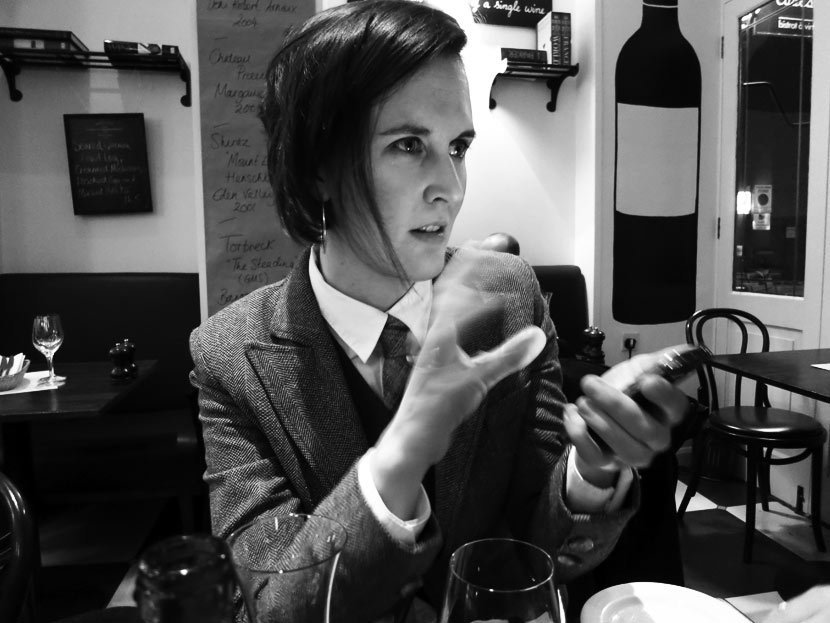 Kimberly Campanello was born in Elkhart, Indiana. She now lives in Dublin and London. She was the featured poet in the Summer 2010 issue of The Stinging Fly, and her pamphlet Spinning Cities was published by Wurm Press in 2011 . Her poems have appeared in magazines in the US, UK, and Ireland, including nthposition, Burning Bush II, Abridged, and The Irish Left Review. MOTHERBABYHOME was published by Zimzalla in 2018. Pic by Brian Kavanagh
 -
subside the rocks
archback
silica of bird leans intoa granite stylus
a grave-bed
green sea-bed of flowering heads.shatter of tree hacked-through,
windmills beside an sruthán geal
gold coins in-stream-glitter out to me.a small a cloud there
her gulfstream ruffles my feathering (toll the …)blood-thickener sloughs blood against
let her eat the disease—a gelid-thaw
clysters the bloomsall that glisters is not white—
not laden with small griefs—Glendalough is © C. Murray
-
press-to
drop-by-drop
raindrop-and-sinew
the whole woman
not tamp-in
onto the still-living-soil
a new shape
embed-in
the bone and the
living-sinew-of
the still-warm blood
slowly-so
and infinitely blue
the milk-flow from crystallising breast
a stone-dress
.material as silk-soft
caul or veil
can be sweet as silk or rain or
blue
rain sinews against and into
chalice of womb.
half-into the wall
and often not
still
a lone bird night-sings
Fossil 1 is © C. Murray
First published, A New Ulster issue VI , 2013
 Chris Murray