Category: How Words Play
-
I have decided to build up a set of links on Small Irish Publishers, this will evolve over time and I hope to add to it. The two that come immediately to mind and that I enjoy immensely are Cló Iar-Chonnachta and the Columba Press, both of which I am adding to the Links that run down the right side column at the base of this post. I have before now alluded to our wonderful book festivals and Culture Nights, these posts can be found peppered throughout the site and include The Dún Laoighre Mountains to Sea Festival, the Dublin Book Festival, the Forge at Gort, the Cúirt International Poetry Festival , Poetry Ireland‘s wonderful sponsorship of readings at the Unitarian Church in St Stephens Green and the countless library and literacy readings that occur under the aegis of the Independent Writers’ Centres and the Irish Arts Council. It is at these wonderful and immensely important places that art occurs and the small presses advertise and sell their wares.
The books on my shelves come from there or from friends who have found them for me in small shops all over the world. I have been reading this weekend Celia de Freine ‘s Faoi Chábaisti is Ríonacha and Cathal Ó Searchaigh’s An Bealach ‘Na Bhaile, both from theCló Iar-Chonnachta Imprint. The work that such presses do in disemminating Irish Literary Work is wholly invaluable and we should support it as much as possible. The Celia de Fréine book was bought at the Dublin City Hall Book festival in 2010, I got Tatú (Arlen) there in 2009, and the Ó Searchaigh was purchased in Indreabhán in 1996 (possibly whilst staying near Spiddal for the Annual Cúirt Festival in Galway that year).
I am adding their website link here and below in the links section, the following poem is Dídean le Cathal Ó Searchaigh :
Dídean , le Cathal Ó Searchaigh.
“Tá stóirm air” , a deir tú. ” Stoirm mhillteanach.”
Míshociar, coinníonn tú ag súil an úrláir , síos
agus aníos go truacanta, do shúile impíoch.
Lasmuigh tá an oíche ag séideadh is ag siabadh
timpeall an tí, ag cleatráil ag na fuinneoga,
ag béicéil is ag bagairt trí pholl na heochrach.
“Dheanfadh sé áit a bhearnú le theacht isteach,”
a deir tú , ag daingniu an dorais le chaothair uilline.
Tagann roisteacha fearthainne ag cnagadh
an fuinneoige . De sceit, sciorann dallóg na cistine
in airde. Creathnaithe, preabann tú as do sheasamh
isteach i m’ucht, ag cuartú dídne.
Ag breith barróige ort, téann mo lamha i ngreim
i do chneas, ag teannadh is ag teannadh. Teas
is teas, scarann do bheola ag súil le póga
díreach is an stoirm ag teacht tríom ina séideoga.
Splancaim is buaileann chaor thineadh do chneas .On this site readers will find links to The Western Writers and the National Campaign for the Arts RSS, please feel free to connect to the sites and petitions, which discuss short-termism in cultural advocacy by the Irish Government in supporting the root of Irish Arts: those that support and nurture writers in the Irish regions:
“The Arts Council of the Irish Republic has withdrawn its funding grant to the Western Writers’ Centre, Galway. The Centre also runs the annual ‘The Forge at Gort Festival’ in Gort, Co. Galway and the literary news-letter, ‘The Word Tree.’ For almost seven years it has been the only such centre West of the Shannon. We are calling upon writers and those with an interest in writing to sign this petition to have the Arts Council restore our grant.” (cf, attached Petition Link for Western Writers)

-
These two poems, Corcracht and Iniata, by Nuala Ní Chonchúir are translated by the poet.
Corcracht
i gcuimhne NessaCéard tá ann nuair
nach bhfuil tú ann ach:scáthaghaidh na bhfoirgneamh
faoi spéir fhuar na maidine,
camsholas ar cheann slinne
ag clúdach easnacha an tí,
d’fhéitheacha teann faoi
chraiceann do lámh,
an chraobh liathchorcra
ag tarraingt mí-ádh sa teach isteach,
tobar dúigh as a dtagann
línte doimhne, dothuigthe,
coinneal na hAidbhinte
ag comhaireamh i dtreo na Nollag.Céard tá ann ach
dath ár gcaointe duitse?
Purpling
Translated by Nuala Ní Chonchúir
What is there
now that you’re gone,
but:shadow-fronted buildings
under a cold morning sky,
the memory of veins
tightening under your skin,
twilight on grey-wet slates
covering the roof-ribs,
lilac branches that bring
bad luck through the door,
an ink-well, dark with
unintelligible lines,
the Advent candle
counting down to Christmas.What is there,
but the colour of our mourning
for you?
Iniata
Iniata leis
an gcraiceann seo támeabhair
atá meadhránach
le himníanam atá
chomh neamhshaolta,
dothuigthe le ceocroí atá
féinbhriste,
brúite mar úll.Má tá sé ar intinn agat
é a oscailtbí ullamh:
doirtfear fuil.
Enclosed
trans, by Nuala Ni Chonchúir
Within this skin
please find enclosed:a mind
over-giddy
with endless worrya soul
wispish as mist
alien to its ownera heart
self-broken and
bruised like fruit.If you intend
to open itbe prepared:
it will bleed.
from Tattoo (Tatú ), le Nuala Ní Chonchúir. Publ.Arlen House 2007.
With thanks to Nuala Ní Chonchúir for the poems and translations from Tatú. Nuala’s new novel, You is available now. I have added a biographical link, so that readers may look up her books and enjoy her writing. The image which accompanies this post is courtesy of Kristina Mc Elroy, and is from the estate of her Late father, Artist Paddy Mc Elroy. I am adding some links here , to Nuala’s site, to my Cúirt 2010 visit, and to You (Via Amazon).

Image by Paddy McElroy , courtesy of Kristina McElroy -
Restored Music : Sylvia Plath’s ‘Ariel’
The first edition of Ariel was published by Faber and Faber in 1965. I am not going to trawl the pit of controversy over the Hughes selection, it has been done. The arguments and counter-arguments are known to mostly all lovers of Plath‘s writing. I will point the general reader to Hughes’ opening salvo in his introduction to The Collected Plath, his Winter Pollen set of essays and to the foreword to the first edition of Ariel for that information.
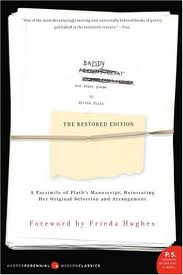
The Restored Edition Ariel was published in 2004, with a foreword discussion by Frieda Hughes. The full title of the edition is, The Restored Edition, Ariel. A Facsimile of Plath’s Manuscript, Reinstating her Original Selection and Arrangement . You can read Frieda Hughes’ foreword here.
This means that the Ariel MSS that Sylvia Plath had left containing its interleaved and codependent set of themes has been restored to its original music in 2004 (39 years after the Hughes edited publication). I feel that it should be the only collection of “Ariel” available, as it is uniquely Plath’s.
The above may be difficult for someone who is not a writer of poetry to understand, but ironically enough it was Hughes who perfectly described Plath’s approach to her making of the poem as hermetically sealed. It hid from her and she worked incredibly hard with many false starts to unearth the work. That was not the case with “Ariel”, which came absurdly quickly.
A book of poetry is not necessarily themed but unified in the interrelationship of the poems, the book’s internal music and the alchemy of words therein. Sometimes a poem is related intimately to another through a strange labyrinthine undercurrent of word and energy which may not be visible to the critic or academic.
As Frieda Hughes points out in her foreword, the two words love and spring form the first and last word of The Restored Edition, in the poems, Morning Song and Wintering. This symbolises the internal music of Sylvia Plath’s volume and indeed the interrelationship of every internal sound, chosen word and interleaved theme. It is restored because the binder was retained , treasured and read by the family and her children.
39 years might be a time to wait for that restoration of music to its meaning, but interestingly it was always preserved intact, which readers of literature are aware does not always happen historically with words that enlighten, provoke or hurt..
from Morning Song, by Sylvia Plath.
(first verse)
‘ Love set you going like a fat gold watch.
The midwife slapped your footsoles, and your bald cry
Took its place among the elements.‘from Wintering , by Sylvia Plath.
(last verse)
‘Will the hive survive, will the gladiolas
Succeed in banking their fires
To enter another year?
What will they taste of, the Christmas roses?
The bees are flying, they taste the spring.’EDIT : I am adding in here as the final link a YouTube of Sylvia Plath reading Daddy
-
from , Paris Review (RSS Link on Poethead main page)
“Michel Houellebecq has finally received the Prix Goncourt, France’s most prestigious literary prize. As Susannah Hunnewell suggested in our current issue, the honor is overdue. Click here to read the most in-depth interview with Houellebecq available in English.
As our diarist Nelly Kaprielian reported last September in The Paris Review Daily, Houellebecq is still living hard. He has aged visibly in the last couple of years. He even tells her that his latest novel, La carte et le territoire, may be his last. We hope and trust that time will prove him wrong.”
There is a permanent RSS link to Paris Review on the main page of the Poethead Blog, which readers can find beneath this post also. The above quote forms the opening two paragraphs to the announcement that Michel Houellebecq has won the 2010 Prix Goncourt for ‘ La Carte et le Territoire’ . Paris Review is today running an interview in English with Houellebecq . Recommended reads by Houellebecq (by me) include HP Lovecraft , Against the World, Against Life and Atomised. I have included links to both here,
-
The Lace World.
(after a piece of sixteenth-century Breton lace)
How eerie it all is, as if linked by synapses;
a face stutters out of the cloud of lace,
a tiny decorative lion dances in a frieze,
a woman, needy arms outstretched, holds onto thread bulwarks against some unseen flood
while her body dissolves into netting, the knots
widen and widen until the limn of her
is finished, she melted to loops of distance … and isn’tthat how you’ve transformed, once-love, while
this strait sleeping-car, this time
spirits me away from you and that night we lay
two palms folded to each other in prayer:how the cat yowled to be let in! and the moths,
darting abortively forward, all ended up
by clinging to the screen in the sleep-sacs
of their wings, while I rolled to the top of my tonguethat word which would end everything and
like Sisyphus, let it fall.Nothing
brings that second back, yet nothing gets lost;hours that separate me from you only
tighten the memory-chain, where my thoughts
like these light acrobats trapeze;
in the white spiderwebbing, in the networkhere’s a sea serpent, a helmeted soldier,
a boy pausing to sing, two dogs leaving a fountain,
someone pushing aside a harp.
The tiny o of her mouth. Those gouged-out holes, her eyes.Monica Ferrell , published 2005. Slate Magazine .

The Lace World – Modern Breton lace from, The Book of Contemporary Indian Poets, ed Jeet Thayil . Bloodaxe Books
-
Apologies for linking to this statement rather late and I know that it is all over the web, I think that it should also be linked here, so I am adding the Fatima Bhutto Twitlonger link that some Irish writers posted and shared on Sunday evening (31/10/2010). The entire statement is added just beneath this following excerpt :
SOMETHING FOR THE MEDIA TO THINK ABOUT : (Tweeted by Fatima Bhutto 31/10/2010) :
“A mob of about a hundred people arrived at my house at 11 this morning (Sunday, October 31, 2010.) They broke through the gate and vandalized property. They shouted slogans against me for my views on Kashmir, and threatened to teach me a lesson. The OB Vans of NDTV, Times Now and News 24 were already in place ostensibly to cover the event live. TV reports say that the mob consisted largely of members of the BJP’s Mahila Morcha (Women’s wing). After they left, the police advised us to let them know if in future we saw any OB vans hanging around the neighborhood because they said that was an indication that a mob was on its way. In June this year, after a false report in the papers by Press Trust of India (PTI) two men on motorcycles tried to stone the windows of my home. They too were accompanied by TV cameramen.
What is the nature of the agreement between these sections of the media and mobs and criminals in search of spectacle? Does the media which positions itself at the “scene” in advance have a guarantee that the attacks and demonstrations will be non-violent? What happens if there is criminal trespass (as there was today) or even something worse? Does the media then become accessory to the crime? This question is important, given that some TV channels and newspapers are in the process of brazenly inciting mob anger against me. In the race for sensationalism the line between reporting news and manufacturing news is becoming blurred. So what if a few people have to be sacrificed at the altar of TRP ratings? The Government has indicated that it does not intend to go ahead with the charges of sedition against me and the other speakers at a recent seminar on Azadi for Kashmir. So the task of punishing me for my views seems to have been taken on by right wing storm troopers.”
Link to the Original Statement by Arundhati Roy
Guardian Report on the issue
South Asia Citizens Web -
Chosen by Anna
I.
Banish Air from Air –
Divide light if you dare –
They’ll meet
While Cubes in a drop
Or Pellets of Shape
Fit
Films cannot annul
Odors return whole
Force Flame
And with a blonde push
Over your impotence
Flits Stream. “
II.
An awful Tempest mashed the air –
The clouds were gaunt, and few-
A Black — as of a Spectre’s Cloak
Hid heaven and Earth from View.
The creatures chuckled on the Roofs –
And whistled in the air-
And shook their fists-
And gnashed their teeth-
And swung their frenzied hair-
The morning lit-the Birds arose-
The Monster’s faded eyes
Turned slowly to his native coast-
And peace-was Paradise!–
This Choice of Emily Dickinson’s verse is edited by Ted Hughes. The essay which forms Hughes’ introduction, is (if I am correct) also included in the Hughes’ essays Winter Pollen ( publ. Faber and Faber). On a slight digression, therefore, I would recommend the essays therein on Sylvia Plath’s poetic process and most especially Hughes’ discussion on the beautiful Sheep in Fog,The Evolution of Sheep in Fog :
“It is undoubtedly the best commentary on the nature and significance of poetical drafts. Here, as someone who has worked on and studied manuscripts for their own sake over a period of 35 years, I can perhaps speak with more authority than on the other aspects that I indicate in this note. No one else has written so eloquently or so perceptively on the importance of drafts and why rather than being discarded they command respect as more than the ‘incidental adjunct to the poem’ — indeed ‘they are a complementary revelation, and a log-book of its real meanings.’ In the case of ‘Sheep in Fog’ the drafts ‘have revealed the nature and scope of the psychological crisis that gives the poem its weird life, sonority, its power to affect us. In other words, they are, as the final poem is not, an open window into the poet’s motivation and struggle at a moment of decisive psychological change.” Roy Davids
Publ. Winter Pollen, Ted Hughes
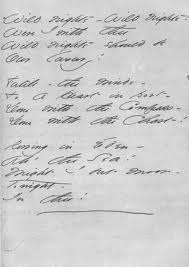
Wiki Image of Dickinson MSS -
Things More Ancient : VIII
First, make a letter like a monument –
An upright like the fast-held hewn stone
Immovable , and half-rimming it
The strength of Behemoth his neck-bone,
And underneath that yoke, a staff, a rood
of no less hardness than the cedar wood.
Then, on a page made golden as the crown
Of sainted man. a scripture you enscroll
Blackly, firmly with the quickened skill
Lessoned by famous masters in our school,
And with an ink whose lustre will keep fresh
For fifty generations of our flesh.
And limn below it the Evangelist
In raddled coat, on bench abidingly,
Simple and bland: Matthew his name or Mark,
Or Luke or John; the book is by his knees,
And thereby his similitudes : Lion,
Or Calf , or Eagle, or Exalted Man.
The winds that blow around the World- the four
Winds in their colours on your pages join –
The Northern Wind – its blackness interpose;
The Southern Wind -its blueness gather in;
In redness and in greenness manifest
The splendours of the Winds of East and West.
And with these colours on a ground of gold
Compose a circuit will be seen by men
As endless patience; but is nether web
Of endless effort- a strict pattern:
illumination lighting interlace
Of cirque and scroll, of panel and lattice.
A single line describes them and enfolds,
One line, one course whose term there is none,
Which in its termlessness is envoying
The going forth and the return one.
With man and beast and bird and fish therein
Transformed to species that have never been.
-With mouth a-gape or beak a-gape each stands
initial to a verse of miracle,
Of mystery and of marvel (Depth of God)
That Alpha and Omega may not spell,
Then,finished with these wonders and these signs,
Turn to the figure of your first outlines.
Axal, our angel, has sustained you so
In hand, in brain; now to seal that thing
With figures many as the days of man,
And colours, like the fire’s enamelling
That baulk, that letter you have greatly reared
To stay the violence of the entering Word !
Adjutorium nostrum , in nomine Domini
Qui fecit caelum et terram.
from The Poet’s Circuits, Collected Poems of Ireland ; Centenary Edition with a Preface by Benedict Kiely. Dolmen Press , Dublin. 1981 The Monuments , by Padraic Colum
-
Aviary (I – excerpted)
By Tom MacIntyre
Spirit-birds love
black of the bog,
banks loaded,
juice on the spade,
from nowhere gather
in celebration,
taste the action,
call it home.
You venture close :
pacey echoes
stir and murmur
names forgone,
Whimbrel, Whinchat,
Grebe, Merganser,
the names don’t fit
quite, the birds mind
their own business,
a heron shows,
lifts, departs,
you’ve met before,
that’s the hero
nicked your cap
and will not, will not
give it back…..
‘Bird in the Sun’ by Leonard Baskin - Aviary , from A Glance Will Tell You And A Dream Confirm,Tom MacIntyre. Dedalus Press, 1994, Dublin.
- ‘The Philosopher and The Birds , Wittgenstein at Rosroe’
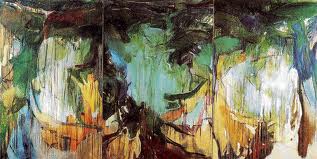
Barrie Cooke ‘Big Forest’ (Irish Times)
 Chris Murray