from Fathomsuns and BenightedTrans Ian Fairley. White Noise, bundled, |
Category: Translation
-
-
I thought to do a note on some poems by Federico Garcia Lorca, though the images he conjures seemed to have thwarted that and instead I found myself ensconced in a book I found years ago in Charlie Byrnes bookshop up in Galway City.
The poetry of Lorca has run like a thread through my visual and intellectual life since I was nineteen, though it seems an age ago when I discovered his writing- it really is not that long. Thus I was unsure whether a poem or two would suffice to capture this greatness; and indeed had prevented me thus far from publishing anything by the man.
The line at the top of this post is by Jorge Guillén , Lorca uses it to begin his Poem Your Childhood in Menton , after he had found himself transplanted into the Americas as a student; and away from the very soil that made his songs, be it bleached by the sun or drenched in blood. Thus, I am going to publish here an excerpt from the poem along with an exhortation to read Lorca, to listen (if at all possible) to the music of the Deep Song; and to recommend from amongst the Biographies of FGL that of Ian Gibson.
Your Childhood in Menton.
love, love, love. The childhood of the ocean.
Your lukewarm soul which is without you and does
not understand you.
Love, love the roe’s flight
over the endless breast of white.
And your childhood, love, and your childhood.
The train and the woman who fills the sky.
Nor air nor leaves nor you nor I.
Yes your childhood fable of fountains now.The above excerpt is taken from a series of published lectures by Federico Garcia Lorca, entitled: Deep Song and Other Prose, Ed and Trans Christopher Maurer. Publ. Marion Boyars 1954.
I believe my bilingual edition is also translated by Christopher Maurer but have not it to hand at the moment. I heartily recommend chapters , which are essentially speeches from these lecture series on The Duende and Lullabies for the new reader to familiarise him/herself with Lorca’s intimate tone , and Poet in New York for a good introduction to some of his later poetry.
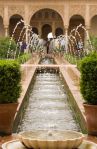
Fountain in the generalife Palace, Alhambra. -

Baskin Mosquito. From ‘Leaf-Stalks’
“Yet I would not dismiss the nonentities. The things that nearly are not. Journey of woodbine, ampelopsis on the ancient walls (of garden and its house), clutch of tendrils and trailing plants, the shuffling of their minute paws, with pads of suction for terminals of their thread-like minute fingers, and claws, green zig-zag path of lizards this way and that, climbing always higher until, until there are masterpieces of space-fillment. No question of it: indeed we bathe our faces in the roistering fire of some noted blooms, therby healing up our remoteness. But what of the props and supports? Candle-stick under the candle’s flame, the stalks, the vegetable scales, thorny pronged candelabras. And the floating wicks, nightlights of a provisional kind, shoepolish tins in times of siege..”
From,Night-Stalks, from ‘Between’ by Agnes Nemes Nagy
In a brief afterword attached to this Volume of Between by Nagy, Hugh Maxton discusses his approach to collaborative translation, along with a brief description of the history and political situation in Hungary in terms of linguistic revival and conservation. It’s well worth the read, I shall be looking for an online link to add in here. In my last piece on translation , I alluded to the appalling translations of Nagy that I found online whilst searching for material by the writer and in brief to the importance of linguistic heritage, (though I am no expert in the field ), it’s actually easy enough to identify a terrible translation into English.
The Nagy/Maxton collaboration is a triumph in sensitivity and awareness, thus his approach to the project is something I would recommend to people who are interested in the area of disseminating literature either online or in publication.
I also like Gallagher’s translations of Ursu and some scraps of Agren Mc Elroy’s work on Nelly Sachs, both of whom I have mentioned on Poethead before now.
Between, The Selected Poems of Agnes Nemes Nagy, trans High Maxton,
Corvina Press Budapest, Dedalus Press, Dublin, 1988
Leonard Baskin Woodcuts.
-
Agnes Nemes Nagy : ‘Between’, a Poetry Ireland Book Review.
“I have no serious doubt,” observed George Szirtes in his Introduction to The Night of Akhenaton, a selection of her poetry, “that Ágnes Nemes Nagy is one of the great indispensable poets of the twentieth century.” Agnes Nemes Nagy (1922-1991) was a Hungarian poet, author, political writer and activist, whose life, as for so many of her generation, was defined by the Second World War, and particularly by the friends she knew who died in Auschwitz. Between by Agnes Nemes Nagy and translated by Hugh Maxton comprises the largest translated collection of Nagy’s work into English, and is published by Dedalus in Dublin and Corvina Press in Budapest.
Angels are always terrifying in Nagy and often allied to tree and branch symbols. Her imagery in general is often ‘off-centre’; she wrote about the process of writing as “I think it is the duty of the poet to obtain citizenship for an increasing horde of nameless emotions”.
I Carried Statues
On board ship carried Statues,
Huge faces unrecognised
On board ship carried statues
To stand on the island.
Between nose and ears
Perfect right angle
Otherwise blank.
On board ship carried statues
And so I sank.Terraced Landscape is a prose piece which visually describes movement through time through the poem’s 34 separate planes or terraces:
Zero Plane.
Now nothing is visible.Yet something continues
To sound, in a fragmentary fashion, breaking down,
Swelling. Do you hear it? Up there somewhere,
Towering little domes like the roofing of a city, unknown bells insideZero Plane is the poem’s introduction, while the overall structure is cyclical, so that the white noise at the end of Level 34 seques back to the beginning, Zero Plane. Not all the levels are described, yet all things acquire depth and shape, everyday objects swell and become, they lose their flatness. This reminds me of Sylvia Plath’
The poem ‘Lazarus’ –
Round his left shoulder, as he got up slowly
Every day’s Muscle gathered in agony
His death was flayed off him like a gauze
Because second birth has such harsh laws.– recalls Leonard Baskin’s Hanged Man’, a lithograph from the Fifties of the Hanged man from the Tarot deck,
Between is divided into short poems and cycles, two essays and some prose, with Nagy herself contributing the foreword. Hugh Maxton talks of the translation / collaborative process at the back of the book, but between intro and postscript the images and words create, for this reader, visual monuments, portals into a mythos and an often sublime awareness.
Ágnes Nemes Nagy, Between, Dedalus Press, Dublin and Corvina Press , Budapest. Trans, Hugh Maxton
-
I have been reading the Simone Weil critique, Thinking Poetically for the last few weeks, interspersed it seems with other activities and work.
In many ways it has prevented me from posting up here because the subject matter is so imperative to the creation of her poetry; and yet and the Poet/Philosopher’s experiences in Vichy as a woman writer are neither subtle nor intriguing.
Her writing is sometimes painful to read. At the end of this brief post I shall include the link to Weil’s poem Necessity which I had published in recognition of the 2009 International Women’s Day.
‘Necessity’ by Simone Weil
The cycle of days in the deserted sky turning
In silence watched by mortal eyes
Gaping mouth here below, where each hour is burning
So many cruel and beseeching cries;All the stars slow in the steps of their dance,
The only fixed dance, mute brilliance on high,
In spite of us formless, nameless, without cadence,
Too perfect, no fault to belie;Toward them, suspended our anger is vain.
Quench our thirst if you must break our hearts.
Clamoring and desiring, their circle draws us in their train;
Our brilliant masters, were forever victors.Tear flesh apart, chains of pure clarity.
Nailed without a cry to the fixed point of the North,
Naked soul exposed to all injury,
May we obey you unto death.(Simone Weil)
One of the themes of this site is ‘of waiting’, or to put it more succinctly: the writing of women who are entrapped (intellectually and spiritually) by the prisons their time has brought them to: many of them, Miriam Tuominen, Liliana Ursu, Nelly Sachs and Weil were writers that knew the shape of their prisons and created from them the most amazing poetic structures.
The other main theme is visibility of women critics and writers in our society. (Usually problematic).
There are strong sympathetic links in how prose is constructed between Porete and Weil, between Julian of Norwich and Weil and I suppose ‘heard ‘in the antiphons of Hildegard of Bingen.
I do not have time to elaborate on the themes, so I thought It would suffice to add in the Porete links and the link to Necessity and that I would complete this in second part with some brief notebook excerpts in the coming days.
Thinking Poetically Joan Dargan, State University of New York Press.1999
Necessity, by Simone Weil.
Barbro Karlen
Excerpts from Marguerite Porete. -
Fillte idir mo
leasracha, oisre, ag crith
is ag frithbhuladhIna luí idir
do chosa, magairlín, ag
leathnú, díbholgadh.An dán seo as Tatú le Nuala Ní Chonchúir.

Tatú, le Ni Chonchúir : Arlen House. I decided to leave the poem as Gaeilge for the minute because I like the sounds and they are not too hard to make (unlike the poor orchis that wilts in Stanza II).
Irish women Writers are really good at fish and flower sexual images – it may be that we have evolved a language due to Catholic repression, or it may just be that its part of our linguistic inheritance , images of beauty and sometimes of terror .
Tatú
Is pailmseist mo chorp
faoi do lámha,
paipír arsa,
scrollaithe fút,
ag tnúth le do rian.
Glanaim mo chraiceann,
sciúraim siar e
go par báiteach
ionas go bpúchfaidh
do lamh mar
dhúch tatuála,
ag liniocht thar
linte dofheicthe
gach fir eile.Níl faic ach tusa
scrábáilte ar mo chorp.Tatú , Le Nuala Ní Chonchúir. Arlen House 2007.
-
Maybe It Isn’t Him.
“I found your body stilettoed from behind,
It would have been much harder otherwise
I pull the blade out terrified and wipe
Its gold handle on my breast and side
Lord, I cry, maybe it isn’t him,
Maybe it’s his earthen shape
Maybe the blood is not actual blood
Maybe his soul is singing across the plain.
Maybe the birds are listening to his song,
And that’s why over the plain they are all
Silent, maybe they too are made of clay
And their one use is magical.
Maybe it is death barely now arrived
That hunts the mystery of your sacred being
After whose form we were made,
Maybe the eternal bird is singing.”
From : After the Raising of Lazarus, Trans, Eiléan Ní Chuilleanáin. South Woard 2005.
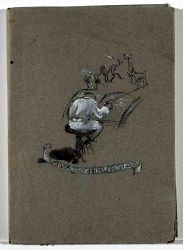
Charlotte Salomon : ‘Boek’ -

Elisaveta Bagryana. The Immortal
Now bloodless and almost fleshless
unmoving , unbreathing, voiceless.
With eyes half closed and sunken,
what matter if -Anna or Maria,
the fine lids will never rise,
the clenched lips will not move or ever
again utter a moan or sigh.
And look how already white and strange is
that ring upon her hands, crossed forever.But do you hear her innocent child
crying in a cradle nearby.
There is her immortal blood, transferred
and her soul now resident in this world.
days will pass by, years, centuries
and the yielded lips of two young lovers
will again whisper ‘Anna’ or ‘Maria’,
at night amidst the fragrance of spring.
The great-granddaughter will bear everything: name,
eyes, lips, locks of the other invisible one.1925.
Selected Poems of Elisaveta Bagryana; Penelope of the Twentieth Century
Trans, Brenda walker, Valentine Borrisov and Belin Tonchev. Forest Books.For Sinead with the Rainbows in her eyes, RIP
-

When Julian of Norwich describes her mystical experiences and her visions in her Revelation of Love, she describes them in three parts, thus:
‘That is to sey, be bodily sight and by word formyd in my understonding and be gostly sight. But the gostly sight I cannot ne may not show it as hopinly ne as fully as I woulde’
There are sixteen ‘Shewings’ – ‘Showings’, a term that midwives and those experienced in the process of birthing would recognise as the first indications of imminent birth.
Julian Of Norwich was an anchoress, she went through a process and experience of visionary state which she then communicated in a non-theological manner. The visions emanated from her experiences in spiritual writing and in an illness that threatened her life. The writing is astounding in descriptive terms, this is how a vision began:
‘and the bodily sight stinted and the gostly sight dwellid in mine understonding. and I desired as I durst to see more’.
The introductory to the folio editions and mss of Julian of Norwich is in print by The Exeter University Press and introduced by Marion Glasscoe. Glasscoe compares the writing of Julian of Norwich to the experiences of Isaac Luria ( a 16th Century Kabbalist) in trying to vocalise his experience. Indeed, Simone Weil and others like Paul Celan have hit upon the same type of writing, although discussion on this topic of mysticism is severely limited and often in the essays accompanying their major works. Its an area of interest that I have threaded throughout this blog in pieces about Weil, Karlen, Julian, Celan, and Marguerite of Porete (who was unfortunately murdered during the Inquisition for refusing to disclaim her works).
Someone entered ‘Penelopiad Rubbish‘ into the search engine and ended up on the site! I suggest reading the ‘Suicide Angel’ by Margaret Atwood before embarking on her lively engagement with mythos, the stringing up of the abused maids might be a little heavy on the palate as an introductory to Atwood and her waddling Penelope, whose shrewish hatred of Helen and thirst for blood might be off-putting to the faint-hearted.
- Funny Bones. By Margaret Atwood.
- ‘A Revelation of Love‘. Julian of Norwich
- Isaac Luria texts and Tzimzum on Wiki.

This work is licensed under a Creative Commons Attribution-NonCommercial-NoDerivs 3.0 Unported License.

 Chris Murray