Kitchen Danube – Duel I wanted to tell you, but there was no time Broken – Winged
|
Category: Maps
-
-
metamorphosis
gulls bathe & fish in temporary rock pools
near the recycling spot in ongpo village. i wonder
if the dead mermaids of old jeju are reincarnate as gulls?
whether they thank the wind for bringing morsels of food to them?
have they returned to the place they liked to forage abalone,
where they taught their children how to recite the poems of the sea
& laced a 1000 soups with shell fish & sea weed?
in the translucent pools objects that don’t belong to the sea
but the sea has made ornate on its potter’s wheel
lie like artifacts waiting to be raised from the dead.
you can hardly recognize shards of green bottles,
broken, budget china plates, the flutes & spouts of blue vases
& their bases with the artists name erased by the currents.
but a saucepan lid, the nipple of its handle.
a rusty tobacco tin with mushed up cigarettes inside.
a bottle of washing up liquid. a cement bag collecting shells & kelp
go unchanged. no matter
the hours the mad sea potter clocks in.
the pacific
we walk 1 km or so,
pass through gangjeong village,
away from where ajummas
who look like permed mussolinis,
gut & flense red porgy & barter
at the pitch of cash registers, on the street corner.
beyond the outskirts
where the abandoned banners of protest
against the construction of a naval base is stationed,
to where the pacific ocean is being itself.
the land emptied. the roads emptied. people emptied.
the ocean here moves the mood to its own way.
& we are moved with it too.
because we are people.
jeju church
the telegraph cables wobble like plucked harp strings.
i follow them to a church: the modem of god.
the fastest router to his love & law.
i doubt they get a decent signal there;
therefore anxiety’s doppleganger cowers behind the plastic pews,
in a church, without nave or apse; persistent
their’s is a church suitable for gaggling wants to god.
the neon crucifix where the lightning rod should be picking petals of dark
to save the air conditioned congregation from the godless element.
the don’t see that the weather is god, their livelihood.
they don’t see out there is all god can be
& the only place he might find comfort from the grind of his silence.
눈 = snow & eye
this blizzard two days deep is an anomaly
: it hasn’t snowed like this for 35 years.
the island’s comatose yet comfortably delivered from
the common arrangements of any old day
: farmers off the hook with needy furrows;
disheartened tourists hop scotch 4 dimensions a-z;
the restaurants full of happy people getting drunk;
biyang island’s buggered off all afternoon,
a graphite smudge in the corner of a child’s sketch.
i feel a perfect ease in this seraglio of snow,
furnished with moving tapestries of conifer & crow.
litters of onion & cabbage, the brown flame
of decay like the edges of old manuscripts
spreading to the whorls & cores.
the harem wenches shaped like soil who swaddled them,
who with familiar cuddles warmed
their spindly legs until the autumn harvest,
look bored without their motherly duties.
there isn’t a soul & if there was
a barrier of snow rushes between us.
flocks of sparrows navigate the drift,
the traffic of currents & pockets of gale
quiff the snow on the ridge ahead.
i hope i never find time to return to the world.
sonnet from a derelict house
the village houses dumb with old age. blind & windowless of their worth.
their pipe-orifices blow off excess steam. asbestos hunkered in their heads.
a few roof tiles absent : old storms popped them off like champagne corks.
cut short like children who are seen but never heard. downcast & diffident.
they mime their rantings at a generation that admires but does not fix.
they had an idiolect arrested by indifference & so they do not croak
objections to invasive mainlanders with café aspirations.
they’ve busied themselves like a mouth chock full of ginseng sweets
so long, they forgot the peal of beauty poking from their grout,
the saturating mold that sticks them together. you’ve not decided you have value yet.
when the aesthetic nuances of apartments lie in tatters: when the weathered marks,
the petroleum foot prints & ichor rust begin to tell on iron bones & fiber glass skin
they’ll hurry back to you with a lick of paint, stucco & warm sibilant love,
their guests will write on post-it notes they are too guilty to compose themselves.fish lady
the jeju grandma who squats outside the chiropractor
sells gold bream, kelp & mackerel piled in little blue baskets.
the lamppost is her backrest, the pavement is her chair.
her back’s bent like an oreum. she must be in a lot of pain.
most of the day she naps with the fishes. i never saw her sell a thing
& i can’t cook fish in the café : it makes a dreadful stink.the air in hallim town is thick with salt & brine.
it comes from the sea hidden in netted hauls of jeju cuttlefish
-red freckled tentacles like broken fingers & heads like bone china vases.
her bones are rusty as a trawlers’ nuts & bolts.
her knuckles have been bleached with salt & cold.
she’s wrapped up in a microfiber blanket, she has no gore-tex clothes.her veins bulge out of tissue flesh, like highways on a map,
the luggage of her grueling years drags under her eyes.
after working seven days a week, outdoors in the fields,
or on the wet street, since she was a teenager,
the elements have buffeted her geography’s shape inside & out.
we can travel her hardships without a compass needle.there is no son or daughter to help her lug the stock.
she has mothered. be sure of that. suckled & smacked them into citizens.
they’ve been consumed with seoul’s nightly attractions: pork & soju.
disfigured by charts & indexes, the etiquette of the salary man
: the boss says drink! we say how much? the boss says jump! we say from where!
if only she’d not shamed their island roots they’d be less corpulent.on sunday all the shops & vendors on the street stop trade.
she goes to church & tends the spirit then goes home to tend the soil.
she has a little garden behind her little house beside the sea.
she grows a row of cabbages, spring onions & garlic
: in autumn for the umpteenth time she’ll make kimchi for the year ahead
: the fuel for her to endure one more ring of seasons in the harbour town.one day, i’ll go to the chiropractor & she won’t be outside
& her fish will not have been caught & birth prodigious shoals.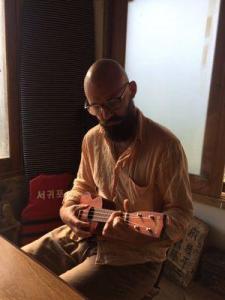 Daniel Marshall is a poet from England who now lives in Jeju Island, Korea, where he runs a café & guesthouse, which he built with his wife from the soil up. He is an emerging writer who, when he manages his time well, writes & blogs. You can read several of his ongoing projects here & a number of articles he wrote on dream psychology & analysis whilst he lived in the mountains of mainland Korea. Feel free to contact him anytime through his blog:
https://danielpaulmarshall.wordpress.com/
or at danielpaulmarshall85@gmail.com
Sonnet From A Derelict House and other poems are © Daniel Marshall -
Windowless church
My church has no windows
in fact it has no doors either
and to be fair no altar
it has no ordained minister
or priest or gospels.
Its in my heart, in
the starry sky
the moon shining over the land
its the planets in our solar system
the sun when it shines or not
its the foods god/creator
left us, berries, leaves, nuts
my church has winter winds that
cut to the bone and to enlighten
I have the sweet smell of roses
as I follow the seasons.
It is bog cotton waving on an
early Autumn evening as the
sun bids farewell.
On nights like these
dark and Irish wintery
the familiar trees and hills
become ancient septs
ready for battle with the ether.
Fields caped in winter fog
appear as crafted cities of the dead
souls roam among the rushes
in search of utopia or a home.
Trees scan the darkened horizon
the wind calls out names too and
winter hangs around like a threat.
This is my church.
Distractions
It’s the end of April.
Spring late this year
begins its infinite ascent
to the tips of the cherry tree
birds come by often
a come-all-ye in the front garden
their songs reach an inner place
like listening to Franz Haydn
his strings reaching out
from centuries past making clear
contact in a podcast
channelling his toils and efforts
an artist whose initial struggles
with mind, soul, pocket
rise and fall with each
strike of the bow
altering my thoughts on outer things
a distraction, like the bird song often
heard in my childhood estate longing
for far flung horizons.
Stone circle alignments
They invite soul connection
invoke an energy of some sort
long past histories underfoot.
Early man was quite the architect
aligning the stones in such a way
that at equinox and solstices
sun rises to light up the passageway.
A seeking brings people here
an ancient longing that needs met.
Creevykeel court tomb is a full tomb
the largest in Ireland.
Tievebaun Mountain seems to guard it
shadows come and go with the sunsets.
we don’t give ancient man enough credit
for the science they carved into the landscape.
Fintona
Or to give it its’ town-land meaning
A fairly coloured field.
A small country town, familiar, friendly.
one can see the whole shopping street
from left to right without shifting a foot.
There is a jewel though
a hidden forested area
where a raised fairy fort stands
once druids conferred their words
in praise of nature.
There too I find the remains of a
burnt out wreckage of a car
perhaps stolen years ago left now for
mother nature to clear up which she did
wrapping her briars in and through the doors
designing the broken glass with her leaves.
Awakening
Sun slants in through the venetian blinds
dust particles float in the narrow space
books, a pen, Sundays newspapers
and a mobile phone cling on the quilt cover.
Its 9.30am Spring has come, crisp April air
drifts in from the ajar window, it will soon be
Summer again, warmth of the sun rejuvenates.
I wander the halls of my mind on wakening
sieve through last nights dream
catching broken pieces of a story or place
and wondering all day if it meant something.
Fintona and other poems © Aine MacAodha
These poems have been published in the online journal Episteme, Vol. 4(1), June 2015 under the section IRISH POETRY | Web address | http://www.episteme.net.in/ Aine MacAodha (1964-2021) was from Omagh North of Ireland, her works have appeared in Doghouse Anthology of Irish haiku titled, Bamboo Dreams, Poethead Blog, Glasgow Review, Enniscorthy Echo, poems translated into Italian and Turkish, honorable mention in Diogen winter Haiku contest, Shamrock Haiku, Irish Haiku, thefirscut issues #6 and #7, Outburst magazine, A New Ulster issues,2 ,4, 27. Pirene’s Fountain Japanese Short Form Issue, DIOGEN Poetry, Argotist Online, The Best of Pirene’s Fountain ‘First Water’ Revival and Boyne Berries. She self published two volumes of poetry, Where the Three rivers Meet and Guth An Anam (voice of the soul). Argotist online recently published ‘Where the Three rivers Meet’ as an E book. Her latest collection Landscape of Self was published by Lapwing Press Belfast.
https://sites.google.com/a/lapwingpublications.com/lapwing-store/aine-macaodha
http://ainemacaodha.webs.com/index.htm -
For Sylvia-Down in Adoration
You were Fulbright a seismic enigma
the fleet foot hare rising in pastel dusk.
It stalked like crows in the breast of a man
who sold your head for hapless wanderlust.
Your damage was like splintering of glass.
Could he not understand what it is to be
a milk jug, wasted lipstick, the outcast
shadow hung from a star-struck hemlock tree.
But a quiet voice is so more loquacious
than a risen phoenix roaring through air.
Maybe now is the time for tempered hush
time to weave your bridal crown through red hair.
He brought Devon sea shells to your headstone
you were his lotus his night passage glow.
For Jane Kenyon
Ten years on, while storm buffets glass and juniper,
snowflake tiers inside my porch
finger an army of miniature baubles.
The plastic robins perch lopsided. Even
that new star, a rushed afterthought, curtseys
on its axis where a black one legged doll should be.
Dear Jane I never met you. But I guess your mother
was at the station with pasteboard suitcases—ready
to sew broken limbs together again.
Now as I make end to season,
with more than a single strand of tinsel,
I nest plywood angels and churches
for a woman who breathed cypress and pondered why
only nightjars or silver fish
knew how to take shadowless flight.
The Pathologist’s Wife Taken as a whole she is like any other woman one heart four chambers one brain eight lobes If I place them in your gloved hands her weight is less than a pre-term infant this woman mute monkey on one shoulder zealous cat on the other At the edge of night she wears a cowl of thorns the spines draw blood if I forget to soften my touch Whatever moves between bright thought & Tahitian body Gauguin’s veneer is noted full mouth broad nose hair above her lip the nest of a bird humming at her wishbone & if you crystallise sadness look close under a microscope you find deep sea brittle stars in that one rare tear Natalia Spencer B.A lived in North Africa at the start of her life & now inhabits a quiet niche of South West England. Like most writers she knows, she has family, cats, many books. Her flash fiction has appeared in Kissing Frankenstein and other Stories, & Flash Frontier. In 2015 she won The MSF Silver Award for Best Poem from Visual Stimulus. More recently she has poems published in The Poetry Shed & various magazines. She is working towards her first collection.
 -
Unrecorded
Stone music
When your music rises
from your grave in flower
and some stones quiver
and sing notes musical
I hear your voiceWhen music pricks the air
from a needle in friction
and touches the first traction
molecule of air-kissing your ear
I have memoriesWhen your words attach a molecule
of air to another and in you we
breathe, sing and live in hope
when we cannot forget we rise
I sing my soul your languageOur hair is proud and sings on air
When loving is truly spoken
It is in your ear in seconds
in your heart and mind and soulAdd warmth and fire to it
Your own interpretation original
Your body moves in dance
Still you rise, still you rise, dance
and fall and rise from the grave in flower.
Weave your joy
With the tips of your fingers
And all of you like the
Orchestra conductor knows that music
Know your body:
Its heart drum
Piano toes…The epic of weavers undaunted
the road to the market is mine
my head is a carrier of universes
I know my step is in space
and those arrows you see on my cloth
have known many lights…
nights and colorsRecognition that ignites
when that face you see again out of nowhere comes
Suddenly feelings surge
blow and rage a real storm
inside
Heart shaken like a vessel love-filled bubbles
Feel every nerve awake
Blood rush blush…
Something lost now
rare since a screen touch keeps
telling where and how you are
Soon surprise will be ancient human feeling…ouch!
trembling dreams
You wake me up each time
but I dream on with hope
You tell me children cannot
eat dreams in a poem
But when I look I see them
only clad in dreams
the only pants they wear
that you cannot tearI have sat and mended endlessly
and washed with tears
things mention would tear this paper
things surfing in my soulCome again, enlarge my spirit
into dreams and let me sleepwalk
and stalk in my talk so many ghosts
Until I ring my bell of peace
and you fall out of your fantasy
and see saints sainting without fainting.
We did not choose the sea
philo 6.1.2014
When we found them washed ashore
they were barely alive but still breathing
We spoke for the voiceless they
said, many times, and now speak to us
and for us and with us share this breathWe shuddered at life’s turns and twists
when the madding crowd kicked them hard
They slave them again, they do, their voices
deadly drilling the stones so alone intone.
Longing
Solitary times teach
so loudly that silence
grows so deep and speaks
a new language: And now
Let me see my love, let me
hear my hope, touch my faith
Let me taste our belonging in fragrance
It has been so long and I have
a new alphabet to share with life.
Come
You come closest
to my chest and tell
me in my own tongue
that you are my latest thought
the fount sings unending
the ocean rises as the rivers dry
and we see the stones still
washing and washedHumans never understood
color then, never not in
all those matches in design
Not in all those pastels in
cake and bathroom tilesNot in all that whiteness
and darkness in the broods of life
We so challenged by the sun
without which we wither
think
color must be bright
and I know
that we have not understood color
Cold
We have not got it in color
We attach to it not the warm sound
that leave our mouths to cut the air
frightened of it we are when it rains
purple
and now we know that sign
like we have worshipped the rainbow
for years.
Round the rock
Roots then finding
their way blindly down
trying you
to pass they go this way
and that
through soil finding you
and hugging youYou sing to them the
song of beginnings you
play for them the sound
of the music of their birth
the sign of life
Do not be sad you are
not in a foreign land you tell
them as they moveRain
falling finds those still
thrusting rootsYours of stone
you have them
and the roots of a tree
carrying generations into
this other freedom so hidden from
our eyes
that the place of gray we think
but we never understoodHere to go, everyone has a visa
given by the first cry, your life and
friction before in your forbearers
Here to go, everyone, is in songHug us rock and break us
as we broke you, break our wood
and if we are ashes, kiss us rock
and let your hardness be the crook
of Our Mother’s arm, so softWe Did Not Choose The Sea and other poems © Philo Ikonya
Philo Ikonya is a writer, lecturer and human rights activist. She is the President of PEN Kenya. She taught semiotics at Tangaza College and Spanish at the United States International University in Nairobi. She graduated in Literature and Linguistics (The University of Nairobi) before reading philosophy in Spain and Italy. She worked as an editor for Oxford University Press (Eastern Africa). Born in Kenya, Philo speaks Kiswahili, Gikuyu, English, Spanish and some Norsk. She has a grasp of Italian and French. Philo is a mother of one. She is currently living in exile in Norway.
.
Her fiction includes two novels, Leading the Night and Kenya, will you marry me? She has published three poetry anthologies: This Bread of Peace, (Lapwing) Belfast, Ireland, and Out of Prison- Love Songs translated into German (Aus dem Gefangnis Liebesgesange). Philo is a Pan-Africanist. -

Delicate
A sea snail, most precious egg, as if
it had touched the ruby feather of a
bluebird. A most precious thing,
bird-egg-shattered, dust in my pores.
This excerpt from “Delicate” is © Christine-Elizabeth Murray.
When we widen the lens, the bigger picture can be divorced from the reality that we think we may have momentarily grasped. The above poem is an excerpt from “Delicate” which is being submitted to an Irish Journal at the present time. I expect I will publish the poem in its entire at some later point. BUT here the poem is performing an imagistic collaborative function and I am very grateful to Ari who notified me of the #BeautifulMars and #MarsPoetica project via the Poethead Contact form. I hope to have more news on #MarsPoetica for readers and contributors to the blog soon ! About HiRISE (HIGH RESOLUTION IMAGING SCIENCE EXPERIMENT): The HiRISE camera onboard the Mars Reconnaissance Orbiter is the most powerful one of its kind ever sent to another planet. Its high resolution allows us to see Mars like never before, and helps other missions choose a safe spot to land for future exploration. NASA’s Jet Propulsion Laboratory, a division of the California Institute of Technology in Pasadena, Calif., manages the Mars Reconnaissance Orbiter for NASA’s Science Mission Directorate, Washington. Lockheed Martin Space Systems is the prime contractor for the project and built the spacecraft. The HiRISE camera was built by Ball Aerospace & Technologies Corp. and is operated by the University of Arizona.
-
Honeymoon
I wouldn’t call it a honeymoon,
those muffled nights in mothballed rooms.
With cake in the boot we pilgrimmed north,
taking a young marriage to old widows,
my father’s brothers dead,
their crucifixes still hanging.
In each house we were given the double bed,
my aunties inviting us to fornicate
on concave mattresses holding dead men’s
seed. Had we come one week before,
you would have been given nothing
but dusty blankets on a downstairs floor,
and I would have sunk, alone and deep,
into the mildewed sponge of a cousin’s bed.
My aunties would have spread
as wide as angels in their marital sheets,
their doors ajar, the solemn whispers
of their night-time prayers beating
as sweet as deathbed love-making.
But our wedding vows were said,
so we sipped tea on upright chairs
still dimpled from Brylcreemed heads,
and rolled like screws in sideways jars
on shelves in locked-up sheds.
Seven years,
one son, one daughter later,
Jesus has been sent to us.
(The aunts are gone, their houses stripped)
His legs are broken (long marriages skipped,
thrown into landfill) and we laugh
when our little children ask about our honeymoon.
I see you dreaming down our garden path
as you hold the broken body in your hands.
He was nailed to the Anaglypta. You are picturing
the twist of wire you’ll use to bind his legs;
the nail, the hammer, the spirit level, the pencil
mark the place he’ll eternally outstare us.
I love the way our daughter sings
as her finger traces our wedding rings.
Dead Sisters
Maria and Elizabeth Brontë, died aged 11 and 10
So young to be marooned here,
we spend our pain on travelling
dreams, skating over frozen seas,
following their inky maps,
our boats to Gondal trapped
on battered moors. We straddle
the backs of galloping hares,
fly flat on the wings of marble-
eyed hawks grown dragon-sized,
since in our dreams we are
as tiny as toy soldiers.
We cry for them to carry us
beyond mountains and frog-filled lakes.
They shake in their beds.
The travelling box lies waiting.
We tiptoe on lopsided floors,
watch the news from Angria
ripple over them in sleep, whisper
We mustn’t keep you any longer.
They have laid out shadows
and attics and mists.
We disappear.
The Aunties
Brewing tea in our kitchen
we snort, remembering you screaming
to your mother we were witches.
Behind her back
we flew to fetch biscuits,
you said. We were trees in the dark
who followed you home,
the lampposts that tiptoed after you
to blind your unclenched eyes.
We fed you trifle, persuaded you
we hadn’t eaten your mother,
that shadows were not black blood
against a sunlit wall. You understood
she was drinking wine,
there was no hole in her side
where we’d ripped you from her,
and you knew that knives were for cake
and the crusts of sandwiches.
You threw careless waves to your mother,
ran into our house like a spring tide,
the seagulls laughing;
the old tricks had worked again.
Gasps and Sighs
Is it because
we fell from our nests
before we knew
we had wings?
that we remember
our heads crowned
in pain? our upended
legs? is it because
our wombs are
falling? a lament?
does all this explain
the gasps and sighs
we hear on landings,
through half-opened
doors, when we are
burglars at the top
of the stairs,
imagining ourselves
beating through
rooms, stealing
nothing?
Thanks for Not Switching Me Off
I’ll have no concept of time
so, no rush, and I may fail to respond
to painful stimuli,
and to sound, but don’t let that stop you
from playing me The Three Degrees
singing When Will I See You Again?
because even though I may be oblivious
to the doctor tipping light in my eyes
from her sterilised torch,
that doesn’t mean I won’t see again
Miss Travis,
Miss FitzSimons
and Mrs Cuthbertson,
or rather, three sixth-form girls on the stage,
done up as them, in gabardine raincoats,
sturdy shoes, clear plastic rain bonnets,
doing the moves, singing
hooo_ooh, haar_aarr,
precious mo_ments!
(The Three Degrees Fahrenheit! came the shout)
and wheeled to the daylight
I’ll shake again,
a laughing girl again
in a sea of other laughing girls –
when the future flung open
the world’s windows,
our lives soared in.
I’ll fly again with oxygen in my blood –
that was the first time I understood love
when I dared to look at the three of them
on the day of their retirement.
They laughed too,
their rock-hard curls trembling,
tears bright
on their bat-wing glasses.
We never knew
if they liked the carriage clocks,
if they ever set
their hearts ticking.
I Remember the Fear of Forgetting
I remember the fear of forgetting
the Austro-Hungarian Empire
under the cuffs of my school blouse.
Archduke Franz Ferdinand
and Sophie, his pregnant wife, are hiding
in my pencil case. The Black Hand,
Bosnia-Herzegovina and Serbia
aren’t visible until I creep
my skirt three inches up my thigh
and Sarajevo, 28 June
1914 is folded so small
it’s a blister on the sole of my foot.
I take Gavrilo Princip to my lips;
I would rather swallow ink
than hand him over.
The Aunties & other poems are © Josephine Corcoran Josephine Corcoran left school early with few qualifications. She returned to full-time studying when she was 30 which was when she started writing and submitting her work for consideration. She has two BBC Radio 4 credits, for a play and a short story, and one of her plays was produced at the Chelsea Centre Theatre in London. She has been writing poetry seriously since 2010 when she was a runner-up for the Bridport Prize. She has been published or is forthcoming in, among other places, The Rialto, Under the Radar, The Manchester Review, New Walk and Poetry Wales. Her pamphlet The Misplaced House was published by tall-lighthouse in November 2014. She edits the poetry site And Other Poems.
-
On the Great Blasket
The wild rose briar scorns
the garden rose,
and jutted from the deep,
this island scorns, defies life
from sunrise to the midnight moon.
Certain of approaching
endings, in a lamp-lit room
bean a’ tí Peig voices island stories.
I sit alone
on a sun-warmed stone, hear,
entangled in the west wind,
the whirl of her spirit
hug this grassy hillside,
those bleached dwellings below,
and below that,
rock-battering ocean waves
ride off
with particles of that past.
Under the shadow of birds
Black birds,
she thinks they are ravens,
hover over her
for the past eighteen years.
Their coarse croaking cries
drown all other sounds;
dark plumage shines
as they circle around
ready to destroy
the little she still has:
a neat house for two. Neat.
For two. Even under attack.
Not a speck of dust –
the aroma of fresh baking
rejoicing through the house,
though, the birds’ shadows stab,
their long bills tear her innards.
One May afternoon in the cul-de-sac.
Her toddler son in a group
playing Simon Says,
and Hop, Skip and Jump
a few feet from them.
A screech of tyres always tells a story.
Her doctor said
another baby would help the healing.
The first flock of black birds swooped down
when her husband said:
Another baby?
No way! You couldn’t look after
the one you had!
Morning sounds
My waking is not
to electric saw sounds,
hammering, voices and timber clatter.
In absence of the familiar,
I hear seagulls’ noisy squall
from opposite ridge-tiled terracotta roofs.
Sunlight chinks filter through
the window shutters’ wooden lattice.
I remember a shaft on mounds
of delicate wood shaving curls,
a man talking about grain, knots,
plywood, ash, pine, sawdust under
finger nails, caught in eyelashes.
I open the window.
Faint sobbing from room below tells
his tree of life has taken the final blow.
On wrought-iron rail
last night’s raindrops tremble,
begin to dry under sunlight.
The seagulls fly away.
I face the day,
reluctant.
No death in the afternoon
i.m E. Hemingway. Sunday, July the 2nd 1961
You woke before the sun
showed over the mountains
east of Ketchum, before it had time to touch
a greeting on your window.
With bathrobe and slippers, ghostly silent
walking by your wife’s bedroom door.
In the storeroom familiar gun oil and leather smells
reaffirming your decision.
Were you, that day, the old man of the sea trailing behind
nothing but fish bones, a defeated carcass unable to feel
the unloving contact of cold metal? Or, in that padlocked
plaza de toros, did you battle with,
run away from the beast? Heat like embers,
hot even the sand under your feet, faced
with a raging bull, black back glistening with blood
that would be repaid with blood. No spectators
to applaud last faena for bull and matador.
No death in the afternoon. Crisp dawn,
and the bells toll for you.
The Meenybradden Bog Woman
(from the late medieval period,
uncovered in 1978 in county Donegal)
Peat brown hours
turned to centuries,
toughened
your skin with the soft touch
of nature’s forgatherings.
A lullaby the drip and squelch
of wet leavings,
the gossip of grasses,
the winnowing wind
and occasional bird song
rippling over you
like the deepest, final note
of a cello.
And you listening
to all that muted music,
stilled in the hold of roots,
under the brown-veined roof
of your dark sky,
hating the silent tongue
of time.
Mother’s cradle
She gathered our days
in her strong apron
the way she gathered autumn
apples in it,
a scoop of maize to scatter
among clucking hens,
fresh mint in flower,
stolen from burbling bees,
her fragrance for days.
She would sit to pod
an apron full of peas, peel
a bowl of potatoes,
rest darning a pile of socks,
knitting to pale winter chills.
Her pockets always bulged
with mysteries.
The sound of a few coins
promised toffee sweets,
a strip of liquorice.
In her lap rainbows were held,
and moon slivers and stars.
Twice held a dead child.
Mother’s Cradle and other poems © Maria Wallace.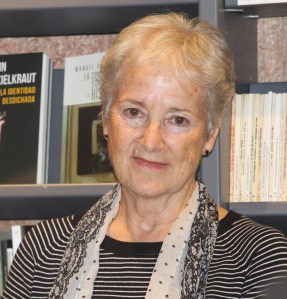 Maria Wallace (Maria Teresa Mir Ros) was born in Catalonia, but lived her teenage years in Chile. She later came to Ireland where she has now settled. She has a BA in English and Spanish Literature, 2004, an MA in Anglo-Irish Literature, 2005. She won the Hennessy Literary Awards, Poetry Section, 2006. Her work has been published widely in Ireland, England, Italy, Australia and Catalonia. Winner of The Scottish International Poetry Competition, The Oliver Goldsmith Competition, Cecil Day Lewis Awards, Moore Literary Convention, Cavan Crystal Awards, William Allingham Festival. She participated in the ISLA Festival (Ireland, Spain and Latin America), 2015, and has published Second Shadow, 2010, and The blue of distance, 2014, two bilingual collections (English – Catalan), a third one to come out within the year. She has taught Spanish, French, Art and Creative Writing. She facilitates Virginia House Creative Writers, a group she founded in 1996, and has edited three volumes of their work.
 -
Canto 1 of Dante’s Inferno
In middle-age I found myself
in an obscure wood,
for the straight road had long since been lost.
Christ, how hard it is for me now
to even contemplate how harsh and savage
a place it was, without renewing my old fears!
It is a place so bitter that death might come as a relief;
But to speak of the good
I will tell of the other things too that I found.
I don’t know how I can begin to describe how I entered,
having been so drugged in a kind of sleep
that I had long since abandoned the straight way.
But, when I reached the foot of the hill,
there where the valley ends,
and where my heart had been seized with such anguish,
I looked up, and I saw its shoulders
dressed in the rays of the planet
which directs us all to where we need to go.
Then the fear was a little quieted,
which had endured well into the night
in the lake of my heart.
And like someone trying to find his breath
on the bank after surfacing from the depths,
looking back over the perilous waters;
So my soul, still reeling,
looked back at the pass,
which had never before let anyone through alive.
Then, after I had rested my weary body,
I looked up once again on the deserted hill,
my left foot treading heavily behind me.
Almost as soon as I had started
a stealthy and light moving leopard appeared,
his fur covered by those distinctive spots.
It did not depart on seeing me,
but instead impeded my movements, blocking my way.
So I had to beat a retreat, over and over again.
It was early in the morning,
the sun was rising with the stars still out,
a sight which still evokes the divine
and that almost mythic time before the big bang;
so I no longer feared the beast as much,
with all it signs of debilitating luxury,
from that hour onto the sweet season.
But, not so much that I didn’t fear
the lion, which next appeared.
He approached me, coming towards me
with his head held high. He had a hungry look,
so much so that the very air about him seemed affected.
Next a she-wolf with all its ravenousness,
seeming to eat into its own need,
and the cause of much misery for so many on earth.
So much heaviness and fear did I feel,
at the sight of her, that I seemed to lose all hope
of ever reaching the summit.
And so, like one just on the brink,
yet time catches up causing them to lose heart,
so who in all thoughts weep, and becomes even more wretched.
So she made me, this restless wolf,
who kept approaching me, little by little,
forcing me back to where the sun sinks,
and while I descended to a very low place,
it was then that my eyes were offered the sight of one
who, as if originating from a great silence, appeared hoarse to me!
When I saw him in that great wilderness
I cried out, ‘ O for Pity’s sake, HELP ME!
Whatever you might be; shade or certain man!’
And he responded: ‘ Not man, but man once
was I. My parents were from Lombardy,
Mantuans both by birth.
I was born sub Julio, though it was late,
and so I also saw Rome during the good Augustus’ reign;
a time of both false and dying gods.
A poet was I, telling principally of that man who was
known as Aeneas, and who came from Troy,
from where the great Iliad come to us.
But why do you turn your back so?
Why don’t you climb that mountain
which is the reason and cause for all possible joy?
‘Are you really the same Virgil who created
that fountain of discourse which flows out like a river?’
I asked, with sudden shame upon hearing my own words.
‘All honour and light to other poets, yet loving
study, and great love, had me searching
through your volumes…
You are my Master, my author.
You alone are to be credited with the
beautiful style, which has brought me great honour and fame.
But, do you see this beast which has been forcing me back?
Please help me, great sage,
for she makes the very blood in my veins tremble.’
‘Ah, you must take another road,’
he replied, when he saw my tears,
‘If you want to escape from this savage place.
For this beast which makes you cry out
will never let you pass by this way,
such is its force that it would murder you in the end.
She has such an evil and malignant nature,
so that when her greed and desire are momentarily
appeased, her fierce appetites are once again renewed.
Many are the animals which she further mates with,
and many more, no doubt, will come. Until, finally
the grey hound will come and put an end to her.
This hound doesn’t feed on anything else found upon the earth
but love, wisdom and virtue;
her estate being built on human emotions.
It alone can be the salvation of the humble Italy
for whom the virgin Camilla died,
Euryatus, Turmus and Nisus, among others…
Only it can chase this ravenous beast out of every town,
until it has been sent back to hell,
where envy alone spawned it.
So, I think it best that you should
follow me, I will be your guide,
taking you far from here to an eternal place
where you will hear desperate shrieking,
coming from the ancient spirits in pain,
and who always cry out, at their second death.
And you will see also those happy to be in the flames
because they believe that hope will still come,
whenever it is the moment to be, to those beatified.
And then, in your own time you will rise up,
a soul more worthy than I,
and with her I shall leave you, taking my leave.
For the Emperor who so reigns, where I will take you,
was unknown to me, my mere birth being an act of rebellion.
So that he doesn’t wish for my kind to be even seen in his city.
In every place there he reigns, and he alone.
There in his city he sits on his high throne,
And happy are they who are chosen.’
And I said to him: ‘ Poet, I beg you.
In the name of the God whom you did not know,
so that I may flee this evil, and worse.
That you might take me to where you spoke of,
so that I may see the gates of Saint Peter,
and all who are assembled there.’
And than he moved, and I followed him.
This transversion is © Peter O’Neill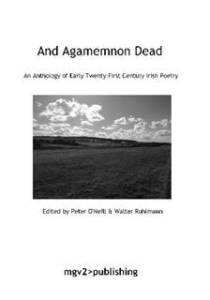 Peter O’ Neill (1967) was born in Cork where he grew up before moving to live in France in the nineties. He returned to Dublin in 1998, where he has been living ever since. He is the author of five collections of poetry, most notably the Dublin Trilogy: The Dark Pool (mgv2>publishing, France, 2015), Dublin Gothic (Kilmog Press, New Zealand, 2015) and The Enemy, Transversions from Charles Baudelaire (Lapwing Press, Northern Ireland, 2015). In his review of The Dark Pool, the critically acclaimed American poet David Rigsbee wrote: Peter O’ Neill is a poet who works the mythical city of Modernism in ways we do not often see enough.’ (A New Ulster )
He holds a degree in Philosophy and a Masters in Comparative Literature, both awarded by Dublin City University. In 2015 he edited And Agamemnon Dead, An Anthology of Early Twenty First Century Irish Poetry with Walter Ruhlmann for mgv2>publishing, and mg 81 Transverser. He also organised Donkey Shots; Skerries First International Avant Garde Poetry Fest in May, this year. He is currently hosting The Gladstone Readings once a month in his home town of Skerries.
Janus- His Mistress Responds and other poems by Peter O’Neill from Dublin Gothic (Kilmog Press, 2015)
“The Elm Tree” by Peter O’Neill
“The Elm of the Aeneid” and “Spadework” by Peter O’Neill. -
Wedding
“Hasty,” the judge mocked
until he read the letter
from the consultant,
his jaded face changing to pity.
We got the green light then,
to marry in a hurry.
We turned up in our jeans
and limped through the ceremony –
upsetting the officiating lady,
determined to make this
a special occasion.
Outside the registry office
we inked a shadow
on the next couple:
the bride, glowing in her plumage,
her robust young groom,
their flower girls fidgeting.
My brother and his wife
had used their lunch hour
to be our witnesses.
They went back to work,
and my new spouse
rode off on his bike:
the big triumph that,
with six months to live,
he could still cycle.
I had to collect our children –
the paltry nuptials would have been
disappointing – no frocks, no fun –
just this boring signing thing,
and so I kept it secret,
left them with Gran.
I sloped off to the train.
It was bright, a May day,
and I was forty-seven –
finally, improbably
a married woman.
Wedding is © Katie Donovan first published in the November 2015 issue of Cyphers Magazine, edited by Eilean Ni Chuilleanain, Macdara Woods and Leland Bardwell
Operation
In the hospital,
gowned in gauzy cloth,
he is prepped;
his limbs so thin,
his head bursting with the tumour,
with knowing that wrestling
the thing out may kill him.
All day the cutters and stitchers
are at work, slicing from lip
to clavicle, sawing bone,
careful not to snick an artery,
gouging a flap from his thigh,
to patch the gap
where the tumour hid
thriving in its secret lair.
When it’s out –
and they have fixed the jaw
with a steel plate;
rivetted the long L-shape
of the wound –
he lies arrayed
with tubes and drains.
He floats in the shallows
of the anaesthetic,
his breath echoing eerily
from the hole in his throat,
his face utterly still.
The night before the operation
he read “Peter Pan”
to our children,
and in the morning
he surrendered;
waving from the trolley,
as if to clutch a last particle
of the life we figured for him,
as if to let it fall.
Operation is © Katie Donovan first published in Irish Pages, The Heaney Issue, 2014, Vol. 8, No.2, edited by Chris Morash and Cathal O Searcaigh
Off Duty
Is my face just right,
am I looking as a widow should?
I pass the funeral parlour
where four weeks ago
the ceremony unfurled.
Now I’m laughing with the children.
The director of the solemn place
is lolling out front, sucking on a cigarette.
We exchange hellos,
and I blush, remembering
how I still haven’t paid the bill,
how I nearly left that day
with someone else’s flowers.
Off Duty is © Katie Donovan first published in The Irish Times, 2014, by Poetry Editor Gerry Smyth
 Katie Donovan has published four books of poetry, all with Bloodaxe Books, UK. Her first, Watermelon Man appeared in 1993. Her second, Entering the Mare, was published in 1997; and her third, Day of the Dead, in 2002. Her most recent book, Rootling: New and Selected Poems appeared in 2010. Katie Donovan’s fifth collection of poetry, Off Duty will be published by Bloodaxe Books in September 2016. She is currently working on a novel for children.
She is co-editor, with Brendan Kennelly and A. Norman Jeffares, of the anthology, Ireland’s Women: Writings Past and Present (Gill and Macmillan, Ireland; Kyle Cathie, UK, 1994; Norton & Norton, US, 1996). She is the author of Irish Women Writers: Marginalised by Whom? (Raven Arts Press, 1988, 1991). With Brendan Kennelly she is the co-editor of Dublines (Bloodaxe, 1996), an anthology of writings about Dublin.
Her poems have appeared in numerous periodicals and anthologies in Ireland, the UK and the US. She has given readings of her work in many venues in Ireland, England, Belgium, Denmark, Portugal, the US and Canada. She has read her work on RTÉ Radio One and on BBC Radio 4 and BBC Radio 3. Her short fiction has appeared in The Sunday Tribune and The Cork Literary Review.
Entering The Mare and other Poems by Katie Donovan
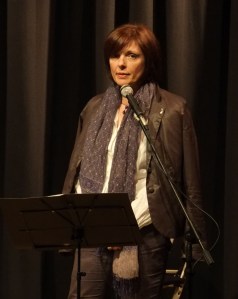

 Chris Murray