British Columbia Pastoral Accident Report: After the Baby Dies at Birth Fugue Travelling Through Tennessee in January |
Hunger [or the last of the daughter-hymns]

(n) a feeling of discomfort or weakness caused by lack of food,
coupled with the desire to eat—


as I talk to wind winnowing my ribs into wind
   chimes. I swallow small coins from the counters,
wanting change my body can keep. I stand

   on the street corner in the rain & coax water
into my mouth like a woman who doesn’t know
   the fullness of the sea. My mother worked

three jobs to feed our family. Now, I horde
   toilet paper & paper towels in spare closets
with cans of soup & creamed corn. The wind

   hollows the oaks. Their bones don’t know
what it is to break, but I am a hollow
  instrument, a sacred text. Daughter [less].


(v) have a strong desire or craving for

a body inside my body—
a child, a man.

Fields, full. The sun,
aflame. Fear like a shot

-gun, an aborted flight
plan, people jumping

from buildings. But
my daughter, I draw back

down. The one I lost.
The ones I have left

to lose. Like snow—
the bodies that are ours

for a season. For less.


(v) to feel or suffer through lack of food


        the weak sunrise

in my daughter’s new

      silence. My skin, a loose

sheet. Her clavicle, hip

        -bone, head. My cervix,

thinned. Her body, an offering. A prayer

I whisper as I tear

			new maps in a lucid dream

where I live alone

	& she folds herself into a crane

			to hang from the ceiling

of someone else’s womb.

Originally published in Sycamore Review
Near Narajiv Selo

-Hunger, cold, and ethnic oppression forced Ukrainian and Jewish
people to look for refuge in faraway lands
(1919-1939, when Eastern Galicia belonged to Poland)- Roman Zakhariy


A dark road. Stars like paper
    lanterns. Long grasses unthread in thousands

           of flickering fingers. Poppies’

mouths buttoned black, as wind
      shrifts crimson

petals from stems, from fields torn by tractor tires, from a barn
       below the hill. My stomach, where I left things
       unliving,
                 pierced by little more than night

       air. Like shackled light, the moon is
       outlawed in the pines. I unholster
the sky:
        at dawn, cattle cry in the clearing

as I dig up
      rutabaga, cabbage to wrap the rice. Water claws through
      dirt. Claw hammers

for hands, I carve our breaths
into trees. Our breaths, like silver buildings. As I slowly empty
            the earth, sky

          buries night. Night
  that smells of gunpowder and grease. Night
         that leaves nothing
more
         than a handful of stars, twined
    in the pines’
rime. Nothing more
			than a river
		where no one has drowned.
Originally published in Southern Humanities Review
|
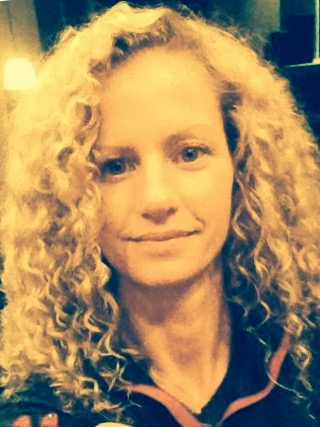 Chelsea Dingman’s first book, Thaw, was chosen by Allison Joseph to win the National Poetry Series (University of Georgia Press, 2017). In 2016-17, she also won The Southeast Review’s Gearhart Poetry Prize, The Sycamore Review’s Wabash Prize, and Water-stone Review’s Jane Kenyon Poetry Prize. Her work can be found in Ninth Letter, The Colorado Review, Mid-American Review, Cincinnati Review, and Gulf Coast, among others. Visit her website. Chelsea Dingman’s first book, Thaw, was chosen by Allison Joseph to win the National Poetry Series (University of Georgia Press, 2017). In 2016-17, she also won The Southeast Review’s Gearhart Poetry Prize, The Sycamore Review’s Wabash Prize, and Water-stone Review’s Jane Kenyon Poetry Prize. Her work can be found in Ninth Letter, The Colorado Review, Mid-American Review, Cincinnati Review, and Gulf Coast, among others. Visit her website. |

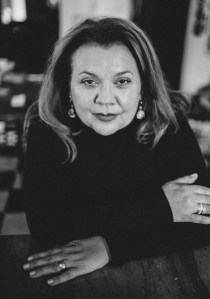 Tess Barry was shortlisted for the 2015 Manchester Poetry Prize (UK). Twice a finalist for North American Review’s James Hearst Poetry Prize and Aesthetica Magazine’s (UK) Poetry Award, she also was shortlisted for the 2014 Bridport Poetry Prize (UK). Most recently, her poems appeared in or are forthcoming in And Other Poems (UK), The Compass Magazine (UK), Cordite Poetry Review (Australia), Mslexia (UK), Mudfish, Pittsburgh Poetry Review, The Stinging Fly (Ireland), and The Woven Tale Press Literary and Fine Arts Magazine. Barry is a Fellow of the Western Pennsylvania Writing Project and teaches literature and creative writing at Robert Morris University in Pittsburgh. Website:
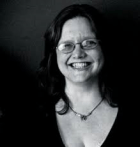 Susan Millar DuMars has published four poetry collections with Salmon Poetry, the most recent of which, Bone Fire, appeared in April, 2016. She also published a book of short stories, Lights in the Distance, with Doire Press in 2010. Her work has appeared in publications in the US and Europe and in several anthologies, including The Best of Irish Poetry 2010. She has read from her work in the US, Europe and Australia. Born in Philadelphia, Susan lives in Galway, Ireland, where she and her husband Kevin Higgins have coordinated the Over the Edge readings series since 2003. She is the editor of the 2013 anthology Over the Edge: The First Ten Years.
 My name is Rus Khomutoff and I am a neo surrealist poet in Brooklyn, NY. My poetry has appeared in Erbacce, Uut Poetry and Burning House Press.Last year I published an ebook called Immaculate Days. I am also on twitter:
 Chris Murray