Kitchen Danube – Duel I wanted to tell you, but there was no time Broken – Winged
|
Category: Nomadics
-
-
Windowless church
My church has no windows
in fact it has no doors either
and to be fair no altar
it has no ordained minister
or priest or gospels.
Its in my heart, in
the starry sky
the moon shining over the land
its the planets in our solar system
the sun when it shines or not
its the foods god/creator
left us, berries, leaves, nuts
my church has winter winds that
cut to the bone and to enlighten
I have the sweet smell of roses
as I follow the seasons.
It is bog cotton waving on an
early Autumn evening as the
sun bids farewell.
On nights like these
dark and Irish wintery
the familiar trees and hills
become ancient septs
ready for battle with the ether.
Fields caped in winter fog
appear as crafted cities of the dead
souls roam among the rushes
in search of utopia or a home.
Trees scan the darkened horizon
the wind calls out names too and
winter hangs around like a threat.
This is my church.
Distractions
It’s the end of April.
Spring late this year
begins its infinite ascent
to the tips of the cherry tree
birds come by often
a come-all-ye in the front garden
their songs reach an inner place
like listening to Franz Haydn
his strings reaching out
from centuries past making clear
contact in a podcast
channelling his toils and efforts
an artist whose initial struggles
with mind, soul, pocket
rise and fall with each
strike of the bow
altering my thoughts on outer things
a distraction, like the bird song often
heard in my childhood estate longing
for far flung horizons.
Stone circle alignments
They invite soul connection
invoke an energy of some sort
long past histories underfoot.
Early man was quite the architect
aligning the stones in such a way
that at equinox and solstices
sun rises to light up the passageway.
A seeking brings people here
an ancient longing that needs met.
Creevykeel court tomb is a full tomb
the largest in Ireland.
Tievebaun Mountain seems to guard it
shadows come and go with the sunsets.
we don’t give ancient man enough credit
for the science they carved into the landscape.
Fintona
Or to give it its’ town-land meaning
A fairly coloured field.
A small country town, familiar, friendly.
one can see the whole shopping street
from left to right without shifting a foot.
There is a jewel though
a hidden forested area
where a raised fairy fort stands
once druids conferred their words
in praise of nature.
There too I find the remains of a
burnt out wreckage of a car
perhaps stolen years ago left now for
mother nature to clear up which she did
wrapping her briars in and through the doors
designing the broken glass with her leaves.
Awakening
Sun slants in through the venetian blinds
dust particles float in the narrow space
books, a pen, Sundays newspapers
and a mobile phone cling on the quilt cover.
Its 9.30am Spring has come, crisp April air
drifts in from the ajar window, it will soon be
Summer again, warmth of the sun rejuvenates.
I wander the halls of my mind on wakening
sieve through last nights dream
catching broken pieces of a story or place
and wondering all day if it meant something.
Fintona and other poems © Aine MacAodha
These poems have been published in the online journal Episteme, Vol. 4(1), June 2015 under the section IRISH POETRY | Web address | http://www.episteme.net.in/ Aine MacAodha (1964-2021) was from Omagh North of Ireland, her works have appeared in Doghouse Anthology of Irish haiku titled, Bamboo Dreams, Poethead Blog, Glasgow Review, Enniscorthy Echo, poems translated into Italian and Turkish, honorable mention in Diogen winter Haiku contest, Shamrock Haiku, Irish Haiku, thefirscut issues #6 and #7, Outburst magazine, A New Ulster issues,2 ,4, 27. Pirene’s Fountain Japanese Short Form Issue, DIOGEN Poetry, Argotist Online, The Best of Pirene’s Fountain ‘First Water’ Revival and Boyne Berries. She self published two volumes of poetry, Where the Three rivers Meet and Guth An Anam (voice of the soul). Argotist online recently published ‘Where the Three rivers Meet’ as an E book. Her latest collection Landscape of Self was published by Lapwing Press Belfast.
https://sites.google.com/a/lapwingpublications.com/lapwing-store/aine-macaodha
http://ainemacaodha.webs.com/index.htm -
For Sylvia-Down in Adoration
You were Fulbright a seismic enigma
the fleet foot hare rising in pastel dusk.
It stalked like crows in the breast of a man
who sold your head for hapless wanderlust.
Your damage was like splintering of glass.
Could he not understand what it is to be
a milk jug, wasted lipstick, the outcast
shadow hung from a star-struck hemlock tree.
But a quiet voice is so more loquacious
than a risen phoenix roaring through air.
Maybe now is the time for tempered hush
time to weave your bridal crown through red hair.
He brought Devon sea shells to your headstone
you were his lotus his night passage glow.
For Jane Kenyon
Ten years on, while storm buffets glass and juniper,
snowflake tiers inside my porch
finger an army of miniature baubles.
The plastic robins perch lopsided. Even
that new star, a rushed afterthought, curtseys
on its axis where a black one legged doll should be.
Dear Jane I never met you. But I guess your mother
was at the station with pasteboard suitcases—ready
to sew broken limbs together again.
Now as I make end to season,
with more than a single strand of tinsel,
I nest plywood angels and churches
for a woman who breathed cypress and pondered why
only nightjars or silver fish
knew how to take shadowless flight.
The Pathologist’s Wife Taken as a whole she is like any other woman one heart four chambers one brain eight lobes If I place them in your gloved hands her weight is less than a pre-term infant this woman mute monkey on one shoulder zealous cat on the other At the edge of night she wears a cowl of thorns the spines draw blood if I forget to soften my touch Whatever moves between bright thought & Tahitian body Gauguin’s veneer is noted full mouth broad nose hair above her lip the nest of a bird humming at her wishbone & if you crystallise sadness look close under a microscope you find deep sea brittle stars in that one rare tear Natalia Spencer B.A lived in North Africa at the start of her life & now inhabits a quiet niche of South West England. Like most writers she knows, she has family, cats, many books. Her flash fiction has appeared in Kissing Frankenstein and other Stories, & Flash Frontier. In 2015 she won The MSF Silver Award for Best Poem from Visual Stimulus. More recently she has poems published in The Poetry Shed & various magazines. She is working towards her first collection.
 -

Delicate
A sea snail, most precious egg, as if
it had touched the ruby feather of a
bluebird. A most precious thing,
bird-egg-shattered, dust in my pores.
This excerpt from “Delicate” is © Christine-Elizabeth Murray.
When we widen the lens, the bigger picture can be divorced from the reality that we think we may have momentarily grasped. The above poem is an excerpt from “Delicate” which is being submitted to an Irish Journal at the present time. I expect I will publish the poem in its entire at some later point. BUT here the poem is performing an imagistic collaborative function and I am very grateful to Ari who notified me of the #BeautifulMars and #MarsPoetica project via the Poethead Contact form. I hope to have more news on #MarsPoetica for readers and contributors to the blog soon ! About HiRISE (HIGH RESOLUTION IMAGING SCIENCE EXPERIMENT): The HiRISE camera onboard the Mars Reconnaissance Orbiter is the most powerful one of its kind ever sent to another planet. Its high resolution allows us to see Mars like never before, and helps other missions choose a safe spot to land for future exploration. NASA’s Jet Propulsion Laboratory, a division of the California Institute of Technology in Pasadena, Calif., manages the Mars Reconnaissance Orbiter for NASA’s Science Mission Directorate, Washington. Lockheed Martin Space Systems is the prime contractor for the project and built the spacecraft. The HiRISE camera was built by Ball Aerospace & Technologies Corp. and is operated by the University of Arizona.
-
Canto 1 of Dante’s Inferno
In middle-age I found myself
in an obscure wood,
for the straight road had long since been lost.
Christ, how hard it is for me now
to even contemplate how harsh and savage
a place it was, without renewing my old fears!
It is a place so bitter that death might come as a relief;
But to speak of the good
I will tell of the other things too that I found.
I don’t know how I can begin to describe how I entered,
having been so drugged in a kind of sleep
that I had long since abandoned the straight way.
But, when I reached the foot of the hill,
there where the valley ends,
and where my heart had been seized with such anguish,
I looked up, and I saw its shoulders
dressed in the rays of the planet
which directs us all to where we need to go.
Then the fear was a little quieted,
which had endured well into the night
in the lake of my heart.
And like someone trying to find his breath
on the bank after surfacing from the depths,
looking back over the perilous waters;
So my soul, still reeling,
looked back at the pass,
which had never before let anyone through alive.
Then, after I had rested my weary body,
I looked up once again on the deserted hill,
my left foot treading heavily behind me.
Almost as soon as I had started
a stealthy and light moving leopard appeared,
his fur covered by those distinctive spots.
It did not depart on seeing me,
but instead impeded my movements, blocking my way.
So I had to beat a retreat, over and over again.
It was early in the morning,
the sun was rising with the stars still out,
a sight which still evokes the divine
and that almost mythic time before the big bang;
so I no longer feared the beast as much,
with all it signs of debilitating luxury,
from that hour onto the sweet season.
But, not so much that I didn’t fear
the lion, which next appeared.
He approached me, coming towards me
with his head held high. He had a hungry look,
so much so that the very air about him seemed affected.
Next a she-wolf with all its ravenousness,
seeming to eat into its own need,
and the cause of much misery for so many on earth.
So much heaviness and fear did I feel,
at the sight of her, that I seemed to lose all hope
of ever reaching the summit.
And so, like one just on the brink,
yet time catches up causing them to lose heart,
so who in all thoughts weep, and becomes even more wretched.
So she made me, this restless wolf,
who kept approaching me, little by little,
forcing me back to where the sun sinks,
and while I descended to a very low place,
it was then that my eyes were offered the sight of one
who, as if originating from a great silence, appeared hoarse to me!
When I saw him in that great wilderness
I cried out, ‘ O for Pity’s sake, HELP ME!
Whatever you might be; shade or certain man!’
And he responded: ‘ Not man, but man once
was I. My parents were from Lombardy,
Mantuans both by birth.
I was born sub Julio, though it was late,
and so I also saw Rome during the good Augustus’ reign;
a time of both false and dying gods.
A poet was I, telling principally of that man who was
known as Aeneas, and who came from Troy,
from where the great Iliad come to us.
But why do you turn your back so?
Why don’t you climb that mountain
which is the reason and cause for all possible joy?
‘Are you really the same Virgil who created
that fountain of discourse which flows out like a river?’
I asked, with sudden shame upon hearing my own words.
‘All honour and light to other poets, yet loving
study, and great love, had me searching
through your volumes…
You are my Master, my author.
You alone are to be credited with the
beautiful style, which has brought me great honour and fame.
But, do you see this beast which has been forcing me back?
Please help me, great sage,
for she makes the very blood in my veins tremble.’
‘Ah, you must take another road,’
he replied, when he saw my tears,
‘If you want to escape from this savage place.
For this beast which makes you cry out
will never let you pass by this way,
such is its force that it would murder you in the end.
She has such an evil and malignant nature,
so that when her greed and desire are momentarily
appeased, her fierce appetites are once again renewed.
Many are the animals which she further mates with,
and many more, no doubt, will come. Until, finally
the grey hound will come and put an end to her.
This hound doesn’t feed on anything else found upon the earth
but love, wisdom and virtue;
her estate being built on human emotions.
It alone can be the salvation of the humble Italy
for whom the virgin Camilla died,
Euryatus, Turmus and Nisus, among others…
Only it can chase this ravenous beast out of every town,
until it has been sent back to hell,
where envy alone spawned it.
So, I think it best that you should
follow me, I will be your guide,
taking you far from here to an eternal place
where you will hear desperate shrieking,
coming from the ancient spirits in pain,
and who always cry out, at their second death.
And you will see also those happy to be in the flames
because they believe that hope will still come,
whenever it is the moment to be, to those beatified.
And then, in your own time you will rise up,
a soul more worthy than I,
and with her I shall leave you, taking my leave.
For the Emperor who so reigns, where I will take you,
was unknown to me, my mere birth being an act of rebellion.
So that he doesn’t wish for my kind to be even seen in his city.
In every place there he reigns, and he alone.
There in his city he sits on his high throne,
And happy are they who are chosen.’
And I said to him: ‘ Poet, I beg you.
In the name of the God whom you did not know,
so that I may flee this evil, and worse.
That you might take me to where you spoke of,
so that I may see the gates of Saint Peter,
and all who are assembled there.’
And than he moved, and I followed him.
This transversion is © Peter O’Neill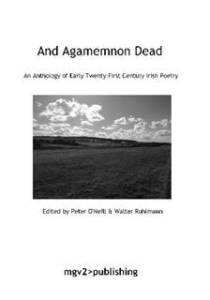 Peter O’ Neill (1967) was born in Cork where he grew up before moving to live in France in the nineties. He returned to Dublin in 1998, where he has been living ever since. He is the author of five collections of poetry, most notably the Dublin Trilogy: The Dark Pool (mgv2>publishing, France, 2015), Dublin Gothic (Kilmog Press, New Zealand, 2015) and The Enemy, Transversions from Charles Baudelaire (Lapwing Press, Northern Ireland, 2015). In his review of The Dark Pool, the critically acclaimed American poet David Rigsbee wrote: Peter O’ Neill is a poet who works the mythical city of Modernism in ways we do not often see enough.’ (A New Ulster )
He holds a degree in Philosophy and a Masters in Comparative Literature, both awarded by Dublin City University. In 2015 he edited And Agamemnon Dead, An Anthology of Early Twenty First Century Irish Poetry with Walter Ruhlmann for mgv2>publishing, and mg 81 Transverser. He also organised Donkey Shots; Skerries First International Avant Garde Poetry Fest in May, this year. He is currently hosting The Gladstone Readings once a month in his home town of Skerries.
Janus- His Mistress Responds and other poems by Peter O’Neill from Dublin Gothic (Kilmog Press, 2015)
“The Elm Tree” by Peter O’Neill
“The Elm of the Aeneid” and “Spadework” by Peter O’Neill. -
Unfinished Business
On their wedding day his father said
I’ll forgive you everything if you do right by this girl
the unfinished education
the empty table setting at Christmas
the family name unpolished, unloved.
I never met my grandfather
a man who lived under the glare of his wife
but I remember my grandmother, a small woman
her mouth eternally disappointed with life.
Dad bringing us down to visit her
to the small dark house on Bulfin Road
where the furnishings took themselves too seriously.
Later in that same house, I found a studio photograph
of the polished family; my grandfather, something familiar
in the way he’s leaning against the table
my dad, a beautiful child about three years old
sitting beside his brothers and sisters, and there
my grandmother upright and disapproving
staring into the camera, daring it to blink.
That blonde haired little boy
the man who loved his wife for sixty years
couldn’t wait to cycle home from work
gave up his wages every week
cooked our fry on Saturday mornings
scrubbed our nails, polished our shoes
still wonders if he did enough
still wonders if he’s been forgiven.
Published in Spring 2015 Edition, Skylight47. Editors Kevin O’Shea, Susan Lindsay and Nicki Griff
At Sea
I’m watching a film.
There’s a scene at the end
where the leading lady gets into her car and drives.
The camera, a bird’s eye view of highways and roads
follows her progress until the journey slows
curves along the edge of sunshine and sea
before braking to standstill on gravel and sand.
I’ve seen this film before, a light-hearted affair
no hidden meaning or sudden twist at the end
but this time, I’m sitting on the couch, trying not to cry
wondering why the sight of the ocean at the end of a film
feels like someone close just died.
As the credits roll, I let the waves run in to shore
until my breathing calms and I am more myself again
forty six years old and counting
acknowledging the sadness
of continents and planets unexplored
of a single self who got side-tracked early.
I think of childless friends
who speak of emptiness and longing
the inconsolable sea inside
and that defining moment
whether through age or circumstance
when only one reality remains
and grief shows up to fill the void.
Published on-line on HeadStuff website Poem of the Week, June 17th 2015, Editor Alvy Carragher.
Groundhog Day
I laugh at 1950’s woman
tied to the kitchen sink
hair in curlers, head filled
with cleaning products
and ways to please her husband
after his long day’s work.
Yet sometimes
lying awake
juggling roles
adding items
to a list of never ending tasks
to be completed
I hear in the darkness
the kitchen sink
shuffling towards me
and her laughter
as she applies coral pink
lipstick to her smiling mouth.
South Wall
We walked the full length
sat on rocks
backs to the lighthouse
looking out at the lazy sea.
The air hummed dusk and evening
water turning from gloss, to satin, to matt
sky and breath descending.
Headed back in silence
footfall into the arms of Dublin bay
its familiar outline softening
night, a short car journey away.
The World Reduced to Sound
Lying in my single bed
a childhood illness for company
the world reduced to sound.
Behind my eyes the darkness echoed
inside my chest uneven notes
rattled and wheezed.
Beyond my room a floorboard creaked
a muffled cough across the landing
grew faint and faded away
My hot ear pressed against the pillow
tuned into the gallop of tiny hooves
then blessed sleepy silence.
In the morning
steady maternal footsteps
sang on the stairs.
I loved that song.
Published in collection ‘Take This Life’ (WordOnTheStreet 2011)
Consolation
In a claustrophobic room
just off intensive care,
he outlined the facts.
‘She only scored four
on the Glasgow Scale.
It’s not looking good.’
Even as he said it
I knew this moment
defined ‘before’ and ‘after’.
I hyperventilated.
My mind looked on
as my body drowned.
We sat by her bed.
The word ‘coma’
came and sat beside us.
That evening she awoke.
Everything had changed.
She saw her daddy cry.
But a lifelong disease
is so much better
than no life at all.
When we got home
the house has moved
to another galaxy.
Published in The Moth Issue 2 Editor Rebecca O’Connor Both a page and performance poet, Anne Tannam’s work has appeared in literary journals and magazines in Ireland and abroad. Her first book of poetry Take This Life was published by WordOnTheStreet in 2011 and her second collection Tides Shifting Across My Sitting Room Floor will be published by Salmon Poetry in Spring 2017. She has performed her work at Lingo, Electric Picnic, Blackwater & Cúirt Literary Festival. Anne is co-founder of the Dublin Writers’ Forum.
.
Anne Tannam’s website -
View
He wrote a picture postcard to me;
A fishing boat on the edge of Lough Currane
Close to his home.Beside the window where he writes his news
The view of fuchsia beside a stone-wall,
Flecked with the sun.His side of the glass; depression, for years
Dependent on medications; then the
Further frustration;As invasion of cancer then threatened
A future made all the more precious;
Delivered in the post,Passing on this message; ‘I knew you’d enjoy
The picture of the lake; thought it would do
You the power of good;Though; my dear; I know you don’t need it
Pray for me, and write soon,” he pleaded.View is © Helen Harrison
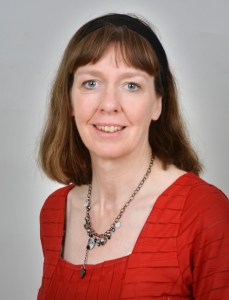 Helen Harrison was raised on the Wirral, seven miles from Liverpool, by Irish parents, and has lived most of her adult life in the border countryside of Co Monaghan, Ireland where she is married with a grown-up daughter. During 2014 she was awarded a bursary from the Arts Council of Northern Ireland to study poetry for a week at The Poets House, Donegal.
Her poems have been published in A New Ulster, North West Words and The Bray Journal. Her first collection of poetry The Last Fire was published during 2015 by Lapwing. Some of her poetry can be found at poetry4on.blogspot.com
-
summer haiku
choppy Irish Sea
failing to dislodge
this red starfish
poppy bed:
the unopened ones
as lovely as the blooms
a garden full of sunflowers swaying tall
muddy summer frogpond no splash
reject samsara ?
this wild summer river
this wild path
these stone walls
hemming him in too-
cinnabar caterpillar
cloudy afternoon…
my sweet pea flowers
becoming peas
A Train Hurtles West
morning downpour-
we have both dreamt
about our mothers
lingering
in my small bathroom…
mum’s perfume
Auld Lang Syne
in the background-
I sign her DNR request
mother dying a train hurtles west
death cert. incomplete granny’s maiden name
All through the Night:
this out of tune version
strangely moving
cloudy morning…
her solar-powered plastic flower
sways hesitantly Maeve O’Sullivan works as a media lecturer in the further education sector in Dublin. Her poems and haiku have been widely published and anthologised since the mid-1990s, and she is a former poetry winner at Listowel Writer’s Week. Initial Response, her debut collection of haiku poetry, also from Alba Publishing, was launched in 2011, and was well-received by readers and critics alike. Maeve is a founder member of Haiku Ireland and the Hibernian Poetry Workshop. She also performs at festivals and literary events with the spoken word group The Poetry Divas. Her poem Leaving Vigo was recently nominated for a Forward Prize for a Single Poem by the Limerick-based journal Revival.
- A Train Hurtles West by Maeve O’Sullivan was published in 2015 by Alba Publishing
- Vocal Chords by Maeve O’Sullivan
- Alba Publishing
- An Index Of Contemporary Irish Women Poets
-
Ode
More happy love! more happy, happy love!
Forever warm and still to be enjoy’d…’—JOHN KEATS, Ode on a Grecian Urn
You lie across my thighs as I write,
my bone-warming hot water bottle,
pure latex, guaranteed to delight the most
discriminating women, mottle their thighs
as they lie deep in their beds, pretending
this rubber sack of warm water
could never replace their lover.
The women of Ireland drive with you
across their laps, hand-knit covers
helping to keep you warm. More love,
the patterns passed down from
mothers and grandmothers, still enjoyed.
They knit covers for each new bottle,
battle the cold, inside and out.
Every woman remembers her first.
I was twelve, three hours after landing
in Ireland, in Granny’s front bedroom.
You are the best invention after
hot water on tap, and when old age hits
and you warm through rheumatism—
not period pains—I hope to bits
I will have more to hug than my hottle
(Granny’s word for hot water bottle).
Women Improve With the Years
after Yeats
I am worn out with diets—
those rain-worn, concrete goddesses
among the skinny streets.
All winter long I look at magazines
and try out each new fad
I find in each new book.
Pretending: I am a future beauty, too.
But I’m pleased with myself,
to have the power of all four limbs,
eyes that can read the headlines, a body
that has grown a baby, loved on a whim.
Women improve with the years;
I switch on the light, don’t mind
who sees my stretch marks. If we meet
at my burning age, watch out! I grow
ludic in the rain—a diet-worn, fleshy
goddess at play among the shops.
Leda Revised
There’re worse things than being fucked by a swan.
Try going in—a young woman, full of life—
to give birth to your firstborn—that perfect
fleshy egg. Sim-fizz-ee-otomy. I’ve learnt how to say it,
properly. A slice here, a slice there, my pelvis opens up.
The next day a young nurse teaches me to walk.
Instead of nursing my crying baby I had to learn
to walk again. A big egg, they said, much later. Too big.
Our Lady of Lourdes was worried that if they did one
they’d end up doing ten C-sections on me.
As if my husband wouldn’t keep his hands off me—
and not a condom allowed within these holy shores.
They must have pictured me pregnant for decades.
Like I could let him near me again. Pain too strong
to let me hold my baby, even. Waddling everywhere.
Fuckin Zeus. Him and his big shoulders.
Always Sligo Rovers
for Shea and Sam
The ancestors at Garavogue Villas
don’t care that we can’t pay the rent.
Their stone circle is still here, disguised
as a roundabout. Lichen covers the stones.
In the middle, the Blessed Virgin Mary—
in an all-white strip—protects the ancestors,
prays over them, right on the spot
where their bones used to lie.
Their 5,000-year-old tomb is gone.
Parked cars hide the touchline
where we used to play kerbs. Sometimes,
late at night, I pass Whitewash Mary,
always praying, always quiet,
that half smile playing around her lips,
her curves dimly lit by streetlights—
lone mother of the night—and I want
to kick the stray football to her, shout:
‘Get up to it, Mary, nod it back!’
At the Showgrounds, the mountains surround us,
ancestors everywhere—on Knocknarea,
Keelogboy, the Ballygawley Hills, Ben Bulben.
The sky is thick with ancestors—
there isn’t too far you can go in this town
without someone knowing what you’re up to.
Bohs are in with a chance but we’ve got Joseph Ndo
who brings a kind of stillness to every
pass of the ball, as though he’s surrounded
by a different type of air, the ancestors at his feet.
And sometimes when it’s a good night
in the Showgrounds and no one
has cursed the result, that same kind
of force field hovers right around the grounds,
around the signs for Tohers and Jako,
energy conjured up by the ancestors—
who else could it be?—watching over us.
A minute’s silence for the ancestors, for their protection,
everyone up on their feet, a minute’s silence for any help
the ancestors might give tonight, the night when
Rovers line out against Bohs, the night when Uncle S
brings his newly-fatherless nephew to see his first match
in the Showgrounds, when Googe brings his future wife
to see what she’s letting herself in for, when
Seamus brings his young son to the only place on earth
where he will be allowed to swear loudly
at each lost tackle, wrong penalty,
missed chance, the ancestors watching over them,
that blessed moment before the whistle blows,
a moment’s silence, please,and we remember
our pasts, our people returned to us for tonight—
as though their spirits could come back to earth,
touch down right there on the pitch.
Friday
Today is Friday and I’m out of metaphors—
the wind howling though the trees outside
is just the wind that knocks down the wheelie bin
which is just a bin blown over that scatters
egg cartons, yoghurt pots and plastic bottles
over the gravel stones outside my house
that are simply stones (though a lot of them)
and my house is a house, rectangular,
white, four walls and a roof, nothing more.
This pen I hold writes only words—
blue words. As in the colour blue.
Somewhere else a five-year-old boy picks up
a fragment of a cluster bomb (where it might
be windy, too)—they aren’t metaphors either
(neither the boy nor the bomb).
My own son is with my neighbour,
(somewhere out there in a black Ford)
both of them flesh and bone, representing
themselves (their best and their worst selves).
I sit here and I mean nothing more than
woman sitting on a couch on a Friday afternoon
writing and waiting.
Gym Poem #1
Tracksuit
My muscles and tendons stitch along my bones
like a comfortable tracksuit that knows the shape of me,
my life, the limited shapes of the work I do.
These poems from Skip Diving (Salmon Poetry, 2014) are © Celeste Augé Celeste Augé is the author of Skip Diving (Salmon Poetry, 2014), The Essential Guide to Flight (Salmon Poetry, 2009) and the collection of short stories Fireproof and Other Stories (Doire Press, 2012).
The World Literature Review said that “Celeste Augé’s poems are commendable for their care, deep thought, and intellectual ambition”, while the Anna Livia Review said that “Fireproof is a remarkably strong debut into the world of short stories and will begin to build what is undoubtedly going to be a strong readership for the author”.
Celeste’s poetry has been shortlisted for a Hennessy Award and she received a Literature Bursary from the Arts Council of Ireland to write Skip Diving. In 2011, she won the Cúirt New Writing Prize for fiction. She lives in Connemara, in the West of Ireland.
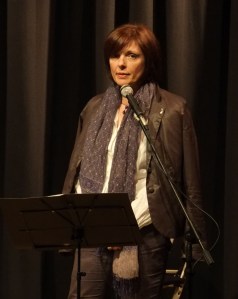

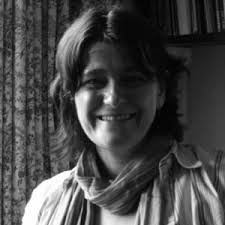

 Chris Murray