Waiting Room Deserted Village, Achill Island Notes for an exhibit Madam Butterfly at Beaumaris Doorways Role reversal |
Category: Sites
-
-
Fable
When I look back I seem to remember singing.
Yet it was always silent in that long warm room.Impenetrable, those walls , we thought,
Dark with ancient shields. The light
Shone on the head of a girl or young limbs
Spread carelessly. And the low voices
Rose in the silence and were lost as in water.Fable is © Doris Lessing (1919-2013)

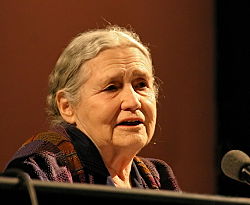
Author and Poet Doris Lessing (1919-2013) Nobel Laureate Doris Lessing (1919-2013) was a novelist, poet, and sci-fi writer. This appreciation of Doris Lessing was first published on the Women Writers, Women’s Books Site in 2013 with thanks to Anora McGaha, and to Barbara Bos who live edited the piece at the time of writing. Thanks to Olivia Guest at Jonathan Clowes Ltd who has allowed me carry Poems by Doris Lessing here at Poethead.
When a person of great age dies, there are many responses about the richness of their life and how we have been blessed by their presence for so long in our world. Yet for me there was and is profound sorrow at the loss to us of Doris Lessing Nobel Laureate, author, philosopher and poet. I do not delude myself that my sorrow is one of intimate connection to her, a whole generation of women writers have that connection to her voice.
My connection to Doris Lessing’s writing began in my twenties when I first read The Golden Notebook, I read almost all her work after that. I am unsure of where the gut tear occurred with my reaction to her work, but here was a writer who did things that I admired. It was difficult to locate her effect on me, but I knew it and recognised it as important to my writing.
Living in Dublin city, I often retreat to a small house in Mayo, where my now deceased friend, Michael McMullin, a philosopher and jungian, had retained a library. His Doris Lessings were collected on the top shelf of his library, alongside some images of Chartres Cathedral, and his Yeats collection. Like Lessing he had attained a great age and had a voracious thirst for knowledge, he was born in Ceylon in 1916.
Michael’s assidious collecting of Doris Lessing was winsome, and he often referred to her. His nomadism had taken him from Ceylon, to Cambridge, to escape from Hitler’s invasion of Paris, to Finland, to Canada, and at the end his life, a hillside In the North-West of Ireland. I did not meet Doris Lessing, but I had met in Michael that intellectual and questing spirit that seems to inflame the diasporist writer. It can only be described as a great and humble presence, their being present to everyone who he/she encounters all the time.
Doris Lessing’s death brought back my own recent loss with a punch. I saw the rumours of her death emerging from early Sunday morning and waited to hear if it were true. My decision to go ahead and link the Lessing poems was an urgent need to show people that there was more to her output, although it is sadly unavailable.
Two years ago while re-reading Lessing in the Mayo library awaiting a death, the Lessing poetry began to make me a bit more than curious. On returning to the city, I thought to do some searches of her writing, as I was aware that she like Ted Hughes, had elements of Sufism in her writing. I was aware that she had written poetry but couldn’t find much. The place to look for the mythological, esoteric, and philosophical mind of the writer is in their poetic output. Poetry is the revelatory act of participation in the world.
Doris Lessing had written a small collection Fourteen Poems in 1959, published by The Scorpion Press, and she had contributed to the Inpopa Anthology (2002). Her poetry isn’t available online. The Scorpion Press Archive is housed at the McFarlin Library (Special Collections) at the University of Tulsa.
Alison Greenlee, Librarian at the McFarlin Special Collections Library located for me a copy of the book in my Alma Mater, University College Dublin. I made an appointment to go in as soon as I could and transcribed a selection of the poems for myself. The next step was to contact Jonathan Clowes Ltd, who are Doris Lessing’s agents.
Olivia Guest at Jonathan Clowes Ltd, Doris Lessing’s Literary Agents, worked on my behalf to bring Doris Lessing’s poetry back online. We corresponded initially by letter and I procured a temporary 12 month licence to add Lessing to my index of women poets. I wanted her to be recognised for her entire body of work and not alone the novels. After the initial permissions to carry the Lessing poetry were given, the first letter went awol and had to be re-issued, I put them up and shared them regularly across multiple social media platforms including FB, Twitter, Salon.
I wrote about the poems on Open Salon. There were 3,000 hits on the poetry over the two blogs. People contacted me to say that they wanted to read the books, that they had no idea that she was a poet, and that they were heartened to see a woman poet of great age appearing on their computer screens, as there is often a problem with having older women visible in the media.
The following year, I sent Olivia Guest a synopsis of the reaction to Doris Lessing’s poetry and we agreed to extend the licence for another 12 months. She was surprised that the reaction to lessing’s poetry had been so widespread and curious. I sent her screenshots of the data and emails regarding the works.
This year of 2013, I again contacted Olivia and reminded her that my licence to carry the poetry was about due to end and that it gave me great sorrow to take the poems off my index, people were always looking for them, they accounted for a lot of searches for women writers, alongside Dorothy L. Sayers and Nelly Sachs.
last week I received an email that made me sadder. Doris Lessing had little confidence in her poetry and her agents were happy to allow me keep them indefinitely because they did not see the possibility of a re-issue.
This is the email that Olivia Guest sent me recently,
Dear Christine
We’d be delighted for you to host the poems for longer especially if you’re getting such good reactions. Doris Lessing was never very keen on her poetry and didn’t think it was any good so I doubt we will see a re-issue but at least this way, they are available in an alternative form.
Many thanks and best wishes
Olivia
The Megaliths Series, by Ann Madden (Irish Artist)I wondered then if Doris Lessing knew over these years that I had the poems and that they had caused such a reaction on the Poethead ? I still do not know if she did. Last week I announced on Poethead that I would be retaining the poems for sometime, and that I had received the above letter, blogged it in absolute delight, because it is a small but profound part of her writing jigsaw and it allows us to call her a poet.
To a mind like Lessing’s, death is a transformation and not an ending. Yesterday, after I decided to honour her writing and look again at the story of the poems, I closed up my blog for the day and took a walk with my daughter. When I got home, I saw that there were upward of a thousand hits on the Lessing letters, articles, posts and poems.
Today there is a similar amount building up. People want to know that questing intellect and they are searching. If I could say one thing to Doris Lessing, it would be that her poetry is the source and cause of joy and many, many people feel her loss in this world.
RIP Doris May Lessing (1919-2013)
Christine Murray is a City and Guilds qualified stone-cutter. Her poetry is published in a variety of print and online publications. Her poem for three voices, Lament, was performed at the Béal Festival in 2012. Her Chapbook Three Red Things was published by Smithereens Press in June 2013. A collection Cycles was published by Lapwing Press in September 2013. A dark tale The Blind (Poetry) was published by Oneiros Books in October 2013. Since time of writing this appreciation She (Oneiros Books) and Signature (Bone Orchard Press) were published in 2014. -
(I don’t know how to spell) Meningioma
I float down icy corridors.
My face slips, blurs on skirting boards.
Plastic tiles suck my shoes.
In the GA Ward,
the flickering mouth of television
hisses at blankness.
An igloo of brains, snow blocks on pillows;
my eyes cast out to look for you.
The German lady asks me for water.
She’s never seen you here, she says.
She’s got a tumour, a hail stone in her head,
frozen on an x-ray in the hall.
In the waiting room, sweat sneaks out my armpits,
from behind bare knees, freezes like a smile.
Sun flaunts its limbs along the wall –
my body perves to lie with it, the mad yellow.
You do not come; I go out double-doors –
anti-bacterial soap melts in my hands.
Sun gropes my body back to skin
in the hospital garden.
You are not here but you are warm.
My hands are yours, palms up.
The bulbs, the bulbs are polyps too,
they have split open in the soil
and there are daffodils.
Iron Dragon
Mother at the ironing board, washing foams at her feet,
shirts to be steamed into submission.
She pulls one out, stretches its striped skin across the board,
licks her lips, tuts at talk-show drone.
A cat purrs against the glass outside, the window full of it,
beyond dark green leaves mantle my mother.
She shimmies the iron into hard to reach places.
In small gaps I think I see where sea turns into air.
The iron’s fat plastic body conceals its metal tongue,
pointed with holes, like buds for tasting.
It licks all the wrinkles out,
wraps its long, thin tail around us.
At his every-day ring she runs, the beast hot on his shirt.
I reach up; disturbed, the creature’s breath scalds.
At my scream she drops the phone,
her slap on my thigh, we both cry.
I touch the burn later; it’s flat, scaly,
like dragon skin.
The Corner House
Lemonade bottles tinkle in crates,
tiny glass babies kept in drawers;
skulled once by your small gullet
after a day on your uncle’s farm –
a packet of fig-rolls for lunch.
Now, push the cap off the bar.
Should anyone open the door,
light would land with a shock
on bouncy floors, splitting ceilings,
flight of the stairs towards sky.
Go back, first to the special orders
of bottled stout, golf on the TV,
Paddy Daly’s three ice-cubes in a Paddy;
your father sneaking pints of lemonade,
(before diabetes)
the colour red.
Go back further, your cousin’s underage den,
fairy lights, cider, Blue Jean Country Queens.
Before that? The granny flat,
the curved bridge of her back,
white hair, a surrender to black.
To pig’s ears wilted over the pot
overhearing your father’s stories
of shoeless feet, neighbours eating swill,
fires out early, rosaries after dances;
his father making the church gates.
Drink up
(the lemonade is flat and stale).
Sneak out
(this place isn’t yours anymore).
Ballycotton Pier
Bright lemon day makes our eyes water,
Dad takes us to the pier to fish.
I don’t know where he found the rods &
without really showing us how, we cast off
into silty sea where humpback rocks congregate.
I don’t want to catch anything,
imagine something slimy will take the bait.
A tug; Dad shouts instructions, I reel in the line.
The fish’s mouth plucked above the surface
blows desperate kisses into air.
Tangled, the dogfish pants, smacks
the swell, swims around itself.
Dad says it’s not worth it, so we cut &
snap – the fish escapes back into black.
We watch it go, white-bellied, bitter & hooked.
At dinner, I squeeze a segment over fish
I will not eat, squint my eyes at splattering juice.
The hook in my heart judders, it is all at sea,
we will both carry it, piercing,
into ever deeper water.
A Decade
Our father is dead, I don’t know where he art,
but my uncle lies in a pale coffin, across the bay window.
We decide they’re both golfing in Heaven, having pints of Murphy’s stout.
My aunt, a Daughter of Charity, leads us in the Rosary;
our lips follow, words jumble out of order, watched children, falling.
Hail Mary (my middle name) ‘Holy Mary,’ my aunt says:
once the little girl who giggled during prayers, scolded, told the ground
would swallow her up. And it will, glory be to God, while my sister’s baby son,
named after my father, is here staring with new blue eyes,
learning how to say the Rosary, so he will be prepared.
Afterwards
‘At dances they twirled her, an upside-down umbrella,
the night greased-down-shiny, couples plastered
onto the side of pint glasses multiplying at the bar.
She stood next to a tall boy for the National Anthem.
He had the smell of petrol, a lift home so;
headlights of his car searched ditches for a kiss.
At the white gate, talk of the pictures,
sound of a door closing; gravel crackling underfoot.
She sat on this step under the window, looked out to sea.
Black water touched the sky’s soft velveteen.
She breathed in, then out; felt all at once
all at one with the air of everything.
Tears pearled her face, drops on a china cup.
She was of the fine make, bone-fine.
If you asked why she was weeping, she couldn’t say.’
I cry when my mother tries to explain her mother,
stars spin above us, frozen bodies miles off.
This is the last night we will sit on her step.
Through the open window, still hanging in the wardrobe,
her dresses listen, old pennies sleeping in their pockets,
their collars starched, skirts pressed and ready for dancing.
A Decade, Afterwards, Ballycotton Pier, The Corner House, Iron Dragon, and (I don’t know how to spell) Meningioma are © Victoria Kennefick
Victoria Kennefick’s chapbook, White Whale, won the Munster Literature Fool for Poetry Competition 2014. It was launched as part of the Cork Spring Poetry Festival 2015. A collection of her poems was shortlisted for the prestigious Melita Hume Poetry Prize 2014 judged by Forward Prize winner, Emily Berry. She has also been shortlisted for 2014 Over The Edge New Writer of the Year Award. In 2013 she won the Red Line Book Festival Poetry Prize and was shortlisted for the Bridport and Gregory O’Donoghue Prizes. She was selected to read as part of the Poetry Ireland Introductions Series 2013 and at the Cork Spring Poetry Festival Emerging Writers Reading in February 2014. Her work has been published in The Stinging Fly, Southword, Abridged,The Weary Blues, Malpais Review, The Irish Examiner and Wordlegs. She was a recipient of a Fulbright Scholarship in 2007 and completed her PhD in Literature at University College Cork in 2009. Originally from Shanagarry, Co. Cork, she now lives and works in Kerry. A member of the Listowel Writers’ Week committee and co-coordinator of its New Writers’ Salon, she also chairs the recently established Kerry Women Writers’ Network . She is the recipient of both a Cill Rialaig /Listowel Writers’ Week Residency Award and a Bursary from Kerry County Council this year. -
The Irish in Britain
Had I lived I would be fifteen now
scrawling your name on my copy-book
as some listless teacher droned,
we made our own spells our own rules
you and I painted circle ‘A’s
on canvas bags with Tippex,
and later in my bedroom I would make
you sniff it so we could channel
some imagined high and discuss
all the things that anarchism isn’t
those were the only times
you ever came close to barefaced
to some great reveal.
We sang Billy Bragg songs
and grasped at something bigger,
something we hoped we could fit in
I held your hand while we marched
against apartheid as if it hadn’t
anything to do with us, but the sixth years
called you faggot and gave you
a lack-lustre kicking even their own hearts
weren’t in it still and all something
in you sickened and we were lost
to ignorance and ecstasy
and the worst you had to offer to yourself
we were lost to poppers,
to the summers in London
you spent sucking off bricklayers:
desultorily fucking.
You came home at the dark end
of your glue and aerosol dream
with a starry plough tattoo, as if some
or other republic waited here for you
had I lived I’d be forty now
but comrade you were never
coming with me –
more’s the pity.
The Irish in Britain is © Sarah Clancy
Sarah Clancy has been shortlisted for several poetry prizes including the Listowel Collection of Poetry Competition and the Patrick Kavanagh Award. Her first book of poetry,Stacey and the Mechanical Bull, was published by Lapwing Press Belfast in December 2010 and a further selection of her work was published in June 2011 by Doire Press. Her poems have been published in Revival Poetry Journal, The Stony Thursday Book, The Poetry Bus, Irish Left Review and in translation in Cuadrivio Magazine (Mexico). She was the runner up in the North Beach Nights Grand Slam Series 2010 and was the winner of the Cúirt International Festival of Literature Grand Slam 2011. She has read her work widely at events such as Cúirt and as a featured reader at the Over the Edge reading series in Galway, the Temple House Festival, Testify, Electric Picnic, Ó Bheal and at the Irish Writers’ Centre, she was an invited guest at the 2011 Vilenica Festival of Literature in Slovenia and in Spring 2012 her poem “I Crept Out” received second prize in the Ballymaloe International Poetry Competition.Sarah Clancy’s Collection Thanks For Nothing, Hippies was published April 2012 by Salmon Poetry.
-
Eleanor Hooker
The Fall
Oh she bared her soul alright; it fell from a star cloud
Reigned by Canis Major. They knew it was authentic,
It whimpered like an unknown set loose inside a crowd
Of urban predators: fierce curs and savage sceptics
That roamed in packs. A few select gave shelter in
The telling, clad the naked soul in their protection,
Made suspect bargains to house her in a harlequin
that masked and silenced looked like her, even wore her skin.
But being undressed is like an honest thought, it cannot
Lie with dogs; it is the thing in itself, nothing more.
The truth is beastly but does not wag the tale. No, that
Is the subplot tellers invent when they call her whore.
And though her flesh is marked by canines, they strain to blame
Her first fall; judging original sin her true shame.
The Fall is © Eleanor Hooker.
First published in The Shadow Owner’s Companion, February 2012
Eleanor Hooker’s debut collection of poems The Shadow Owner’s Companion, published by the Dedalus Press in February 2012, has been shortlisted for the Mountains to Sea dlr Strong/Shine award for best first collection in 2012. Her poem A Rite won the Trocaire/Poetry Ireland competition in June 2013.
Her poetry has been published in The Irish Times, Poetry Ireland Review, The Stinging Fly, The SHOp, Agenda, POEM: International English Language Quarterly, Southword (forthcoming), CanCan, Wordlegs, And Other Poems, ink sweat and tears (forthcoming).
She is a founder member and Programme Curator for the Dromineer Literary Festival. She is a helm and Press Officer for Lough Derg RNLI Lifeboat.Fiona Bolger
cure poem for the lovelorn
a woman sits alone
her eyes are on the swan feathers
dropped by the moon upon the sea
she sees no-one on the horizon
but who can walk on water
dance on down
by day she weaves her stinging sadness
into nettle shirts, by night she waits
for her lover – the one who needs
to wear those painful clothes
to be fully human again
no longer trapped
on a cold moon
dropping feathers
on the sea
Cure Poems are © Fióna Bolger
Fiona Bolger’s work has appeared in Headspace, Southword, The Brown Critique, Can Can, Boyne Berries, Poetry Bus, The Chattahoochee Review, Bare Hands Poetry Anthology and others. Her poems first appeared in print on placards tied to lamp posts (UpStart 2011 General Election Campaign). They’ve also been on coffee cups (The Ash Sessions). Her grimoire, The Geometry of Love between the Elements, was published by Poetry Bus Press. She is of Dublin and Chennai and is a member of Dublin Writers’ Forum and Airfield Writers.Mary Noonan
The Card
What goes by the name of love is banishment,
with now and then a postcard from the homeland.
– Samuel Beckett, First Love
I’m looking for a card,
one that holds the oriole
on the black pear tree –
will it be brazen or sweet,
junebug or whippoorwill,
Tupelo or Baton Rouge?
I drape myself in maps,
drift in colours and signs,
sleep on my seven books
of owls, frogs, alligators.
I want a card that quickens
codes, spills the secrets
of words, sends letters flying.
We used to name things,
now we travel the lines
past ghost-shack and scrub,
sun-bothered lizards skittering
under creosote and cocotillo.
This card must distil the frenzy
of the firefly as it waltzes
with its own blazing corpse.
The Card is © Mary Noonan
Mary Noonan lives in Cork. Her poems have been published in The Dark Horse, The North, Poetry Review, Poetry London, The Threepenny Review, Cyphers, The Stinging Fly, Wasafiri and Best of Irish Poetry 2010. She won the Listowel Poetry Collection Prize in 2010. Her first collection – The Fado House (Dedalus Press, 2012) – was shortlisted for the Seamus Heaney Centre Prize for a First Collection (2013) and the Strong/Shine Award (2013).Máire Mhac an tSaoi
Ceathrúintí Mháire Ní Ógáin
I
Ach a mbead gafa as an líon so –
Is nár lige Dia gur fada san –
B’fhéidir go bhfónfaidh cuimhneamh
Ar a bhfuaireas de shuaimhneas id bhaclainn
Nuair a bheidh arm o chumas guíochtaint,
Comaoine is éiteacht Aifrinn,
Cé déarfaidh ansan nach cuí dhom
Ar ‘shonsa is arm o shon féin achaine?
Ach comhairle idir dhá linn duit,
Ná téir ródhílis in achrann,
Mar go bhfuilimse meáite ar scaoileadh
Pé cuibhreann a snaidhmfear eadrainn.
II
Beagbheann ar amhras daoine,
Beagbheann ar chros na sagart,
Ar gach ní ach bheith sínte
Idir tú agus falla –
Neamhshuim liom fuacht na hoíche,
Neamhshuim liom scríb is fearthainn,
Sa domhan cúng rúin teolaí seo
Ná téann thar fhaobhar na leapan –
Ar a bhfuil romhainn ní smaoinfeam,
Ar a bhfuil déanta cheana,
Linne an uain, a chroí istigh,
Is mairfidh sí go maidin.
III
Achar bliana atáim
Ag luí farat id chlúid,
Deacair anois a rá
Cad leis a raibh mo shúil!
Ghabhais de chosaibh i gcion
A tugadh go fial ar dtúis,
Gan aithint féin féd throigh
Fulaing na feola a bhrúigh!
Is fós tá an creat umhal
Ar mhaithe le seanagheallúint,
Ach ó thost cantain an chroí
Tránn áthas an phléisiúir.
IV
Tá naí an éada ag deol mo chíchse
Is mé ag tál air de ló is d’oíche;
An garlach gránna ag cur na bhfiacal,
Is de nimh a ghreama mo chuisle líonta.
A ghrá, ná maireadh an trú beag eadrainn,
Is a fholláine, shláine a bhí ár n-aithne;
Barántas cnis a chloígh lem chneas airsin,
Is séala láimhe a raibh gach cead aici.
Féach nach meáite mé ar chion a shéanadh,
Cé gur sháigh an t-amhras go doimhin a phréa’chas;
Ar lair dheá-tharraic ná déan éigean,
Is díolfaidh sí an comhar leat ina séasúr féinig.
V
Is éachtach an rud í an phian,
Mar chaitheann an cliabh,
Is ná tugann faoiseamh ná spás
Ná sánas de ló ná d’oíche’ –
An té atá i bpéin mar táim
Ní raibh uaigneach ná ina aonar riamh,
Ach ag iompar cuileachtan de shíor
Mar bhean gin féna coim.
VI
‘Ní chodlaím istoíche’ –
Beag an rá, ach an bhfionnfar choíche
Ar shúile oscailte
Ualach na hoíche?
VII
Fada liom anocht!
Do bhí ann oíche
Nárbh fhada faratsa –
Dá leomhfainn cuimhneamh.
Go deimhin níor dheacair san.
An ród a d’fhillfinn –
Dá mba cheadaithe
Tréis aithrí ann.
Luí chun suilt
Is éirí chun aoibhnis
Siúd ba cheachtadh dhúinn –
Dá bhfaigheann dul siar air.
Cathrúintí Mháire Ní Ógáin from, Margadh na Saoire. Dublin: Sairseal agus Dill, 1956, 1971.
Mary Hogan’s quatrains
I
O to be disentangled from this net –
And may God not let that be long –
Perhaps the memory will help
Of all the ease I had in your arms.
When I shall have the ability to pray,
Take communion and hear Mass,
Who will say then that it is not seemly
To intercede on yours and on my behalf?
But meanwhile my advice to you,
Don’t get too firmly enmeshed,
For I am determined to let loose
Whatever bond between us is tied.
II
I care little for people’s suspicions,
I care little for priests’ prohibitions,
For anything save to lie stretched
Between you and the wall –
I am indifferent to the night’s cold,
I am indifferent to the squall or rain,
When in this warm narrow secret world
Which does not go beyond the edge of the bed –
We shall not contemplate what lies before us,
What has already been done,
Time is on our side, my dearest,
And it will last til morning.
III
For the space of a year I have been
Lying with you in your embrace,
Hard to say now
What I was hoping for!
You trampled on love,
That was freely given at first,
Unaware of the suffering
Of the flesh you crushed under foot.
And yet the flesh is willing
For the sake of an old familiar pledge,
But since the heart’s singing has ceased
The joy of pleasure ebbs.
IV
The child of jealousy is sucking my breast,
While I nurse it day and night;
The ugly brat is cutting teeth,
My veins throb with the venom of its bite.
My love, may the little wretch not remain between us,
Seeing how healthy and full was our knowledge of each other;
It was a skin warranty that kept us together,
And a seal of hand that knew no bounds.
See how I am not determined to deny love,
Though doubt has plunged its roots deep;
Do not force a willing mare,
And she will recompense you in her own season.
V
Pain is a powerful thing,
How it consumes the breast,
It gives no respite day or night,
It gives no peace or rest –
Anyone who feels pain like me,
Has never been lonely or alone,
But is ever bearing company
Like a pregnant woman, in her womb.
VI
‘I do not sleep at night’ –
Of no account, but will we ever know
With open eyes
The burden of the night?
VII
Tonight seems never-ending!
There was once such a night
Which with you was not long –
Dare I call to mind.
That would not be hard, for sure,
The road on which I would return –
If it were permitted
After repentance.
Lying down for joy
And rising to pleasure
That is what we practised –
If only I could return to it.
Translation by James Gleasure.
Cathrúintí Mháire Ní Ógáin from, Margadh na Saoire. Dublin: Sairseal agus Dill, 1956, 1971.
Máire Mhac an tSaoi (born 4 April 1922) is one of the most acclaimed and respected Irish language scholars, poets, writers and academics of modern literature in Irish. Along with Seán Ó Ríordáin and Máirtín Ó Direáin she is, in the words of Louis de Paor, ‘one of a trinity of poets who revolutionised Irish language poetry in the 1940s and 50s. (Wiki)Deborah Watkins

Missing
Hour by hour you lie hidden under forest light
as it rises and falls dimly through the trees.
Year by year you slip a few more degrees
into the earth while you wait and yet
your ending clings, like the lingering sound of an old tune.
Each season breeds cool abeyance –
wood sorrel drifts ivory white
while chard green ivy creeps.
Dog roses run wild. They root in your place,
parade their disdain but your bones
remain constant and strong – poised
silent cymbals in the theatre’s gloam –
they wait for the musician to stand,
take them in his arms and ring
out a crash of sound that cries
I’m here, I’m here!
Missing is © Deborah Watkins
Deborah Watkins is a painter and a writer who also worked for many years making decorative ceramics. She grew up in Dublin and studied craft design at the National College of Art and Design. Deborah moved to Connemara in 1991 where she now lives with her three young daughters and her husband Gavin Lavelle, who is also an artist. They run the family business together in Clifden – The Lavelle Art Gallery which showcases painting and sculpture by local and nationally renowned artists.
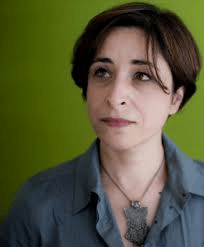
Deborah began to paint more or less full time in 2008. She writes a blog about her painting processes and the natural landscape in Connemara, which reached the final of the 2012 Irish Blog Awards. Deborah began writing poetry in 2013 and she attends a poetry workshop run by Galway poet and essayist Kevin Higgins. Two of her poems have been published in Skylight 47, the Galway poetry newspaper, one in the forthcoming Summer issue. Deborah is also a feature writer in her local newspaper the Connemara JournalDoireann Ní Ghríofa
Recovery Room, Maternity Ward
(for Savita Halappanavar)
The procedure complete,
I awaken
alone, weak beneath starched sheets.
As the hospital sleeps, my fingers fumble
over the sutured scar, a jagged map
of mourning stitched into my skin —
empty without and empty within.
Beyond these white curtains,
stars shine bright as Diwali
in a cold night sky.
Someday, within these walls,
I will hear my baby cry.
Cradling my hollowed womb,
I trace this new wound and weep.
The only sound I hear now is the fading retreat
of a doctor’s footsteps, echoing my heartbeat.
Recovery Room, Maternity Ward is © Doireann Ní Ghríofa
Doireann Ní Ghríofa’s poems have appeared in literary journals in Ireland and internationally. Her Irish language collections Résheoid and Dúlasair are both published by Coiscéim. The Arts Council of Ireland has twice awarded her literature bursaries (2011 and 2013). In 2012, she was a winner of Wigtown Gaelic poetry contest— the Scottish National Poetry Prize. Her short collection of poems in English Ouroboros was recently longlisted for The Venture Award (UK). -
Once Upon A Time
in memory of Leila Sarahat Roshani
Granny used to say
always keep your magic sack
tucked inside your ribcage.
Don’t say the sun’s worn out,
don’t say it’s gone astray.
Say, I’m coming back.
May the White Demon
protect and watch over you.
Oh, daughter of the dawn,
perhaps this sorry tale,
stuck in the mud,
was of your doing.
Take the comb from the sack,
throw it in the Black Demon’s path:
seven jungles will grow at his feet.
Don’t say heaven’s too far,
earth’s too hard. Don’t throw the mirror
if you fear the sea and her nymphs.
Don’t say there was, don’t say there wasn’t,
trust in the god of fairytales.
May Granny’s soul rest in peace.
Give the mirror to Golnar’s mother
who, down by the charred vineyards,
dreams of birds and fish.
Don’t say the rooftop’s sun’s too brief.
Say, I’m coming and this time,
forget love’s foolish griefs.
Shake out the sack.
In the name of the White Demon,
burn that strand of hair.
Wasn’t there,
once upon a time …?
Once upon a time there was
a girl in whose long, endless dreams,
an old woman with white braids,
forever telling beads, would pray:
‘May the Shomali Plain still fill with song
and through the ceilings
of its ruined homes, let light pour in.’
Once Upon A Time is © Shakila Azizzada.The literal translation of this poem was made by Zuzanna Olszewska.The final translated version of the poem is by Mimi Khalvati
Once Upon A Time: this poem refers to a fairytale in which the hero sets off to fight the Black Demon, aided by the White Demon and the magic powers of a sack with a mirror, a comb and a strand of hair. Fairytales traditionally start with the refrain, ‘There was one, there wasn’t one, apart from God, there was no one.’
View from Afar
I’m left again with no one standing behind me,
ground pulled from under my feet.
Even the sun’s shoulders are beyond my reach.
My navel chord was tied
to the apron strings of custom,
my hair first cut over a basin of edicts.
In my ear, a prayer was whispered:
‘May the earth behind and beneath you
be forever empty’.
However, just a little higher,
there’ll always be a land
purer than any land Satan could wish on me.
With the sun’s hand on my shoulder,
I tear my feet away, a thousand and one times,
from the things I leave behind me.
View From Afar is © Shakila Azizzada
Translated by Zuzanna Olszewska and Mimi Khalvati.
Haft Seen
If it weren’t for the clouds,
I could
pick the stars
one by one
from this brief sky,
hang them
in your ever ruffled hair
and hear
you saying:
‘I’m like a silk rug –
the older it gets,
the lovelier it grows,
even if
two or three naughty kids
peed on it.’
Am I finally here?
Then let me spread
the Haft Seen tablecloth
in the middle of Dam Platz.
Even if it rains,
The Unknown Soldier
and a flock of pigeons
will be my guests.
Haft Seen is © Shakila Azizzada.
The literal translation of this poem was made by Zuzanna Olszewska.
The final translated version of the poem is by Mimi Khalvati.from The Poetry Translation Centre
Shakila Azizzada is a poet from Afghanistan who writes in Dari. Shakila Azizzada was born in Kabul in Afghanistan in 1964. During her middle school and university years in Kabul, she started writing stories and poems, many of which were published in magazines. Her poems are unusual in their frankness and delicacy, particularly in the way she approaches intimacy and female desire, subjects which are rarely adressed by women poets writing in Dari.After studying Law at Kabul University, Shakila read Oriental Languages and Cultures at Utrecht University in The Netherlands, where she now lives. She regularly publishes tales, short stories, plays and poems. Her first collection of poems, Herinnering aan niets (Memories About Nothing), was published in Dutch and Dari and her second collection will be published in 2012. Several of her plays have been both published and performed, including De geur van verlangen (The Scent of Desire). She frequently performs her poems at well-established forums in The Netherlands and abroad.
-
Opening
A black feather
from her
black feather treesways down
she has spread
her red and blacks out
for carrion loverslace their moons with trawling nets
bird-pecked crabbed and sweet apple
windfallsroll them into grass
bamboo worms a curve into flared groundblack feather sways down
through dream
to this waking place
of stonesA black feather from her black feather tree is the opening poem of SHE, published 12th March 2013.
© C. Murray
“I do not expect anyone will believe me, but I know that my dreaming life is as real as my waking life. Indeed, I have learnt not to call these sleeping narratives anything other than a different part of my reality.When I first encountered the entity that appears on the towpath I was afraid for She seemed hardly human to me. I had gone little by little into this dreaming place over the course of twenty years, and I had explored it almost wholly. I do not know what my encounter with this lady means, I intend to find out.”
With She Christine Murray explores the spaces between waking and dreaming, that we all inhabit yet are so rarely revealed to us in this day and age. Part shaman part Sybil,she takes us on a Jungian odyssey to meet the archetype that stands at the crossroads of birth and death, one whom we are all destined to encounter sooner or later.
Thanks to Dave Mitchell at Oneiros Books, To Michael McAloran, and to Anastasia Kashian who painted her beautiful cover.
-
Impress by C.V Auchterlonie. Published Punk Hostage Press 2012
nest
1.
I see us
as if we’re not us at all
as if we’ve let our body suits already
slipped off and skinny dipped under some glass blown
lake
one in /one out
we walk the same /we drown the same.’
nest is © Candi V. Auchterlonie from Impress (Amazon)Impress is Candi V. Auchterlonie’s second poetry collection, published by Punk Hostage Press 2012.
Candi V. Auchterlonie is a woman of the landscape. She is a poet of the open vista and of the outdoors. One feels that the house and the hearth are an alien skin that somehow do not fit her. The house functions as doors and windows that lead to water and wide open spaces. There is an obsidian thread running as a deep cleft through and under her expression. She mines this vein revealing a controlled sure craftsmanship in her approach to poetic form.
Auchterlonie’s writing approach to her poetry is singular. Whilst she takes on themes of motherhood, alienation, beauty and violence, the aforementioned obsidian vein reveals a linguistic nomadism inherent in her expression and it runs through the whole of Impress. Sometimes the words she seeks to communicate the depth of her experience are lost to her pen. This does not give her pause, nor does it reveal a desperate clutch for the right image or symbol. In fact, Auchterlonie shows herself prepared to wait for her poetic imagery to develop.
Auchterlonie handles poetic series and inter-related themes with extreme care and she will extend them without losing control of the symbols she has assembled to voice her poetry. There are series of poems with interlinked themes throughout Impress: terrarium, chambers, walnut, woman without a landscape, and ghost hands the ultimate poem of the collection are in series.
The pivotal part of Impress occurs in the series woman without a landscape:
woman without a landscape
it still startles her
the way old pain does.
she remembers it well, every hurt that tamed her
irises.
it hits her like a thousand paper cuts
to her fragile vellum skin.’
woman without a landscape is © Candi V. AuchterlonieThe tropes and symbols Auchterlonie has assembled for herself are dominated by water, rock, ocean, blue,and metallurgy. The home represented by the house sometimes feels imprisoning or unsafe in the poems of Impress :
terrarium 1.
should you remember
in retrospect
the gossamer, or
the ghostly silence
of her
the glass house in the hills
tiny crystal knobs over brass
secret kept,
unbroken stave, marble smooth
terrarium 1. is © Candi V. AuchterlonieHouse is not a place of safety from storm and almost exists alone to provide metaphor or symbol. Houses have cellars and doorways that are like a magic kingdom into well-guarded memory
rock-a-bye
rocked-you-wildly
middle of the night storm
so very turbulent
that this house of mine
began to caw and creak like a flock/
like antique brass hinges flittering off like fairies.
the old house rattled right
down to its foundation.
I could hear its old belly aching
discomfort and some superficial seething pain.
3 am.
dozed
only to be woken
by the violent husbandry
of the shaking of my walls/my bed.
I began conversations
with the trees outside.
from rock-a-bye by Candi V. Auchterlonie
Objects and Auchterlonie’s perception of them are made new when she observes her child in his world. In her poems about motherhood there is a tsunami of tenderness and of self- recognition, and of her own engagement with the small and miraculous world of her son.
The experience of birthing reflects the sex that created the small boy _whose silence /goldfish gasp _ are the poet’s own. The child in Impress is the keystone of the arch that supports her epic structure. He is a window to the world and his visual language and gesture is a learning curve for the poet.
once upon a time ago
his tiny peach hands
distorted blur under lemon white
the glow of animate life
his, the digits of newness still
over worthless relics broken
ever storyless, he carefully cleans and collects them
from around the yard, ‘
from once upon a time ago by Candi V. Auchterlonie
Often there is a sense of total alienation from the domestic world, and that nomadism or will to unfold the world is of the utmost importance. Domestic ties and a tying to objects is secondary to unravelling a feeling of her place in the world.
The importance of place and one’s relation to it through the observation and study of talismanic objects, natural objects which speak of mystery are always subject to the poet’s minute investigation, as if the huge is presently too much to handle. She holds in her own hands small symbols of the enormity of place, these are shards of wonder and not remnants or leavings from. There is a questing curiousity about Auchterlonie which bodes well for her future work , as it is allied with a subtle craftsmanship in her approach to form.
Alienation from is a still evolving in Auchterlonie’s forms and tropes. Stone (or crystals) / the walnut/ water, and sub-total immersion provide useful tools for a sense of powerlessness or littleness in the utter vastness of nature.
That thread of obsidian running through the book which belies the poet’s statement of beauty as encompassing all and everything. There is a determined desire to find her place in a world which is hers – an almost childlike beligerence and desirousness to make sense of it all. This may be a linguistic disconnectedness, a nomadic inherence , or an endless wanting that is eternally restless. Restive even.feast of figs
ravens are rare here
I find when I fumble stumble across one
should I be so lucky
I fall onto my knees searching for
the stars, Corvus!
I think of the greeks and Babylonians
the hydras tail, the raven and adad
the story of apollo’s raven
and the feast of figs, the punishment
of being stuck in the sky, thirsty for all time.
the cost was high, I recoil.
I immediately search for headstones
marble carved eyes
cemeteries
that’s where the stars live these days
onyx forms
perched and crooning over
named and muted pale stones
under storms of rusty steel wool.’
feast of figs is © Candi V. Auchterlonie
-
This year I wrote a cycle of poems relating to war and to women. I titled part of it Two Songs of War and a Lyric for the SouthWord Journal, although it is intimately related to an earlier sequence of art poems, and to the 75th anniversary of Guernica which was marked in 2012.
The second poem in the art series , Gernika, was written for Euskal PEN and was read during the 75th anniversary commemoration of Guernica this summer of 2012. The first and last poem of the sequence, A Lament, was written some time ago and had been put in a folder. A Lament is too awkward a piece to submit to most journals as it is written for three voices and does not slip easily into the submission guidelines of many reviews. A Lament was written firstly as a poem and then as a chorus. It was conceived to weave in and out of the sequence which was published initially in SouthWord Magazine. Lament is an inherent part of the sequence because it involves the voices of the women who inhabit the poems in Two Songs of War and a Lyric.
As if, Sabine, Gernika , A Lament, and Through the Blossom-Gate are meant to work together, and are about loss and recovery. Here is what has happened to the original cycle, the Lament, and the unpublished cycle of seven poems since I sent them out.
Gernika
- Gernika was read on the Anniversary of the Guernica Massacre in 2012
- It was published in a batch of poems titled, Two Songs of War and a Lyric
- It will be anthologised forthis project
A Lament
- A Lament is a companion poem to Two Songs of War and a Lyric, published SouthWord in 2012.
- It will be programmed at the Béal Festival , November 2012. Notice here.
- Cycle of seven poems , at Bone Orchard Poetry
The 7 cycle is provisionally entitled Eamon Ceannt Park Cycle , after the park that the dream-sequence was written in. I had planned to send it out, as it is ready. However, in all the entire sequence including the lament amounts to thirteen inter-related poems written over the period of a year or two. They inherently form one piece. There is also an emergent coda for the entire. (Completed)
I am glad the poems have found homes and that they resonate with people. I hope to publish the thirteen poems together at some point, but I see that I will have to make my own arrangement for them, as they hardly fall into a traditional submission-shape. The most important thing for me is that they maintain their integral unity and coherence. I am editing them into a folder and deciding how I will eventually publish them in their integrity as a whole piece.
I included the list where the poems appear separately beneath this post.