• chris murray
  • journals – bibliography – publication notes
  • downloadable items – essays – media
  • copyright
  • Home

Chris Murray

  • ‘Reluctant Oration’ and other poems by Fiona King

    February 28th, 2018

    BIRTH

    The last point of the quadrant remains to be drawn,
    Out on the fringe of a shadowy dawn.
    The air is still, devoid of all sound,
    The raven encircles the battleground.
    The troops are assembled, their swords held with poise,
    To face the enemy engulfing his choice.
    He arrives with his foe, emits a loud cry,
    The prophetic bird falls dead from the sky.
    Morning’s mist begins to fade,
    The child is here, no longer afraid.


    CHILD’S PLAY

    The couple play a childish game,
    Their toys are guilt, betrayal, shame.
    They scatter them across the floor,
    Expose insecurities raw and sore.
    Their song is angry, well-rehearsed,
    A tune of sadness, bitterly versed.
    Their painting, an unfinished mess,
    Made in haste, under duress.
    They dance a dance of hideous precision,
    Wrong is right, final decision.
    Nothing to lose and less to gain,
    Familiar role play, hate and pain.
    Their child looks on, he takes the blame,
    Discarded toy in an adult game.
     

    WOODEN SPOON

    Deed is done, misdemeanour little,
    Anger rises, no acquittal.
    Shriek is sharp, the echo rings,
    Room spins, skin stings.
    Hot tears, salty lip,
    ‘Water please, just one sip,’
    Words strangled, sound drowned,
    Face of inequity gloriously crowned.
    Door slams, key turns,
    Legs weak, stomach churns.
    Patterned flowers on the wall,
    Footsteps thud and stab the hall.
    Captive now in my own space,
    Prisoner in this sacred place.
    Fear abates, the edge is gone,
    Acquiesce to what is wrong.
    No apology required,
    Guilty conscience long expired.


    RELUCTANT ORATION

    Faces staring, pressure loaded,
    She fears she will be taunted, goaded.
    Hands moist, mouth dry,
    Self-expectation running high.
    She takes a stand, she’s on display,
    Composure falls to disarray.
    Blood pumps, breath claimed,
    The sound emerges, wounded, maimed.
    She perseveres, an uphill battle,
    Spectators whisper, chairs rattle.
    Her colour deepens, voice shakes,
    Seeks perfection, makes mistakes.
    They cast their judgement, mark their score,
    Perverse entertainment, wanting more.
    Silence falls, she concedes,
    Last remnant of strength, fades, recedes.
    Emotions naked, reserve depleted,
    Feigned applause, occasion defeated.

    Reluctant Oration and other poems are © Fiona King

    Fiona King is a married mother of four from East Cork. She is currently on career break from her job as a primary school teacher, to care for her youngest son, Adam (in picture). Adam is 3 years old, and has a genetic condition called Osteogenesis imperfecta, a brittle bone condition. In recent months, She has begun to reflect on the arrival of her precious boy into this world and has found the best way to express her thoughts and feelings through verse. From this, she wrote the poem ‘Birth’. After this creative expression, deeper reflections from my past inspired her to write further, on experiences with emotions of such gravity that they stay with her. 
    Irish Times report on Fiona King

  • ‘No-one is watching’ and other poems by Nicola Geddes

    February 20th, 2018

    No-one is watching

    Unharness your two beasts
    Ambition and Anxiety
    from your chariot
    Unharness yourself
    from all electronic devices
    You will not be followed

    Did you look, did you
    see the tree tops career above you
    in an ecstasy of elements,
    smell the damp brown
    leaves under your feet?
    Did you witness yourself
    in the middle
    of all this rejoicing
    and all this decay?

    Or are you still stooped
    under the weight of your expectations?
    See the grey clouds skitter across a yellow sky
    See the fat bluebottle climb the window again
    See the oceans
    who have carried our ships on their backs
    and from whom the feast was delivered
    See the oceans
    Rise up
    No-one is watching


    star

    our smallness is vast
    realised in darkness
    my stardust is bone

    animated by light
    sculpted in our sway
    stone is changing still


    the moon

    i am the crayfish, from the murky waters of the sea of cleverness
    i am the yellow dog, the moon illuminates me and i shine
    i am the dark dog, the moon illuminates me from behind
    and i remain in silhouette
    i am the path, i wind and dip
    you think you can see me but you can’t see everything
    i am the two stone pillars, i am petrified
    i am seas of dust and rocks, the illusion of what has become known
    i am the crayfish, my wet armour gleams in the moonlight.


    Stupid Cow

    Do you think he can hear you,
    your missing baby?
    his world lurches and surges
    doesn’t know where he’s heading
    still thinks he’ll come back
    to solid ground and your warm flank

    Do you think she can hear you,
    your absent mother?
    latched onto her udders
    gluttonous metal jaws
    drain every drop of milk
    her body just keeps on
    making for you


    The Demon

    You cannot name me
    yet I mould your normality.
    I make a squalid mockery of
    all the pretty things in your house.

    I slip like an adulteress
    between your soft sheets,
    and suck the air from your chambers.
    You wake in musty spoil.

    I stack up episodes
    like ill-matched crockery
    Rankled by uncertainty, you
    deny me; I reign.
    Unnamed, I crouch
    in your heart’s lower cavities.

    No-one is watching and other poems are © Nicola Geddes


    Originally from Scotland, Nicola Geddes studied Environmental Art at the Glasgow School of Art, and Cello Performance at the London College of Music. She has been based in County Galway for the past twenty five years, where she works as a cellist and music tutor. To date her poetry has been published in Crannog, the Galway Review, and Skylight 47. In 2017 Nicola’s poems received a Special Commendation from the Patrick Kavanagh Award.
  • ‘The Salt Escape’ and other poems by Jude Cowan Montague

    February 20th, 2018

    Too North

     
    Due to the severe cold
    we worked continuously
    just to keep alive.
     
    Sometimes our clothing
    was frozen so hard
    over our tattoos
     
    we were unable to enter our bunks
    until we threw hot water
    over each other.
     
    Our skipper had been urged
    not to trust the charts
    but to rely on his own knowledge
     
    after a gale off Port Barrow
    had blown us into
    a narrow fjord.
     
    Steaming down pitch hardship
    in perfect calm
    we neared a yellow band
     
    fat with life; our trawler shouldered
    through its skin of fire.
    No cod or halibut for miles.
     
    I dropped a double hook,
    without bait,
    to pull up two human skeletons,
     
    W. Hatter’s sons,
    missing since warm summer rain
    unsettled the penal code.
     

    From the Steps of St John

     
    You can see them in the corner of your eye,
    then they’re gone.
    Sometimes you recognise them in a body like ours,
    some well-kept, some more slovenly.
    some fat, some squat.
    Most of them are clever.
     
    The buzzing and flying
    are side-effects of natural power.
    Never try to trap one.
    Leave them matches and food.
    They can help us but you have to give them things.
    They have control of the wind.
     
    Who knows what’s under their coats.
    I have spotted the little dog prints
    at the edge of the park where nobody’s been,
    the tree twisted too close to the road.
    There’s a hole in the sky
    affecting us all.
     

    The Salt Escape

     
    ‘Where are you going?’ I asked.
    ‘You never will find him again.’
    She walked out onto the sodium plain
    where sour gusts scour the crags.
     
    She found a groove in the ground.
    Her body fit inside the crack.
    I lay down on top, pressed my face in her back
    wrapping my feelers around
     
    The snowlace winds whipped our flesh
    to ribbons, though swaddled in fur.
    I folded my legs close and breathed in her hair.
    I dreamed we were eggs in our nest.
     
    Stiffened to stone in the night
    and humming to underground forces
    we heard the dark whisper of runaway horses
    shuddering into the light.
     

    The Riff

     
    Kofia-wearing djembe owners
    are workshopping African merengue.
    We shut our eyes. Listen to Dalston.
    Close breathe sirens and exhausts, in, out.
    We play the same riff for thirty minutes.
    I write my own version. Not bad.
    But it takes so long for me to learn
    what I have written, I get finger cramp.
     
    Folo asks me to be in his band.
    I take round my boyfriend and he cooks us tomato rice.
    I’m going to sing original songs
    with a master guitarist from Sierra Leone.
    Before rehearsals, he arranges photographs.
    They are huge, severe, b/w.
    My nose droops in the heavy contrast.
    Folo doesn’t like the talc,
    it puffs away his roguish sweat.
     
    He knows a man in Homerton
    with a very cheap motor for sale.
    Above the cab office, a large blonde
    half-pulls her cornblue negligee over her bosom.
    Nearly everyone is in the bumpy bed,
    and there’s a lot of us in the room.
    A wide-eyed man clicks open a suitcase.
    Out swims a school of dried fish.
     

    Disappearance of the Body

     
    While the ice sawed together,
    the ghost story began
    with the shrieking in the ventilator,
    the wind always headed south.
     
    As the photographer,
    I had a dark room that used to be a store room.
    My assistant ignored the long box
    left on the stable marked ‘Surgical Supplies’.
     
    Our fireman had left a chisel
    and returned unexpectedly.
    I thought it my bad luck
    when he discovered the cut-up body.
     
    The fireman said ghosts
    do not make noises.
    But how would a deaf man
    hear them?
     
    The biscuits ran out on Christmas Day.
    It was time to clear off.
    Some lay down on the snow
    while the fireman and I walked about
     
    while the wind hummed continuously.
    Maybe it was the cold in my ears
    but a crazy voice
    pursued one of us.
     
    Developing the negatives,
    such an astonishing proposition
    presented itself to me
    that I have never ceased thinking of it since.
     

    The Mirror

     
    How had she come here?
    That answer was easy.
    She had looked in the mirror.
    Then she had walked into the mirror
    at which moment
    she walked into herself.
    Or not herself, but herself
    in mirror world. Where she
    was still herself.
     
    She was still Alice.
    Alice was a fixed point in time.
    She was safe only in
    who she thought she was
    while everything
    around her was changing
    so fast, faster than breakfast
    down to dinner and sleep
    and the next day on its crazy round
    of meals and conversations.
     
    Time was backwards
    but she was still going forwards
    when the White Queen tried
    to grab her escaping shawl,
    flinched at her own blood
    and finally pricked her skin
    as Alice helped her fasten
    the cloth around her shoulders.
    Alice tried her best to help the Queen.
    but Alice hadn’t understood
    that it was Alice who was wrong.
    ‘I’m talking to myself again,’ she noticed.
     
    She was still a child,
    and her confusion was that of a child’s.
    These adults, even if they were chess pieces
    ran past her complaining and crying
    until the knight caught her in his arms
    and lifted her high in the air.
    She didn’t want to be a prisoner.
    She needed to cross the brook
    and become Queen Alice
     
    but the White Knight was too strong,
    holding her upside down,
    trapped inside her own logic.
     
    The Salt Escape and other poems are © Jude Cowan Montague

    Jude Cowan Montague worked for Reuters Television Archive for ten years. Her album The Leidenfrost Effect (Folkwit Records 2015) reimagines quirky stories from the Reuters Life! feed. She produces The News Agents on Resonance 104.4 FM. Her most recent book is The Originals (Hesterglock Press, 2017).

  • Three poems inspired by Ric Carfagna, Rus Khomutoff

    February 10th, 2018
    Vintage ghosts of
    joy and sadness
    a saccharine statement
    the highest expression of the autopoetic force
    the incarnation and withdrawal of a God
    declaration of hither swarms
    accretion of the torrential becoming
    instances emancipated from
    all anxieties and frustrations
    in the anagogic phase
    made dizzy by the hybris
    a regular pulsating
    metre of recurrence


    This is not a method

     
    O blacklist of preeminence
    louder than life itself
    countdown sequence
    of aired mysterious booms
    natural coction
    the shadow of a shadow of an
    obtainable new order
    to bathe in the splendor
    of lathe and labyrinth
    as momentum grows
    that bold and legitimate certainty
    of endlessly repeating variations
    and recollections that
    erect their desire to exist
    like a new sensation
    articulating lifelong repeal


    In this mode and vague notion
    of a stay in your placeism
    event horizon
    a derangement of senses
    dragging the echo
    from the culvert
    from the book of common prayer
    eschewing the copula
    almost like the pace of a dream
    ordered fragments of a
    disordered devotion
    a space we can enter
    the bareness of time’s passing
     
    This is not a method and other poems are © Rus Khomutoff

    Rus Khomutoff is a neo surrealist poet in Brooklyn, NY. My poetry has been featured in Erbacce, Fifth Day journal and Burning House Press. In 2017 he published an ebook called Immaculate Days.
  • ‘The Music of Stones’ and other poems by Colette Colfer

    February 10th, 2018

    Stepping Stones

     
    Here are my hands, outstretched for your bare feet
    so that each step of your path through darkness
    and gravel bits splintered with thorns will meet
    uncalloused palms of moccasin softness.
     
    This is your extraordinary journey
    beyond mapped landscape and into unknowns
    but my knuckles will jigsaw rocks like keys
    filling locks to smooth roughness for your soles.
     
    My hands will be luminous with love light
    anticipating your transformation,
    pulsating warmth for this your longest night
    when each footstep is a destination.
     
    Although you are alone you’re not alone,
    I’m reaching out my hands as stepping-stones.
     

    Anchors

     
    I search shorelines at low tide
    for portals that open time
    to the pip of it.
     
    Fingers like a blind man’s
    on stones, periwinkles, chainies,
    and drops of smooth blue-glass on sand.
     
    I trace cat-gut through seaweed
    to hidden hooks on feathers,
    German baits, spoons and spinners.
     
    Each rock a prayer bead
    in the litany of belonging.
    Pock-air, Connigeer, Shollister, Claim.
     

    Worms

     
    The graveyard was January grey and cold.
    Dad was crying. I’d never seen him cry before.
     
    Strangers spilled over mounds and dips,
    around jaded headstones that tilted towards sleep.
     
    Grandad was lying in a fresh coffin
    with brassy handles that glinted like baubles.
     
    I stood in my little girl knees at the frontline
    by the open hole that gasped for closure.
     
    A priest’s ragged voice led the chorus of mourners
    in prayers that lifted up into the sky like birds.
     
    Men used ropes to slowly lower the coffin
    till it was anchored deep and still on the black.
     
    Some one of them broke the shadowy silence
    with the thud of a shovelful of clay on wood.
     
    Nanna turned her back, took broken steps away,
    my two sisters at her sides like crutches.
     
    There would be worms now on Grandad’s face and clothes,
    wriggling over his eyelids, into his ears, up his nose.
     
    Afterwards, in a carful of adults who laughed and told stories,
    I stared at the hedges so the whole world blurred green.
     

    The Music of Stones

     
    We tuned ourselves to skylark song and searched
    the skies all summer for their high hovering spots
    where birds trilled like semi-quavers
    in the unlined stave of a hot blue sky.
     
    We paused to stare, enthralled by dives that spliced
    our days. Then satisfied we’d amble on
    through sunburnt fields beside the sea towards
    the lighthouse, stopping at the next birdsong.
     
    All summer that summer we spied on skylarks,
    climbed cliffs, found caves, swam skinny dips
    and lay naked on reclusive sandy beaches
    where you taught me that even stones can sing.


    No Looking Back

     
    Sometimes you’ve got to leave behind a place
    you’ve loved since tumbling into time and go
    for good, that is forever, go goodbye
    without a looking back like Lot’s wife did
    and died from turning, turning into salt
    still standing, white dissolving in the rain
     
    The Music of Stones and other poems are © Colette Colfer

    Colette Colfer works as a part-time lecturer in world religions at Waterford Institute of Technology. She has also worked for many years in journalism and is an award winning radio documentary maker. She has had poems published in Poetry Ireland Review, The Caterpillar (for kids), Skylight 47, The Poets’ Republic, Three Drops From a Cauldron and Algebra of Owls.

    Image: Sea shells (mainly the whirl shell, Zethalia zelandica) in a rock pool at Te Arai Point, Auckland, New Zealand. CC-By-ND: Avenue


  • Further excerpts from Paul Celan’s ‘microliths’

    February 6th, 2018
    16 He who transforms himself wants, being the same, to become someone else.

    Shape = semblance


    17  There is no such thing as the Ibolithic, you say! Well, where would we wind up if we agreed with that? For then the Lithic wouldn’t exist either, the basic Lithic, this idiom worked up with such great pains. And Paleo, Mezzo and Neo, so excellent, they too would then be as if extinguished — and — do I dare ask — where in this case would we be at? We, so proud to have managed to put the ice age behind us… Why, I heard it asked — and I hear resentment roiling in that question, yes indeed, resentment! —, Why? Was that necessary? We stand pretty now, we, those of today… Gone, our past, gone… And our future? Our future-bearing future? I’m asking, I’m not answering. Let the others, the anti-iboliths, answers. But, isn’t it so, Rumpelstiltskin, we two, you and I, we want into the Open once again, into the forest, and crossing the swath that leads to the nuclear reactor, and where the honeysuckle, so beguiling, rambles, we, despite the danger of falling into discredit, even here, we want to sing

    18                                                                                                                Verbier, 6.25.57.

    18.1  We were one flesh with the night.

    18.2     In the gaze you throw at it, the looked at awakens.

    19                                                                                                                 10.26.57.

    Poems are passageways. A toi de passer, Vie!  [Your turn to pass through, Life!]

    20  

    A paradise was indeed promised us, but to no one among us, not even to the fiercest believers, a vehicle with tail flukes, so as not to remain unnoticed on the roads up there, when the driver chauffeurs us to the confectioner’s.

    21               For so much anguish, so much symbolism!

    22                                                                                                                  Hermeticism—

    Certain “citizens” and the poem: They buy the surprise bag; one knows vaguely what’s in it, it won’t be much, but then it doesn’t cost much either, and if one happens to visit the fair and one has enjoyed the lady without lower- but with upper body, one’s amusement also demands this. And when what’s in it turns out — but here too the buyer’s superior humor can prove itself — to be even cheaper than cheap, there still remains the fun that all of that was “too” /[“zu” “closed”]

    23 9.9.59.

    …. and sounded off against his God.

    these translations are © Pierre Joris


    Paul Celan
    Extracts from Microliths
    translated by Pierre Joris
    forthcoming from attem press in 2018
  • ‘A Hierarchy of Halls’ by C. Murray

    February 5th, 2018
    This is not a universe,
    it is a garden. Trees,
     
    a hierarchy of halls,
    halls, a universe to sing.
     
    Follow wren’s sound
    into the lowest corridors.
     
    There, a huge gap, fox
    -made,
    is where blackbirds sing.
     
    Stone-plateaued, daisy garlanded
    ground-held.
    Tree looms above it all.

    Early summer occurs
    in a calamity of falling
    young,
     
    petals, birds, the
    bright souls of birds.
     
    A small dead bird
    is at my feet,
    tree looms
    over this soul-ossuary
     
    dignifying the small
    body with her dark needles,
     
    bird-map-lost,
    obliterate–


    A Hierarchy of Halls  ©  C. Murray (Smithereens Press, 2018)

    Thanks to Ken Keating of Smithereens Press for publishing A Hierarchy of Halls.

    Cover art by Salma Ahmad Caller.

    Streaming options for A Hierarchy of Halls at The Internet Archive

  • ‘Poet Mother’ and other poems by Felicia McCarthy

    January 30th, 2018


    Reading the Omens

     
    A chorus of voices called, No!
    when I reached for the latch
    Don’t let her out, she’ll die.
     
    A monarch hatched from the rafters.
    Her orange and black wings a mirror
    to the hot coals that waked her.
     
    A trail of twisted cobweb sported flies
    as if it were a kite tail tied with bows
    and she ready to be launched to the sky.
     
    Though we turned away,
    she is with me still, as
    I plan for the days ahead.
     
    Take this as written:
    when my time comes,
    to hatch from this body
     
    I want you to open the window.
     
    First published in Boyne Berries 18, in the autumn of 2015
    Published online at Trevor Conway’s website; Poems in Profile #17 (April, 2016-07-15)


    Let Morning Come

    (after Jane Kenyon)
     
    Let the street lamps blink out,
    the lights of Ballyvaughn grow dim,
    as darkness gives way to day.
     
    Let the shush-shush of the tides
    slide into your dream, beckon you awake,
    to open your eyes. Let morning come.
     
    Let the sky lift her grey skirts,
    draw up her shawl of cloud, the way
    the curtain must rise before the play.
     
    To the heron strutting along the shore,
    to gulls drifting above the bay, to lovers
    still in their beds, let morning come.
     
    Let the gold disc deliver on its promise.
    Let the wind come up. Let the fishing boats
    sail from safe harbours. Let morning come.
     
    Let it come, as it will, and don’t
    keep yourself back. The world begins fresh
    each day, so let morning come.
     
    Skylight 47, issue 8, 2017


    Poet Mother

    (for Liz)

    Don’t let the baby swallow your words,
    the ones that arrive in the night
    while you swaddle her, humming.
    Sing into her small ears the lines
    you will write in the morning.
     
    She won’t mind what it is as long
    as you talk softly and rock her gently
    in the rhythm of your next poem. This
    will keep the words from stifling you,
    from choking her.
     
    She loves all of your creations.
    The lines you remember at dawn
    become the maps she will take
    away from these sweet days
    and nights in your arms.

    Skylight 47, issue 7, 2016


    Where I’m From

     
    (for Margaret McDonough)
     
    I am from corn, hot Ohio miles of it. And the smell of ether
    seeping from a black leather bag stashed on top of the fridge.
    I am from pony men and card sharks, drunks and steam train drivers.
    I’m from blue pencil marks on galley proofs, created on an upright Royal.
    I am from screen doors slapping against armies of Canadian soldiers
    every June. I am from the dog days of August, the ice storms of winter,
    the frozen mud trenched roads of spring.
     
    I am from a lake that died and a river that burned,
    from The Erie, The Cuyahoga, and a town called Ashtabula.
    I am from ore boats and the fog horns sounding long and lonely
    as they herd the hulls of boats into their lanes. I am from the Bascule bridge,
    the brick yards, the railway yards, and a back yard that was the lake.
     
    I’m from The Mother of Sorrows, The Confraternity of Christian
    Mothers, and the Sisters of the Holy Humility of Mary.
    I’m from a ham-fisted man with a fedora and a black skirted priest;
    both with whiskey breath and an enviable reach.
     
    I am from among her effects:
    The loose powder box made of pasteboard,
    stuffed with letters from her Iowa mother,
    My dearest girl, she wrote, and Dear grand girl.
     
    I am from Mayo’s Foot of the Reek
    to the Allegheny farm on the Black Creek
    still walking on from the Great Famine of 1845.
     
    Jenny, YSA online journal, 2016

    Felicia McCarthy practices the arts of poetry and healing in the West of Ireland. Her poetry has been published in Boyneberries, Skylight 47, as well as in The Sea, An Anthology by Rebel Poetry. She was a featured reader for December 2015’s Over the Edge. She has also read her work at Belmullet’s Festival of Words and Letterkenny’s Northwest Words. In 2015, her work was shortlisted for the Bailieborough Prize. In summer 2017 her poetry was shortlisted for the Dermot Healy Award, The Red Line Book Festival Poetry Prize and the Over the Edge Writer of the Year award. Her poetry was published online in September 2016 in Jenny, while four poems were published in the UK ezine, The Blue Nib, issue 14. Felicia is also an Energy Medicine teacher, speaker and therapist with a specialty in cancer support. Her articles on Energy Medicine have appeared in Perspectives in Healing, The Living Link and Positive Life.
     

    The Blue Nib

    Image is © Mark Waters

  • Making ‘Den of Sibyl Wren’ by Salma Ahmad Caller

    January 26th, 2018


    Notes on Salma Ahmad Caller’s process for the making of ‘Den of Sibyl Wren’.


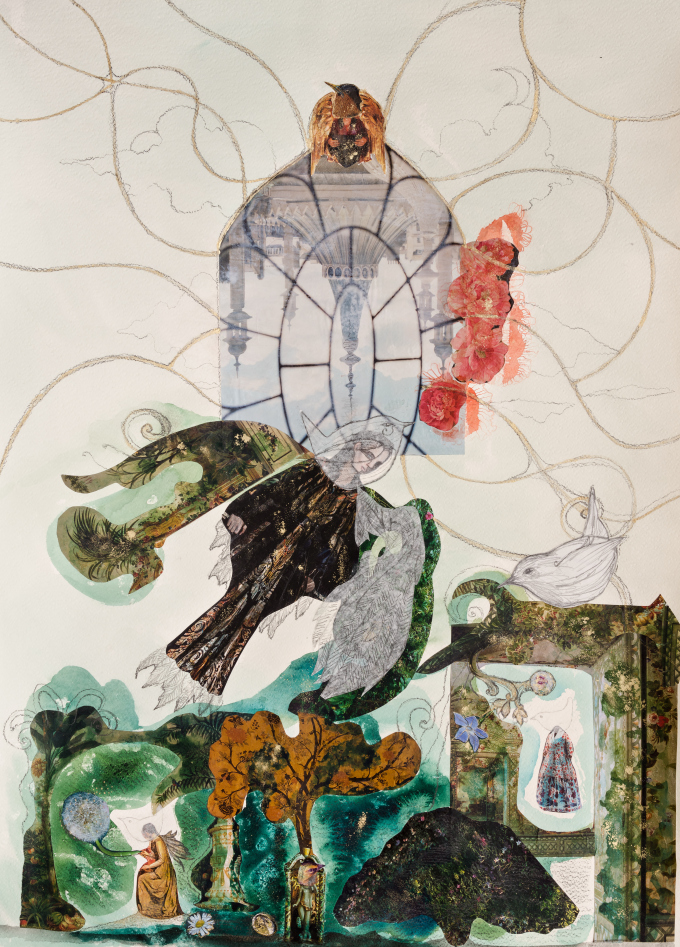
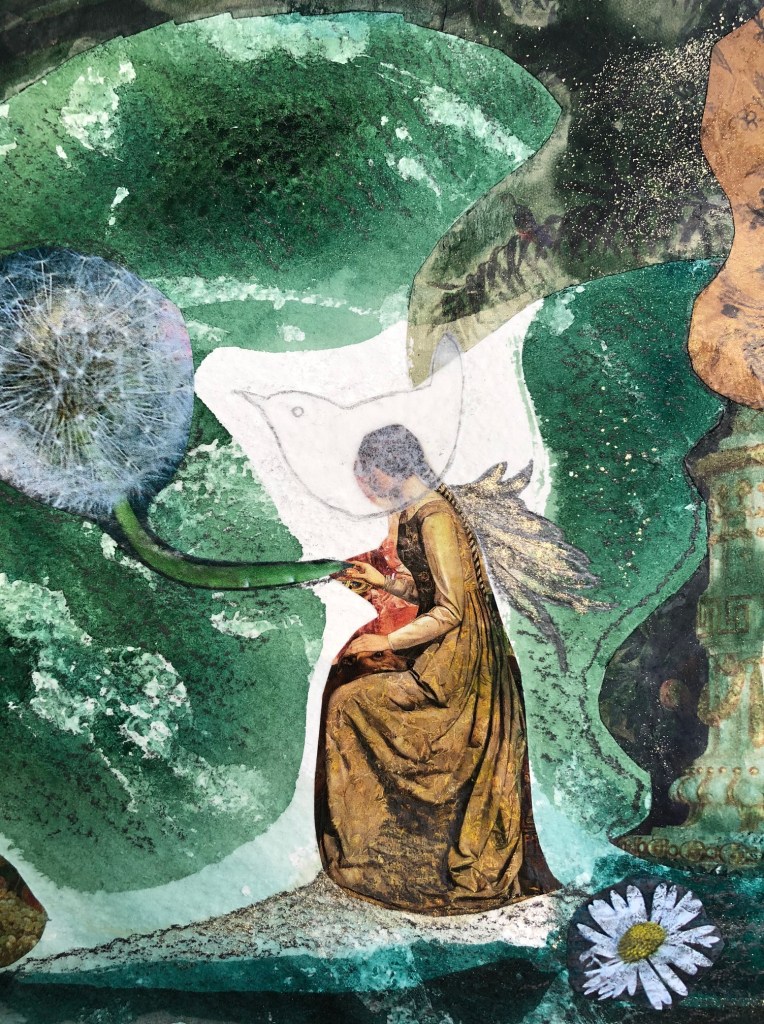
    The Den of Sibyl Wren is my response to Chris Murray’s A Hierarchy of Halls published by Smithereens Press It is my response to words Chris wrote about how she feels about this poem, and what she sees in her mind’s eye.
      
    Details of the image ‘Den of Sibyl Wren’ by Salma Ahmad Caller 
    Materials: Watercolour, Indian ink, collage, graphite and gold pigment on Fabriano acid-free paper 57cm x 76.3cm


    My process involves an intense working back and forth with words and images in my imagination. I write a lot as part of my creative process as an artist, and these writings help me create and develop the visual image. The so-called ‘visual’ image is to me embodied, materialised, haptic and tactile. So the ‘image’ in poetry and metaphorical writing is almost the same as the visual image in art, to me. So there is not a huge gap between text and image. Not in my mind in any case. The flat 2 D image is neither flat nor 2 D – but rather it is a complex and multi-dimensional terrain of emotion, sensation and concept, just as is the written word, especially in poetry.

    So it felt very natural to respond to Chris Murray’s very imagistic poetry, which I already love so much.

    In preparing to make work in response to A Hierarchy of Halls, I spent time reading and re-reading the poems and reading and re-reading Chris’s little notes she had sent to me via Twitter. And so the The Den of Sibyl Wren emerged. My notes on my own thoughts and responses to reading A Hierarchy of Halls and to what Chris told me about her notion of a Sibyl that represented the wren and its qualities:

    • The smallness and greatness of Sibyl Wren, her green den of spaces that we cannot see and her flight paths carved out in the sky. Tiny but potent and majestic in her domain.
    • A shamanistic female bird being interpreting or bringing the mysteries of the other worldly to us.
    • A materialisation of the invisible.
    • A feminine nature of delicacy, strength and bravery. A guardian.
    • An oracle seeing into the unknown and leading the reader bravely forwards through pain and difficulty.
    • A garden world of tiny potent things.
    • A sky above that is carved into great structures and pathways by nature that we cannot see.
    • A fecundity and joyfulness. Spring, summer.
    • A soaring upwards towards mystery.
    • Invisibility of worlds around us and within us.
    • The dandelion clock telling of another time besides the time we know.
    • A bird shrine under a shadowy tree to the dead bird in Chris’s poem.
    • A tiny female presence sitting and moving in an underworld of unseen unspoken spaces.


    Twitter Notes

    What Chris Murray said in a series of little Twitter notes to me: “The chapbook is called ‘a hierarchy of halls’ and is about small things, flight, wrens, and huge dreamlike structures are implied. My sibyls and messengers are birdlike creatures/ the little chapbook is called ‘a hierarchy of halls’ and is about a wren’s flight through my garden, am obsessed with bird workings. I didn’t see a sibyl specifically in bodies, but the first image on the Poethead page has a little putti. This is how my head works: I see the wren as a type of sibyl, a small messenger, and female. The sibyl should represent the wren! A type of oracle who leads one into the book.


    Salma Caller’s process and approach to the Smithereens Press published chapbook ‘A Hierarchy of Halls’

    *


    artwork-a-hierarchy-of-halls-srgb-3590x5000px-1 (7)

    Salma Ahmad Caller is an artist and a hybrid of cultures and faiths. She is drawn to hybrid and ornamental forms, and to how the body expresses itself in the mind to create an embodied ‘image’. UK based, she was born in Iraq to an Egyptian father and a British mother and grew up in Nigeria and Saudi Arabia. With a background in art history and theory, medicine and pharmacology, and several years teaching cross-cultural ways of seeing via non-Western artefacts at Pitt Rivers Museum in Oxford, she now works as an independent artist and teacher.

    The Infinite Body of Sensation; visual poetry by Salma Caller
    Patterns of Sensation, the Bodies of Dolls, by Salma Caller
    Website.


    IMG_4693 (8)

    All images & images associated with ‘Den of Sibyl wren’, ‘A Hierarchy of Halls’, and ‘Gold Friend’ are © Salma Ahmad Caller

  • ‘Starlings’ by C. Murray

    January 25th, 2018

    Chris Murray's avatarPoethead by Chris Murray

    starlings

    the sea opened its avenue just now
    pearl-throated I
    they call              mother     mother
     

    sweet the sun-in
         to walk up into it
     

    and the starlings have come to peck the grass
    round us
    the young are screaming for the bread that is
    at their feet
     

    Starlings is © C. Murray

    reduced palette version here (pdf) > starlings pdf

    Creative Commons License
    starlings is by C. Murray 

    View original post

←Previous Page
1 … 21 22 23 24 25 … 106
Next Page→
 

Loading Comments...
 

    • Subscribe Subscribed
      • Chris Murray
      • Already have a WordPress.com account? Log in now.
      • Chris Murray
      • Subscribe Subscribed
      • Sign up
      • Log in
      • Report this content
      • View site in Reader
      • Manage subscriptions
      • Collapse this bar