• chris murray
  • journals – bibliography – publication notes
  • downloadable items – essays – media
  • copyright
  • Home

Chris Murray

  • Christine Murray’s ‘Yellow Music’ at Ecotones: Poems and Poetics

    October 27th, 2014

    Tom D’ Evelyn looks at ‘And Her Yellow Music Caught in the Throat of Birds’ at Ecotones  and adds   Further Notes. 


  • ‘Entering The Mare’ and other poems by Katie Donovan

    October 22nd, 2014

    Entering the Mare

    (The inauguration of an Irish chieftain, as observed by Gerald of Wales in the 12th century)
     
    She stamps and shivers,
    her white coat vainly shrugging,
    as the would-be chieftain
    plunges in, burying deep
    his puny, acrid man’s seed,
    between her fragrant haunches.
     
    The Goddess lives
    in her fine rearing head,
    the pink stretch of her lips,
    the wide, white-haired nostrils.
    Her hoof
    might have crippled him,
    her tail
    whipped out his arrogant eyes.
    Instead she jerks clumsily,
    trying to escape
    the smell of his hand.
     
    Later he swims
    in the soup of her flesh,
    sucking on her bones,
    chewing the delicate morsels
    of her hewn body.
     
    He has entered the Goddess,
    slain and swallowed her,
    and now bathes in her waters –
    a greedy, hairy, foetus.
     
    Rising from her remains
    in a surge of steam –
    her stolen momentum –
    he feels a singing
    gallop through his veins:
    a whinnying, mane-flung grace
    rippling down his spine.
     
    Riding off on the wings
    of the divine Epona,
    he lets loose his dogs
    to growl over her skeletal remnants,
    the bloody pickings
    in the bottom of his ceremonial bath.
     
    from Entering The Mare (Bloodaxe,1997)


    CONFLUENCE

    Beneath the amber hood
    of the street lamp,
    beside the black gates
    of the somnolent park,
    we are eyed by fanlights,
    flanked by motionless cars.
     
    In this blind Georgian lane
    you lean in
    to claim a kiss.
     
    I offer you my goodnight lips,
    staying like a shut purse
    in your embrace,
    wary after years
    of opening too fast
    my burns still hurt and proud.
     
    Yet the sweetness of your mouth,
    and your tongue — a luscious,
    sinuous sea-creature –
    is a feast I cannot resist;
     
    nor can I pull back
    from the strength in your arms
    as you draw me close,
    loosening your coat
    to fold me
    in your cinnamon heat.
     
    Here it is, timeless,
    a scene on a street:
     
    a man and a woman
    tongued and grooved
    into one.


    Rootling

    Little wrestler,
    you snort, snuffle
    and lunge;
    latching on
    like a cat
    snatching and worrying
    her prey.
    Once attached,
    you drag on me
    like a cigarette,
    puffing between sucks,
    nose pressed close,
    somehow catching
    your wheezy breath.
    Between rounds,
    in your white wrap
    you arch your back
    for a rub,
    like I’m your coach,
    readying you
    for newfound strength
    in the ring.
    Your fists flail,
    fingers hooking
    my nursing bra,
    your feet curl and kick,
    toes a feast
    of tiny action.
    There is nothing romantic
    in this vital ritual,
    yet I crane over you,
    a loose sack,
    liquid with the loss
    of your form,
    with the tears of labour
    and lolling hormones
    making me gush
    along with my womb,
    still churning out afterbirth.
    So when
    you dandle my nipple
    with a gummy smile,
    I tell myself
    your grin’s for me,
    even if you’ve got
    that look
    of a seasoned souse
    on his most
    delicious tipple.
     
    ©Katie Donovan 2002


    All poems published here are from Rootling: New and Selected Poems published by Bloodaxe (2010). Entering the Mare originally appeared in 1997, in a collection called Entering the Mare. Confluence comes from Day of the Dead, a collection from 2002.
     

    Katie Donovan Image is © Mark Granier
    Katie Donovan Image is © Mark Granier

    Katie Donovan has published four books of poetry, all with Bloodaxe Books, UK. Her first, Watermelon Man appeared in 1993. Her second, Entering the Mare, was published in 1997; and her third, Day of the Dead, in 2002. Her most recent book, Rootling: New and Selected Poems appeared in 2010. She is currently working on a novel for children.

    She is co-editor, with Brendan Kennelly and A. Norman Jeffares, of the anthology, Ireland’s Women: Writings Past and Present (Gill and Macmillan, Ireland; Kyle Cathie, UK, 1994; Norton & Norton, US, 1996). She is the author of Irish Women Writers: Marginalised by Whom? (Raven Arts Press, 1988, 1991). With Brendan Kennelly she is the co-editor of Dublines (Bloodaxe, 1996), an anthology of writings about Dublin.

    Her poems have appeared in numerous periodicals and anthologies in Ireland, the UK and the US. She has given readings of her work in many venues in Ireland, England, Belgium, Denmark, Portugal, the US and Canada. She has read her work on RTÉ Radio One and on BBC Radio 4 and BBC Radio 3. Her short fiction has appeared in “The Sunday Tribune” and “The Cork Literary Review”.
     
      from Katie Donovan’s website

  • ‘It Was For This’ by Kevin Higgins

    October 13th, 2014

    It Was For This

     
      That Queen Maeve prepared for battle
    by angrily shaving her armpits with a razor
      improvised from north Fermanagh shale.
    For this W.B. Yeats took all that
      experimental Viagra, and waited for
    the consequences to grow. For this
      Archbishop McQuaid
    rolled naked through fields of Lavender.
      For this Maude Gonne let slip
    from her womb a future
      Minister for External Affairs,
    while loudly denying
      the Holocaust in Irish.
    For this Oliver J. Flanagan warned us:
      “where the bees are there is the honey,
    and where the Jews are there is the money”
      For this latter day Druids moved
    to Ballyvaughan or west Cork,
      and began accepting payment by PayPal.
    For this Fiachra of the fashionable whiskers
      took his herbal tincture and sat
    letting silence surround him
      for the twenty four hours
    his homeopath recommended. For this
      genuine girls all over Ireland
    are waiting for your call
      after you stop shouting
    at the terrible news. For this
      you paid the phone bill though it left
    your bank account burnt
      as a cottage visited once too often
    by the black and tans. For this
      on wild Atlantic nights –
    the lines down and the cattle crying
      in the fields, you keep trying
    to get through – though you’re pretty sure
      some of those girls aren’t genuinely
    girls. For this Eoin O’Duffy
      put all his bulls in the one field
    and dreamed of one day
      holding in this hand
    Heinrich Himmler’s mickey. For this
      Sean O’Casey broke the window
    to let the winter in
      and wrote letters backing
    the Hitler-Stalin pact. For this
      Dr Maureen Gaffney of Trinity College
    went on the radio every Saturday
      to express concern about poverty,
    and people phoned in to agree.
      For this the people of Roscommon drank
    from their toilets, and threw up
      thankful prayers to the monks
    at Glenstal Abbey. For this
      you voted to keep the black babies out
    a sensible policy for a cleaner
    Glenamaddy, Hacketstown, Portlaoise…

    For this the bus driver didn’t stop just now
      when he saw you waving.
     
    All that history
     so you can stumble up the steps,
    sweat gushing from your armpits, late
      for that crucial interview; or arrive
    at the hospital ten minutes after
     they’ve switched off the respirator
    and folded the sheet white
      over your father’s face.
    It was all for this.
     
    © KEVIN HIGGINS

    Kevin author photo December 2013 (1)Kevin Higgins is co-organiser of Over The Edge literary events in Galway City. He has published four collections of poems: Kevin’s most recent collection of poetry, The Ghost In The Lobby, was launched at this year’s Cúirt Festival by Mick Wallace TD. His poems also features in the anthology Identity Parade – New British and Irish Poets (Bloodaxe, 2010) and one of his poems is included in the anthology The Hundred Years’ War: modern war poems (Ed Neil Astley, Bloodaxe May 2014). His poetry was recently the subject of a paper titled ‘The Case of Kevin Higgins: Or The Present State of Irish Poetic Satire’ given by David Wheatley at a symposium on satire at the University of Aberdeen; David Wheatley’s paper can be read in full here http://georgiasam.blogspot.ie/2014/05/the-case-of-kevin-higgins-or-present.html . Mentioning The War, a collection of his essays and reviews, was published by Salmon in April, 2012. Kevin’s blog is http://mentioningthewar.blogspot.ie/ . and has been described by Dave Lordan as “one of the funniest around” who has also called Kevin “Ireland’s sharpest satirist.”

    .

    • Kevin Higgins will be taking part in the Lingo Festival this coming Saturday.
  • “The Corner House” and other poems by Victoria Kennefick

    October 11th, 2014

    (I don’t know how to spell) Meningioma

     
    I float down icy corridors.
    My face slips, blurs on skirting boards.
    Plastic tiles suck my shoes.
     
    In the GA Ward,
    the flickering mouth of television
    hisses at blankness.
     
    An igloo of brains, snow blocks on pillows;
    my eyes cast out to look for you.
    The German lady asks me for water.
     
    She’s never seen you here, she says.
    She’s got a tumour, a hail stone in her head,
    frozen on an x-ray in the hall.
     
    In the waiting room, sweat sneaks out my armpits,
    from behind bare knees, freezes like a smile.
    Sun flaunts its limbs along the wall –
     
    my body perves to lie with it, the mad yellow.
    You do not come; I go out double-doors –
    anti-bacterial soap melts in my hands.
     
    Sun gropes my body back to skin
    in the hospital garden.
    You are not here but you are warm.
     
    My hands are yours, palms up.
    The bulbs, the bulbs are polyps too,
    they have split open in the soil
     
    and there are daffodils.
     

    Iron Dragon

     
    Mother at the ironing board, washing foams at her feet,
    shirts to be steamed into submission.
    She pulls one out, stretches its striped skin across the board,
    licks her lips, tuts at talk-show drone.
     
    A cat purrs against the glass outside, the window full of it,
    beyond dark green leaves mantle my mother.
    She shimmies the iron into hard to reach places.
    In small gaps I think I see where sea turns into air.
     
    The iron’s fat plastic body conceals its metal tongue,
    pointed with holes, like buds for tasting.
    It licks all the wrinkles out,
    wraps its long, thin tail around us.
     
    At his every-day ring she runs, the beast hot on his shirt.
    I reach up; disturbed, the creature’s breath scalds.
    At my scream she drops the phone,
    her slap on my thigh, we both cry.
     
    I touch the burn later; it’s flat, scaly,
    like dragon skin.
     

    The Corner House

     
    Lemonade bottles tinkle in crates,
    tiny glass babies kept in drawers;
    skulled once by your small gullet
    after a day on your uncle’s farm –
    a packet of fig-rolls for lunch.
     
    Now, push the cap off the bar.
    Should anyone open the door,
    light would land with a shock
    on bouncy floors, splitting ceilings,
    flight of the stairs towards sky.
     
    Go back, first to the special orders
    of bottled stout, golf on the TV,
    Paddy Daly’s three ice-cubes in a Paddy;
    your father sneaking pints of lemonade,
    (before diabetes)
      the colour red.
     
    Go back further, your cousin’s underage den,
    fairy lights, cider, Blue Jean Country Queens.
    Before that? The granny flat,
    the curved bridge of her back,
    white hair, a surrender to black.
     
    To pig’s ears wilted over the pot
    overhearing your father’s stories
    of shoeless feet, neighbours eating swill,
    fires out early, rosaries after dances;
    his father making the church gates.
     
    Drink up
      (the lemonade is flat and stale).
     
    Sneak out
      (this place isn’t yours anymore).
     

    Ballycotton Pier

     
    Bright lemon day makes our eyes water,
    Dad takes us to the pier to fish.
    I don’t know where he found the rods &
    without really showing us how, we cast off
    into silty sea where humpback rocks congregate.
     
    I don’t want to catch anything,
    imagine something slimy will take the bait.
    A tug; Dad shouts instructions, I reel in the line.
    The fish’s mouth plucked above the surface
    blows desperate kisses into air.
     
    Tangled, the dogfish pants, smacks
    the swell, swims around itself.
    Dad says it’s not worth it, so we cut &
    snap – the fish escapes back into black.
    We watch it go, white-bellied, bitter & hooked.
     
    At dinner, I squeeze a segment over fish
    I will not eat, squint my eyes at splattering juice.
    The hook in my heart judders, it is all at sea,
    we will both carry it, piercing,
    into ever deeper water.
     

    A Decade

     
    Our father is dead, I don’t know where he art,
    but my uncle lies in a pale coffin, across the bay window.
    We decide they’re both golfing in Heaven, having pints of Murphy’s stout.
    My aunt, a Daughter of Charity, leads us in the Rosary;
    our lips follow, words jumble out of order, watched children, falling.
    Hail Mary (my middle name) ‘Holy Mary,’ my aunt says:
    once the little girl who giggled during prayers, scolded, told the ground
    would swallow her up. And it will, glory be to God, while my sister’s baby son,
    named after my father, is here staring with new blue eyes,
    learning how to say the Rosary, so he will be prepared.
     

    Afterwards

     
    ‘At dances they twirled her, an upside-down umbrella,
    the night greased-down-shiny, couples plastered
    onto the side of pint glasses multiplying at the bar.
     
    She stood next to a tall boy for the National Anthem.
    He had the smell of petrol, a lift home so;
    headlights of his car searched ditches for a kiss.
     
    At the white gate, talk of the pictures,
    sound of a door closing; gravel crackling underfoot.
    She sat on this step under the window, looked out to sea.
     
    Black water touched the sky’s soft velveteen.
    She breathed in, then out; felt all at once
    all at one with the air of everything.
     
    Tears pearled her face, drops on a china cup.
    She was of the fine make, bone-fine.
    If you asked why she was weeping, she couldn’t say.’
     
    I cry when my mother tries to explain her mother,
    stars spin above us, frozen bodies miles off.
    This is the last night we will sit on her step.
     
    Through the open window, still hanging in the wardrobe,
    her dresses listen, old pennies sleeping in their pockets,
    their collars starched, skirts pressed and ready for dancing.
     
    A Decade, Afterwards, Ballycotton Pier, The Corner House, Iron Dragon, and (I don’t know how to spell) Meningioma are © Victoria Kennefick


    Victoria Kennefick’s chapbook, White Whale, won the Munster Literature Fool for Poetry Competition 2014. It was launched as part of the Cork Spring Poetry Festival 2015. A collection of her poems was shortlisted for the prestigious Melita Hume Poetry Prize 2014 judged by Forward Prize winner, Emily Berry. She has also been shortlisted for 2014 Over The Edge New Writer of the Year Award. In 2013 she won the Red Line Book Festival Poetry Prize and was shortlisted for the Bridport and Gregory O’Donoghue Prizes. She was selected to read as part of the Poetry Ireland Introductions Series 2013 and at the Cork Spring Poetry Festival Emerging Writers Reading in February 2014. Her work has been published in The Stinging Fly, Southword, Abridged,The Weary Blues, Malpais Review, The Irish Examiner and Wordlegs. She was a recipient of a Fulbright Scholarship in 2007 and completed her PhD in Literature at University College Cork in 2009. Originally from Shanagarry, Co. Cork, she now lives and works in Kerry. A member of the Listowel Writers’ Week committee and co-coordinator of its New Writers’ Salon, she also chairs the recently established Kerry Women Writers’ Network . She is the recipient of both a Cill Rialaig /Listowel Writers’ Week Residency Award and a Bursary from Kerry County Council this year.
  • Blank pages and Other Poems by Ellie Rose McKee

    September 27th, 2014
     

    This Feeling

     
    This feeling is a soft, slow touch
    A gentle trickle,
    A dying ember and a silent whisper
     
    A glistening, glowing light
    A haunting melody,
    A sad smile and a quiet sigh
     
    This feeling is longing
    Love and waiting wrapped as one
    The girl by the window
    Scanning the wide, still sea
    Waiting for her prince

    Blank Pages

    I got a new notebook today
    The cover was so bright – shining
    And the pages: the highest quality
    But it was difficult deciding
    Just what to use it for
    Part of me didn’t want to use it at all, lest I spoil it
    I wanted to fill the pages with something important
    That I’d want to keep, and look back on
    Wanted to take extra care, so I’d never need to rip out any pages
    And then I thought to myself, how much this notebook is like my life
    And I still don’t know what to write
    And the years are slipping by


    Festival (To Be Young)

    Sweat, on top of dirt, on top of sun burn
    Headache from the heat, and a chill
    From the cold walk back to the tent, in the dark
    Adrenaline in my blood, and a reverberated beat in my chest
    Laughter, chatter, and noise
    No sleep under the full moon
    Many unforgettable memories
     
    This Feeling, Blank Pages and Festival are © Ellie Rose McKee

    This Feeling was originally published in McKee’s first collection of poetry and short stories Still Dreaming.

    1959492Ellie Rose McKee is Originally from Bangor in Northern Ireland, Ellie lived in Lincoln, England for three years. Since then she has spent six months living in Oxford and a considerable amount of time travelling elsewhere around the UK. She is the author of Still Dreaming and Wake – collections of poetry and short stories – is currently working as a freelance writer while finishing her first novel, a love story with the working title Rising from Ashes, in her spare time.
  • “Now I am a Tower of Darkness” and Other Poems by Freda Laughton

    September 27th, 2014

    Now I am a Tower of Darkness

     
    As a child I knew
    How, beyond the lamp’s circuit,
    Lay the shadow of the shadow
    Of this darkness,
     
    Waiting with an arctic kiss
    In the well of the staircase,
    Ready to drape the bed with visions
    No eyelids can vanquish.
     
    Now I am a tower of darkness,
    Whose windows, opening inward,
    Stare down upon tidal thoughts.
    And in this responsive bell,
     
    Hollowed by the silence of the eyes,
    The mind swings its clapper.
    And life resolves into relationships
    Of cadence and dissonance.


    The Woman with Child

     
    How I am held within a tranquil shell,
    As if I too were close within a womb,
    I too enfolded as I fold the child
     
    As the tight bud enwraps the pleated leaf,
    The blossom furled like an enfolded fan,
    So life enfolds me as I fold my flower.
     
    As water lies within a lovely bowl,
    I lie within my life, and life again
    Lies folded fast within my living cell.
     
    The apple waxes at the blossom’s root,
    And like the moon I mellow to the round
    Full circle of my being, till I too
     
    Am ripe with living and my fruit is grown.
    Then break the shell of life. We shall be born,
    My child and I, together, to the sun.


    The Welcome

     
    Awaits no solar quadriga,
    But a musty cab,
    Whose wheels revolving spiders scare
    Pigeons from plump pavanes among the cobbles.
     
    Past the green and yellow grins
    Of bold advertisements
    On the walls of the Temple of Arrivals and Departures,
    (Due homage to the puffing goddesses
     
    Stout, butting with iron bosoms),
    We drive, and watch
    The geometry of the Dublin houses
    Circle and square themselves; march orderly;
     
    Past the waterfalls of lace dripping
    Elegantly in tall windows;
    Under a sun oblique above the streets’
    Ravines; and past the river,
     
    Like the slippery eel of Time,
    Eluding us; eight miles clopping
    Behind the horses rump to where
    The mouth of Dublin gulps at the sea.
     
    And there beside the harbour
    And the Castle,
    And the yellow rocks and the black-beaked gulls,
    The piebald oyster-catchers, limpets, lobster-pots,
     
    There is a house with a child in it,
    Two cats like ebony
    (Or liquorice); and a kitten with a face
    Like a black pansy, a bunch of fronded paws;
     
    And a dog brighter than a chestnut,–
    A house with a bed
    Like an emperor’s in it, –
    It is late. Let us pay the cabman and go in.
     

    Now I Am A Tower of Darkness and other poems are © Freda Laughton.

    CfIiRXYWsAAlpFQCfIiRXVWwAAi85r

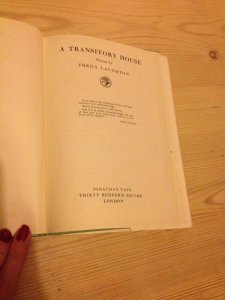
    Freda Laughton (1907-1995) was born in Bristol and moved to Co. Down after her marriage. She published one collection of poetry A Transitory House (Jonathan Cape, 1945), little else is known of her life and work. She may have lived in Dublin for some time, as her poem The Welcome details the textures of Dublin City and its suburbs, and suggests she knows the city by heart.  Freda Laughton’s poems were submitted by Emma Penney, a graduate of the Oscar Wilde Centre, Trinity College Dublin. Her thesis, Now I am a Tower of Darkness: A Critical History of Poetry by Women in Ireland, challenges the critical reception of Eavan Boland and the restrictive criteria, developed in the 1970’s, under which poetry by women in Ireland has been assessed. She considers the subversive nature of women’s poetry written between 1921 and 1950, and calls into question the critical assumption that Eavan Boland represents “the first serious attempt in Ireland to make a body of poems that arise out of the contemporary female consciousness”. In Object Lessons, Boland concluded that there were no women poets before her who communicated “an expressed poetic life” in their work. Emma’s thesis reveals how this view has permeated the critical landscape of women’s poetry, facilitating an absurd privation of the history of poetry by women in Ireland and simplifying it in the process


    • Dear Freda, Your Poems are being discussed on Jacket2
  • “Sin-Eater” and other poems by Jessica Traynor

    September 22nd, 2014

    An Education in Silence

    for the women of the Stanhope Street Magdalene Laundry

    This morning, light spilled into the courtyard
    as if God had opened a window.
    The light is quiet and can’t be herded
    from dormitory beds to morning mass –
    it shines where it wants,
    blushing the stained glass windows,
    washing the priest’s words.

    My mother doesn’t write.
    It’s been three years. My hands
    crack from the heat of the sheets
    as we feed them through the mangle.
    The high windows admit one square
    of light, on the word repent
    and I am silent like the sunlight.
     
    An Education In Silence is © Jessica Traynor
     

    Sin-Eater

    He blows on his hands to warm them;
    it looks like some ritual, some totem.

    Between us, nothing but certainty –
    the death-sound in the old woman’s throat –

    and uncertainty – the priest’s whereabouts.
    Our whispers summon only a flutter in her eyelids.

    Someone had mentioned the man down the road
    who lives alone, who gives some kind of absolution,

    so here we find ourselves with this stout man
    in a muddied fleece, who breathes on his hands

    and places them on the woman’s shoulders.
    Tears come first, spilling from her eyes;

    those milky shallows that have mirrored us all evening
    clear for a moment as he bows his face to hers.

    He doesn’t look at her tears, allows her gaze to travel
    to the ceiling above her bed. Only we invade her privacy.

    He says nothing. Not one prayer or word of comfort.
    We give him a fifty and wonder.

    Some begin to mutter; one man asks what he did.
    He tells us that at that late stage she had no voice left,

    so he took her sins upon himself,
    allowing her to pity him for all he carried.

    Sin-Eater is © Jessica Traynor

    Letters from Mount Fuji

    From the top of Mount Fujiyama I send you letters,
    written on square pages, then folded

    in as many different patterns as a snowflake.
    I drop them onto thin air; watch them fall into the world.

    Open one. In it is a picture from your childhood.
    You can look at it, but it melts in your hand

    like the question I ask you, caught on a breeze,
    and your answer, taken by the river to the flat sea.

    Even through this constant, year-devouring snow,
    I will always send you letters.

    Letters From Mount Fuji is © Jessica Traynor

    Pearls at Blackfriars

    For his Winter’s Tale,
    Master Shakespeare calls
    for a covered stage
    with the scent of candle-grease
    and orange-peel heavy on the air.

    There must be torches
    to give movement to shadows
    and life to the statue;
    and for Hermione’s face –
    tincture of pearl, crushed.

    With this bowl of dust
    we’ll lacquer her age,
    encase her in memory
    so only a movement of the mind
    might release her,

    might absolve
    her husband’s transgression,
    as the jealous moon
    flings her light
    against Blackfriars slates.

    Pearls At Blackfriars is © Jessica Traynor
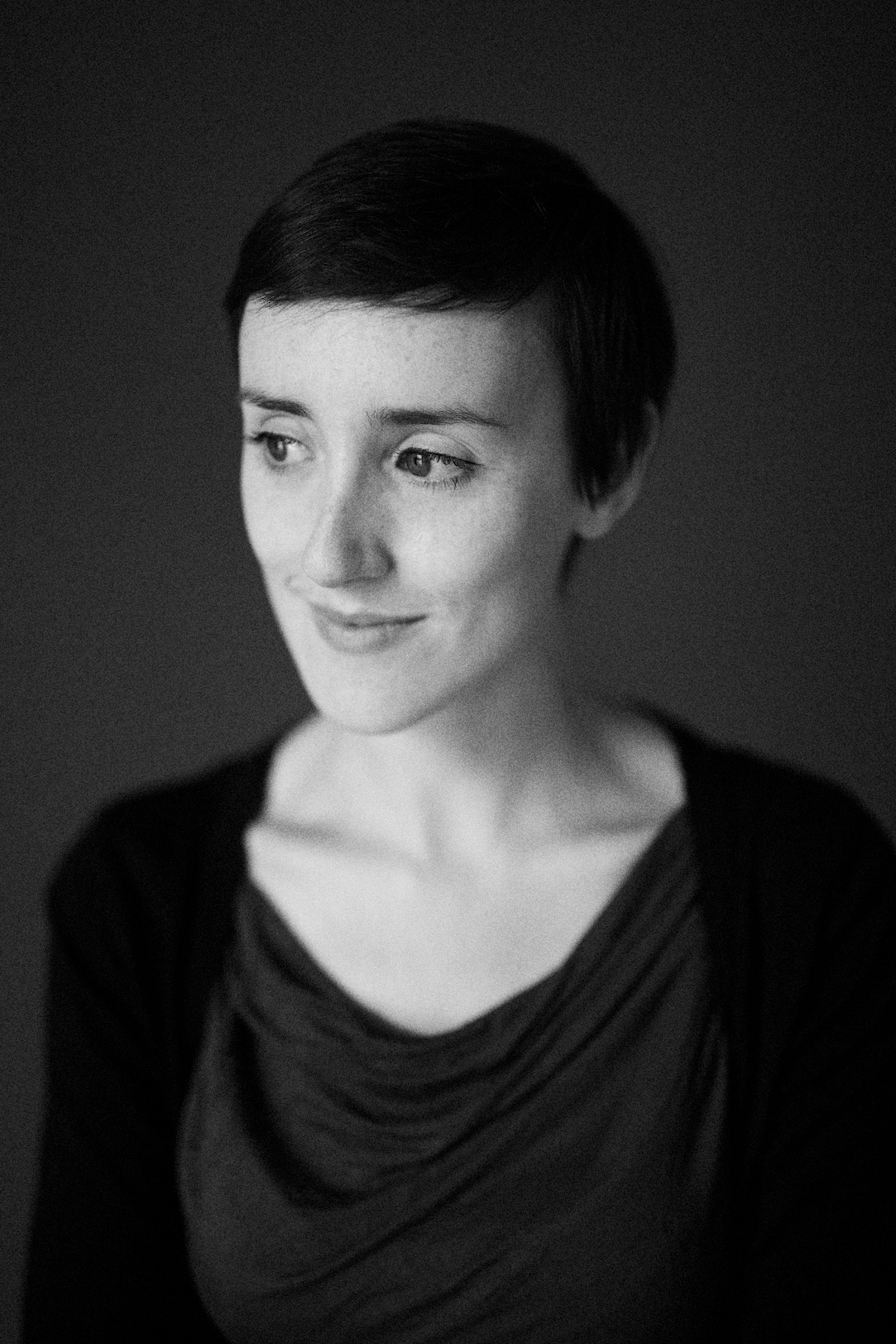

    Jessica TraynorJessica Traynor is from Dublin. Her first collection, Liffey Swim, was published by Dedalus Press in 2014. Poems have appeared or are forthcoming in Poetry Ireland Review, The Raving Beauties Anthology (Bloodaxe), Other Countries: Contemporary Poets Rewiring History, If Ever You Go (2014 Dublin One City One Book), The Irish Times, Peloton (Templar Poetry), New Planet Cabaret (New Island Books), The Pickled Body, Burning Bush II, Southword, The SHOp, Wordlegs, The Moth, Poetry 24, The Stinging Fly, and New Irish Writing among others.
     
    She is the 2014 recipient of the Ireland Chair of Poetry Bursary. She was named Hennessy New Irish Writer of the Year in 2013 and was highly commended at the 2013 Patrick Kavanagh Award. She won the 2011 Single Poem Competition at Listowel Writer’s Week. She received a Literature Bursary from Dublin City Council in 2010 and in was part of the 2009 Poetry Ireland Introduction Series.
     .
    Jessica works as Literary Reader for the Abbey Theatre and teaches creative writing courses through Big Smoke Writing Factory and the Irish Writers Centre. She also works as a freelance dramaturg.
     .

  • “Madame Matisse Is Shown Her Portrait, 1913” & other poems by Susan Millar DuMars

    September 13th, 2014

    Dreams for Breakfast

     
    Sometimes everything is blue;
    the hills, my hands,
    house keys, chimney smoke.
    If I bit the air
    my mouth would fill with blue juice.
    I’m peaceful, though I wonder,
    what casts such a big shadow?
     
    Or I’m on a bus
    with plaid seat covers.
    The other passengers
    are wilted, short
    of breath. I think
    I missed my stop.
     
    Other times I walk through
    a silent city of stone
    and nothing is where I remember
    except the swans
    and the church on the hill.
     
    I unwrap these dreams
    for you over breakfast.
    You say they are big budget,
    Technicolour
    while yours are pocket sized,
    abridged; small men
    in smaller circumstances.
    You butter the toast and laugh.
     
    I smile, marooned
    in all this blue distance.
     
    Dreams For Breakfast is © Susan Millar DuMars
     
    (published in Dreams for Breakfast, Salmon Poetry, 2010)
     

    Learning to Swim

    for Mary
      
    i.
     
    Reach and then kick and then kick and then
    breathe in the clean smell of chlorine.
    The ripples of light making circles
    to thread with my body.
     
    So what if you won’t take your pill?
    If you clutch at your stomach but won’t let me help?
    And I kick and then sputter and spit;
    no good at this.
     
    ii.
     
    Next day I find you entangled in stockings and bra.
    How to look without looking, be matter of fact?
    I have to be brisk
    or we both will be broken.
     
    Come here, Cinderella, I say when I finally
    put on your shoes. It’s time to make tea so I hold
    both your hands and walk backward; like teaching
    a toddler to stand. Thus we shuffle along.
    What must we look like? I say. We’re laughing.
    You reply: We look like we’re dancing.
     
    iii.
     
    A week later, you’re gone.
     
    I do twenty laps.
    Pulled through the water like thread
    in a stitch. As I get out, I feel
    nothing but small,
    on the edge
    of that open space.
     
    What have I learned?
    Don’t forget to keep breathing.
    Don’t try to move water. Let the water
    move you.
     
    Learning to Swim is © Susan Millar DuMars (from The God Thing,Salmon Poetry, 2013)
     

    Madame Matisse Is Shown Her Portrait, 1913

     
    Whose is this face?
    A pebble thrown in a pond,
    sinking grey over black over grey,
    further and further away.
     
    Whose are these hands?
    Fingers unfinished; flippers to flap
    around garden and house.
    My hands are stronger than that.
    Counted coins, wrote ferocious letters,
    once. Don’t you remember?
     
    Why that hat?
    With blushing rose
    and peacock feather.
    What does that sexless creature
    need with a Paris hat?
    Why not a dowager’s veil,
    a housemaid’s cap?
    Why not a wimple and beads,
    my Lord!
    The better to toil toward
    your veneration.
     
    I’m a good disciple, you will allow –
    everybody loves you now.
     
    Why these tears? Why this feeling I’m sinking?
    Portrait of Madame Matisse. Who is she?
    Henri, my love, my dear old friend.
    When did you stop seeing me?
     
    Madame Matisse Is Shown Her Portrait is © Susan Millar DuMars (from The God Thing)
     

    Sunday Morning, Lorient

     
    There’s a man wiping down the carousel
    as if it’s the only thing that matters.
    Beneath his white rag flattered panels
    blush and flash like fallen sections of sky.
     
    There’s an old man up on his balcony
    wrapped like something precious in his white robe.
    He’s looking at the church across the square.
    The air so still he can hear the choir.
     
    A pine cone rattles to the cobbles.
    Jackdaws, and the warm wood of this bench
    expanding as though with breath.
    Small white roses grow on the square,
     
    their fluttering faces like candles.
    I need no other cathedral.
     
    Sunday morning, Lorient is © Susan Millar DuMars (from The God Thing)

    Hampshire College Halloween 
     

    Wearing prom pink with white gloves, I was hypnotised by
                                                    my skirt spinning.
    Chuck and Mike were lazing on this bench –
                                                    the moon was silver.
    And Andy walked by, dressed as Jesus in a long white toga, hair wavy
                                                    like a midnight ocean.
    And he was carrying this crazy cross, big as him, and it was
                                                    white in the moonlight.
    And Andy said “hey” and we said “hey”, and then Chuck got up
    and he was walking behind Andy,
                                                    matching step for step.
    And I said, “Watcha doin’?” and Chuck said,
                                                    “Following Jesus, Dude.”
    And we giggled and got in line and then we were all followers of Jesus.
                                                    And Jesus led.
    And if Jesus drank, we drank; and if Jesus danced, we danced;
                                                    and if Jesus did a bong hit,
                                                    we praised Jesus,
    and did one right after Him.  And we fell around giggling
                                                    and Jesus giggled too.
    And He led us through the silvered night, and we were free;
    
                                                    and no one got nailed to anything.
     

    untitledSusan Millar DuMars has published three poetry collections with Salmon Poetry, the most recent of which, The God Thing, appeared in March, 2013. She also published a book of short stories, Lights in the Distance, with Doire Press in 2010. Her work has appeared in publications in the US and Europe and in several anthologies, including The Best of Irish Poetry 2010. She has read from her work in the US, Europe and Australia. Born in Philadelphia, Susan lives in Galway, Ireland, where she and her husband Kevin Higgins have coordinated the Over the Edge readings series since 2003. She is the editor of the 2013 anthology Over the Edge: The First Ten Years.

  • ‘L’Heure Bleu’ poems by Aad de Gids and C. Murray

    September 12th, 2014

    L’Heure Bleu

    a dwell in the night a, sigh. a dervish dislodged a textile, sigh
    it is the night it is a night on earth the hedges prematurely in
    bloom with almost lightning, flowers so, white and optic so,opioid
    a scent as some people sit on a bench and conspicuous leaves on
    the forestrial floor. oak moss and waterlily release pungent smells
    as pungent as sexual. it is the blue hour between love and war,
    dark mosses vessels almost for some astral war, the trail of laurel
    and pittosporum the navigational mappology by which we float as in,
    an unseen jar a headspace placed on the venezolan roraima to catch
    this petite star orchids’ unbelievable strong pineapplescent. as
    the classic perfumes however stay true to a private royaume along
    forgotten paths in venezuela, brazil, malaysia and italy, guerlain’s
    famous perfume l’heure bleue stays true to its 1912 formula…..

    L’Heure Bleue is © Aad de Gids

    .
    *L’Heure Bleue or ‘the bluish hour’ was created by Jacques Guerlain in 1912. The fragrance is velvety soft and romantic, it is a fragrance of bluish dusk and anticipation of night, before the first stars appear in the sky. The top notes are opening with spicy-sweet aniseed and fresh bergamot that gently lead to the heart of rose, carnation, tuberose, violet, and neroli. The soft and powdery floral notes are resting on a base of vanilla, Tonka bean, iris and benzoin. The perfume is mysterious, elegant and timeless. It was created by Raymond Guerlain. The bottle is shaped like the one of Mitsouko and the stopper is shaped like a hollow heart that alludes to romantic pre-war years. [fragrantica]

    Famine Ship at Murrisk Abbey *

    ‘L’heure bleue’ for Aad de Gids
     
    That almost night
    at Murrisk Abbey.
     
    Darkness begins to drop
    its black capillaries, its ink blots.
     
    Rorschach animals ink sky’s ultramarine
    seeping their blue tones into the sea.
     
    The reek looms above Murrisk Abbey.
    Altared, a blown bouquet
     
    tissues its stem toward
    the famine ship,
     
    bone-souldered
    its graven skeletons
     
    knit ‘ship’
    it baulks the dark,
     
    blacker than the fallen sky,
    the fairylight houses.
     
    Blacker still than stone.
      
    by C. Murray
    * The National Famine Memorial by John Behan RHA at Murrisk, Co Mayo

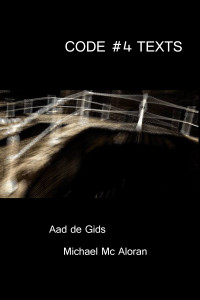
    7408_944735395543989_347432016492282884_nAad de Gids is from Schiedam, Netherlands. He  works as a psychiatric nurse. trance the ibisworld by Aad de Gids  is available on Poethead. He has co-authored Machinations (KFS Press) an ekphrastic collaboration with Michael McAloran  soon to be reissued via Oneiros Books , and a text collaboration Code #4 Texts  (Oneiros Books, 2014). His  chapbook acryl lacquer lost in the forest  was published by Bone Orchard Press in  2014.

    Books by Aad de Gids

     Famine Ship at Murrisk Abbey * ‘L’heure bleue’ for Aad de Gids That almost night at Murrisk Abbey. Darkness begins to drop its black capillaries, its ink blots. Rorschach animals ink sky’s ultramarine seeping their blue tones into the sea. The reek looms above Murrisk Abbey. Altared, a blown bouquet tissues its stem toward the famine ship, bone-souldered its graven skeletons knit ‘ship’ it baulks the dark, blacker than the fallen sky, the fairylight houses. Blacker still than stone. * The National Famine Memorial by John Behan RHA at Murrisk, Co Mayo behan.jpg acryl lacquer lost in the forest

    acryl lacquer lost in the forest
    Code #4 Texts
    Code #4 Texts
    Machinations
    Machinations
    1. Code #4 Texts
    2. acryl lacquer lost in the forest
    3. trance the ibisworld
  • ‘Bees and The Authorities’ by Dave Lordan

    September 1st, 2014

    Solinus, on the authority of Camden,
    incontrovertibly declares that there are no bees in Ireland.
    Keating impugns both Camden and Solinus
    stating Such is the quantity of bees,
    that they are found not only in hives,
    but even in the trunks of trees, and in holes in the ground.
     
    Modomnoc the beekeeper, who was with St David in Wales,
    was followed to Ireland by an adoring swarm of bees.
     
    Writing in the 8th century, Bede the so-called Venerable
    opines Hibernia … et salubritate ac serenitate aerum
    … Diues lactis ac mellis insula …
    Or, so Google tells us,

    Ireland has a fine climate, and is a land rich in milk and honey.
     
    In 1920 Benedictine Brother Adam hybridized the Buckfast Bee.
    According to The Economist in 1996 Brother Adam was
    unsurpassed as a breeder of bees. He talked to them,
    he stroked them. He brought to the hives a calmness that,
    according to who saw him work, the sensitive bees responded to
    .

     
    The Buckfast Bee – Brother Adam’s supreme though far
    from only achievement as a breeder – is super-productive,
    extremely fecund, resistant to disease and disinclined to swarm.
    However, it cannot perform miracles.
     
    Good St Bega could. She fled Ireland for Northumbria,
    away from enforced marriage to a Norwegian Prince.
    There she founded the still-extant Cumbrian coastal village
    of St Bees, pop 1,717 according to the census of 2001.
     
    Sometime after, although not too long after, 850AD, St Bega,
    to gain the land on which to build her priory
    from the goading Lord Egremont, made it snow
    three inches deep on Midsummer’s Day. Yes, she made
    it snow three inches deep on Midsummer’s Day,
    dispossessing Lord Egremont, as well as, presumably,
    seriously upsetting the bees as a consequence.
     
    Bees and the Authorities is © Dave Lordan, from Lost Tribe Of The Wicklow Mountains
     

    About Lost Tribe of the Wicklow Mountains

    untitled‘It may be said, in truth, that he changed his manner almost for every work that he executed’, Vasari said of Di Cosimo, and in Lost Tribe of the Wicklow Mountains Dave Lordan’s poems embrace a wide range of formal and vocal possibilities. Internationally renowned as one of the most inventive and provocative of Ireland’s contemporary performance poets, Lordan reinforces that position in this new collection. There are also poems here that demand a quieter hearing, however, including a long and powerful elegy for Denis Boothman and an urgent meditation on the scourge of suicide in Irish society. The anger that often characterized the poems of Lordan’s first two collections is transformed in Lost Tribe of the Wicklow Mountains into profound explorations and expressions of loss, love and hope – ‘music as a possible sanctity’.

    Lost Tribe of the Wicklow Mountains is Dave Lordan’s 3rd collection of poetry and will be published shortly by Salmon Poetry.

    • website
    • first book of frags
    • invitation to a sacrifice
    • the boy in the ring
    • the fucking titanic
    • the abyss staring back
    • poetry international
    • creative writing workshop testimonials
←Previous Page
1 … 43 44 45 46 47 … 106
Next Page→
 

Loading Comments...
 

    • Subscribe Subscribed
      • Chris Murray
      • Already have a WordPress.com account? Log in now.
      • Chris Murray
      • Subscribe Subscribed
      • Sign up
      • Log in
      • Report this content
      • View site in Reader
      • Manage subscriptions
      • Collapse this bar