• chris murray
  • journals – bibliography – publication notes
  • downloadable items – essays – media
  • copyright
  • Home

Chris Murray

  • ‘Swallows’ and other poems by Doireann Ní Ghríofa

    June 22nd, 2013

    Swallows

    The knitting needles
    drew melodies from silence
    as stitches seemed to follow
    one another like swallows
    alighting upon a wire,
    watching the tiny dress
    of softest yellow wool
    grow like a sunrise
    waiting for she
    who waited within.

    She, who came
    and left
    all too soon.

    Stretched and stitched,
    I lie empty, raw, alone
    In the cold corridor of the hospital
    grey knot of my mind
    grasping blindly for meaning
    I hold the soft brightness to my cheek,
    then unravel the stitches
    one
    by
    one

    Swallows of hope
    disappearing at sunset
    to some unfathomable,
    faraway land.

    My grief grows, like wound wool.
    Dull. Full.

    Swallows is © Doireann Ní Ghríofa
     

    Recovery Room, Maternity Ward

    (for Savita Halappanavar)
     

    The procedure complete,
    I awaken
    alone, weak beneath starched sheets.
    As the hospital sleeps, my fingers fumble
    over the sutured scar, a jagged map
    of mourning stitched into my skin —
    empty without and empty within.
    Beyond these white curtains,
    stars shine bright as Diwali
    in a cold night sky.
    Someday, within these walls,
    I will hear my baby cry.
    Cradling my hollowed womb,
    I trace this new wound and weep.
    The only sound I hear now is the fading retreat
    of a doctor’s footsteps, echoing my heartbeat.

    Recovery Room, Maternity Ward is © Doireann Ní Ghríofa
     

    Rusted Relic

    Drifts of dust muffle the old typewriter’s surface
    each dead key is encrusted with rust—
    a forgotten Gaelic font
    of blurred syllables and bygone symbols.
    Muted music. Smothered percussion.

     Rusted Relic is  © Doireann Ní Ghríofa

    doireannDoireann Ní Ghríofa’s poems have appeared in literary journals in Ireland and internationally. Her Irish language collections Résheoid and Dúlasair are both published by Coiscéim. The Arts Council of Ireland has twice awarded her literature bursaries (2011 and 2013). In 2012, she was a winner of Wigtown Gaelic poetry contest— the Scottish National Poetry Prize. Her short collection of poems in English Ouroboros was recently longlisted for The Venture Award (UK).

    •  www.doireannnighriofa.com
    • Waking, read by Doireann Ní Ghríofa
  • In Damage Seasons by Michael McAloran

    June 21st, 2013
    ‘Clear the air! Clean the sky! Wash the wind!
    Take the stone from the stone,
    take the skin from the arm, take the muscle from
    the bone, and wash them.
    Wash the stone, wash the bone, wash the brain,
    wash the soul, wash them wash them!’
     
    The Chorus , from Murder In The Cathedral by T.S Eliot.
     
     
    (we convulse in sun light there are skins to trace and there is flesh to caress in some sudden dawning where the sudden shakes the boundary’s clasp….)

    Scene Forty Two, In Damage Seasons


     The structure underpinning Michael McAloran’s In Damage Seasons is Palladian (a.b.a) or a quasi-triptych. It isn’t however an altar-piece or a pleasure-dome of a book. The parts of the triptych structure are: Onset, In Damage Seasons, and nothing’s bones-. The thematic thrust of the book which fully comprises 130 pages interspersed with kaleidoscope images, is barely contained in the second section eponymously titled and consisting of fifty individual scenes. Onset opens the book setting the myriad kaleidoscope theme, and nothing’s bones-  the third part of the work, is a paean. It forms an accumulation and gathering of the essence of the book. It is a beautifully written after-death, where life is the exilic condition.
     
    Make no mistake, the doors of the triptych: Onset and nothing’s bones-, barely enclose the mid-section of the book and do not make for a sense of containment let alone comfort. Their purpose is to iterate the wolf howl of loss and an uncompromising poetic-voice that sometimes feels oxygenless. The book encloses this disembodied voice that has deranged from its centre and meaning. In visual terms the book is the raw howl of a lost generation. McAloran is too consummately skilled  in his image making to drop his theme (the howl) and he works it with a fine acuity:
     
    ‘sing spun alone till dry of speech the asking of the
    prayers from the hollow entity unto some foreign grace
     traceless depth will in end no end in depth sing spun
    alone till speech evaporated’
     
    from nothing’s bones-
     
    The dystopian landscape and setting of In Damage Seasons is dense with image and requires the reader’s full concentration. Here the wusses may leave, it is not for you. Onset and nothing’s bones- form the closable field of the overall triptych that is In Damage Seasons. They are as splattered with blood, torn nails, ejaculate and shit as the Hieronymus Bosch nightmare mid-section of the book:
     
    ‘an amber nocturne and the force of blue stun a
    silhouette a shadowing a trail of dead words scattered
    behind in retrospect of hollow oblivion’s benign claim I
     or we/eye dead of yet but once heart meat heart less…’
     
    Scene Twenty Five (is dead meat heart…) 
     
     The walls of the cylinder form occur throughout In Damage Seasons. The cylinder, of polished metal-sides, with an interesting kaleidoscopic window detail. Sylvia Plath often described the rarefied air of her bell-jar, and her reader knows that its breach involved the fatal-wounding of her panic-bird. She described her artifice, her work, as the blood-jet of poetry. In McAloran’s case its blood-jet, ejaculate, tearing, bruising, incision and excreta. It is loss, torture, violence and pain:
     
    ‘the blood comes to the fore and there is nothing.…’
     
     Colours inherent in the book are amber and blue, a streak of red, and shades of metallic. One minute the writer is imprisoned in the doom of the non-working affair, the next he is shattering the funnel against a stone-wall and walking through the shardings of glass barely observing the beauty he made. It is meant to wound his feet, his hands and his body. We read rupture, derangement of form and the screaming voice:
     
    ‘kicking convulsive in the reek asking of the breaking
    night’s dissemble through the cortex mirror a sheen of
     black iris flowerings a kaleidoscope of burning
    carousels spun alone reaching for none…
     
     the blade asks of the final wind the death inhaled the
    caress of some vital wound ask of till subtle bound
    some stasis somewhere other than sung aloud in glint
    of darkness…’  Scene Forty Two (is stillness to brace…)
     
     There is no piety to the howling of the poet. There is a type of tenderness and wry acceptance which could not be called compromise in any way, shape or fashion. This is strong and assured work. It is unrelenting for the reader:
     
     ….here and there the blind terse the fettering of all spun
    till head of till spire of spine recorded as if to un-know
    hence laughter cracks the ice like some obscene
     symphonium trace of desire still the living clot in the
    eye the tongue torn out silenced of all …
     
    ah break the bones of it there’ll yet be asked of till
    splendour held in mockery of stun shards of bone and
    foreign silences child’s toy fragments the walls peeling
    in the artificial light…
     
    from Onset, 5-
     
     The sense, or aftertaste of a book gives it its meaning. I tend to leave down a McAloran book with a sense of altered-reality. To me that is the meat of the poetic work, and it is often absent from the canon due to a mistaken sense that poetry should lack violence, or maybe it should do something pretty. Like adorn the margins of a chocolate-box culture bent into its own restless consumption.
     
     If your taste runs to Bataillesque, then this is the meat for you. In Damage Seasons is post-apocalyptic with a hint of tender. The apocalypse inherent in the book’s imagery is of body and of mind. It contains the reality of violence worked on the body and told through the disembodied mouth in the brilliantly written nothing’s bones-
     
    529303_526490027394180_1927032004_nIn Damage Seasons by Michael McAloran is Published by Oneiros Books In 2013.

    • Oneiros Press link.
  • A Celebration of Irish Women Poets on Bloomsday 2013

    June 11th, 2013

    Rebecca O’Connor

    Domestic Bliss

     
    I place a jug of lavender on the table
    to mask the smell of mould from under the fridge
     
    while you draw nails to hammer with your fist.
    Then I draw a hammer , and watch
     
    as you try to lift it from the page.
    by day it’s Mr Men, Mad Men, by night,
     
    your father and I wishing we could be so bold.
    you have no such wants, though sometimes I wonder
     
    as you try to peer into Jack and Jill’s well
    or climb the tiny ladder of your toy farm
    to mend the roof of your miniature barn.
     

    –  Rebecca O’Connor

    images
    Rebecca O’Connor edits The Moth Magazine and organises the Ballymaloe International Poetry Prize. She worked as a commissioning editor of literary fiction at Telegram Books in London before returning to Ireland with her family in 2008. She won a Geoffrey Dearmer Prize in 2004 and her chapbook Poems was published by the Wordsworth Trust, where she was a writer in residence in 2005. Her poetry has been published in, among other places, The Guardian, Poetry Review and The Spectator.

    Kelly Creighton

    World Put to Rights

     
    The dream that burst riverbanks
    held you; blackstrap molasses,
    antidote for your poison.
     
    Your plummets spraying wetness
    like a coin in a cascade
    woke no-one, not even us.
     
    The church spire grew legs, scaled bricks,
    ran to your side, spotlighted.
    I put glass over that glow.
     
    Quiet-huff of your refuge,
    flailing arms, spluttering snores.
    Ungainly crooning tunes
     
    to the realms of purity;
    I found too sickly-sweet. You
    fought the humdrum, from your seat.
     
    You would sleep outside, would sing,
    stand on ledges mollified.
    I won’t sing, no matter what.
     
    Float on, keep your whistles of
    booze-hounds. When I awaken
    I will join you, watch for me.
     
    World Put to Rights is © Kelly Creighton , all rights reserved.

    Kelly Creighton

    K. C
    Kelly Creighton is a poet and writer with work currently and forthcoming in literary journals Ranfurly Review, A New Ulster, Electric Windmill Press, Inkspill Magazine, The Galway Review, Saudade Review, PEN Austria’s Time to Say: No! e-book, Recours au Poeme and other numerous other publications. She has recently finished editing her historical fiction novel Yielding Fruit. Kelly is working on her second poetry collection.

    Moya Cannon

    Viola D’Amore

     
    Sometimes, love does die,
    but sometimes , a stream on porous rock,
    it slips down into the inner dark of a hill,
    joins with other hidden streams
    to travel blind as the white fish that live in it.
    It forsakes one underground streambed
    for the cave that runs under it.
    Unseen , it informs the hill
    and , like the hidden streams of the viola d’amore,
    makes the hill reverberate,
    so that people who wander there
    wonder why the hill sings,
    wonder why they find wells.
     
    Viola D’Amore is ©  Moya Cannon
     
    Bio (source Wikipedia)

    downloadMoya Cannon was born in 1956 in Dunfanaghy, County Donegal. She studied History and Politics at University College Dublin, and at Corpus Christi College, Cambridge.

    She has taught in the Gaelscoil in Inchicore, in a school for adolescent travellers in Galway, and at the National University of Ireland in Galway. She served as editor of Poetry Ireland in 1995. Her work has appeared in a number of international anthologies and she has held writer-in-residence posts for Kerry County Council and Trent University Ontario (1994–95).

    Cannon became a member of Aosdána, the affiliation of creative artists in Ireland, in 2004.

    Her first book, Oar, (Salmon 1990, revised edition Gallery Press 2000) won the 1991 Brendan Behan Memorial Prize. It was followed by The Parchment Boat in 1997. Carrying the Songs: New and Selected Poems was published by Carcanet Press in 2007.

    Dorothea Herbert

    The Rights Of Woman,

    Or Fashions for the Year 93 – being the Era of Women’s literally wearing the Breeches. – Health and Fraternity!
     
    Whilst man is so busy asserting his Rights
    Shall Woman lie still without gaining new lights
    Our sex have been surely restrain’d enough
    By stiff prudish Dress and such old fahion’d stuff
    Too long have been fetter’d and tramelld I wot
    With Cumbersome Trains and the Strict petticoat
    Yet should a poor Wife dare her Tyrant to chide
    Oh she wears the Breeches they tauntingly cried
    But now we’re enlighten’d they’ll find to their Shame
    We’ll have the reality not the bare Name
    No longer will Woman to Satire be Dupe
    For she is determin’d to figure Sans Jupe
    And once she is rouzed she will not be outdone
    Nor stop at this one Reformation alone
    For mark me proud Man she’ll not yield thee a Jot
    But soon will become e’en a true Sans-Culote
    And flourish away e’er the Ending of Spring
    Sans Jupe, Sans Culote , in short – sans any thing
     
    – Ca va et ca…ira
    –Liberty and Equality for ever ! 
     
    © by Dorothea Herbert
     
    from, Introspections, the Poetry and Private World of Dorothea Herbert by Frances Finnegan , Congrave Press 2011.
     
    from Congrave Press

    download (1)The “lost” poetry of the celebrated Irish writer Dorothea Herbert, whose Retrospections, first published in 1929-30 more than a century after her death, continues to captivate readers.  By turns amusing and melancholic, the recently recovered poems – and particularly her astonishing mock-heroic epic The Buckiad – are an important contribution to late eighteenth and early nineteenth century Irish literature.

    Paula Meehan

    Seed

     
    The first warm day of spring
    and I step out into the garden from the gloom
    of a house where hope had died
    to tally the storm damage, to seek what may
    have survived. And finding some forgotten
    lupins I’d sown from seed last autumn
    holding in their fingers a raindrop each
    like a peace offering, or a promise,
    I am suddenly grateful and would
    offer a prayer if I believed in God.
    But not believing, I bless the power of seed,
    its casual, useful persistence,
    and bless the power of sun,
    its conspiracy with the underground,
    and thank my stars the winter’s ended.
     
    ‘Seed’ is © Paula Meehan, all rights reserved.

    Paula Meehan

    Image from Imagine Ireland
    Image from Imagine Ireland

    Paula Meehan has published five collections of poetry, the most recent being Painting Rain (Carcanet, 2009). A selected volume, entitled Mysteries of the Home, was published in 1996. Her writing for stage includes the plays Mrs Sweeney (1997), Cell (1999), and, for children, Kirkle (1995), The Voyage (1997) and The Wolf of Winter (2003/2004). Her poetry has been set to music by artists as diverse as the avant-garde composer John Wolf Brennan and the folksinger Christy Moore.

    Eileen Sheehan

    All About Climbing

     
    After he slaughtered her
    he dumped her body
    in the market square
     
    where merchants and citizens
    continued their trading
     
    averting their eyes
    from the sight of
    her broken corpse;
    the limbs skewed
    at grotesque angles.
     
    A fly alighted on her eyelid
    its blue-green body
    gleaming like a jewel.
     
    A mouse
    nibbled flour
    from under a fingernail.
     
    A goat strayed from its pen
    sniffed at her body
    lay down beside her.
     
    Her house cat
    navigated the alleyways
    of the rural town
    till he found her.
     
    A rat curled to sleep
    in her armpit.
     
    Then the last slice of moon
    slid down from the sky,
    lodged in the small of her back.
     
    From high in the hay loft
    an owl let out
    it’s long note
    across the dark
     
    and that was the sound
    she heard as she woke;
    the sound that led her
    to walk to the foot
    of the mountain.
     
    Now she carries
    the moon on her back
    and she climbs.
     
    Her days are all about climbing;
    all about purpose;
     
    committed
    to restore the moon
    to the sky:
    hang it aloft.
     
    So she climbs
    in her blood-red shoes,
    her tattered garments:
     
    there is no slipping back.
     
    © Eileen Sheehan
     
    from the collection Down the Sunlit Hall (Doghouse Books)

    Eileen Sheehan

    Eileen Sheehan
    Eileen Sheehan

    Eileen Sheehan is from Killarney, Co Kerry. Her collections are Song of the Midnight Fox and Down the Sunlit Hall (Doghouse Books). Anthology publications include The Watchful Heart: A New Generation of Irish Poets (ed Joan McBreen/Salmon Poetry) and TEXT: A Transition Year English Reader (ed Niall MacMonagle/ Celtic Press). She has worked as Poet in Residence with Limerick Co Council Arts Office and is on the organizing committee for Éigse Michael Hartnett Literary & Arts Festival. Her third collection, The Narrow Place of Souls, is forthcoming.

    Mary O’ Donnell

    Hungary

     
    came to me in stamps.
    “Magyar Posta” ice-skaters, delicate
    as Empire porcelain, a fish, an astronaut
    and rocket, a silvery boy on 1960s skis.
    I understood only difference.
    Now, flying home from Budapest,
    I touch the pages of my poems, freshly minted
    in translation. Now I really don’t get them,
    but did I ever? The words will make me
    briefly native to a coffee-slugging morning reader
    on the Vaci Ut, who may not understand,
    even in his own tongue.
    The lines shimmer as night slips
    through the tilting crowded cabin. Again
    I press fingers to page, blind, as if by touch
    I could capture a fish, an astronaut, a rocket,
    or those elegant, ice-cutting skaters.
    Outside, clouds I cannot see
    busily translate country to country.

    Hungary is ©  Mary O’ Donnell
     

    Mary O' Donnell
    Mary O’ Donnell

    Mary O’Donnell is the author of eleven books, both poetry and fiction, and has also co-edited a book of translations from the Galician. Her titles include the best-selling literary novel “The Light-Makers”, “Virgin and the Boy”, and “The Elysium Testament”, as well as poetry such as “The Place of Miracles”, “Unlegendary Heroes”, and her most recent critically acclaimed sixth collection “The Ark Builders” (Arc Publications UK, 2009). She has been a teacher and has worked intermittently in journalism, especially theatre criticism. Her essays on contemporary literary issues are widely published. She also presented and scripted three series of poetry programmes for the national broadcaster RTE Radio, including a successful series on poetry in translation during 2005 and 2006 called ‘Crossing the Lines‘. Today, she teaches creative writing in a part time capacity at NUI Maynooth, and has worked on the faculty of Carlow University Pittsburgh’s MFA programme in creative writing, as well as on the faculty of the University of Iowa’s summer writing programme at Trinity College Dublin.

    • Bloomsday 2012
  • ‘What She Sings Of’ and other poems by Eileen Sheehan

    June 8th, 2013

    an elegy of sorts

     
    for want of an ash-tray
    I rest my cigarette
    on this grey plate,
    a remnant
    from some depleted set,
    now serving as candle-holder
     
    the cigarette tip sizzles
    as it hits a pat of wax
     
    I inhale and taste the tallow
    as red seeps down the paper
    stains the filter
     
    a last molten drop
    from a crimson candle, lit
    as votive for an injured cat
     
    the cat now buried
    in a sunny spot
    by the back wall
     
    a favoured place of his
    for grooming
     
    somewhere
    there was a point to all of this
    which now evades me
     
    like that raw evening,
    placing his still-warm body
    in the grave, how everything
    but the weeping
    failed me
     
    © Eileen Sheehan from the collection Down the Sunlit Hall (Doghouse Books)

    What She Sings Of

     
    Once in a time he was the sky clothing me,
    the warm earth supporting me,
    the all-in-all of every night and day to me.
     
    He was salt waves washing me,
    he was wind caressing me, fire igniting me,
    the first and last of every cause that moved me.
     
    He was fish that jumped for me,
    bird that sang for me, beast that nourished me,
    the craving and cure of every need inside of me.
     
    Now he is a bright ship pulling away from me,
    white sail gone from me, his rough wake drowning me,
    he is shimmer of scales growing out of me;
     
    soon I will sing to him, comb out my hair for him,
    draw him back to me, lure him down to me.
     
    © Eileen Sheehan
     
    first published in The Watchful Heart: A New Generation of Irish Poets (ed Joan McBreen/Salmon Poetry)


    Eileen Sheehan
    Eileen Sheehan

    Eileen Sheehan is from Killarney, Co Kerry. Her collections are Song of the Midnight Fox and Down the Sunlit Hall (Doghouse Books). Anthology publications include The Watchful Heart: A New Generation of Irish Poets (ed Joan McBreen/Salmon Poetry) and TEXT: A Transition Year English Reader (ed Niall MacMonagle/ Celtic Press). She has worked as Poet in Residence with Limerick Co Council Arts Office and is on the organizing committee for Éigse Michael Hartnett Literary & Arts Festival. Her third collection, The Narrow Place of Souls, is forthcoming.

  • Poems by Michèle Vassal

    June 1st, 2013

    Drunk as Brendan Behan

    Lovers    lovers
    their empty skins
    hang limp in opiate closets
    pulsing between insinuations
    of naphthalene and the barbitural scent
    of forgetting, they swing embittered
    and toxic, mothy costumes
    of a play that lingers only
    on faded posters
    and skin.

    On the wrong side of midnight
    drunk as Brendan Behan
    I scooped up a last high king
    kneeling on Clontarf road
             battled out
    knees sanded to the bone
    by the wet grit of ancient wars
            singing
            something
    about not worrying about a thing
    amongst Viking corpses
    on the steps of the Bank of Ireland
    where Wood Quay used to be
    we kissed ourselves an island.
     
    I clinched a burned out arsonist
           hands shaking
         climbing railings
    in Stephens Green
         ..fucking
    left an aftertaste of phosphorus
            reeking red
           like inhaling
    the soul of a cracked match.
     
    I chased a light eyed dragon
    heart caving in to the count of nine
    elliptic filigree of sins I kept
    twitching inside a reliquary
    of abalone dreams whilst
    the rosary of Chopin’s Polonaise
    undid itself in silver beads.
    I slashed my defeats in the wrists of actors
    snorted stars on the mercurial mirrors
    of their well rehearsed eyes
    and DT-ed on night’s poitín
    when I drank neat the distilled dew
    glistening on the mouths of girls.
     
    © Michèle Vassal, published in A Taste of Hemlock, Salmon 2011
     

    Dublin 75

     
    Nineteen seventy five and
    Mary worked Fitzwilliam square
    genuflecting at closing time
    for wretched men in nylon shirts
    too drunk to know
    too drunk to care
    that whilst on bended knees
    she thought only of communion.
     
    From the Liberties to the Green
     
    Dublin vomited poets and patriots
    under the gassy glare of streetlights
    leaning on convoluted shadows
    and not quite balladed out
    saints and scholars spewed up Spancil Hill and
    Dirty Old Town, like a bad pint
    In nineteen seventy five
    love smelled of stout and vinegared chips.”
     
    © Michèle Vassal, published in A Taste of Hemlock, Salmon 2011
     

    Michèle Vassal
    Michèle Vassal

    Michèle Vassal is from Barcelonnette, a small town in the French Alps. She moved to Ireland, aged seventeen, to learn English and stayed there for thirty years. Her collection, Sandgames (Salmon 2000), received first prize at Listowel Writers’ Week and some of her poems were short-listed for the Hennessy/Sunday Tribune Awards. She has been widely published internationally, in both French and English. Michèle currently lives and writes in France.

    • Youtube
    • Salmon
    • Amazon
    • Amazon

    Links

  • A Gentle Nihilism: Throats Full of Graves by Gillian Prew

    May 24th, 2013
    3

    A gentle nihilism; on reading of Throats Full of Graves  by Gillian Prew. Published Lapwing Publications, Belfast 2013.


    My first instinct about naming this reading of Gillian Prew’s poetic-work was to entitle it requirements for poetry. I wanted to focus on what happens to the reader when she approaches a book of poetry that is minimal in its intent, and full of quietude as of necessity.

    The necessity inherent in Prew’s expression is dysphoric, that she has pared down her use of symbol to the bare skeletal minimal inviting the reader to partake in a world-view that is bleak and damaging by virtue of its unspoken violences. Motherhood as a type of encroachment and its effect on one’s independence. The violence of the body as witness in its own decay.

    Threadings of symbols run through Throats Full Of Graves, small creatures, mirrors, the encroachments of nature and weather. Prew picks up and examines these images in single poems and in series throughout the book.


    Prew’s understated and wistful approach to the decay of the body is masterful and nowhere more evident than in Beyond This Skin: 

    These thin breasts each a grief
    plump-robbed and plucked dead
    like two starved birds.

    Beyond this skin the world weeps for its swept-up beds
    and its loneliness;
    its hearts blown like empty stones.

    (from Beyond This Skin, by Gillian Prew)

    Prew’s  imagery recalls Sylvia Plath’s Medean Edge: the mother as vessel of and progenitor. The mother attempting to recall her individualism and usefulness after child-bearing. This is a theme often left unexplored in poetry. I am including an excerpt from Edge here :
     

     Edge

      
    Each dead child coiled, a white serpent,
    One at each little
    Pitcher of milk, now empty.
    She has folded
    Them back into her body as petals
    Of a rose .
      

    from Edge , by Sylvia Plath from Ariel (Faber and Faber 1965)
      
    Prew does not explore Medean rage, her tone is elegiac throughout. She invites the reader to explore the ravage of time on femininity, the experience of mothering as a type of loss to woman’s identity in which memory plays useful tricks. Prew’s search for joy and self-identity pervades the book as a sub-theme but it never overwhelms the reader.

    While Reading The Spines Of Books

     Up, is a diary of clouds. The sky
    tucked into them. There is the
    meaning of a bird. There is a quiet belief.

    Down, we are bare bones of an isolated incident
    and we cleanse ourselves in mere water.

    We are played; music unable to hear itself.
    Deaf instruments that skirt shine but
    want to build monuments : cold stone and dates.

    We do not need war to be a broken soldier.

    The time we have taken
    – rehearsing our exit lines in black seconds.

    Here, in the spines of books,
    it is an expensive place to die.

    While Reading The Spines Of Books is by Gillian Prew from Throats Full Of Graves.

    Prew contains and works her images beautifully throughout this book. She allows herself  to pace it according to what she feels is necessary revelation. Her obliqueness is tenacious and requires the reader to engage. I was very taken with her series Six Pieces in Search of Unity which occurs just past the mid-section of the book:

    take down
    your loud voices from the walls. No one
    wants to see them they are blinding. Or
    cover them with sheets as if they are yet
    to be unveiled as if they are fresh as motion
    as if silence still counts for something
    when people are trying to die.

    from Six Pieces in Search of Unity by Gillian Prew


    Throats Full of Graves by Gillian Prew

    •  Throats Full of Graves by Gillian Prew
    • Lapwing Poetry Website 
    • Purchase Link for Throats Full Of Graves (Lapwing)
  • The Health of Poetry

    May 20th, 2013

    From Clare Pollard

    poetclare's avatarclarepollard

    anatomy

    I was honoured to present the first Hippocrates Young Poets Award on Saturday, for a poem on a medical subject, to 17-year old Rosalind Jana for a brave, beautiful piece about her treatment for scoliosis of the spine. The award, sponsored by NAWE, was part of an International Symposium on Poetry and Medicine at the Wellcome Centre, organized by Donald Singer and Michael Hulse, and came at the end of an inspiring afternoon.

    I started with a quick look around the Wellcome’s brilliant ‘Souzou’ exhibition of Japanese outsider art, created by artists within social welfare facilities (which includes such joyous objects as Shota Katsube’s army of action figures made from the sparkly, multi-coloured twist-ties used for bin-liners; Sakiko Kono’s dolls representing staff who had been kind to her and Takahiro Shimoda’s ‘Fried Chicken Pyjamas’). And then at the conference I heard Cheryl Moskowitz talk about poetry and dementia, Andrew Mcmillan…

    View original post 1,060 more words

  • trance the ibisworld by Aad de Gids

    May 18th, 2013

    trance the ibisworld

     
    fleur de lys not, but hemlock and yet roses red, pink, yellow,
    ligustrum fully gleaming green, the yellow variant of digitalis,
    lilies abundant, pink, red and orange in honour of carolyn, the
    first buds of saponaria, phlox and a wide assortment of herbs
     
    still undecidedly in the nursery, bilobal firstlings, definitely out,
    drawn, because of incessant springsun, rundspringa this fresh
    naive sun still easily bearable, friendly, ecofriendly, drawing at
    the anthracite earth this anciennity of green carpet when we
     
    walked then, unforgotten and long, long forgotten, softly enjoying
    this mildest of pains, pains of the antropocene, connected with
    and dissipative condensed out of our collective retroretrieving
    unmight, the sheer vulnerability of wo/man, shone by this light
     
    and still we keep searching for the path, home, to the source,
    in, out, up, down, left, right, through, before and after where we look
    as an archingly achingly old GPS saying, like the birds “this is me”
    “here i am” and thinking of the dead continuance “the world”
     
    trance the ibisworld is © Aad de Gids
     

    Bas de Gids
    Image © Bas de Gids

    between inexhaustive mappology


    between unphilosophic ‘just a bit walking in the rain and before the rain’
    and acknowledging a huge new tiredness of the soles of the feet and muscles
    of the legs, arms, pulses, thorax, back, shoulders, face, mouth, calves, thighs and
    fleeing the rain also a hazardous affair with halfly a sense of direction, plan
     
    a tired jazz, an endjazz heralded because it gives a spread of soothening space,
    that we’re heading slowly towards an end finally,bc gals and boys are we tired
    even the boids are tired only MARS has this mussoliniesque presentism to
    boss everyone around my god he would even boss a dawg around looking down
     
    upon him, her, with that ‘go fuck yourself’ look, well when MARS isn’t tired that
    then isn’t indicative for the levels of the meteorological and emotional tiredness
    of the evening,  shall this be spring and how lonesome a saxophone, no distant
    saxophone, uncertain trumpet , lyotard, with these variables we shall try to
     
    start some mappology of emotions, scents (the magnificent loukhoum by
    keiko mecheri, beverly hills, the eau poudrée, this almond-turkish delight confection)
    a fantastically jazzy contribution to a somehow emptied out, dysphasic evening
    an earned disorientation, an earned depersonalization, longitudinal saxophone
     
    sexy clichéeing not so much as the desolateness of gritty tiles slabs of stones
    in the evening which at once invite and make you forget to walk on them, walk
    like a hooker walk like a banker walk like a streetwalker, a cigaretteuse who
    sexily smokes her pall mall and spikes it with some coke, some laBrea decency
     
    and this is the last evening all is still coloured and cold a spikey spring is waiting
    to fill the greenery and furnish the globe also in ‘artificial land’ whereto our
    sojourn inescapably leads us and she whore her polyester diaphanous miniskirt
    and ‘tonight i am gonna sell every inch of my body’ a micropolitique du jour
     
    between inexhaustive mappology is © Aad de Gids


    Image Bas de Gids
    Image Bas de Gids


    Thanks to Aad De Gids for the two poems. I begged  trance the ibisworld from him when I read it on a Facebook note. It is related to  some images by Leonard Baskin who illustrated Crow by Ted Hughes. I hope Poethead readers enjoy Baskin’s extensive sculptural and lithographic work as much as I do.

    Aad De Gids ekphrastic textual collaboration with Michael McAloran, Machinations is linked in series below here.

    • Machinations I
    • Machinations II
    • Machinations III


    Images are © Bas De Gids

  • Bruise by C. Murray

    May 10th, 2013

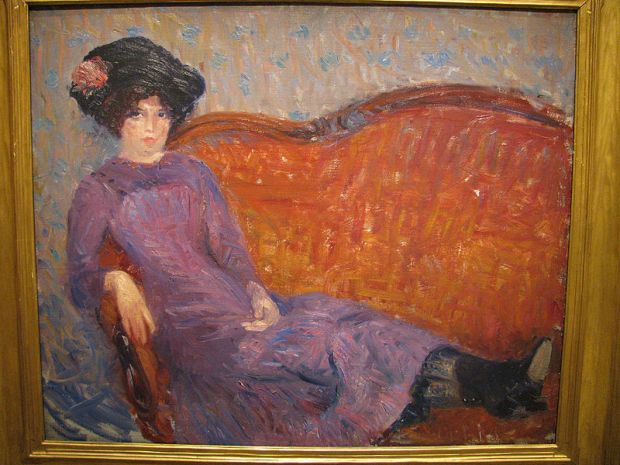
    I’d rather it were a muse dangling above my head in her purple cloud dress
    than a crystal chandelier of gaudy pattern floating in the many-coloured sky

    floating in the many-coloured sky

    a painted backdrop is between the vanished bookcase and wall
    each breeze brings the noise of tea-cup-clatter a loud tea room

    separator of light

    I am scraping my bare foot on a bright tiger claw
    and I am agitated down to my bruised flesh

    give me the muse
    the reed song
    song of the bones
    a hollow bone a
    twin reeds’ tune

    anything but this noise

    by C. Murray


    • reed-song
    The Purple Dress , by William Glackens
    The Purple Dress , by William Glackens
  • ‘There are less Wikipedia articles on women poets than pornographic actresses’ James Gleick

    April 30th, 2013

    “There are less Wikipedia articles on women poets than pornographic actresses.”

    The above quotation is derived from Wikipedia’s Women Problem written by James Gleick at the New York Review of Books made during this last week. It interests me as it is embedded in article about the sub-categorisation of American women novelists, an ongoing row about editorial habits that infect androcentric working environments. I have had some experience of these environments, which I consigned to their rightful place when I began blogging about poetry and poets.

    Many discussions about resolving this issue have emerged online in recent days and none of them are fit to purpose. Imagine a scenario where a woman has spent some years writing about the American woman novelist, the woman poet, the woman editor or translator for Wikipedia – only to find that sleight of hand had consigned this work to some irrational sub-category based on an ephemeral and subjective desire to tidy-up ?

    One can address the issue in a number of ways : subvert the categorisation, appoint editors to recategorise, or assert one’s independence and  transcend the necessity of endless and pointless plea-bargaining on the subject of poetry and novels by women writers.  I chose the latter route over five years ago and I am sticking to it in the face of reports from VIDA about the invisibility of women writers in the canon.There was the 100% men issue of The New Yorker (April 29th 2013).

    There is a turbulence inherent in unearthing a viewpoint that asserts that there is a difficulty in our value system that relegates women’s views on every subject to the amateurs section including but not limited to issues of rape, torture, birthing (or not). There are even awards to those men who put words into the mouths of women historical figures.

    The muse has become a tattered prostitute framed by the self-importance of the male writer. I wouldn’t go to the bother of redressing this imbalance via traditional publication routes.


    Dear Friends: Grow Your Own Index

    'Life or Theatre ?' Charlotte Salomon

    An Index Of Women Poets

    A

    • Aíne Mac Aodha
    • Anna Akhmatova
    • Dvora Amir
    • Margaret Atwood

    B

    • Ingeborg Bachmann
    • Elisaveta Bagyrana
    • Elizabeth Barrett-Browning
    • Elizabeth Bishop
    • Eavan Boland

    C

    • Kimberly Campanello
    • Moya Cannon
    • Nancy Cato
    • Nuala Ní Chonchúir
    • Glenda Cimino
    • Sarah Clancy
    • Kelly Creighton

    D

    • Kathy D’Arcy
    • Kate Dempsey
    • Imtiaz Dharker
    • Nuala Ní Dhomhnaill
    • Mary O’Donnell
    • Eilis Ní Dhuibhne
    • Emily Dickinson
    • Assia Djebar
    • Carol Ann Duffy
    • Katherine Duffy
    • Mona Van Duyn

    F

    • Ruth Fainlight
    • Monica Ferrell
    • Celia De Fréine
    • Kit Fryatt
    • Margaret Fuller

    G

    • Colette Ní Ghallchóir
    • Louise Glück
    • Eva Gore-Booth
    • Vona Groarke

    H

    • Kerry Hardie
    • Dorothea Herbert
    • Brittany Hill
    • Sue Hubbard
    • Eleanor Hull

    I

    • Philo Ikonya

    J

    • Julian of Norwich

    L

    • Maira Laina
    • Shaznaz A’Lami
    • Sarah Leech
    • Doris Lessing
    • Denise Levertov
    • Janet Lewis
    • Liz Lochead
    • Amy Lowell

    M Mc/Mac

    • Constance Madden
    • Ileana Mãlãncioiu
    • Tal Al-Mallouhi
    • Paula Meehan
    • Máire Nic Mhaoláin
    • Marguerite Of Porete
    • Dorothy Molloy
    • Chris Murray
    • Medbh McGuckian
    • Nessa O Mahony

    N

    • Ágnes Nemes Nagy
    • Saronjini Naidu

    O and O’

    • Rebecca O Connor
    • Nessa O Mahony
    • Catríona O’ Reilly 

    P

    • Sylvia Plath

    R

    • Mehri Rahmani
    • Kathleen Raine
    • Adrienne Cecile Rich
    • Ann Ridler
    • Christina Rossetti

    S

    • Nelly Sachs
    • Anne Seagrave
    • Mallika Sengupta
    • Anne Sexton
    • Edith Sitwell
    • Prageeta Sharma
    • Stevie Smith
    • Anne Stevenson
    • Eithne Strong
    • Elizabeth Kate Switaj

    T

    • Marina Tsvetaeva
    • Mirjam Tuominen

    U

    • Unidentified
    • Liliana Ursu

    V

    • Ruth Vanita

    W

    • Simone Weil
    • Hannah Weiner
    • Dorothy Wellesley
    • Enda Wyley

    Z

    • Antonella Zagaroli

    Irish Women Poets on SoundCloud

    • La Pucelle, by Nuala Ní Chonchúir
    • A Woman Without A Country, by Eavan Boland
    • The Bond, by Nuala Ní Dhomhnaill
    • Seed, by Paula Meehan (read by Frances Uku)
    • A Dream In Three Colours, by Medbh McGuckian
    • The Room In Which My First Child Slept, Eavan Boland
    • Atlantis -A Lost Sonnet, by Eavan Boland (read by Nicholas Reiner)
    • Strip-Tease, by Eithne Strong
    • The Valley, by Kerry Hardie
    • Well, read by Paula Meehan
←Previous Page
1 … 52 53 54 55 56 … 106
Next Page→
 

Loading Comments...
 

    • Subscribe Subscribed
      • Chris Murray
      • Already have a WordPress.com account? Log in now.
      • Chris Murray
      • Subscribe Subscribed
      • Sign up
      • Log in
      • Report this content
      • View site in Reader
      • Manage subscriptions
      • Collapse this bar