-
Issue 22 of the Southword Literary Journal of the Munster Literature Centre is now online. I am adding one of my published poems from Southword 22, a contents page from the journal, and a link to the Munster Literature Centre’s homepage. Please do visit the poetry, review and essay pages, as well as the other three poems on my page.
Issue 22 of Southword, the editors and contributors
- Poetry in English is edited by Leanne O’ Sullivan.
Poetry written by , Jeffrey Alfier, Fióna Bolger, Tomas De Faoite, Kevin Graham, Richard Halperin, Brian Kirk, John Liddy, Mary Madec, Afric McGlinchey, David Mohan, Paddy Moran, Sue Morgan, Christine Murray, Paul Ó Cólmain, Caitríona O’Reilly, John W. Sexton, Michael Sheehan, Knute Skinner, Fiona Smith, Gerard Smyth, Matthew Sweeney, and Ken Taylor.
- Short Stories are edited by Ian Wild.
Short Stories are by , Lane Ashfeldt, Armel Dagorn, Seán Kenny, Kieran Marsh, Danielle McLaughlin, and Nuala Ní Chonchúir.
- An Ghaoth Aneas: Forlíonadh Gaeilge. Eagarthóir, Ailbhe Ní Ghearbhuigh
Filiocht : Colm Breathnach, Clíodhna Cussen, Biddy Jenkinson, Dairena Ní Chinnéide, agus Séamus Barra Ó Súilleabháin
Prós : Mícheál Ó Ruairc
Léirmheastóireacht : Eilís Ní Dhúill agus Muiris Ó Meara
- Reviews and Criticism , edited by Patrick Cotter.
Contributors are ,Sara Baume, Philip Coleman, Dave Lordan, Jennifer Matthews, Thomas McCarthy, Eugene O’Connell
As If
“It had not once occurred to her to ask (who) ?
Wherefrom is grace , and to whither it goes when
it departs ?High-wordedness has stymied her sense of longing
in every colour from indigo to amber, amber to indigo.As if , as if the jewels caught up in the blades of grass
were instead attached to the lashes of her eyes,
skewing her not-vision.She peeked at herself in walking again and again
in that place. Only to be torn there,
back from those things most fiercely desired,those hollowed-out things of indigo and amber,
amber , indigo, their very shadows mired by the
not-lighttrees maybe,
© C. Murray , all rights reserved.

The Munster Literature Centre -
1.
He who’s never known tempting distance,
the momentum of moving,
the wonder of danger,
the tipsiness of space
and the weariness of wandering –
He’ll never know the meaning of either life, or death,
nor will he ever grasp good, or evil.
Nor will he ever try the communion of the trial,
the joyous lull of arriving.
He’ll never taste the true ambrosia
of warmth in the nest that’s home,
of bread on the father’s table,
or rest near a mother’s knee!
2.
Cosmic, heavenly whiteness, of veiled distance,
from early childhood you attracted my eyes,
you infected my blood, which restlessly spurts
drawing me to eternal quests and wonder.
Whenever soft breezes flailed green cornfields,
whenever a bird’s wing sliced the blue heaven,
a caravan of clouds , grainey and forlorn,
or a sail on the sea’s horizon –
The hands were stretched like stems –
until, transparent and thin they dispersed,
the eyes like birds took off to free skies,
and so they stayed yearning for space.by Elisaveta Bagryana , from Selected Poems of Elisaveta Bagryana; Penelope of the Twentieth Century. Publ. Forest Books 1993, Trans. from the Bulgarian by Brenda Walker, with Valentine Borrisov and Belin Tonchev.
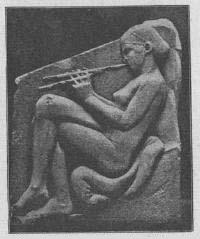
-
The Fairies’ Lullaby.
My mirth and merriment, soft and sweet art thou.
Child of the race of Conn art thou ;
My mirth and merriment, soft and sweet art thou.
Of the race of Coll and Conn art thou.-
My smooth green rush, my laughter sweet,
My little plant in the rocky cleft.
Were it not for the spell on thy tiny feet.
Thou wouldst not here be left.
Not thou.
Of the race of Coll and Conn art thou.
My laughter, sweet and low art thou ;
As you crow on my knee,
I would lift you with me.
Were it not for the mark that is on your feet,
I would lift you away,
and away,
with me.
Translated by Eleanor Hull (1860-1935)
from, The Smile and the Tear ; Poems and Songs of Ireland. Ed. Seán McMahon, Publ. 2011 by Londubh Books.The Adulteress Song
Little white bug
who comes at the wrong time,
at home is the father
of the crying child.Little black bug
with snowy wings
at home is the father
of the child who sings.from : The adulteress song that is sung in Alba de Tormes

Fairies by Charles Rennie MacIntosh , 1898 First Published in GB by Marion Boyars Publishers Limited 1980. translations by Christopher Maurer.
-
 Nuala Ní Chonchúir
is a writer and poet, who has contributed poems and translations to the blog over sometime. I am linking here to her poetry collections page
La Pucelle
In the hush of my father’s house,
before dusk rustles over the horizon,
I take off the dress my mother made
-it’s as ruby red as St Michael’s cloak-
and with a stitch of linen, bind my breasts.
By the greasy light of a candle,
I shear my hair to the style of a boy,
in the looking glass I see my girlhood
swallowed up in a tunic and pants,
I lace them tightly to safeguard myself.
My soldiers call me ‘Pucelle’, maiden,
they cleave the suit of armour to my body,
and know when following my banner
over ramparts into Orléans, that
there will only ever be one like me.
When the pyre flames fly up my legs,
I do not think of the Dauphin,
or my trial as a heretical pretender,
but see my mother, head bent low,
sewing a red dress for her daughter to wear.
As Tatú, le Nuala Ní Chonchuir, Arlen House, 2007.http://poethead.wordpress.com/2009/06/13/la-pucelle-by-ni-chonchuir/
 Eithne Strong
“(née Eithne O’Connell) (1923-1999), poet and writer of fiction. Born in Glensharrold, Co. Limerick, she was educated at TCD. She worked in the Civil Service, 1942-3. Her first collection, Songs of Living (1961), was followed by Sarah in Passing (1974), Flesh-the Greatest Sin (1980), Cirt Oibre (1980), Fuil agus Fallaí (1983), My Darling Neighbour (1985), Aoife Faoi Ghlas (1990), An Sagart Pinc (1990), Spatial Nosing (1993) and Nobel (1999). The Love Riddle (1993) was a novel.”
from http://www.answers.com/topic/eithne-strong#ixzz1xr4mc0lx
Strip-Tease.
A poet
must talk in riddles
if he will not risk himself
for fear
of public eye and tongue
blaspheming privacies :
a host
of leeches sucking parallels
carnivores to strip his shivering secrecies
wrapped
intricately. he should be
silent or speak out.
No one
asked for
his arbitrary offerings.
from Sarah in Passing , by Eithne Strong. Dolmen Books 1974.http://poethead.wordpress.com/2011/03/19/strip-tease-by-eithne-strong/
 Sarah Clancy
Phrase Books Never Equip you for the Answers
On the morning of the fifteenth time we went through
our sleep-with-your-ex routine, I had the usual optimism
thing about mistakes is to not keep repeating the same ones
I said disregarding the government health warning
on the cigarettes I was sucking, crossing the road without
stopping speaking or looking, ignoring the red man pulsing
on the lights at the junction, I was wired direct and I said;
I know, I’ll write you the definitive user manual for me.
You said I was arrogant that we should make it up as we go,
and I said; well could I do a mind map then? With
here be dragons marked clearly in red, so we won’t flounder
like last time end up washed up dehydrated and drained
well I was, fairly wired, I said ‘in each shipwreck we’re lessened
embittered, come on, let me at least try to fix it, I can write us
a blueprint for the new improved version, and you laughed
and said well damn you for a head-wreck, go on then and do it.
So I wrote, but it came out all stilted, like a work in translation
see when I say, let me fix that or give it here and I’ll do it
it means I need you, and if I tell you for example how
I’ll re-arrange the universe to your liking it doesn’t mean
I’m superior in fact, translated it’s about the same as the last one-
‘can you not see, how I need you? And when I come out with all those
‘you-shoulds’ that drive you demented, there’s no disrespect in ‘em
verbatim they’re whispering I’d be desolated without you
and when you call me control freak, the tendencies you’re describing
are inherently rooted in my fear of you leaving and how I’ll react.
Less-wired more hopeful I brought you my phrase book
on our very next meeting but you kissed my cheek and said
let me stop you a minute and then those awful words that never
signify good outcomes, listen I’ve been thinking… I know
we’ve got this weird cyclical attraction thing going and I’m sorry
for my part in it but really I can’t see it working, the problem
for me is how you just don’t need anything and my phrase book
had nothing listed under that heading.© Sarah Clancy
Thanks to Sarah Clancy for the poem, Phrase Books Never Equip you for the Answers , which is taken from Thanks for Nothing Hippies . Published Salmon Poetry 2012.
 Kate Dempsey
Kate Dempsey’s poetry is widely published in Ireland and the UK including Poetry Ireland Review,The Shop, Orbis and Magma. Kate blogs at Writing.ie and Emerging Writer .
You can catch her on Twitter at PoetryDivas.
It’s What You Put Into It
For Grace
On the last day of term
you brought home a present,
placed it under the tree,
a light, chest-shaped mystery
wrapped in potato stamped paper
intricate with angels and stars.
Christmas morning
you watched as we opened it,
cautious not to tear the covering.
Inside, a margarine tub, empty.
Do you like it? eyes huge.
It’s beautiful.
What is it, sweetheart?
A box full of love, you said.
You should know, O my darling girl,
it’s on the dresser still
and from time to time, we open it.”
© Kate Dempsey, all rights reserved.
 Celia De Fréine
Celia de Fréine is a poet, playwright and screenwriter who writes in Irish and English, her site is at http://celiadefreine.com/
An Bhean Chaointe
Taim ag caoineadh anois chomh fada
agus is chumhin liom
ce gur dócha go raibh me óg trath-
seans fiú amháin gp mbinn ag súgradh.
Ni cuimhin liom an t-am sin
ná an ghruaim a chinn an ghairm seo dom.
Ni cuimhin liom ach oiread
éinne den dream
atá caointe agam-
ní dhearna mé taighde ar a saol
ná nior léigh mé cur síos orthu
i gcolún na marbh.
Ach is maith is eol dom
gach uair a sheas mé
taobh le huaigh bhealschoilte,
gur chomóir me gach saol
go huile is go hiomlán,
gur laoidh mé éachtaí
na nua-mharbh
is gur eachtaigh mé
lorg a sinsear.
Tigím anois
go bhfuil na caointe seo
tar éis dul in bhfedhim orm.
Dá mbeadh jab eile agam
ba bhreá liom bheith im scealaí-
sui le hais na tine is scéalta a insint.
D’éistfeá liom- tharraingeodh
d’Eddifon asam iad
á n-alpadh sa treo is go slanofaí mé.
Faoi Chabáistí is Ríonacha, Published by Clo Iar-Chonnachta, indreabhán, 2001.
-
Aluine’s Gardens
Before the house
behind the sea,
a garden.Before the mountain
behind the house,
a circuit of trees.Before the small house
behind the grey sea,
A strip of lawn enclosed with box.Before the tall mountain
behind those six white walls of house,
rows of young alders a circuit make.Before the house of three steps up
behind the rocky strand down to the sea,
a wild field conceals her garden’s bloom.Before that shadow the reek casts onto green fields
behind the grass rolling and tumbling to rocky beach,
her lawn encloses varieties of bees.Before Croagh Patrick,
the Reek,
a mazed world wherein shadows flit.Before the house where grasses tumble to rocky shore,
behind the sound where gather the gulls, a small ingress,
a light step to rose’s bloom, lawn of green.Before the cloud-shrouded reek
behind the house with fish in the windows,
there is a forest of trees, a flitting child.Before the small house where wind’s flute and bassoon
mocks the squake of gulls,
a strip of lawn to where butterflies play.Before the sheltering reek
and behind this small house of gardens,
a simple circuit of trees.Birds sing there.
© C Murray, all rights reserved.
With thanks to Anora McGaha who first published the poem on the Books by Women website http://booksbywomen.org/aluines-gardens-a-poem-by-c-murray/ With thanks to the PIWCC who published the poem on the Diversity blog of the PEN International Women Writers Committee, http://www.diversity.org.mk/index.php?option=com_multicategories&view=article&id=41%3Amurraychris&catid=33%3Awomen-writers&Itemid=38&lang=en

-
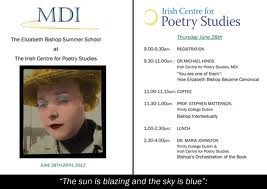
“The sun is blazing and the sky is blue”
.
.
.
The Irish Centre for Poetry Studies at Mater Dei Institute are proud to announce details for their upcoming Elizabeth Bishop Summer School.
Date: Thursday 28th June – Friday 29th June
9.00-9.30 am REGISTRATION
9.30-11.00 am : DR.MICHAEL HINDS
Irish Centre for Poetry Studies, MDI“You are one of them”:
How Elizabeth Bishop Became Canonical
11.00-11.15 am: COFFEE
11.30-1.00 am PROF. STEPHEN MATTERSON,
Trinity College DublinBishop Intertextually
1.00-2.30 pm: LUNCH
2.30-4.00 pm DR. MARIA JOHNSTON
Trinity College Dublin &
Irish Centre for Poetry Studies
Bishop’s Orchestration of the BookFriday June 29th
9.30-11.00 am: DR. CATHERINE KILCOYNE
University College Dublin &
Irish Centre for Poetry StudiesBishop and Sexuality
11.15-11.30 am: Coffee
11.30-1.00 am DR. ALEX RUNCHMAN
Trinity College Dublin &
Irish Centre for Poetry Studies“Manners”: Bishop, Friendship and
(IN) Formality
1.00-2.30 pm: LUNCH
2.30-4.00 pm FORUM DISCUSSIONemail Michael Hinds michael.hinds@materdei.dcu.ie for more details on fees or to book a place
JUNE 28TH-29TH, 2012
“The sun is blazing and the sky is blue”Sestina
by Elizabeth Bishop
” September rain falls on the house.
In the failing light, the old grandmother
sits in the kitchen with the child
beside the Little Marvel Stove,
reading the jokes from the almanac,
laughing and talking to hide her tears.She thinks that her equinoctial tears
and the rain that beats on the roof of the house
were both foretold by the almanac,
but only known to a grandmother.
The iron kettle sings on the stove.
She cuts some bread and says to the child,It’s time for tea now; but the child
is watching the teakettle’s small hard tears
dance like mad on the hot black stove,
the way the rain must dance on the house.
Tidying up, the old grandmother
hangs up the clever almanacon its string. Birdlike, the almanac
hovers half open above the child,
hovers above the old grandmother
and her teacup full of dark brown tears.
She shivers and says she thinks the house
feels chilly, and puts more wood in the stove.It was to be, says the Marvel Stove.
I know what I know, says the almanac.
With crayons the child draws a rigid house
and a winding pathway. Then the child
puts in a man with buttons like tears
and shows it proudly to the grandmother.But secretly, while the grandmother
busies herself about the stove,
the little moons fall down like tears
from between the pages of the almanac
into the flower bed the child
has carefully placed in the front of the house.Time to plant tears, says the almanac.
The grandmother sings to the marvelous stove
and the child draws another inscrutable house. “Sestina by Elizabeth Bishop
Sestina by Elizabeth Bishop is published in Questions of Travel , which is discussed here in Modern American Poetry. Information on the poem is also published in a previous post about sestinas.
-
Fire of the Gaels!
‘She is every woman
who struggles for survival
in a world of prisons
of one form or another.
Her stories, etched on the
landscapes of the universe.
She is the mouth
of the Blackwater,
the secrets of the Alder,
the writing on the caves
and the shedder of light.
She is the blueprints
of the past,
the wishes of the unborn,
the spirit of the crops
and the heat of the sun
bursting on buds.
Shes the midges on the lough,
the guardian of the wells,
the bones of the earth
and the ties that bind
by spirit and blood.
Shes the songs sung so often
renewed on the lips of the young.
Her tongue fiery can cut like an axe
or sooth like a lullaby.
She is goddess of the people,
the fire on the hills.
Shes the shadow on the stones
glinting on river beds.
The breath of a new morning,
and a beacon in the night.
She is every woman.
She is Aine,
fire of the gaels.’
Fire of the Gaels is © Aine Mac Aodha, all rights reserved. The poem was first published in Argotistonline
 Aine Mac Aodha lives in Omagh. Her work has been published internationally as well as locally, and in the UK. She is a Founder member of The Busheaneys Writers Group and The Derry Playhouse Writers. Her work has appeared in Luciole Press, The Glasgow Review, Irish Haiku, Pirene’s Fountain and Argotist online to name a few. She begins much of her writing at her Residencies at The Tyrone Guthrie Centre in Monaghan and is greatful to her time spent there.
Her poetry is plainly written, she is inspired by the Irish landscape and by poets Seamus Heaney, John Montague, Rumi, Basho and many of the modern poets today.Related links
-
I hope that those artists and developers who are interested in broadening out the discussion on a proposed new copyright regime in Ireland visit and contribute to this site, http://copyrightreform.ie/ Legislators should be aware that reform begins at the level of innovation, and not through the offices of intermediaries whose aims appear to be grounded in the short-term.
Copyright Reform In Ireland
.“This site is intended to give the public a chance to comment on, and hopefully improve, the text of a proposed submission to the Copyright Review Commission. For information on the working group that produced this text see Who We Are.
It works like this:
Look to the left of this page. See the Table Of Contents? Go to the bit of the document that looks like it interests you.
Now, each paragraph can be commented on individually. Just click on the little blue speech bubble to add your own comment. You will be able to see all the comments on the right hand side of every page, beside the text.
In addition, we will be making the full text available as both a pdf and in an editable format under the Irish Creative Commons Attribution licence. If you agree with some parts of this submission, but not others, please feel free to download this text, make the changes to the parts you think should be different, and send it to the Copyright Review Committee at copyrightreview@djei.ie.
I am adding the link here because it is imperative that people who wish to protect and to disseminate original works online know the facts about the breadth of current discussions.
I have noted in meetings and in casual discussion that quite a few people are not even fully aware of the headings of the discussions which will have wide-ranging implications in Ireland’s creative community.
There are just days left for artists and individuals to have their say about how they transmit their work. I am very interested in the fact that the most contentious issue has been in the arena of fair-use and that media discussions, with notable exceptions, have been limited to government press-releases, sound bytes and usage of buzz-words like , criminalisation, blocking and banning !
It would appear that politicians do not trust the artistic encounter, and that the intermediary believes that they know what is best for everyone. The fact that creative practices do not occur at intermediary level has wholly escaped our political and business communities. Companies who are willing to deprive the artistic community of tools including those of free-speech, to corner a market are depriving a community of innovation. I am pretty sure Ireland should not be beholden to vested interests when it comes to intellectual property no matter how prettily business people may ask.
A list of those who have submitted on the issue of copyright reform in Ireland is available here , http://www.djei.ie/science/ipr/crc.htm and I am re-posting my submission on Arts and the Public Domain; arts practice as culturally necessary here, http://poethead.wordpress.com/2012/05/18/my-submission-to-the-the-copyright-review-committee-2012/
-
‘The Arts and the Public Domain; Arts Practice as Culturally Necessary.’
The Arts and the Public Domain.
Ireland requires not alone a statutory organisation, such as a copyright council, it requires also a non-governmental centre for social-media where artists and developers can discuss and decide manifestos which will protect their original works and others’ rights to access those works online.
- The very nature of arts practice lends itself to derivatives which allow original works to be adapted, used, or translated for the benefit of the entire community. A locked-in copyright system deprives the community of access to original-works in theatre, film, music and performance. (Center for Social Media, America and The Harriet Monroe Institute of the Poetry Foundation)
- Certain aggressive methodologies of blocking can cause those artists who use CC licences, blogging-platforms, wikimedia-commons, and other modes of dissemination to lose both income and influence. The artist , in this case has chosen to invite others to use their works (cf. CC-Licences, UCC, 2011-2012. Development of Creative Commons licences, incl. Sharealike.)
- Limiting the modes of transmission of code and/or blogging tools used by The Telegraph, The Guardian, France24 , the BBC, Wordpress and others is counter to Ireland’s stated acceptance of free-speech as a right. It is also counter to the artist’s ability to work as an avant-gardeist in terms of how their work utilises web-tools which have been available globally for an entire generation.
- Access to web-tools and free-speech online is an issue that should not be decided by how much lobbying access is available to a stake-holder , but must needs countenance how legislation impacts on all areas of arts-practice and innovation. The CRC12 Review has not afaik broadened its base to include proponents of arts practice, or the Arts Council. Whilst business is in the business of protecting its hard-cash and profit-base, legislators should be advised that web-tools that were freely developed and shared have ameliorated the lives of artists and writers by allowing access to data that required travel and expense before now. It also allows for shared interests at the level of creativity that was unthinkable 20 years ago. In terms of collaborative translations , for instance, the web allows real-time collaboration in the musical and poetic arts.
Further to my submission of July 2011 and my engagement with the online questionnaire, I wish to expand on the issue of arts practice and the public domain under the following specific headings:
- Use of Creative Commons Licences in arts practice.
- Use of social-media by artists/rights holders and innovators.
- Derivatives in arts practice.
- Intellectual rights and access to legal remedies
- Summary.
Initial remarks regarding the difference between arts practice at cultural level, and the entertainment industry.
There is a very real danger of the Copyright Review Committee leaving out originators of creative works due to issues which include, but are not limited to : artist’s lack of online capacity, know-how, awareness; and knowledge of tech by artists. Artist-intermediaries include, web-designers , agents, publishers and others like tech-innovators. It is the intermediary’s job to understand current thinking on copyright. Not all artists, indeed the vast majority of artists lack agents and or other intermediaries.
Innovation occurs at the base level and is not top down. Further to that a distinction must be made between arts practice which is a cultural form, and entertainment which is mass-dissemination of a product and is generally profit-based in its thinking. The fact that media tend to swap and blur the boundaries between culture and entertainment should not advise the issue.
There is no demonstrable parity of esteem evinced by legislators who wish to protect the intellectual property rights and/or rights of transmission to those who are not protected within corporate legal frameworks. The majority of artists, translators, and tech-developers are innovators and are thus not fairly treated with regard to accessing legal remedy because of the prohibitive cost of legal-remedy. Tech-development has been ongoing for over a generation with artists using licensing such as ccs for permitted sharing based in attribution, this issue is not discussed demonstrably within the media-coverage and current discussion within the CRC12 Review.
Use of Creative Commons Licences in arts practice.
Legislators are necessarily not reviewing copyright at the level of innovation but at the level of business where original works are not created, but where funds are immeasurabely larger for access to legal remedies. There is a presupposition on the part of legislators that artists are managed or governed by a few limited companies, this is inherently wrong. An example of this would be a person who has caught a film or photograph and put it up online, if the thing goes viral but is ripped off there is no remedy for someone who happened to be in the right place at the right time to get an exclusive coverage of an event.
Media platforms such as France24, Guardian Open-source and Telegraph co.uk, have provided copyright remedies or attribution, (through using open-source platforms) over a period of some years to allow for ground-up access to mass-media by individuals and artists.
There is an inherent responsibility on the part of legislators to allow for innovation and open-source work to develop for fear of ossification by what is sometimes referred to as mainstream media. In free-speech terms , current media tends to be quite male-dominated and uncaring of women’s perspective in issues that are often made invisible by the signal to noise level of mass media. There is a responsibility to protect and nurture free-speech in relation to avant-garde web-use by women, by artists and by those people who are using the web in an innovative manner. To that end one wonders why media and government have been under-utilising open source and other modes of communication that have been developed over a generation?
There is a very real danger of removing the artist’s choice in how s/he wishes their work to be used and allowing that decision to be made by an intermediary,hence an entity who profits from the original works of other people. Review of copyright in arts practice begins at the level of artistic creation and not at the level of sales.
Use of social-media by artists, rights-holders and innovators.
The Harriet Monroe Institute of The Poetry Foundation , and the Center for Social Media (U.S) have been leading on issues pertinent to artists with regard to Fair-use and online distribution of original works I have cited this discussion before in my July 2011 submission to DETI on ‘Radical Copyright Reform’.
Artists wish for attribution and fair-use policies to both protect and allow for the online distribution of their original works. The difference between the development of a fair-use doctrine in the US and in Ireland is that the issue is led not by business, but by those people who understand creative practice. The fact that the discussion here in relation to copyright reform and to isp-blocking has been led by increasingly narrow interests, with little desire to communicate widely on issues of pertinence to originators: innovators , poets , artists, and those who use licences to protect their work.
The severe limitation here is that there appears to be a generational bias that does not countenance how artists are actually using blogging and tech platforms that are available to them. The matter of choice in how one accesses a song or poem is reduced to a profit-based understanding of artistry. Many bands and artists are streaming their original works online and fully utilising social-media to reach mass-distribution levels for their works. In cutting out the middle-men they are working directly with their audiences to bring their work to newer and younger audiences who use online very naturally and have little awareness of issues like copyright. The reduction of , or threatening of social-media methodologies of arts transmission could actually impact an entire generation who rightly perceive the use of blocking tools to be a desperate and badly educated attempt to corner profit for those people who have thrived on other’s work and who proffer a mostly limited idea of what is actually entertaining for young people.
I question why there is a resistance amongst corporate interests to broadening out the discussion on rights to include those people who they actually claim to represent. Very few artists are represented by big business who have access to parliaments and to lobbying materials. Interestingly avant-garde arts were never subject to ownership by business, but developed upward from creative works. Limiting avant-garde approaches to web-dissemination of arts practices can also have impact on freedom of speech which is demonstrated in censorship of civil-society groups and artists in repressive regimes. Having what could be called an ‘acceptable art’ is both anti-art and anti creative-practices. People are moving away from mass-consumption of ‘entertainment’ towards cultural discourses and expression, necessarily limiting that in order to create a cultural locus based in what is considered ‘entertainment’ only contributes to ossification at a cultural level.
Derivatives in arts practice.
At one end of the scale globalisation contributes to calls for censorship of the cornerstones of western culture, such as in the recent calls for the filtering of Dante’s ‘The Divine Comedy‘ from Italian universities, and at the other end of the scale writers of original works face into mass-distribution systems of art-works which include machine-based translations and bad derivatives of their original works. Whilst debates about how to cope with these issues are ongoing, the people who create the works are left out of the discussions by intermediaries who do not comprehend arts practices.
I have used before now examples of derivatives in arts-works. They include theatrical and musical adaptation, translations, pictorial adaptations from, and use of original lines from works, including how artists like Leonard Cohen or Sinead O’Connor use lines and quotes from Lorca, or from biblical sources – Who owns the original , Lorca or Cohen , when the source of the work is creative practice based in inspiration from an existent object or piece of art ?
The fact is that I can set my derivatives licence in a manner that allows for certain adaptations of my original work and hope that it isn’t ripped off or badly translated. In poetry, for instance, there are numerous translators like google and babel who have adapted my lines through machines and lost the sense of the poem. Vast machine-like translations of poetry can destroy the original work and take from it the intent of the originator of that work. Interestingly this aspect of internet discussion is wholly absent from current debate because the company or entity involved in leading discussions has not the experience of how bad derivatives can effect the work, their interest is solely in protecting their income source without reference to the artist.
This is why I have called again and again for the wider and broader discussion about the type of platforms, open-source systems and methods of creative practice and licensing that are available to originators, again I see little discussion of these issues in the media or the legislature.
Intellectual rights and access to legal remedy.
Robert Spoo, in his essay Tithonus, Dorian Gray, Ulysses ,* discusses the problems related to locked down (locked-in) copyrights which do not recognise the relative merits of the three above-mentioned works. He cites the case of the Joyce estate V David Fennesy in relation to a musical adaptions from Finnegans Wake, and other cases wherein copyright has become little more than a toll-booth with negative repurcussive impact on arts and adaptions from original work. A Fair Use doctrine would have allowed Mr Fennesy to adapt the few words from the Wake in order to create a work that had been commissioned in Europe.
The difficulty inherent in a straitened and overly legalistic approach to copyrights is that ossification occurs at a cultural-level. The artist has the right to ownership of their original work which should benefit their estate. However , there is an understanding with arts and art’s practice that derivatives do occur at the levels mentioned above here in regard to theatrical/cinematic/ musical and other adaptations. The right of ownership and attribution should be clearly established with creative works but the knowledge that creative works , such as Ulysses, or the songs by Leonard Cohen which clearly are adapted from , or inspired by the work of the late Federico Garcia Lorca require some degree of flexibility in terms of copyright. A fair use doctrine in the intellectual and artistic sphere is necessary for the protection of the rights of the originator and for the rights of the adapter.
Robert Spoo refers to this as ‘ overlong copyright protection’ which exists as ‘an inhibition on the full organic development of a masterpiece’. In the case of access to legal remedy , it is the intermediary or the corporate entity who have access and rarely the individual blogger or developer whose works are barely protected under law. A more mature approach to parity before law would be for the artist to have good access to licences like Creative Commons , and copyrights to protect their works coupled with an ability to access remedy in smaller courts. This isn’t discussed with any seriousness in what has become a tit for tat set of threats and sound bytes which include the words ‘banning’, ‘blocking’, ‘criminalisation’.
Tithonus, Dorian Gray,Ulysses by Robert Spoo, The National Library Of Ireland, Joyce Studies 2004. Dublin, Ireland.
Summary
Ireland requires not alone a statutory organisation , such as a copyright council but a non-governmental centre for social-media where artists and developers can discuss and decide manifestos which will protect their works and rights.The nature of arts practices lends itself to derivatives which allow original works to be adapted, used, translated for the benefits of the entire community. A locked-in copyright system deprives the community of access to original-works in theatre, film, music and performance.
Those that need to be brought into this discussion on copyright are not being brought in because the issue is considered to be ephemeral and that others (intermediaries) can transmit information to them. As I quoted from Spoo above here I will reiterate my comments again,
‘a work does not really become a classic until it is unqualifiedly available for cultural exploitation.‘ *
* Tithonus, Dorian Gray, Ulysses by Robert Spoo, The National Library Of Ireland. Joyce Studies 2004. Dublin, Ireland.

‘The Arts and the Public Domain ; Arts Practice as Culturally Necessary.’ by C Murray is licensed under a Creative Commons Attribution-NonCommercial-NoDerivs 3.0 Unported License.I should just call it an anti-mechanism manifesto , which is what Irish politics have become reduced to: mechanistic expedience, a reductio ad absurdum of leadership !
EDIT
I am adding here the pdf that I initially submitted to DJEI in 2011 as link, http://www.djei.ie/science/ipr/murray_christine.pdf
-
Subscribe
Subscribed
Already have a WordPress.com account? Log in now.
 Chris Murray