-
Indoors
by Vona Groarke.
It breaks apart as water will not do
when I pull , hard, away from me,
the corners bunched in my two hands
to steer a true and regulated course.I plunge the needle through and through,
dipping, tacking, coming up again.
The ripple of thread that follows pins,
out of its depth , a shallow hem.I smooth the waves and calm the folds.
Then, to ensure an even flow,
I cast a line which runs from hook to hook
and pulls the net in overlapping pleats.Which brings me to the point where I am
hanging a lake, by one shore, in my room,
to swell and billow between the light
and opaque , unruffled dark.I step in. The room closes round me
and scarcely puckers when I move my limbs.
I step out. The path is darkened where I walk,
my shadow steaming off in all this sun.
from : The New Irish Poets , Edited by Selina Guinness . Bloodaxe Books 2004 -
from : Deep Song and Other Prose, Federico Garcia Lorca
Little white bug
who comes at the wrong time,
at home is the father
of the crying child.Little black bug
with snowy wings
at home is the father
of the child who sings.from : The adulteress song that is sung in Alba de Tormes
First Published in GB by Marion Boyars Publishers Limited 1980. translations by Christopher Maurer.
Deirín Dé.
Deirín dé deirín dé,
the brown goat calling in the heather,
deirín dé, deirín dé,
the ducks are squawking in the marsh.Deirín dé , deirín dé
cows go west at dawn of day,
deirin de , deirín dé ,
and my babe will mind them on the grass.Deirín dé , deirin dé,
moon will rise and sun will set,
deirín dé , deirín dé ,
and you are my babe and share of life.Deirín de, deirín dé ,
a thrush’s nest in my little press,
deirín dé , deirín dé ,
yes, and gold for my little darling.Deirín dé , deirín dé ,
I’ll let my babe out picking berries,
deirín dé , deirín dé ,
if he’ll just sleep sound till the round of day.- from : An Duanaire 1600-1900 , Poems of the Dispossessed. Le Seán O Tuama , Thomas Kinsella. Foras na Gaeilge 1981.

-
I speak in those words suddenly
That rise once in the soul. So sharply comes
The musty odour of an old sachet,
A bee hums on a white chrysanthemum.
And the room , where light strikes through slits,
Cherishes love, for here it is still new.
A bed, with a french inscription over it,
Reading : ‘ Seigneur , ayez pitié de nous.
‘Of such a lived-through legend the sad strokes
You must not touch, my soul, nor seek to do…
of Sèvres statuettes the brilliant cloaks
I see are darkening and wearing through.
Yellow and heavy, one last ray has poured
Into a fresh bouquet of dahlias
And hardened there. And I hear viols play
And of a clavecin the rare accord..
- From: Anna Akhmatova, Selected Poems , Trans. D M Thomas with a foreword by Carol Ann Duffy.Vintage Books 2009.
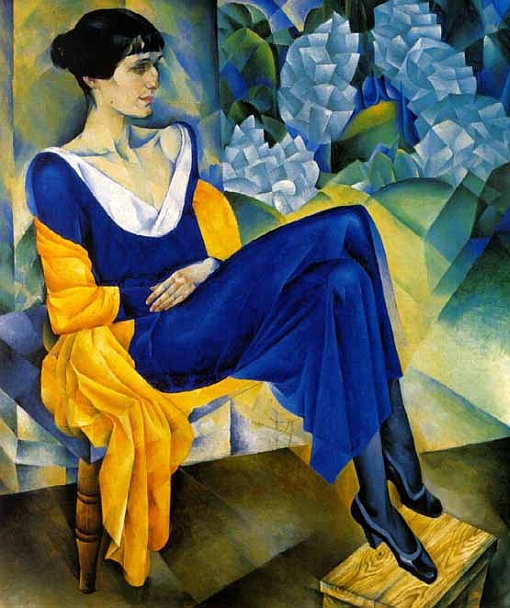
- Image of Anna Akhmatova by Olga Della-Vos-Kardovskaya
- Alla Bayanova sings Anna Akhmatova: “Chernye kosy”
 Anna Andreyevna Gorenko (1889 –1966) is better known by the pen name Anna Akhmatova. She was a Russian modernist poet, one of the most acclaimed writers in the Russian canon.
Akhmatova’s work ranges from short lyric poems to intricately structured cycles, such as Requiem (1935–40), her tragic masterpiece about the Stalinist terror. Her style, characterised by its economy and emotional restraint, was strikingly original and distinctive to her contemporaries. The strong and clear leading female voice struck a new chord in Russian poetry. Her writing can be said to fall into two periods – the early work (1912–25) and her later work (from around 1936 until her death), divided by a decade of reduced literary output. Her work was condemned and censored by Stalinist authorities and she is notable for choosing not to emigrate, and remaining in Russia, acting as witness to the atrocities around her. Her perennial themes include meditations on time and memory, and the difficulties of living and writing in the shadow of Stalinism. (Wiki)
-
Mo Mháistir Dorcha.
Táimse in aimsir ag an mbás
eadrainn tá coinníollacha tairrice
réitíomair le chéile ar feadh tréimhse is spás
aimsire, achar roinnt bliana is lae mar a cheapas-sa.Bhuaileas leis ag margadh na saoire.
D’iarr sé orm an rabhas hire-áilte.
‘Is maith mar a tharla ; máistir ag lorg cailín
is cailín ag lorg máistir .’Ní rabhas ach in aois a naoi déag
nuair a chuas leis ar dtúis faoi chonradh.
Do shíneas mo laímh leis an bpár
is bhí sé láithreacha ina mharghadh.Do chuir sé a chruacaí in lár
cé nar thug sé brútail ná drochíde orm.
Ba chosúla le greas suirí nó grá
an caidreamh a bhí eadrainn.Is tugam a tháinte dubha chun abhann,
buaibh ud na n-adharca fada.
Luíonn siad sios i móinéir.
Bím á n-aoireacht ar chnoc san imigéin
atá glas agus féarach.Seolaim ar imeall an uisce iad
is gaibheann siad scíth agus suaímhneas.
Treoraím lem shlat is lem bhacall iad
trí ghleannta an uaigneas .from : Poetry, Contemporary Irish poetry Oct-Nov 1995. Ed Chris Agee.
My Dark Master
Translated by Paul Muldoon
I’ve gone and hired myself out, I’ve hired myself out to
Death.
We drew up a contract and set the seal
on it by spitting in our palms. I would go with him to
Lateeve
for a year and a day—at least, that was the deal
–
as I remember it. When I met him at the hiring-fair
he inquired if I’d yet
been taken: ‘What a stroke of luck,’ he declared,
‘when a master who’s set on a maid finds a maid who’s set
–
on a master.’ I was only nineteen years old
at the time the bargain was struck.
I made my mark on a bit of paper and was indentured
on the spot. What a stroke of luck,
–
I declare, what a stroke of luck that I fell
into his clutches. Not, I should emphasize again,
that he meddled with or molested me for, to tell
you the truth, our relationship was always much more akin
–
to walking out, or going steady. I lead his blue-black cows
with their fabulously long horns
to water. They lie down in pastures of clover and fescue
and Lucerne. I follow them over hills faraway and green.
–
I lead them down beside Lough Duff
where they find rest and where they are restored.
I drive them with my rod and my staff
through the valleys of loneliness. Then I might herd
–
them to a mountain-pass, to a summit
where they browse on bog-asphodel and where I, when I
look down, get somewhat dizzy. His realm extends as far as the eye
–
can see and beyond, so much so
a body might be forgiven for thinking the whole
world’s under his sway. Particularly after the sough-sighs
of suffering souls
–
from the darkness. He himself has riches that are untold,
coming down as he is with jewels and gems.
Even John Damer of Shronel, even his piles of gold
would be horse-shit compared to them.
–
I’ve hired myself out to death. And I’m afraid that I’ll not
ever be let go. What I’ll have at the end of the day
I’ve absolutely no idea, either in terms of three hots and a cot
íor if I’ll be allowed to say my say. -
On the Other Hand.
by Phyllis Levin
” The leaves of the ivy
Are heavy today.
Even we are too heavy,
Their shadows say :Nothing moves us,
We cannot stray
Across a walkway.
But glory is still green.Whoever leaned
Against a screen
Unlatches the door,Whoever said
There, there, now
Doesn’t anymore.”
from : The Making of a Sonnet , Edited by Edward Hirsch and Eavan Boland . A Norton Anthology 2008.
-
This morning it is reported that nine poets are disputing the Arts Council cuts in England. Poetry is an encounter, and always surprising, so I am adding in here the links and reports on what is (imo) a most utilitarian and pedestrian set of decisions regarding funding cuts across the water.
Nine leading poets call for ACE rethink on PBS cut.
“Nine of the UK’s leading poets, including laureate Carol Ann Duffy, Blake Morrison and Don Paterson, have called for Arts Council England (ACE) to “urgently reconsider their decision” to withdraw funding from the Poetry Book Society (PBS). The ACE has scheduled a meeting with PBS board members for Monday [4th April].
In a letter published in today’s Times, the poets said they were “shocked that the Arts Council has decided to withdraw all funding from the Poetry Book Society, a widely respected and unique organisation that selects outstanding poetry collections for readers and libraries.
The PBS also administers the T S Eliot Prize, an award for new collections of poetry in English, and has supported works in translation. It was established by Sir Stephen Spender, with T S Eliot and Philip Larkin among previous board members.
In the letter, the poets, which also included Simon Armitage, Wendy Cope, David Harsent, Jo Shapcott, Christopher Reid and George Szirtes, added: “We ask the Arts Council to urgently reconsider their decision which will have a devastating impact on poets, publishers and, especially, on readers of contemporary poetry.”
Vice-chair of the PBS board, Desmond Clarke, said ACE has now contacted the PBS and arranged a meeting for Monday [4th April]. He said: “Clearly the PBS and the T S Eliot Prize are the most high-profile casualty of the Arts Council cuts. This letter is very powerful and it’s great that nine of our country’s leading poets have come out in support. To lose the T S Eliot Prize, the highest profile prize in the English language, would be very very sad.”
Save the Poetry Book Society
Here is the Poetry Book Society Petition-link, both Salt Publishing and the Poetry Book Society have suffered 0% funding, similar indeed , to the cuts to our Irish Writer’s Centres, which are areas of resource for writers :
-
Serenade: Any Man to Any Woman
Dark angel who art clear and straight
As canon shining in the air,
Your blackness doth invade my mind
And thunderous as the armored wind
That rained on Europe is your hair;And so I love you till I die—
(Unfaithful I, the canon’s mate):
Forgive my love of such brief span,
But fickle is the flesh of man,
and death’s cold puts the passion out.I’ll woo you with a serenade—
The wolfish howls the starving made;
And lies shall be your canopy
To shield you from the freezing sky.
Yet when I clasp you in my arms—
Who are my sleep, the zero hour
That clothes, instead of flesh, my heart,—
You in my heaven have no part,
For you, my mirage broken in flower,
Can never see what dead men know!
Then die with me and be my love:
The grave shall be your shady grove
And in your pleasaunce rivers flow
(To ripen this new paradise)
From a more universal flood
Than Noah knew: But yours is blood.
Yet still you will imperfect be
That in my heart the death’s chill grows,
—A rainbow shining in the night,
Born of my tears … your lips, the bright
Summer-old folly of the rose.
Serenade: Any Man to Any Woman by Edith Sitwell
-
The meaning of collaborative work in Poetry and Literature.
The author is entitled to ownership of their work. In poetic terms, derivatives do occur, mostly in music and in translations. As stated before on this blog, derivatives are seen as adding to the original works, once attribution is established. The fact that there are appalling non-collaborative translations online of great poets is irritating. The issue of copyright and fair use has been linked here Via the Poetry Foundation and it really is a most important text.
Digitising bodies of works and how derivatives occur
Digitisation is widespread, many authors will need to learn to establish their rights on blogging platforms, and indeed how to use such services as Scribd. Not all original works are necessarily confined to publishing contracts. Thus we have access to licensing services like Creative Commons.
Literary and poetic work is meant to be shared and to be accessible, for that reason innovating is necessary, but there are conventions and respects for authorship in place, which take cognisance of the rights of ownership to original works. Some issues in the GBS row which were not fully discussed were concerned in the area of pictorial, collaborative translation, and forewords! A book or piece of digital-work does not come in snippets and it is really up to the author if they wish snippets to be made available to online communities. Using CC is one way of doing so.
Libraries are mostly works of collaboration and are already digitising at that level !
The ideality of a library making original works available online is a wonderful one in many ways, everyone has seen how vulnerable libraries are to attack, to cuts and to censorship. The idea of building up a digital library should be based in the highest understanding of the merits of literary and artistic works, and to the best in copyright law which takes cognisance of the author’s rights to ownership. This would mean involving authors at a level of understanding which is evinced in my first link above, to the Poetry Foundation.
Code of Best practices in Fair-use for Poetry, Centre for Social-media.
“Poetry is more than a body of writings or a typology of forms; first and foremost, it is an evolving set of practices that engage, and are engaged by, the creative work of others. During the extensive conversations leading up to this document, a few central themes about poetic practice emerged. The first was that poets generally (though not universally) want their poetry to be as widely available to potential audiences as possible, both during their lifetimes and beyond. However, poets, especially those not working in and for new media formats, expressed anxiety about how new media might affect their ability to make money from their work and to establish and advance academic careers. And they were concerned about the ease with which new media enable others to distribute and alter their poems without permission. At the same time, poets urgently expressed their need to use material derived from the poems of others (including twentieth and twenty-first-century writers) in their own work, and their desire to do so in ways that were both ethically and legally appropriate.”
Poetry Ireland Discussion Doc. on The Google Book Settlement (GBS)
“To spread awareness about the Google Book Settlement, Poetry Ireland and the Irish Copyright Licencing Agency have joined resources to provide rights-holders with the most up-to-date, unbiased, and clear-cut information available.*
A number of seminars on the settlement have taken place around the country. One of the most important messages that emerged from these meetings was that whether or not the settlement stands, digital publishing is part of the future, and similar digitalization projects are in progress. Rights-holders need to decide how to deal with Google and other such projects.
With the advice and help of Samantha Holman (Director of ICLA), Poetry Ireland has put together a compact, but in no way comprehensive, fact-sheet on the settlement.”
You may want to begin at the end: the last page is a very useful set of questions that should help to put the dizzying complexities of the settlement into perspective and will direct rights-holders on what their next steps may be.
March 22nd Judgement on Google Books Settlement digitisation.
“While the digitization of books and the creation of a universal digital library would benefit many, the ASA would simply go too far. It would permit this class action – – which was brought against defendant Google Inc. (“GoogleI1) to challenge its scanning of books and display of “snippets” for on-line searching – – to implement a forward-looking business arrangement that would grant Google significant rights to exploit entire -2-books, without permission of the copyright owners. Indeed, the ASA would give Google a significant advantage over competitors, rewarding it for engaging in wholesale copying of copyrighted works without permission, while releasing claims well beyond those presented in the case.”
- http://www.centerforsocialmedia.org/fair-use/related-materials/codes/code-best-practices-fair-use-poetry
- http://www.law.cornell.edu/treaties/berne/overview.html
- http://www.nysd.uscourts.gov/cases/show.php?db=special&id=115
- http://www.poetryireland.ie/resources/googlebooksettlement.html
- http://poethead.wordpress.com/2011/03/17/link-to-my-article-on-licensing-poetry-and-original-work-at-writing-ie/
- http://www.nytimes.com/2011/03/24/opinion/24darnton.html?_r=1
- http://www.centerforsocialmedia.org/fair-use/related-materials/codes/code-best-practices-fair-use-poetry
- http://www.poetryireland.ie/resources/googlebooksettlement.html
-
Subscribe
Subscribed
Already have a WordPress.com account? Log in now.
 Chris Murray