• chris murray
  • journals – bibliography – publication notes
  • downloadable items – essays – media
  • copyright
  • Home

Chris Murray

  • “Credo” by Eithne Strong

    May 3rd, 2009

    I feel witness
    to unchangingness
    as well as to change.

    If I incline to
    leave unmirrored
    political moil, it is because

    the human composition,
    person to private person,
    is my sphere, my particular

    theme. In brief:
    the things of state-
    bland blue suit smile,

    smooth shirt doubledo
    (we beg true blue but
    have them shot by dark)

    Lobbying;
    feather-nesting; high inflate
    of rigmarole; vigilant spite

    that splits the nose
    to spoil the party face-
    all these things I have to see

    as but reflections
    in macro of doings round
    the micro centre. As people

    pattern in private
    so, unchangingly, will they
    project in their public scale.

    The central attitude
    is inexorable; there is no
    escape; life demands encounter

    with figures like
    fathers, brothers, lovers,
    rivals, mistresses, mothers, wives.

    Inevitably, national
    and international are but larger
    shapes of interpersonal procedures:

    appetites and checks
    that flux around the swallowing
    demand of predatory devouring ‘Me’

    large happenings
    in the state wear secondary
    coverings. My bent is primary.

    “Credo” by Eithne Strong is from ‘Sarah in Passing’ (The Dolmen Press,
    1974)

  • A Saturday Woman Poet , Ileana Mãlãncioiu

    April 25th, 2009

    Samson’s Hair

    Delilah did her job,
    Samson’s head lay on her knees
    As on a dish
    And his hair was cut and his strength
    Was gone without his knowledge.

    When he woke up and tried to break
    The ropes that bound him it was too late,
    But the story could not be finished
    As long as Samson was still alive.

    The world knows only how his strength was taken
    But I remember also what came later
    And in the immense hall I feel afraid
    Standing beside those two golden pillars
    As I wait for Samson’s hair to grow.

    Ileana came to Dublin and she signed my book! This poem is taken from After the Raising of Lazarus trans, Éilean ní Chuilléanain, 2005 Southward Editions.


  • St Jordi’s Day , link on censorship and imprimaturs.

    April 23rd, 2009
    A Compass rose for St Jordi's Day
    A Compass rose for St Jordi’s Day

    I love this little bit of writing from a very good friend who doesn’t like censorship and likes to tell stories, so I sent him a rose (image).

    • Jordi Kills the dragon (again)
    • Ethnopoetics.
    • Translation and Linguistic Rights.
  • Protected: Goldfriend, an Elegy.

    This content is password-protected. To view it, please enter the password below.

  • Julian of Norwich ‘8’ and related links.

    April 17th, 2009

    A recapitulation of what is seid and how it is shewid to hir generally for all

    And as Longe as I saw this sight of the plentiuos bleding of
    the hede I might never stinte of these words ; ‘Benedicite domine!’
    In which the sheweing I understode vi things : the first is the
    toknys of the blissid passion and the plentious sheddyng of
    his pretious blode; the iid is the maiden that is his derworthy
    moder; the iid is the blissful Godhede that ever was, is and
    ever shal bene, al mighty, al wisdam, al love; the iiiith is althing
    that he hath made; for wele I wete that hevyn and erth and
    all that is made is mekil and large, fair and gode, but the cause
    why it is shewid so litil to my sight was for I saw it in the
    presence of him that is the maker of all thing, for a
    soule that seith the maker of all, all that is made semith full
    litil, the vth is that he made all things for love; be the same
    love it is kept and shall be withoute end, the vith is that God
    is all thing that is gode, as to my sight, and the godeness that
    al thing hath, it is he; and al these our lord shewid me in the
    first sight with time and space to beholden it. And the bodily
    sight stinted and the ghostly sight dwellid in myne understondying.
    And I abode with reverent drede ioyand in that I saw. And
    I desired as I durst to se more , if it were his will, or ell lenger
    time the same. In all this I was mekil sterid in charite to mine even
    cristen, that their might seen and knowyn the same that I saw;
    for I would it were comfort to they, for al this sight was shewid
    general. Than said I to them that were aboute me ‘It is today
    domysday with me’. And this I seid for I went a deid, for that day
    a man deith he is demyd as he shal be without end, as to
    my understondying. This I seid for I would their love Gode the better,
    for to make hem to have mende that this life is shorte as thei
    might se in example: for in al this time I went have deid and that
    was mervil to me and sweeme in partie, for methowte this
    vision was shewd for hem that should leven. And that I say of me
    I sey in the person of al mine even cristen, for I am lerned
    in the gostly shewing of our lord God that he menyth so;
    and therefore I pray you al for God’s sake and counsel you
    for your own profitt that ye levyn the beholding of a wretch
    that it was shewid to, and mightily, wisely and mekely
    behold God, that of his curtes love and endless godeness
    wolde shewyn it generally in comfort of us al; for it is God’s will
    that ye take it with gret ioy and likyng as Iesus had shewid it on to
    you al.


    Julian of Norwich, a Revelation of Love, ed Marion Glascoe. University of Exeter Press 1976.


    Midwifery

  • Some EBB.

    April 4th, 2009

    To George Sand

    A Recognition

    “True genius, but true woman! dost deny
    Thy woman’s nature with manly scorn,
    And break away the gauds and amulets worn
    By weaker women in captivity?
    Ah, vain denial! That revolted cry
    is sobbed in by a woman’s voice for
    -lorn!–
    Thy woman’s hair, my sister, all unshorn,
    Floats back dishevelled strength in agony,
    Disproving thy man’s name! and while
    before
    The world thou burnest in a poet-fire,
    We see the woman heart beat evermore
    Through the large flame. Beat purer,
    heart, and higher,
    Till God unsex thee on the heavenly
    shore,
    Where unincarnate spirits purely aspire.”

    The Soul’s Expression

    “With stammering lips and insufficent
    sound
    I strive and struggle to deliver right
    That music of my nature day and night
    With dream and thought and feeling
    interwound,
    And inly answering all the senses round
    With octaves of a mystic depth and
    height
    Which step out grandly to the infinite
    From the dark edges of the sensual
    ground!
    This song of soul I struggle to outbear
    Through portals of the sense, sublime
    and whole,
    And utter all myself into the air.
    But if I did it-as the thunder-roll
    breaks its own cloud, my flesh would
    perish there,
    Before that dread apocalypse of soul.”

    I highly recommend that young women who like poetry get into Mrs Barrett Browning.

  • On Simone Weil’s ‘Thinking Poetically’

    March 31st, 2009

    I have been reading the Simone Weil critique, Thinking Poetically for the last few weeks, interspersed it seems with other activities and work.

    In many ways it has prevented me from posting up here because the subject matter is so imperative to the creation of her poetry; and yet and the Poet/Philosopher’s experiences in Vichy as a woman writer are neither subtle nor intriguing.

    Her writing is sometimes painful to read. At the end of this brief post I shall include the link to Weil’s poem Necessity which I had published in recognition of the 2009 International Women’s Day.

    ‘Necessity’ by Simone Weil

    The cycle of days in the deserted sky turning
    In silence watched by mortal eyes
    Gaping mouth here below, where each hour is burning
    So many cruel and beseeching cries;

    All the stars slow in the steps of their dance,
    The only fixed dance, mute brilliance on high,
    In spite of us formless, nameless, without cadence,
    Too perfect, no fault to belie;

    Toward them, suspended our anger is vain.
    Quench our thirst if you must break our hearts.
    Clamoring and desiring, their circle draws us in their train;
    Our brilliant masters, were forever victors.

    Tear flesh apart, chains of pure clarity.
    Nailed without a cry to the fixed point of the North,
    Naked soul exposed to all injury,
    May we obey you unto death. 

    (Simone Weil)

    One of the themes of this site is ‘of waiting’, or to put it more succinctly: the writing of women who are entrapped (intellectually and spiritually) by the prisons their time has brought them to: many of them, Miriam Tuominen, Liliana Ursu, Nelly Sachs and Weil were writers that knew the shape of their prisons and created from them the most amazing poetic structures.

    The other main theme is visibility of women critics and writers in our society. (Usually problematic).

    There are strong sympathetic links in how prose is constructed between Porete and Weil, between Julian of Norwich and Weil and I suppose ‘heard ‘in the antiphons of Hildegard of Bingen.

    I do not have time to elaborate on the themes, so I thought It would suffice to add in the Porete links and the link to Necessity and that I would complete this in second part with some brief notebook excerpts in the coming days.

    Thinking Poetically Joan Dargan, State University of New York Press.1999


    Necessity, by Simone Weil.
     Barbro Karlen
     Excerpts from Marguerite Porete.

  • ‘Maudlin’ By Sylvia Plath.

    March 27th, 2009

    Mud-Matressed under the sign of the hag
    In a clench of blood, the sleep-talking virgin
    Gibbets her curse, the moon’s man,
    Faggot-bearing jack in his crackless egg;

    Hatched with a claret hogshead to swig
    He kings it, navel-knit to no groom,
    But at the price of a pin-stitched skin
    Fish-tailed girls purchase each white leg.

    from The Colossus 1960, Faber Paperbacks.

    • Restored Music, Sylvia Plath’s ‘Ariel’ 2004

    Nicholas Hughes died this week by his own hand .

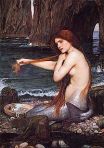
    John William Waterhouse’s ‘Mermaid’ from Wiki.
  • ‘Haiku Coirp’ le Nuala Ní Chonchúir

    March 20th, 2009
    Fillte idir mo
    leasracha, oisre, ag crith
    is ag frithbhuladh

    Ina luí idir
    do chosa, magairlín, ag
    leathnú, díbholgadh.

    An dán seo as Tatú le Nuala Ní Chonchúir.


    Tatú, le Ni Chonchúir : Arlen House.
    Tatú, le Ni Chonchúir : Arlen House.

    I decided to leave the poem as Gaeilge for the minute because I like the  sounds and they are not too hard to make (unlike the poor orchis that wilts in Stanza II).

    Irish women Writers are really good at fish and flower sexual images – it may be that we have evolved a language due to Catholic repression, or it may just be that its part of our linguistic inheritance , images of beauty and sometimes of terror .

    Tatú

    Is pailmseist mo chorp
    faoi do lámha,
    paipír arsa,
    scrollaithe fút,
    ag tnúth le do rian.
    Glanaim mo chraiceann,
    sciúraim siar e
    go par báiteach
    ionas go bpúchfaidh
    do lamh mar
    dhúch tatuála,
    ag liniocht thar
    linte dofheicthe
    gach fir eile.

    Níl faic ach tusa
    scrábáilte ar mo chorp.

    Tatú , Le Nuala Ní Chonchúir. Arlen House 2007.

  • Protected: Three poems by C Murray.

    This content is password-protected. To view it, please enter the password below.

←Previous Page
1 … 90 91 92 93 94 … 106
Next Page→
 

Loading Comments...
 

    • Subscribe Subscribed
      • Chris Murray
      • Already have a WordPress.com account? Log in now.
      • Chris Murray
      • Subscribe Subscribed
      • Sign up
      • Log in
      • Report this content
      • View site in Reader
      • Manage subscriptions
      • Collapse this bar