Telescope tree tell me the truth of why and what for I stand at the door not the one before but the floor is the ceiling and the window the floor but I made the game which lost the key to the door.
from:- Views from the Windy House, Rob Smith Notebooks. Publ, The Irish Museum Of Modern Art. 1994.
I published this because it is an interesting exemplar of the marriage between image and poetics; and also because the pragmatism displayed in Rob’s chosen divisions is very like Colum’s approach to the work of the poet in The Poet’s Circuits.
I am a great admirer of a pragmatic approach to artistic communication and thus organise all my bits into colour-coded online folders in google docs, that way I can avoid the in progress headache of some prose (completely) and work through the painful blocks.
Note: I have just linked in my archive to Poetry Ireland discussions and contributions on the blogroll, it sits beneath the Tara petition and Feis notices.
The image is by Sophie Tauber-Arp and is to be found in the NMWA. The day began with Dada and I suppose it shall end thusly. I hope to include the link to the Women’s Art Museum on the blogroll when I have a little more time to do so.
In the meantime Dada and it’s place in the linear art-historical (or academic approach to Art History) is encapsulated quite beautifully in a book by Hans Richter : Dada, Art and Anti-Art , by Hans Richter, Trans, David Britt. Thames and Hudson 1997.
The Dada relation to Surrealism is abysmally discussed in the small piece : Babylon, Art and Image , which is further down this blog. That particular piece was about the excellent collaboration between René Crevel and Max Ernst in shaping the Book Babylon, Quartet Publications, Trans, Kay Boyle.
I am sorely tempted to include some Hans Arp or Kurt Schwitters Poetry (maybe later..,)
Night is whispering In the reeds. The waters are dark And eerie, And the weeds Have turned to silver. Hark! There is a sudden Flutter of wings, And a mallard rises Into the dusk. The shattered silence rings With its squak, And the hush of husk of night Has descended.
The Road to the Point
Curling between the mountains and raced by streams That dance along beside you, silently you go, Pondering, and the marble on your surface gleams In the sunlight. the misty clouds are drifting low Above you, while at your edges, ferns and heather Blend their beauty with the lonely bog and the sky- The heart of a dreamy island. And together, As we wander to the sea, the gulls above us cry.
These poems by Sonia Kelly (nee Mc Mullin) were written during WW2.
For information on the areas round Cartron lake and Mayo environs google maps and the Irish Ordinance Survey are excellent. Sonia is still writing and has just published another book ,Doris: Ecstasy for the Elderly, Sonia Kelly, 2008, Authorhouse.
The two poems that I have just published come from a small book of poetry published by Arthur H Stockwell Limited. Elms Court, Ilfracombe, N. Devon… Duration Address. I was delighted to see the small book of poems and to read them whilst in Mayo. Another piece on this blog entitled ,The Philosopher and the Birds discusses in the briefest way possible the relation of Wittgenstein to the area of Rossroe. The Poet Richard Murphy‘s relation to the area is described in his book, The Kick.
I suppose that the only workable link to the wonderful Murphy poem on Wittgenstein in available through using the search engine on the right. I enjoy Murphy’s ability to encapsulate the geography and quality of light (and silence) in the areas of Mayo that have become both familiar and intoxicating to me anyhow.
Separated as I am from my library of women’s voices and essays, it has been an interesting visit. The scaffolding that had clamped Westport House is gone . It looked like a huge hangar or insect from across at Roman Island. The weather is awful with not one hope of even climbing the lower section of the Reek, but it’s nice to have black dark nights and to awaken at first light, it beats the clatter of the city.
The Rare and Interesting Bookshop have extended their range and had some good books, including the few small ones I bought, one being an uncorrected proof of Julian by Gore Vidal., It’s a novel about Julian the apostate, which I have not gotten my teeth into yet. He also had a copy of Mosada by Yeats, whose waxen doppleganger inhabits the Westport House Library section during the Tourist season .
I am reading some complex stuff in Metaphysics and wondering if its possible to get out and walk without a complete soaking ?
The ducks have taken to sitting in small lakes within flooded fields. We shall be missing the Education Protests in Dublin tonight, which is unfortunate. I am pretty sure that there will be many more, given the seriousness of the issue of providing education to our kids: who deserve the best. Meanwhile learning to live without telly and surrounded by excellent books and music seems to be good for one of them at least. Back to the Saturday Woman Poet at the weekend. I have discovered up here a small volume of poems written in 1945 (and self-published) which I hope to transcribe and put on the site. Interestingly the publisher’s address is given along with these words :Duration Address
This image is one of 19 Max Ernst images that grace René Crevel‘s Bayblon, the book is published by Quartet Encounters (1988) and originally published in French as Babylone (1927). The Quartet Encounters translation is provided by Kay Boyle. I am taking the book away with me on a train today because it is a while since I read it and I remember it as lit.
The most persistent symbol therein being that of the Grandmother applying a clyster to a rose and the child’s wonder at such an exercise.
Each chapter is illustrated by the Ernst prints which are food for the eyes. Other collaborations mentioned on Poethead include : Alice Maher and Eilis Ní Dhuibhne , Leonard Baskin and T. Hughes.
In terms of illustration and writing, the work of RB Kitaj throughout The First Diasporist Manifesto perfectly illustrates how the artist combines a strong visual ability and a need to communicate in words their experience of creating symbol that we fully recognise. Many of these above named collaborations are based in dialogue that attempts to make sense of the appalling political situation in Europe in the period between two World Wars.
Dadaism and Surrealism were attempts by persons of great personal integrity to resist the mass-movement of totalitarianism.
Crevel died by his own hand as he witnessed the spiralling violence that people must react to and resist even today. His words are printed at the back of the book and are pertinent to anyone who refuses to accept that there is no thread of fascism apparent in modern politics,
“The Mind turned outward for a change and reason folded under. A long time ago I wrote something about Reason creating so many mindless divisions, such as Mind, body, spirit/flesh, real/unreal, sane/insane, dream/action that Mind was obliged to declare war on reason. Then I asked myself, Well, if consciousness is the thesis and unconsciousness the antithesis, when does the synthesis come about?” :
“I think it comes about in a fusion that is absolute love. That love is different from the everyday article because it implies total honesty, while conventional morality and customs declarations are alike in that both make people cheat.”
The excellent translation by Kay Boyle and illustrations by Ernst make this a beautiful volume to read.
For info on Dadaism and Surrealism , use google. How and ever many natural surrealists declined the honour of joining the varied groups of clever types including Frida Kahlo but don’t let that put ye off reading about Art and image. Another Surrealist book that I’d recommend is The Story of the Eyeby Georges Bataille, though I have not time to go into the imagery at the moment.
Beyond the seven mountains the seven valleys the seven rapid torrents the seventy-seven nights the seventy-seven days the seven hundred-hundred-and-seventy-seven days and nights the seven thousand and seventy-seven paradise years shut up in the mountain beyond the valleys beyond the rapids beyond the nights and days the days-and-nights the paradise years inferno years purgatory years inside shut in outside shut out I cry: Awake! Come Back! Why did you abandon me? A whole is more than a half. A Half cannot live as a whole. Awake awake awake! Go back the long way the hard way over the seven mountains through the seven long valleys soar float plunge over through the violent currents the dangerous whirlpools! See: I look like a human being and am a semblance a hollow shell without you. You say that you are dead. I say that you are asleep. I call you back. I cry out for you I beg I appeal: come The darkness takes me fear screams shrilly with a bird’s voice. Fear O fear fear you gave me life. Give me back set me free the chains rattle I weep there is blood where I walk. Fences grilles barriers the birds are eating from my eyes those cruel birds with strong beaks and averted gaze O birds birds birds harbringers chosen ones shimmering white deep-black you not those cruel ones, not the eagles but you mortal harbringers you that travel with messages from death take me on your wings fetch me back birds birds birds sorrow-swan black swan lonely swan I call upon you I cry out I beg wild swan you that do not exist gentle swan: Fetch me back give me back my living entrails out there outside insuide shut in! Give me grant me Fetch me! Sorrow-swan black swan harbringer from death’s kingdom together we must plunge soar float the veils of the water are soft the sky without weight. It is easy to soar hard to walk. Breathe breathe breathe like the bird when it floats. I want to travel the long way there return again here.
by Mirjam Tuominen
I find this a most difficult and traumatic poem to read, but Mirjam never lost the tension nor the thread of her voice through it. She sustains it’s monumental impact right through to the elegiac section at the end, and sure that’s what we call composition.
Invocation by Mirjam Tuominen, from Selected Writings of Mirjam Tuominen Translated by David Mac Duff. Bloodaxe Books. Publ. 1994. For bio please google and read Tuominen, she was a fascinating writer on fear and loathing. She was also consummate at composition, although difficult to read.
I was ordered to live in a nest of leaves, in an earthen cave under an oak. I writhe with longing in this ancient hole; The valleys seem leaden, the hills reared aloft, And the bitter towns all bramble patches of empty pleasure. The memory of parting Rips at my heart. my friends are out there, Savoring their lives, secure in their beds, While at dawn, alone, I crawl miserably down Under the oak growing out of my cave. There I must squat the summer-long day, There I can water the earth with weeping For exile and sorrow, for sadness that can never Find rest from grief nor from the famished Desires that leap at unquenched life.
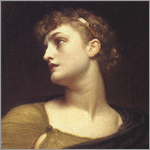
The condition of the woman’s exile is left unexplained but it can be gleaned that she was a leaving, an unwanted wife in exile. She may have been replaced or she may have been an adulteress.The imagery is fascinating as it calls to mind both the Antigoneand the Apocryphal tales of the Magdalene in her earth cave. The images of the long-haired Magdalene seemed to have left the artistic imagination , though some can be still viewed in galleries round the globe. Of course the Antigone of legend along with other Women in the Wall or women figures in fertility stories and rites are common to all cultures. The story of Antigone is treated also in Egyptian terms and that story may have provided the basis for the Greek. The condition of women has hardly improved , thus the lament and the tales of exile have new voices and songs.
I have referred over and over to the theme of the woman in waiting throughout this blog, so I shall just add in the book details and mention my favorites:
I have long forgotten the name of that author of a scarlet-clad Encyclopaedia, but the alphabetical references marked upon each volume have remained for me an indelible and magical word :
Degas: Fan with Dancers 1879 .From the Tacoma Art Museum. Priv Collection.
Sylvia Plath‘s return to the United States as a teacher at Smith College was dominated by fear, its evident from her diaries and from her utter helplessness. I had thought to publish this morning ,without comment two of her poems: Mary’s Song from Winter Trees and The Magi from The Collected Plath.
It is Autumn here (despite the sunshine ),there is both a significant temperature drop and a filigree of copper on pavements and grasses , thus I got to thinking about winter palettes and warm clothing.
I read the Diaries in the last years and remember wondering at Plath’s connectedness to her intimate objects, how bemused she was at the amelioration of her condition of cold by the wearing of a pair of red silk stockings and how it alleviated her mood of intense depression. She disliked abstract art and had told a painter friend that she adored the “Thinginess of Things“.
In the last few days I had published a small piece on the Island women and the Trousseau, in relation to both Mary Lavin and plays by Federico Garcia Lorca.
I also thought about the issues of women’s homelessness (homelessness) as a result of War; and those little knickknacks and mementoes that are to many people Valueless .
The amount of young women on the streets of Dublin in this condition of abodelessness has increased significantly. Thus the value of small and intimate things has decreased in the face of oncoming winter and the struggle for survival. I watched people literally walk over a young girl and infant the other day in their own struggle and fear of ending up like her and it worried me. And what would ameliorate her condition and that of the infant? In many statements against war and ecological destruction I have published wordson the value of objects and trinkets. How , on my bookshelf there is a small clay snail painted in gold; and made by the hand of a small child who in learning about colour had underpainted the snail in red and left the imprint of his small fingers upon it. How, when he got older and copped onto the issue of preservation, he had lacquered the little snail with PVA in order to preserve the red-gold and give the shell a glossy sheen. To anyone else the process of creation from a simple pallets and the indented fingerprints would suggest a simple child’s play and not a process of working out and creation that progressed, it seemed, over many weeks.
I am happy that I have a shelf to put the troublesome snail onto.
Mary’s Song
The Sunday lamb cracks in its fat. The fat Sacrifices its opacity….
A window, holy gold The fire makes it precious, The same fire
Melting the tallow heretics, Ousting the Jews. Their thick palls float
Over the cicatrix of Poland, burn-out Germany. They do not die.
Grey Birds obsess my heart, Mouth-ash, ash of eye. They settle. On the high
Precipice. That emptied one man into space The ovens glowed like heavens, incandescent.
It is a heart, This holocaust I walk in, O golden child the world will kill and eat .



 Chris Murray