Strip-Tease
|
Tag: A Saturday Woman Poet
-
-
At Carmel Highlands.
by Janet Lewis.
Below the gardens and the darkening pines
The living water sinks among the stones,
Sinking yet foaming, till the snowy tones
Merge with the fog drawn landward in dim lines.
The cloud dissolves among the flowering vines,
And now the definite mountain-side disowns
The fluid world, the immeasurable zones.
The white oblivion swallows all designs.
But still the rich confusion of the sea,
Unceasing voice, sombre and solacing,
Rises through veils of silence past the trees;
In restless repetition bound, yet free,
Wave after wave in deluge fresh releasing
An ancient speech, hushed in tremendous ease.
From The Making of a Sonnet, Eds, Edward Hirsch and Eavan Boland. A Norton Anthology, 2008.
-
On Rebellion, by Prageeta Sharma.
(for Katy Lederer)
“It was not a romantic sentiment , nor self-determined; rather , it was embarrassing.
My love of spearheading, from introvert to extrovert,
from cowardice to consequence, from the enjambment to the unspecified dunce.
It was a sabotage, a reckless moment : a purulent, tawny decree.
All temptation puzzled me and drew me in.
I dropped out of a large life,
I flew over exams, I punched out breakfast teachers with lunch money,
toiling over the idea of belonging rather than over upward mobility.
I understood how power flung outward
into the troves of the cursed ( I felt troubled or cursed all of the time).
I wasn’t bearing oranges, limes, or even lemons.
All of it blurred together so that a mere suggestion made by
an outside force was something to be freely ignored.
I could nod off, I could misinterpret, it could be reconfigured as a negotiation.
The fog felt like an aphorism. Never lifting, always dull,
always an added pull. The tribunal cloud judged below, judged my direction.
There was lying, conning, faking, elucidating in order to get away with undoing.
I was interested in preserving yet I can’t tell you if it felt
sacred or befallen.
Your anxiety might have represented a crushing faith
or a character assassination, my own or someone else’s.
Or a lack of grip on reality : the wet rip of the grocery bags
all of it falling –
your body on all fours.
Accumulating soot upon retrieval.
There were downsides to feeling different so I huddled
in the corner (not a ball, not rocking). I felt friendless and yet social.
I felt no aptitude towards refining a skill.
However, words cut my brain into two brains with their precipice
their demarcations, their incisions (too strong a word).
They held me captive against their edge,
their influence : I felt like insinuating something delicate or dear.Now- I am playing on- trying to pay attention to the collusion that I must
be playing over
and over in my mind, and it was my mind,
it needed me to leave everything outside, on the steps or in the sky,
to feign exhaustion in order to meet an aberration,
the one in the corner that felt large and carefree with its
own vernacular sprawled with whitewash on bricks or floors or that ghastly
far above that kept me standing very still but perhaps I wasn’t inactive,
I was just interpreting what had already been an assumed boundary,
immersed in its insularity and in what stuck to its roundedness.”Prageeta Sharma was born in Framingham, Mass. in 1972. Her parents came from Jaipur. This poem is taken from The Bloodaxe Book of Contemporary Indian Poets, ed Jeet Thayil. Bloodaxe Books 2008. Reviewed at this link.
-
Making Poetry.
by Anne Stevenson.
‘You have to inhabit poetry
if you want to make it.’
And what’s to ‘inhabit ‘ ?
To be in the habit of, to wear
words, sitting in the plainest light,
in the silk of morning, in the shoe of night;
a feeling bare and frondish is surprising air;
familiar…rare.
And whats ‘to make’ ?
To be and to become words’ passing
weather ; to serve a girl on terrible
terms, embark on voyages over voices,
evade the ego-hill, the misery-well,
the siren-hiss of success, publish,
success, success, success.
And why inhabit, make, inherit poetry ?
Oh , it’s the shared comedy of the worst
blessed ; the sound leading the hand;
a worldlife running from mind to mind
through the washed rooms of the simple senses;
one of those haunted, undefendable, unpoetic
crosses we have to find.
from Anne Stevenson , Poems 1955-2005, Publ. Bloodaxe Books.
Carol of the Birds
by Anne Stevenson.
Feet that could be clawed, but are not ….
Arms that might have flown, but did not…
No-one said, ‘Let there be angels!’ but the birds
whose choirs fling alleluias over the sea,
Herring gulls, black backs carolling raucoucly
While cormorants dry their wings on a rocky stable.
Plovers that stoop to sanctify the land
And scoop small, roundy mangers in the sand,
Swaddle a saviour each in a speckled shell.
A chaffinchy fife unreeling in the marsh
Accompanies the tune a solo thrush
Half sings, half talks in riffs of wordless words,
As hymns flare up from tiny muscled throats,
Robins and hidden wrens whose shiny notes
Tinsel the precincts of the winter sun.
What loftier organ than those pipes of beech,
pillars resounding with the jackdaws’ speech,
And poplars swayed with light like shaken bells?
Wings that could be hands, but are not…
Cries that might be pleas yet cannot
Question or disinvent the stalker’s gun,
Be your own hammerbeam angels of the air
Before in the maze of space, you disappear,
Stilled by our dazzling anthrocentric mills.
from Anne Stevenson , Poems 1955-2005, Publ. Bloodaxe Books. -
The Valley
by Kerry Hardie.
The first valley is the Valley of the Quest,
the second the Valley of Love
the third is the Valley of Understanding
the fourth is the Valley of Independence and Detachment
the fifth of Pure Unity
the sixth is the Valley of Astonishment
and the seventh is the Valley of Poverty and Nothingness
beyond which one can go no further.’That is a Sufi story
about a whole crowd of birds getting ready
to go on an Awful Journey.
They elect the Hoopoe as leader
because he knows a thing or two,
for instance the lie of the various valleys,
and which one comes after which.
What I like is the way it’s all more or less as expected
until you hit the sixth.I should like to go
to the Valley of Astonishment.
I wonder where it lies
this astonishing Valley of Astonishment ?
In China perhaps?
Or Peru?
I wonder if you could stay there
Out of your wits with astonishment,
or if , in this witlessness, you might find yourself
stumbling on , over the mountain –Note : the first stanza is quoted from The Conference of the Birds by Farid ud-Din Attar, written in the second half of the twelfth century AD. This rendering in english is by C.S Nott.
Taken from The Stinging Fly , 25th Issue. Ed Declan Meade.
Kerry Hardie bio page from Poetry International Web
Women writers on Poethead 2010
Tapestry Bird from Fine Art, America. -
A Saturday Woman Poet 2010 , some Women Writers from the Poethead blog .
The Saturday Woman Poet category of Poethead is related to other categories and themes within this site called , 25 Pins in a Packet , Women Creators, A Saturday Woman Poet and Saturday Women Poets. I will be adding those links and archives at the end of this piece.
Poets who have appeared in the Saturday Woman Poet this year include, Ágnes Nemes Nagy, Eithne Strong, Nuala Ní Chonchúir, Moya Cannon, Sylvia Plath , Eavan Boland, Nelly Sachs , Glenda Cimino, Eva Gore-Booth, Sarojini Naidu, Denise Levertov , Liliana Ursu, Shahnaz A’Lami, Mirjam Tuominen and Celia De Fréine.
Alongside these women poets appear their translators and editors. Sometimes I have thought to add a writer of prose and or poetic prose, this list includes Nagy , Mary Lavin, Mirjam Touminen and Elisaveta Bagyrana . Tess Gallagher, Kay Boyle and Marian Glasscoe feature as editors and translators of Liliana Ursu , René Crevel and Julian of Norwich respectively .
Collaborative Translation and Visual Art, some favourites on the Poethead site.
Collaborative translations and artwork are very popular on the site with Alice Maher and Éilis Ní Dhúibhne’s work being very sought after, along with the René Crevel and Max Ernst posts. I think that Tess Gallagher’s translations of LilianaUrsu’s poems are as popular as Weil also. The most interesting thing about the women writers on Poethead is the fact that they are sought and found through search-engines through memory, scraps of remembered lines are put through multi-lingual engines and readers end up here . The most popular search-engine terms seek Bachman, Simone Weil and Levertov. It’s also heartening to see Poethead comprises a good fifth of the site’s search-engine terms, which means that readers come back to visit the site if they are happy enough with the transcriptions, book title information and translator’s works.
I also wanted to add in here a November 2010 Review of Nancy Spero’s Torture of Women , from The Nation Magazine :
“The limits of my language,” Ludwig Wittgenstein famously declared, “are the limits of my world.” One of the most notorious limits of our language, and one that has done much to limit our world, is “man” being the embodiment of humanity. That the pronoun “he” can represent indifferently “he” or “she,” that “man” represents “man” or “woman”: these are grammatical traces of the phenomenon that Simone de Beauvoir made the starting point of The Second Sex more than sixty years ago: “humanity is male and defines woman not in herself but relative to him.”
- No Images of Man: On Nancy Spero Barry Schwabsky
- Archive for the ‘A Saturday Woman Poet’ Category
- 12/11/2010 A Saturday Woman Poet , Ágnes Nemes Nagy. posted in 25 Pins in a Packet : Women Creators, A Saturday Woman Poet, Alphabets, Translation tagged A Saturday Woman Poet, Ágnes Nemes Nagy, Corvina, Dedalus Poetry, George Szirtes, Hugh Maxton, Translation
- 12/04/2010 A Saturday Woman Poet , Eithne Strong. posted in 25 Pins in a Packet : Women Creators, A Saturday Woman Poet, How Words Play., Maps, Saturday Women Poets tagged A Saturday Woman Poet, Dolmen Press, Eithne Strong, Sarah in Passing
- 11/27/2010 A Saturday Woman Poet, Eavan Boland. posted in 25 Pins in a Packet : Women Creators, A Saturday Woman Poet, Art, How Words Play., Images, Saturday Women Poets tagged Ariel: The Restored Edition, Chris Agee, Eavan Boland, poetry, Sylvia Plath
- 11/20/2010 A Saturday Woman Poet , Nuala Ní Chonchúir. posted in 25 Pins in a Packet : Women Creators, A Saturday Woman Poet, Art, How Words Play., Images, Translation tagged A Saturday Woman Writer, Nuala Ní Chonchúir, Translation
- 11/13/2010 Restored Music , Sylvia Plath’s ‘Ariel’ posted in 25 Pins in a Packet : Women Creators, A Saturday Woman Poet, How Words Play., Saturday Women Poets tagged Ariel: The Restored Edition, Faber and Faber, Frieda Hughes, Sylvia Plath, Ted Hughes
- 10/30/2010 A Saturday Woman Poet : Moya Cannon posted in A Saturday Woman Poet, Art, Images, Magic, Maps tagged A Saturday Woman Poet
- 10/23/2010 A Saturday Woman Poet : Emily Dickinson. posted in 25 Pins in a Packet : Women Creators, A Saturday Woman Poet, How Words Play., Saturday Women Poets tagged A Saturday Woman Poet, Emily Dickinson, Sylvia Plath, Ted Hughes, The Evolution of ‘Sheep in Fog’, Women Poets
- 10/16/2010 A Saturday Woman Poet : Sarojini Naidu. posted in 25 Pins in a Packet : Women Creators, A Saturday Woman Poet, Saturday Women Poets, Translation, Women Writers tagged Translation, Women Poets
- 09/11/2010 A Saturday Woman Poet, Glenda Cimino. posted in A Saturday Woman Poet, How Words Play., Images, Saturday Women Poets, Transformation, Women Writers tagged 25 Pins in a Packet : Women Creators, insects, Women Writers
- 09/04/2010 Two Book Versions of Julian of Norwich’s ‘Revelation’ posted in 25 Pins in a Packet : Women Creators, A Saturday Woman Poet, Alphabets, How Words Play. tagged editors, Julian of Norwich, Revelations of Divine Love, Translations, University of Exeter Press, Women Writers
- 07/24/2010 ‘In Progress’ by Christina Rossetti. posted in 25 Pins in a Packet : Women Creators, A Saturday Woman Poet, Alphabets, How Words Play., Images, Saturday Women Poets, Transformation tagged Rossetti, Transformations, Women Writers
- 04/25/2010 ‘Outside and In’ : Three Women at the Cúirt Literary Festival 2010. posted in 25 Pins in a Packet : Women Creators, A Saturday Woman Poet, Alphabets, Saturday Women Poets, Women Writers tagged ‘You’, Cúirt, galway, Joyce Carol Oates, Marina Carr, Ní Chonchúir
- 11/05/2009 Eithne Strong’s ‘Sarah in Passing’. posted in A Saturday Woman Poet, Alphabets, Images, Reclamation, Women Poets, Women Writers tagged Alice Maher, Women’s Work
- 09/03/2009 Pretty useless things : by Poethead posted in A Saturday Woman Poet, Images, Uncategorized tagged Arts, Groupware, Wiki Engines
- 03/27/2009 Maudlin, By Sylvia Plath. posted in 25 Pins in a Packet : Women Creators, A Saturday Woman Poet, Alphabets, Art, Images tagged Ariel, poetry, Sylvia Plath, Ted Hughes
Archive for the ‘25 Pins in a Packet : Women Creators’ Category
- 10/23/2010 A Saturday Woman Poet : Emily Dickinson. posted in 25 Pins in a Packet : Women Creators, A Saturday Woman Poet, How Words Play., Saturday Women Poets tagged A Saturday Woman Poet, Emily Dickinson, Sylvia Plath, Ted Hughes, The Evolution of ‘Sheep in Fog’, Women Poets
- 10/16/2010 A Saturday Woman Poet : Sarojini Naidu. posted in 25 Pins in a Packet : Women Creators, A Saturday Woman Poet, Saturday Women Poets, Translation, Women Writers tagged Translation, Women Poets
- 10/13/2010 ‘ Said Sori to the Mirror’ Sadaf Ahmadi. posted in 25 Pins in a Packet : Women Creators, Art, Images, Women Writers tagged art, image, visual communication, Women Writers
- 10/12/2010 Two pieces for discussion regarding Gender and Publication: Publication Bias ? posted in 25 Pins in a Packet : Women Creators, Campaigns, Censorships, Ephemera, Spinnin’ Threads, Women Writers tagged gender, publication bias, Women
- 10/10/2010 Exilic Conditions #1. posted in Dispossession, Ephemera, Images, Maps, Translation tagged boats, Exiles, Ezra Pound, islands, the Seafarer, Translation
25 Pins in a Packet , Women Creators continued
March 8th 2009 , ‘Necessity, by Simone Weil
Poethead by C Murray is licensed under a Creative Commons Attribution-NoDerivs 3.0 Unported License. -
Hemisphere
by Ágnes Nemes Nagy.
Here, is the upper hemisphere. Still grey,
where grey and liquid white
meet a liquid stairway,
and with the white whiter yet.Here, is the upper zone where
on frosty grass thaw starts,
where the dew
stitching grass and air
makes the field seem higher –
an uncertain rainbow.Then suddenly, God’s optic,
with its expanding triangle
like snap mutation
in prolonged epochs –
and from then, metal,
this concave height is metal
which sucks the last drop of haze
as the cursive traces
of a rising vertigo ;because here, is the horizon of white metals,
upper-half of the sphere-world,
late morning’s theology,where midnight is a motionless
black cauldron in the big lakes.from Between, by Ágnes Nemes Nagy, Trans Hugh Maxton.
Above the Object
by Ágnes Nemes Nagy.
For there is light above every object.
Like polar circles, the shining trees are decked.
Comes one by one a glowing skybound regiment,
in caps of light , the ninety-two elements,
bearing on each brow the image of each mode –
I believe in the resurrection of the body.Above the Object , by Ágnes Nemes Nagy.

Ágnes Nemes Nagy Between, by Ágnes Nemes Nagy, Trans. by Hugh Maxton. Corvina Press , Budapest and Dedalus Press, Dublin. 1988.
-
Up and Out
At this empyrean time when we have gained the moon
in our nineteen seventies’ boots we smash barbarian heels
on bowels and ballsof internee; jag flesh on spikes of glass, fry babies,
sear with liquid fire old men, depose the irretrievablebrain; slit, mutilate,
in cruelty far outlashing jungle territorial lusts.
North or brown, black or west, there is no clear differenceas to time nor place
in our nice savageries — perhaps a finer point of torture
here or there: electronics has its undeniable innovative
advantages –but the vomit of prehistory reeks curiously
identical with that of the twentieth century.

Up and Out by Eithne Strong , from Sarah in Passing . The Dolmen Press Poetry , 1974.
-

Viola D’Amore
Sometimes, love does die,
but sometimes, a stream on porous rock,
it slips down into the inner dark of a hill,
joins with other hidden streams
to travel blind as the white fish that live in it.
It forsakes one underground streambed
for the cave that runs under it.
Unseen, it informs the hill
and, like the hidden streams of the viola d’amore,
makes the hill reverberate,
so that people who wander there
wonder why the hill sings,
wonder why they find wells.( by Moya Cannon )
From : Poetry (October- November 1995) ; Contemporary Irish Poetry, Ed Chris Agee.
-
Chosen by Anna
I.
Banish Air from Air –
Divide light if you dare –
They’ll meet
While Cubes in a drop
Or Pellets of Shape
Fit
Films cannot annul
Odors return whole
Force Flame
And with a blonde push
Over your impotence
Flits Stream. “
II.
An awful Tempest mashed the air –
The clouds were gaunt, and few-
A Black — as of a Spectre’s Cloak
Hid heaven and Earth from View.
The creatures chuckled on the Roofs –
And whistled in the air-
And shook their fists-
And gnashed their teeth-
And swung their frenzied hair-
The morning lit-the Birds arose-
The Monster’s faded eyes
Turned slowly to his native coast-
And peace-was Paradise!–
This Choice of Emily Dickinson’s verse is edited by Ted Hughes. The essay which forms Hughes’ introduction, is (if I am correct) also included in the Hughes’ essays Winter Pollen ( publ. Faber and Faber). On a slight digression, therefore, I would recommend the essays therein on Sylvia Plath’s poetic process and most especially Hughes’ discussion on the beautiful Sheep in Fog,The Evolution of Sheep in Fog :
“It is undoubtedly the best commentary on the nature and significance of poetical drafts. Here, as someone who has worked on and studied manuscripts for their own sake over a period of 35 years, I can perhaps speak with more authority than on the other aspects that I indicate in this note. No one else has written so eloquently or so perceptively on the importance of drafts and why rather than being discarded they command respect as more than the ‘incidental adjunct to the poem’ — indeed ‘they are a complementary revelation, and a log-book of its real meanings.’ In the case of ‘Sheep in Fog’ the drafts ‘have revealed the nature and scope of the psychological crisis that gives the poem its weird life, sonority, its power to affect us. In other words, they are, as the final poem is not, an open window into the poet’s motivation and struggle at a moment of decisive psychological change.” Roy Davids
Publ. Winter Pollen, Ted Hughes
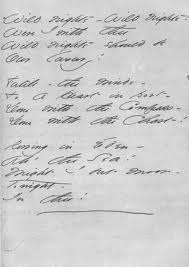
Wiki Image of Dickinson MSS

 Chris Murray