The Chamber One ear to chimney-breast, on bended knee, better to hear The Chamber is published in The Irish Times. Fugit Amor At the Musee Rodin I looked for us back to back lying across air. And yet. free and fleet as a bird. They were once bodies caught in space. still, governs her tongue, consumes
Fugit Amor is published in Suntrap, Blackstaff Press (Belfast 2007). An early version of this poem was published in The Irish Times.
The First Rod: Mackerel at Inis Oírr Cast the line off the pier where a shoal The First Rod: Mackerel at Inis Oír is published in Suntrap, Blackstaff Press, Belfast 2007. An early version of this poem was published in The Irish Times. Artichokes From early summer Artichokes was first published in The Irish Times, May 11, 1991 and is published in This Hour of the Tide (Salmon 1994) |

Tag: Arts
-
-

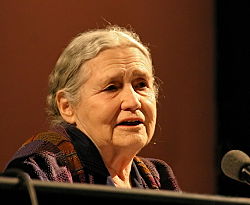
Author and Poet Doris Lessing Doris Lessing died a matter of days after I had received permission to carry some of the poems from her Fourteen Poems on this site indefinitely. I had put up the following note and message and see no reason to remove it. I am happy that I have carried her work for a few years. I wrote a brief tribute to Lessing’s writing and her influence on my writing life here.
Dear Christine We’d be delighted for you to host the poems for longer especially if you’re getting such good reactions. Doris Lessing was never very keen on her poetry and didn’t think it was any good so I doubt we will see a re-issue but at least this way, they are available in an alternative form.
Many thanks and best wishes
Olivia- Poems by Doris Lessing
- Index of Women poets
- Author and Poet Doris Lessing
-
Rebecca O’Connor
Domestic Bliss
I place a jug of lavender on the table
to mask the smell of mould from under the fridge
while you draw nails to hammer with your fist.
Then I draw a hammer , and watch
as you try to lift it from the page.
by day it’s Mr Men, Mad Men, by night,
your father and I wishing we could be so bold.
you have no such wants, though sometimes I wonder
as you try to peer into Jack and Jill’s well
or climb the tiny ladder of your toy farm
to mend the roof of your miniature barn.
– Rebecca O’Connor

Rebecca O’Connor edits The Moth Magazine and organises the Ballymaloe International Poetry Prize. She worked as a commissioning editor of literary fiction at Telegram Books in London before returning to Ireland with her family in 2008. She won a Geoffrey Dearmer Prize in 2004 and her chapbook Poems was published by the Wordsworth Trust, where she was a writer in residence in 2005. Her poetry has been published in, among other places, The Guardian, Poetry Review and The Spectator.Kelly Creighton
World Put to Rights
The dream that burst riverbanks
held you; blackstrap molasses,
antidote for your poison.
Your plummets spraying wetness
like a coin in a cascade
woke no-one, not even us.
The church spire grew legs, scaled bricks,
ran to your side, spotlighted.
I put glass over that glow.
Quiet-huff of your refuge,
flailing arms, spluttering snores.
Ungainly crooning tunes
to the realms of purity;
I found too sickly-sweet. You
fought the humdrum, from your seat.
You would sleep outside, would sing,
stand on ledges mollified.
I won’t sing, no matter what.
Float on, keep your whistles of
booze-hounds. When I awaken
I will join you, watch for me.
World Put to Rights is © Kelly Creighton , all rights reserved.Kelly Creighton

Kelly Creighton is a poet and writer with work currently and forthcoming in literary journals Ranfurly Review, A New Ulster, Electric Windmill Press, Inkspill Magazine, The Galway Review, Saudade Review, PEN Austria’s Time to Say: No! e-book, Recours au Poeme and other numerous other publications. She has recently finished editing her historical fiction novel Yielding Fruit. Kelly is working on her second poetry collection.Moya Cannon
Viola D’Amore
Sometimes, love does die,
but sometimes , a stream on porous rock,
it slips down into the inner dark of a hill,
joins with other hidden streams
to travel blind as the white fish that live in it.
It forsakes one underground streambed
for the cave that runs under it.
Unseen , it informs the hill
and , like the hidden streams of the viola d’amore,
makes the hill reverberate,
so that people who wander there
wonder why the hill sings,
wonder why they find wells.
Viola D’Amore is © Moya Cannon
Bio (source Wikipedia)
Moya Cannon was born in 1956 in Dunfanaghy, County Donegal. She studied History and Politics at University College Dublin, and at Corpus Christi College, Cambridge.She has taught in the Gaelscoil in Inchicore, in a school for adolescent travellers in Galway, and at the National University of Ireland in Galway. She served as editor of Poetry Ireland in 1995. Her work has appeared in a number of international anthologies and she has held writer-in-residence posts for Kerry County Council and Trent University Ontario (1994–95).
Cannon became a member of Aosdána, the affiliation of creative artists in Ireland, in 2004.
Her first book, Oar, (Salmon 1990, revised edition Gallery Press 2000) won the 1991 Brendan Behan Memorial Prize. It was followed by The Parchment Boat in 1997. Carrying the Songs: New and Selected Poems was published by Carcanet Press in 2007.
Dorothea Herbert
The Rights Of Woman,
Or Fashions for the Year 93 – being the Era of Women’s literally wearing the Breeches. – Health and Fraternity!
Whilst man is so busy asserting his Rights
Shall Woman lie still without gaining new lights
Our sex have been surely restrain’d enough
By stiff prudish Dress and such old fahion’d stuff
Too long have been fetter’d and tramelld I wot
With Cumbersome Trains and the Strict petticoat
Yet should a poor Wife dare her Tyrant to chide
Oh she wears the Breeches they tauntingly cried
But now we’re enlighten’d they’ll find to their Shame
We’ll have the reality not the bare Name
No longer will Woman to Satire be Dupe
For she is determin’d to figure Sans Jupe
And once she is rouzed she will not be outdone
Nor stop at this one Reformation alone
For mark me proud Man she’ll not yield thee a Jot
But soon will become e’en a true Sans-Culote
And flourish away e’er the Ending of Spring
Sans Jupe, Sans Culote , in short – sans any thing
– Ca va et ca…ira
–Liberty and Equality for ever !
© by Dorothea Herbert
from, Introspections, the Poetry and Private World of Dorothea Herbert by Frances Finnegan , Congrave Press 2011.
from Congrave Press
The “lost” poetry of the celebrated Irish writer Dorothea Herbert, whose Retrospections, first published in 1929-30 more than a century after her death, continues to captivate readers. By turns amusing and melancholic, the recently recovered poems – and particularly her astonishing mock-heroic epic The Buckiad – are an important contribution to late eighteenth and early nineteenth century Irish literature.Paula Meehan
Seed
The first warm day of spring
and I step out into the garden from the gloom
of a house where hope had died
to tally the storm damage, to seek what may
have survived. And finding some forgotten
lupins I’d sown from seed last autumn
holding in their fingers a raindrop each
like a peace offering, or a promise,
I am suddenly grateful and would
offer a prayer if I believed in God.
But not believing, I bless the power of seed,
its casual, useful persistence,
and bless the power of sun,
its conspiracy with the underground,
and thank my stars the winter’s ended.
‘Seed’ is © Paula Meehan, all rights reserved.Paula Meehan

Image from Imagine Ireland Paula Meehan has published five collections of poetry, the most recent being Painting Rain (Carcanet, 2009). A selected volume, entitled Mysteries of the Home, was published in 1996. Her writing for stage includes the plays Mrs Sweeney (1997), Cell (1999), and, for children, Kirkle (1995), The Voyage (1997) and The Wolf of Winter (2003/2004). Her poetry has been set to music by artists as diverse as the avant-garde composer John Wolf Brennan and the folksinger Christy Moore.
Eileen Sheehan
All About Climbing
After he slaughtered her
he dumped her body
in the market square
where merchants and citizens
continued their trading
averting their eyes
from the sight of
her broken corpse;
the limbs skewed
at grotesque angles.
A fly alighted on her eyelid
its blue-green body
gleaming like a jewel.
A mouse
nibbled flour
from under a fingernail.
A goat strayed from its pen
sniffed at her body
lay down beside her.
Her house cat
navigated the alleyways
of the rural town
till he found her.
A rat curled to sleep
in her armpit.
Then the last slice of moon
slid down from the sky,
lodged in the small of her back.
From high in the hay loft
an owl let out
it’s long note
across the dark
and that was the sound
she heard as she woke;
the sound that led her
to walk to the foot
of the mountain.
Now she carries
the moon on her back
and she climbs.
Her days are all about climbing;
all about purpose;
committed
to restore the moon
to the sky:
hang it aloft.
So she climbs
in her blood-red shoes,
her tattered garments:
there is no slipping back.
© Eileen Sheehan
from the collection Down the Sunlit Hall (Doghouse Books)Eileen Sheehan

Eileen Sheehan Eileen Sheehan is from Killarney, Co Kerry. Her collections are Song of the Midnight Fox and Down the Sunlit Hall (Doghouse Books). Anthology publications include The Watchful Heart: A New Generation of Irish Poets (ed Joan McBreen/Salmon Poetry) and TEXT: A Transition Year English Reader (ed Niall MacMonagle/ Celtic Press). She has worked as Poet in Residence with Limerick Co Council Arts Office and is on the organizing committee for Éigse Michael Hartnett Literary & Arts Festival. Her third collection, The Narrow Place of Souls, is forthcoming.
Mary O’ Donnell
Hungary
came to me in stamps.
“Magyar Posta” ice-skaters, delicate
as Empire porcelain, a fish, an astronaut
and rocket, a silvery boy on 1960s skis.
I understood only difference.
Now, flying home from Budapest,
I touch the pages of my poems, freshly minted
in translation. Now I really don’t get them,
but did I ever? The words will make me
briefly native to a coffee-slugging morning reader
on the Vaci Ut, who may not understand,
even in his own tongue.
The lines shimmer as night slips
through the tilting crowded cabin. Again
I press fingers to page, blind, as if by touch
I could capture a fish, an astronaut, a rocket,
or those elegant, ice-cutting skaters.
Outside, clouds I cannot see
busily translate country to country.Hungary is © Mary O’ Donnell

Mary O’ Donnell Mary O’Donnell is the author of eleven books, both poetry and fiction, and has also co-edited a book of translations from the Galician. Her titles include the best-selling literary novel “The Light-Makers”, “Virgin and the Boy”, and “The Elysium Testament”, as well as poetry such as “The Place of Miracles”, “Unlegendary Heroes”, and her most recent critically acclaimed sixth collection “The Ark Builders” (Arc Publications UK, 2009). She has been a teacher and has worked intermittently in journalism, especially theatre criticism. Her essays on contemporary literary issues are widely published. She also presented and scripted three series of poetry programmes for the national broadcaster RTE Radio, including a successful series on poetry in translation during 2005 and 2006 called ‘Crossing the Lines‘. Today, she teaches creative writing in a part time capacity at NUI Maynooth, and has worked on the faculty of Carlow University Pittsburgh’s MFA programme in creative writing, as well as on the faculty of the University of Iowa’s summer writing programme at Trinity College Dublin.
-
“There are less Wikipedia articles on women poets than pornographic actresses.”
The above quotation is derived from Wikipedia’s Women Problem written by James Gleick at the New York Review of Books made during this last week. It interests me as it is embedded in article about the sub-categorisation of American women novelists, an ongoing row about editorial habits that infect androcentric working environments. I have had some experience of these environments, which I consigned to their rightful place when I began blogging about poetry and poets.
Many discussions about resolving this issue have emerged online in recent days and none of them are fit to purpose. Imagine a scenario where a woman has spent some years writing about the American woman novelist, the woman poet, the woman editor or translator for Wikipedia – only to find that sleight of hand had consigned this work to some irrational sub-category based on an ephemeral and subjective desire to tidy-up ?
One can address the issue in a number of ways : subvert the categorisation, appoint editors to recategorise, or assert one’s independence and transcend the necessity of endless and pointless plea-bargaining on the subject of poetry and novels by women writers. I chose the latter route over five years ago and I am sticking to it in the face of reports from VIDA about the invisibility of women writers in the canon.There was the 100% men issue of The New Yorker (April 29th 2013).
There is a turbulence inherent in unearthing a viewpoint that asserts that there is a difficulty in our value system that relegates women’s views on every subject to the amateurs section including but not limited to issues of rape, torture, birthing (or not). There are even awards to those men who put words into the mouths of women historical figures.
The muse has become a tattered prostitute framed by the self-importance of the male writer. I wouldn’t go to the bother of redressing this imbalance via traditional publication routes.
Dear Friends: Grow Your Own Index

An Index Of Women Poets
A
B
C
D
F
G
H
I
J
L
M Mc/Mac
N
O and O’
P
R
S
T
U
V
W
Z
-
The following two poems are by Sarah Clancy from a forthcoming collection of prose and poetry, called Friction.
Veracity and other stories
for Alice Kennelly
I’ve lived in four different decades today
stepped onto three continents
I took no visas no tickets no passports
I wrote my own bill of passage I forged it
and what of my fraud if it served us?
I inhabited flesh that wasn’t my own
I scratched it kneaded stiff shoulders
with hands that emerged from some other wrists
some forearms some oxters then I left it
I walked from it and encountered new bones
new ligaments new eyes with which I saw
what I wanted I decided you were an abstraction
so I tried to walk through you but couldn’t
I put my palm on your chest but it met
with resistance I got caught in your substance
then fuck it I lied about it said you meant nothing
that your whole existence was a blip a pot-hole
that no-one was fixing and I burst a tyre or might have
I buckled my wheel rims in it didn’t I?
but then I gunned it and drove on
I read my old diaries as page turners with no idea
what might happen from one page to the next
I took guesses blind stabs at historic events
to see if it seemed like they’d happened me
then whatever I remembered what I wanted
even if I had to invent it I swore it as fact
rose to my feet to defend it
it was my truth in that moment and there wasn’t
a chance I’d let it be rebutted and as a result
I found myself heartless my past cast off
all reinvented and I liked it I was made light by it
and as to the future all those futures I’m writing
I’m telling you I’ll inhabit several actions at once
and believe what I want
I’ll pay no dues to this fiction
this tyrant
this actual bastard
reality?
I’m over it.
©Sarah Clancy January 2013
Gullible.
I met the take-it back man down in the shopping centre
where he was soap boxing, waxing lyrical and I drank his potion.
It was said that it could cure the worst of all the words
you’d ever spewed out in fury or in disappointment
and if a cure was beyond the bounds of either language or elixirs
it could reclaim the offending utterances and put them in storage
so long as you swallowed and didn’t spit that is. It could make
happenstances fall from their standing, go over old ground
and make it new sown, it could undo the damage sharp tongues
had inflicted on the unsuspecting, the suspicious and the blameless.
It could pale the blushes from stupid outbursts, cool them
before they ever hit your cheekbones – if that is you took
just two small mouthfuls and vowed to stay quiet for the duration
of its troubled ingestion. It could banish shame before it ever
caught your tonsils and traipsed its way down your resistant gullet
I know it sounds far-fetched but I for one swallowed it.
©Sarah Clancy November 2012
-

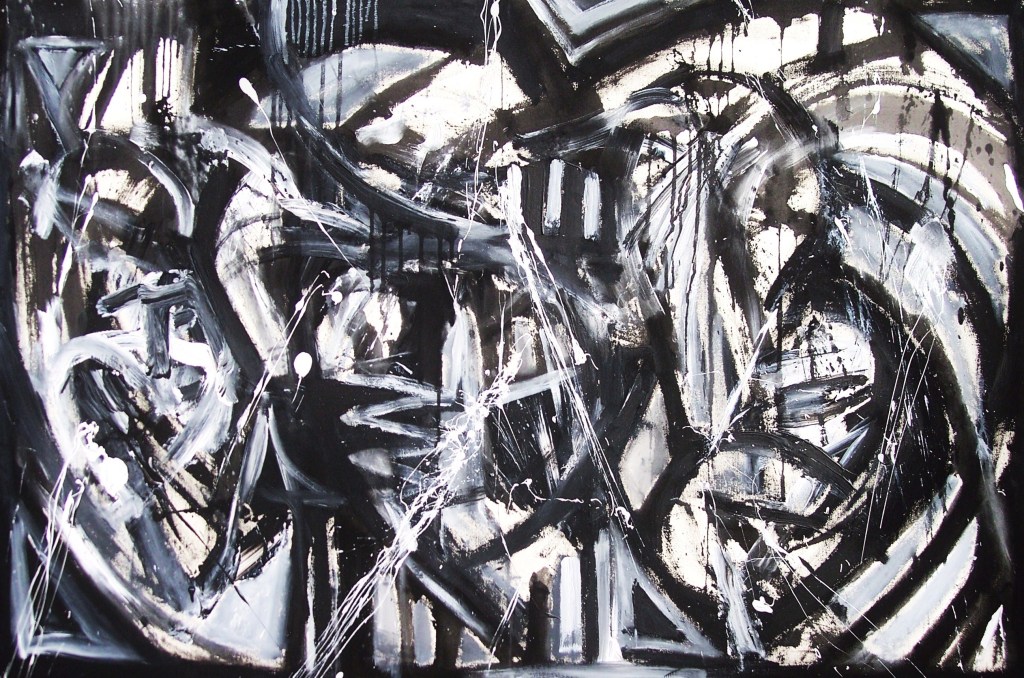
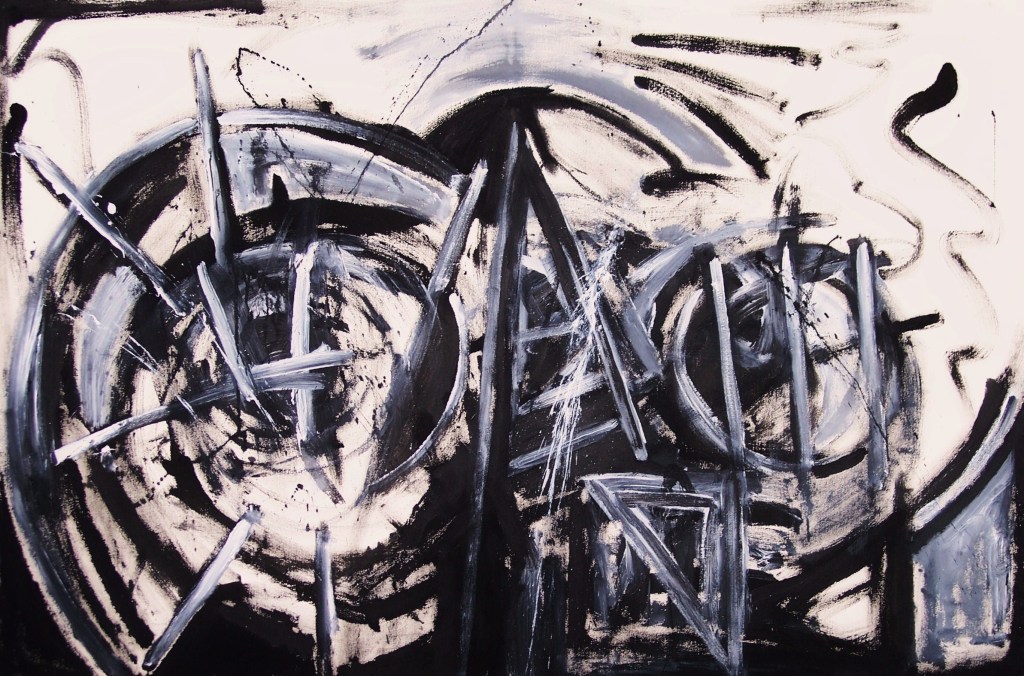
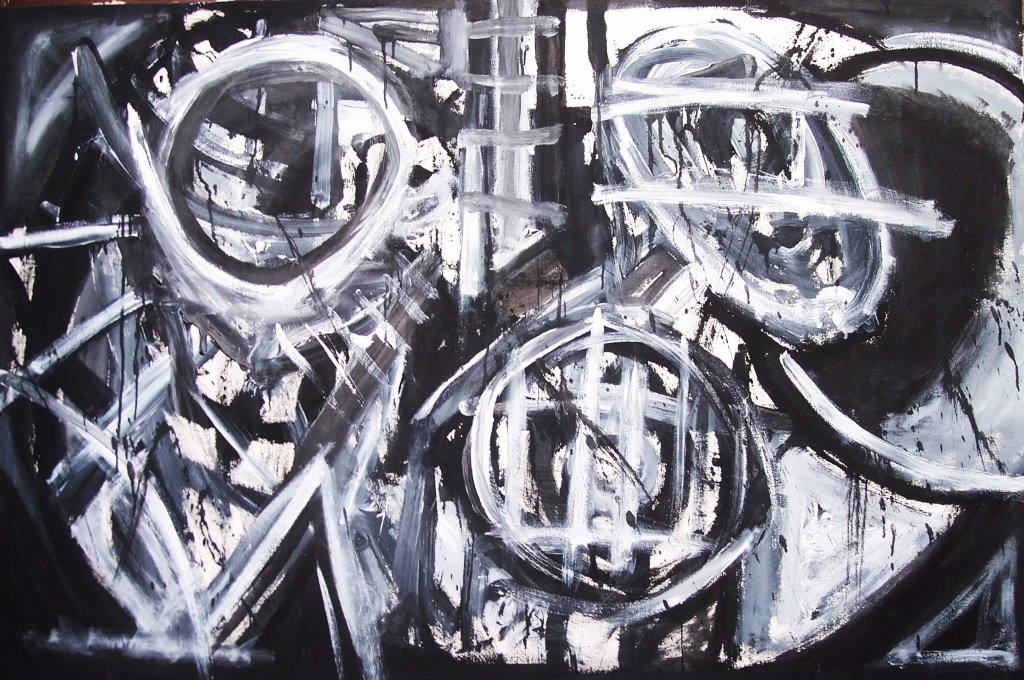
untitled image , oil on canvas by © Michael McAloran 2003
histology slice 3
[ a tissue cloth so delicately coloured in mauves and purples indigo
and ivory cells become tissue whereas this isn’t at all the case
all is one in febrile disequilibrium not excluding momentary states
of euphoria and relative equilibrium the macabre beauty of histology
like a travelogue along enlarged detailed drawings of funghal spores
or sporoform zoophytes white exquisitely and hypersensitively drawn
by haekcle against a black CSO corps sans organes the hubris debris
humus against which lines flightlines maps nomadologic trails micro
politic events pointillistic gestes rhizomatic ghanaean junglean infra
branchings dadaistic or ba’akan pygmee refrains establish unfold
glare and disappear amongst glacis’ of ice basalt slate sapphire or
northsea grayness and mist histology is that : the slice with obsolete
or ephemereal or contingent a truth to leave the observor with her’s
his’s own ponderings of carcinogenic intimacy or clean tissue missive
towards the ones receptive the ones donating slices out of their body
to be mapped navigated coloured in mauves grays deep purples
to indigo ]Text is © Aad de Gids
- Discussion of the paintings and texts of Machinations is here
- Purchase link for Machinations
-
Irish Poets and Reviewers call-out.
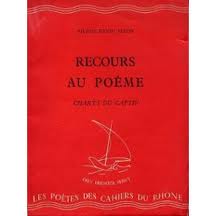
Recours Au Poème is edited by Matthieu Baumier. Baumier is inviting contemporary Irish poets and poet-reviewers to consider submitting to the journal. There is a contact form link available in the base of this post for those who are interested in having their poems published in a modern multi-lingual contemporary poetry journal dedicated to excellence in poetry and review.
In order to give the Irish poet, poetic-reader, reviewer, and/or essayist an idea of the breadth of the site I am adding herein the index of Recours Au Poeme for issue #26. I suggest that the aspirant poet-writer would read some of the critiques and essays before submitting.
Below the index I have included some examples of works that I enjoyed reading recently. These include an essay on Poetry In Translation by Raymond Humphreys, a review of Surrealism, Underground Tour by Paul Vermeulen and the works of the two women poets, Marissa Bell Toffoli and Dominique Hecq
I am excerpting a teeny piece of Hecq’s Canted bone poem here as a taster. The entire poem can be read at this link
Canted Bone Poem
Poems grow in the dark, trace
the descent of sound
into silenceThis is a song of silence
This is the sound of the bone
breaking through the skin
of a slow waistingCanted Bone Poem is © copyright Dominique Hecq. Published, Recours Au Poème
Recours Au Poème, Issue # 26 (index):
Rencontre: Jean-Charles Vegliante, traducteur de La Comédie, de Dante.
Focus : Abdourahman Waberi
Poèmes: Cécile Guivarch, Laurence Sarah Dubas, Sonia Khader, Triunfo Arciniegas, Nikola Madzirov
Chroniques: S’ils te mordent, Morlay, la chronique de Christophe Morlay autour du Manifeste pour la vie d’artiste de Bartabas.
Notes pour une poésie des profondeurs (5) : Marc Alyn en présence de la poésie, par Paul Vermeulen.
Essai : Vu de New York : Is Poetry (Scene) alive in New York (and beyond)? par Maya Herman Sekulić
Le jardin des adieux : flux et reflux de la perte ou l’abandon lumineux, sur la poésie d’Alain Duault, par Sylvie Besson
Critiques Michèle Finck, L’élégie balbutiée, par Mathieu Hilfiger
Une syllabe, battant de bois de Mary-Laure Zoss, par Pascale Trück
Vision de Roger Munier, par Fabien Desur
MIDRASH d’Eurydice désormais de Muriel Stuckel, par David Schnee
Mon pays ce soir de Josué Guébo, par Etty Macaire

The following are a collation of links mentioned in the post above. They are to a review, an essay on translation, and links to the poems of Dominique Hecq and Marissa Bell Tofolli.
Related Links
- Poetry in Translation par : Raymond Humphreys
- Surrealism, underground route by : Paul Vermeulen
- http://www.recoursaupoeme.fr/marissa-bell-toffoli/threshold
- The poetry of Marissa Bell Toffoli
- Recours Au poème contacts
- http://www.recoursaupoeme.fr/dominique-hecq/canted-bone-poem
Thanks to Matthieu Baumier for requesting submissions and proposals regarding the work of some contemporary Irish Poets. I thought the best way to deal with a call-out to Irish Poets was to link the site (as I have done so above here) and see if any poets wish submit to it.
Note – I joined the Recours Au Poème mailing list in recent weeks. Weeks that have been incredibly busy, and in terms of collaborative and writing work both very interesting and fruitful. I sent along a few poems for consideration, and they will be published later in the year.